Article Contents:
- Classification of wooden skirting boards by profile shape
- What is a 'profile' and why it is the main feature of a skirting board
- Skirting board height: how it affects the perception of a room
- Shaped wooden skirting board — Baroque, Classic, Empire profiles
- What makes a profile 'shaped'
- STAVROS K-series profiles: from moderate to grand
- For which interiors is a shaped skirting board essential
- Shaped skirting board and lighting: an unexpected aspect
- Flat wooden skirting board — minimalism and Scandinavian style
- Simplicity as an artistic choice
- Profiles K-034 and K-125: standards of modern minimalism
- Flat skirting board and flooring
- Corner wooden skirting board and triangular — where it is used
- Corner skirting board: a different geometry of solution
- Triangular wooden skirting board: application
- Compatibility with other millwork elements
- Cove wooden skirting board — what it is and where it is used
- Cove: a historically authentic profile
- Where cove is used
- Cove vs standard skirting board: when to choose what
- Euro wooden skirting board — how it differs from standard
- What is a 'Euro skirting board'
- Wooden Euro skirting board vs PVC Euro skirting board
- Cove and Euro skirting board: what is the difference
- How to choose a wooden skirting board profile to match the interior style
- Systematic approach: skirting board as part of the architectural ensemble
- Table: skirting board profile for interior style
- Wood species: beech or oak — what to choose
- Connection of skirting board with other wooden elements of the room
- FAQ: Answers to Popular Questions
- About the Company STAVROS

Skirting board is an architectural term. It came to us from Greek through Latin, and literally meant 'a slab at the base of a column' — that very element which supports the entire vertical structure while remaining invisible to the eye. Millennia have passed, but the logic hasn't changed: a wooden skirting board still supports the boundary between the floor and the wall, still forms the lower 'horizon' of the room — and still remains the element thought of last, even though it sets the final tone for the entire interior.
But here's what's interesting: 'skirting board' is not a single product. It's a whole family of forms, each speaking its own architectural language.Wooden figured skirting board— is Baroque and Classicism, richness of relief and play of shadows.Flat wooden skirting board— is minimalism and Scandinavian restraint. Corner and triangular — is an engineering solution that became elegant. Cove and Euro skirting — is modernity, laconicism, and precision.
Understanding this diversity means making the right choice. Not by price or 'what was in stock', but by meaning: which profile suits your home, your floor, your style. This is exactly what this article is about.




Classification of wooden skirting boards by profile shape




What is a 'profile' and why it's the main thing in a skirting board
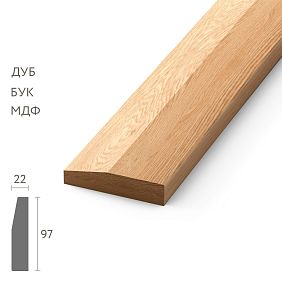
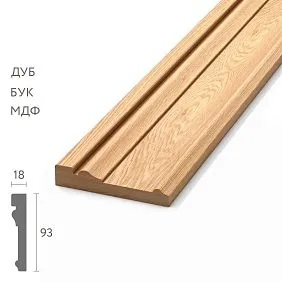
The profile of a skirting board is the shape of its cross-section. It is the profile that determines everything: how the skirting board looks, how light falls on its surface, how it fits into the interior style, how easy it is to install and join in corners.
When a craftsman looks at the end of a skirting board — he sees everything. Height. Thickness. Relief of the front part. The angle of contact with the wall and the floor. It is these parameters that determine the final result of installation.
AllTypes of wooden baseboardsare divided into five main groups by profile shape:
1. Figured (Classical, Baroque, Empire) — a complex multi-element profile with cavettos, toruses, fillets, and scotias. Height: from 60 to 200+ mm. Application: Classicism, Baroque, Empire, Renaissance.
2. Flat (Euro, modern) — a minimalist profile with a slight rounding of the top edge. Height: 40–80 mm. Application: Scandinavian style, modern minimalism, loft.
3. Corner and triangular — a profile of triangular or similar cross-section. Covers the corner where the floor meets the wall. Application: wooden floors, parquet, engineered wood flooring.
4. Coves (quarter rounds) — a small profile of quarter-round cross-section. Minimal size, maximum versatility. Application: parquet, stair treads, junctions.
5. Euro skirting — a modification of the flat profile with a more pronounced 'nose' at the top. A modern standard for economy and business-class apartments.
Our factory also produces:



Skirting board height: how it affects the perception of a room
This is a parameter that is rarely discussed — and in vain. The height of a skirting board changes the visual proportions of a room as noticeably as the ceiling height.
-
Skirting board 40–60 mm — 'neutral'. Does not attract attention. For rooms with low ceilings (up to 2.6 m): the skirting board does not 'eat up' height.
-
Skirting board 80–100 mm — 'standard'. Works in most interiors. Noticeable, but not dominant.
-
Skirting board 120–150 mm — 'accent'. Creates a pronounced architectural lower zone. For rooms with ceilings from 2.8 m.
-
Skirting board 160–200+ mm — 'ceremonial'. Classical halls, mansions, interiors with ceilings from 3.2 m.
Rule: the lower the ceiling, the lower the skirting board. A wide skirting board in a room with a 2.4 m ceiling will visually 'cut' the height by 10–15 cm.
Get Consultation
Figured wooden skirting board — Baroque, Classical, Empire profiles
What makes a profile 'figured'
Wooden figured skirting board— is not just 'beautiful'. It is a profile with architectural history. Each element of its relief has a name and originates from classical order architecture: cavetto (cymatium), quarter (quadrant), torus, fillet (abacus), scotia.
These elements are not random. They were born over centuries as a solution to one task: how to make the transition between horizontal and vertical planes beautiful, logical, and 'readable' under any lighting. When daylight glides over the surface of a figured skirting board — it creates a play of light and dark stripes, which gives the lower part of the room 'weight' and completeness.
STAVROS K-series profiles: from moderate to grand
Wooden molded skirtingSTAVROS K-seriescovers the entire range of classic profiles—from restrained to formal.
K-006 (from 440 rub./lm) — a moderate classic profile with a height of ~80 mm. Upper torus, smooth transition to the shelf, lower bevel. This is the 'workhorse' of classic interiors: expressive enough to be noticeable, restrained enough not to dominate. Oak or beech, chamber-dried to 8–10%.
K-070 (from 950 rub./lm) — a rich molded profile with a height of ~110 mm. Double torus, developed shelf, lower groove. Ideal for classic interiors with ceiling heights of 2.8–3.2 m. Contrasting play of light and shadow under side lighting.
K-009 (from 1,420 rub./lm) — a profile in the Empire tradition, ~130 mm. Three relief elements in the upper part, a wide 'wall' zone, lower torus. Used in interiors with molded cornices, with richwooden cornices of the KZ seriesfor curtains and with casings from the same family.
K-018 (from 1,630 rub./lm) — height ~150 mm. The most complex of the 'accessible' profiles: four relief elements, a developed shelf with a groove. For mansions and representative apartments with ceilings of 3.0–3.5 m.
K-066 (from 2,580 rub./lm) — one of the widest profiles in the K-series, ~170 mm. Combines the height of a 'formal' skirting with refined relief. Monumental but not heavy—thanks to the fine detailing of the profile.
K-104 (from 6,060 rub./lm) — the pinnacle of the K-series. A profile with a height of 200+ mm in the spirit of palace interiors of the 18th–19th centuries. Used in formal halls, mansion lobbies, representative offices with historical interiors. This is not just a skirting—it's an architectural element.
For which interiors is molded skirting essential
Molded profiles are inseparable from the following styles:
Classicism and Neoclassicism — straight lines, strict proportions, order system. The skirting must 'rhyme' with the profiles of cornices and casings. K-006, K-070, K-009 — standards of classicism.
Baroque and Neo-Baroque — richness of relief, play of volume, dynamic forms. K-018, K-066 — the minimum threshold for a Baroque interior. K-104 — for maximum expression.
Empire — monumentality, severity, heavy 'horizon'. Wide skirting with a developed lower zone: K-009, K-018 combined with dark wood (oak with 'wenge' or 'walnut' oil finish).
Traditional English style — rich wooden molding in white paint. K-066 or K-009 in white satin enamel withwooden cornices of the KZ series— this is an interior in the spirit of a London townhouse.
Molded skirting and lighting: an unexpected aspect
A molded profile changes its 'face' depending on lighting. Under natural side light — expressive chiaroscuro, clear relief. Under top directional light — volume diminishes. Under direct frontal light (like from LED strips on the ceiling) — relief almost disappears.
This is important when planning lighting. If the molded skirting K-070 is chosen as an accent element — lighting fixtures are better placed with side direction, not frontal.
Flat wooden skirting — minimalism and Scandinavian style
Simplicity as an artistic choice
Flat wooden skirting board— this is not 'economy'. It's a different aesthetic stance. Scandinavian and Japanese design have long formulated the principle: beauty lies in the absence of excess. A flat skirting without relief is a clean line that separates floor and wall, without aspiring to more.
In an interior with white walls, light plank flooring, and minimalist furniture, a molded skirting would be an alien element—excessive. A flat profile is organic: it exists, it performs its function, it doesn't interfere.
Profiles K-034 and K-125: standards of contemporary minimalism
K-034 (from 230 rub./lm) — the basic flat profile of the K-series. Height ~60 mm, thickness ~16 mm. Face surface — flat with a slight rounding of the upper edge (radius ~3 mm). Lower bevel at 45°. This is the most in-demand profile in modern apartments: universal, inexpensive, functional.
For painting white — ideal: a minimalist profile in white creates a clean 'horizon' without unnecessary shadows. With oil finish — looks modern and warm. With varnish — strict and graphic.
K-125 (from 270 rub./lm) — a slightly more pronounced profile compared to K-034: the upper edge is more rounded, a small 'nose' creates minimal chiaroscuro. Height ~70 mm. For Scandinavian and contemporary interiors where a slightly greater 'presence' of the skirting is needed without transitioning to a molded profile.
K-105 (from 300 rub./lm) — an intermediate profile between flat and Euro. A slightly more pronounced upper torus gives it character without losing conciseness. For contemporary interiors with elements of retro-minimalism.
Flat skirting and flooring
Flat wooden skirting is versatile in application: parquet, engineered wood flooring, laminate, tile, carpet. But it looks especially organic with:
-
Wide plank flooring (from 180 mm) with white oil finish — K-034 skirting in matching tone, creating a unified wooden "base" for the room
-
Light laminate in grey-beige tones — K-034 in white or light grey paint
-
Large ceramic tile in "stone" color — K-125 or K-034 painted to match the grout color
What doesn't work with flat skirting: opulent classical interiors with moldings, heavy curtains with valances, carved wooden doors. Here the flat profile will look unfinished.
Corner wooden skirting and triangular skirting — where they're used
Corner skirting: a different geometric solution
Wooden corner skirting— is a profile that "lives" in the corner where the floor meets the wall, not along the wall. Unlike standard skirting, corner skirting covers this angle from the inside, creating a smooth or straight transition.
There are several forms of corner skirting:
Rounded corner profile — a concave quarter-circle that "rounds off" the corner. Smooth transition without sharp lines. Used in rooms with terrazzo, marble, and poured floors — where the expansion gap is absent or minimal.
Straight corner profile — rectangular or L-shaped cross-section, covering the corner from two sides. Closer to standard skirting but installed in the corner.
Triangular profile — the simplest option: an isosceles right triangle in cross-section. Attaches with one leg to the floor, the other to the wall. Covers the corner with minimal means.
Wooden triangular skirting: application
Wooden triangular skirting board— one of the most functional solutions for wooden floors. Its main applications:
Parquet and engineered wood flooring. An expansion gap at the base of the wall is mandatory for any plank floor. This gap must be covered, but covered "softly": the skirting attaches to the wall, not the floor, and doesn't interfere with the natural movement of the flooring. Triangular profile is the minimal and neat option for such coverage.
Stair treads. The junction between the tread and riser and the side cheek — this is a corner that needs covering. Triangular quarter-round profile covers this joint neatly without overloading the form. In the system ofwooden stair components— this is an essential element.
Furniture junctions. The joint between a work surface and the wall in a kitchen or cabinet — triangular profile covers it without visible gaps.
Compatibility with other trim elements
Corner and triangular skirting are functional elements that are typically used in combination with main trim. For example: main K-034 skirting along the wall + triangular quarter-round in the corner junction at a stair tread.
When selecting, consider: the wood species (beech or oak) and finish must match the main skirting and other wooden elements —plinth, with matching legs, frames.
Wooden quarter-round skirting — what it is and where it's used
Quarter-round: a historically authentic profile
Quarter-round is one of the oldest words in construction terminology. In joinery and carpentry, "quarter-round" referred to both the tool — a plane with a semicircular blade — and the result of its work: a concave semicircular groove or quarter-round transition.
Wooden quarter-round skirting— is a profile with a concave (or quarter-round) cross-sectional shape. Small size: height 20–40 mm, width 20–40 mm. Attaches to the floor and wall with two straight edges, while the front face is a concave quarter-circle.
This profile solves the same task as any skirting — to cover the expansion gap at the base of the wall — but does so with the most modest means. Quarter-round almost "disappears" in the interior: it works without drawing attention.
Where is quarter round used
Parquet and engineered wood flooring — traditional application. Wooden parquet requires an expansion gap that must be covered with a thin profile. Quarter round is the classic solution for this: its small size doesn't 'steal' room height, and its concave shape doesn't interfere with cleaning.
Furniture manufacturing. Quarter round is used as a decorative molding in furniture: it rounds off internal corner joints, covers gaps between panels, and finishes the lower perimeter of case furniture.
Staircase junctions. On wooden staircases, quarter round covers the junction of the tread to the balusters and to the side panel — where a standard baseboard physically doesn't fit. As part ofwooden staircase components— it is an essential functional element.
Window reveals. The transition from the reveal to the windowsill or to the wall — quarter round covers it elegantly and without clutter.
Quarter round vs standard baseboard: when to choose what
| Criterion | 'Galtel' | Standard baseboard |
|---|---|---|
| Height | 20–40 mm | 40–200 mm |
| Visibility in interior | Minimal | From moderate to accent |
| Application at floor | Parquet, thin coverings | Any floor coverings |
| Furniture Application | Yes | No |
| Staircase joints | Yes | Limited |
| Cost | Below | Depends on profile |
Euro baseboard wooden — how it differs from standard
What is 'euro baseboard'
'Euro baseboard' is a marketing term that appeared in the Russian construction lexicon in the 1990s, when European finishing materials first entered the domestic market. There is no strict standard behind this name — it is more of a stylistic characteristic.
Wooden euro baseboardis usually described by the following features:
-
Height: 60–90 mm — higher than the classic 'Soviet' baseboard of 45–50 mm, lower than representative ones
-
Profile: flat or with minimal relief in the upper part (one 'nose' or heel)
-
Angle of the front plane: slight tilt from vertical (5–10°) — creates a feeling of 'slimness'
-
Functional groove on the back side: for laying cables or for a hidden cable channel
Euro baseboard is a modern 'working' profile: performs its function, looks neat, does not claim historical architectural allusions.
Wooden euro baseboard vs PVC euro baseboard
On the market, euro baseboards dominate in PVC execution. Wooden euro baseboard is different. Wood provides what PVC cannot:
-
A living texture that is visible even under paint — wood 'breathes'
-
Stability under mechanical loads — PVC bends and deforms
-
Repaintability — PVC yellows over time and cannot be repainted with enamel
-
Eco-friendliness — natural material without plasticizers and phthalates
-
Repairability — scratches on wood can be sanded, scratches on PVC cannot
K-034 and K-125 fromSTAVROS K-series— these are wooden Euro skirting boards in the modern sense: height 60–70 mm, minimalist profile, stable geometry, solid beech or oak.
Cove molding and Euro skirting board: what's the difference
A frequently asked question: what is the difference between cove molding and a Euro skirting board?
The answer is clear:
-
Cove molding — a small-sized concave (or quarter-round) profile. Installed in corner joints. Used at floors, in furniture, on stairs.
-
Euro skirting board — a flat or minimally profiled element of standard 'skirting board' size (60–90 mm). Installed along the wall at the floor.
These are different products with different functions. Cove molding is a specialized profile for joints. Euro skirting board is the modern standard for floor skirting.
How to choose a wooden skirting board profile to match the interior style
Systematic approach: skirting board as part of the architectural ensemble
Most buyers' mistake: they choose skirting board separately from everything else. They only look at shape and price. But skirting board is part of a system. Its profile must be coordinated with the profiles ofcasings, with ceiling cornices, with furniture front profiles, with door frames.
In architectural tradition, this is called 'coordination of order profiles': all elements forming horizontal interior belts (skirting at the bottom, cornice at the top, trims vertically) must belong to the same stylistic language.
The simplest principle: if the skirting board is shaped — the trims should also be shaped. If the skirting board is flat — the trims are flat. You cannot place a formal K-066 next to a flat K-034 trim.
Table: skirting board profile for interior style
| Interior style | Recommended profile | Species | Finish |
|---|---|---|---|
| Scandinavian, minimalism | K-034, K-125 | Beech | White matte enamel |
| Modern | K-105, K-125, K-016 | Beech/oak | Acrylic, oil |
| Loft, industrial | K-034 | Oak | Black enamel, oil |
| Classicism, neoclassicism | K-006, K-070, K-009 | Oak | White satin enamel, oil |
| Baroque, neo-baroque | K-018, K-066 | Oak | White glossy, gold |
| Empire, formal | K-066, K-104 | Oak | White, dark oil |
| English style | K-009, K-066 | Oak | White semi-gloss |
| Provence | K-006, K-070 | Beech | White/cream matte |
| Japandi | K-034 | Oak | Natural oil |
| Traditional wooden house | K-006, K-011 | Oak | Teak/walnut oil |
Wood species: beech or oak — which to choose
All K-series STAVROS profiles are available in two wood species. This isn't just about different prices — these are different materials with different properties.
Beech — a uniform, light-colored wood species with almost no pronounced grain. Ideal for painting: smooth surface, minimal fiber relief, painting yields an even, solid-color result. With 'natural' oil — light, warm, 'neutral'. Janka hardness: ~1300 HB.
Oak — a wood species with pronounced grain: large rays, annual rings, a 'lively' pattern. With oil — golden-brown, with depth. With dark oil — walnut, wenge, chocolate. Under white paint — the grain 'shows through', creating a subtle relief under the enamel layer. Janka hardness: ~1500 HB — harder than beech, more resistant to scratches.
Recommendation: if the baseboard is to be painted — choose beech. If for oil or clear varnish — choose oak.
Connection of the baseboard with other wooden elements in the room
A wooden baseboard is not an isolated element. It works within a system. For a complete wooden ensemble in the lower part of the room:
-
wooden cornices KZ-seriesfor ceiling curtain rods — the same wood species and finish as the baseboard
-
K-series casingsfor doorways — stylistic unity with the baseboard
-
Furniture legsfrom the same wood species — visual unity of the lower zone
If the house has a wooden staircase —staircase componentsfrom the same solid wood (oak or beech) completes the system into a unified wooden space.
FAQ: Answers to popular questions
How does a profiled wooden baseboard differ from a flat one?
Profiled baseboards have a complex, multi-element profile — beads, coves, grooves, shelves. Creates pronounced light and shadow, looks rich, used in classic interiors. Flat — minimalist, almost no relief, for modern and Scandinavian interiors. The fundamental difference is stylistic, not functional.
What is a bead and how does it differ from a baseboard?
A bead is a small profile with a concave quarter-round shape (20–40 mm). Installed in corner joints. Used on parquet, furniture, stairs. A standard baseboard is taller (40–200 mm), installed along the wall at the floor. These are different products for different application zones.
Which wooden baseboard to choose for a modern apartment?
K-034 or K-125 — optimal profiles for modern housing. Height 60–70 mm, minimalist profile, beech for white painting or oak for oil. Universal for laminate, engineered wood flooring, tile.
Triangular wooden baseboard — what is it for?
For closing the corner joint between floor and wall with a minimal profile. Used on parquet (covers expansion gap), on stairs (joint between tread and riser), in furniture corner joints.
Beech or oak — which wood species to choose for a baseboard?
Beech — for painting (uniform surface, perfect result). Oak — for oil or clear varnish (expressive grain, lively pattern). In terms of hardness, oak is more durable — preferable in hallways and corridors with high traffic.
Can I order a wooden baseboard with a custom profile?
Yes, STAVROS manufactures millwork to custom order subject to a minimum production run. Contact us for consultation by phone 8 (800) 555-46-75 or via the form on the website.
About the company STAVROS
Thirty profiles. Two wood species. One production philosophy: wooden millwork must be made so that the craftsman, upon receiving it, feels — everything is right. Geometry is stable. Surface is ready for finishing. Drying — kiln-dried, to 8–10%. Milling — 3D, with precision to tenths of a millimeter. Sanding — manual, P180.
wooden K-series millworkSTAVROS covers the entire range of profiles: from the minimalist K-034 (from 230 rub./lm) for a Scandinavian apartment to the monumental K-104 (from 6,060 rub./lm) for a formal hall. For each profile — beech and oak. For each interior — its own system.
For the skirting board —Casingsthe same K-series,KZ-series cornicesfor curtains,Furniture legsmade of solid wood. For stairs —wooden accessories. For wet rooms —KPU-seriesfrom 30+ polyurethane profiles.
Samples — from 180 rub. Stock program. Shipment on the day of order. Delivery throughout Russia and CIS countries.
STAVROS is when the skirting board profile is chosen correctly, the material is reliable, and the interior gets the finishing touch it deserves.