








































Article Contents:
- What Are Patterns for Trim and Why Are They Needed
- What Types of Patterns for Trim Exist
- Geometric patterns
- Floral Patterns
- Patterns in Russian Style
- Classic Decorative Patterns
- Modern patterns
- How to choose patterns for architraves
- By House Style
- By window size
- By composition
- Patterns for Wooden Window Trims: Why This Is the Best Option
- Where to Use Patterns for Window Trims
- How to Assemble a Beautiful Composition
- Patterns for Window Trims of a Wooden House
- What Affects the Price of Patterns for Window Trims
- Where to Buy Patterns for Window Trims
- Technical Details That Are Important to Consider When Purchasing
- Comparative table of architrave pattern types
- FAQ: frequently asked questions about architrave patterns
- What types of architrave patterns exist?
- How to choose architrave patterns to match the house style?
- How to select ornament for architraves if there are several?
- What's better: ready-made carved architrave or overlays on a smooth one?
- Where to buy wooden architrave patterns?
- How much do wooden architrave patterns cost?
- Can different patterns be combined on one facade?
- How to care for a wooden architrave with ornament?
- Conclusion

A pattern is not something applied 'on top' to make things prettier. It is architectural speech. Every ornament on a window surround is part of a dialogue between the house and the person looking at it.decorative patterns for window trims— is a system where every detail matters: the scale of the pattern, its character, its placement on the frame, and its combination with other facade elements.
If you want to buy wooden window surround patterns and don't know where to start — this article will give you a guide. Not a handbook on the history of carving, but a practical guide: which pattern to choose, how to fit it into the house's style, what to add nearby, and where to find ready-made carved solutions. Patterns for window surrounds are a topic where the right choice begins long before the purchase.


What are patterns for window trims and why are they needed
This is not a question with an obvious answer. Many think that a carved ornament on a window surround is just decor, an optional detail for those who like it 'richer'. But if you look closely at how a facade works, the picture turns out to be more complex.
The role of pattern in framing an opening. A window opening is an emptiness in a wall. Visually — a gap that needs to be 'held'. The window surround fixes this gap, defines its boundaries. And the pattern on the surround turns a neutral boundary into an accent. It draws the eye exactly where it should — to the window as the central point of the facade.
The difference between a plain window surround and a decorative one. A plain window surround is an architectural pause. It is present, but silent. A decorative window surround withornament— is a statement. It speaks about the character of the house, the owner's taste, the building's style. The difference between them is like between a strict suit and a suit with embroidery: both are the same in form, but produce a completely different impression.
How a pattern changes the perception of a facade. A facade with carved window surrounds looks more expensive, more complex, and more alive. This is not an illusion — it is the work of the ornament, which creates visual depth through the play of light and shadow on the relief. Even a small geometric motif on the upper part of the window surround changes the feel of the entire house.
When a pattern is needed as an accent, and when as part of a whole composition. On a modest house with a laconic facade, one beautiful carved window surround is a focal point, sufficient and self-sufficient. On a house with a developedhouse carvingThe casing becomes part of the system: it corresponds to the cornice, supports the bargeboard, and rhymes with the brackets. Understanding this difference is key to making an informed choice.




What patterns for casings exist
This is the richest section of the topic. The ornamental vocabulary of wooden architecture has been formed over centuries—and today it offers several established types, each with its own logic, place, and application.
Our factory also produces:


Geometric patterns
Geometry is the most ancient language of ornament. Strict, precise, not allowing for arbitrariness.Geometric patterns for casings—these are patterns built on the repetition of forms: diamonds, zigzags, meanders, and wavy broken lines.
Diamonds. One of the most historically stable motifs. A diamond-shaped grid covering the surface of the casing creates the impression of a woven pattern—dense, rich, but not overloaded. It reads well on a wide casing with a smooth surface.
Zigzags. A simple motif with a strong rhythmic effect. A zigzag line running along the side strip gives the casing dynamism and 'movement.' It looks especially expressive paired with a smooth upper frame.
Meander. An endless broken line, closed in loops. One of the most 'intellectual' geometric ornaments—it is difficult to read at first glance, but it creates a sense of continuity and completeness. Suitable for classical and neoclassical facades.
Symmetrical repeating motifs. Any geometric element placed in a row with a clear repetition step creates rhythm. This is a powerful property: rhythm works even in peripheral vision, creating a sense of order and precision.
Geometric patterns excel where strictness without coldness is needed. They are appropriate on modern houses, Scandinavian buildings, and strict cottages—anywhere where opulence is not required, but character is desired.
Get Consultation
Floral patterns
Plant ornament is the most vibrant and diverse type. Natural forms—leaves, shoots, tendrils, flower heads—are endlessly varied, allowing for designs ranging from delicate to monumental.
Leaves. The acanthus leaf, oak leaf, grape leaf—each carries its own stylistic nuance. Acanthus is classic and baroque. The oak leaf signifies strength and stability. Grapes represent southern languor and abundance. The choice of a specific motif depends on the overall character of the facade.
Shoots and branches. A smooth S-shaped shoot with leaves and tendrils is one of the most universal motifs in wood carving. It works on both narrow and wide window surrounds, scales beautifully, and organically combines with other elements.
Floral ornaments. Buds, rosettes, daisies, tulips—floral decor makes a window surround festive and light. This is the choice for a dacha, Provence, country, or a suburban house with a garden.
Soft, wavy forms. When a plant ornament is built on a wavy axis with branching stems, it creates a sense of growth and movement. Such a window surround 'lives'—changing depending on the viewing angle and lighting.
The main rule of plant ornament is scale. A fine, delicate pattern on a wide window surround gets lost; a large element on a narrow plank feels oppressive. The motif must be proportional to the surface on which it is placed.
Patterns in the Russian style
Patterns for window surrounds in the Russian style—is a separate, very rich chapter. Folk wooden architecture developed a unique ornamental language that is unmistakable.
Solar disc. A circular ornament with rays is one of the most recognizable symbols of Russian house carving. It was traditionally placed in the center of the upper part of the window surround—as a 'crown' for the window opening. Buycarved patterns for architravesWith a sun motif — means turning to an archetypal image that works flawlessly.
Kokoshnik. An arched pediment in the shape of a kokoshnik is a typical element of Russian facade architecture. It gives the window solemnity and completeness, turning a simple opening into a small architectural portal.
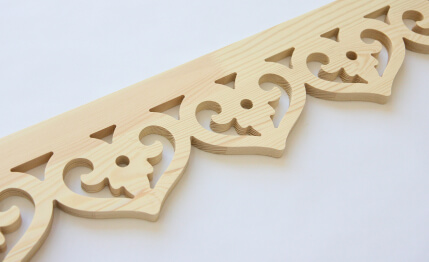
Traditional fretwork motifs. Fretwork is delicate, lacy filigree cut into a board along a complex contour. Birds, scrolls, flowers, and braids — all create a 'lace' effect, especially noticeable in contrast with the dark wall of the house.
Historical facade compositions. In traditional architecture, the window surround did not exist separately — it was part of a larger system: the cornice, frieze, and valance. Recreating such a system today means creating a house with authentic character. Understanding the logic of these systems is aided by the section wood carving with applique.
Russian patterns for window surrounds are not exotic or museum pieces. They are a living tradition that STAVROS craftsmen reproduce in modern materials with the precision of CNC machines.
Classical decorative patterns
Classic — is an ornament developed by the European architectural tradition from antiquity to neoclassicism. It is built on symmetry, balance, and a clear hierarchy of elements.
Symmetry as the foundation. A classic window surround is always symmetrical vertically: the left and right sides are mirrored. This creates a sense of completeness and tranquility.
Cartouche elements. A cartouche is a decorative frame with scrolls, often with an empty central field or ornament inside. It works well in the upper part of the window surround as a finishing touch to the composition.
Ornamental frames. A window surround as an ornamental frame — is when the decoration is placed not in the center, but along the perimeter of the strip, forming a 'frame within a frame.' The effect is a visual multiplication of depth.
Combination with cornices and moldings. Classic ornament is especially powerful in an ensemble.Decor for MoldingIn a classic style — corner overlays, central rosettes, end caps — forms a unified system with the casing, not inferior to interior solutions in complexity.
Modern patterns
Modern aesthetics does not reject ornament — it reconsiders it. Conciseness, geometry, absence of overload — these are the principles of modern decorative solutions for casing.
Concise reliefs. Not a drawing, but a texture: a slightly expressed relief on the surface of the casing, which creates a play of light and shadow without narrative content.
Calm geometry. Horizontal grooves, parallel lines, a minimalist frieze along the edge — that's all a modern home needs for the casing to speak without shouting.
Minimalist decorative elements. A small corner accent, a connecting rosette in the corner, a single central motif on the upper part — and the casing ceases to be faceless without becoming loud.Decorative InsertsIn a neutral execution — a ready-made tool for such work.
How to choose patterns for architraves
Choosing an ornament is not the same as choosing a favorite pattern. It is a coordination task. The pattern must suit the house, not contradict the scale of the window, and work in ensemble with other facade elements.
By house style
Russian style. A house in the tradition of folk wooden architecture requires an ornament of the same nature: kokoshnik, solar disk, openwork swirls, plant patterns with characteristic 'burrs' and 'berries'. This is not a matter of taste — it is a matter of respect for the architectural context. See ready-madeCarved window casings— solutions specifically for such houses are collected there.
Scandinavian style. A Scandinavian house features white or gray walls, large windows, and minimal details. The pattern on the casing here is not the main focus but a background note. A geometric motif with slight relief works well, perhaps a groove or channel along the edge of the strip. The key is not to overload it.
Country and Provence. Soft botanical patterns: flowers, leaves, shoots—anything related to nature, the garden, summer. The pattern can be relief-based with good plasticity but without excessive complexity. Staining to mimic natural wood or painting white—both options are organic.
Modern cottage. Ornament here is the exception, not the rule. One accent carved casing on the most visible window, with the others being smooth or with minimalist decor. This is the 'single accent' principle, which works much stronger than total carving all around the perimeter.
To window size
The size of the opening strictly dictates the scale of the pattern. This is not an aesthetic consideration but an architectural one.
For small windows—narrow, legible, clear patterns without fine, fragmented filling. An openwork pattern with thin details on a narrow casing simply won't be visible from a distance. Large, confident shapes with a clear silhouette are needed.
For large facade windows—complex, multi-element patterns that maintain scale. A wide casing allows for a central motif, corner accents, and a frame ornament around the perimeter.Patterns for window casingsFor a large opening—it's always a hierarchical system, not a uniform carpet.
How not to overload the opening. If you place a wide patterned casing on a narrow window—it visually narrows it even more. If the casing on a wide window is too narrow—it gets lost. Balance is achieved through proportion: the width of the casing should be 8–12% of the width of the opening, and the scale of the ornament should correspond to the scale of the casing itself.
By composition
The pattern is also a matter of placement. Where exactly the ornament is located on the casing is no less important than what the pattern itself is.
One central motif. One strong element in the middle of the top horizontal bar — a classic and reliable scheme. The eye finds it instantly, the ornament works like a capital letter.
Corner elements. Carvedappliquein the corners of the casing — where the vertical bars meet the horizontal ones. They cover the joint and simultaneously form 'four points' of accent, like a picture frame.
Top accent. Ornament only on the top part of the casing — the horizontal 'cap' above the window. The side bars remain smooth. This is a solution for those who want character without opulence.
Multi-layer system. Layering technique: a wide, smooth base casing + a thin carved overlay on top of it. This creates volume, shadow, and artistic depth — without the need to order a solid milled casing with a pattern.wooden casingas a base plus an ornamental overlay on top — a universal and economically sound scheme.
Patterns for wooden casings: why this is the best option
Plastic, MDF, polyurethane — alternatives exist, and some of them look quite decent until the first frosty season. Wood is different. It doesn't imitate the material: it is the material.
Natural material with a living texture. A wooden casing with an ornament is not a printed pattern or a stamp. It is a structure where the wood grain participates in the pattern. Year of growth, fiber density, cut direction — all this influences how the finished product looks. Two casings with the same ornament from the same species will never be identical. This is a value, not a defect.
Possibility of any finish. Wood is an open surface, ready for any finish. Painting in white, tinting to oak, oil with natural pigment, antiseptic with a slight tint — choose according to your facade.carved patterns for architravesPine takes paint beautifully; oak takes stain and oil, which reveal its noble texture.
Repairability. After ten to fifteen years, wood can be sanded, repainted, and given a second life. Plastic darkens, yellows, cracks—and needs to be replaced entirely. A wooden casing with a pattern is a long-term asset that is restored, not replaced.
Harmony with a wooden house. Wood works with wood. A carved ornament on the casing of a wooden house is not an alien decoration but a continuation of the architecture. The material of the house and the framing material speak the same language. This unity requires no explanation—it is simply felt.
Eco-friendliness and safety. Natural wood does not release toxins, does not accumulate static electricity, and does not heat up to dangerous temperatures in the sun. This is important for a home, especially if children live there.
Where to use patterns for casings
The ornament is not limited to the window opening. It works in several contexts—and understanding these contexts expands the possibilities of choice.
Window casings. The main and most obvious application.patterns for window casings—this is the framing of an opening from the outside of the facade or from inside the room. On the facade—they work in tandem with the cornice and house carving. In the interior—they set the character of the room, especially in historical interiors, wooden baths, hunting lodges.
Door casings. The front door is the 'face' of the house. A casing on it with a good ornament is the first thing a guest sees.Wooden casing with an ornamentAn entrance door requires a more solemn solution than a window: a large motif, possibly paired brackets on the sides or an arched finish above the opening. The topic of door trims is well covered in the material aboutdoor casings and extensions.
Facade compositions. Here, the ornament extends beyond a single opening. A system of cornices with decorative overlays, pediments with sawn patterns, connecting elements between trims — all together form a unified ornamental program for the facade.
Decorative solutions in the interior. A trim with an ornament on an interior opening — door or window — can change the feel of an entire room. In a classic interior, it is an element as essential as moldings and cornices. In a modern one — a striking contrast that works as an accent.
How to assemble a beautiful composition
Buying one ornamental trim is the beginning, not the end. The true beauty of a facade or interior is achieved through a system of coordinated elements.
Trims + overlays. A basic trim fromcarved trims STAVROSplus a decorative overlay on top — this is a multi-layered effect on a moderate budget. The overlay is attached to the base and creates volume that cannot be achieved on a flat surface.
Trims + cornices. A cornice above a window opening is an architectural 'hat' that protects the trim from water and simultaneously creates a horizontal line on the facade. It is important that the cornice ornament corresponds to the trim ornament — not repeating it literally, but belonging to the same family of forms.
Trims + connecting elements. The STAVROS house carving system includes connecting elements of the SNL series — carved parts that cover the corners and joints of the trim. They are not utilitarian — they are ornamental. Instead of a boring 45° miter cut, you get an artistic point in the corner of the frame.
Window trims + molding decor.Decor for Molding— these are corner elements, central inserts, decorative overlays for flat profiles. They function as 'punctuation' in the ornamental text of the facade: they place points, create rhythm, complete the phrase.
When to choose a ready-made carved window trim, and when to choose separate overlays. A ready-made carved window trim is the best choice if you have a standard opening size and no desire to assemble it. Separate overlays on a base are for non-standard sizes, if you want your own composition, or if you need to achieve maximum artistic effect on a limited budget.
Patterns for wooden house window trims
A wooden house is not just a type of building. It is an architectural context that dictates a certain system of ornamental thinking.
Traditions. In Russian wooden architecture, window trims were never chosen arbitrarily. They grew out of the overall ornamental concept of the house. Patterns for wooden house window trims were formed by regional schools: Yaroslavl, Nizhny Novgorod, Vyatka carving — each has its own plastic language, its own sense of scale. Understanding this tradition means choosing consciously, not just 'what you liked'.
Modern interpretation. Today, traditional ornamentation is reproduced on CNC machines — precisely, cleanly, without loss of detail. This allows for products indistinguishable from handcrafted work at significantly lower cost. It is important to choose a supplier who works from competent drawings — otherwise, machine carving will look mechanical, without living plasticity.
How to select a pattern for the facade. Look at the overall character of the house. A log cabin with dark walls needs a contrasting, ornate pattern that reads well against a dark background. Light-colored timber — a more subtle pattern that will benefit from tinting. Half-timbering or half-log — strict geometry without folk motifs.
How to combine with house carving.patterns on wooden house mouldingsshould belong to the same ornamental vocabulary as the frieze boards, cornices, and eaves. This does not mean all patterns must be identical — but their 'kinship' should be felt. A geometric pattern on the window trim and a floral pattern on the cornice will clash. A geometric window trim and a geometric frieze board will harmonize.
What Affects the Price of Architrave Patterns
The question of price is inseparable from the question of choice. The range is wide: from hundreds of rubles for a simple overlay to several thousand for a complex carved element. Let's break down what makes up the cost.
Material. Pine is an affordable and popular wood. Oak or beech are more expensive but visually richer and more durable. In the catalogdecorative overlays STAVROSmost products are made of beech and oak — this explains their high decorative qualities and above-average price.
Complexity of carving. A simple geometric element — minimal machine time, affordable price. A complex floral ornament with fine details — more passes of the cutter, manual finishing, higher cost. An artistic multi-element pattern — a premium item.
Type of element. An overlay or connecting element — a separate part with fixed dimensions, relatively affordable. A ready-made full-size carved architrave (2000 mm) — a different price category: more material, more processing.
Ready-made architrave or separate overlay. An overlay on a base is always cheaper than a ready-made carved architrave. If the budget is limited — build a system based on base + overlay.Decor for Moldingallows you to achieve a rich ornamental effect with significantly lower investment.
Number of parts in the composition. One architrave with one central motif — one price. A full system: architrave + connecting elements + cornice with overlays + corner accents — a different sum. But it is the full system that gives a truly professional result.
Price guidelines:
-
Decorative corner elements for moldings — from 500 rubles per piece
-
Carved overlays — from 920 to 15,000 rubles and above depending on complexity
-
Ready-made carved architraves (NL series) — from 2550 to 7300 rubles per item
-
Connecting elements SNL — from 1090 to 1350 rubles
Where to buy patterns for architraves
Purchasing wooden decorative elements for architraves requires a clear understanding of what exactly is needed. Go through the selection logic — and the purchase will become more precise.
Ready-made carved architraves. If you need a complete ready-made part with a standard-size ornament — see the section carved casings. It contains items with ready-made patterns that are mounted directly on the opening.
Overlays. If you want your own system based on a smooth architrave — look for Decorative Inserts. Over 400 models in oak and beech: from small corner accents to large ornamental panels. The choice is practically limitless.
Molding decor. Corner elements, center inserts, end caps — all in the sectiondecoration for moldingsEspecially useful when creating an interior-style casing in a classical or baroque key.
House carving elements. Brackets, bargeboards, SNL connecting elements, NL series casings — a complete facade carving system in one section. It's a ready-made constructor from which the facade is assembled.
Ready-made compositional solutions. If you don't want to assemble the system yourself — explore the sectionfacade decorationand ready-made examples of window decoration. There you can see how the system works as a whole — with cornices, brackets, and connecting parts.
Technical details that are important to consider when purchasing
A beautiful ornament on the casing is not everything. There are several technical nuances that an experienced buyer checks before placing an order.
Product thickness. The standard thickness of a STAVROS wooden casing is 18 mm. This is sufficient for mounting on a wooden or plastered wall without an additional backing. For facade mounting on profiled timber, thickness adjustment is sometimes required.
Uncoated surface — an advantage, not a defect. Delivery without a finish layer allows you to choose the required finish for a specific facade. If casings are painted at the factory — you are tied to one color. Without coating — you are in control.
Order size and multiplicity. Products are sold from 1 piece. This is important: if you want to check how a specific ornament looks on your house — you can buy one sample without ordering the entire set.
Delivery. STAVROS ships throughout Russia. The standard product length is 2000 mm, which is important to consider when choosing a transportation method.
Comparative table of trim pattern types
| Pattern type | House style | Difficulty | Pattern scale | Application |
|---|---|---|---|---|
| Geometric | Scandinavian, modern | Low | Small–medium | Exterior, interior |
| Floral | Country, Provence, classic | Medium | Medium–large | Exterior, interior |
| Russian folk | Wooden house, Russian style | High | Large | Exterior only |
| Classic | Classic, baroque, empire | High | Medium–large | Exterior, interior |
| Modern | Minimalism, loft, chalet | Low | Small | Exterior, interior |
FAQ: frequently asked questions about window casing patterns
What types of window casing patterns are there?
There are five main types: geometric (diamonds, zigzags, meanders), floral (leaves, shoots, flowers), ornaments in Russian folk style (kokoshnik, solar disk, fretwork), classical (acanthus, cartouche, volute), and modern (concise reliefs, minimalist motifs). Each type has its own logic of application and architectural context.
How to choose window casing patterns to match the style of the house?
Start from the architecture: a wooden house in a folk spirit — Russian ornament, a Scandinavian house — geometry, a cottage in a classical style — floral or classical pattern, a modern house — a minimalist accent or a plain smooth casing. Read the house — it will suggest the right ornament itself.
How to choose an ornament for window casings if there are several?
All casings on the house should belong to the same ornamental family — not necessarily the same design, but the same stylistic register. Geometry on all, or a floral motif on all. Mixing incompatible styles is risky.
What is better: a ready-made carved casing or overlays on a smooth one?
It depends on the task. A ready-made carved casing is for standard sizes and the desire to get a result without assembly. Overlays on a smooth base are for non-standard openings, individual composition, or economy. The 'base + overlay' system often gives a richer and more voluminous effect.
Where to buy wooden patterns for window trims?
In the STAVROS catalog: the carved window trims section — ready-made products with ornamentation, the decorative overlays section — elements for self-assembly, the molding decor section — corner and central components for system solutions.
How much do wooden patterns for window trims cost?
Individual decorative elements — from 500 rubles. Medium-sized carved overlays — from 1000 to 4000 rubles. Ready-made carved window trims — from 2500 to 7000 rubles per piece. Complex panels and large corner elements — from 8000 rubles. The final cost of a set depends on the number of windows, the complexity of the chosen ornament, and the presence of accompanying cornice elements.
Can different patterns be combined on one facade?
Yes, but carefully. The cornice ornament and the window trim can have different patterns — provided they belong to the same ornamental vocabulary. Two different floral motifs — possible. A geometric trim and a Baroque cornice — already a conflict.
How to care for a wooden window trim with ornament?
Every 3–5 years — inspect the coating, if necessary — light sanding and repainting or tinting. Pay special attention to the ends and lower parts of the side planks, which bear the main moisture load. Antiseptic impregnation before the final coating is mandatory.
Conclusion
Trim patterns— this is not 'minor decor' or an optional detail for those who love complexity. It is the architectural language of the facade. A correctly chosen ornament makes a house recognizable, gives it individuality, and elevates the perception of the entire structure to a fundamentally different level.
But it's better to buy not a random element of ornament, but a coordinated system. A patterned window trim + connecting elements + cornice + decorative overlays in the style of the house — that's what turns a set of parts into a true facade solution.
Everything needed for such a system is collected in the catalog:
-
Carved window casings— finished products with ornament
-
Decorative Inserts— for assembling an individual composition
-
Decor for Molding— corner and central elements for a complete system
-
wooden house ornament— context and inspiration for selection
STAVROS is a Russian manufacturer of wooden decor with production facilities and warehouses in Moscow and St. Petersburg. The assortment includes over 400 models of decorative overlays, series of carved window and door trims, elements of house carving, cornices, and molding decor. All products are made from natural wood—pine, oak, and beech—using modern CNC milling equipment with subsequent manual finishing. Supplied without final coating—ready for your finishing and your facade. Orders from 1 piece, delivery across Russia. STAVROS is wooden ornament that lives in your home for decades.