Article Contents:
- Philosophy of Space: Why Decor is More Than Beauty
- Psychology of Environment: How Interior Affects State of Mind
- Identity Through Environment: Home as Self-Portrait
- Investment in Time: Quality vs. Quantity
- Walls as Canvas: Techniques for Decorating Vertical Surfaces
- Moldings: Architecture on a Plane
- Decorative Overlays: Jewelry Details of Wall Decor
- Pilasters and Half-Columns: Vertical Power
- Painting and Patination: Color as a Tool
- Ceiling: The Fifth Wall and Its Possibilities
- Ceiling Rosettes: The Crown of Lighting Scenarios
- Ceiling Cornices and Skirting Boards: Transition of Dimensions
- Coffers: Architectural Geometry of the Ceiling
- Floors: The Foundation of Style
- Skirting Boards: Unsung Heroes
- Rosettes and Medallions on the Floor
- Window and Door Openings: Portals Between Spaces
- Casing and trimmings
- Pediments and Gables
- Furniture Decor: Integrating Objects into Composition
- Overlays on Furniture Fronts
- Carved Legs and Supports
- Furniture Handles as Jewels
- Integration of Lighting and Decor
- Light and Shadow Play on Relief
- Backlighting Behind Decor
- Chandeliers and Rosettes: Central Duet
- Color Strategies in Room Decor
- Monochromatic Elegance
- Contrast Dramaturgy
- Accent colors
- Natural Palette
- Style Directions in Interior Decoration
- Classicism and neoclassicism
- Baroque and Rococo
- Art Deco
- Minimalism
- Loft and Industrial
- Practical Recommendations: From Idea to Implementation
- Stage 1: Space Analysis
- Stage 2: Defining Style and Mood
- Stage 3: Creating a Decor Plan
- Stage 4: Material Selection
- Stage 5: Procurement
- Stage 6: Installation
- Mistakes to avoid
- Overcrowding
- Mismatched Scale
- Ignoring proportions
- Saving on quality
- Lack of Unity
- Answers to popular questions
- Conclusion: Your Space, Your Story, Your Choice
- Why STAVROS is the Choice of Professionals and Connoisseurs

You enter a room. What do you feel? Joy, peace, inspiration? Or emptiness, indifference, a desire to leave quickly? A room is not just a set of walls and furniture. It is a space of emotions, memories, daily rituals. And how it is decorated directly affects your quality of life.Ideas for Interior Decorationcan transform a bland space into a territory where you want to be, create, relax, and truly live.
Interior decoration is the art of creating harmony between function and aesthetics, between necessity and desire, between trends and personal taste. It is a process where every detail matters: from large-scale architectural elements to tiny decorative accents. But how not to get lost in an ocean of possibilities? How to create a space that is both stylish and cozy, modern and timeless, individual and harmonious?
The answer lies in understanding the basic principles of decoration, knowledge of materials and techniques, and the ability to see the potential of a space. In this material, we will open the doors to the world of interior transformation—from modest rooms to luxurious apartments, from minimalist solutions to baroque opulence. You will learn how professional designers work, which elements create atmosphere, how to skillfully place accents, and avoid typical mistakes.


The Philosophy of Space: Why Decor is More Than Beauty
Why decorate a room at all? Isn't functionality enough? Walls protect from cold, the floor is a foundation for furniture, the ceiling hides the structure. Why add anything else?




Environmental Psychology: How Interior Affects State
Neuropsychologists have proven: the environment critically affects emotional state, productivity, even physical health. A visually rich, harmonious environment reduces cortisol levels (the stress hormone), stimulates serotonin production (the happiness neurotransmitter), and improves cognitive functions.
Monotonous, empty spaces cause feelings of discomfort and depressive states. The brain needs visual stimulation, but balanced. Too much chaotic decor overloads and creates anxiety. The optimum is structured diversity: repeating patterns, harmonious colors, thoughtful accents.
molding in interior, moldings, decorative panels create visual structure. They divide large surfaces into zones, create rhythm, and guide the eye. This is not chaos, but order. The brain perceives such spaces as safe, controlled, and pleasant.
Our factory also produces:





Identity Through Environment: Home as a Self-Portrait
Your home is your autobiography, written not with words, but with forms, colors, textures. Every decor choice tells about you: your values, experience, dreams. Classical stucco speaks of respect for traditions, modern minimalist solutions—of a desire for purity of thought, eclecticism—of breadth of views.
Decorating a room's interior is not copying pictures from magazines. It is creating a space that resonates with your essence. When you choose a specific ceiling rosette, you are making a statement. Baroque, opulent—'I value luxury, I am not afraid of emotions.' Strict, geometric—'I prefer order, clarity, rationality.'
Get Consultation
Investment in Time: Quality vs. Quantity
We spend a huge part of our lives in our rooms. Bedroom—a third of the day. Living room—evenings, weekends. Office—working hours. In total, these are years. Does it make sense to save on the quality of the environment in which life passes?
Quality decor is an investment not in the cost per square meter upon resale (though that too). It is an investment in the quality of lived time. In the pleasure of contemplating beautiful forms. In pride when guests admire your taste. In the daily joy that your home is truly yours, unique, one-of-a-kind.
Walls as Canvas: Techniques for Decorating Vertical Surfaces
Walls are the largest visible surface in a room. Their design is critical for the overall perception of the space.
Moldings: Architecture on a Plane
Moldings and cornices— are horizontal or vertical strips with a profiled cross-section that are attached to the wall. They create relief, divide the wall into zones, and frame it.
Classical panel system (boiserie):
European aristocratic interiors of the 17th-19th centuries used wooden panels framed by moldings. A modern interpretation: moldings are attached to a painted wall, forming rectangular frames. Inside the frame — the same color, a contrasting shade, wallpaper, or fabric.
Effect: a wall transforms from a flat surface into an architectural element. Depth, structure, and visual richness appear. The room looks more expensive, more thoughtful, and more elegant.
Horizontal division:
A molding running horizontally at one-third of the wall height from the floor visually lowers ceilings that are too high, creating classical proportions. The lower part (panel) is usually darker or more contrasting than the upper part. This adds stability and 'grounds' the interior.
Vertical accents:
Vertical moldings visually raise ceilings. Especially effective in low rooms. Several vertical strips from floor to ceiling create rhythm and slenderness.
Framing functional zones:
Moldings around the TV, fireplace, mirror, or painting highlight these objects, making them part of the architectural composition, not just items on the wall.
Materials:
Wood (oak, beech) — premium, natural, warm. Suitable for classic, English, and Scandinavian interiors.
Polyurethane — lightweight, moisture-resistant, budget-friendly. Ideal for modern interiors and damp rooms.
MDF — a middle option. Cheaper than wood but requires quality painting.
Decorative overlays: the jewelry details of wall decor
If moldings are the structure, then overlays are the accents. Carved elements, rosettes, cartouches, and corner decorations add sophistication.
Corner elements:
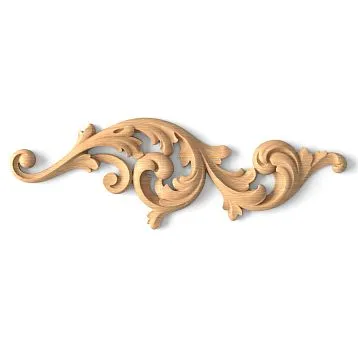
Carved corner overlays are installed at the corners of panel frames made from moldings. They mask joints and add decorativeness. They can be floral (leaves, swirls), geometric (rosettes, fans), or figurative (masks, putti).
Central medallions:
A carved medallion in the center of a wall panel. Round, oval, shield-shaped. Attracts the eye, becomes a focal point. Especially effective in living rooms, dining rooms, and formal bedrooms.
Decorative consoles and brackets:
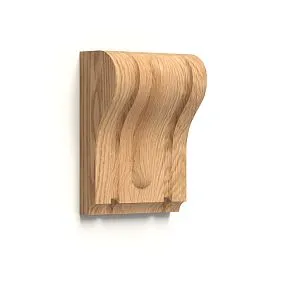
Wall elements imitating supports. You can place vases, figurines, or books on them. A combination of functionality and decorativeness. Often used in pairs — symmetrically on both sides of a fireplace, window, or door.
Bas-reliefs and panels:
Three-dimensional compositions: narrative scenes, still lifes, abstract ornaments. Made from polyurethane, plaster, or wood. Large-scale bas-reliefs become the central element of a wall, turning it into an art object.
Pilasters and half-columns: vertical power
pilasters and columns— vertical elements that create architectural character. A pilaster is a flat rectangular projection with a capital (upper decorative part) and a base (lower part). A half-column is semicircular and three-dimensional.
Application:
Framing door and window openings: pilasters on both sides create a portal.
Zoning space: pilasters divide a long wall into sections.
Decorating corners: corner pilasters mask and decorate external wall corners.
Creating false fireplaces: pilasters form the side parts of a portal, with a decorative firebox or niche inside.
Styles:
Doric order: austere, unadorned, simple capital.
Ionic: capital with scroll-like volutes, more elegant than Doric.
Corinthian: lush capital with acanthus leaves, the most decorative.
Composite: combination of elements from different orders.
Painting and patination: color as a tool
Decorative elements can be left in the material's color (natural wood) or painted.
Monochromatic solution:
Moldings, overlays in the wall color. The decor is discernible only by relief, play of light and shadow. A restrained, elegant solution for minimalist and neoclassical interiors.
Contrasting:
White moldings on a dark wall (or vice versa). Clear graphics, expressiveness. Popular in modern interiors, Art Deco, Scandinavian style.
Gilding and patina:
Gilding the protruding parts of carved elements creates the luxury of Baroque, Empire. Patina (artificial aging) adds nobility, vintage charm. Suitable for classical, Provençal, shabby chic interiors.
Gradients and ombre:
Modern technique: smooth color transition from one shade to another on moldings or panels. Creates volume, dynamism, modernity.
Ceiling: the fifth wall and its possibilities
The ceiling is often ignored in decor. But it is a huge surface, visible from any point in the room.
Ceiling rosettes: the crown of the lighting scenario
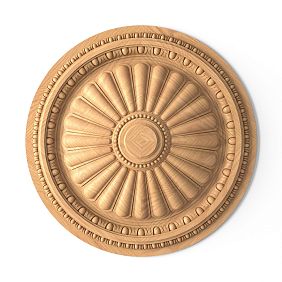
ceiling rosettes— round or polygonal decorative elements placed in the center of the ceiling (usually around a chandelier) or at other points.
Functions:
Decorative framing of the light fixture: the rosette visually enlarges the chandelier, makes it more monumental.
Concealing wiring and fasteners: hides technical elements.
Accentuating zones: several rosettes above different functional areas (dining group, lounge area).
Creating a ceiling composition: the rosette as the center, from which moldings radiate, creating coffers, rays, geometric patterns.
Styles and ornaments:
Classical: symmetrical plant ornaments (acanthus, laurel, roses), scrolls, palmettes.
Baroque: lush, multi-level, with putti, garlands, asymmetrical details.
Empire: austere, with laurel wreaths, stars, geometry.
Art Nouveau: flowing, asymmetrical, with natural motifs (irises, seaweed).
Modern: geometric, minimalist, sometimes abstract.
Dimensions and proportions:
The rosette diameter should correlate with the room size and chandelier. General rule: rosette diameter is 1.5-2 times the chandelier diameter. In tall spacious rooms — large rosettes (60-100 cm and more). In compact ones — modest ones (30-50 cm).
Ceiling cornices and baseboards: transition of dimensions
Cornice — a molding at the junction of the wall and ceiling. Visually completes the space, creates a transition.
Effects:
Visual ceiling lift: a cornice with backlighting (LED strip behind the cornice) creates a floating ceiling effect.
Concealing imperfections: masks gaps and unevenness at the junction.
Color separation: if the walls and ceiling are different colors, the cornice serves as a clear boundary.
Decorativeness: carved, multi-level cornices add luxury.
Types:
Simple smooth: minimalism, modernity.
Profiled: classical profiles with protrusions, grooves.
Carved: with ornaments (meander, dentils, egg-and-dart).
Wide multi-level: for high ceilings, creates monumentality.
Coffers: architectural geometry of the ceiling
Coffer — a recess in the ceiling framed by moldings or beams. Creates volume, structures the ceiling.
Construction:
A grid of moldings is attached to the ceiling, forming rectangular or square cells. Inside each cell — a recess (real or illusory, created by painting). The center of the cell may feature a rosette, an insert of contrasting color, or a mirror tile.
Styles:
Classicism: strict grid of squares, symmetry.
Renaissance: coffers with interior painting.
Modernity: asymmetrical coffers of various sizes, creating a dynamic pattern.
Materials:
Polyurethane moldings — lightweight, inexpensive.
Wooden beams — naturalness, for country, Scandinavian interiors.
Drywall constructions — for deep, real coffers.
Floors: the foundation of style
The floor is the foundation of the interior. Literally and metaphorically. Its decoration sets the tone.
Baseboards: unsung heroes
The baseboard covers the junction of the floor and wall. But it's not just a technical detail.
Height and proportions:
Standard baseboard — 6-10 cm. High (15-25 cm) — for classical interiors, high ceilings. Creates monumentality, elegance. Low (3-5 cm) — for minimalism, modern styles.
Materials:
Wood: oak, beech, ash. Naturalness, durability, possibility of restoration.
MDF: budget option, paints well.
Polyurethane: moisture-resistant, flexible (can wrap around columns, curves).
Ceramic, stone: for wet areas, pairs with tile.
Decorativeness:
Smooth: minimalism, Scandinavian style.
Profiled: classic profiles.
Carved: for luxurious interiors, paired with carved furniture and doors.
With cable channels: functionality (wire concealment) + aesthetics.
Floor sockets and medallions
Analogous to ceiling medallions, but for floors. Used in the center of a room (under a chandelier, creating a vertical axis), in zones (under a dining table).
Materials:
Inlay from various wood species (parquet medallion).
Mosaic from stone, ceramics.
Carpet medallions (round rugs with ornamentation).
Effect:
Floor focal point, zoning, luxury, personalization.
Window and door openings: portals between spaces
Casing and trim
Casing — a plank framing a door or window opening. Conceals the gap between the frame and wall, provides decoration.
Styles:
Simple flat: minimalism, loft.
Profiled: classic, neoclassical.
Carved: Baroque, Art Nouveau, Russian style.
Extended framings:
Adding pilasters, capitals, pediments (triangular or arched completions above an opening) to the casing transforms a simple door into a portal. Suitable for main entrances, living rooms, studies.
Sundries and pediments
Sundries — a decorative element above a window or door. Pediment — a triangular or arched completion of a portal. Creates monumentality, classical architectural character.
Often paired with pilasters: pilasters on the sides of the opening, a sundry above. Results in a classical portal in the spirit of antiquity.
Furniture decoration: integration of objects into the composition
Furniture — not separate objects, but parts of an interior composition. Their decoration creates unity.
Overlays on furniture facades
Carved or milled overlays on cabinet doors, dressers, kitchen units transform standard furniture into custom pieces.
Technique:
Decorative overlays are glued or screwed onto a smooth facade. Then everything is painted in a single color (monochrome) or contrasting colors (overlays gold, facade white).
Styles:
Classic: symmetrical floral ornaments.
Baroque: lush, voluminous, asymmetrical details.
Art Nouveau: flowing, botanical lines.
Carved legs and supports
Replacing standard furniture legs with carved ones transforms it. A sofa on simple legs — ordinary furniture. The same sofa on carved cabriole-style legs — antique luxury.
Furniture handles as jewelry
The handle is the only furniture element you physically interact with daily. Its aesthetics and ergonomics are critical.
Wooden carved handles add personality to furniture. Instead of standard chrome-plated ones - handles made of oak, beech, with carving, patina. Furniture instantly changes character.
Integration of lighting and decor
Light is the invisible decorator. How does it interact with physical decor?
Light and shadow play on relief
Carved elements, moldings, stucco create relief. With side lighting (recessed lights, sconces, floor lamps) the relief comes alive. Protruding parts are highlighted, recesses sink into shadow. Volume and drama appear.
Directional lighting on carved panels, bas-relief turns it into sculpture. By changing the angle and intensity of light, you change the perception of decor.
Backlighting behind decor
LED strip behind ceiling cornice creates soft diffused glow, visually separating ceiling from walls. Floating effect.
Backlighting behind wall panels (if leaving a gap between panel and wall) creates a halo of light, adds futurism to classical forms.
Chandeliers and rosettes: the central duo
A chandelier without a rosette often looks orphaned, especially in a spacious room. The rosette is the pedestal on which the chandelier becomes queen. The more complex and lush the chandelier, the richer the rosette should be. But maintain balance: they shouldn't compete, but complement each other.
Color strategies in room decor
The color of decorative elements affects space perception no less than their shape.
Monochromatic Elegance
All walls, ceiling, decor - shades of one color. For example, various shades of gray: walls medium-gray, moldings light-gray, ceiling almost white. Creates sophistication, calmness, visual integrity. Suitable for bedrooms, studies, minimalist living rooms.
Contrast drama
Dark walls, white moldings and cornices. Or vice versa: white walls, black decorative elements. High contrast creates graphic quality, modernity, boldness. Art Deco, contemporary eclectic interiors.
Accent colors
Main background neutral (beige, gray, white), but individual decorative elements - accent color (blue, emerald, burgundy). For example, white walls and moldings, but inside wall panels - deep blue. Creates focal points, energy, individuality.
Natural palette
Wooden elements in natural tones, walls in natural shades (green, terracotta, ochre). Creates connection with nature, coziness, organic quality. Scandinavian, eco, Mediterranean styles.
Stylistic directions in interior decoration
Decor should match the overall interior style. Or consciously play with it.
Classicism and neoclassicism
Symmetry, proportionality, antique motifs.molding in interiorClassicism features strict lines, restrained ornaments (meander, palmettes, laurel wreaths), white or cream color, sometimes with gilding.
Elements:
Ceiling rosettes with radial symmetry.
Moldings creating panel systems.
Pilasters of Doric or Ionic order.
Cornices with dentils, egg-and-dart.
Baroque and Rococo
Opulence, emotionality, abundance of decoration. Baroque is monumental, symmetrical overall, but with dynamic details. Rococo is light, asymmetrical, playful.
Elements:
Volumetric carved overlays with putti, garlands, mascaron masks.
Asymmetrical rocaille scrolls.
Abundant gilding.
Multi-level cornices and rosettes.
Art Deco
Geometry, luxury of materials, symmetry, contrasts. 1920s-30s.
Elements:
Geometric moldings (zigzags, steps, trapezoids).
Sunburst rosettes and panels.
Contrasting colors (black-white-gold).
Inlays, mirror inserts.
Minimalism
Rejection of excessive decoration, but not of decoration altogether. Minimalist moldings — thin, laconic. Or completely hidden — shadow seams creating lines without physical moldings.
Elements:
Thin flat moldings.
Hidden baseboards (recessed into the wall).
Monochromatic painting.
Functional decor (niches, shelves, built-in storage systems as decorative elements).
Loft and industrial
Roughness, openness of structures, industrial materials. Decoration is minimal but accentuated.
Elements:
Rough wooden beams on the ceiling.
Metal elements (pipes as decor).
Brickwork (real or imitation with panels).
Contrast of rough and elegant (industrial walls + one classic plaster rosette as irony).
Practical recommendations: from idea to implementation
Theory is beautiful, but how to move to action?
Stage 1: Space analysis
Measure the room. Determine ceiling height, wall area, placement of windows, doors, furniture. Photograph from different angles. This is your database for planning.
Assess the shortcomings: low ceilings? Narrow room? Lack of light? Decor can compensate.
Low ceilings: vertical moldings, vertical stripes, light-colored ceiling.
Narrow room: horizontal moldings on long walls (visually widen), an accent short wall (will attract attention, balance proportions).
Lack of light: light tones of decor, glossy finishes (reflect light), mirror inserts.
Stage 2: Determining style and mood
What atmosphere do you want? Calm, energetic, luxurious, cozy? Style follows from mood.
Calmness: classicism, Scandinavian style, minimalism.
Energy: Art Deco, eclecticism, bright contrasts.
Luxury: Baroque, Empire, Neoclassical with gilding.
Cozy: Provence, country, Scandinavian with wood.
Stage 3: Creating a Decor Plan
Draw (by hand or in a program) wall layouts indicating where moldings, overlays, pilasters will be. Ceiling plan with rosettes, cornices, coffers.
This allows you to see the result before purchase, make adjustments, and avoid mistakes.
Stage 4: Material Selection
Budget, style, and operating conditions determine the material.
Wet rooms (bathroom, kitchen): polyurethane.
Classic interiors on a budget: high-quality polyurethane, MDF with good painting.
Premium classic: wood (oak, beech).
Modern styles: polyurethane, MDF, metal.
Stage 5: Purchase
Buy from trusted manufacturers. Poor-quality decor (blurred details, warping, fragility) will ruin the result.
Buy with a 10-15% surplus for trimmings, mistakes, possible defects.
Stage 6: Installation
Professional installation guarantees quality. But simple elements (moldings, overlays) can be installed independently if you have tools, care, and time.
Surface preparation: cleaning, leveling, priming.
Marking: accuracy is critical. Use a level, tape measure, pencil.
Adhesive: specialized for the specific material.
Fixation: during adhesive drying, elements are secured with painter's tape, pins, props.
Sealing joints: putty, sanding.
Painting: primer, base color, patina/gilding if necessary, protective varnish.
First mistake - unstructured mixing. A classic chair, loft table, Scandinavian chest, and minimalist cabinet in one room is not eclecticism, but visual chaos. Each item draws attention to itself, not creating cohesion. A system, logic, unifying idea is needed. Choose one dominant style, add a second as an addition, and possibly a third as an accent. But no more than three, and all should have something in common - color, material, era, or functionality.
Overload
The desire to use all liked elements leads to chaos. Adhere to the principle 'less is more'. Let there be fewer elements, but high-quality and thoughtfully placed.
Mismatch in scale
Tiny moldings in a huge room will get lost. Massive stucco in a small room will overwhelm. The scale of the decor must match the room size.
Ignoring proportions
Golden ratio, rule of thirds, classical proportions work. Study basic composition principles before placing decor.
Economy on quality
Cheap decor is doubly bad: looks bad immediately, deteriorates quickly. Better less, but quality.
Lack of unity
Decor must be stylistically, color-wise, and scale-wise coordinated. A Baroque rosette, minimalist moldings, rustic beams in one room create dissonance.
Answers to Popular Questions
How much does it cost to decorate a room with decor?
The range is huge. Budget option (polyurethane moldings, simple overlays, DIY installation) for a 20 sq.m. room — from 15,000-30,000 rubles. Mid-level (quality polyurethane or MDF, professional installation) — 50,000-100,000 rubles. Premium (wooden elements, custom orders, intricate carving, gilding, installation and painting by specialists) — from 150,000 rubles and up. Everything depends on the room size, complexity of decor, and materials.
Can different materials be combined in decor?
Yes, if done skillfully. For example, wooden moldings + polyurethane rosettes (cheaper, lighter). Or MDF panels + wooden overlays (saving on the base, accent on details). The main thing is stylistic unity, quality painting that hides material differences.
How to care for decorative elements?
Polyurethane: wipe with a damp cloth, wash with mild detergents. Moisture-resistant.
Wood: dry cleaning (dust with a brush), periodic treatment with oil or wax (for untreated wood), avoid excess moisture.
MDF: wet cleaning, but without excess water (can swell at joints).
Plaster: dry cleaning, caution (fragile).
Can decor be used in modern minimalist interiors?
Absolutely. Minimalism is not the absence of decor, but its intentionality, conciseness. Use thin simple moldings, hidden baseboards, monochrome coloring. The decor is distinguished by relief, not by contrast.
How does decor affect the perception of room size?
Vertical elements (vertical moldings, pilasters) visually raise the ceiling.
Horizontal (horizontal moldings, wide cornices) can visually lower overly high ceilings or widen narrow walls.
Light decor expands, dark — narrows.
An abundance of small details overloads a small space.
Is a designer needed to decorate a room with decor?
Not necessarily, but helpful. If you have a clear vision, understanding of style, planning skills — you can do it yourself. But a designer consultation (even a one-time one, at the planning stage) will help avoid mistakes, see unconventional solutions, and use the budget wisely.
Many decor manufacturers (for example, STAVROS) provide free consultations from their specialists upon purchase. Use this opportunity.
How long does decor last?
Quality polyurethane — decades (30-50 years) without loss of properties.
Wood with proper care — centuries (examples: decor from the 17th-18th centuries has survived to this day).
MDF — 15-25 years (depends on quality, conditions, coating).
Plaster — centuries, but fragile, requires careful handling.
Can decor be installed on stretch ceilings?
Yes, but with limitations. Polyurethane cornices are glued not to the ceiling, but to the wall under the ceiling. Rosettes — more complicated: special lightweight models are needed, or installation on the base ceiling before installing the stretch ceiling (the rosette protrudes through a cut in the film).
Conclusion: your space, your story, your choice
Decorating a room's interior is not just buying beautiful elements and placing them. It's creating an environment that will influence you daily, shape your mood, inspire, calm, and delight. It's an investment in quality of life, in aesthetic pleasure, in pride for your home.
Modern technologies and materials make quality decor accessible. You don't need to be a millionaire to live in a beautiful space. You need knowledge, taste, and a willingness to invest time and resources.
In this process, the choice of partner — a manufacturer of decorative elements who offers not just products, but solutions, consultations, quality, reliability — is critically important.
Why STAVROS is the choice of professionals and connoisseurs
When it comes to transforming interiors with top-class decorative elements, one name carries particular weight — STAVROS. A company that for over two decades has been creating products for those who are not ready to compromise between beauty and quality.
STAVROS offers a comprehensive range of decorative solutions:
Moldings and cornices— made of oak, beech, MDF — for creating wall panels, framing openings, ceiling decor.
Polyurethane ceiling rosettes— from compact 30 cm to monumental 100+ cm, in dozens of styles from classic to modern.
pilasters and columns— carved, turned, for creating architectural portals, space zoning.
Decorative wall panels— ready-made compositions or elements for creating boiserie.
Overlays, rosettes, consoles, brackets — hundreds of models for accents.
STAVROS's own production is not just a factory. It is a synthesis of traditional craftsmanship and modern technology. Selected premium wood undergoes multi-stage processing. High-density European-quality polyurethane is molded in precision forms created from 3D models. Each product is controlled at all stages of production.
But STAVROS is not just a catalog. It is an individual approach. The company creates decor according to your sketches, dimensions, and wishes. From a single element to comprehensive mansion design. A team of designers will help develop a concept, visualize the result, and select combinations.
STAVROS professional installation teams implement turnkey projects. From delivery and marking to final painting and varnishing. You get the result, not components with an instruction manual.
STAVROS's geography is all of Russia. Delivery to any region, showrooms in Moscow and St. Petersburg for personal product familiarization, consultation centers, partner network.
STAVROS's pricing policy is based on honesty. Own production, direct material supplies, and no intermediaries allow offering premium products at adequate prices. Regular promotions, loyalty programs, and wholesale discounts make quality even more accessible.
STAVROS is the choice of those who understand: details create the whole, quality defines the impression, beauty shapes life. This is a company for people who build not just interiors, but spaces for living, love, creativity, happiness.
Start creating your ideal interior with STAVROS. Visit the website, explore the collections, contact the consultants. Let your room tell your story — the story of a person who chooses beauty consciously, quality fundamentally, individuality consistently.
STAVROS — where ideas take shape, and rooms turn into works of art.