Article Contents:
- Typology of corner elements: from protection to decoration
- External corners: protection of protruding edges
- Internal corners: softening and filling
- Furniture corners: accents and reinforcement
- Materials and technologies: from solid wood to composites
- Solid wood: nobility and durability
- MDF with coating: versatility and affordability
- Polyurethane: imitation of molding
- Architectural corners: creating spatial structure
- Pilasters on corners: vertical rhythm
- Arch framing: reinforcing the opening
- Wall corner protection: practicality in motion
- Furniture corners: from construction to image
- Cabinet corner columns: architectural logic
- Facade corner overlays: jewelry accents
- Countertop corner protection: strength and style
- Echo between architectural and furniture corners: unity of language
- Repetition of forms: rhythmic echo
- Material unity: same wood, same finish
- Stylistic consistency: one language of details
- Installation of corner elements: precision as the foundation of quality
- Corner preparation: leveling and cleaning
- Fastening: adhesive and mechanical
- Final finishing: masking and protection
- Frequently asked questions about corner elements
- Is it mandatory to install corner pilasters or can they be omitted?
- How to choose the color of corner elements — matching the walls or contrasting?
- Can ready-made corner inserts be used or is it necessary to cut moldings?
- Do wooden corner elements require special care?
- How much does installation of wooden corner elements cost?
- Conclusion: finishing touches by STAVROS
A corner is the meeting point of two planes, a point of architectural tension where space changes direction. In standard interiors, corners remain empty, unprotected, visually weak.Wooden corner elementstransform these problem areas into architectural accents, protect against mechanical damage, and create compositional completeness. A properly designed corner is not only about aesthetics but also about the logic of spatial construction, where every element has meaning and function.
Why do corners require special attention? Because it is here that all construction flaws are visible — imperfect geometry, wall irregularities, gaps between finishing elements. A corner element conceals these defects, creating a clean line that organizes the space. Additionally, corners are subject to mechanical impacts — bumps from moving furniture, being brushed by passing people. Protecting corners with wooden elements prevents finishing damage and preserves the perfect appearance of the interior for decades.


Typology of corner elements: from protection to decoration
Wooden corner elements vary in shape, size, and function. Understanding the typology allows for selecting the right solution for a specific task.




External corners: protection of protruding edges
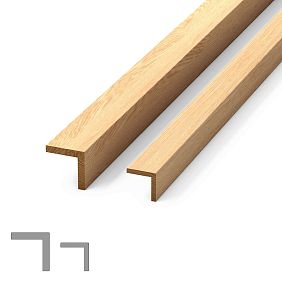
An external corner is the protruding edge of a wall, column, pilaster, or furniture. This is the most vulnerable spot, the first to suffer from mechanical impacts. Protective corner strips for external corners are profiled elements with an L-shaped cross-section that are applied over the edge, covering both adjacent planes.
The simplest option is an equal-shelf corner piece with shelves 20-40 millimeters wide. The shelves can be flat or have a decorative profile — bevel, bead, fluting. Such corners are used to protect wall corners in hallways, passages, and high-traffic areas. They are attached with adhesive or screws, creating durable protection.
Decorative corner elements for external corners have a complex profile with relief, carving, or ornamentation. Shelf width is 50-80 millimeters, thickness up to 15 millimeters. Such elements not only protect but also adorn corners, turning them into architectural accents. They are used in classical interiors on pilaster corners, arch framing, and fireplace surrounds.
Corner pilasters — vertical elements imitating columns, installed on external corners of a room. They consist of a base, shaft, and capital, creating a full architectural order. The shaft can be smooth, fluted, or twisted. The capital is adorned with carved elements — acanthus leaves, volutes. Such a pilaster not only protects the corner but creates a vertical dominant that organizes the space.
Our factory also produces:


Internal corners: softening and filling
An internal corner is the junction where two walls meet, forming an inward angle. Here, the issue is not protection but the visual design of the joint. Moldings, casings, baseboards, when meeting at an internal corner, require precise fitting. Special corner inserts simplify installation and create a perfect joint.
Corner insert for moldings — an element that replicates the molding profile in the shape of a quarter-circle or right angle. The insert is installed in the internal corner, and straight sections of molding are joined to it. This eliminates the need for complex miter cuts on the molding, guaranteeing a perfect connection without gaps.
Baseboard corner pieces — ready-made elements for finishing internal and external baseboard corners. For internal corners — a concave element; for external — a convex one. Using corner pieces speeds up installation, especially with baseboards of complex profiles where precise 45-degree miter cuts are difficult.
Corner rosettes — decorative elements in the shape of a quarter-circle, adorned with carving or relief. Installed in the upper corners of a room at the junction of walls and ceiling, creating a visual transition. Four corner rosettes around the perimeter of the ceiling form a frame, with the main ceiling rosette positioned in the center — resulting in a complete composition.
Get Consultation
Furniture corners: accents and reinforcement
Furniture corners require finishing for the same reasons as room corners — protection from damage and visual reinforcement of form.Furniture decorin the form of corner elements transforms a simple cabinet box into an architecturally meaningful object.
Furniture corner overlays — small carved elements installed on the corners of facades, tabletops, legs. Size is typically 30-80 millimeters, shape — triangle, sector of a circle, stylized floral motif. Overlays are attached with adhesive, covering the joint of two planes and creating a three-dimensional accent.
Furniture corner columns — vertical elements installed on the corners of cabinets, dressers, sideboards. They imitate columns, creating architectural logic. The column consists of a base, shaft, and capital, replicating the structure of a full-sized column in miniature. The shaft can be round, square, faceted, smooth, or adorned with fluting.
Corner protective overlays for tabletops — metal or wooden elements protecting the corners of tables, dressers, bar counters from chipping. Especially relevant for marble, glass, and other fragile materials. A wooden overlay with a bronze insert combines protection with decorativeness, creating a historical effect of furniture that has endured for centuries.
Materials and technologies: from solid wood to composites
The choice of material for a corner element determines its durability, appearance, and cost. Each material has advantages and limitations.
Solid wood: nobility and strength
Corner elements made from solid oak, beech, ash offer maximum strength and a noble appearance. Oak is the hardest, most resistant to mechanical impacts, with a pronounced grain. Oak corner elements last for decades without losing shape. Color ranges from light honey to dark brown, allowing matching to any interior tone.
Beech — a more homogeneous wood with a pinkish hue, easier to work with. Beech corner elements are ideal for carving — clarity of detail, no chipping. Beech takes stains well, accepting almost any color. This provides freedom in creating color schemes — from bleached Scandinavian to rich wenge.
Ash is a contrasting wood with an active grain pattern, similar to oak but lighter. Ash corner elements create a dynamic visual effect, suitable for modern interpretations of classic styles. The strength of ash is comparable to oak, ensuring durability.
The manufacturing technology for solid wood corner elements involves milling the profile on high-precision CNC machines, manual refinement of carved details, sanding, tinting, and finishing. Wood moisture control is critical—8-12% guarantees geometric stability after installation.
MDF with coating: versatility and affordability
Corner elements made from MDF—medium-density fiberboard made from wood fibers—combine geometric stability with an affordable price. MDF has no grain direction, does not crack, and does not deform with changes in humidity. This allows for creating elements of complex shapes with fine details.
The MDF coating determines the appearance. Natural wood veneer creates the effect of solid wood at a lower cost. Enamel provides a smooth painted surface in any color. Patination creates an effect of noble aging with paint accumulation in recesses. PVC film imitates wood grain and is resistant to moisture and stains.
The disadvantage of MDF is its lower mechanical strength compared to solid wood. An impact can leave a dent, and a chip can expose the internal structure of the board. Therefore, MDF is optimal for decorative elements in areas with low mechanical load, while solid wood is for protective elements in passageways and on furniture.
Polyurethane: imitation of stucco
Corner elements made of polyurethane imitate plaster stucco but are lighter, easier to install, and cheaper. Polyurethane corner pieces for ceiling cornices, rosettes for corners, and arch overlays create a classic look at minimal cost. The material is moisture-resistant, does not crack, and is easy to paint.
However, polyurethane is an artificial material, lacking the warmth and tactile feel of wood. It cannot reproduce the natural wood grain, the play of annual rings, or the depth of a tinted surface. Polyurethane is a choice for budget projects or rooms with high humidity where wood is undesirable.
Combining materials is a common practice. Ceiling corner elements made of polyurethane are combined with wooden furniture corners. This optimizes the budget while preserving nobility where it is most noticeable—at eye level, on furniture that hands touch.
Architectural corners: creating spatial structure
Wooden corner elements on walls are not just decoration but a tool for organizing space, creating architectural logic, and managing perception.
Pilasters on corners: vertical rhythm
Installing pilasters on the external corners of a room creates a vertical rhythm, divides the space, and emphasizes height. Two pilasters on opposite corners of a long wall break it into three parts, eliminating monotony. Four pilasters at the corners of a square room create a centered composition.
A pilaster consists of three parts. The base—the lower part, 150-250 millimeters high, creating a foundation. The shaft—the middle part, from floor to ceiling minus the base and capital. The capital—the upper part, 200-400 millimeters high, crowning the composition.interior decorationin the form of carved capitals turns a simple vertical into an architectural order.
The pilaster shaft can have various treatments. A smooth shaft—a simple flat or slightly convex surface. A fluted shaft—with vertical grooves creating rhythm and chiaroscuro. A twisted shaft—spirally twisted, creating dynamism and lushness. A rusticated shaft—with horizontal protrusions imitating stone masonry.
The width of the pilaster should correspond to the proportions of the room. For a room 4-5 meters wide, a pilaster 80-120 millimeters wide is optimal. For a spacious hall 7-8 meters wide—150-200 millimeters. A too-narrow pilaster will be lost, a too-wide one will look massive, consuming space.
Framing arches: enhancing the opening
An arched opening requires framing that emphasizes its shape and creates a transition between rooms. Wooden arch framing consists of vertical elements on the sides and a curvilinear element repeating the shape of the arch.
Vertical elements—pilasters or simple architraves 60-120 millimeters wide. They are installed from the floor to the beginning of the arch curve, creating a visual support. The profile of the vertical elements should match the profile of the arch element, ensuring compositional unity.
The arch element—a curved strip repeating the arch radius. Made either by bending (steamed wood bent to shape) or by assembly (short segments forming a curve). Bending technology gives a monolithic line without joints. Assembly is simpler to manufacture but requires careful fitting of segments.
The keystone—a decorative element at the top point of the arch. Imitates the stone in the center of the arch on which the side parts rest. Usually has a trapezoidal or wedge shape with carved ornamentation. The keystone creates a visual accent, emphasizing the constructive logic of the arch.
Protecting wall corners: practicality in motion
In areas of intensive movement—corridors, passageways, staircases—wall corners are prone to impacts, bumps, and abrasion. Protective wooden corner pieces prevent the destruction of plaster, wallpaper, and paint, preserving the perfect appearance of walls.
The corner piece is attached to both planes of the corner with screws or adhesive. Screws provide maximum strength, but their heads are visible. Adhesive creates a hidden fastening but requires a perfectly flat wall surface. A combination—adhesive plus several screws—is optimal.
The installation height of the protective corner piece depends on the risk zone. In a corridor where bags and suitcases are carried—from the floor to a height of 1200-1500 millimeters. In an entryway where shoe impacts are possible—from the floor to 300-500 millimeters. On a staircase—along the entire height of the corner adjacent to the flight.
The color and finish of the protective corner piece can match the walls, making it inconspicuous, or contrast, turning it into a decorative element. A dark corner piece on light walls creates a graphic accent. A gilded or patinated corner piece on painted walls adds historicism and status.
Furniture corners: from construction to image
Furniture corners carry both constructive and decorative loads. Proper corner design turns a utilitarian object into a piece of furniture art.
Corner Cabinet Columns: Architectural Logic
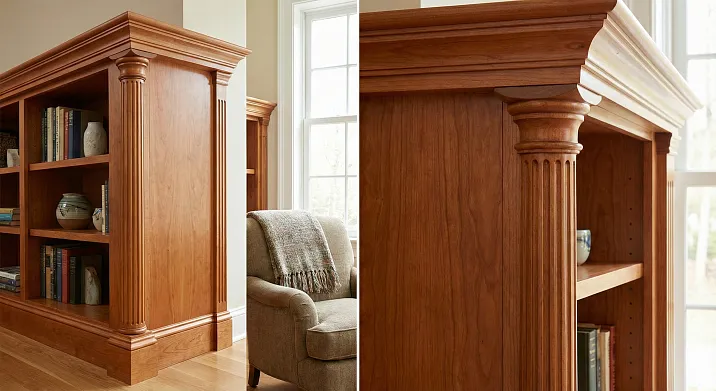
Classic Furnitureoften uses corner columns—vertical elements installed at the corners of the cabinet body. The column creates visual reinforcement of the corner, emphasizes verticality, and segments the facade.
Structurally, a corner column can be applied or recessed. An applied column is attached to the front plane of the cabinet's side wall, protruding in front of the facade. A recessed column is installed into the corner, partially set into the body, creating a more organic connection.
Column cross-section — round, square, polygonal. A round column creates softness, classic elegance. A square one — strictness, constructive clarity. A polygonal (hexagonal, octagonal) one — richness of forms, play of light on the facets.
The diameter or width of the column should be proportional to the cabinet's dimensions. For a cabinet 1200 millimeters wide, a column with a diameter of 50-70 millimeters is optimal. For a 1800-millimeter cabinet — 80-100 millimeters. A column that is too thin looks fragile, too thick — massive.
The base and capital of the column create completeness. The base — an expansion at the bottom part, 50-100 millimeters high. The capital — an expansion at the top part, 80-150 millimeters high, often decorated with carving. Without a base and capital, the column looks unfinished, like a cut-off stick.
Corner Appliqués on Facades: Jewelry Accents
Small carved corner appliqués on cabinet doors, dresser drawers create richness of detail without overloading the composition. Appliqué size 30-80 millimeters, thickness 8-15 millimeters. Shape — triangle, circle sector, stylized leaf, volute.
The placement of corner appliqués follows symmetry. If there are two appliqués on a door — they are installed in the upper or lower corners symmetrically. If four — on all corners. Asymmetric placement creates visual discomfort and disrupts balance.
Carving on corner appliqués can be bas-relief (the pattern is recessed into the plane) or high-relief (the pattern protrudes above the plane). Bas-relief carving is more delicate, suitable for furniture in a restrained style. High-relief is more expressive, used in Baroque and Empire interiors.
Toning of appliqués can match the facade, creating a monochrome solution, or contrast — light appliqués on a dark facade, dark on light. Gilding appliqués against the natural color of the facade creates a luxurious effect, characteristic of palace furniture.
Protection of Tabletop Corners: Strength and Style
Tabletop corners are the most vulnerable spots, prone to chipping upon impact. Protective corner overlays made of metal, leather, or wood prevent damage, extending the furniture's life. Simultaneously, they become a style accent.
Metal corner overlays — brass, bronze, nickel-plated steel — create the historical effect of furniture that has survived centuries. Such overlays are characteristic of English writing desks, French dressers, campaign furniture of the 18th-19th centuries. Size 40-80 millimeters, fastened with screws with decorative heads.
Leather corner overlays — a tradition of English library tables. Leather — natural, embossed, often green or brown — is applied to the tabletop corners, fastened with small brass nails. Creates tactile comfort, protects against chipping, adds nobility.
Wooden corner overlays are used for solid wood tabletops. An overlay made of the same species but with a cross-grain direction strengthens the corner structurally, preventing chipping along the grain. Can be toned contrastingly, creating a decorative inlay effect.
Echo of Architectural and Furniture Corners: Unity of Language
When corner elements on walls and furniture are connected by a common logic, compositional unity arises. The space is perceived as a system where architecture and objects speak the same language.
Repetition of Forms: Rhythmic Echo
The most obvious connection is the repetition of form. If fluted pilasters are installed at room corners, furniture should have corner columns with fluting. The rhythm of vertical grooves repeats at different scale levels — on walls and on cabinets. The eye registers this repetition, senses coherence.
The form of pilaster capitals and furniture column capitals should also echo. Corinthian capitals with acanthus leaves on walls require similar capitals on furniture. Ionic capitals with volutes — respectively, Ionic ones on columns. Variation is permissible in scale — furniture capitals are smaller, but the character of the carving is similar.
Corner appliqués on furniture can repeat the motifs of corner rosettes at the junction of walls and ceiling. If rosettes have a floral ornament with palmettes, appliqués on the cabinet use the same motif in a reduced size. This creates thematic unity of decor at all levels of the interior.
Material Unity: One Wood, One Finish
Even with differences in form, material unity creates a connection. If architectural corner elements are made of oak with an oil finish, furniture should be made of oak with the same finish. Wood species, stain color, type of final finish — everything matches.
Tactile experience is also important. Touching a wooden pilaster on the wall and a cabinet column, a person feels the same texture, temperature, roughness. This subconsciously convinces that the entire space is made from one material, constitutes an organic whole.
Contrast is permissible but must be conscious. Dark architectural elements made of stained oak and light furniture made of beech create a play of tones that can be interesting. But chaotic mixing — oak, beech, ash, MDF under walnut — will create visual disorder.
Stylistic Consistency: One Language of Details
Classicist pilasters with strict order proportions require classicist furniture. Baroque pilasters with twisted shafts and lush capitals — Baroque furniture with curved forms. Mixing styles is possible but requires deep understanding and subtle taste.
Solid Wood Itemsin one style create a harmonious environment. If elements of several styles are present in the interior, it is important to determine the dominant one and subordinate the others to it. For example, the foundation is classicism, additions are Empire elements. This creates richness while maintaining integrity.
Installation of Corner Elements: Precision as the Foundation of Quality
Installing corner elements requires precision and professionalism. Sloppy installation will ruin the impression of even the highest quality elements.
Corner preparation: leveling and cleaning
Before installing corner elements, wall or furniture corners must be prepared. For architectural elements — check the verticality of the corner with a plumb line or laser level. A deviation of more than 3-5 millimeters over a height of 2.5 meters requires leveling with plaster.
Cleaning the surface from dust, grease, and old coatings is mandatory. Adhesive or screws only hold on a clean surface. Primer improves adhesion, especially on loose substrates — old plaster, MDF.
Marking is a critical stage. The position of the element is marked with a pencil on both planes of the corner. For vertical elements, the verticality of the marking is checked. For horizontal ones — horizontality. An error in marking will lead to the element being skewed.
Mounting: adhesive and mechanical
Wooden corner elements are fastened with a combination of adhesive and mechanical fasteners. Adhesive — carpenter's PVA for rooms with normal humidity, polyurethane for damp rooms. Adhesive is applied in a zigzag pattern on both planes of the element, ensuring even distribution.
Mechanical fastening — screws, nails, bolts. For solid wood elements — wood screws with a diameter of 3-4 millimeters, length ensuring penetration into the base by 25-30 millimeters. Screw heads are countersunk into the wood by 2-3 millimeters, holes are filled with putty.
For heavy elements — large pilasters, massive columns — additional dowels are used. A through hole through the element into the wall, installation of a dowel, screwing in a screw. The fastening point is covered with a decorative plug or rosette.
Pressing the element after applying adhesive and installing fasteners is an important moment. The element is pressed tightly against both planes of the corner, held for 2-3 minutes. For long elements, clamps, spacers are used. Excess adhesive squeezed out during pressing is immediately removed with a damp cloth.
Finishing: masking and protection
After installation, fastener points and joints require refinement. Screw holes are filled with wood putty, matched to the tone of the element. Putty is applied with excess, as it shrinks when drying. After complete drying — sanding with fine sandpaper until smooth.
Element joints — connections of pilasters with floor and ceiling, corner overlays with facades — should be tight. Gaps up to 1 millimeter are acceptable, filled with acrylic sealant to match the tone. Gaps larger than 1 millimeter are a sign of poor-quality installation and require rework.
Final coating — varnish, oil, wax — is applied after installation if the elements were supplied unfinished. This ensures uniformity of color and coating, including joint and fastener areas. Two to three coats with intermediate sanding create a durable protective coating.
Frequently asked questions about corner elements
Is it mandatory to install corner pilasters or can they be omitted?
It is not mandatory — it is a matter of style and function. In minimalist modern interiors, pilasters are inappropriate. In classical interiors, corners often remain unadorned if the walls are painted or wallpapered. Pilasters are necessary when walls are paneled, there are moldings creating an architectural composition. Then pilasters logically complete the system.
From a functional point of view, pilasters are useful in high-traffic areas — corridors, halls, stair landings. They protect corners from damage and create visual landmarks. In bedrooms, studies, where movement is minimal, the protective function is secondary, aesthetics are more important.
How to choose the color of corner elements — matching the walls or contrasting?
The decision depends on the desired effect. Corner elements matching the wall color visually blend with the plane, create delicate accents, emphasize shape, but do not attract attention. This is suitable for interiors where a calm atmosphere and absence of visual noise are important.
Contrasting corner elements — dark on light walls, light on dark, gilded on painted — create expressive accents, divide space, draw attention to the architecture. This is characteristic of formal interiors where representativeness is important.
An intermediate option — corner elements several tones darker or lighter than the walls. This creates distinguishability but not sharp contrast. For example, walls are light gray, corner elements are medium gray. There is a difference, but it is soft, delicate.
Can ready-made corner inserts be used or is it mandatory to miter moldings?
Ready-made corner inserts for moldings, baseboards, trims significantly simplify installation and guarantee a perfect joint. For complex profiles with multiple lines, mitering at 45 degrees is difficult even for professionals. The insert is installed in the corner, straight sections are joined to it — simple and reliable.
However, inserts are not available for all profiles. If the profile is unique, custom, inserts may not exist. Then mitering is necessary. Also in historical interiors, where authenticity is important, mitering was used; inserts are a modern simplification.
A well-executed miter is visually indistinguishable from an insert. With the right tool (miter saw) and experience, mitering is the optimal solution. Without them — inserts save time and nerves.
Do wooden corner elements require special care?
Care is simple — regular wiping with a dry soft cloth once a month to remove dust. Dust accumulates in the recesses of carvings, on horizontal surfaces of capitals. Use a soft brush or vacuum with a soft attachment.
Wet cleaning is acceptable for varnished elements — a well-wrung cloth without excess water. Elements with oil or wax coating are wiped only with a dry cloth. Every 2-3 years, the coating is renewed — a new layer of oil or wax is applied to the cleaned surface.
Mechanical damage — chips, scratches — are repaired locally. The damaged area is sanded with fine sandpaper, filled with putty, tinted to match, and coated with varnish or oil. Deep damage may require replacing the element.
How much does installation of wooden corner elements cost?
Installation cost depends on the type of element, complexity of installation, and condition of corners. Installation of simple protective corner guards costs 200-400 rubles per linear meter. Installation of decorative pilasters ranges from 3000-6000 rubles per piece depending on size and complexity.
Installation of corner overlays on furniture costs 300-800 rubles per element. Installation of corner columns on cabinets costs 2000-4000 rubles per pair. Prices vary depending on region and craftsman's qualifications.
Self-installation is possible with proper tools and skills. Simple protective corner guards can be installed by anyone with basic skills. Complex carved pilasters requiring precise marking and fastening are best entrusted to professionals.
Conclusion: finishing touches by STAVROS
Wooden corner elements are not just protection or decoration, but architectural logic that transforms a set of planes into volumetric space with character. From protective corner guards in hallways to carved pilasters in formal living rooms, from furniture overlays to corner rosettes - each element serves a function, creates meaning, and forms completeness. Proper corner finishing is a hallmark of a professional approach to interior creation.
STAVROS offers a complete range of corner elements made from solid oak, beech, and ash for architectural and furniture applications. Production facilities are equipped with high-precision equipment capable of creating elements of any complexity - from simple protective strips to complex carved pilasters with capitals and bases.
STAVROS's catalog features ready-made solutions - corner columns for furniture in various diameters and styles, protective corner guards of different profiles, decorative overlays with carvings, fully-equipped pilasters. All elements are available in various finishing options - natural oil, varnish, tinting, patination, enameling.
Custom manufacturing is STAVROS's specialty. If standard elements don't suit, company specialists will develop unique corner elements according to your sketches and dimensions. Non-standard height pilasters for rooms with 3.8-meter ceilings, carved overlays with custom patterns, corner columns with special cross-sections - all are achievable.
Consultation support at all stages - from concept to installation. STAVROS specialists will help select corner elements matching your interior style, calculate required quantities, and create placement diagrams. Installation recommendations, fastener selection, coordination with installers - full service for successful project implementation.
STAVROS works with private clients, interior designers, furniture factories, and construction companies throughout Russia and CIS countries. The logistics system ensures delivery from Kaliningrad to Vladivostok with guaranteed safety. Showrooms in Moscow and Saint Petersburg allow viewing product samples, assessing processing and carving quality, and receiving professional consultation.
Choosing STAVROS means choosing quality solid wood, manufacturing precision, rich selection, and professional support at all stages. Create interiors where every corner is thoughtfully designed, where architecture and furniture form a unified whole, where wood reveals its beauty, strength, and nobility. Corners are not problem areas but opportunities to create architectural accents that make spaces complete, logical, and beautiful.