Article Contents:
- Character of the dining area: atmosphere, not just furniture
- Atmosphere is created by details
- Psychology of the dining room
- Character through contrast
- Dark baseboard and dark frames create a 'framework' around light walls
- Graphics of the dark baseboard
- Dark frames of mirrors and paintings
- Moldings as part of the framework
- Material of the dark framework
- One large mirror opposite the table or to the side — for depth and light
- Mirror size: large, dominant
- Placement: opposite the table or to the side
- Mirror opposite the window: maximum light
- Mirror shape: rectangular or arched
- Moldings around the mirror and on adjacent panels — create rhythm
- Moldings around the mirror: frame within a frame
- Panels on adjacent walls: rhythm and symmetry
- Horizontal moldings: wall articulation
- Combination with textiles: curtains, chair upholstery, tablecloth
- Curtains: noble fabrics
- Chair upholstery: velvet, leather, linen
- Tablecloth: linen, cotton, no tablecloth
- Warm lighting: pendants above the table + reflection in the mirror
- Pendant lights above the table
- Reflection of light in the mirror
- Additional lighting
- How to create a composition that looks good both day and evening
- Daylight: balance of light and dark
- Evening Light: Warmth and Intimacy
- Lighting Flexibility
- Frequently Asked Questions
- Conclusion: The Dining Room as an Event Space

A restaurant dining room differs from a home one not just in its menu. It's the atmosphere: light falls softly, mirrors reflect candles, dark frames create depth, the space feels larger, more elegant, more ceremonious. You walk in and sense: this is an event, here they don't just eat, they live in the moment, enjoy, converse.
Is it possible to create such an atmosphere at home? Yes. Not by copying restaurant design exactly, but by borrowing the principles, techniques, details.A dark skirting board forms a visual framearound light walls, creates contrast, graphic quality, clarity of boundaries.A large mirror opposite or to the side of the tablevisually doubles the space, reflects the chandelier's light, creates an illusion of depth.Large frame moldings around the mirror and on the wallsstructure the planes, create rhythm, architectural organization.
Add textiles (curtains of noble fabrics, chair upholstery in velvet or leather, a linen tablecloth), warm lighting (pendant lights over the table, their reflection in the mirror doubles the light), the right composition — and the home dining room transforms into a space where every dinner feels like an event, where guests sense attention to detail, where the family gathers not just to eat, but to share an atmosphere of beauty, coziness, ceremony.


The Character of the Dining Zone: Atmosphere, Not Just Furniture
Many think: a dining room is a table and chairs. You buy a quality dining table, comfortable chairs — the dining room is ready. No. Furniture is function, but not atmosphere. You can have an expensive table costing a million rubles, but if it stands in an empty white room without details — it's not a dining room, it's a canteen, a cafeteria, a functional place.




Atmosphere is created by details
What distinguishes a restaurant dining room from a mediocre home one? Details. In a restaurant, there are no random elements: every painting on the wall, every light fixture, every skirting board, every mirror frame is thought out, coordinated, works towards the overall idea.
A dining area in a classic stylerequires architectural wall treatment: moldings creating panels, skirting boards of sufficient height forming the base, framed mirrors adding depth and light. These elements are not functional in the literal sense (they don't bear weight, don't store things), but are critically important for the atmosphere.
Our factory also produces:


The Psychology of the Dining Room
The dining room is a space of ritual. Here they gather for breakfast before the workday, here they dine as a family, discussing events, here they host guests, celebrate holidays. This space should set the mood for conversation, slow the pace, create a sense of occasion.
A light, empty room with functional furniture does not create this mood. One wants to eat and leave, not linger, talk, enjoy the moment. A room with details (dark contrasting frames, mirrors, lighting, textiles) creates intimacy, coziness, a feeling of a space specially created for feasting.
Get Consultation
Character Through Contrast
Contrast is a powerful tool for creating character. A completely light or completely dark room is monotonous, lacks visual interest. But a room where light walls contrast with dark skirting boards, where a light tablecloth contrasts with a dark wood table, where a bright chandelier contrasts with soft shadows — has drama, visual tension, energy.
Restaurant dining rooms actively use contrast: light walls + dark frames, light ceilings + dark floors, bright accents (flowers, paintings) + neutral background. This principle works at home too.
Dark skirting boards and dark frames create a 'frame' around light walls
A dark skirting board on light walls is not just a decorative solution. It's an architectural technique that creates a visual frame, structure, boundaries of the space.
The Graphics of a Dark Skirting Board
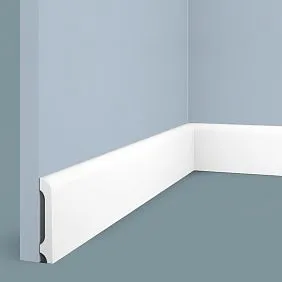
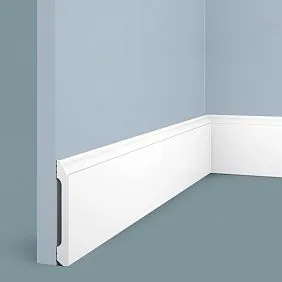
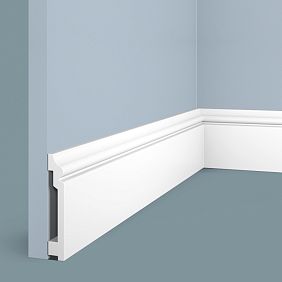
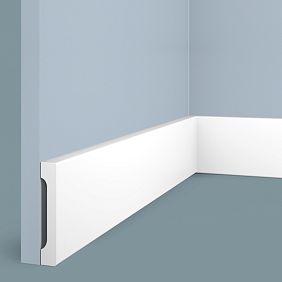
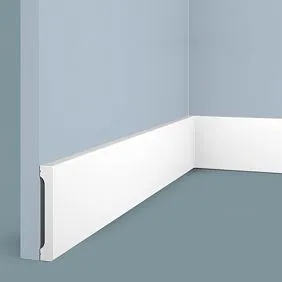
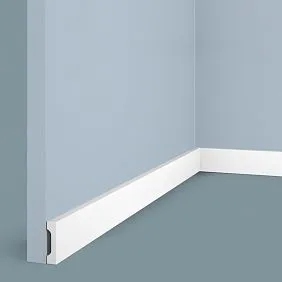
A black or dark brown skirting boardon white or light beige walls creates a clear horizontal line at the base of the wall. This line forms a visual boundary between the floor and the wall, emphasizes the room's geometry, makes the space graphic, structured.
The height of a dark skirting board for a dining room is 100–150 mm. This is enough for the skirting board to be noticeable, create visual weight, but not overload the space. Skirting boards smaller than 80 mm get lost against light walls, don't create sufficient contrast.
Dark frames of mirrors and paintings
If the baseboard is dark, the frames of mirrors and paintings should also be dark (or similar in tone). This creates a visual connection: a dark baseboard at the bottom, dark frames on the walls—they form a unified system of dark accents on a light background.
Mirror Framesmade of dark wood (wenge, stained oak, oak with dark tinting) or painted black, graphite create contrast with light walls. Frame width for large mirrors (height 150–200 cm) — 80–120 mm. These are massive frames with visual weight, creating a sense of solidity and luxury.
Moldings as part of the frame
In addition to baseboards and frames, a dark frame can include moldings—horizontal and vertical strips that structure the walls. Moldings in a dark color (matching the baseboards and frames) create panels on the walls, divide the space into zones, and add architectural complexity.
Example composition:
Dining room walls are light gray (RAL 7035). Baseboard is dark brown, height 120 mm, made of solid oak with dark tinting. On one wall—a large mirror 180×120 cm in a frame made of the same dark oak, frame width 100 mm. Around the mirror—oak moldings forming a rectangular panel, inside which is the mirror. On adjacent walls—similar panels made of moldings, inside which are wallpapers with texture or paint a shade darker than the main walls.
Result: light walls are framed by a dark frame (baseboard at the bottom, moldings and frames around the perimeter), creating a visual structure, graphic quality, and a sense of thoughtfulness.
Material of the dark frame
Solid wood:
Baseboards made of solid oakwith dark tinting (stain, oil in a dark shade), mirror frames made of the same oak. Advantages: naturalness, tactile quality, durability, possibility of repair (scratches can be sanded, coating renewed). Solid wood is visually warm, noble, and creates a sense of quality and investment.
Painted MDF or solid wood:
Baseboards and frames made of MDF or solid wood, painted with enamel in black, graphite, dark blue. Advantages: any color, perfectly smooth surface (enamel hides the wood texture, creating uniformity). Painted elements look more modern and graphic than natural wood.
Polyurethane with painting:
For moldings—polyurethane painted to match the color of baseboards and frames. Polyurethane is lighter than wood, cheaper, and easy to install. Disadvantage—lacks the tactile quality and nobility of solid wood, but visually (from a distance) indistinguishable from wood.
One large mirror opposite the table or to the side—for depth and light
A mirror in the dining room is not just a decorative element. It is a functional tool that solves several tasks: visually expands the space, enhances lighting (reflects light from the chandelier and windows), creates depth, and adds luxury.
Mirror size: large, dominant
Small mirrors (60×80 cm) in the dining room get lost and do not create the desired effect. For the dining room, a large mirror is needed: minimum 120×150 cm, optimally 150×200 cm or even 180×220 cm (if the wall allows).
A large mirror becomes a visual accent, a dominant feature of the wall. It doesn't just hang; it forms a compositional center around which everything else is organized (furniture, lighting, decor).
Location: opposite the table or to the side
Opposite the table:
A mirror on the wall opposite the dining table reflects the table, the people at it, and the chandelier above the table. This creates a doubling effect: it seems as if there are two tables, twice as many people, and two chandeliers in the room. The space visually expands twofold.
Advantage: maximum space expansion effect. Disadvantage: people at the table see themselves in the mirror, which can be distracting. Not everyone is comfortable looking at themselves in the mirror while eating.
To the side of the table:
A mirror on a side wall (to the left or right of the table) reflects not the table, but another part of the room (window, shelving with decor, part of another wall). This creates depth, visually expands the room in width, but does not double the table.
Advantage: people at the table do not see themselves in the mirror, are less distracted. The mirror works as a visual expansion, but not as a mirror reflection of the dining scene. Disadvantage: the expansion effect is less than when placed opposite.
Mirror opposite the window: maximum light
If there is a window in the dining room, the optimal place for a mirror is the wall opposite the window. The mirror reflects natural light, effectively doubling its amount in the room. The dining room becomes brighter, more airy, and more spacious.
During the day, the mirror reflects daylight and the view outside the window (if the view is pleasant—trees, sky). This creates a connection with nature, a sense of openness. In the evening, the mirror reflects artificial light (chandelier, sconces), doubling the illumination.
Mirror shape: rectangular or arched
Rectangular vertical:
A classic shape for the dining room. Vertical orientation (height greater than width) creates a visual upward thrust, making ceilings appear higher. Proportions of 3:2 (e.g., 180×120 cm) are harmonious and classic.
Arched:
A mirror with an arched top (semi-circular finish) adds softness, elegance, and associations with classical architecture (palace and cathedral arches). Arched mirrors are well-suited for dining rooms in classic, Mediterranean, and Provence styles.
Square or horizontal:
Less typical for a dining room, but possible. A square mirror (150×150 cm) creates symmetry, stasis, and monumentality. A horizontal mirror (120×180 cm) visually expands the space in width but does not raise the ceiling.
Moldings around the mirror and on adjacent panels create rhythm
Moldings are not just decorative strips. They are a tool for structuring space, creating rhythm, and establishing visual connections between elements.
Moldings around the mirror: a frame within a frame
The mirror already has a frame (dark wood, wide, massive). But around this frame, you can add a second frame made of moldings attached to the wall. This creates a 'frame within a frame' effect, enhances the visual significance of the mirror, and makes it not just an element on the wall but an architectural composition.
Dimensions of the molding frame:
Moldings should extend beyond the mirror frame by 15–30 cm on each side. For a mirror of 150×120 cm with a frame (final size with frame 170×140 cm), the molding frame around it would be 200×170 cm. Between the mirror frame and the moldings, there is a 15 cm section of wall, creating a visual pause and transition.
Molding Profile:
A simple rectangular profile (width 60–80 mm) for modern and minimalist dining rooms. A classic profile with beads, chamfers, and carved elements for classic dining rooms. The molding profile should echo the profile of the baseboard and mirror frame, creating visual unity.
Panels on adjacent walls: rhythm and symmetry
If there is a large mirror with a molding frame on one wall of the dining room, you can create similar panels on adjacent walls using the same moldings and the same size, but without mirrors. Inside these panels, you can use wallpaper with texture, paint a shade darker than the main walls, fabric upholstery, or wooden panels.
Effect:
This creates rhythm: identical rectangles (panels) repeat on different walls, visually linking the space. The room looks not like a collection of random elements but like a thoughtful architectural composition where each element is part of a system.
Symmetry:
If the mirror is on the central wall (opposite the entrance to the dining room), you can create two symmetrical panels of the same size on the side walls. Symmetry creates solemnity, classic harmony, and a sense of order.
Horizontal moldings: wall division
In addition to frames around the mirror and panels, you can use horizontal moldings running along the entire perimeter of the dining room at a height of 90–100 cm from the floor. This is a classic technique that divides the wall into two parts: the lower part (from the floor to the molding) and the upper part (from the molding to the ceiling).
Color solution:
The lower part of the wall (up to the molding) is painted in a darker color or covered with textured wallpaper. The upper part (from the molding to the ceiling) is light and monochromatic. The molding is dark (the color of the baseboard), separating the two zones.
This creates visual solidity (dark bottom), airiness (light top), and architectural complexity.
Combination with textiles: curtains, chair upholstery, tablecloth
Architectural elements (baseboards, moldings, mirror frames) create structure. But the atmosphere of the dining room is also shaped by textiles—soft, tactile, colorful materials that add coziness, warmth, and comfort.
Curtains: noble fabrics
A dining room in a restaurant style requires curtains made of quality fabrics: linen, velvet, silk, heavy cotton. Cheap synthetic curtains ruin the impression, no matter how beautiful the baseboards and mirrors are.
Curtain color:
Neutral tones (beige, gray, light brown) are universal, do not overload the space, and combine with any color scheme of walls and furniture. Dark tones (dark gray, graphite, burgundy) create drama and luxury but require sufficient lighting, otherwise the room will become gloomy. Accent tones (emerald, blue, terracotta) add color and character but must be supported by other elements (chair cushions, tableware, decor).
Density and drapery:
Curtains should be sufficiently dense with good draping (folds, volume). Flat thin curtains look cheap. Floor-length draped curtains (touching the floor or even lying on it in folds) create luxury and solemnity.
Chair upholstery: velvet, leather, linen
Dining chairsshould be not only comfortable but also beautiful. Upholstery is critical.
Velvet:
A classic choice for restaurant dining rooms. Velvet is tactilely pleasant, visually luxurious, and creates associations with palaces and theaters. Velvet color — neutral (gray, beige) or accent (emerald, sapphire, burgundy). Velvet chairs in a dining room with dark baseboards and mirrors in massive frames create a complete picture of luxury.
Leather:
A more strict, masculine option. Leather upholstery (genuine or high-quality faux leather) is durable and easy to clean (critical for a dining room where spilled drinks and crumbs are possible). Color — brown, black, gray. Leather suits classic and modern dining rooms, adding solidity and seriousness.
Linen:
A lighter, summer, less formal option. Linen upholstery creates a sense of naturalness, simplicity (in a good way), and connection with nature. Suitable for dining rooms in Provence, country, or Scandinavian style. Color — natural beige, light gray, white. Linen is less durable than velvet or leather but visually appealing.
Tablecloth: linen, cotton, no tablecloth
Linen tablecloth:
A classic for formal dinners. A linen tablecloth in a natural beige color, slightly wrinkled (linen is not ironed perfectly smooth, that's its character) creates a feeling of homey coziness combined with elegance. Suitable for family dinners when you want solemnity but not formality.
No tablecloth:
Ifa table made of quality wood(oak, walnut) with beautiful texture, a tablecloth is not necessary. An exposed tabletop shows the material, its quality, and texture. This is a modern approach, less formal, more demonstrative of the furniture's value. Suitable for everyday dinners, for interiors where material honesty is important.
Runner:
A compromise between a tablecloth and an exposed tabletop — a runner along the center of the table (width 40–60 cm, length corresponding to the table length). The runner protects the central part of the table (where hot dishes and vases are placed), leaving the edges open to show the wood. The runner can be contrasting (dark on a light table, light on a dark one) or tone-on-tone.
Warm lighting: pendants over the table + reflection in the mirror
Lighting in the dining room is critical. Cold white light kills the atmosphere, making the space resemble an office cafeteria. Warm light creates coziness, intimacy, a sense of evening, feasting, and conversation.
Pendant lights over the table
The main light source in the dining room is a pendant light (or a group of lights) over the table. Hanging height — 70–90 cm from the tabletop to the bottom edge of the light fixture. This provides sufficient table lighting without blinding those seated.
Type of light fixtures:
Classical chandelier (with several arms, crystal pendants, decorative elements) for classic dining rooms. Minimalist pendants (one large or several small shades of simple shape) for modern dining rooms. Material — glass (clear, frosted, colored), metal (brass, bronze, black metal), fabric (lampshades).
Light color:
Warm white (2700–3000 K). This is a color temperature close to incandescent light, candles, and fireplace light. It emphasizes warm tones (brown, beige, red) and creates a cozy atmosphere. Neutral white (4000 K) is acceptable but less cozy. Cold white (5000+ K) is categorically unsuitable for a dining room — it makes the space cold, unwelcoming, and food looks less appetizing.
Reflection of light in the mirror
If a large mirror is placed so that it reflects the pendant light over the table — the light is visually doubled. It seems like there are two chandeliers, two light sources in the room. This enhances illumination, creates a play of reflections, adds depth and luxury.
In the evening, when the main light is off and only the pendant light over the table is on — its reflection in the mirror creates soft additional light that fills the space. The dining room doesn't sink into darkness but remains cozily lit.
Additional lighting
In addition to the pendant light over the table, the dining room can have additional sources:
Wall sconces:
On the sides of the mirror or on adjacent walls. Sconces provide diffused light directed upward or along the wall, creating soft ambient lighting. The light color is the same warm white (2700–3000 K).
Hidden lighting:
LED strip behind the cornice (near the ceiling), providing light directed at the ceiling. The ceiling reflects the light downward, creating soft, diffused illumination for the entire room. This is ambient light, turned on when the bright pendant light is not needed (e.g., after dinner, when sitting at the table, talking, drinking wine).
Candles:
For special occasions — real candles on the table (in candlesticks, candelabras). The live flame of a candle creates maximum atmosphere, warmth, romance. The reflection of candles in the mirror doubles the effect, creates flickering, a play of shadows.
How to create a composition that looks good both during the day and in the evening
The dining room is used at different times of the day: morning breakfast in daylight, daytime lunch, evening dinner under artificial lighting. The composition should work under any lighting.
Daylight: balance of light and dark
During the day, under natural light, light walls reflect light, making the room bright and spacious. Dark baseboards, frames, and moldings create contrast, structure, and graphic lines. The mirror reflects daylight from the window, enhancing illumination.
The composition looks crisp, graphic, and modern during the day. Dark elements do not appear gloomy (there is enough daylight to compensate for their visual weight), but create visual organization and order.
Important:
If the dining room faces north (little sun), an excess of dark elements can make it gloomy even during the day. In this case, keep the dark baseboard, but make the mirror frames and moldings not completely dark, but combined (e.g., the outer part of the frame is dark, the inner part is light) or entirely light, leaving only the baseboards dark.
Evening light: warmth and intimacy
In the evening, under warm artificial lighting, the dining room changes. Dark elements (baseboards, frames) absorb some of the light, creating shadows, depth, and intimacy. Light walls reflect light from the chandelier and sconces, remaining light but not blinding.
The mirror reflects the light from the chandelier above the table, visually doubling it. It creates the feeling that there is more light than there actually is, that the space is larger and deeper. The reflection of candles (if used) in the mirror creates flickering, a romantic haze.
The composition looks cozy, warm, and intimate in the evening. It makes you want to sit at the table, not rush, talk, and enjoy the atmosphere.
Lighting flexibility
For the composition to work in different scenarios, the lighting must be flexible: several independent light sources, controlled separately.
Scenario 1: Bright light (morning, lunch)
All sources are on: pendant light above the table (100% brightness), wall sconces, ambient backlighting. The dining room is brightly lit, functional, everything is clearly visible.
Scenario 2: Medium light (evening dinner)
Pendant light above the table (60–80% brightness), sconces off or at minimum. The table is well-lit, the rest of the room is in soft half-shadow, creating a focus on the table.
Scenario 3: Intimate light (romantic dinner)
Pendant light off or at minimum (20%), sconces at minimum, candles on the table. The main light is from candles, soft, flickering, creating maximum intimacy and romance.
Frequently asked questions
Won't a dark baseboard make the room smaller?
No, if the walls are light and there is enough light. A dark baseboard creates a visual boundary but does not reduce the space. On the contrary, the contrast between the dark baseboard and light walls makes the walls appear visually taller (the gaze slides from the dark base upward along the light plane).
Won't a mirror opposite the table be distracting?
It can be, if people are sensitive to their reflection. But usually, during meals and conversations, attention is focused on the food, companions, and not on one's own reflection. The mirror is perceived peripherally, as an expansion of space, not as an object for self-observation.
What is the optimal mirror frame size?
For a large mirror (150×200 cm) — a frame width of 80–120 mm. A narrower frame gets lost against the large mirror, not creating sufficient visual weight. A wider one (150+ mm) can be overwhelming and look bulky.
Won't moldings around the mirror look old-fashioned?
Depends on the molding profile. Carved Baroque moldings—yes, that's classic, not for everyone. But simple rectangular moldings with a minimalist profile look contemporary, creating structure without old-fashionedness.
How much does it cost to decorate a dining room in this style?
From 100,000 to 500,000 rubles depending on the room size, materials, complexity. Solid wood skirting boards, moldings, mirror frame — 80–150 thousand. Custom mirror — 30–50 thousand. Lighting fixtures — 30–100 thousand. Textiles (curtains, chair upholstery) — 50–150 thousand. Total ballpark figure — 200–400 thousand for full decoration.
Can this concept be implemented in a small dining room?
Yes, but with adjustments. In a small dining room (10–12 sq.m), the mirror should be proportionally smaller (120×150 cm instead of 180×220 cm), the skirting board can be lower (100 mm instead of 150 mm), moldings narrower (60 mm instead of 80 mm). The principle is the same (dark frame, light walls, large mirror), but the scale is adapted to the size.
Do the dark frames have to be made of wood?
No, they can be made of painted MDF (black enamel, graphite), metal (black aluminum, bronze), polyurethane with painting. The main thing is the color and visual weight, not necessarily natural wood. Although solid wood provides tactility, nobility, which synthetic materials do not fully provide.
How often should a large mirror be cleaned?
Wipe once a week with a dry or slightly damp microfiber cloth (no chemicals, otherwise streaks). A mirror in the dining room gets less dirty than in the bathroom (no water splashes, soap), but dust settles, so regular wiping is necessary.
Conclusion: The dining room as an event space
We eat every day. But food can be a routine (eat quickly, get back to business) or an event (gather the whole family, talk, enjoy the moment). A dining room decorated as an event space turns an ordinary dinner into a ritual, an important part of the day.
Dark skirting boards and dark frames create a visual framework, structure, graphics — they contrast with light walls, form contrast, energy.A large mirror in a massive framedoubles the space, reflects light, creates depth, the illusion that the room is larger than it is.Large moldings around the mirror and on the wallsstructure the planes, create panels, rhythm, architectural organization.
Textiles (noble curtains, velvet chair upholstery, linen tablecloth) add softness, tactility, color. Warm lighting (pendant lamp over the table, its reflection in the mirror, candles) creates coziness, intimacy, an atmosphere where you want to linger, talk, not rush.
All this together turns the dining room from a functional room (a place where you eat) into a space with character, mood, atmosphere. A space that works both during the day (bright, spacious, graphic) and in the evening (cozy, warm, intimate). A space where every dinner feels like an event, where guests feel attention to detail, where the family gathers not just to eat, but to share a moment of beauty, communication, life.
The company STAVROS has been creating interior elements for over two decades for spaces where atmosphere, details, quality matter.solid wood skirting boards(oak, beech, ash) with a height of 100–180 mm with the possibility of tinting to any shade — from light natural to dark stained, from graphite to black. Simple or decorative profiles (with beads, chamfers, flutes) for classic and modern dining rooms.
STAVROS Moldingsmade of solid wood and polyurethane for creating panels on walls, frames around mirrors, horizontal wall articulation. Simple rectangular profiles for minimalism, classic with decor for traditional interiors. Any width (from 40 to 120 mm), any length, possibility of painting in any RAL color.
STAVROS Mirror Framesmade of solid wood with hand carving for classic dining rooms, from simple profiled solid wood for neoclassical, from painted MDF or metal for modern ones. Any size (for mirrors from 60×80 cm to 200×250 cm), any color, any frame width (from 50 to 150 mm).
STAVROS Consulting Servicehelps design the dining room: determine the optimal mirror size (taking into account the room and table size), select the skirting board height and profile, calculate the number of moldings for panels, coordinate the colors of all elements, create a project visualization.
STAVROS Production manufactures elements exactly according to the project dimensions: skirting boards are cut to the required length with 45° miter cuts for joints, moldings are supplied with corner elements, mirror frames are produced for specific mirror sizes with the possibility of built-in mounting.
The STAVROS Finishing Department tints wood to any shade (from light oak to black ebony), patinates for an aging effect, gilds or silvers carved elements, paints with enamel in any RAL color. Professional compositions are used (Osmo, Biofa oils, waxes, Sayerlack varnishes), eco-friendly, durable, emphasizing the wood texture or creating a perfectly smooth surface.
STAVROS Logistics delivers elements throughout Russia in packaging that prevents damage. Mirrors in frames are packed with particular care: rigid boxes with cushioning, protecting the fragile glass and frame from impacts during transportation.
The STAVROS Installation Service (or recommended partners in the regions) performs installation: mounts skirting boards with perfectly even joints in corners, attaches moldings, forming panels with symmetrical geometry, hangs heavy mirrors in frames on reinforced mounts ensuring safety.
STAVROS works not just as a manufacturer of individual elements. It is a partner in creating interiors where atmosphere, details, quality turn an ordinary space into a place where you want to be, where every dinner feels like an event. Wheredining roombecomes the center of the home, a family gathering place, a space of beauty, comfort, and conversation.
Contact STAVROS — and we will help create a dining room that looks like a fine restaurant, yet remains homey, cozy, and yours. Where the dark baseboard made ofsolid natural wood, a large mirror in a massive frame, and large wall moldings create an architectural framework within which life unfolds — breakfasts, lunches, dinners, celebrations, conversations, laughter, memories. A space where details matter, where quality is felt, where every element contributes to the atmosphere, beauty, and joy of being.