Article Contents:
- Constructive Role of Newel Posts in Staircase Systems
- Balusters: From Decoration to Construction
- Support Nodes: Critical Points in Construction
- Load Compensation in the Guardrail System
- Hinged and Rigid Connections
- Materials and Their Impact on Load-Bearing Capacity
- Calculation of Guardrail Load-Bearing Capacity
- Installation Considering Constructive Logic
- Visual Harmony and Constructive Practicality
- Longevity of the Guardrail System
- Modern Technologies in Traditional Construction
- Typical Errors and Their Consequences
- Safety Compliance Requirements
- Frequently Asked Questions
- Conclusion

A staircase is not merely a means of moving between floors. It is a complex engineering structure where each element performs a strictly defined function. Treads bear vertical loads from the weight of people and cargo. Stringers or treads transfer these forces to the floor. But what do newel posts and balusters do? Many consider them purely decorative elements, ornaments, a tribute to tradition. This is a deep misconception.
Railings and balusters for wooden staircasesThey form a guardrail system that not only prevents falls but also bears significant horizontal loads. In doing so, they work in conjunction with the handrail, forming a rigid spatial frame. Moreover, a properly designed guardrail further strengthens the staircase’s load-bearing structure, effectively turning it into a truss-like system.
Why do some staircases stand for decades without a single creak, while others begin to wobble and sway within a couple of years of use? The secret lies in understanding the load-bearing logic of the structure and correctly executing support nodes. Visual beauty of the guardrail is important, but it must be a consequence of constructive practicality, not its antagonist.


Constructive Role of Newel Posts in Staircase Systems
Newel posts are vertical support elements of the guardrail, installed at key points of the staircase: at the start and end of the flight, at turns, and on intermediate landings. Unlike standardbalusters for staircaseposts, newel posts have significantly larger cross-sections and bear the primary load from horizontal forces on the handrail.
When a person leans on the handrail while ascending or descending, a horizontal force arises, directed away from the staircase. This force is transmitted through the handrail to the newel posts and balusters. Newel posts, due to their substantial cross-section and rigid attachment to the staircase’s load-bearing elements, bear the majority of this load. Balusters primarily serve to fill the space between newel posts, preventing people from slipping, but they also participate in load distribution.
Newel post cross-sections typically range from 80×80 mm to 120×120 mm for round elements — diameter 80-100 mm. These dimensions provide sufficient rigidity against bending and resistance to tipping. The height of newel posts depends on the overall guardrail height and usually measures 1100-1200 mm, which is 150-200 mm taller than standard balusters.
The placement of newel posts on a staircase follows the logic of load distribution. Mandatory installation occurs at the start of the flight, where horizontal load is maximal — here, the person begins movement and instinctively leans on the handrail more strongly. The end of the flight also requires a newel post, as movement concludes and direction changes. On long flights with more than 10-12 steps, intermediate newel posts are recommended with spacing of 1500-2000 mm to ensure structural rigidity.
Newel post shapes can be cylindrical, square, or decorative. Cylindrical newel posts, machined on a lathe, are traditional for classic interiors. They work uniformly under bending in all directions and have no stress concentration points. Square newel posts are simpler to manufacture and install, but require correct orientation — the larger cross-section must align with the primary load direction. Decorative newel posts with precisely machined elements combine functionality and aesthetics.
The material of newel posts determines their strength and durability. Hardwood species — oak, ash, beech — provide maximum load-bearing capacity and wear resistance. Coniferous species — pine, spruce — are more affordable but require increased cross-sections to achieve the same strength. Wood moisture should be stabilized at 8-12% to prevent deformation and cracking.
Decorative processing of newel posts should not compromise their strength. Turning, carving, and milling reduce the effective cross-section of the element. It is critically important to preserve sufficient cross-section at the most heavily loaded area — typically, the lower third of the post, where bending moment reaches its maximum. Decorative elements are better placed in the upper part, where loads are minimal.




Balusters: From Decoration to Construction
Wooden balusterTraditionally perceived as a decorative element intended to adorn the staircase. However, the constructive role of balusters is much broader. They form a protective guardrail, preventing falls from height, distribute loads from the handrail to the staircase’s load-bearing structure, and participate in the overall operation of the guardrail system.
Standard baluster height is 900 mm from the tread surface to the top of the handrail for internal residential staircases. For external staircases and balconies above the first floor, height increases to 1100 mm. This is a regulatory requirement ensuring safe operation. Lower height creates a risk of falling through the guardrail, especially for children.
Baluster cross-sections vary depending on material and spacing between them. Round turned balusters typically have a diameter of 40-50 mm at their thinnest point. Square balusters — cross-section 40×40 or 50×50 mm. Flat balusters — thickness 25-35 mm and width 60-120 mm. These dimensions ensure sufficient strength against bending under horizontal loads.
The distance between {count} {name} in the clear should not exceed 100 mm — this is a critical safety requirement for homes where children live. A child's head should not pass between the balusters. Typically, balusters are installed with a 120–150 mm spacing between centers, which, with a baluster cross-section of 40–50 mm, results in a clear distance of 70–110 mm.wooden balustersThe number of balusters per step is determined by the width of the stair run and the chosen installation spacing. A classical solution is two balusters per step for a stair run width of 900–1000 mm. Wider staircases require three balusters per step. Narrow spiral staircases may suffice with one baluster per step, but with an increased element cross-section.
Baluster shapes are extremely diverse. Polished round balusters with classic profiles — sphere, vase, spindle — are traditional for historical interiors. Square balusters with bevels or router profiles suit modern styles. Flat balusters with carved ornamentation are characteristic of folk architecture. Combined balusters combine various processing techniques.
Structurally, balusters function as vertical posts, fixed at the bottom (to the tread or sub-baluster) and pinned at the top (to the handrail). The main load is horizontal force applied at handrail height. This force causes bending of the baluster and shear forces at the connection joints. Proper section calculation and secure fastening ensure load-bearing capacity.
Baluster material is selected based on structural requirements and aesthetic preferences. Oak, ash, beech provide maximum strength and durability, but require high-quality equipment for processing due to hardness. Pine and birch are easy to process, affordable, but less strong and require protective treatment. Larch combines strength with natural resistance to biological damage.
Support joints: critical points of the structure
Our factory also produces:
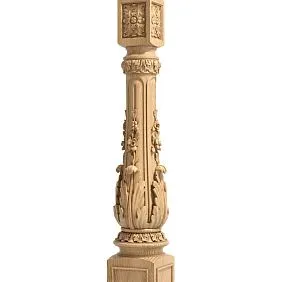
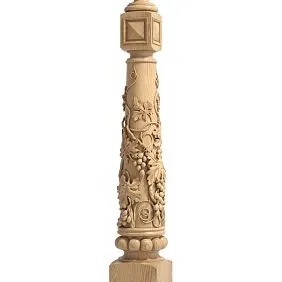

The strength of the railing is determined less by the cross-section of elements and more by the quality of joint execution. Support joints are the connection points between posts and balusters with load-bearing staircase elements and handrails. It is here that maximum stresses concentrate, and it is here that problems most often arise due to improper design or installation.
The lower joint connecting the baluster to the tread withstands shear force and bending moment. There are several proven methods for executing this connection. Dowel connection provides maximum strength — a cylindrical or rectangular dowel of 12–16 mm diameter and 40–50 mm length is formed at the baluster end and inserted into a corresponding socket in the tread. The joint is glued with carpenter’s or polyurethane glue. This joint works on dowel shear and glue joint rupture.
Connection via metal rod is used for heavy, massive balusters. Coaxial holes of 10–12 mm diameter and 50–60 mm depth are drilled in the baluster end and tread. A steel rod (threaded rod, rebar) is installed using epoxy glue or chemical anchor. This connection withstands significant loads on pull-out and bending.
Connection through sub-baluster — a guide rail mounted on treads — simplifies installation and ensures precise geometry. The sub-baluster is fastened to treads with screws or nails, and balusters are secured to the sub-baluster with dowels, screws, or special fastening plates. This method allows pre-assembling the railing section in the workshop and installing it on the staircase as a whole.
The upper joint connecting the baluster to the handrail primarily works on shear. The classical method is a blind or through dowel at the baluster end, inserted into a groove cut in the lower part of the handrail. Dowel cross-section 10–15 mm, groove depth 30–40 mm. The joint is glued and additionally secured with hidden screws driven at an angle through the handrail into the baluster end.
Modern fastening systems use metal elements — plates, angles, sleeves — fastened to the handrail and baluster with screws. Such connections are technologically efficient, ensure precise installation, and allow adjustment, but they are inferior to traditional dowel joints in rigidity and aesthetics. Metal fasteners require decorative cover plates.
Column connections to the staircase load-bearing structure must ensure absolute joint rigidity. The lower end of the column may rest on a tread, stringer, load-bearing floor beam, or floor. Different fastening methods are applied in each case. Through bolt connection with 12–16 mm diameter bolts through the column and load-bearing element ensures maximum strength. The bolt is tightened with force, the nut is pressed in and covered with a decorative cap.
Connection via hidden steel rods is used when through connection is impossible or undesirable for aesthetic reasons. Deep coaxial holes are drilled in the column end and support surface, into which a steel rod of 16–20 mm diameter is installed using epoxy glue. The embedment length in each element must be at least five rod diameters.
Reinforcement of joints with metal elements — bolts, angles, plates — is necessary for structures subjected to increased loads. Public buildings, wide grand staircases, structures with large spans between columns require additional reinforcement. Metal elements can be hidden (within wooden parts) or exposed (as design elements in loft or industrial style).
Load compensation in the railing system
Get Consultation
The staircase railing works not as a set of individual elements, but as a single spatial system.
Together with the handrail and support columns, they form a frame that receives and distributes loads. Understanding the mechanics of this system’s operation is critically important for designing a reliable structure.Handrails and balustersThe normative horizontal load on the handrail is 100 kg, applied at a height of 900–1100 mm above the tread surface. This load corresponds to the force an adult person can apply, leaning on the handrail with full weight or during loss of balance. The railing structure must withstand this load without failure or residual deformation.
Load distribution among railing elements depends on the stiffness of each element and joint construction. The handrail acts as a horizontal beam supported by columns and intermediate balusters. Columns bear the main portion of the load due to larger cross-section and rigid connections. Balusters act as additional supports, reducing the handrail span and decreasing its deflection.
The bending moment in the baluster reaches its maximum at the connection to the tread. It is here that the highest material stresses and maximum joint forces occur. Baluster strength calculation is performed at this section, taking into account the actual element profile. For turned balusters, the critical point is the thinnest part of the profile.
Shear forces at connection joints are often underestimated during design. However, failure of the joint due to shear is one of the most common causes of railing load-bearing capacity loss. The dowel in the socket works on shear, the glue joint on sliding, screws on shear and pull-out. Proper calculation and choice of connection method ensure reliability.
Dynamic loads arise during people’s movement on the staircase, especially during running or rapid descent. These loads cause structural vibrations, which may significantly exceed static loads due to the dynamic coefficient. The railing’s stiffness must be sufficient to limit vibration amplitude and prevent resonance.
Temperature deformations of wood are considered in joint design. Wood expands and contracts with changes in humidity and temperature. Rigid joints limit these deformations, which may lead to cracking of elements or joint failure. A certain degree of freedom in joints allows wood to "breathe" without harming the structure.
Fatigue phenomena in wood and glued joints develop under repeated load application. A staircase in a residential building may be traversed tens of thousands of times in a year. Each passage is a load cycle for the railing. Quality materials and proper joint execution ensure long-term structural durability without loss of strength.
The spatial work of the railing transforms it into a kind of truss, where the handrail acts as the top chord, the sub-baluster or treads as the bottom chord, and the balusters as diagonal braces. Such a structure has high stiffness with relatively low material consumption. Proper design allows using this effect to lighten the structure.
Hinged and rigid connections
The choice of connection type at railing joints determines the overall behavior of the structure. Hinged and rigid connections have fundamentally different mechanics and areas of application.
Rigid connections completely restrict mutual rotation of connected elements. Such joints transmit not only longitudinal and transverse forces, but also bending moments. Rigid connections are created using glued dowel joints, bolted connections with pre-tightening, or welding of metal elements. In staircase railings, rigid joints are used to attach columns to load-bearing structures and to connect the handrail to support columns.
Rigid connections completely restrict mutual rotation of connected elements. Such joints transmit not only longitudinal and transverse forces but also bending moments. Rigid connections are created using glued tenoned joints, bolted connections with pre-tensioning, or welding of metal elements. In stair railings, rigid joints are used to attach posts to the load-bearing structure and to connect the handrail to support posts.
A pinned connection allows relative rotation of elements when transmitting longitudinal and transverse forces, but does not transmit bending moment. In wooden structures, an ideal pin joint does not exist — there is always some resistance to rotation due to friction. However, attaching balusters to a handrail via a thin tenon or with screws without glue is close to a pinned connection.
Advantages of rigid joints — high structural stiffness, minimal deformation under load, possibility of creating non-detachable monolithic connections. Disadvantages — complexity of execution, high requirements for manufacturing accuracy, limitation of wood's thermal deformations, difficulty of disassembly for repair.
Advantages of pinned joints — simplicity of installation, ability to compensate for manufacturing inaccuracies, freedom for thermal deformations, ease of disassembly. Disadvantages — lower structural stiffness, possibility of play appearing with wear, need for periodic tightening of fasteners.
Combined systems use rigid connections in key joints and pinned connections in less loaded areas. Posts are rigidly attached to the load-bearing structure and to the handrail, forming fixed supports. Balusters are pinned to the handrail, allowing them to rotate when the handrail deforms without generating additional stresses.
Wear of joints and appearance of play — a natural process in operational structures. Pinned connections with screws and bolts require periodic tightening. Glued connections may weaken under moisture and temperature fluctuations. Regular inspection and timely maintenance prevent defect development.
Joint calculations are performed considering the actual nature of the connection. Overestimating joint stiffness leads to underestimating loads on elements and possible failure. Underestimating gives excessive safety margin, but increases material consumption and construction cost. Proper joint modeling is essential for optimal design.
Materials and their influence on load-bearing capacity
Selection of wood species forstaircase componentsdetermines the strength, durability, and appearance of the structure. Different species have different physical and mechanical properties, which must be considered during design.
Oak is the benchmark for strength among hardwoods. Bending strength 95-110 MPa, density 650-750 kg/m³, Brinell hardness 3.7-3.9. Oak posts and balusters are practically immune to deformation, resistant to mechanical damage, and have a distinctive grain. Disadvantages — high cost, difficulty of processing, tendency to crack if drying regime is violated.
Ash has strength comparable to oak or even exceeds it. Bending strength 100-120 MPa, density 650-700 kg/m³, hardness 4.0-4.1. Ash is more elastic and tough, making it ideal for elements subjected to dynamic loads. Color is light with a grayish tint, grain is distinctive. Easily processed and finished.
Beech has a uniform fine-grained structure, bending strength 90-100 MPa, density 650-680 kg/m³. Color ranges from light rose to reddish-brown, grain is fine and uniform. Surface after sanding is exceptionally smooth. Disadvantage — high hygroscopicity, beech actively absorbs moisture and tends to warp. Requires stable operating conditions.
Larch is the best among coniferous species. Bending strength 90-95 MPa, density 650-700 kg/m³, natural resistance to biological damage. High resin content protects wood from rot and insects. Color is warm, from light yellow to reddish-brown. Ideal for outdoor staircases and humid interiors.
Spruce is the most accessible species. Bending strength 70-80 MPa, density 450-500 kg/m³. Easy to process, but requires increasing cross-section of elements by 20-30% compared to hardwoods to achieve the same load-bearing capacity. Sprucebuy balusterscan be significantly cheaper than oak, which determines their popularity.
Wood moisture critically affects strength and stability. At moisture above 15%, wood strength decreases, and risk of fungal decay increases. At moisture below 8%, wood becomes brittle and prone to cracking. Optimal moisture for indoor staircases is 8-12%, matching equilibrium moisture in heated rooms.
Wood defects — knots, cracks, grain deviation, rot — reduce element strength. Knots create stress concentrators and may fall out upon drying. Cracks develop under load and lead to failure. Grain deviation reduces strength by 30-50% compared to straight-grained wood. For critical load-bearing elements, first-grade wood with minimal defects is used.
Protective wood treatment extends the service life of structures. Antiseptics protect against biological damage, fire-retardant impregnations reduce flammability, water-repellent compounds prevent swelling. Finish coatings — varnishes, oils, waxes — protect surfaces from abrasion and contamination. Comprehensive treatment ensures long-term durability of railings.
Calculation of load-bearing capacity of railings
Designing a reliable railing requires engineering calculation considering applied loads, material properties, and structural features. Calculation is performed in accordance with construction codes and regulations.
Normative loads on railings are regulated by SNiP "Loads and Effects". For residential building staircases, normative horizontal load on the handrail is 80 kg, applied at handrail height. Calculated load is obtained by multiplying normative load by reliability coefficient 1.3, yielding 100 kg. For public buildings, loads are higher — 120 kg normative, 150 kg calculated.
Baluster calculation scheme — vertical cantilever beam, fixed at the bottom and loaded by horizontal force at the top. Bending moment at the fixed end equals force multiplied by baluster height. Normal stress under bending is calculated as bending moment divided by section resistance moment.
Section resistance moment depends on shape and dimensions. For circular section with diameter d, resistance moment W = πd³/32. For square section with side a: W = a³/6. For rectangular section with width b and height h: W = bh²/6. Increasing dimensions in the direction of load application provides maximum effect.
Condition of strength under bending: normal stress must not exceed calculated resistance of wood. For spruce, calculated bending resistance is about 13 MPa, for oak — 17 MPa. If condition is not met, baluster section must be increased, span between balusters reduced, or stronger wood used.
Deflection calculation checks structural stiffness. Maximum allowable deflection of handrail between supports is usually taken as 1/150 of span length. Greater deflection makes railing appear unreliable and causes discomfort during use, although it may formally satisfy strength condition.
Checking strength of connection joints is critically important. Tenon in mortise is checked for shear and crushing. Tenon shear area must be sufficient to withstand transverse force. Glued joint is checked for shear — wood glue joint strength is 6-10 MPa depending on glue type and bonding quality.
Safety factor coefficient shows how many times actual structural strength exceeds calculated load. Minimum allowable safety factor 1.0 — structure withstands normative load without failure. Recommended safety factor 1.3-1.5 ensures reliability accounting for possible material property deviations and manufacturing quality.
Computer modeling allows precise calculation of stress-strain state of complex structures. Modern finite element analysis programs consider real element geometry, wood anisotropy, material nonlinearity, and element interaction. Modeling results help optimize structure design.
Installation according to constructive logic
Correct installation sequence of railing ensures geometric accuracy and structural reliability. Violation of technology leads to misalignment, gaps, and weakened joints.
The preparatory stage includes checking the staircase geometry and preparing railing elements. Steps must lie in a single plane, without misalignment or deflection. Deviations exceeding 2-3 mm per meter length are not permitted. Railing elements are checked for compliance with drawings, absence of defects, and wood moisture content.
Marking locations for post installation is performed considering constructive logic. Initial and final posts are installed at points of direction change. Intermediate posts are placed at intervals ensuring handrail stiffness. Marking is done using string, laser level, and templates.
Installation of support posts begins with rigid attachment to the load-bearing structure. Through-bolted connections ensure maximum reliability. Post verticality is checked with a level in two planes. Deviation exceeding 1-2 mm per meter height is not permitted. Posts are set to height considering handrail slope.
Handrail installation is performed after all posts are installed. The handrail is marked and cut to length considering connection nodes to posts. Handrail connection to posts is done using tenons, dowels, or metal fasteners. Joint tightness is controlled — gaps exceeding 0.5 mm are not permitted. Joints are glued and additionally secured.
Marking locations for balusters on steps is performed maintaining equal spacing. Templates, stops, and measuring tools are used. Marking accuracy determines the visual perception of the railing — uneven baluster spacing is immediately noticeable. Marking is transferred to steps and to the underside of the handrail.
Drilling holes for fastening is performed strictly perpendicular to the surface or at a specified angle. Hole diameter corresponds to the tenon or fastener size with minimal clearance. Depth is controlled by a drill depth limiter. Coaxiality of holes in the step and handrail is critically important — misalignment causes baluster misalignment.
Baluster installation begins with trimming to height considering staircase slope. Bottom and top ends are beveled to angles ensuring baluster verticality and tight fit to the handrail. Balusters are installed with glue and secured at bottom and top points. Verticality is checked with a level.
Final finishing includes filling fastening locations, sanding joints, applying protective coating. Screw and bolt heads are covered with decorative caps or wooden plugs. Glue spills are removed before drying. After final assembly, the entire structure is coated with a finish.
Visual harmony and constructive appropriateness
The railing's aesthetics do not contradict constructive logic — on the contrary, proper construction serves as the basis for beauty. Visual order, rhythm, and proportions of elements should reflect the nature of the structure's operation.
Proportions of posts and balusters determine the visual perception of the staircase. Massive posts and slender balusters create a sense of both reliability and lightness simultaneously. Posts are perceived as primary supports, balusters as fillers. Too slender posts appear unreliable, too thick balusters look crude and heavy.
Baluster installation rhythm creates visual dynamics. Uniform spacing provides a calm, monotonic rhythm suitable for classic interiors. Grouping balusters in twos or threes per step creates a more complex rhythm with accents. Alternating balusters of different profiles adds variety.
Element profiles must correspond to their constructive role. Posts with massive bases tapering upward visually express bending behavior — maximum cross-section at the point of maximum moment. Balusters with thickening in the middle resemble classical column forms.
Decorative elements — carving, turning, inlays — are placed in areas not critical for strength. Carved decoration at the top of posts emphasizes the end of a load-bearing element. Turned bands on balusters divide them into thirds, creating visual scale. Applied carved elements enrich form without weakening cross-section.
Color solution affects perception of structural mass. Dark shades make elements visually heavier and bulkier. Light tones lighten the structure. Contrasting combinations of posts and balusters emphasize element hierarchy. Monochromatic solution creates a sense of unity.
Railing style must match room architecture. Classic interiors require traditional turned forms with symmetrical profiles. Modern minimalism implies simple geometric forms with clear lines. Country and rustic styles allow deliberate roughness and asymmetry.
Element scale relates to staircase and room dimensions. Grand wide staircases in high halls require massive posts and large balusters. Compact staircases in small rooms look better with elegant slender elements. Scale mismatch destroys harmony.
Detailing and execution quality determine overall impression. Carelessly executed joints with gaps, uneven sanding, glue and varnish spills immediately catch the eye and undermine even correct construction. Careful execution of each operation is a sign of professionalism.
Longevity of the railing system
Service life of wooden railing depends on material quality, correct construction, protective treatment, and operating conditions. With proper approachstaircase componentsserve for decades without loss of strength or appearance.
Wood species selection determines basic longevity. Oak, beech, and larch have natural resistance to biological damage and mechanical wear. Service life of oak railing under normal conditions exceeds 50 years. Pine is less durable, but with proper protective treatment serves 25-30 years.
Protective treatment is critically important for longevity. Antiseptic treatment prevents fungal damage and insect damage. Deep impregnation with oils or stains protects against moisture and UV. Finish coating with varnish or oil creates a protective barrier on the surface. Comprehensive treatment extends service life 2-3 times.
Operating conditions determine wear rate. Stable temperature and humidity, absence of direct sunlight, moderate usage intensity — ideal conditions. Temperature and humidity fluctuations cause deformation and cracking. High humidity promotes fungal damage. Intensive usage accelerates mechanical wear.
Constructive moisture protection includes proper node design without stagnant zones and capillaries, condensate drainage, and ventilation. End sections — most vulnerable to moisture ingress — require careful sealing. Horizontal surfaces are made with slope for water runoff.
Regular maintenance extends service life. Cleaning from dust and dirt prevents coating wear. Monitoring protective coating condition and timely renewal protects wood. Checking fastener strength and tightening loose joints prevents defect development. Annual inspection and minor repairs as needed — sensible strategy.
Wear of contact zones — top surface of handrail, bottom ends of balusters — is a natural process. Handrail wears from constant hand contact. Balusters wear at fastening points when loosened. Local restoration of worn areas is simpler and cheaper than replacing entire structure.
Modernization and repair are possible due to modular construction. Damaged balusters are replaced without dismantling entire railing. Worn handrail is replaced while retaining posts and balusters. Strengthening weakened joints with additional fasteners restores strength. Reasonable repair extends structure life for decades.
Modern technologies in traditional construction
Innovations in materials and technologies open new possibilities for wooden railings. While preserving traditional aesthetics, modern solutions can be used to enhance strength and longevity.
Laminated wood has more stable properties compared to solid timber. Gluing lamellas with cross-oriented fibers compensates for wood anisotropy. Laminated posts do not warp or crack when humidity changes. The strength of laminated elements is 20-30% higher than solid ones due to the absence of large defects.
Modified wood — thermowood, acetylated wood — has increased resistance to biological damage and dimensional stability. Thermal treatment at 180-220°C alters the wood structure, reducing hygroscopicity and increasing biostability. The service life of thermowood is 2-3 times longer than regular wood.
Wood-based composite materials — wood-polymer composites (WPC) — combine the aesthetics of wood with the durability of polymers. WPC does not rot, crack, or require protective coatings. Application is limited to enclosure fill elements — self-supporting WPC structures have insufficient strength.
Innovative fastening systems simplify installation and increase reliability. Hidden adjustable fasteners allow precise baluster installation with compensation for inaccuracies. Quick-release joints ensure ease of disassembly for repair. Reinforced metal inserts in joints increase strength without altering the external appearance.
Protective coatings of the new generation provide long-term protection. Two-component polyurethane varnishes create an exceptionally strong and wear-resistant film. UV-curable coatings polymerize instantly, ensuring high productivity. Nanocoatings with self-cleaning effects repel dirt and water.
Computer-aided design and CNC machining increase manufacturing accuracy. A 3D enclosure model allows identifying errors before production begins. Parametric modeling automates structural adaptation to specific dimensions. CNC machines produce elements with precision down to tenths of a millimeter, ensuring perfect fit.
Monitoring structural condition using sensors is a promising direction for critical structures. Sensors for deformation, humidity, and temperature transmit data to building management systems. Early detection of deviations allows preventing defect development. Such systems are redundant for private homes but justified for public buildings.
Typical Errors and Their Consequences
Errors in enclosure design and installation lead to loss of strength, defects, and reduced service life. Knowledge of typical problems helps avoid them.
Insufficient baluster cross-section — a common error caused by the desire to make the structure visually light. Thin balusters cannot withstand normative loads, bend, and loosen. Section calculation is mandatory, especially when using soft wood or large baluster spacing.
Weak column attachment to the load-bearing structure leads to overall enclosure loosening. Attachment using thin self-tapping screws without glue is insufficiently reliable. Columns must be secured with through bolts or deep metal rods with adhesive fixation.
Poor baluster joint quality — thin tenons, shallow mortises, lack of glue — leads to rapid wear. A tenon with diameter less than 10 mm or depth less than 30 mm operates at strength limits. Joint without glue quickly loosens.
Using raw wood — the most severe error. Balusters made from unseasoned material warp, twist, and crack after installation. Wood moisture must not exceed 12%, preferably 8-10%. Moisture control with a moisture meter is mandatory.
Lack of protective treatment drastically reduces service life. Unprotected wood darkens from UV, absorbs moisture, and is attacked by fungi. Minimum protection — antiseptic treatment and finish coating. Enhanced protection is required for outdoor staircases.
Incorrect installation geometry — uneven baluster spacing, deviation from vertical, gaps at joints — is visually obvious and creates an impression of poor workmanship. Careful marking, control at each stage, and use of templates and measuring tools ensure precision.
Ignoring thermal deformations leads to element cracking and joint failure. Rigid fixation of long elements prevents wood from expanding and contracting. A certain degree of freedom in joints is necessary, especially for long handrails.
Safety requirements: The height of the railing must be at least 900 millimeters for indoor staircases and 1100 millimeters for outdoor ones. This ensures the safety of adults and prevents accidental falls.
Design and installation of stair railings are regulated by building codes. Compliance is mandatory to ensure safety.
The height of internal stair railings must be at least 900 mm from the tread surface to the top of the handrail. For external staircases and balconies above the first floor — at least 1100 mm. Lower height creates a fall risk.
The clear distance between balusters should not exceed 100 mm in buildings where children may be present. This prevents a child’s head from slipping through. In buildings without children, a distance up to 150 mm is permitted.
The railing strength is tested under horizontal load: 100 kg for residential buildings, 120 kg for public buildings. The load is applied to the handrail at 900-1100 mm height. The structure must not fail or sustain residual deformations.
The handrail must be continuous along the entire stair run. Breaks in the handrail create hazards. Joints must be maximally strong and smooth. At turns, the handrail smoothly curves or connects using corner elements.
The handrail cross-section shape ensures comfortable grip. Optimal round handrail diameter is 40-50 mm. Rectangular handrail has width 60-80 mm, height 40-50 mm, and rounded corners with radius not less than 10 mm. Too thin or too thick handrails are uncomfortable.
Absence of sharp edges and protruding elements prevents injuries. All angles are rounded, fasteners are recessed and covered with caps. Surface is carefully sanded without splinters or scratches.
Fire resistance of wooden structures increases with fire-retardant treatment. Evacuation routes require higher fire resistance. Fire-retardant impregnations and paints are used, slowing ignition and flame spread.
Frequently asked questions
What is the optimal distance between posts on a staircase?
For straight runs, posts should be installed at the beginning and end; for lengths over 3 meters — an additional intermediate post. Posts are mandatory at turns. Excessive spacing between posts reduces structural rigidity.
Can pine be used for critical load-bearing elements?
Yes, but with a 20-30% larger cross-section compared to oak to achieve the same strength. First-grade pine without large knots is suitable for posts and balusters with proper calculation.
How often should protective coating on railings be renewed?
Varnish coating lasts 5-7 years under normal conditions. Oil-based coatings require renewal every 2-3 years. Heavily used areas — top of handrails — may require more frequent local restoration.
Is vapor barrier needed for wooden balusters inside the house?
No, inside heated rooms with normal humidity, vapor barrier is not required. Wood must 'breathe'. Stability of the microclimate without sharp humidity fluctuations is important.
Can glass be installed instead of balusters?
Yes, glass 10-12 mm thick (tempered or triplex) can be used as fill between posts. Special profiled fasteners are required. Glass withstands horizontal loads but is not a load-bearing structural element.
How to eliminate squeaking in the stair railing?
Squeaking occurs due to friction between elements in weakened joints. It is necessary to identify the source of squeaking, tighten fasteners, and if necessary, reinforce joints with additional screws or gluing. Prevention involves regular tightening of threaded connections.
Which wood species is better for outdoor staircases?
Larch is the optimal choice due to its natural resistance to moisture and biological damage. Oak is also suitable but more expensive. Enhanced protective treatment with oils or stains suitable for outdoor use is mandatory.
Is it necessary to paint or can the natural wood color be left?
Transparent coating with varnish or oil preserves the natural beauty of the texture and is preferable for valuable species. Painting is used to conceal defects, achieve a specific color solution, or provide additional protection.
How to calculate the required number of balusters for a staircase?
The length of the stair run is divided by the selected installation step (usually 120-150 mm). Two to three spare balusters are added to the resulting number. For a 3-meter-long staircase with a 150 mm step, approximately 20 balusters plus spare are required.
Can a cracked baluster be repaired or must it be replaced?
Surface cracks can be filled with epoxy glue, followed by sanding and repainting. Through cracks in the load-bearing section require replacement of the baluster — repair does not ensure sufficient strength.
Conclusion
Creating a reliable and beautiful railing for a wooden staircase is a complex task requiring understanding of structural logic, knowledge of material properties, and mastery of installation techniques. Posts and balusters are not merely decorative elements but full structural components operating within a complex system of loads.
Correct design begins with load calculations and selection of element cross-sections ensuring sufficient strength and stiffness. Support joints must be designed considering the nature of transmitted forces — rigid joints for posts, allowing a certain degree of freedom for balusters. Compensation for thermal deformations prevents cracking and failure of connections.
Selection of high-quality wood with proper moisture content, careful treatment of elements, protective impregnation, and finishing coating ensure the longevity of the structure. Precision installation with control at each stage guarantees reliability and aesthetic result.
Visual harmony of the railing is achieved through correct proportions of elements, rhythm of installation, and alignment with interior style. The beauty of the structure should be a consequence of its constructive rationality, not contradict it.
Company STAVROS offers a wide range ofbalusters and posts for staircasesmade from valuable wood species. The catalog features classic turnedbalusters, modern flat elements, massive support posts of various shapes and sizes. AllWooden staircase components for salecan be delivered throughout Russia.
STAVROS professional consultants will help select the optimal solution for your project, taking into account structural requirements and aesthetic preferences. Product quality is confirmed by years of experience and thousands of completed projects. Choosing STAVROS means choosing reliability, beauty, and longevity.