Article Contents:
- Digital Design: From Idea to Model in Hours
- Parametric Modeling: Flexibility Without Loss of Precision
- 3D Visualization: See the Result Before Production
- Connection to Production: From Model to Control Program
- CNC Technologies: Precision and Complexity Without Limits
- Five-Axis Milling: Three-Dimensional Carving from Solid Wood
- Repeatability and Scalability
- Integration with Decor: Carving as Part of the Structure
- Ergonomics: Comfort as the Basis of Form
- Height, Depth, Angle: The Mathematics of Comfort
- Transformability: One Piece of Furniture, Multiple Functions
- User Adaptation: Customization of Parameters
- Minimalism of Forms: Fewer Details, More Meaning
- Geometry Instead of Ornament
- Material as Decor
- Hidden Complexity
- The Role of Decor in Modern Furniture: Precision Instead of Excess
- Carved Overlays: Accent on the Facade
- Textured Surfaces: Relief Without Ornament
- Legs and Handles as Decorative Elements
- Materials: From Traditional to Innovative
- Solid Wood: Naturalness and Technological Capability
- Metal: Structures and Accents
- Glass and Stone: Premium Quality and Functionality
- Digital Libraries and Their Role in Design
- Hardware Libraries: From Hinges to Mechanisms
- Decor Libraries: Overlays, Moldings, Rosettes
- Parametric Collections: Variability from a Single Base
- Production Automation: From Model to Product
- Material Cutting: Waste-Free Optimization
- Milling: Micron-Level Precision
- Quality Control: Measuring Every Part
- Sustainability: Conscious Manufacturing
- Certified wood
- Water-Based Coatings
- Zero-waste production
- 2026 Trends: Where Design is Heading
- Hybridity of Styles
- Smart Furniture
- Modularity and Mobility
- Natural Textures and Colors
- Frequently Asked Questions
- How Does 3D Modeling Reduce Furniture Production Costs?
- Can You Order Custom Furniture Without a High Price?
- Which Materials Are Most Durable for Modern Furniture?
- Why is Decoration Needed in Minimalist Furniture?
- How to Choose Between Mass-Produced and Custom Furniture?
- Which Technologies Will Define Furniture Design in the Coming Years?
- Conclusion

What is happening with furniture in 2026? It is ceasing to be merely a functional object and becoming a synthetic phenomenon where technology merges with aesthetics, where ergonomics blends with minimalism, where CNC machines create what only a master's hand could previously conceive.Modern Furniture Design— is the language spoken by spaces, it is the philosophy of habitation, it is the ability to combine opposites and achieve not a compromise, but a new quality.
Furniture is no longer divided into 'beautiful' and 'comfortable.' It simultaneously serves and pleases the eye, meeting the demands of both body and soul.Modern Furnitureis born at the intersection of calculation and intuition, software code and artistic vision. Digital models create virtual prototypes, CNC milling machines carve the most complex geometry from solid oak, and designers decide howinterior decorationwill fit into a minimalist form without destroying its purity, but rather enhancing its expressiveness.
Why is this important right now? BecauseFurniture Market 2025has shown: the era of mass production of identical cabinets and tables is coming to an end. The customer wants individuality but is not willing to wait for months. They demand sustainability but are not prepared to pay three times more. They value craftsmanship but welcome technological advancement. And furniture design responds to these demands by usingmodels for BasisFurniture Maker, 3D modeling, parametric design, automated cutting — tools that turn desire into reality in days, not months.
Let's examine how this works. How technology has changed not only production but the very essence of furniture design. How ergonomics has become not a limitation but a source of inspiration. How minimalism of form does not eliminate decoration but makes it precise, meaningful, surgically accurate. And how all this comes together into a picture where furniture is not a set of objects, but a living environment created for the 21st-century human.


Digital Design: From Idea to Model in Hours
Previously, furniture design began with a sketch on paper, followed by a technical drawing, a mockup, a prototype, revisions, and another mockup. The process could stretch for months. Today, a designer opens a 3D modeling program — and creates a virtual model of a chair, table, or cabinet in a few hours. Changing the leg height, increasing the seat depth, adding a decorative bevel — a matter of minutes, not days.




Parametric Modeling: Flexibility Without Loss of Precision
Modern design systems use a parametric approach. Instead of rigid geometry, linked parameters are created: if you change the width of a tabletop, the dimensions of the underframe, the distance between legs, and the thickness of stiffening ribs are automatically recalculated. This provides incredible flexibility: one base model can generate dozens of variants for different room sizes and different customer requirements.
models for BasisFurniture design software is component libraries where every element is already parameterized. The designer doesn't draw from scratch but assembles from ready-made blocks, adjusting them for the project. A hinge, a slide, a panel, a leg—all are digital objects with precise dimensions, information about material, and fastening methods. Design transforms from a creative process into engineering, where artistic vision meets engineering precision.
Our factory also produces:


3D Visualization: See the Result Before Production
A virtual model allows you not just to imagine the furniture, but to see it in photorealistic quality, place it in an interior, change the lighting, wood texture, or upholstery color. The client sees the result before the first board is cut. This reduces risks, saves time, and eliminates disappointment: what looked good in the imagination might turn out poorly in reality. Visualization prevents this.
Modern FurnitureIt is designed considering the environment. A cabinet model is placed in a virtual room to check how it relates to windows, doors, and ceiling height. This is the design of not an isolated object, but an element of a system where furniture is part of the architecture of the space.
Get Consultation
Connection to Production: From Model to Control Program
A digital model is not just a picture. Production data is automatically generated from it: material specifications, cutting layouts, control programs for CNC machines. The model's geometry is directly transferred to a milling machine, which cuts the part with an accuracy of tenths of a millimeter.
This eliminates the human factor: errors in transferring dimensions from a drawing to a machine, inaccuracies in manual marking. The machine does exactly what is defined in the model. If the model is correct, the product will be correct. This is a quality guarantee that only bespoke workshops with years of experience could previously provide.
CNC Technologies: Precision and Complexity Without Limits
Computer Numerical Control machines have changed not only production speed but the very nature of what is possible. What a carver would take weeks to carve, a CNC milling machine does in hours. But it's not about speed—it's about the complexity of forms that become accessible.
Five-Axis Milling: Three-Dimensional Carving from Solid Wood
Modern CNC machines work not in a plane, but in volume. Five-axis machining allows creating the most complex three-dimensional geometry: curved furniture legs, relief panels, carved fronts, where every millimeter of the surface has its own form, its own curvature.
Solid Wood ItemsElements of oak, beech, ash, which previously required the manual work of a master carver, are now created on machines. But this is not a simplification of the craft, but its evolution. The program for the machine is written by a person who understands wood, who sees the form, who knows where to remove excess, where to leave the solid. CNC is a tool, but it is controlled by a master, only now his chisel is a cutter rotating at thousands of revolutions per minute, his hand is a program, precise to the micron.
Repeatability and Scalability
A manual carver cannot make two absolutely identical parts. There will always be micro-differences, which in a single piece are charm, but in a series are defects. CNC creates identical parts: the first and the hundredth will differ by fractions of a millimeter. This is critical formodern furniture design, where modularity, interchangeability, and serial production without loss of quality are key.
At the same time, CNC does not exclude uniqueness. Every program can be unique, every part can be one-of-a-kind. Mass production and bespoke items cease to be opposites. You can release a series where each element is slightly different from the previous one—program variability, create controlled diversity.
Integration with Decoration: Carving as Part of the Structure
interior decorationDecoration in the form of overlays, carved elements, relief panels used to be a separate stage: first make the base, then attach the decor. CNC allows carving the decor directly from the solid wood, making it part of the structure. A cabinet door with a carved relief is not an overlay on a smooth plane, but a monolithic part where the relief is carved from a single piece of wood.
This provides strength, durability, and visual integrity. There are no joints that can come apart, no glue seams that fear humidity. Decoration becomes a structural element, not an adornment on top of the construction.
Ergonomics: Comfort as the Basis of Form
Furniture exists for people, and its form must correspond to the human body, its movements, its needs.Modern FurnitureIt is designed considering anthropometry, biomechanics, and the psychology of space perception.
Height, Depth, Angle: The Mathematics of Comfort
Seat height, seat depth, backrest angle—these are not arbitrary values, but the result of research. The optimal chair height for a dining table is 45-47 cm from floor to seat. For an office chair—40-55 cm with adjustment. Seat depth—40-45 cm, so the thigh rests on two-thirds of the length, and the seat edge doesn't press behind the knee.
These parameters are embedded in digital models. The designer doesn't guess, doesn't rely on intuition—they use verified data. But ergonomics doesn't dictate aesthetics. A chair can be minimalist or decorative, Scandinavian or classic—the main thing is that it is comfortable. Form follows function, but within this 'following' remains a vast space for creativity.
Transformability: One Piece of Furniture, Several Functions
Apartment space isn't increasing, but the number of functions we want to accommodate is growing.Modern Furniture DesignIt responds with transformability: a sofa turns into a bed, a table unfolds, doubling its area, a cabinet hides a workspace that slides out when needed.
Transformation mechanisms are designed in 3D, checked for collisions, for the movement trajectories of parts. The virtual model allows you to 'unfold' the table, see how the parts move, ensure nothing jams or breaks. This is engineering precision applied to household furniture.
User Adaptation: Customization of Parameters
Same height, same weight, same habits—these don't exist. Parametric modeling allows furniture to be adapted to a specific person: increase the tabletop height for a tall customer, adjust shelf depth to fit books, make cabinet handles higher or lower depending on family members' height.
Previously, this was a privilege of custom-made, one-off furniture. Now it's an opportunity provided bymodels for BasisFurniture Maker: parameters are set in the program, the model is recalculated, production receives updated data—and the furniture fits the customer perfectly.
Minimalism of Form: Fewer Details, More Meaning
Minimalism is not poverty, not a rejection of beauty. It is the distillation of form, retaining only the essential, purging the incidental.Modern Furnitureis often minimalist: clean lines, geometric volumes, absence of excessive decor.
Geometry Instead of Ornament
A rectangular cabinet without handles, with facades that open with a push. A table on thin metal legs with a wooden tabletop without beveling, without carving. A bed—a cube with a soft headboard, no backrest, no legs, standing on a podium. This is minimalism where beauty lies in proportions, material quality, and precision of execution.
Geometric forms demand flawlessness. A curved line can hide a slight inaccuracy, a straight line—never. Millimeter deviations are visible. Therefore, minimalism is high production technology, CNC machine precision, quality control at every stage.
Material as decoration
When there is no carving, no overlays, no moldings—the material comes to the forefront. Wood texture, annual ring patterns, color, surface tactility become the main expressive means.Solid Wood Itemsoak is valued precisely for this: each board is unique, each pattern is one-of-a-kind.
Minimalist furniture emphasizes the material, doesn't hide it under layers of paint or varnish. Oil, wax, matte finishes that preserve the wood's tactility provide a sense of naturalness. This is a return to naturalness, but at a new technological level: wood is processed so that it is protected, durable, yet remains wood, not a plastic imitation.
Hidden Complexity
Minimalism on the outside does not mean simplicity on the inside. A cabinet without visible handles conceals a push-to-open system requiring precise engineering. A table with thin legs supports a large load thanks to a well-thought-out construction where forces are optimally distributed. A bed that looks like a monolith contains a storage system, drawers, a lifting mechanism.
Modern Furniture Designconceals technological sophistication, makes the complex appear simple. This is the highest skill: creating a sense of lightness, naturalness, when behind it lie hours of design, precise calculations, advanced technologies.
The Role of Decoration in Modern Furniture: Precision Instead of Excess
Minimalism does not abolish decoration. It makes it precise, meaningful, functionally or visually necessary.interior decorationin minimalist furniture is not embellishment, but an accent that enhances form, emphasizes a joint, creates a visual center.
Carved Overlays: Accent on the Facade
A smooth cabinet facade can have one carved overlay in the center. Not across the entire surface, not on all doors—just one that draws the eye, creates a focal point. This is using decoration as a compositional tool. The overlay can be geometric—a rosette with concentric circles—or botanical—a stylized leaf, flower.
Carving is performed on CNC machines, providing clarity of lines, repeatability of elements, precision that matches minimalist aesthetics. This is not blurry, approximate carving, but precise, graphic, where every facet is in its place.
Textured Surfaces: Relief Without Ornament
Instead of carved ornament—a textured surface: a cabinet door with regular relief—parallel grooves, a grid of indentations, wavy texture. This creates interplay of light and shadow, makes the surface lively, not flat, but without narrative carving, without figurativeness.
CNC milling allows creating such textures with perfect regularity. Grooves of identical depth and width, positioned with precise spacing. This is order, systematicity, characteristic ofmodern furniture.
Legs and Handles as Decorative Elements
In minimalist furniture, structural elements can play a decorative role. Table, chair, sofa legs—not just supports, but expressive forms. Thin metal spindles, massive wooden blocks, curved turned legs—each option creates its own character.
Furniture handles—small details, but visually significant. A solid wood handle repeating the facade texture creates unity. A contrasting metal handle—an accent that breaks monotony. A hidden handle—a recess in the facade—emphasizes minimalism.
Materials: From Traditional to Innovative
Solid Wood ItemsWood is the foundation of furniture production, but modern design is not limited to wood. Metal, glass, stone, composites, textiles — all of these are part of the material palette that a designer combines to create complex, multi-layered objects.
Solid wood: naturalness and technological sophistication
Oak, beech, ash — species valued for their strength, beauty of texture, and durability. Modern processing technologies — kiln drying, thermal modification, water-based protective coatings — preserve the naturalness of wood while making it stable, unafraid of humidity, and temperature fluctuations.
CNC processing of solid wood allows for the creation of forms that were previously impossible: curved panels, complex dovetail joints, three-dimensional carving. Wood ceases to be a limitation; it becomes a material whose possibilities are expanded by technology.
Metal: structures and accents
Metal frames for tables, chairs, shelving — this is industrial aesthetics, strength, visual lightness. Thin metal legs support a massive tabletop, creating a contrast between light and heavy. Metal drawer slides, hinges, hardware — these are functional elements that can be hidden or, conversely, showcased as part of the design.
Metal is combined with wood, with glass, with stone. A table with a wooden top on a metal base, a chair with a metal frame and a wooden seat, a shelving unit with metal posts and wooden shelves — classic examples of material contrast.
Glass and stone: premium quality and functionality
Glass tabletops, cabinet doors, shelves — this is transparency, visual lightness, light. Glass expands space, makes furniture less massive. Stone countertops — natural marble, granite, quartz agglomerate — this is durability, prestige, resistance to damage.
These materials require precise processing, quality fasteners, and thoughtful construction. Glass is heavy and fragile at the same time, stone is massive.Modern Furniture DesignThe designer takes these properties into account, designing structures so that the materials work to their strengths, and their weaknesses are compensated for.
Digital libraries and their role in design
models for BasisA furniture component is not just a set of geometric objects. These are intelligent components that contain information about the material, fastening methods, cost, and hardware manufacturer. The designer selects a hinge from the library — and receives not only its three-dimensional model but also data on the load it can withstand, the installation method, and compatibility with different door types.
Hardware libraries: from hinges to mechanisms
Hinges, slides, lifting mechanisms, opening systems — all of these are complex products that must be precisely installed. Digital models of hardware allow it to be 'tried on' the furniture being designed even before production. To check that the hinge fits within the door thickness, that the slide won't collide with the side wall, that the bed lift mechanism won't hit the headboard.
This eliminates errors that were previously discovered during the assembly stage when it was too late to change anything. Virtual design is a rehearsal of real assembly, where all problems are solved on screen, not in the workshop.
Decorative libraries: overlays, moldings, rosettes
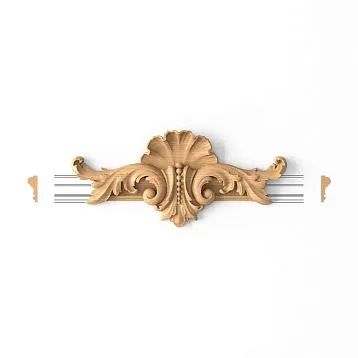
interior decorationDecoration in the form of carved overlays, moldings, rosettes is also represented in digital libraries. The designer selects an overlay, scales it to the size of the facade, and places it in the desired location. The program checks that the overlay does not exceed the facade boundaries and that its thickness matches the construction.
Libraries are constantly updated: new hardware models, new decorative elements, new materials. This is a living system that grows with the market, reflects trends, and provides designers with relevant tools.
Parametric collections: variability from a single base
One base overlay model can generate dozens of variations: changing size, pattern scale, relief depth. A parametric library is not a warehouse of ready-made models but a generator of options. The designer sets parameters — the program creates a unique model that remains part of the style collection, preserving characteristic features and proportions.
This is a balance between standardization and individualization. The components are standard, but their combinations and variations are unique.
Production automation: from model to product
The digital model is transferred to production not as drawings that a machine operator must interpret, but as control programs that the machine executes automatically. These are CAM systems — Computer-Aided Manufacturing — which translate the geometry of the model into tool movement trajectories.
Material cutting: optimization without waste
Cutting maps are automatically generated from the digital furniture model: which parts to cut from which sheets or boards, how to arrange them to minimize waste. The program considers the direction of the wood grain, the presence of defects in the material, and optimizes placement to use the material as efficiently as possible.
Previously, a master did this manually, marking the sheet, estimating how to place the parts. A mistake — and the sheet is ruined, material lost. The program does not make mistakes; it evaluates thousands of options in seconds and finds the optimal one.
Milling: precision to the micron
The CNC milling machine receives the program — and begins work. The cutter moves along a given trajectory, removing material, creating the shape. Precision — tenths of a millimeter. Repeatability — absolute: the hundredth part is identical to the first.
This makes it possible to create complex joints that assemble without glue or fasteners, solely due to the precision of the fit. This makes it possible to create carving where every facet, every curl is precise, symmetrical, if the design requires it.
Quality control: measuring every part
After processing, parts undergo inspection: automated measuring systems check dimensions, geometry, and compliance with the model. Deviation beyond tolerance — the part is rejected and remade. This is a quality guarantee that does not depend on the inspector's attentiveness, experience, or fatigue at the end of a shift.
Modern Furnitureis produced with control at every stage, with data recording, and traceability: you can find out when, on which machine, and from which material each part was made.
Eco-friendliness: conscious production
Furniture Market 2025year showed an increase in demand for eco-friendly furniture. Buyers want to know where the wood comes from, how it is harvested, what finishes are used, and how the furniture is disposed of after its service life ends.
Certified Wood
Forestry with FSC or PEFC certification guarantees that the timber is harvested legally, that the forest is restored, and that the ecosystem is not destroyed.Solid Wood Itemsfrom certified wood — this is the choice of responsible manufacturers and buyers.
Water-based finishes
Varnishes and paints based on organic solvents emit volatile substances harmful to health and the environment. Water-based finishes — this is safety, absence of odor, fast drying. They provide the same surface quality as traditional ones, but without toxicity.
Waste-free production
Optimization of cutting layouts, using offcuts for small parts, recycling sawdust into fuel briquettes or boards — this is a comprehensive approach where every piece of wood is utilized.Modern Furniture Designis designed to minimize waste already at the modeling stage: part dimensions are multiples of material sizes, shapes are optimized for cutting.
Trends of 2026: where design is heading
What is relevant now, at the beginning of 2026? Which ideas defineModern Furniture Design?
Hybridity of styles
Pure classic or pure minimalism are giving way to hybrids. Minimalist form with classical proportions. Laconic facade with a carved overlay. Metal frame with wooden elements executed in art deco style. This is a blend where styles do not conflict but complement each other.
Smart furniture
Built-in charging devices, lighting, motion sensors, control systems via an app. A bed that raises the headboard on command, a wardrobe that turns on light when opened, a table with a heated tabletop — these are technologies integrated in such a way that they do not ruin aesthetics but enhance functionality.
Modularity and mobility
Furniture that can be reconfigured, rearranged, adapted to changed needs. Modular storage systems where elements are added or removed. Tables on wheels that are easily moved. Sofas whose configuration can be changed by connecting modules differently.
Natural textures and colors
Return to naturalness: wood is not painted white or black but remains in its natural color, with visible texture. Stone is not polished to a mirror shine but left matte, with visible structure. Textiles — linen, cotton, wool — natural, undyed or in natural shades: beige, gray, brown, green.
Frequently asked questions
How does 3D modeling reduce furniture production costs?
3D models eliminate the stage of creating physical mockups, reduce design time, and allow virtual testing of the structure before production. This reduces the number of errors, reworks, and defects. Automatic generation of control programs for machines speeds up production preparation. As a result, the time from idea to finished product is reduced manyfold, which lowers the cost.
Is it possible to order custom-designed furniture without a high price?
Yes, parametric modeling allows adapting a base model to individual requirements without creating a project from scratch. Changing dimensions, selecting materials, configuring modules — this is parameter adjustment that does not require significant time investment. Production on CNC machines is equally efficient for series and for single items, if the program is written.
Which materials are the most durable for modern furniture?
Solid oak, beech, ash — traditionally durable species, especially with modern processing: kiln drying, thermal modification. Metal frames of steel, aluminum are strong and stable. High-quality MDF boards with coating, composite stone for countertops — modern materials with good durability when properly used.
Why is decoration needed in minimalist furniture?
Decoration in minimalism — this is a pinpoint accent that creates a visual center, emphasizes an important zone, breaks monotony. One carved overlay on a smooth facade attracts the eye, makes the furniture memorable. Textured surface creates light play, adds tactility. This is using decoration as a compositional tool, not as ornamentation.
How to choose between mass-produced and custom furniture?
Mass-produced furniture is cheaper, available immediately, but limited to standard sizes and configurations. Custom furniture is adapted to a specific space, to individual requirements, but more expensive and requires production time. Modern technologies narrow the gap: parametric models allow obtaining 'semi-custom' furniture — a standard model adapted to your dimensions — at a price not much higher than mass-produced.
What technologies will define furniture design in the coming years?
Artificial intelligence for automatic generation of design options based on specified parameters. Augmented reality for virtual fitting of furniture in interiors. 3D printing not only of plastic prototypes but also functional parts from composite materials. Internet of Things for creating smart furniture that interacts with other devices in the home. Robotic assembly that reduces the cost of complex structures.
Conclusion
Modern Furniture DesignIn 2026, it is a synthesis of ideas from different eras and directions, the application of technologies that seemed like science fiction just ten years ago, attention to the person, their needs, and their responsibility towards nature. Furniture has ceased to be a set of items arranged in a room. It has become an environment that is shaped for a specific user, that adapts, that interacts.
Ergonomics has ceased to be a limitation—it has become a source of form. Minimalism has not abolished decor—it has made it precise. Technology has not destroyed craftsmanship—it has given the artisan tools with which they can create what was previously impossible.models for BasisFurniture makers, CNC machines, digital component libraries—this is not a replacement of creativity with automation, but an expansion of the designer's capabilities, who can now realize the most complex ideas quickly, precisely, and with guaranteed quality.
Modern Furniturecombines natural materials and high technology.Solid Wood ItemsWood is processed on CNC machines, creating forms that previously required weeks of manual work.interior decorationfrom carved overlays, moldings, rosettes is designed in 3D, parameterized, adapted to a specific project, while maintaining stylistic integrity.
The market is changing.Furniture Market 2025The year has shown: buyers want individuality, eco-friendliness, technological sophistication, quality—and all of this simultaneously, without compromise. Manufacturers who have mastered digital design, automated production, and parametric customization have gained a competitive advantage. They can offer what was previously available only in custom workshops: unique furniture that perfectly fits the space and the person, at a reasonable price and in short timeframes.
Company STAVROS operates at the forefront of these changes, combining years of experience working with natural wood and advanced digital manufacturing technologies. We createSolid Wood Itemsthat combine traditional quality and modern precision. Our production facilities are equipped with the latest generation CNC machines, which allow us to create the most complex forms with micron precision. We develop digital component libraries used by designers across the country, creating projectsmodern furnitureandinterior decor.
By choosing STAVROS products, you get not just furniture or decorative elements. You get the result of a synthesis of craftsmanship and technology, traditions and innovations, artistic vision and engineering precision. We understand that furniture is not a temporary purchase, but a long-term investment in comfort, in the aesthetics of life, in a space that shapes the mood and character of the home. Therefore, each of our products is created with attention to detail, with quality control at every stage, with a guarantee of durability and functionality.
In an era whenModern Furniture Designis rapidly developing, when technologies open up new possibilities every year, it is important to work with a partner who not only follows trends but shapes them, who not only produces furniture but creates solutions for life. STAVROS is your reliable partner in creating a space where form and function exist in harmony, where technology serves beauty, where every detail has meaning and purpose.