Article Contents:
- Modern engineering solutions STAVROS
- Evolution of baseboard functionality
- Construction of a modern multifunctional baseboard
- Integration of smart systems
- How to integrate lighting into the profile
- Types of LED strips for baseboards
- Color temperature and perception of space
- Technical requirements for power supply
- Types of baseboards with niche and hidden mounting
- Baseboard with front LED niche
- Baseboard with top LED niche (floating wall effect)
- Aluminum baseboard with integrated system
- Advantages for visual lightness and comfort
- Space expansion effect
- Night navigation without main lighting
- Decorative effect and accent lighting
- Technical details of installation
- Foundation Preparation and Layout
- Installation of baseboard and mounting elements
- Installation of LED strips and electrical connection
- Examples of interiors with lighting
- Modern studio apartment
- Child's room with colored lighting
- Home theater with accent lighting
- Conclusion

Modern interiors require not only aesthetic expressiveness, but also technological richness.— is a horizontal element that frames the room at the bottom of the walls where the wall meets the floor. Skirting boards perform several functions: they hide the technological gap between the wall and floor covering (necessary for thermal expansion), protect the lower part of the wall from mechanical damage, create visual completion, and may conceal wiring.With built-in cable channel, hides wires from view, preserving architectural lines.Wooden baseboardWith LED lighting, creates soft contour lighting, visually expanding the space.Decorative railWith integrated LED strip, forms glowing vertical lines.provides night orientation without turning on main lighting.provides night orientation without turning on main lighting.Interior STAVROScombines the decorative role of architectural elements with the practical functionality of modern engineering systems.


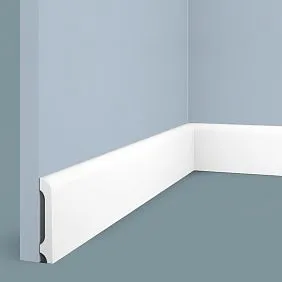
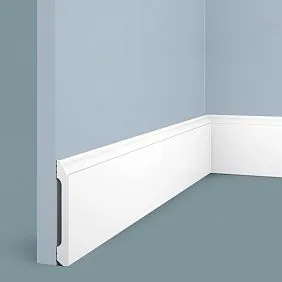
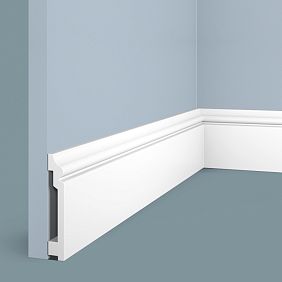
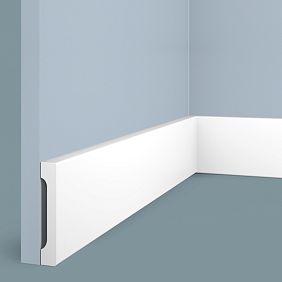
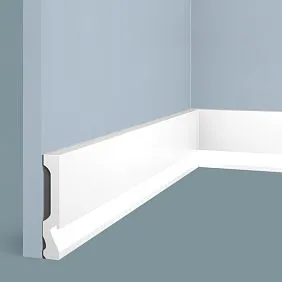
Modern Engineering Solutions STAVROS




Evolution of the Plinth's Functionality
Traditional plinth performed two functions - protection of the lower part of the wall from mechanical damage and covering the technological gap between the wall and floor. A rectangular wooden strip with a 50x20 mm cross-section was nailed to the wall, creating the simplest functional solution. The aesthetic role was secondary, and decoration was absent.Wooden baseboardserved for centuries in peasant houses.
The development of electrification in the twentieth century created a problem of wiring placement in residential spaces. Concealed wiring in walls required grooving - a labor-intensive and dirty operation. Open wiring created a visual chaos of wires on walls. Plinths with cable channels elegantly solved the problem - the internal cavity of the plinth became a natural place for wiring.— is a horizontal element that frames the room at the bottom of the walls where the wall meets the floor. Skirting boards perform several functions: they hide the technological gap between the wall and floor covering (necessary for thermal expansion), protect the lower part of the wall from mechanical damage, create visual completion, and may conceal wiring.with a cable channel combines decorative and engineering functions.
The development of LED technology opened a new direction - plinths with built-in lighting. An LED strip with 4-8 W per meter consumes minimal energy, lasts 50,000 hours, and does not heat up. Placing the LED strip in a special niche of the plinth creates contour lighting for the room.provides night orientation without turning on main lighting.became a full-fledged element of the interior lighting system.
Our factory also produces:


Construction of a modern multifunctional plinth
Modern plinth is a complex multi-component system. A base profile made of MDF or solid wood, 80-120 mm high, is mounted to the wall. The internal cavity is divided into two channels - the lower one for power cables up to 3x2.5 mm², the upper one for low-voltage cables - telephone, computer, TV. Separation of power and low-voltage lines eliminates electromagnetic interference.
The upper part of the plinth has a groove for installing LED strips. The groove is located on the front part of the plinth or on the upper edge depending on the lighting concept. Front placement creates diffused light directed forward. Upper placement directs light onto the wall, creating a floating wall effect.— is a horizontal element that frames the room at the bottom of the walls where the wall meets the floor. Skirting boards perform several functions: they hide the technological gap between the wall and floor covering (necessary for thermal expansion), protect the lower part of the wall from mechanical damage, create visual completion, and may conceal wiring.with LED strips placed at the top creates a light band on the wall 300-500 mm high.
A diffusing screen made of matte polycarbonate or acrylic covers the LED strip, creating even illumination without visible LED points. A 2-3 mm thick screen diffuses light, forming a soft glowing line. Screen transparency of 60-70% ensures sufficient brightness when diffusing light. The removable screen allows servicing the LED strip without dismantling the plinth.
A decorative cover conceals the cable channel, creating a clean front surface. The cover is secured with clips, easily removable for access to wires. The cover material - MDF, solid wood, PVC - is chosen according to the main plinth material.Wooden baseboardwith a wooden cover creates visual material unity.
Get Consultation
Integration with Smart Systems
Modern plinths integrate with smart home systems. Motion sensors built into the plinth every 3-4 meters automatically turn on the lighting when a person appears in a dark room. The 30-60 second delay after motion stops ensures comfortable operation. Sensor sensitivity is adjustable - from 2 to 8 meters depending on room size.
RGB controller manages the lighting color. A multi-color LED strip with red, green, and blue LEDs creates any shade of light from warm white 2700 Kelvin to cool blue 6500 Kelvin. Programmable scenes change the color depending on the time of day - warm light in the evening, cool light in the morning.provides night orientation without turning on main lighting.with an RGB strip creates a dynamic lighting environment.
Integration with voice assistants - Alice, Google Assistant, Alexa - allows controlling the lighting via voice commands. "Turn on blue lighting in the living room" - and the room's perimeter glows blue. Control via smartphone provides access to settings from anywhere in the world. Turning on lighting before coming home creates a sense of occupancy, deterring potential intruders.
How to integrate lighting into the profile
Types of LED strips for plinths
Standard SMD 3528 LED strip with 60 LEDs per meter creates soft diffused lighting at 4.8 W per meter. Light output of 300-350 lumens per meter is sufficient for contour lighting of rooms up to 20-25 square meters. Strip width of 8 mm allows placement in narrow grooves of the plinth.Decorative railwith SMD 3528 LED strip creates delicate illumination.
SMD 5050 LED strip with 60 LEDs per meter creates bright lighting at 14.4 W per meter. Light output of 900-1000 lumens per meter is sufficient for primary lighting of small rooms - bathrooms, hallways, closets. Strip width of 10 mm requires wider grooves in the plinth. High brightness creates expressive contour lighting in spacious rooms.
Flexible LED neon is a silicone tube with a diameter of 8-12 mm containing LEDs inside. Silicone diffuses light, creating a continuous neon glow without visible LED points. Flexibility allows bending neon around radii of 50 mm, which is important for decorating bay windows and curved elements.— is a horizontal element that frames the room at the bottom of the walls where the wall meets the floor. Skirting boards perform several functions: they hide the technological gap between the wall and floor covering (necessary for thermal expansion), protect the lower part of the wall from mechanical damage, create visual completion, and may conceal wiring.Creates soft, even illumination with LED neon.
WS2812B addressable LED strip with individually controllable LEDs creates dynamic lighting effects. Each LED receives its own command for color and brightness, enabling running lights, waves, gradients, and music synchronization. LED density of 30–144 LEDs per meter determines the smoothness of effects. Addressable strips require a special controller but unlock limitless lighting design possibilities.
Color Temperature and Spatial Perception
Warm white light at 2700–3000 Kelvin creates an atmosphere of coziness, relaxation, and intimacy. The yellowish hue is associated with sunset, candle flames, and fireplaces.provides night orientation without turning on main lighting.Warm light is optimal for bedrooms, living rooms, and relaxation zones. Evening activation of warm lighting signals the body that sleep is approaching, preparing for rest.
Neutral white light at 4000–4500 Kelvin is closest to daylight. The absence of color tint creates a neutral atmosphere suitable for workspaces.Wooden baseboardNeutral lighting is used in offices, kitchens, and hallways. Neutral light does not distort colors, which is important for areas with color accuracy requirements.
Cool white light at 5000–6500 Kelvin creates a feeling of freshness, alertness, and cleanliness. The bluish tint is associated with daytime sky, ice, and cold water. Cool lighting stimulates activity and concentration. Morning activation of cool lighting helps wake up and prepares for work mode.Decorative railCool lighting is optimal for bathrooms.
RGB lighting creates any color in the visible spectrum. Red light excites and stimulates, creating an atmosphere of passion. Green light calms and balances, associated with nature. Blue light relaxes and cools, creating a meditative mood. Color lighting is used to set moods — parties, romantic dinners, relaxation. The ability to change color adapts the space to current needs.
Electrical Power Requirements
LED strip operates on constant voltage of 12 or 24 volts. The power supply converts 220-volt mains voltage to low-voltage DC. The power of the supply is calculated based on the total strip length with a 20% reserve. A room perimeter of 20 meters with a strip power of 4.8 W per meter requires a power supply of 20 × 4.8 × 1.2 = 115 W. A 120 W power supply is selected.
Power supply placement requires ventilated space. The power supply dissipates 10–15% of its power as heat — 12–18 W for a 120 W unit. Placement behind furniture, under baseboard, or in a junction box ensures air access.— is a horizontal element that frames the room at the bottom of the walls where the wall meets the floor. Skirting boards perform several functions: they hide the technological gap between the wall and floor covering (necessary for thermal expansion), protect the lower part of the wall from mechanical damage, create visual completion, and may conceal wiring.A wider cable channel accommodates a compact power supply unit.
Voltage drop on long strip sections causes uneven brightness. A 10-meter strip with 4.8 W per meter consumes 4 amps at 12 volts. The strip’s resistance of 0.5 ohms causes a 2-volt drop, reducing the brightness at the end by 15–20%. Parallel connection from both ends equalizes voltage along the entire length.
Types of Baseboards with Niches and Hidden Mounting
Baseboard with Front LED Niche
A baseboard with a front niche has a groove on the front surface at a height of 30–50 mm from the floor. The groove, 12–15 mm wide and 8–10 mm deep, accommodates an LED strip with an adhesive layer. A matte polycarbonate diffuser covers the groove, creating a glowing horizontal band.Wooden baseboardA 100 mm high baseboard with a front niche creates a striking light line.
Light is directed forward and downward at an angle of 30–45 degrees, illuminating the floor 1–1.5 meters from the wall. A 300–500 mm wide light band on the floor creates a sense of depth, visually expanding the room. Brightness of 300–400 lumens per meter is sufficient for nighttime orientation without main lighting. Front niche is optimal for dark floors, where the light band creates contrast.
The matte diffuser disperses light, hiding individual LEDs. LED density of 60 LEDs per meter with 16 mm spacing creates visible points without a diffuser. Matte polycarbonate with 60% light transmission disperses light, creating even illumination. A 2–3 mm thick diffuser provides sufficient rigidity during installation.
Baseboard with Top LED Niche (Floating Wall Effect)
A baseboard with a top niche has a groove on the upper edge. The LED strip is placed horizontally, directing light toward the wall. A 10–15 mm gap between the baseboard and floor creates a dark band that visually detaches the wall from the floor.— is a horizontal element that frames the room at the bottom of the walls where the wall meets the floor. Skirting boards perform several functions: they hide the technological gap between the wall and floor covering (necessary for thermal expansion), protect the lower part of the wall from mechanical damage, create visual completion, and may conceal wiring.A top niche creates a floating wall effect — the wall appears to have no support.
Light is directed vertically onto the wall, illuminating it to a height of 300–500 mm. The light spot creates a gradient from bright at the baseboard to fading at height. This gradient visually increases room height — the gaze moves along the light spot upward. Brightness of 400–600 lumens per meter creates a striking light spot visible even with main lighting on.
The baseboard mounted on clips can be easily removed for servicing the LED strip.provides night orientation without turning on main lighting.Aluminum Baseboard with Integrated System
An aluminum profile combines the load-bearing structure, cable channel, and LED niche into a single unit. Extruded aluminum 1.5–2 mm thick creates a rigid profile 60–100 mm high. Internal partitions divide the space into a cable channel for wires and a niche for LED strips. Aluminum dissipates heat from LEDs, extending strip lifespan.
Anodized aluminum surfaces in silver, gold, bronze, and black create a metallic sheen suitable for modern interiors. Powder coating in any RAL color adapts the aluminum baseboard to any color scheme.
Powder coating in any RAL color adapts the aluminum baseboard to any color scheme.Decorative railAnodized aluminum creates a high-tech aesthetic.
The removable cable channel cover is secured by clips, providing access to wires without removing the baseboard. The light-diffusing polycarbonate screen is inserted into the slot, covering the LED strip. All components are easily replaceable, simplifying maintenance. The modular system of corner pieces, connectors, and caps creates a complete perimeter for any configuration.
Advantages for visual lightness and comfort
Effect of space expansion
Contour lighting creates an illusion of greater space through several optical effects. The light strip along the perimeter of the room draws the eye, guiding it along the walls. Perceiving the perimeter as a distant light source creates a sense of greater distance.provides night orientation without turning on main lighting.Visually expands a 15-square-meter room to the sensation of 18-20 square meters.
The gap between the baseboard and the floor creates a floating wall effect, visually lightening the space. A wall without visible support on the floor appears weightless and floating. This breaks the visual heaviness of massive walls, creating a sense of airy space.— is a horizontal element that frames the room at the bottom of the walls where the wall meets the floor. Skirting boards perform several functions: they hide the technological gap between the wall and floor covering (necessary for thermal expansion), protect the lower part of the wall from mechanical damage, create visual completion, and may conceal wiring.With a 15-millimeter gap, it creates a pronounced floating effect.
The light gradient on the wall visually increases the height of the room. A bright strip at the baseboard gradually fades at a height of 300-500 millimeters, creating a vertical light gradient. The eye involuntarily moves along the gradient from bottom to top, perceiving the height as greater. A room 2.6 meters high with a light gradient is perceived as 2.8-2.9 meters.
Night navigation without main lighting
Contour lighting at 4-8 watts per meter provides sufficient illumination for safe movement in the dark. A light output of 300-600 lumens per meter illuminates the floor and lower wall sections, allowing one to distinguish obstacles — furniture, thresholds, steps.Wooden baseboardWith lighting, there is no need to turn on the main light at night.
Automatic activation by motion sensor ensures comfort. Entering a dark room automatically activates the lighting. A 30-60 second delay after motion stops allows time to exit the room or reach the main light switch. Sensor sensitivity is adjustable — high for large rooms, low for small ones, where any movement should trigger the light.
Low brightness of night lighting does not disrupt sleep. Light at 50-100 lux at floor level is sufficient for orientation but does not cause excessive eye stimulation. Melatonin — the sleep hormone — is suppressed by bright light over 300 lux. Contour lighting below this threshold preserves the natural sleep cycle. Warm light at 2700 Kelvin has minimal effect on melatonin compared to cool light.
Decorative effect and accent lighting
Colorful RGB lighting creates emotional lighting scenarios. Red perimeter lighting forms an atmosphere of passion, energy, and celebration. Blue creates coolness, calm, and meditativeness. Green is associated with nature, harmony, and balance.Decorative railWith RGB lighting, the space transforms into a dynamic lighting environment.
Synchronization with music creates an immersive effect at parties. A special controller analyzes the music’s frequency spectrum, controlling the brightness and color of the lighting in sync with the rhythm. Bass creates red flashes, high frequencies — blue. The pulsation of light around the room synchronized with music creates the feeling of a dance floor at home.
Zoning through different lighting colors marks functional zones. A living room with warm white lighting creates a cozy atmosphere. A dining area with 2700 Kelvin yellowish lighting stimulates appetite. A work area with 5000 Kelvin cool lighting concentrates attention.Interior STAVROSWith zoning through light, it creates functional and emotional differentiation of spaces.
Technical details of installation
Foundation preparation and marking
Installing a baseboard with lighting requires a flat surface. Wall irregularities exceeding 5 millimeters per meter create gaps between the baseboard and wall, through which LED strip light will be visible. Leveling walls with plaster or putty ensures tight fitting.— is a horizontal element that frames the room at the bottom of the walls where the wall meets the floor. Skirting boards perform several functions: they hide the technological gap between the wall and floor covering (necessary for thermal expansion), protect the lower part of the wall from mechanical damage, create visual completion, and may conceal wiring.With soft edges, compensates for irregularities up to 3 millimeters.
Horizontal line marking is done with a laser level. The line is marked at the height of the top edge of the baseboard — 80, 100, or 120 millimeters from the floor depending on baseboard height. The laser level creates a perfectly horizontal line around the entire perimeter. Marking every 50-70 centimeters with a pencil fixes the line for mounting mounting elements.
Calculating the required length of LED strip takes into account the room’s perimeter plus a 5-10% reserve for cutting. A 4x5 meter room has a 18-meter perimeter. With reserve, 19-20 meters of strip are needed. LED strip is sold on 5-meter reels, requiring 4 reels. Cutting points are marked by the manufacturer — only at these marks, every 50 or 100 millimeters depending on strip type.
Installation of baseboard and mounting elements
Baseboard mounting to the wall is done via mounting clips or direct screwing. The clip system ensures disassembly — the baseboard can be easily removed for servicing the LED strip. Clips are installed at 40-50 centimeter intervals and secured to the wall with 6x40 millimeter screws.Wooden baseboardSecured to clips with a light press.
Direct screwing creates maximum secure fixation. 4x40 millimeter screws with anchors are installed every 50-60 centimeters. Pre-drilling the baseboard with a 3-millimeter drill bit prevents cracking of MDF or wood. Screw heads are recessed by 2-3 millimeters and masked with decorative caps or filled with putty.
Corner joints are made at a 45-degree angle using a miter saw. Cutting accuracy is critical for tight joints. A 1-2 degree angle deviation creates a visible gap. Modern miter saws with laser marking ensure accuracy of ±0.5 degrees. Corner joints are additionally secured with PVA glue or liquid nails to prevent misalignment over time.
LED strip is installed after baseboard mounting. The adhesive layer on the back of the strip ensures fixation. The groove surface is cleaned with alcohol to improve adhesion. The protective film is removed from the adhesive layer, and the strip is pressed onto the groove surface with slight tension.
with a wide groove, accommodates a strip up to 12 millimeters wide.Decorative railwith a wide groove, accommodates a strip up to 12 millimeters wide.
Segments of the strip are connected by soldering or connectors. Soldering creates a reliable connection with minimal resistance. The contacts of two strip segments are joined with a solder blob, and the soldered area is insulated with a heat-shrink tube. Connectors provide quick connection without soldering — strip contacts are inserted into the connector and secured by a clip. Connectors are less reliable but simplify installation.
The power supply is placed in an accessible, ventilated location. Concealed mounting behind furniture, in a niche, or in a junction box hides the unit from view. Wires from the power supply to the LED strip are routed through the baseboard’s cable channel. Wire cross-section of 0.75–1.5 square millimeters is sufficient for currents up to 6 amperes.provides night orientation without turning on main lighting.with quality wiring, serves for decades without maintenance.
Examples of interiors with lighting
Modern studio apartment
A 40-square-meter studio apartment with 2.7-meter ceiling height is styled in a modern minimalist design. Open-plan layout unifies the kitchen, living, and sleeping areas. Walls are painted light gray. Floor is light laminate in oak finish.— is a horizontal element that frames the room at the bottom of the walls where the wall meets the floor. Skirting boards perform several functions: they hide the technological gap between the wall and floor covering (necessary for thermal expansion), protect the lower part of the wall from mechanical damage, create visual completion, and may conceal wiring.white, 80 millimeters high, with an upper LED niche, installed around the perimeter.
LED strip emitting warm white light at 3000 Kelvin creates a floating wall effect. 12-millimeter gap between baseboard and floor forms a dark band visually separating walls from the floor. 400-millimeter high light spot on the wall creates soft contour lighting. In the evening, lighting turns on automatically via motion sensor, creating a cozy atmosphere without main lighting.
Zoning through varying backlight brightness marks functional zones. Living area receives 600 lumens per meter for sufficient reading light. Sleeping area — 300 lumens per meter for relaxation. Kitchen area — 800 lumens per meter for task lighting. Control via smartphone allows creating lighting scenes for different situations.
Child’s room with colored backlighting
A 18-square-meter child’s room with 2.6-meter ceiling height is styled in bright colors. Walls are painted white with colorful accents.Wooden baseboardMade of pine wood, 70 millimeters high, painted white. Front LED niche accommodates an RGB strip with 60 LEDs per meter.
Colored backlighting creates a playful atmosphere. During the day, blue or green is activated for active play. In the evening — warm yellow for calm activities. Before bedtime — red with minimal brightness for a winding-down ritual. RGB controller with remote control allows the child to independently choose backlight color, fostering a sense of control over the space.
With interactive backlighting, transforms the child’s room into a magical space.Interior STAVROSwith interactive lighting, turns a child's room into a magical space.
Home theater with accent lighting
A 25-square-meter home theater room with 3.0-meter ceiling height is styled in dark tones. Walls are painted dark gray. Black ceiling with sound-absorbing system.Decorative railBlack with LED niche creates contour lighting.
Cool blue light at 6500 Kelvin creates a cinematic atmosphere. Low brightness of 200–300 lumens per meter ensures orientation without screen glare. Automatic backlight dimming upon projector activation eliminates screen reflections. Gradual backlight fade-out after movie ends adapts eyes to light without sudden glare.
Synchronization of backlight with content creates an immersive effect. Special system analyzes dominant frame color, controlling backlight color. Ocean scene creates blue backlight around perimeter. Sunset — orange. Explosion — red flash. Ambient light effect expands image beyond screen, immersing viewer in on-screen action.
Conclusion
Modern baseboards and rails have evolved from simple utilitarian elements into complex multifunctional systems.— is a horizontal element that frames the room at the bottom of the walls where the wall meets the floor. Skirting boards perform several functions: they hide the technological gap between the wall and floor covering (necessary for thermal expansion), protect the lower part of the wall from mechanical damage, create visual completion, and may conceal wiring.With cable channel and LED backlighting, combines decorative role, engineering functionality, and lighting system into a single element.Wooden baseboardWith integrated backlighting, preserves the nobility of natural material while adding technological richness.
Decorative railWith LED strip, creates expressive light lines that organize space through light.provides night orientation without turning on main lighting.Ensures comfortable nighttime navigation, visual space expansion, decorative lighting effects. Integration with smart home systems transforms architectural elements into intelligent components of living environment.
Interior STAVROSWith functional baseboards and rails, demonstrates future architectural solutions where form beauty is inseparably linked with technological functionality. 23 years of experience, deep understanding of materials and technologies, professional consultation help realize projects of any complexity — from simple baseboards with cable channels to complex systems with RGB backlighting, motion sensors, and smart home integration.