





























































Article Contents:
- What is Considered a Wide Floor Skirting Board
- When a Wide Skirting Board is Really Needed
- For high ceilings
- For classic interiors
- For Modern Light Interiors
- For Rooms with Large Wall Surfaces
- For Expensive Floor Finishing
- Which Wide Skirting Board to Choose: Wood or MDF
- Wide wooden baseboard
- Wide MDF skirting board
- What is Better Specifically for the Floor
- How to Select the Height of a Wide Skirting Board
- 80 mm — neat wide option
- 100 mm — universal commercial size
- 120 mm — for expressive interior
- 150 mm — architectural effect
- When high is better, and when just wide
- White, paintable, or wood-like: what to choose
- White wide skirting board
- Wide skirting board for painting
- Wide wood-like skirting board
- Which color is better for floor, walls, and doors
- How to match wide skirting boards with flooring, doors, and architraves
- Which floor coverings are suitable for wide skirting boards
- Under laminate
- Under parquet
- For engineered board
- For quartz vinyl
- For tile
- When wide skirting boards are better than standard ones
- Mistakes when choosing wide skirting boards
- Installing wide skirting boards: key considerations
- Wall Preparation
- Adhesive installation and fasteners
- Angle cutting
- Joints
- Geometry with wide profiles
- Wide skirting boards in different rooms: application scenarios
- Wide skirting boards and adjacent interior elements
- Additional materials for in-depth study
- FAQ: Popular Questions and Answers
- About the Company STAVROS
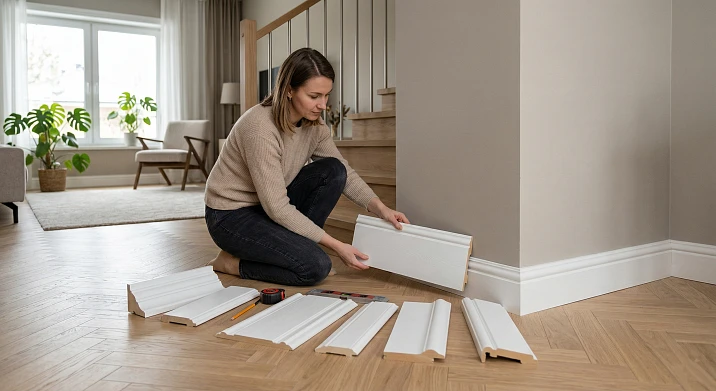
There are interior details that work quietly—but without them, something is subtly off. Wide floor skirting boards fall into this category. When chosen correctly, the room looks complete, solid, and architecturally composed. When it's missing—or too thin, too low, random—even expensive flooring and good furniture can't save it: the interior feels like an unfinished draft.
A wide floor skirting board is not a matter of fashion. It's a matter of proportions. A correctly chosen profile connects the wall and floor into a unified system, sets the scale of the space, and, no less importantly, visually elevates the value of the entire finish. That's why in expensive interiors, wide skirting boards are almost always present—it's one of the cheapest ways to make a room feel noticeably more expensive.
This guide covers everything you need to know before buying: what counts as wide, when it's needed, which material to choose, how to select the height and color, what mistakes are most commonly made—and how to avoid them.
Choose a wide floor skirting board right now:
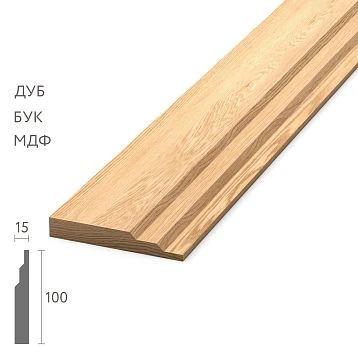
MDF Skirting Board— white, paintable, in wood decor
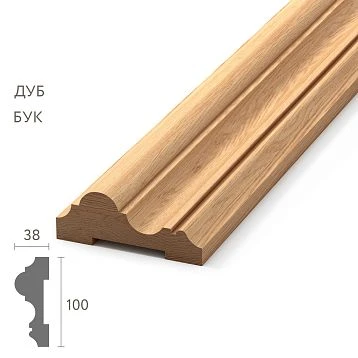
Wooden baseboard— solid oak and beech
All STAVROS skirting boards— 60, 80, 100, 120 mm
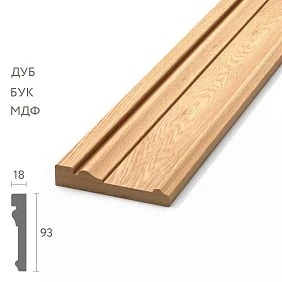
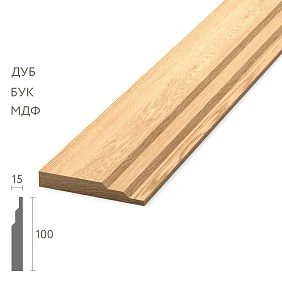
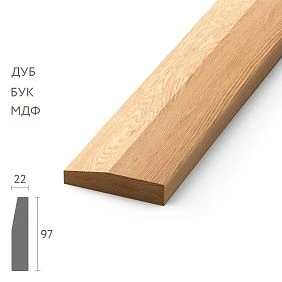
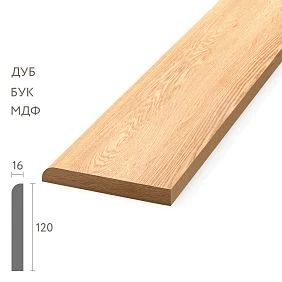
What is considered a wide floor skirting board
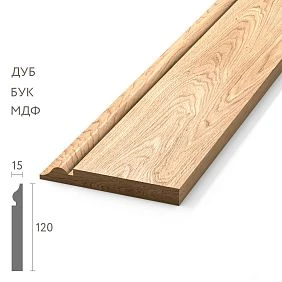
Before making a choice, it's worth understanding the terminology. In everyday language, 'wide' and 'tall' are often used as synonyms—and this is not a mistake: when referring to a floor skirting board, the profile height is its 'width' in a visual sense. The taller the profile, the wider it appears along the wall.
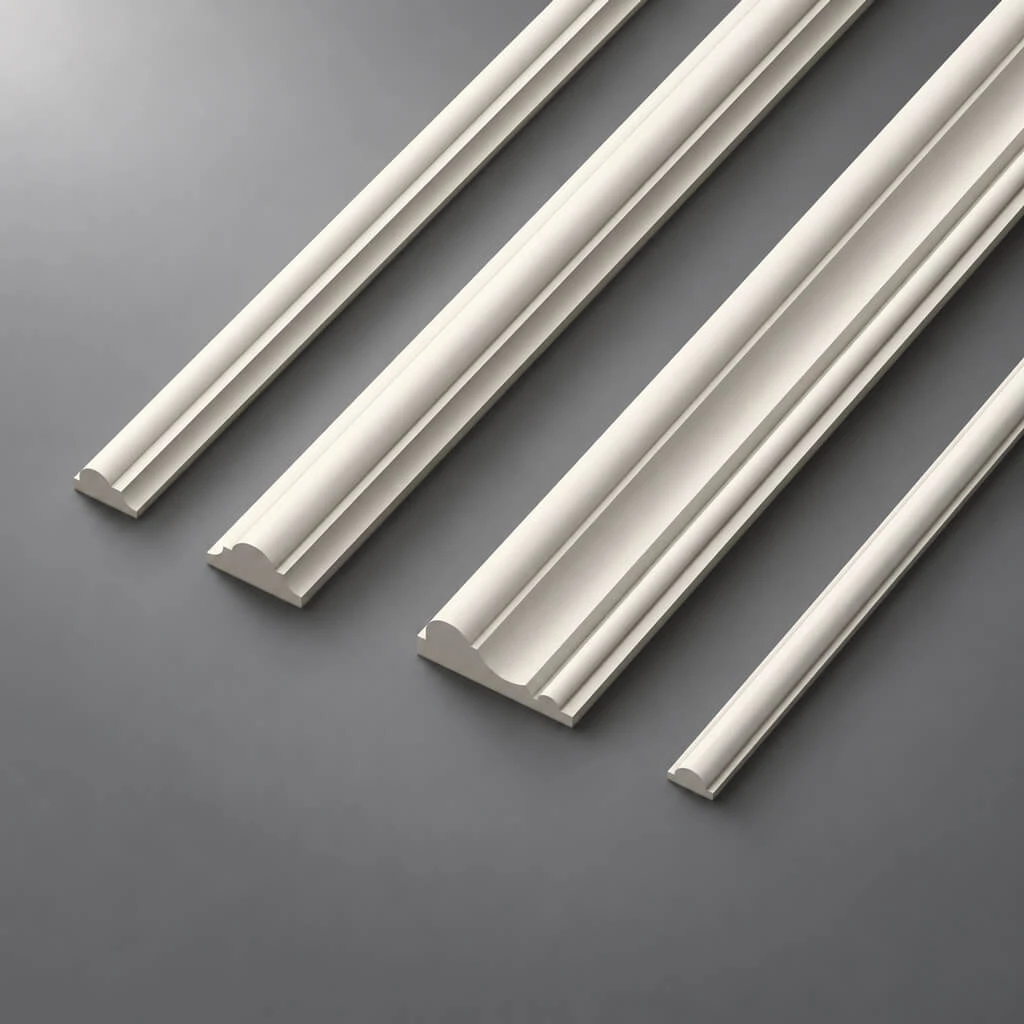
In industry practice, a skirting board is considered wide if its profile height is 80 mm or more. The standard is 40–60 mm. Anything from 80 mm is already a noticeable shift to the wide format. From 100 mm—definitely wide. From 120–150 mm—large-scale, architectural, prestigious.
How does a wide floor skirting board differ from a standard one? Not just in size:
-
It occupies more of the wall plane, creating visual support for the space.
-
It better conceals irregularities at the base of the wall—especially relevant in homes with uneven walls or variations at the floor junction.
-
It carries greater decorative potential—relief, milling, and the profile look significantly more expressive on a wide surface.
-
It sets the scale for the entire room, linking the proportions of the skirting board with the ceiling height.
A tall floor skirting board is an architectural tool. It doesn't work on its own, but as part of a system with the ceiling, doors, architraves, and flooring. That's why choosing a wide skirting board requires not just 'taking a bigger one,' but understanding the logic of the space.


When a wide skirting board is truly needed
There is a temptation to install wide skirting boards everywhere—because it's 'beautiful.' But here, beauty follows the logic of proportions, and violating this logic produces the opposite effect. Let's examine specific situations in which a wide profile works exactly as it should.
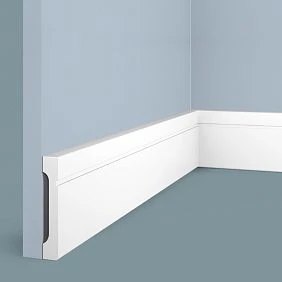
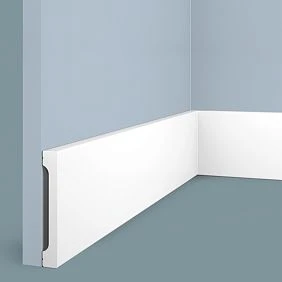
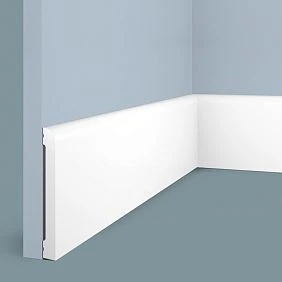
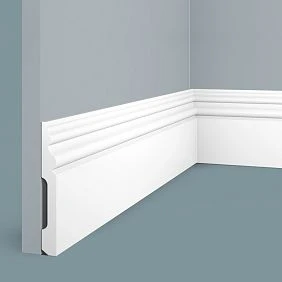
Our factory also produces:


For high ceilings
This is the main and most obvious scenario. With ceiling heights from 2.7 m, a standard 40–50 mm skirting board looks like a thin strip accidentally glued to the floor. It gets lost—and by its presence only emphasizes the mismatch of scales.
A wide skirting board for high ceilings is not a desire, but a necessity. For ceilings 2.7–3 m — from 80 to 100 mm. For ceilings from 3 m — from 100 to 150 mm. For exceptional heights — from 150 mm and above, up to the use of multi-level profiles with a cornice.
Get Consultation
For classic interiors
Classicism is the architectural consistency of details. A wide skirting board in a classic interior is part of a system: a molded cornice, a ceiling profile, pilasters, door architraves, wall moldings. Without a wide skirting board at the floor, this system looks incomplete.
In classicism, the profile usually carries relief: a cavetto, a fillet, a bevel. The higher the skirting board, the richer its geometry can be played out.
For modern light interiors
Paradox: a white wide skirting board in a minimalist space with white walls and a light floor works excellently. It creates a clear horizontal line—an architectural accent without excessive decorativeness. This is an 'invisible' presence: the skirting board is there, it is wide, it sets the proportion—but the eye does not catch on it, it glides over it.
For rooms with large wall planes
In a living room with long walls, in a corridor with high planes—a wide floor skirting board in an apartment becomes a visual foundation. Without it, a long wall seems unstable, 'floating'. A wide profile literally 'roots' it.
For expensive floor finishes
Parquet, engineered wood, natural stone—all of this requires appropriate framing. A wide skirting board in a house with such a floor is an honest correspondence of levels. To put a narrow plastic skirting board next to expensive parquet is like hanging a Levitan painting in a foil frame.
Which wide skirting board to choose: wood or MDF
This is a central choice. The answer depends on the specific interior, and there is no universal truth—there are scenarios.
Wide wooden skirting board
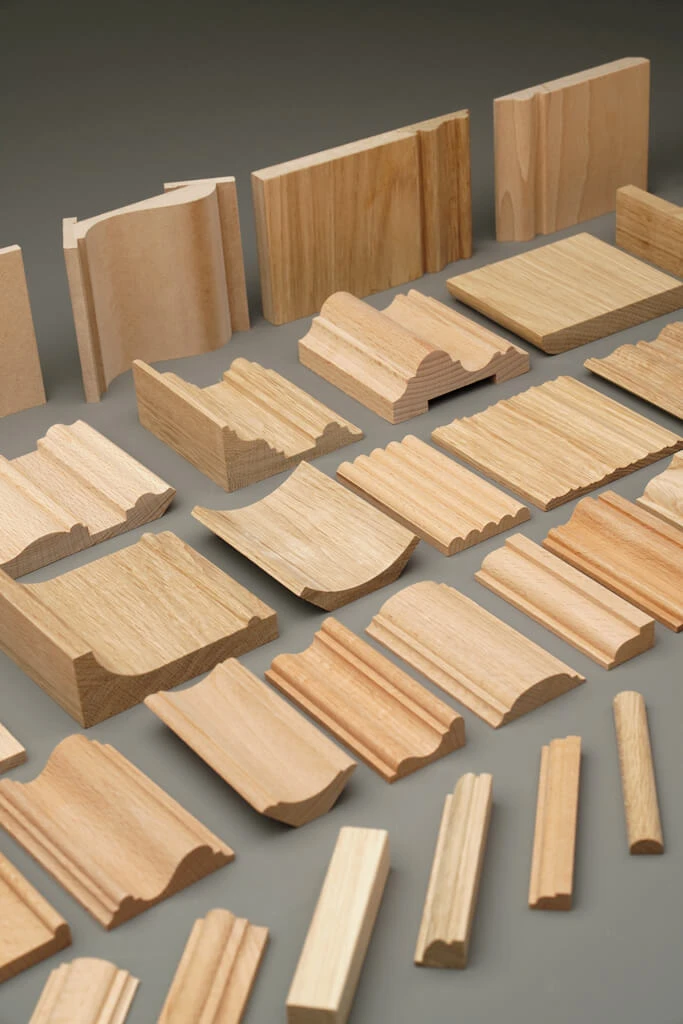
Wide Wooden Skirting Board—a choice for those who value material. The natural texture of oak or beech, visible fiber structure, a living surface that can be sanded and repainted—this is what MDF cannot fully replicate, no matter how hard it tries.
When a wide wooden skirting board is suitable:
-
Floors made of natural materials—parquet, engineered board, solid wood
-
Wooden staircase, wooden doors with natural finish
-
Classical, neoclassical, Scandinavian, rustic style
-
Interior in a country house or cottage with high ceilings
-
The task is to create a unified system from natural materials
A wide solid oak skirting board lasts for decades. It can be restored: sand out scratches, apply new oil or varnish. It is an investment, not just a consumable. Article on how to properly select a wide wooden floor skirting boardwill help you understand all the nuances of selection and application
Wide MDF skirting board
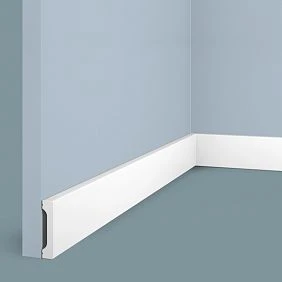
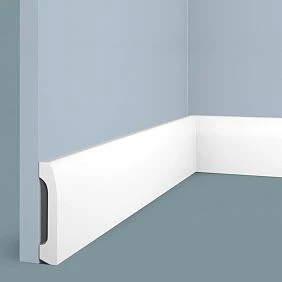
Wide MDF skirting board— the choice for those who want precision. MDF has no knots or defects: each plank is geometrically perfect, profile milling is precise, the surface is smooth as a taut thread. This is what makes wide MDF floor skirting the first choice in modern interiors, especially for painting.
When wide MDF skirting is suitable:
-
White walls and light interiors
-
Laminate, quartz vinyl, solid color flooring
-
Interiors where everything is painted one color: doors, slopes, window sills, skirting
-
Modern, minimalist, Scandinavian style with emphasis on uniformity
-
Budget lower than solid wood, with high quality requirements
White wide MDF skirting board is an absolute hit. It fits literally with any interior, doesn't draw unnecessary attention, and works as a neutral frame for the entire space.
What is better specifically for the floor
Honest comparison of two materials:
| Parameter | Wide MDF skirting board | Wide wooden skirting board |
|---|---|---|
| Geometric precision | Ideal | Good, slight curvature possible |
| Painting | Perfect — primed for any color | Good, but requires preparation |
| Natural texture | Imitation (film, painting) | Real solid wood texture |
| Price | Below | Higher |
| Restoration | More difficult | Easy to sand and repaint |
| Combination with parquet | Satisfactory | Excellent |
| For a white interior | Ideally | Requires treatment |
| Durability | 15–20 years | 25–50 years with care |
Conclusion: for white, modern, laminate interiors — MDF. For natural, wooden, classic — solid wood. Both options in the catalogall STAVROS skirting boards is convenient..
Popular solutions for wide skirting boards:
How to choose the height of a wide skirting board
Height is not an arbitrary choice. It is an architectural decision that affects the perception of the entire room. Here are specific guidelines.
80 mm — a neat wide option
Wide skirting board 80 mm — the lower boundary of the 'wide' range. It is noticeable, creates proportion, but does not overload the space. Suitable for apartments with ceilings 2.6–2.8 m, where neat expressiveness without architectural declarativeness is needed.
80 mm — the most popular commercial size in the wide skirting board segment. It is universal: works with both modern minimalism and light classic, and in residential spaces of any purpose.
100 mm — universal commercial size
Wide skirting board 100 mm — the point of balance. It is already unequivocally 'wide', but not yet 'monumental'. With ceiling heights of 2.7–3 m, it looks organic and convincing.
100 mm allows for a more pronounced profile: a shelf, a bevel, a rounded frontal plane. At the same time, the profile does not overload the wall and does not compete with other architectural elements.
120 mm — for an expressive interior
A wide 120 mm skirting board — a transition to an architectural statement. On a 3 m ceiling, it looks exactly as it should: large-scale, confident, complete. Used in designer interiors, in classic styles with moldings, in spaces with framed wall panels.
With ceilings below 2.8 m, 120 mm may be perceived as overkill — the skirting board begins to dominate the room instead of creating its foundation.
150 mm — architectural effect
A wide skirting board of 150 mm and above is already an architectural element. It is appropriate in palace-classic interiors, in mansions with high ceilings, in prestigious offices and lobbies. For a standard residential apartment — too large-scale; for a country house with 4-meter ceilings — just right.
When is tall better, and when is just wide better
Practical tip: a tall floor skirting board is needed where there is a lot of verticality and a horizontal counterbalance needs to be created. A wide one without much height (which is only possible in decorative panels) — where a horizontal stripe is important without a vertical accent.
For most situations, it's the same thing: the height of the skirting board is visually equal to its width. Therefore, a wide, tall floor skirting board is not two different products, but one solution with different profile sizes.
White, paintable, or wood-look: what to choose
The color of the skirting board is not a final touch chosen at the last moment. It is a strategic decision that influences how the entire interior is perceived.
White wide skirting board
White wide floor skirting board is the most common and versatile choice. It literally suits any flooring: light laminate, dark parquet, tile, and quartz vinyl. It works with white walls (merging with them to create a monolithic look) and works with colored walls (creating a clear horizontal boundary).
White is neutrality. But neutrality here is not a weakness, but an architectural technique. That's why white wide MDF skirting board is found in nine out of ten modern interiors.
Important nuance: white varies in temperature. Cool white (bluish undertone) is for neutral and cool interiors. Warm white (creamy, ivory) is for interiors with wood, warm walls, gold accents. Mixing temperatures is undesirable: it's immediately noticeable and looks untidy. Read more about white options in the articleWhite MDF Skirting Board.
Wide skirting board for painting
Skirting board for painting is the choice for those who want perfect color accuracy. The primed surface accepts acrylic or alkyd enamel in any shade according to RAL or NCS. This means the skirting board can exactly match door frames, slopes, moldings, and wall panels—without approximate 'white-like' matching.
Wide skirting board for painting is a professional designer's tool. In complex interiors where finish color is calculated to the exact tone, only it delivers the desired result.
Wide skirting board in wood finish
Wide skirting board in wood finish is for those who want natural warmth without the price of solid wood. Laminated MDF with decorative film in oak, walnut, or beech color is a good alternative, especially if the floors are laminate with a similar decorative surface.
Main principle: the skirting board finish and floor finish should be from the same line or as close as possible in tone and texture. Mismatch here is very noticeable.
Which color works best for the floor, walls, and doors?
Three color strategies for a wide baseboard:
-
Baseboard matching the wall color — it disappears, the room expands, and the space becomes monolithic. Works best in small rooms.
-
Baseboard matching the floor color — the baseboard continues the floor, giving the wall a clear architectural boundary. Works well in modern interiors with contrasting walls.
-
Baseboard matching the doors and casings — creates a unified decorative outline, linking all vertical and horizontal elements into a system. This is a classic professional solution.
How to coordinate a wide baseboard with the floor, doors, and casings
A wide baseboard is part of a system, not a separate element. It is this understanding that turns a good renovation into an excellent one.
If the floor has an active texture — parquet with a pronounced pattern, plank flooring with a bevel, mosaic tile — it's better to choose a calm, neutral wide baseboard. White or a solid color for painting. It won't compete with the floor but will frame it.
If the doors are white — a white wide baseboard is logical and professional. It continues the theme of white along the wall perimeter. White casings, white reveals, white baseboard — this is called a 'unified decorative system'.
If the casings are massive — a narrow baseboard next to a large casing looks out of place. The scale doesn't match. A wide baseboard for the doors establishes correct proportions: the taller and thicker the casing, the wider the baseboard should be.
If the walls are dark—a wide baseboard matching the wall color creates a monolithic and dramatic volume. A white baseboard on a dark wall is a sharp contrast that can be a design technique but requires intentionality.
For a dark floor—a wide baseboard matching the floor tone creates depth and weight. For a light floor—a white or neutral baseboard does not break the horizontal plane but complements it.
For which floor coverings is a wide baseboard suitable
The type of flooring is another selection parameter. Different materials require different approaches to the baseboard.
Under laminate
A wide baseboard for laminate—the most common combination. For laminate 'under wood'—MDF with a decorative film in a similar color or a white baseboard. For solid-color laminate—a baseboard for painting in the desired shade.
Important: laminate requires an expansion gap at the wall (8–12 mm). A wide baseboard covers this gap—this is one of its technical functions, not just decorative.
Under parquet
A wide baseboard for parquet works best if made from solid wood of the same or a similar species.Wooden baseboardnext to parquet creates a unified wooden world: one texture, one tone temperature, one material. MDF falls short here—even with good imitation, the difference is noticeable in daylight.
For engineered board
Engineered board—this is a real veneer of a valuable species on a technical base. For it, aWide Wooden Skirting Boardmade from the same species as the veneer is suitable. This creates a professional pairing that speaks to attention to detail.
For quartz vinyl
Wide skirting board for quartz vinyl – MDF or laminated with 'concrete', 'stone', or 'wood' decor, depending on the floor finish. Quartz vinyl is a modern material, and the skirting should match its character: clear geometry, minimal unnecessary decoration.
For tile
In tiled rooms (kitchen, hallway, bathroom), a wide MDF floor skirting is suitable in areas with normal humidity. For high humidity, ceramic skirting or well-sealed MDF is better. For warm porcelain tiles – beige or cream skirting supports the warm color palette.
When a wide skirting board is better than a standard one
This is an honest question – and an honest answer: wide isn't always better. But in certain situations, narrow loses unconditionally.
By visual weight: A wide profile creates a sense of monumentality. In a large room, this is a quality: it 'anchors' the walls and gives the floor confidence. In a small room – it overloads.
By status: The perception of an interior's cost is directly linked to details. A wide skirting board is one of those elements that the brain subconsciously registers as a sign of quality renovation. This isn't snobbery – it's the neuropsychology of space.
By completeness: In a room with high ceilings and a narrow skirting, there's always a feeling of something left unsaid. A wide profile closes that 'unclosed' intonation.
By connecting wall and floor: The larger the skirting area, the more it works as a transitional element between vertical and horizontal planes. This is especially important in interiors with contrasting walls and floors.
When standard is better than wide: small rooms with low ceilings, minimalist interiors where the focus is on emptiness and air, bathrooms with floor-to-ceiling tiles.
Breakdown of choices for different interiors – in the article Which skirting board to choose for the floor and interior.
Mistakes when choosing a wide skirting board
They are predictable. And most of them are made not out of ignorance—but because they didn't think about the system, they thought about an individual detail.
Mistake 1. Taking too high a profile for a small room
A wide skirting board 120–150 mm in a 9 sq.m. kitchen with a 2.5 m ceiling—this visually compresses the space. The skirting board occupies too large a portion of the wall, and the room starts to 'feel oppressive'. For small rooms—no higher than 70–80 mm.
Mistake 2. Choosing a white skirting board without support from white architraves or doors
A white wide skirting board next to dark doors and brown architraves—a visual break. Either white should be a system (skirting board + architraves + doors), or you need to choose a skirting board in a different solution.
Error 3. Not taking the profile thickness into account
A wide skirting board with a thin cross-section looks flimsy. For a wide profile (from 80 mm), the thickness should be at least 16–18 mm. Otherwise, it looks 'cardboard-like'.
Mistake 4. Confusing 'wide' and 'high'
Technically, it's the same thing when it comes to floor skirting. But some customers understand 'wide' as greater thickness (protrusion from the wall), not height. Check with the seller or look at the profile diagram — everything is clear there.
Mistake 5. Choosing a profile without considering the floor covering
A wide wooden skirting next to cold gray laminate under concrete creates a thermal conflict of materials. Each covering requires its own skirting in terms of color and material — this is not a strict rule, but it shouldn't be ignored.
Mistake 6. Not coordinating the skirting height across all rooms
If the living room has a 100 mm skirting and the hallway has 60 mm, it's perceived as an accident or cost-saving. Ideally, the skirting height is coordinated throughout the house or changed deliberately — for example, increasing along with the ceiling height.
Mistake 7. Taking a profile without a margin
For cuts, joints, and unforeseen trims, you need 10–15% more than the calculated length. Saving here often results in urgently buying the needed profile — which sometimes comes from a different batch with a slightly different shade.
Installing wide skirting: what's important to consider
Wide skirting is more difficult to install than standard — not fundamentally, but requires care.
Wall Preparation
The wall under a wide profile must be sufficiently even. Wide skirting covers a large area, and any wall irregularities will be visible in the gap between the skirting and the surface. For irregularities of more than 4–5 mm per linear meter — level before installation. An alternative is acrylic sealant in the color of the skirting to close gaps, but this is a compromise.
Adhesive installation and fasteners
Installing wide skirting boards on liquid nails is standard. Apply adhesive in a zigzag pattern, press the skirting board and secure with painter's tape for 30–40 minutes. For heavy wooden skirting boards, additionally use finishing nails or countersunk screws.
Installing wide skirting boards on clips is a more flexible solution: allows removing the profile for cable access or during repairs. For wooden skirting boards, clips are used less frequently — hidden fasteners are more common.
Cutting Angles
How to cut wide skirting boards: a miter saw with a precise 45° angle is essential. A wide profile with an inaccurate cut will create a noticeable gap in the corner. Always dry-fit before final fixing.
Wide skirting board corners — internal and external — can be finished either by cutting or with ready-made corner caps. For MDF, caps provide precise results without chipping risk. For solid wood, a cut looks more professional.
Joints
On long runs (over 2.4–2.8 m — standard plank length) skirting boards are joined. The joint is made at a 45° angle to the profile axis — this hides potential opening due to temperature changes. Two pieces meet 'at a miter' — the result looks monolithic.
Geometry with wide profile
Wide skirting boards require precise wall and floor geometry. Any deviation from a right angle in corner joints with a 100–120 mm profile height will create a noticeable gap. Therefore, before installing wide skirting boards, check room corners with a square and laser level. More about installation — in the articleMDF skirting board: types, sizes, installation and care.
Wide skirting boards in different rooms: application scenarios
Theory is good. But specific scenarios are better.
Wide skirting board for the living room: height from 80 to 120 mm depending on the ceiling. White or paintable to match the wall color — for a modern interior. Wooden — for a classic one. Creates the architectural foundation of the entire room.
Wide skirting board for the bedroom: 80–100 mm, calm color. In the bedroom, a sense of peace is important — a wide skirting board provides a horizontal line that visually 'calms' the space. White paintable or matching the wall color is preferable.
Wide skirting board for the hallway: here the skirting board experiences maximum mechanical stress. For the hallway, it's better to choose Wooden baseboard made of hardwoods or dense MDF with a protective coating. Height — 80–100 mm to protect the wall from impacts.
Wide skirting board for the apartment as a whole: uniform height across all rooms — 80 or 100 mm. Uniform color — white or matching the doors. This creates a sense of a well-thought-out interior, not a set of random decisions.
Wide skirting board and adjacent interior elements
A wide skirting board rarely exists in an interior alone. It is often used together with wall moldings, cornices, decorative battens, and architraves. When all of these are from the same line and the same manufacturer — the interior gains a rare trait: consistency.
For walls with decorative battens and vertical panels, the skirting board should pick up their rhythm in color and material. All options for decorative trim — moldings, cornices, and baseboards— in a unified catalog. Individual solutions forslat panelsandwooden slatsallow you to build a unified system for wall and floor finishing.
AllPogonazh iz massiva— baseboards, slats, corners, additional elements — are compatible in finish and wood species, which is important for a consistent interior.
What to view together with wide baseboard:
moldings, cornices, and baseboards— full decorative molding
Rafter panels— for accent walls
Wooden planks— for vertical decorative solutions
Pogonazh iz massiva— the entire line of wooden profiles
Additional materials for in-depth study
If you want to explore the topic in more detail, here are useful articles:
-
MDF Floor Skirting: How to Choose and Install— a detailed guide to MDF profiles
-
MDF skirting board: types, sizes, installation and care— a technical breakdown of all aspects
-
Wide Wooden Floor Skirting— a complete guide to selection and operation
-
with a classic profile creates a sense of solidity, reliability.— how to choose solid wood for apartments and houses
-
White MDF Skirting Board— dimensions, painting, installation
FAQ: Popular Questions and Answers
What is considered wide floor skirting?
Floor skirting with a height from 80 mm is generally considered wide. Standard is 40–60 mm. From 100 mm — definitely wide. From 120 mm — large-scale and architecturally significant.
Which wide skirting board is better: MDF or wood?
Depends on the interior. MDF is ideal for white, painted, modern spaces. Wood is for natural floors, classic styles, solid wood staircases. Both options are in the catalog.all STAVROS skirting boards is convenient..
Is a wide skirting board suitable for an apartment?
Yes, but taking into account ceiling height and room scale. For a standard apartment with ceilings 2.6–2.7 m — 80–100 mm. For an apartment with high ceilings — 100–120 mm.
Which wide skirting board to choose for high ceilings?
For 2.7–3 m — 100 mm. For 3–3.5 m — 120–150 mm. Higher — from 150 mm, possibly using a composite profile with a cornice.
White wide skirting board or wood-look — which is better?
White is more versatile, compatible with any interior. Wood-look works more precisely with wooden floors, wooden furniture, warm color schemes. More details — in the article.wide wooden skirting board for painting.
Which size of wide skirting board to choose: 80, 100 or 120 mm?
80 mm — for standard rooms. 100 mm — universal for most cases. 120 mm — for large rooms and high ceilings. 150 mm — for palace-classical interiors.
Is a wide skirting board suitable for laminate flooring?
Yes. For wooden laminate — MDF in matching color or white. For plain laminate — paintable. The wide profile also reliably covers the expansion gap at the wall.
How to attach a wide skirting board to the wall?
Using mounting adhesive (liquid nails) with fixation using painter's tape until dry. For heavy wooden profiles — additionally use finishing nails or hidden fasteners. Joints are sealed with acrylic sealant in the color of the skirting board.
When does a wide skirting board look better than a regular one?
In large rooms, with high ceilings, in classical and neoclassical interiors, next to massive door architraves, and with expensive flooring — parquet, engineered wood.
Where to buy wide skirting boards for the floor?
The entire range of wide skirting boards — wooden and MDF, with heights of 80, 100, and 120 mm, in white and paintable — is available in the catalog ofSTAVROS skirting boards with Contact us to confirm shipping to your destination.
About the company STAVROS
STAVROS is a Russian manufacturer of wooden architectural elements made from solid oak and beech. The company's assortment includes Wooden Skirting BoardsandMDF skirting boards with heights from 60 to 120 mm in a wide color range, paintable, and with natural wood texture. The wide floor skirting board by STAVROS features precise profiling, dense material, stable geometry, and an assortment that allows for furnishing any interior within a unified system.
STAVROS produces a complete Pogonazh iz massiva: skirting boards, moldings, cornices, battens, architraves, corner pieces, and decorative elements for walls and doors. Everything is made from selected wood that has undergone chamber drying, with finishing on modern milling equipment.
Orderwide floor skirting board in the STAVROS catalog with delivery across all of Russia — and get not just a profile, but a complete architectural element that works in your interior for many years.