Article Contents:
- The History of the Pull Handle: from Utility to Design
- Anatomy of the Pull Handle: Construction and Parameters
- Main Elements
- Key Parameters
- Geometric Minimalist Handles: Purity of Lines
- Straight L-Shaped Handles
- Cylindrical Handles
- Profiled Integrated Handles
- G-Shaped and T-Shaped Handles
- Flat "Flat" Handles
- Organic Enveloping Forms: Nature in the Interior
- Ergonomic Curved Handles
- Wavy Handles
- Asymmetric Organic Handles
- Biomorphic Handles
- Handles with Variable Cross-Section
- Pull Handle Materials: From Metal to Wood
- Metal Handles
- Wooden Handles
- Composite Handles
- Handle Sizes: From Compact to Monumental
- Short Handles 32–96 mm
- Medium Handles 128–192 mm
- Long Handles 256–448 mm
- Extra-Long Handles 512–960 mm and Above
- Proportion Rule
- Application of Handles in Various Rooms
- Kitchens
- Closets and Wardrobes
- Chests and Dressers
- Bathrooms
- Offices and Offices
- Stylistic Universality of the Handle
- Minimalism
- Scandinavian Style
- Industrial Style
- Neoclassicism
- Classic
- Eclecticism
- Technical Aspects: Selection, Purchase, Installation
- Determining the Required Size
- Quality Check
- Where to buy
- Installation
- Care and Maintenance of Appearance
- Trends for 2026 in Handle Design
- Psychology of Choice: What Your Handle-Skob Says About You
- Ecological sustainability and development
- Conclusion: The Handle as a Philosophy of Design

The P-shaped form, ease of grip with the entire palm, and reliable two-point mounting make the handle-skob indispensable for kitchens, closets, chests, and any furniture where functionality and aesthetics matter.handle-skobIn the form of a handle-skob, they can radically change the perception of furniture — giving it a modern technological feel or natural softness, graphic strictness or sculptural expressiveness. This complete guide will reveal all aspects of choosing, applying, and stylistic diversity of handle-skobs in modern interiors.Furniture HandlesThis complete guide will reveal all aspects of choosing, applying, and stylistic diversity of handle-skobs in modern interiors.




History of the Handle-Skob: From Utility to Design
The handle-skob in its basic form has existed for centuries. A simple metal arc, fixed at two points, allowing it to be gripped with the palm and pulled — this is a functional solution proven by time. In medieval furniture, handles were crude, forged, purely utilitarian. In the Baroque and Rococo eras, handles were adorned with floral ornaments, becoming more elegant. Classicism simplified forms, making handles stricter and more symmetrical.
The Industrial Revolution of the 19th century made metal handles accessible and standardized them. The 20th century of modernism brought minimalism — handles became simple, functional, devoid of decoration. The mid-20th century — the era of mass production — standardized handles to a few standard sizes and shapes.
In the 21st century, especially from the 2010s, interest in the design of furniture hardware began to revive.Bracket HandleIt ceased to be merely a functional element and became an object of designer attention. Handles of unusual shapes, materials, and sizes appeared. Long horizontal handles, profile-integrated solutions, handles made of composite materials, sculptural asymmetrical forms — all this expanded the understanding of what a handle-skob can be.
In 2026, the variety of handle-skob forms has reached its maximum. From strictly geometric rectangular profiles to smooth organic lines reminiscent of natural forms — modernfurniture handle-skobssatisfy any aesthetic and functional requirements.




Anatomy of the Handle-Skob: Construction and Parameters
Understanding the constructionhandle-eyesis necessary for correct selection and installation.
Our factory also produces:



Main Elements
Handle — the part held by hand. Can have various cross-sections (round, square, rectangular, oval, custom), different thicknesses and shapes (straight, curved, wavy).
Mounting plates (flanges) — parts of the handle that are attached to the facade. Can be round, square, rectangular, hidden (handle attached directly to the facade without visible plates), or decorative (with ornamentation or relief).
Mounting screws — pass through mounting plates, facade, and are secured with nuts on the opposite side. Standard thread M4; screw length depends on facade thickness.
Get Consultation
Key parameters
Center-to-center distance (c-c) — distance between centers of mounting holes. This is the main parameter when selecting a handle. Standard values: 32, 64, 96, 128, 160, 192, 224, 256, 288, 320, 352, 384, 416, 448, 480, 512, 576, 640, 736, 832, 928 mm. When replacing a handle, the new one must have the same center-to-center distance.
Overall length — distance from edge to edge of the handle. Usually 40–80 mm longer than center-to-center distance, since mounting plates extend beyond the mounting holes.
Projection (overhang) — how far the handle extends from the facade surface. Usually 25–45 mm. A larger projection is easier to grip but increases the risk of snagging clothing. A smaller projection is more compact but may be less convenient, especially for larger hands.
Handle thickness/diameter — affects grip comfort. Round handles are usually 10–16 mm in diameter. Square or rectangular handles — 10–20 mm per side. Too thin handles are uncomfortable; too thick ones are bulky.
Weight — depends on material, size, and construction. Important for heavy, long handles — the mounting must withstand weight and load during use.
Geometric minimalist handles: purity of lines
Minimalism remains the dominant style in modern interior design, andhandle-eyesgeometric forms perfectly embody its principles.
Straight L-shaped handles
Classic minimalism — a completely straight handle with rectangular or square handle. No curves, ornamentation, or unnecessary details. Pure geometry, functionality, modernity. Suchhandlesare suitable for modern kitchens, minimalist wardrobes, office furniture.
Materials — most often metal (stainless steel, aluminum, brass) with matte finish. Matte black — the hit of 2026. Matte stainless steel (satin) — timeless classic. Matte brass — warm alternative to cold metal.
Lengths of straight handles vary from short 96 mm to extra-long 960 mm and more. Short handles for compact furniture, medium (128–192 mm) are universal, long (300–960 mm) create a graphic accent, especially on tall facades.
Cylindrical handles
Round-section handle creates a softer, yet still minimalist, aesthetic. Cylinder is easier to grip and more pleasant to touch than square edge.Cylindrical handlesare suitable for Scandinavian, minimalist, even industrial interiors.
Diameter is usually 12–16 mm — optimal for comfortable grip. Mounting plates can be round (matching the handle) or hidden (handle directly attached to facade through ends).
Profiled integrated handles
Handle does not protrude from facade but is integrated into its edge. Top or bottom edge of facade has a recess or protrusion serving as handle. Maximum minimalism — smooth facades without visible hardware. Such solutions are popular in high-tech, premium minimalist kitchens.
ProfiledHandlesrequire special facade manufacturing with milling or special profile. They are not universal — cannot simply be purchased and installed like a standard handle. But the aesthetic effect is unique.
G-shaped and T-shaped handles
Geometric variations of L-shaped form. G-shaped handle (one end straight, other bent at an angle) creates asymmetrical dynamics. T-shaped handle (handle perpendicular to facade, mounting in center) is compact and has an industrial look.
These forms are less universal but create individuality, especially in eclectic or designer projects.
Flat "flat" brackets
Brackets made from flat metal strip, not from bulky handrails. Creates a refined, graphic aesthetic. Minimal protrusion, maximum minimalism.Flat bracketsSuitable for ultra-minimalist interiors where the invisibility of hardware is important.
Strip width is usually 10-30 mm, thickness 2-5 mm. The thinner and narrower, the more elegant, but less convenient for frequent use.
Organic enveloping forms: nature in the interior
In contrast to strict geometry, organichandle-eyesimitate natural forms — smooth curves, waves, asymmetry characteristic of plants, water flows, the human body.
Ergonomic curved brackets
The handrail has a smooth curve, mimicking the natural position of the palm when gripping. This is not just aesthetics, but also ergonomics — suchbracketis more comfortable than straight, especially for people with arthritis or other joint problems.
The curve can be gentle (almost imperceptible, creating a delicate elegance) or pronounced (the bracket resembles an arch, sculptural). Materials — metal, wood, combinations. Wooden curved brackets are especially warm and pleasant to the touch.
Wavy brackets
The handrail is not simply curved, but has a wavy shape — several bends creating a dynamic line. Suchhandlesare sculptural, expressive, suitable for eclectic, neoclassical, even art-nouveau interiors.
Wavy forms are more complex to manufacture, especially from wood — bending, carving, or CNC milling is required. Therefore, such handles are usually more expensive than straight ones, but their uniqueness justifies the price.
Asymmetric organic brackets
Abandoning symmetry in favor of natural organic forms. One end of the bracket is thicker or longer than the other, bends are not symmetrical, the shape is unique. SuchHandlesare works of art, created by designers or handmade by artisans.
Asymmetric brackets are suitable for designer furniture, where each detail is unique, for people who value individuality and reject mass production.
Biomorphic brackets
Imitation of specific natural forms — branches, leaves, shells, stones.Biomorphic bracketscreate a connection between the interior and nature, supporting the philosophy of biophilic design.
From wood, such brackets are especially organic — the wood grain enhances the naturalness of the form. Carving can imitate bark, knots, growth rings. From metal — cast or milled biomorphic forms create sculptural expressiveness.
Brackets with variable cross-section
The handrail is not uniform in thickness, but varies — thicker in the center (more convenient for gripping), thinner towards the edges (visually lighter). Or vice versa — thinner in the center, thicker at the ends (creates visual solidity). Variable cross-section adds dynamism, volume, makingbracketsculptural.
Technically more complex to manufacture, requires turning, milling, and molding of complex shapes. Result — a handle that is not only functional but visually interesting from any angle.
Handle brackets: from metal to wood
Materialhandle-eyesAffects tactile feel, durability, style, price.
Metal brackets
Stainless steel — the most common material. Strong, rust-resistant, resistant to moisture and scratches. Matte stainless steel (satin) — restrained elegance. Polished — mirror shine.Steel bracketsIdeal for kitchens, bathrooms, and high-humidity areas.
Aluminum — lightweight, does not corrode, easy to process. Can be anodized (colored, textured) or painted with powder coating.Aluminum bracketsLighter than steel, but less strong.
Brass — a noble golden-colored metal. Warm, develops patina over time, creating a vintage effect. Polished brass shines like gold, matte is more elegant, patinated is vintage.Brass bracketsfor classic, neoclassical, vintage interiors.
Bronze — a copper alloy, darker and more noble than brass. With patina, it creates an antique, historical look.Bronze bracketsFor classic libraries, offices, luxurious interiors.
Zamak (zinc alloy) — inexpensive material, easily cast into complex shapes. Can be coated with chrome, nickel, or paint. Less durable than steel or brass, but significantly cheaper. Most budget brackets are made of zamak.
Black metal — steel or aluminum with black coating (powder, PVD, anodizing). Trend for 2026. Matte black creates graphic, modern, and universal aesthetics.Black bracketsComplements any facades and styles.
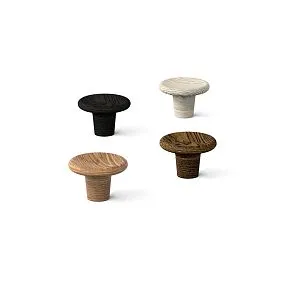
Wooden brackets
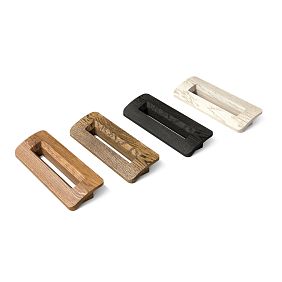
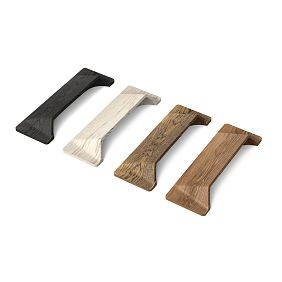
Wood creates warmth, naturalness, tactile pleasure.Wooden handle bracketsPleasant to the touch, do not chill hands in winter, age beautifully.
Hardwoods — oak, ash, beech, walnut — strong, durable, with pronounced texture.Oak bracketsWithstand intensive use, do not deform.
Exotic woods — teak, mahogany, rosewood, zebrawood — create a premium look, unique texture, rich colors. Expensive, but luxurious.
Light woods — ash, birch, maple, whitewashed oak — create a Scandinavian, light, airy aesthetic.Light wooden bracketsFor Scandinavian and minimalist interiors.
Finishing — oil enhances texture and creates a matte finish. Wax provides a silky feel. Lacquer creates a protective layer, can be matte or glossy. Lacquer is preferred for kitchens and bathrooms (more moisture-resistant).
Combined brackets
Combining materials unites their advantages. Wood + metal — warm wood + strong metal. Wooden handles with metal ends or inserts.Combined bracketsfor eclectic, neoclassical interiors.
Metal + leather — leather wrapping on a metal handle creates softness, premium quality. For designer furniture, offices, yachts.
Wood of different species — combination of light and dark wood in one handle creates visual interest, highlights craftsmanship.
Bracket sizes: from compact to monumental
Sizehandle-eyesaffects comfort, visual perception, proportions of furniture.
Short brackets 32-96 mm
Compact brackets for small furniture — narrow drawers of chests, small doors, bedside tables. Delicate, do not dominate, suitable for furniture with many drawers, where overall composition is important.Short brackets64 mm — often for upper drawers of chests, 96 mm — universal for medium-sized.
Medium brackets 128-192 mm
The most universal size range. Suitable for most kitchen fronts, wardrobes, chests.Bracket 128 mm— standard for kitchens 40-50 cm wide.Bracket 160 mm— for fronts 50-60 cm.Bracket 192 mm— for 60-80 cm.
Easy to grasp, secure in mounting, visually balanced with the front size.
Long brackets 256-448 mm
For wide fronts, tall doors.Bracket 256 mm— for fronts 80-100 cm.Bracket 320 mm— for 100-120 cm.Bracket 448 mm— for very wide cabinet doors.
Create horizontal graphic lines, modernity. Convenient — can be grasped at any point.
Extra-long hinges 512-960 mm and above
2026 trend — hinges running along the full height or width of the facade.Hinge 640 mmfor tall cabinets.Hinge 960 mmfor very tall wardrobe doors.
Visually elongate space, make furniture slimmer, create architectural expressiveness. Become the dominant element of the facade.
Proportion Rule
General rule: the center-to-center distance of the hinge should be 50-75% of the facade width (or height). For example, for a 60 cm facade, a 128-160 mm hinge is optimal (center-to-center 128-160 mm, facade width 600 mm, 128/600 = 21%, but visually balanced). However, this is only a recommendation — modern design welcomes breaking rules, especially with long hinges.
Application of hinges in various rooms
handle-eyesUniversal, but each room has optimal solutions.
Kitchens
Most common application of hinges. Kitchen — a high-traffic area, thereforehinges for the kitchenmust be strong, convenient, and resistant to moisture and grease.
Materials: stainless steel, aluminum with quality coating, brass (if willing to maintain). Matte finishes are more practical — fingerprints are not visible.
Sizes: for standard kitchen modules 40-60 cm — hinges 128-192 mm. For wide oven and dishwasher doors — 256-320 mm.
Shapes: straight L-shaped — classic for modern kitchens. Cylindrical — for Scandinavian. Profiled — for minimalist premium kitchens.
Placement: on upper cabinets — at the bottom (easier to pull down). On lower cabinets — at the top (easier to pull up). On drawers — centered horizontally.
Closets and cabinets
Hinges for cabinetsfor wardrobes should be convenient, strong, and aesthetically pleasing.
Materials: any — metal, wood, combinations. Moisture resistance is less critical than in the kitchen.
Sizes: for standard doors 60-80 cm — hinges 160-256 mm. For tall cabinets — long 320-640 mm, creating a vertical accent.
Shapes: straight for modern wardrobes, curved for neo-classical, wooden for Scandinavian and eclectic.
Placement: on tall doors — centered vertically or slightly above (more convenient for average height). On wide doors — two hinges symmetrically.
Commodes and cabinets
Hinges for commodesLess loaded, can be more decorative.
Materials: wood is especially suitable — warm, pleasant to the touch, suitable for bedrooms. Metal — for modern interiors. Combinations — for eclectic.
Sizes: depend on drawer width. For narrow (40-50 cm) — 64-96 mm. For medium (50-70 cm) — 128-160 mm. For wide (over 70 cm) — two hinges or one long 192-256 mm.
Shapes: straight for minimalism, curved for elegance, wooden with carving for classic.
Bathrooms
A humid environment requires corrosion-resistant materials.
Materials: stainless steel, aluminum with quality coating, brass (polished or lacquered).
Sizes: compact bathroom furniture — short brackets 64–128 mm.
Shapes: simple, easy to clean. Avoid complex reliefs where moisture and dirt accumulate.
Offices and offices
Office and office furniture require solidity and functionality.
Materials: metal (stainless steel, brass, black) for modern offices. Wood or wood+metal for respectable offices.
Sizes: medium and long brackets, creating a solid appearance.
Shapes: straight for offices, curved or combined for offices.
Bracket stylistic versatility
handle-eyesSo universal that they suit any style, but shape, material, and finish must match.
Minimalism
Straight geometric brackets, profiled solutions. Materials — matte metal (stainless steel, black, gray). No decoration, maximum functionality.Minimalist bracketsClean lines, geometry, modernity.
Scandinavian style
Simple shapes, natural materials.Wooden bracketsFrom light woods, cylindrical metal, wood+metal combinations. Functionality, naturalness, restraint.
Industrial style
Rough metal brackets, black matte, with texture. Tubular shapes, square profiles.Industrial bracketsUtilitarian beauty, technological sophistication.
Neoclassicism
Curved elegant brackets, combinations of metal (brass, bronze) and wood. Subdued decoration, symmetry.Neo-classic brackets— modern interpretation of classic.
Classic
Curved brackets with floral ornament, brass or bronze with patina, wood with carving.Classic bracketsHistorical solidity, luxury.
Eclecticism
Mix of shapes, materials, eras. Different brackets on different furniture, but unified by a common thread (color, material, proportions).Eclectic bracketsIndividuality, boldness.
Technical aspects: selection, purchase, installation
Determine the required size
When replacing handles, measure the center-to-center distance of existing ones. When installing on new furniture, calculate proportions — the bracket should occupy 50–75% of the facade width (or follow your taste, breaking the rules).
Quality check
Material: confirm what the bracket is made of. Zamak is cheaper but less durable. Steel, aluminum, brass are higher quality.
Finish: must be even, without streaks, bubbles, or roughness. Matte finish — velvety to the touch.
Mounting: screws included should be high-quality with good threading. Cheap screws rust and strip.
Weight: a quality bracket made from good material has a noticeable weight. Lightweight, hollow ones may be made of thin zamak.
Where to buy
Buy a furniture handlecan be purchased in specialized hardware stores, construction hypermarkets, online shops, or directly from manufacturers.
Specialized stores: consultation available, you can assess quality, but often more expensive.
Online: huge selection, price comparison, but you cannot touch or feel the product.
STAVROS offersWooden bracketshandmade, high-quality, with the option for custom orders.
Installation
Marking: use a template or measuring tools for accurate hole marking. Symmetry is critical.
Drilling: drill from the front side using a drill bit slightly larger than the screw (usually 4-5 mm). Place a wooden strip on the back side of the facade to avoid chipping when the drill exits. Drill perpendicular to the surface, slowly, without excessive pressure.
Screw insertion: insert screws from the back side of the facade, aligning withbracketthe screws. Tighten by hand first, then with a screwdriver or drill at low speed. Do not over-tighten — this may damage the threads, crack the facade, or deform the handle.
Check: after installation, check if the bracket is securely fastened, properly aligned, and easy to open. If there is play or misalignment, loosen the screws, adjust, and tighten again.
Care and Maintenance of Appearance
handle-eyeslast decades with proper care.
Regular cleaning: wipe with a damp soft cloth once a week or every two weeks. Remove dust, grease, and dirt. Then dry with a clean cloth.
Metal brackets: use neutral cleaning agents. Avoid abrasives, acids, and chlorine. Polished metals (chrome, brass) should be polished periodically with special products.
Wooden brackets: wipe with dry or slightly damp cloth. Avoid excess water. Every 1-2 years, reapply oil or wax — apply a thin layer, wipe off excess, and let dry.
Fastener inspection: check screw tightness every 6-12 months. Screws may loosen from frequent use. Tighten as needed.
Moisture protection: in bathrooms and kitchens, wipe water off brackets. Prolonged contact with water may cause corrosion even on stainless steel (especially at welds or fastening points).
Handle design trends for 2026
In 2026,handle-eyesare evolving in several directions.
Extra-long handles: 600-960 mm and longer, running along the full height or width of the facade. Create architectural expressiveness, graphic appeal, and convenience.
Organic shapes: smooth curves, waves, asymmetry, mimicking natural forms. Moving away from strict geometry toward sculptural forms.
Material combinations: wood+metal, leather+metal, stone+metal. Rich textures, individuality.
Matte finishes: velvety, tactile, premium. Especially in black.
Textured surfaces: relief, grain, linear patterns. Add tactile interest.
Hidden and profiled solutions: maximum minimalism, smooth facades without protruding elements.
Custom solutions: handmade, designer, unique handles from artisans and designers. Reject mass production.
Psychology of choice: what does your handle-bracket say about you
Choosingfurniture handle-bracketThis is not a random decision, but a reflection of personality, values, and lifestyle.
Straight geometric handles are chosen by people who value order, clarity, functionality. Minimalists, rationalists, technocrats.
Curved organic handles — the choice of people who value nature, harmony, softness. Romantics, nature lovers, creative personalities.
Long horizontal handles — for people who value modernity, technology, graphic design. Trendsetters, urbanites.
Wooden handles — chosen by people who value nature, eco-friendliness, tactile experience. Advocates of slow living, naturalists.
Combined handles — for eclectic, individualistic people who refuse to conform and value uniqueness.
Designer custom handles — chosen by people for whom details matter, who are willing to invest in quality, uniqueness, craftsmanship.
Ecological Sustainability
In the era of ecological awareness, choosinghandle-hingesalso becomes an ethical question.
Wooden handles made from FSC-certified wood: guarantee that the wood comes from managed forests where reforestation is underway.
Metal handles made from recycled materials: stainless steel, aluminum can be recycled multiple times without loss of quality.
Durability: high-qualitybracketlasts 20-30 years and more. This is the opposite of the culture of disposability, where things are discarded after a few years.
Repairability: high-quality handles can be restored — polish the metal, renew the wood finish, replace damaged parts.
Local production: choosing handles from local manufacturers such as STAVROS reduces transportation carbon footprint, supports local economy and artisans.
Minimal packaging: quality manufacturers use minimal, recyclable packaging, avoiding excessive plastic.
Conclusion: the handle as a philosophy of design
Furniture handle-hingeIt is not just a functional furniture element, but a design philosophy expressed in metal, wood, shape, lines. From minimalist geometric handles embodying strictness and functionality, to enveloping organic ones mimicking natural softness — handles of 2026 offer endless variety for any style, any aesthetic, any personality.
Choosing the right handle is a balance between functionality and aesthetics, between comfort and visual impact, between mass production and individuality.Buy kitchen handlesIt is an investment in details that daily interact with you, shaping your perception of furniture and interiors, serving for decades and becoming part of your home’s history.
Company STAVROS offers a wide rangehandle-hingesFrom classic straight to designer organic, from metal to wooden, from standard sizes to custom solutions. We understand that every detail matters in creating a harmonious interior, and we offer quality that serves for decades.
Wooden bracketsHandles from STAVROS are made from solid oak, walnut, beech — species that are beautiful, durable, and pleasant to the touch. Our craftsmen create each handle by hand, paying attention to texture, shape, and finish. We offer straight minimalist handles for modern interiors, curved elegant ones for neoclassicism, combined wood+metal for eclecticism.
We offer custom manufacturing — you can order a handle of a specific length, shape, from a particular wood species, with a unique finish. Your furniture deserves unique details that reflect your individuality.
Furniture HandlesHandles from STAVROS — an investment in quality, durability, beauty that will delight you and your loved ones for years. Choose details that create character. Choose STAVROS — and your furniture will acquire a soul, expressed in perfect form, noble materials, and masterful craftsmanship.