












































































Article Contents:
- Ceiling Socket: Choosing Diameter and Shape
- Rule of Thirds: Linking Socket Size to Room
- Socket Shape: From Circle to Polygon
- Relief and Ornamentation: From Simple to Complex
- Central Hole: Function and Aesthetics
- Aligning Socket with Staircase Posts
- Stylistic Unity: Common Language of Forms
- Proportional Harmony: Scale and Rhythm
- Material Harmony: Wood, Polyurethane, Gypsum
- Color Solution: Contrast or Nuance
- Stylistic Interpretations: From Neoclassicism to Modernity
- Minimalist solutions: minimalism in form
- Art Deco: Geometric Luxury
- Modern Classicism: Balance of Tradition and Innovation
- Minimalism: Accent Through Absence
- Lighting and Power: Technical Aspects
- Calculating Lighting Power
- Socket as Light Reflector
- Chandelier Weight and Socket Load Capacity
- Wiring Integration
- Implemented Projects: Cases from Practice
- Case 1: Country Estate in Neoclassical Style
- Case 2: Urban Apartment in Art Deco Style
- Case 3: Contemporary Apartment in Contemporary Style
- Case 4: Townhouse in Scandinavian Style
- Practical recommendations for selection and installation
- Sequence of Actions
- Common mistakes
- Conclusion

In interior architecture, there are elements that operate in the background — baseboards, cornices, door casings. They are important but do not attract attention. And there are soloist elements that become compositional centers around which the entire spatial drama is built. The ceiling socket under the chandelier and the staircase posts — these are exactly such elements. They draw the eye, set the tone of the interior, and demonstrate the owner’s status and taste.
Surprisingly, these two elements — one on the ceiling, the other on the staircase — are connected not only functionally (both are accents), but also compositionally. In a well-designed interior,Polyurethane moldings for ceilingsas a socket andBalusters and posts for wooden staircasesform a visual axis connecting the vertical space — from floor through the staircase to ceiling and chandelier.
Ceiling rose: choosing diameter and shape


Ceiling rose: choosing diameter and shape
The rose under the chandelier is not just a decorative cover hiding the mounting point of the light fixture. It is an independent architectural element that organizes the ceiling plane, creates a compositional center, and emphasizes the importance of the chandelier.ceilings with moldingsThey look finished, acquiring an architectural structure.




The rule of thirds: the relationship of the rose's size to the room
There is a proven formula for calculating the optimal rose diameter: it should be approximately one-third of the chandelier's width or one-tenth of the room's smaller side. For a 4x5 meter room, the optimal rose diameter is 40-50 cm. For a spacious 6x8 meter living room, it is 60-80 cm.
A too small rose disappears on a large ceiling, looking short and disproportionate to the chandelier. A too large rose overwhelms the space, creating an impression of a low ceiling. The golden middle is determined not only by mathematics but also by visual intuition — the rose should appear proportionate to the room.
The ceiling height also affects the choice of diameter. For ceilings 2.5-2.7 meters high, roses with a diameter over 60 cm are already excessive — they visually lower the height. For ceilings 3.5-4 meters high, roses 80-100 cm look harmonious and proportional.Polyurethane decorative molding for wallsIt should be scaled to match the ceiling rose.
Our factory also produces:



Rose shape: from round to polygonal
The classic rose is round. A circle is a symbol of perfection, harmony, and infinity. It is universal, suitable for any style, from baroque to minimalism. Round roses with diameters ranging from 20 cm (for small rooms like bedrooms or offices) to 120 cm (for grand halls and mansion living rooms) make up 80 percent of the entire assortment.
Oval roses are used in elongated rectangular rooms where a round rose would appear disproportionate. An oval repeats the room's geometry, creating visual harmony. Typical oval sizes are 50x70 cm, 60x90 cm, 80x120 cm.
Square and rectangular roses — a choice for modern interiors where geometric clarity is valued. A square with sides 40-60 cm acts as a graphic accent on a smooth ceiling. A rectangle can be very elongated — 30x100 cm — creating a linear composition for multiple fixtures in a row.
Polygonal roses — hexagonal, octagonal — refer to Islamic architecture, creating an exotic accent. They require appropriate context — oriental motifs in the interior; otherwise, they appear foreign.
Get Consultation
Relief and ornamentation: from simple to complex
The depth of relief determines the expressiveness of the rose. A shallow relief of 5-10 mm creates a delicate texture, suitable for close viewing. A deep relief of 20-40 mm provides strong chiaroscuro, visible from afar, creating a dramatic effect.
Smooth roses with minimal relief — concentric circles, simple geometric patterns — are suitable for minimalism and modern classicism. They structure the ceiling without overloading it with details.installation of polyurethane moldingSuch elements are simple and quick to install.
Roses with vegetal ornament — acanthus, laurel, oak leaves intertwined in wreaths — are characteristic of baroque and empire styles. They create opulence and grandeur, suitable for formal interiors. The diameter of such roses is usually 60-100 cm, with multi-level ornamentation and deep relief.
Roses with geometric ornament — meanders, rosettes, modular patterns, casettes — are characteristic of neoclassicism and art deco. They combine classical forms with geometric precision, suitable for elegant but not overly ornate interiors.
Roses with radial structure — rays spreading from the center, forming a star or sun — create dynamism and energy. They are suitable for high ceilings where the relief is visible. The number of rays is usually a multiple of four or six for symmetry.
Central opening: function and aesthetics
The hole in the center of the rose is intended for passing the chandelier's wire and mounting hardware. Its diameter is usually 8-15 cm, sufficient for most mountings. However, the hole is not merely a technical necessity — it is a compositional center that must be aesthetically refined.
A simple round hole with a smooth edge — minimalist option. A hole with decorative trim — beads, leaves, rosettes — classic option. A hole shaped like a recessed funnel with petals — luxurious option for mansions.
If the chandelier is mounted on chains or cables, the hole can be minimal — 3-5 cm, only for the wire. If the chandelier is mounted on a heavy rod, a 10-15 cm hole is needed. Choose a rose with the appropriate hole diameter, or be prepared to enlarge it during installation.
Aligning the rose with staircase columns
The staircase and chandelier are often located in the same space — the hall or living room. They must be visually coordinated, forming a unified composition.Balusters and posts for wooden staircasesThe staircase columns and the ceiling rose — two accents that communicate with each other.
Stylistic unity: a common language of forms
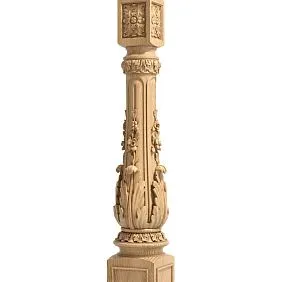
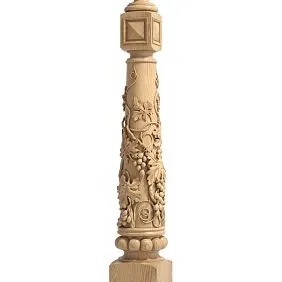
If the rose is executed in a classical style with vegetal ornament, the staircase columns should have classical proportions, possibly with carved capitals and decorative capitals. Simple square columns would conflict with an ornate rose.
If the newel post is geometric, minimalist, in the Art Deco style, the balusters should also be of strict forms - square or octagonal section, with minimal decoration. Ornate, carved balusters would be out of place.
If the newel post is minimalist or absent (modern interiors often do without newel posts), the staircase should also be minimalist -Flat wooden balusters, metal posts, glass panels.
Proportional correspondence: proportions and rhythm
A large newel post with a diameter of 80-100 cm requires proportionally sized posts - massive, 120-150 cm high above the handrail, 12-15 cm in diameter (or side of square). Thin, delicate posts against a giant newel post look disproportionate.
A small newel post of 40-50 cm harmonizes with elegant posts 80-100 cm high, 8-10 cm thick. Massive, thick posts would overwhelm a small newel post.
The rhythm of balusters between posts can correspond to the rhythm of the ornament elements on the newel post. If the newel post has 24 rays or petals, the number of balusters on the staircase can also be chosen as a multiple of 6 or 8. This creates a subtle harmony that is felt subconsciously.
Material correspondence: wood, polyurethane, plaster
Traditionally, staircase posts were made from the same material as the molding - wood or stone in wooden houses, plaster in stone palaces. Today, materials are combined more freely, but logic should prevail.
A wooden staircase with massive oak posts harmonizes well with a polyurethane newel post painted to resemble wood - in warm beige-brown tones. Imitating wood texture is not mandatory (polyurethane will never fully match), sufficient color harmony is enough.
If the staircase is modern - metal frame, glass panels, wooden steps - the newel post should also be of modern form. It is better to completely abandon the newel post in favor of minimalist ceiling-mounted chandelier fixtures.
A classical stone or marble staircase (in mansions, palaces) requires an opulent plaster or polyurethane newel post with deep relief, imitating plaster molding.Facade decoration made of polyurethaneThe same series can be repeated on exterior portals, creating unity between interior and exterior.
Color solution: contrast or nuance
Classic option - white newel post and white (painted) or natural color (polished) wooden posts. White color unifies disparate elements, creating a sense of purity, classic elegance. This option works well in neoclassicism, Scandinavian style, Provence.
Contrasting option - dark posts (wenge, black paint) and white newel post on a white ceiling. Contrast creates graphic effect, suitable for modern classicism, Art Deco. Dark staircase grounds the space, white newel post lightens the ceiling.
Monochromatic option - posts and newel post of the same color, for example, all painted gray or beige. This creates a calm, harmonious space without sharp accents. Suitable for minimalism, Japanese style.
Colored option - posts and newel post painted in saturated colors (blue, green, burgundy). This is a bold solution for eclectic interiors, requires professional color sense. Color should repeat in other interior elements - textiles, furniture.
Stylistic interpretations: from neoclassicism to modernity
Each interior style imposes its own requirements on accent elements. Let's examine how the newel post and staircase posts function in different stylistic contexts.
Neoclassicism: elegant restraint
Neoclassicism takes proportions, symmetry, and order system from classical style, but simplifies ornamentation, making it more delicate. Newel post for neoclassical interior - diameter 50-70 cm, shallow relief (10-15 mm), ornament of stylized laurel wreaths, rosettes, flutes.
Prefer symmetric compositions with clear center - circle divided into sectors by radial lines, each sector filled with identical ornament. No asymmetry, free swirls, random elements.Polyurethane wall decorIn neoclassicism, it also adheres to strict symmetry.
Color - white or very light beige, ivory. Newel post does not contrast with ceiling, but creates subtle texture. Light patination - gold or silver - in recesses of relief for emphasizing volume.
Staircase posts in neoclassical style - square section 10-12 cm, height 100-120 cm, simple base, smooth stem, cap with minimal profiling. Material - painted white wood or natural light oak under matte lacquer.
Balusters between posts - turned, classic profile, but without excessive baroque ornamentation. Baluster consists of base, central thickening (body), and upper collar. Proportions elongated, elegant. Color matching posts.
Lighting - classic multi-armed chandelier made of crystal or metal with crystal pendants. Chandelier is elegant but not massive - diameter 60-80 cm for living room area 25-30 sq.m. Light is soft, diffused through crystal elements.
Art Deco: geometric luxury
Art Deco loves geometry, graphic design, symmetry, and simultaneously - luxury materials, rich finishes. Newel post in Art Deco style - more often square or octagon with diameter (side) 60-90 cm, with clear geometric ornament.
Typical Art Deco ornament - concentric rhombuses, stepped pyramids, radial rays forming stars, zigzags. Relief deep - 20-30 mm, creating strong chiaroscuro. Forms angular, without smooth curves of classicism.
Color - contrasting. Black newel post on white ceiling, white on black, gold on dark blue. Art Deco loves drama, theatricality. Use of metallic paints - gold, silver, bronze - to emphasize the geometry of the ornament.
Staircase newels in art deco - geometric shapes, often octagonal or with flat faces. Height 120-150 cm, thickness 12-15 cm. Material - dark wood (wenge, stained oak) or painted black/dark brown. Possible inlays of metal or mother-of-pearl.
Balusters - not traditional turned, but flat or square, closely spaced, creating almost a solid wall with narrow gaps. Each baluster may have a geometric pattern - cut-out rhombuses, triangles. Color contrast - dark balusters on light walls or light ones on dark backgrounds.
Lighting - geometric chandeliers, often with lampshades in the form of cubes, cylinders, truncated cones. Materials - chrome, nickel, bronze, milk or smoked glass. Directional light, creating sharp shadows that emphasize geometry.
Modern Classicism: balance between tradition and innovation
Modern classicism is a reinterpretation of classical forms using modern materials and technologies. The rose here may be traditionally round, but with simplified ornamentation or even smooth, with only concentric rings.
Diameter 40-60 cm, minimal relief 5-10 mm. Shape may be non-traditional - square, rhombus, but with classical proportions, inscribed in a circle or square. No random, asymmetrical compositions - everything is governed by order.
Color - neutral. White, gray, beige - tones that create a background, not a dominant feature.Ceiling molding made of polyurethaneIn modern classicism, form and color are also restrained.
Staircase newels - simple shapes, square or round cross-section 10-12 cm, without capitals or bases in the classical sense. Maximum - slight tapering downward for elegance, beveled edges to soften geometry.
Material - natural wood of noble species (oak, ash, walnut) under matte oil or varnish, preserving texture. Color natural or slightly tinted in gray shades.polyurethane decorative cornersMay complement wooden elements.
Balusters - simple profile or flat, spaced evenly. Possible combination of materials - wooden newels and glass panels between them, metal posts with wooden handrails.
Lighting - modern chandelier with classical proportions. This may be a multi-tiered structure with simple spherical, cylindrical lampshades. Or a ring chandelier - one or several concentric rings with LED backlighting. Bright, but not harsh, evenly distributed light.
Minimalism: accent through absence
Minimalist interiors often forgo chandeliers entirely - the chandelier is mounted directly to the ceiling, and the mounting point is concealed flush. But if a chandelier is used, it is extremely minimalist - a simple circle or square 30-40 cm in diameter, without ornamentation, just two or three concentric rings.
Minimal relief - 3-5 mm, creating barely noticeable texture. Color exactly matching the ceiling or contrasting (black rose on white ceiling), but without gradients, patina, or decorative effects.
Staircase newels - simple prisms with square cross-section 8-10 cm, without bases or capitals. Or entirely metal posts 50-60 mm in diameter from stainless steel or matte black metal.
Balusters - flat wooden or metal verticals, creating rhythmic graphics. Or glass panels - absolutely smooth, transparent or matte, without pattern.
Lighting - minimalist chandelier with geometric shape or group of simple-form pendant lights - spheres, cylinders, cones. Bright, functional light, without decorative effects.
Lighting and power: technical aspects
Chandelier rose - not only decoration, but also a technical detail that must match the chandelier's parameters.
Lighting power calculation
For residential spaces, recommended illumination is 150-200 lux. For a 25 sq.m. living room, this is 3750-5000 lumens. Modern LED lamps provide about 100 lumens per watt, so a chandelier with total LED power of 40-50 W or equivalent in other lamp types is needed.
The number of chandelier arms is determined not only by light, but also by aesthetics. For a 25 sq.m. living room, a chandelier with 6-8 arms is optimal, allowing lamps of 5-7 W each. This creates even light distribution and visually harmonious construction.
Chandelier suspension height is critical. From the lowest point of the chandelier to the floor, there should be at least 2.1 meters in walkways, 1.8 meters above the table. For a room with a 2.7-meter ceiling and a 60 cm chandelier, the distance from the ceiling to the chandelier is 50-60 cm, which is normal. For a 3.5-meter ceiling, the chandelier may descend 1-1.2 meters.
Rose as a light reflector
A white rose acts as an additional reflector, increasing lighting efficiency by 10-15 percent. The rose's relief diffuses light, creating soft shadows and reducing the harshness of direct lamp light.
Colored or dark rose absorbs light, reducing illumination. If you use a black rose in art deco, account for this and increase chandelier power by 20-30 percent.
Deep rose relief under side lighting creates beautiful light-shadow play on the ceiling. Directional spotlights or track lights shining at an angle onto the rose transform it into a standalone art object.
Chandelier weight and rose load capacity
The polyurethane rosette is not a load-bearing element. The chandelier is mounted to the ceiling through the rosette, but the weight is supported by the ceiling anchor, not the rosette. The rosette merely conceals the mounting point.
The maximum weight of a chandelier that can be hung through the rosette is limited not by the rosette, but by the ceiling. A concrete ceiling can support up to 100-150 kg (but such heavy chandeliers are rare). A gypsum board ceiling supports up to 5-10 kg; for heavier chandeliers, embedded anchors extending into the main ceiling are required.
If the chandelier is very heavy (a palace-style crystal chandelier weighing 50-80 kg), the rosette can be reinforced — glued with a particularly strong adhesive and additionally secured with anchors around the perimeter. However, the main weight is still borne by the anchor in the ceiling.
Wiring integration
Modern rosettes have a central hole with a diameter of 8-15 cm, through which the chandelier's wiring and mounting hardware pass. This is sufficient for most installations. If the chandelier is mounted on a thick rod with a diameter of 20-25 cm, the hole will need to be enlarged.
The hole is expanded using a sharp knife (for polyurethane) carefully, in a circular motion. The edges are sanded with sandpaper. After installing the chandelier, the edges of the hole are not visible — they are concealed by a decorative mounting cap.
If there are several chandeliers in a room (for example, two chandeliers along the central axis in a long living room), you can use several identical rosettes to create a rhythmic composition. Or, one large oval rosette under which two chandeliers are mounted.
Implemented projects: real-world cases
Theory takes on flesh through concrete examples. Let's consider several implemented projects where the rosette and staircase balusters create a unified composition.
Case 1: Country estate in neoclassical style
Object: two-story mansion, 350 sq. m, Moscow region. Hall area 40 sq. m, ceiling height 3.8 meters. Grand staircase made of light marble leading to the second floor is located in the center of the hall directly under the chandelier.
Rosette solution: circular rosette with a 90 cm diameter and shallow (12 mm) relief ornament of laurel wreaths and rosettes. Material — high-density polyurethane. Color — matte white with a slight cream tint, with a light gold patina in the ornament recesses for added depth.
Staircase solution: square-sectioned oak support columns, 14x14 cm, 140 cm high. Painted in white semi-matte. Base 25 cm high with simple profiling, smooth shaft, 20 cm high capital with classical breaks. Turned balusters, classic profile, white, installed at 12 cm intervals.
Lighting: classic-style crystal chandelier, 12 arms, 120 cm diameter, 100 cm height. Suspended by chains 80 cm from the ceiling. Total power 600 W (halogen lamps), providing luxurious bright lighting and light play in the crystal.
Result: a composition of tremendous power. Entering the hall, one sees a vertical axis — the white staircase columns rise upward, the gaze glides along them to the second-floor landing, then to the sparkling chandelier and the crowning rosette. All elements are unified in style, proportionally balanced, evoking a sense of grandeur and elegance.
Case 2: City apartment in art deco style
Object: three-room apartment, 120 sq. m, in a Stalinist building, Moscow. Living room 28 sq. m with ceiling height 3.2 meters. Staircase to the attic second level (library) located against the far wall of the living room.
Rosette solution: square rosette with 70 cm sides, rotated 45 degrees (oriented as a rhombus). Geometric ornament — concentric squares with stepped angles, forming a pyramidal structure. Deep relief — 25 mm. Contrast color — glossy black rosette on a matte white ceiling.
Staircase solution: octagonal-sectioned mahogany support columns, inscribed circle diameter 12 cm, 120 cm high. Dark brown color, almost black, under glossy lacquer. Column faces slightly concave, creating light play. Balusters — flat, made of the same wood, 25 mm thick, 80 mm wide, with cut-out rhombuses in the center. Installed closely, 30 mm apart.
Lighting: art deco-style chandelier — chrome metal structure with geometric shape (concentric rings of different diameters), 80 cm diameter, 60 cm height. Lanterns — milk glass in truncated cone shape, 6 units. Total power 360 W (LED lamps), bright downward-directed light.
Result: dramatic, theatrical composition. The black square rosette on the white ceiling — a graphic accent that immediately draws attention. The dark staircase with geometric balusters continues the theme of graphics and contrast. The chrome chandelier connects top and bottom, reflecting light and creating highlights on the glossy surfaces of the columns. The interior looks luxurious, stylish, with a strong character.
Case 3: Modern apartment in contemporary style
Object: studio apartment, 80 sq. m, in a new building, St. Petersburg. Ceiling height 2.8 meters. Staircase to the second level (bedroom on the attic) located in the center of the studio, chandelier above the dining area 3 meters from the staircase.
Rosette solution: simple circular rosette with 45 cm diameter and minimal relief — three concentric rings 5 mm deep. Color — gray, exactly matching the ceiling tone (light gray, RAL 7035). The rosette is almost invisible, creating only a subtle texture on the smooth ceiling.
Staircase solution: metal frame made of black matte profile, steps made of natural-colored oak under oil. Support columns — black metal tubes 60 mm diameter, 110 cm high. Railing — 12 mm thick glass panels mounted in aluminum profiles. Handrail — oak, round section 50 mm diameter.
Lighting: three pendant lights in a row above the dining table. Each light — simple frosted white glass globe, 25 cm diameter, on a black cord. Total power 150 W (LED), soft, even light.
Result: restrained modern composition. The rosette is so delicate that it is almost invisible — it does not compete with the minimalist staircase, but creates a subtle structure on the ceiling. The black metal elements of the staircase echo the black cords of the pendant lights. The wooden steps and handrail add warmth to the cold geometry of metal and glass. All elements are simple, yet carefully proportioned, creating a sense of modern comfort without excess.
Case 4: Townhouse in Scandinavian style
Object: townhouse, 180 sq. m, Finland. Living-dining room 35 sq. m with ceiling height 3 meters. Wooden staircase to the second floor (bedrooms) located along the wall, chandelier above the dining table in the center of the room.
Rosette solution: circular rosette with 50 cm diameter and simple relief — radial rays from the center forming a sun. Relief depth 8 mm. Color — matte white, without patina or decorative effects. Clean, simple form.
Staircase solution: support posts made of light beech wood with square cross-section 10x10 cm, height 95 cm. Painted in matte white. Corners of the posts are slightly rounded with a 5 mm radius for softness. Balusters - vertical square planks 4x4 cm made of the same beech, white, installed with a 8 cm spacing. Handrail - round, 45 mm diameter, beech wood with clear matte oil finish (natural light texture preserved).
Lighting: Scandinavian-style pendant lamp - white metal conical shade, 50 cm in diameter, 35 cm high. Inside - 40 W LED lamp, providing bright downward light (for dining table) and soft upward reflection (from the inner white surface of the shade).
Result: a bright, airy space. White ceiling rose on a white ceiling creates a subtle texture without overwhelming. White staircase is light, almost weightless, does not clutter the space. Natural wood handrail - the only warm accent that adds coziness without disrupting the overall light palette. Scandinavian simplicity and functionality in pure form.
Practical recommendations for selection and installation
Theoretical and examples are good, but practical advice is needed for implementing your own project.
Sequence of actions
Start designing with an overall interior concept - style, color palette, materials. This will determine the choice of ceiling rose and staircase.
Choose the chandelier. Its size, style, and mounting method determine the requirements for the ceiling rose. Multiply the chandelier's diameter by 0.6-0.8 to get an approximate rose diameter.
Select a ceiling rose to match the chandelier - in style, scale, and color. Ensure the hole in the rose is suitable for mounting your chandelier.
Design the staircase - construction, materials, details. Posts and balusters must stylistically match the ceiling rose - unified in form language, proportions, and color.
Order all elements from reputable manufacturers.polyurethane moldings buyWhich are available from reliable suppliers, guaranteeing quality.
Install in the correct sequence: first the staircase (it is heavy and may damage finishes), then the ceiling rose, lastly the chandelier.
Typical mistakes
Mismatched scale - a tiny rose under a huge chandelier or vice versa. Always maintain proportions.
Stylistic mismatch - a baroque rose and a minimalist staircase. Choose one style and follow it consistently.
Wrong color - a rose that clashes in color with the ceiling or staircase. Plan the color harmony in advance.
Poor installation quality - poorly glued rose, visible gaps and seams. Entrust installation to professionals or study the technology thoroughly.
Insufficient lighting - a chandelier too weak for a large room. Calculate power using formulas, not by guesswork.
Conclusion
Ceiling rose and staircase posts are not just functional structural elements. They are accents that define the character of the interior, demonstrate style and taste, and create visual axes that organize space.ceilings with moldingsAs ceiling roses, they acquire architectural completeness, becoming not just flat surfaces but compositionally worked surfaces.
Proper coordination of the ceiling rose and staircase posts is a sign of professional design approach. These elements must speak the same language - stylistically, in scale, and in color. A classical round rose with floral ornament requires classical turned posts. An art deco geometric rose requires geometric posts and balusters. A minimalist rose requires a sleek modern staircase.
The diameter and shape of the ceiling rose are determined by room size, ceiling height, and chandelier parameters. The formula is simple: rose diameter is approximately one-third of the chandelier's width or one-tenth of the room's smaller side. Shape follows style - round for classic, square for art deco and minimalism, oval for elongated rooms.
Lighting - a critical factor. The ceiling rose not only decorates but also affects light distribution. White rose acts as a reflector, dark rose absorbs light. Relief diffuses, creating soft shadows. Consider this when calculating chandelier power.
STAVROS company offers a full range of elements for creating harmonious interior compositions - from elegant ceiling roses of all styles and sizes to noble solid wood posts and balusters. High-quality materials, precision craftsmanship, and diverse designs allow implementing projects of any complexity - from modest apartments to luxurious mansions. Choosing STAVROS means choosing reliability, beauty, and professional support at every stage of creating your dream interior. Create a home where every detail is thought out, every accent contributes to overall harmony, where the ceiling rose under the chandelier and staircase posts silently converse about style, taste, and perfection of form.


