










































































Article Contents:
- What are carved window trims and why are they needed
- Types of Carved Window Casings
- By pattern type
- By Carving Saturation
- By composition
- Why wooden carved window trims are the best option
- How to Choose Carved Window Casings
- By House Style
- By window size
- By depth and density of carving
- Carved window trims for a wooden house
- What to combine carved window trims with
- Technical parameters: what you need to know before ordering
- Carved window trims: step-by-step selection
- What affects the price of carved window trims
- Where to buy carved window trims
- Installation of carved trims: basic principles
- Comparison table: which carved trim to choose for your house type
- FAQ: common questions about carved window trims
- How to choose carved window trims?
- Which carved window trims are better: with floral or geometric ornament?
- Where to buy carved window trims for a wooden house?
- How much do carved window trims cost?
- Can I order carved trims in non-standard sizes?
- How to paint wooden carved trims for outdoor use?
- Carved window trims - for windows only or for doors too?
- How to combine carved window trims with the rest of the facade decor?
- Conclusion

There are houses that are memorable. Not because they are big or expensive - but because they have character. A detail that catches the eye. One element that says: people with taste live here. Most often, this detail turns out to beCarved window casings— a wooden ornamental frame that turns a window from an architectural necessity into an accent element of the facade.
Buying carved window trims doesn't just mean choosing a beautiful pattern. It's a decision about what your house will be like. What style you want to convey. How the carving on the windows relates to the cornice, the house carving, and the overall architecture of the building. Wooden carved window trims don't work alone - they are part of a system. And it's best to choose them from this perspective: not as a separate product, but as part of an entire facade composition.




What are carved window trims and why are they needed
Before talking about selection, it's worth understanding the nature of this element. What exactly does it do - functionally and architecturally.
Framing the window opening. In its basic function, the trim covers the mounting gap between the frame and the wall. But that hasn't been the main point for a long time. A plastic seal would handle that task just as well. A wooden carved trim is a different story: it doesn't just cover, it frames. It turns a technical opening into an architectural portal.
Enhancing the house's image. The facade is the building's face. And the window is the main feature of that face. A smooth window without framing is a gaze without eyebrows: there's a physiognomy, but no expression.Carved window casingsgive the window expression - character, intonation, strength.
Visual emphasis on the facade. A well-executed carved window surround is the first thing a person looks at when approaching a house. It sets the scale and rhythm of the entire facade. An expressive ornament on the window framing works as an anchor for the gaze, structuring the plane of the wall.
Connection with the tradition of house carving. A wooden house with carved window surrounds is not a fashionable trend or a retro game. It is a living tradition of folk architecture that goes back centuries.wooden house carving— is an integral system: window surrounds, cornices, fascia boards, brackets — all are connected by a single ornamental language. Entering this system through the window surround is the most organic way.




What types of carved window trims exist
The assortment of wooden carved window surrounds is significantly richer than it seems at first glance. Before making a choice, it is useful to understand the classification.
Our factory also produces:


By pattern type
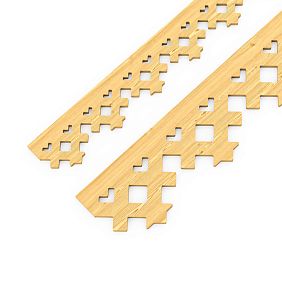
Geometric patterns. Diamonds, zigzags, meanders, symmetrical lattices — strict, mathematically precise carving. Perfect for houses with restrained architecture: Scandinavian style, modern timber, minimalism with wooden elements. Geometric carving is well legible from a distance — the silhouette is clear, the ornament does not get lost.
Floral patterns. Leaves, shoots, scrolls, flower heads — natural forms in a wooden interpretation. The most lively and plastic type of carving. Floral ornament on a window surround enriches the facade with 'biological' dynamism — there is always movement, growth, directionality here. Suitable for country, Provence, classic, country houses with a garden.
Classical patterns. Acanthus, cartouche, volute, ornamental frames — this is carving with European roots, oriented towards symmetry, hierarchy, and balance. Classical carved window surrounds are appropriate for cottages in the Empire, Neoclassical, or strict historical aesthetic styles.
Patterns in the Russian style. Solar disk, kokoshnik, fretwork scroll, 'repi', 'yagodki' — folk motifs born in wooden architecture. Carved window surrounds in the Russian style are the most expressive and most authentic option for a log cabin, wooden house, or traditional Russian dacha.
Modern laconic patterns. Not carving in the traditional sense, but rather architectural relief: parallel grooves, horizontal scores, a small geometric accent on the edge. For those who want a 'living' window surround without historical connotations.
Get Consultation
By carving density
Restrained relief. Shallow carving with soft transitions. Ornament is present but not dominant. A good choice for houses where the window trim should not be the main hero of the facade — only a supporting note.
Expressive carving. Deep relief with clear shadows, a well-readable silhouette, a recognizable ornament. This is the main working category: the trim is noticeable, beautiful, not loud, but holds the gaze.
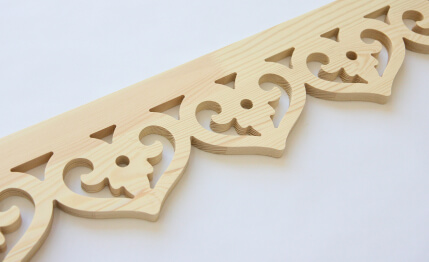
Decorative 'wooden lace'. Saw-cut technique — where the carving forms an openwork contour that shows through. Maximum elegance, maximum effect. Used on facades with a developed artistic program — wheredecorative carved facadeis built as a holistic architectural statement.
By composition
Side elements. Carved vertical slats on the sides of the window opening. They set the height of the frame and create 'columns' on the sides of the window.
Upper pediment. A horizontal 'cap' above the window — often the most decoratively rich part of the trim. It is here that the main ornament is traditionally placed: a solar disk, a floral rosette, a cartouche.
Carved windowsill board. An element that is often overlooked — and in vain. The lower horizontal board under the window with a carved ornament completes the 'frame' from below and gives the opening true completeness.
Complete frame around the window. Full set: two side slats + upper frieze + lower board + connecting rosettes in the corners. Such a frame turns the window into an independent architectural object.
Why wooden carved window trims are the best option
Alternatives exist: polyurethane foam, plastic, MDF with film, metal profiles. They all have their admirers — and they all fall short of wood in one key quality.
Natural material — living texture. A carved wooden casing is not an imitation of an ornament, but an ornament in a living material. The texture of wood participates in the pattern: fibers, annual rings, cut density create visual depth that artificial material lacks. No polyurethane casting can give this feeling — only wood.
Expressiveness of texture for finishing.Wooden carved window sillsare supplied without a final coating — this is a deliberate decision. You choose the finish yourself: white paint, dark oak tinting, oil with a natural shade, antiseptic with a light tint. Wood accepts any coating — and each time gives a different result, depending on the species and finishing method.
Good compatibility with a wooden house. Wood on wood is not a tautology, it is harmony.Beautiful carved casingsmade of pine or oak on a log house look organic precisely because both materials belong to the same natural system. A plastic casing on a wooden log house is a break in context that is felt immediately.
Repairability. After ten to fifteen years, any facade element requires maintenance. A wooden casing is sanded, treated with antiseptic, and repainted — and it's like new again. Plastic has cracked, polyurethane foam has yellowed? They need to be replaced entirely. Wood can be restored.
Holistic perception of the facade. When the casing, cornice, brackets, and connecting elements are made from the same material — the facade is perceived as a single whole. This is not just an aesthetic observation: it is precisely such unity that forms that feeling of a 'quality house' which is impossible to describe in words, but which everyone who passes by feels.
How to choose carved window trims
Now we've reached the most practical section. Theory is good, but the choice is made under specific conditions: a specific house, specific windows, a specific budget. Let's break it down by blocks.
By house style
Russian style. This is perhaps the most obvious case: a Russian wooden house requires Russian carving. Pierced ornaments, solar disks, kokoshnik finials—all of these work precisely here. To buy carved window trims in the Russian style means choosing a type of ornament that historically 'belongs' to this architecture. For more details on how to select patterns, see the article aboutornaments for a wooden house.
Wooden house (log house, log). The key parameter here is scale. The log is large, the facade is powerful. The trim must be proportionate: wide, with an expressive ornament. A thin, lacy pattern will get lost on a thick log. A contrasting, easily readable pattern is needed.
Timber-framed house. A timber house is more restrained in character than a log one. Here, both floral and geometric ornaments are appropriate, depending on the overall character of the building. Trim width is 90–120 mm, with moderate relief.
Dacha (country house). At a dacha, there are fewer obligations. You can afford a festive floral pattern, bright painting, a playful ornament. Wooden carved window trims for a dacha are always a bit of a celebration. To buy carved window trims for a dacha in a bright design is an investment in the atmosphere, in the mood of a dacha summer.
Cottage with a decorative facade. If the facade already carries architectural elements—pilasters, cornices, decorative brackets—the trim must integrate into this system. Here, it's worth looking at ready-made facade solutions: the sectionfacade decorationprovides ready-made examples of how carved trims work in an ensemble with other elements.
To window size
For small windows (width up to 800 mm) — trim width of 60–80 mm. The ornament should be large and readable, without small, fragmented filling. A narrow trim with fine carving on a small window simply won't be visible from a distance.
For wide openings (1200–1500 mm) — trim width of 100–130 mm. Here, you can apply a complex ornament with a central motif and corner accents. A wide trim with a floral or classical pattern holds a large opening effortlessly.
For tall facades — the vertical side strips should be 'held' not by length, but by ornamental rhythm: a repeating motif along the strip creates vertical dynamics and prevents the side trim from looking boring.
Practical proportion rule: casing width is 8–12% of the opening width. For a 1000 mm window, that's 80–100 mm. No more — otherwise the window visually 'shrinks'; no less — otherwise the casing gets lost.
By depth and density of carving
When light, airy lacework is needed. Openwork carving with gaps is a celebration. It suits a dacha, a house in Russian folk style, any object where festivity is valued more than restraint. This 'wooden lace' is beautiful, light, transparent.
When a rich accent decor is needed. Deep relief, distinct shadows, confident silhouette — for a cottage with character, for a house that wants to make a statement.Wooden carved window casingwith pronounced carving depth works as an architectural accent even at a significant distance.
How not to overload the facade. The main mistake is 'the more carving, the better.' No. The richness of a facade is not the quantity of ornament, but its quality and coherence. One expressive carved casing on the main window will work better than five different carved elements unrelated to each other. Moderation is a sign of taste.
Carved window casings for a wooden house
Wooden house and carving are almost synonymous. But why exactly does wood require wooden ornament, not just any decor?
Material organicity. In a wooden house, all elements — walls, beams, casings — belong to one material world. A carved pine casing on a log cabin is a continuation of the architecture, not an addition to it. A foreign material always 'falls out' of this unity, even if it looks similar externally.
How to combine carved window trims with the facade. Focus on three parameters: wood species, trim width, and ornament type. The trim species does not have to match the log house species—but should be close in color and density. Width—proportional to the opening. Ornament—from the same stylistic vocabulary as the other facade elements.
When to use traditional motifs. If the house is being built or restored in the spirit of folk architecture—only traditional ornament. A kokoshnik above the window, sawn curls on the sides, a geometric valance under the cornice. This is a system where each element refers to the next—and together they formhouse carvinga single artistic whole.
When more modern patterns are suitable. A modern wooden house—made of laminated veneer lumber, with panoramic windows, a flat or gable roof without complex decoration—requires a different trim. Geometric ornament, laconic relief, possibly an oak overlay with horizontal grooves. A traditional sawn kokoshnik on such a house would be a stylistic conflict.
Understanding the difference between traditional and modern interpretations of carved decoration is well aided by the article aboutpatterns on wooden house mouldings—specific ornamental types are analyzed there in relation to architectural styles.
What to combine carved window casings with
Having understood the trim itself, move on to the system. A single carved trim is good. A carved trim in the right surroundings—that is already architecture.
Cornices.Wooden cornices—a horizontal accent along the roof overhang and above the window openings. The cornice and trim should 'converse': if the trim has a floral ornament, the cornice carries similar motifs or a neutral profile that supports but does not overpower. Matching scale is important: a large cornice requires a substantial trim.
Connecting elements. The STAVROS house carving system includes SNL series connecting parts—carved elements for corner joints of the trim. Instead of a mechanical 45° cut—an artistic ornamental corner. This is a small detail that radically elevates the class of the entire solution. You can view them in the sectiondecoration for moldings.
Decorative appliqués.Decorative Inserts—a separate category of elements that are mounted onto a smooth base. If a fully carved trim seems like an expensive solution—you can take a smooth trim and add an overlay with an ornament. The effect is often better than that of a monolithic carved product: volume, layering, and relief depth appear.
Elements of house carving. Bargeboards, cornices, brackets —House Carvingas a system. When the window casing is carved, the other facade elements should belong to the same ornamental family. Not necessarily the same pattern, but one stylistic logic.
Carving on other parts of the facade. Gable, veranda, balcony — if there is wooden decor there, the carved window casings should rhyme with it. Examples of ready-made facade compositions where all this works together are in the sectionfacade solutions.
Technical parameters: what you need to know before ordering
Beauty is important, but technique determines the result. Before placing an order for wooden carved window casings — check several parameters.
Standard size. Most STAVROS products are produced in a length of 2000 mm. This is a standard that suits most window openings when cut on site. Carved window casing NL-1 — 2000×110×18 mm. NL-14, NL-16 — similar length, different width and ornament.
Thickness. 18 mm — the optimal thickness for facade mounting. Sufficient for reliable fixation on a wooden wall without the risk of cracking due to temperature fluctuations.
Material. Pine is the main material for the NL series carved window casings. This is the correct choice for the facade: ease of installation, good workability, proven durability when finishing conditions are observed.
Uncoated surface. All products are supplied without a finish coating — this is an advantage, not a limitation. You choose the finish yourself: paint, tint, oil, antiseptic. To buy carved window casings for painting means to get a clean surface ready for any color.
Adaptation to the project. Standard products can be adapted to non-standard openings. Ordering carved window trims to size is a service that STAVROS provides for project and individual solutions.
Carved window trims: step-by-step selection
We structure the selection as a sequence of steps — for those who want to make a decision systematically, not 'by intuition'.
Step 1. Determine the style of the house. This is not about personal taste — it's about architecture. Look at the house as an object: what is its geometry? What is the character of the structure? Are there already any decorative elements on it?
Step 2. Measure the openings. The width and height of each window are the starting data. From this, the width of the trim and the length of the planks are calculated.
Step 3. Choose the type of ornament. Based on the style of the house — geometry, floral pattern, folk ornament, or classical relief. Look at the catalogcarved casings, starting with the NL series.
Step 4. Determine the completeness. Only side planks and the top 'cap'? Or a full frame with a bottom board and corner connecting elements? A full set looks significantly better — and this difference is noticeable.
Step 5. Select accompanying elements. Cornice, overlays, decor for moldings — coordinate them with the trim in terms of style and scale of the ornament.
Step 6. Choose the finish. Painting, tinting, oil — the decision is made before installation. White color is most advantageous on a dark or gray wall. Wood tinting is organic on light timber. Oil — for those who want to preserve the natural texture without hiding the grain.
What affects the price of carved window trims
The price range for wooden carved window trims is from several hundred to several thousand rubles per piece. What exactly forms this range?
Material. Pine is an affordable category with good characteristics for the facade. Oak is denser, heavier, visually richer, and more expensive. Larch is the optimal choice for humid climates and open facades: it practically does not rot or warp.
Complexity of the pattern. Simple geometric design — minimal machine time, affordable price. Complex floral ornament with fine details — more passes of the cutter, manual sanding of details, a different price point. Saw-cut carving with an openwork contour — the most labor-intensive and expensive category.
Number of elements. One trim — one price. A set for a window (side + top + bottom + connecting elements) — a different sum. A full facade with several windows — calculation by quantity. But it is the full set that gives the visual result that justifies the investment.
Standard size or custom order. Stock item — quick shipment, fixed price. Manufacturing to a non-standard size or according to your own drawing — higher in cost, but fully matches the project.
Ready-made set or assembled composition. Ready-made carved trim — easier to install, but selection is limited to the catalog. An assembled scheme of 'base + overlays' — more flexible, sometimes cheaper, but requires more careful selection of compatible elements.
Price guidelines (STAVROS):
-
Carved trims of the NL series — from 2550 to 7300 rubles per piece
-
Connecting elements SNL — about 1000–1400 rubles per piece
-
Decorative overlays — from 920 rubles
-
Brackets and cornices — price depends on model and size
Where to buy carved window trims
Let's break down this question specifically — what exactly to look for and where.
Ready-made carved trims. CatalogSTAVROS house carving— here are collected carved trims of the NL series with dimensions, ornament, and price. All in stock, ready to order and ship.
Custom solutions. If non-standard sizes or individual ornaments are needed — STAVROS provides this option. Clarify terms and deadlines when placing an order.
Choosing a pattern. Before purchasing, it makes sense to study the topic of ornaments in more detail — the article aboutPatterns for window casingshelps understand which type of design suits a specific style and scale.
Related elements. Overlays — in the sectiondecorative insertsMolding decor — in the corresponding section. Cornices — separately. All of them form a system that is best selected comprehensively.
General listing of architraves. If you need not only carved but also shaped or smooth options — seefull catalog of architraveswith filters by type and purpose.
Installation of carved architraves: basic principles
Before discussing installation, it's important to understand: a carved architrave is a delicate element. Several basic principles will help keep the ornament intact and ensure a long service life.
Surface preparation. The wall around the opening must be dry, even, and without flaking coating. Especially important for facade installation: moisture under the architrave will start the rotting process even in a quality product.
Fastening. On a wooden wall — nails with a smooth shaft or self-tapping screws with subsequent puttying of the heads. On stone or plastered walls — dowels or liquid nails. Do not nail a carved architrave in the ornament area — only along the edges, in neutral zones.
Pre-installation treatment. The ends and back side of the architrave must be treated with an antiseptic before attaching to the wall. After installation, access to the back side is closed — the ends will remain unprotected. They are the most vulnerable area.
Final coating. After installation and puttying of fasteners — a final layer of paint or tinting. Pay special attention — the lower end of the side planks, which receives rainwater.
Plane inclination. If the installation situation allows, slightly tilt the architrave face down: water will drain forward without lingering on the top plane of the product.
Comparison table: which carved architrave to choose for the house type
| Type of house | Type of ornament | Sticker Width | Finish | Set |
|---|---|---|---|---|
| Log cabin | Folk / fretwork | 110–130 mm | Toning, painting | Full + cornice |
| Timber house | Floral / geometric | 90–110 mm | Painting | Full |
| Dacha | Floral / Lace | 80–100 mm | Painting in Bright | Sides + Top |
| Cottage Classic | Classic / Cartouche | 100–130 mm | White / Ivory | Full + Connectors |
| Modern house | Concise relief | 70–90 mm | Tinting / Oil | Sides + Top |
| House in Russian Style | Kokoshnik / Sun Disk | 110–130 mm | White / ocher | Full set + house carving |
FAQ: common questions about carved window trims
How to choose carved window trims?
Start with the architecture of the house — it determines the style of the ornament. Then — the dimensions of the openings (trim width = 8–12% of the window width). Choose the depth of carving: restrained relief for modern houses, expressive carving — for folk or classical style. Determine the completeness and finish.
Which carved window trims are better: with floral or geometric ornament?
Depends on the style of the house. Floral ornament — warmer, more organic, suitable for country, folk architecture, Provence. Geometry — stricter, more modern, suitable for Scandinavian style, modern wooden architecture. Both options are good — provided they match the style.
Where to buy carved window trims for a wooden house?
In the STAVROS house carving catalog — NL series, standard sizes 2000×110×18 mm, several types of ornament in stock. Delivery throughout Russia, order from 1 piece.
How much do carved window trims cost?
From 2550 to 7300 rubles per piece — depending on the complexity of the ornament. A full set for one window (three to four planks + connecting elements) — from 8000 to 25,000 rubles, depending on the size and chosen model.
Can I order carved window trims in a non-standard size?
Yes. STAVROS adapts to individual parameters — clarify the terms and conditions when placing your order.
What should I use to paint wooden carved window trims for outdoor use?
Acrylic-based facade paint — reliable and durable. Stain + facade varnish — for tinting while preserving the texture. Pigmented oil — for an eco-friendly option with a natural look. Before any coating — antiseptic impregnation.
Are carved trims for windows or only for doors?
For both. The NL STAVROS series — trims for windows and doors. For window facade application, for decorating the entrance door, for interior doorways. The selection principle is the same — the scale of the ornament should match the size of the opening.
How to combine carved window trims with the rest of the facade decor?
Maintain a unified ornamental vocabulary: if the trim has a floral motif — the cornice should also carry organic elements, not geometry. Ensure the scale of the ornaments is comparable. Use connecting elements to finish joints — this sharply elevates the overall class of the solution.
Conclusion
Carved window trims are not a decorative excess or a tribute to fashion. They are a fundamental architectural element that defines the character of the facade. A house with well-chosen carved trims looks different: more vibrant, richer, more significant.
Choose them not as a separate item, but as part of a system. The ornament is coordinated with the style of the house. The width is proportional to the opening. Cornice, overlays, connecting elements—all speak the same architectural language. Only then does the carved casing work to its full potential.
Take the next step right now:
-
View carved casings in the catalog— NL series, standard sizes, various ornaments
-
Explore ready-made facade solutions— how casings work in the system
-
Select decorative overlays— for assembling an individual composition
-
All casings in one catalog— smooth, shaped, carved
STAVROS is a Russian manufacturer of wooden decor for facades and interiors. Production is equipped with modern CNC milling machines—processing precision ensures a perfect ornament without manual refinement where it is not needed. All carved casings are made from natural pine, supplied without a finish coating for maximum freedom in choosing the finish. Standard length—2000 mm, thickness—18 mm. Several series of ornaments, a stock program, and the possibility of manufacturing to non-standard sizes. Delivery throughout Russia. STAVROS—a wooden facade that lasts for decades.