Article Contents:
- Doorway: from utilitarian portal to architectural frame
- Cultural codes of door portals
- Psychology of thresholds and transitions
- Functional necessity of framing
- Carved oak and beech overlays: texture and relief
- Oak: depth of carving and monumentality
- Beech: lightness and delicacy of details
- Overlay typology: from rosettes to cartouches
- Mounting wooden overlays: adhesive and fasteners
- Polyurethane elements: symmetry and technology
- Mouldings: basic framing
- Pilasters: vertical architecture
- Gables and sashings: finishing portals
- Rosettes and medallions: decorative accents
- Material and color combinations: harmony of contrasts
- Monochromatic strategy: unity through color
- Contrast strategy: emphasis through color
- Material hierarchy: wood dominates, polyurethane frames
- Color accents through gilding
- Installation and maintenance practice: longevity through precision
- Foundation preparation: key to reliability
- Adhesive compositions: selection by material
- Final finishing: painting and protection
- Maintenance and care: preserving appearance
- Conclusion: portal as art of transition

Doorway - transition between spaces, boundary between private and public, moment of architectural attention that forms the first impression upon entering a room.carved wooden inlaysTransform utilitarian portals into artistic objects, demonstrating craftsmanship in woodwork, depth of relief, and refinement of ornamentation.Oak Mouldingscreate monumentality, prestige, expressive texture.Oak inlaysadd lightness, uniformity, delicate elegance.polyurethane elementscomplement the composition where symmetry, moisture resistance, and accessibility of complex forms are important. The combination of natural wood and technological polyurethane creates door frames where every detail is thought out, each material occupies its optimal position, and function merges with aesthetics.






Door opening: from utilitarian portal to architectural frame
Historically, the door opening performed a purely functional role — it allowed passage, enabled closing the room with a door, and separated the interior from the exterior. Decorating door openings was a privilege of palaces, churches, and public buildings. Residential homes were content with simple casings, covering the installation gap between the frame and the wall.
Our factory also produces:


Cultural codes of door portals
In various architectural traditions, the door opening acquired symbolic meaning. Antiquity adorned temple portals with columns, pediments, and reliefs — entry into the sanctuary required solemnity. The Middle Ages created pointed arches with carved vegetal ornamentation — Gothic doors led to the spiritual world. The Renaissance returned classical proportions with pilasters, cornices, and symmetry — the humanist order spread to all architectural elements.
Russian wooden architecture demonstrated virtuosity in carving on window and door casings. Solar symbols, vegetal motifs, geometric patterns transformed a simple frame into an apotropaic — a protective charm shielding the home from evil forces. Functionality and magical thinking intertwined in artistic form.
The 20th century, with its modernism, simplified door openings to a minimum — a rectangular aperture, the simplest casing or its absence. Function without decoration, honesty of construction. The 21st century returns decorative elements, but on a new level — not blind copying of historical models, but reinterpretation, adaptation to modern spaces, technologies, and lifestyles.
Get Consultation
Psychology of thresholds and transitions
Anthropologist Arnold van Gennep introduced the concept of liminality — an intermediate state in transition rituals. The threshold, the door opening — the physical embodiment of liminality. The moment of crossing the threshold is psychologically significant — one state (outside) ends, another begins (inside). A decorated opening enhances awareness of the transition, turning it into an event rather than a mechanical action.
Grand door with carvedoak inlaysand polyurethane casing conveys: transition is important, the space beyond is valued, guests are honored. A simple unprocessed opening conveys the opposite — space is temporary, insignificant, and guests are indifferent. In professional contexts — offices, clinics, restaurants — the entrance zone’s design affects the first impression, formed within 3–5 seconds.
Internal openings between rooms are also psychologically significant. The opening between the living room and bedroom, decorated with carved elements, marks the transition from public to private. The opening between the kitchen and dining room with polyurethane casing creates an architectural boundary between the utilitarian cooking zone and the formal dining zone. Visual boundaries help the brain switch between behavioral modes.
Functional necessity of casing
The 10–20 millimeter installation gap between the door frame and wall is filled with installation foam. Without casings, the foam is visible, and aesthetics are compromised. Casings cover technical gaps, creating visual cleanliness. This is a basic function requiring no decorative excess — a simple rectangular casing suffices.
But the casing also protects the opening’s angles from mechanical damage. The corners of the opening — zones of frequent contact, impacts from bags, furniture during moving, hand touches. A casing protruding 5–10 millimeters absorbs impacts, preserving the wall. Wooden casing is stronger than gypsum board or plastered angles, polyurethane is more elastic and does not crack under impact.
Carved inlays on casings are not merely decoration — the protruding relief additionally protects the corners, distributing impact load. A 15–25 millimeter thick inlay with deep relief creates an amortizing barrier. For openings in heavily used zones — hallways, corridors — functional protection is important.
Carved inlays of oak and beech: texture and relief
carved wooden inlays— the culmination of wood processing craftsmanship, where a two-dimensional plane transforms into three-dimensional relief, and natural texture is enhanced by handcrafted ornament.
Oak: depth of carving and monumentality
Oak Mouldings— choice for interiors where solidity, prestige, and connection to classical traditions are important. Oak’s hardness of 3.7–4.0 on the Brinell scale allows carving the finest details without chipping — flower petals, acanthus leaves, geometric borders retain sharp edges for decades.
The depth of oak inlay relief reaches 20–35 millimeters. Multi-level carving with height variations creates pronounced play of light and shadow. Under side lighting, the inlay is most pronounced — each protrusion casts a shadow, each recess fills with darkness. In the evening under artificial light from a wall sconce, the drama intensifies.
Oak inlay ornament motifs are diverse. Vegetal — grapevines, oak leaves with acorns, roses, palmettes — for classical and baroque interiors. Geometric — meanders, interlacing patterns, diamonds, circles — for neoclassicism and art deco. Zoomorphic — lion heads, griffins, birds — for eclecticism and historicism.
Carving technologies vary. Hand-carved by master — uniqueness, individuality of each element, high cost 15,000–50,000 rubles per 200x100 mm inlay with complex ornament. CNC machine carving — precision, repeatability, accessibility 3,000–12,000 rubles for similar inlay. Visually, the difference is minimal when viewed from more than one meter away, functionally identical.
Finishing of oak inlays affects perception. Natural tone under oil demonstrates texture, creates warmth, organic feel. Dark staining in wenge or black adds drama, contrast against light walls. Painting in white, cream, pastel tones while preserving visible texture — classic solution for French and Provencal interiors. Patination — applying gold or dark patina to raised relief parts — creates effect of noble aging.
Beech: lightness and delicacy of details
Oak inlays— choice for interiors where lightness, airiness, and modern interpretation of classical forms are important. Beech’s natural pink-yellow color is 3–4 tones lighter than oak, creating visual expansion of the opening, and light perception.
The fine-grained structure of beech allows carving of the finest details - the thickness of ornamental elements can be 2-3 millimeters while maintaining strength. For appliqués with delicate openwork carving, beech is optimal. Delicate interweavings, thin stems of plant motifs, small geometric border beads - beech holds all this without risk of cracking.
The uniform texture of beech provides a clean visual background for carving. The ornament is clearly readable and does not compete with the natural grain of the wood. For appliqués where graphic clarity of carving is important, beech is visually preferable to more active oak.
The drawback of beech is higher hygroscopicity, requiring quality protective treatment. For interior openings where humidity is stable, this is not critical. Multi-layer lacquering or special oils with water-repellent additives provide sufficient protection. For humid zones - doorways to bathrooms, saunas - oak is more reliable.
Appliqué types: from rosettes to cartouches
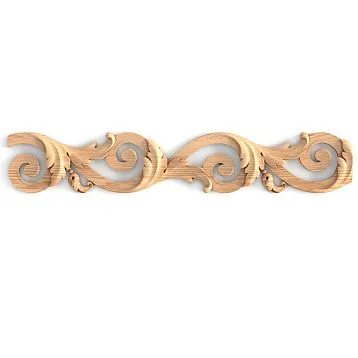
Rosettes - circular or oval elements with centrally symmetrical ornament - classic appliqué shapes. Diameter 80-200 millimeters depending on the scale of the opening. Placed in upper corners of the casing, creating accents. Ornament ranges from simple concentric circles to lush plant compositions with multi-level relief.
Corner appliqués - square or rhomboid elements sized 60x60, 80x80, 100x100 millimeters - placed in corners of rectangular casing frames. Four identical appliqués at the corners create symmetry and classic order. Ornament is usually plant-based - leaves, flowers, scrolls, rarely geometric.
Vertical decorative strips - narrow, long appliqués 40-80 millimeters wide, 300-800 millimeters long with repeating ornament - placed vertically along the sides of the opening. Create elongation and architectural slenderness. Ornament includes interwoven stems, alternating geometric elements, fluting.
Cartouches - decorative shields of oval or shaped forms with scrolls along the edges, often with coats of arms, monograms, or plant compositions inside. Size 150-300 millimeters along the long side. Placed above the door at the center of the upper casing as the main accent of the opening. For grand entrances, offices, and reception rooms, cartouches create a sense of grandeur.
Pediments - triangular or arched finishes above the door - mimic classical architectural elements of porticos. Height 200-400 millimeters, width matches the opening width. Intricate carved ornament within the pediment - plant-based, geometric, or shaped. Pediments transform a simple door into an architectural portal, creating monumentality.
Mounting wooden appliqués: glue and fasteners
Wooden appliqués are mounted to casings or directly to walls in two ways - adhesive and mechanical. Adhesive mounting - PVA or polyurethane glue is applied to the back of the appliqué, which is pressed onto the base and secured with painter’s tape or weight until it sets (12-24 hours). Clean method, no visible fasteners, but less reliable for heavy appliqués.
Mechanical mounting - thin finishing nails without heads or with small heads are driven through the appliqué into the base. Spacing 80-120 millimeters. Nail heads are countersunk and covered with wooden plugs 5-8 millimeters in diameter or filled with putty. After sanding and painting, mounting points are invisible. Reliable method, appliqué won’t detach over years.
Combined mounting - glue plus nails - most reliable. Glue ensures full surface contact, nails secure until glue sets and reinforce the mounting. For appliqués weighing over 500 grams or larger than 200 millimeters, combined mounting is recommended.
Surface preparation is critical. Base must be flat, clean, and degreased. Irregularities over 2 millimeters are leveled with putty. Dust is removed. Appliqué is placed dry and checked for tight fit. Only after this, glue is applied and final mounting is performed.
Polyurethane elements: symmetry and technology
polyurethane elementsIn door openings, they serve as architectural structures creating symmetry, completeness, and classical order with minimal weight and simple mounting.
Casing: basic framing
Polyurethane casings 60-120 millimeters wide with simple or complex profiles create a frame for the opening, separating it from the wall plane. Profile ranges from rectangular for modern interiors to multi-step with rounded edges, moldings, and fluting for classical styles. Standard length 2200-2400 millimeters for vertical elements, width of opening plus 200 millimeters for horizontal.
Advantages of polyurethane casings - weight 400-800 grams per element versus 2000-4000 grams for wooden ones. Mounting with glue without risk of detachment. Absolute moisture resistance - for openings in bathrooms, saunas, kitchens, polyurethane does not deform from humidity. Can be painted any color with acrylic paints.
Combining with wooden appliqués enriches the composition. A white polyurethane casing with a simple profile creates a frame. Over the casing, at corners, natural-toned oak carved rosettes are glued. Contrast between smooth white polyurethane and natural textured wood creates visual interest and layering.
Pilasters: vertical architecture
Polyurethane pilasters - vertical elements imitating columns with bases and capitals - placed on both sides of the door opening, creating classical order. Height from floor to top of opening 2200-2600 millimeters, width 80-150 millimeters, thickness 20-40 millimeters. Styles range from Doric (simple capital) to Corinthian (rich with acanthus leaves).
Pilasters are mounted with glue directly to the wall adjacent to the door opening. They create an illusion that the opening is supported by columns - architectural logic appealing to classical interiors. Base at the level of the skirting board, capital at the level of the top of the opening. Horizontal element (architrave) connects capitals, completing the portal.
Pilaster coloring matches the overall color scheme. White on white walls - classic solution, structure readable through shadows. Colored in contrasting tones (black, dark gray, gold) - accentuating the portal, making it stand out from the wall plane. Patinated - aging effect, suitable for interiors with historical references.
Pediments and sashings: portal finishes
Polyurethane pediments - triangular or arched elements above the door - create classical architectural finishes. Width matches the opening or slightly wider, height 200-500 millimeters. Ornament is possible within the pediment - plant-based, geometric, or smooth surface for minimalism.
Sashings - horizontal projecting awnings above the door - mimic protective elements of exterior doors, transposed into interior design. Length 200-400 millimeters wider than the opening, projection from wall 80-150 millimeters, height 60-120 millimeters. Complex profile with rounded edges creating light play. For interiors with high ceilings (3+ meters), sashings add scale.
Combining with wooden elements creates hybrid solutions. Polyurethane pediment with a wooden carved cartouche in the center. Or polyurethane sashing with wooden consoles along the edges, mimicking support. Materials complement each other - polyurethane creates geometric base, wood adds craftsmanship and tactile quality.
Rosettes and medallions: decorative accents
Polyurethane rosettes 100-300 millimeters in diameter with ornament are placed above the door at the center or sides of the opening. Ornament ranges from simple concentric circles to lush plant compositions. Lightweight (50-300 grams) allows gluing without additional fasteners. Can be painted any color, patinated, or gilded.
Medallions - oval decorative elements sized 200x150, 300x200 mm - are mounted horizontally above the door. Inside the medallion, painting, monogram, or emblem can be applied. Or a relief ornament - plant-based, geometric. In reception areas, medallions create uniqueness and personalization.
Corner elements - small inserts 50x50, 80x80 mm with ornament - are placed in the corners of the door casing, complementing the composition. Four identical elements at the corners create symmetry. Or two in the upper corners, lower ones remain undecorated - a simplified composition, visually lightened.
Material and color combinations: harmony of contrasts
Successful door frames combine wood and polyurethane so that the difference in materials enriches the composition, creating textural and color diversity while maintaining structural unity.
Monochromatic strategy: unity through color
Oak inserts and polyurethane casings are painted in one color - white, cream, light gray. Wood texture is visible under paint, polyurethane is smooth. Material difference is perceived through texture while maintaining color unity. For classic interiors, where restraint is valued, the monochromatic strategy creates elegance.
Patination of both materials in a unified tone enhances monochromaticity. Base white, gold patina on raised parts of wood carving and polyurethane relief. Visual connection through finishing technique despite material differences. Effect of noble aging, suitable for interiors with historical references.
Contrast strategy: emphasis through color
Natural oak inserts in golden-brown tone, white polyurethane casings and pilasters. Classic contrast of warm wood and cool white creates visual structure - wood as accents, polyurethane as frame. For interiors where compositional clarity is important, contrast is effective.
Dark oak inserts stained in wenge, light gray polyurethane elements. Modern contrast for minimalist and Scandinavian interiors. Or inversion - light beech inserts painted white, black polyurethane casings. Graphic, dramatic, unconventional.
Material hierarchy: wood dominates, polyurethane frames
Oak casings around the entire opening perimeter - composition base. Polyurethane rosettes in upper corners, polyurethane pediment above the door - additions. Wood dominates in area and visual mass, polyurethane creates accents. For interiors valuing naturalness, such hierarchy is logical.
Inversion - polyurethane casings and pilasters create structure, oak inserts at key points (corners, center above door) - accents. Polyurethane as architectural base, wood as artistic inserts. Economically efficient - polyurethane is cheaper than wood, yet visually the composition is rich.
Color accents through gilding
Natural oak or beech inserts with gilded raised parts of carving, white or cream polyurethane elements - classic baroque combination. Gold attracts the eye, creates luxury and solemnity. Suitable for grand entrances, reception areas, classic living rooms.
Gilding technique varies. 24K gold - real ultra-thin gold leaves - expensive (5000-15000 rubles per insert), prestigious, eternal. Patina - imitation of 24K gold from alloys - more affordable (1000-3000 rubles per insert), visually similar from over one meter away. Gold paint - budget solution (100-500 rubles per insert), but less convincing up close.
Installation practice and maintenance: longevity through precision
Quality installation determines the longevity of door frames. Mistakes lead to peeling, cracking, visual defects. Proper maintenance extends the life of elements.
Base preparation: key to reliability
Surface on which inserts and polyurethane elements are mounted must be flat, clean, strong. Irregularities over 3 mm are leveled with putty and sanded. Loose areas are reinforced with deep-penetration primer. Dust is removed with vacuum cleaner, surface wiped with damp cloth and dried.
Marking is done with pencil using a level. Vertical elements are checked with plumb bob or laser level - deviation from vertical over 2 mm per meter is noticeable to the eye. Horizontal elements are also checked - a slanted pediment above the door is obvious.
Dry fitting is mandatory. All elements are placed without glue, joints, symmetry, and fit are checked. If necessary, elements are trimmed and adjusted. Only after perfect dry fitting is glue applied and final installation performed.
Adhesive compositions: selection by material
For wooden inserts, carpenter's PVA glue - classic choice. Setting time 30-60 minutes, full curing 12-24 hours. Eco-friendly, odorless, excess easily removed with damp cloth. Or polyurethane glue - water-resistant, strong, setting time 15-30 minutes, full curing 6-12 hours.
For polyurethane elements, special polyurethane glue or acrylic mounting glue. Applied with a zigzag or dots on the back of the element. Element pressed against base, secured with painter's tape until set. Lightweight elements under 300 grams hold on glue, heavy ones are additionally secured with finish nails.
Silicone sealant is not recommended for permanent mounting - over time it loses adhesion, elements peel off. May be used as temporary fix until main glue sets, but not as sole mounting method.
Final finishing: painting and protection
Wooden inserts installed in natural color are coated with oil or varnish after mounting. Oil is applied with brush, worked into carving, excess removed after 20-30 minutes. Varnish is sprayed or brushed on in 2-3 coats with intermediate 320-400 grit sanding. Ends of inserts and joints are treated especially carefully.
Patination is performed after base coating. Base layer white or cream is dried. Patina (gold, dark brown) is applied with brush to raised parts of relief, excess wiped with cloth after 5-10 minutes. Patina remains in recesses and on edges, creating aging effect. Final matte varnish layer secures patina.
Patination is performed after base coating. Base layer white or cream is dried. Patina (gold, dark brown) is applied with brush to raised parts of relief, excess wiped with cloth after 5-10 minutes. Patina remains in recesses and on edges, creating aging effect. Final matte varnish layer secures patina.
Care and Maintenance: Preserving Appearance
Wooden mouldings are wiped with a dry, soft cloth weekly or every two weeks—dust should not accumulate in the grooves. Grooves are cleaned with a soft brush or vacuum cleaner with a brush attachment. Monthly wet wiping with slightly damp (not wet!) cloth removes grease from hands.
Oil finish is renewed every 2–3 years—apply new oil after cleaning. Lacquered mouldings do not require renewal for 8–10 years. For scratches, local restoration—damaged area is sanded and re-lacquered.
Polyurethane elements are wiped clean of dust with a dry cloth. Monthly wet cleaning with neutral cleaning agents. Raised areas are cleaned with a soft brush. Colored surfaces do not require renewal for decades if no mechanical damage occurs. Chips are filled with putty and locally repainted.
Conclusion: Portal as Art of Transition
Door openings withcarved wooden inlaysandpolyurethane elementstransform utilitarian portals into architectural artworks that define the character of space.Oak Mouldingscreate monumentality, depth of relief, expressive texture.Oak inlaysprovide lightness, delicacy of details, modern elegance.
Polyurethane mouldings, pilasters, and cornices create architectural structure with minimal weight and simple installation. The combination of natural wood and technologically advanced polyurethane optimizes budget without sacrificing aesthetic effect. Wood is used where tactile quality, craftsmanship, and prestige are critical. Polyurethane is used where lightness, moisture resistance, and accessibility of complex forms are important.
Color strategies from monochromatic to contrasting provide tools for any style. Proper installation—preparation of base, quality adhesives, precise marking—ensures longevity. Regular care extends the life of elements for decades.
Investing in quality door frame trim pays off through daily aesthetic pleasure, increased interior status, and unique solutions. Every entry and exit through a decorated portal becomes a moment of awareness, a transition between states, a micro-routine that structures daily life. Your home deserves portals that don’t just pass through, but invite; don’t just divide, but connect; don’t just function, but inspire.