Article Contents:
- Ceiling as Canvas: Philosophy of Vertical Design
- Psychology of Perceiving Ceiling Structures
- Acoustic Properties of Ceiling Rails
- Technical Features of MDF Rails for Ceiling Applications
- Thermal Deformations
- Suspension and Mounting Systems
- Integration of Engineering Systems
- Design Concepts for Ceiling Finishing
- Classic Directions in Ceiling Design
- Minimalist solutions
- Avant-garde and Experimental Approaches
- Lighting as an Integral Part of Ceiling Composition
- Architectural Lighting of Rail Structures
- Integration of Recessed Lighting
- Colored Lighting and Dynamic Effects
- Features of Installing Ceiling Structures
- Preparation Work and Planning
- Installation of Load-Bearing Structures
- Installation of Rail Elements
- Practical Solutions for Various Types of Rooms
- Residential Interiors: Creating a Home Atmosphere
- Commercial Spaces: Functionality and Aesthetics
- Special Requirements for Different Zones
- Innovative Technologies in Ceiling Design
- Smart Ceiling Systems
- Adaptive Materials of the New Generation
- Digital Design Technologies
- The Future of Ceiling Design
- Integration with Industry 4.0 Technologies
- Ecological innovations
- Conclusion
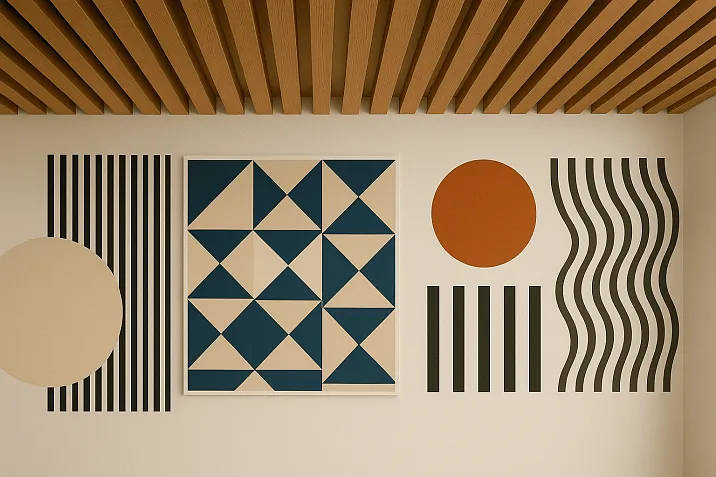
Look Up. What do you see? A boring white plane or an endless canvas for creative experiments? MDF Rail for Ceiling Interior has turned the fifth wall of the room into the main character of modern design. This material became the catalyst of an architectural revolution, forcing designers to look at the possibilities of ceiling space in a new way and ushering in the era of three-dimensional interior compositions.
The times when the ceiling remained a neutral background have irrevocably passed. Today, ceiling structures define the character of the interior, create the mood, and form a unique atmosphere in living spaces. But what lies behind this trend? What technological and aesthetic breakthroughs made it possible to transform the ceiling into a work of architectural art?


Ceiling as Canvas: Philosophy of Vertical Design
In architectural history, ceilings have always played a special role. Cathedral vaults, painted ceiling coffers of palaces, coffered structures of ancient temples—all of this indicates that ceiling space has long been perceived as a symbol of heaven, infinity, and divine origin. Modern interior MDF ceiling profile continues this tradition but within new technological realities.




Psychology of ceiling structure perception
Human perception is structured in such a way that the ceiling exerts a powerful influence on emotional state. High ceilings create a sense of freedom and grandeur, while low ceilings evoke coziness and security. MDF material allows manipulating these sensations, creating an illusion of changing the spatial characteristics of the room.
Neuroarchitecture studies show that horizontal lines on the ceiling expand space, vertical elements increase height, and diagonal lines create a sense of movement and dynamism. Profiled structures allow using all these effects within a single project, creating multi-layered compositions with different perception zones.
Our factory also produces:


Acoustic properties of ceiling profiles
Ceiling structures made of MDF profiles have unique acoustic characteristics. Gaps between elements create resonant chambers, effectively absorbing sound waves of certain frequencies. The sound absorption coefficient reaches 0.7–0.9 in the speech range when the gap dimensions and air layer depth are properly selected.
This is especially important for rooms with high ceilings, where echo and reverberation problems arise. Profiled structures solve acoustic issues without compromising interior aesthetics. Moreover, they transform the need for acoustic correction into a design advantage.
Get Consultation
Technical features of ceiling applications of MDF profiles
Using profiles in ceiling structures imposes special requirements on the material and installation technology. Gravitational loads, thermal deformations, and the need to integrate engineering systems—all these factors require a professional approach to design and execution.
Load and Deformation Calculations
Self-weight MDF rails amounts to 5–8 kg/m² of finished surface depending on the thickness of elements and density of installation. This load is supplemented by the weight of the mounting system (2–4 kg/m²) and possible additional loads from built-in lighting (1–3 kg/m²).
Maximum deflection of elements 2500–3000 mm long should not exceed L/300, where L is the span length. For a standard 20×40 mm profile 2700 mm long, the maximum deflection is 9 mm, achieved under uniformly distributed load up to 8 kg/m.
Thermal deformations are calculated based on the linear expansion coefficient of MDF 8–15×10⁻⁶ 1/°C. With a temperature difference of 20°C, a 3000 mm long profile will change size by 0.5–0.9 mm. Compensatory gaps are provided at locations of rigid fixation of the structure.
Suspension and mounting systems
Ceiling profiled structures require reliable suspension systems capable of withstanding not only static but also dynamic loads. Standard suspensions are designed for a load of 25–40 kg each with a safety factor of 2.0.
Suspension spacing is determined by the characteristics of the main ceiling and the weight of the structure. For reinforced concrete slabs, a spacing of 800–1200 mm is recommended; for wooden structures, 600–800 mm. Mounting is performed using anchor bolts 8–12 mm in diameter, installed to a depth of no less than 60 mm.
Adjustable suspensions allow setting a perfectly horizontal ceiling plane with accuracy ±2 mm across the entire room area. A quick-mount system reduces installation time by 30–40% compared to traditional methods.
Integration of Engineering Systems
The space above ceiling profiles is ideally suited for housing various engineering communications. Electrical wiring, air conditioning systems, fire alarm systems, and acoustic systems integrate easily into the overall design concept.
Special attention is paid to fire safety. All cables are laid in non-combustible corrugated pipes, light fixtures are equipped with thermal protection, and fire-rated junction boxes are provided at locations where cables pass through the structure.
Ventilation systems are integrated through special perforated profiles or grilles built into the ceiling system. Air velocity at exhaust openings should not exceed 0.3 m/s to avoid acoustic discomfort.
Design concepts for ceiling decoration
Classic directions in ceiling design
use MDF laths for interior to create coffered ceilings that imitate traditional wooden structures. Geometric modules of 600×600 mm or 900×900 mm create a rhythmic structure that emphasizes the classical proportions of the room.
Color palette leans toward noble tones of natural wood—oak, walnut, mahogany. Contrasting combinations of light and dark elements add additional depth and expressiveness to the composition. Gold and silver accents highlight the luxury and status of the interior.
Lighting is integrated as delicately as possible. Concealed cornices create the effect of floating modules, while spotlights are placed at the geometric centers of coffers, creating even light distribution.
Minimalist solutions
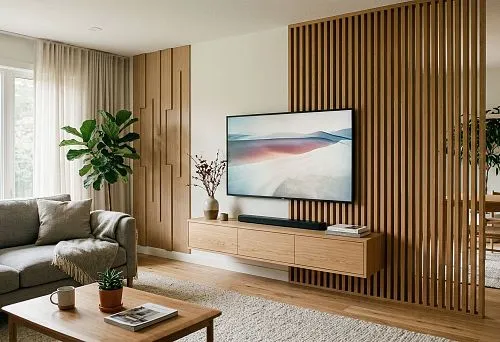
Minimalism finds in ceiling rails the ideal tool for creating concise yet expressive compositions. Parallel elements arranged with even spacing create a calm rhythm, not distracting from the main functions of the space.
Monochromatic solutions in white and gray tones highlight the purity of lines and perfection of form. The absence of decorative elements is compensated by flawless execution and precise geometry. Each element is in its place, and every gap is calculated with mathematical precision.
Lighting integration is performed as unobtrusively as possible. LED strips are hidden in special grooves, creating a surface glow effect. The absence of visible light sources enhances the feeling of magic and technological perfection.
Avant-garde and experimental approaches
Modern designers are not limited by traditional rail layouts. Curvilinear compositions, variable element spacing, multi-level constructions open up boundless opportunities for creative self-expression.
Diagonal compositions create a sense of movement and dynamism. An installation angle of 30-45° is optimal for most rooms, creating a balance between static and dynamic elements. Intersections of rails at different angles form complex geometric patterns.
Multi-level constructions allow creating volumetric compositions with different functional zones. Height differences of 100-300 mm are sufficient for zoning space without creating a feeling of confinement.
Lighting as an integral part of the ceiling composition
Architectural lighting of rail structures
Properly designed lighting transforms Decorative MDF rails into an independent light source. LED technologies allow creating uniform backlighting across the entire ceiling area with minimal energy consumption.
The power of LED strips is 8-24 W/m depending on the required illumination level. Color temperature 2700-6500K allows creating various lighting scenarios from warm domestic to cool working lighting.
Dimming provides smooth brightness adjustment from 1% to 100%, allowing lighting to be adapted to different room usage scenarios. Memory settings save favorite lighting modes for quick access.
Integration of point lighting
Built-in fixtures with a diameter of 60-120 mm easily integrate into rail structures due to the ability to precisely trim holes. The ceiling grid determines the placement of light points, creating an orderly lighting system.
Rotatable spotlights allow directing light to desired zones, creating accent lighting for artworks, architectural details, and functional areas. A rotation angle of 30-40° ensures flexibility in managing light beams.
The power of built-in fixtures 5-15 W is sufficient for creating comfortable lighting with the luminous efficacy of modern LED sources 80-120 lm/W. LED lifespan of 30000-50000 hours minimizes maintenance costs.
Color lighting and dynamic effects
RGB+W technology opens boundless possibilities for creating colorful lighting compositions. Millions of shades, smooth transitions, synchronization with music transform the ceiling into an interactive media surface.
Control via mobile applications makes interaction with lighting intuitive and convenient. Voice commands through virtual assistants add a high-tech element to daily life.
Programmable scenes automatically adjust lighting depending on time of day, weather conditions, user activity. The system learns residents' preferences and suggests optimal settings.
Features of installing ceiling structures
Preparation and planning
Installation of ceiling rail systems requires careful preparation and planning. Inspection of existing structures includes checking load-bearing capacity of floors, condition of engineering utilities, and room geometry.
Room height is measured at several points to identify deviations of the main ceiling from horizontal. A difference exceeding 20 mm requires project adjustments or additional leveling measures.
Development of the installation scheme takes into account the location of existing utilities, access requirements to engineering systems, and the client's design preferences. 3D modeling helps visualize the result and avoid errors.
Installation of load-bearing structures
Installation begins with mounting perimeter guides, which define the overall geometry of the system. Profiles are mounted to walls with 8×60 mm screws at 400-500 mm spacing. Levelness is controlled with a laser level.
Main load-bearing profiles are installed at calculated spacing and aligned vertically using adjustable hangers. Each profile is checked at three points — ends and center. Deviation from the design position must not exceed ±2 mm.
Transverse connections ensure system rigidity and even load distribution. They are installed every 1200-1500 mm and connected to main profiles using special locking joints.
The Internet of Things turns each element of the ceiling structure into a node of a single network. Rails with built-in microcontrollers transmit data about their condition, surrounding conditions, and energy consumption to the building's central management system.
Finishing MDF rails Installation begins from one of the walls, following the design pitch. The first rail is installed particularly carefully, as it determines the geometry of the entire structure.
Fastening is performed using hidden clips or self-tapping screws, depending on the chosen technology. The clip system ensures an ideal appearance but requires high precision in manufacturing grooves at the ends of the rails.
Elements are joined along their length on load-bearing profiles with a 2-3 mm gap to compensate for thermal deformations. Joint locations are evenly distributed across the ceiling area to create a unified compositional rhythm.
Practical solutions for various types of rooms
Residential interiors: creating a home atmosphere
Living Rooms MDF Rail for Ceiling Interior Often used to create multi-level compositions that zone the space. Lowering the ceiling above the sofa group by 200-300 mm creates a cozy resting zone, while raising the level above the dining area emphasizes its grandeur.
Bedrooms require a special approach to ceiling design. Warm wood tones, soft lighting, and smooth lines create an atmosphere of calm and relaxation. The slatted structure above the bed headboard becomes the main decorative accent of the room.
Children's rooms offer wide opportunities for creative experimentation. Bright colors, unusual shapes, and interactive elements transform the ceiling into a play area. A starry sky from recessed lights, a rainbow from colored rails, clouds from matte panels — all of this becomes reality.
Commercial spaces: functionality and aesthetics
Office spaces use ceiling slat systems to improve acoustic comfort and integrate engineering systems. The modular construction ensures easy access to communications for maintenance and modernization.
Restaurants and cafes value the ability to create a unique atmosphere using ceiling structures. Warm wood tones add coziness, while dynamic lighting creates different scenarios for different times of day.
Shopping centers use slat ceilings to create navigation systems. Different colors and directions of the slats help visitors orient themselves in large spaces, while an integrated information system provides up-to-date information about stores and promotions.
Special requirements for different zones
Wet areas require the use of special moisture-resistant MDF grades containing paraffin additives. The water absorption coefficient must not exceed 15% after 24-hour immersion. Additional protection of ends and joints with hydrophobic compounds extends service life.
Areas with high hygiene requirements use antibacterial coatings with silver ions. Such surfaces suppress the growth of pathogenic microorganisms and facilitate maintaining sanitary standards.
High-temperature zones require materials with enhanced heat resistance. Special binder compositions withstand heating up to 80-120°C without deformation or emission of harmful substances.
Innovative technologies in ceiling design
Smart ceiling systems
Integration of sensors and control systems transforms ceiling structures into elements of an intelligent living environment. Presence sensors automatically turn on lighting upon entry into the room and turn it off when no one is present.
Climate sensors monitor temperature, humidity, and CO2 levels, automatically adjusting the operation of ventilation and air conditioning systems. Predictive algorithms take into account external weather conditions and room usage schedules.
Acoustic systems are integrated directly into slat structures, creating immersive sound without visible speakers. Beamforming technology directs sound precisely to designated zones without disturbing adjacent rooms.
Next-generation adaptive materials
Thermochromic coatings change color depending on temperature, creating visual indicators of climatic conditions. At 18-22°C, the material has a neutral tone; as temperature increases, it becomes warmer; as temperature decreases, it becomes cooler.
Photocatalytic surfaces purify air from harmful impurities and unpleasant odors. Titanium dioxide in nanoscale is activated by light and breaks down organic pollutants into harmless substances.
Self-diagnosing materials change color upon detection of hidden defects — cracks, delamination, deformation. This allows early problem detection and prevents emergency situations.
Digital design technologies
Virtual reality allows clients to "enter" the future interior and evaluate various ceiling design options. Immersive technologies convey not only visual but also acoustic characteristics of the space.
Augmented reality overlays digital models onto real spaces via mobile devices. This helps assess the scale of structures, their compatibility with existing interiors, and necessary project adjustments.
Parametric design automates the creation of complex geometric compositions. Algorithms generate multiple layout options, optimizing them according to specified criteria — aesthetics, functionality, material cost.
The future of ceiling design
Integration with Industry 4.0 technologies
Artificial intelligence analyzes patterns of space usage and automatically optimizes the operation of all systems. Machine learning enables the system to adapt to changing user needs.
Blockchain technology ensures the security and immutability of data regarding the technical condition of structures. Every maintenance, component replacement, or modernization is recorded in a distributed ledger.
Carbon-negative materials absorb more CO2 from the atmosphere than they emit during production. Special additives bind carbon dioxide into stable compounds, preserving it within the material's structure for decades.
Ecological Innovations
Biodegradable composites based on plant fibers and natural binders ensure complete disposal of structures at the end of their service life. Composting takes 12–24 months depending on the material composition.
Closed production cycles eliminate waste generation. All scraps, defective items, and dismantled structures are returned to production as secondary raw materials.
Closed production cycles exclude waste generation. All scraps, defective items, and dismantled structures are returned to production as secondary raw material.
Conclusion
The era of boring white ceilings has irrevocably passed. MDF Rail for Ceiling Interior Opened a new chapter in interior design history, transforming the fifth wall of a room into an active participant in shaping the spatial environment. This material became a catalyst for architectural revolution, compelling designers to reconsider the role of ceiling space in creating modern interiors.
The technological sophistication of modern MDF ensures the reliability and longevity of ceiling structures under the most demanding operating conditions. Dimensional stability, moisture resistance, fire resistance, and ecological safety — all these characteristics make the material an ideal choice for ceiling applications.
Design possibilities are virtually limitless due to the variety of sizes, colors, textures, and installation methods. From classic coffered ceilings to avant-garde installations — every project finds its unique solution in rail-based structures.
Integration of modern technologies transforms ceiling systems into smart, adaptive, interactive environments. LED lighting, climate sensors, acoustic systems, automation elements — all of these are seamlessly integrated into rail-based structures.
Economic efficiency is demonstrated by the optimal balance between initial costs and long-term benefits. Energy savings, ease of maintenance, and the possibility of modernization make investments in high-quality ceiling systems justified and profitable.
Ecological responsibility is becoming an increasingly important factor in selection. Use of renewable raw materials, energy-efficient production, and recycling programs meet modern requirements for sustainable development.
The future of ceiling design is linked to further integration of digital technologies, development of smart materials, and higher ecological standards. Ceilings will become not just decorative elements, but active participants in creating a comfortable and healthy living environment.
The professional design community highly values the potential of ceiling rail systems to create outstanding interiors. The material opens new horizons for creativity, enabling the realization of the most daring architectural fantasies.
Technological progress continues to expand the application possibilities of MDF rails in ceiling structures. New processing methods, innovative coatings, intelligent control systems — all of this is already available to advanced manufacturers today.
Design personalization is becoming increasingly accessible thanks to digital manufacturing technologies. Each project can receive unique elements specifically created to meet the specific requirements of the client.
STAVROS, with its rich experience and relentless drive for innovation, stands at the forefront of ceiling technology development. Every STAVROS product embodies cutting-edge material science achievements, flawless manufacturing quality, and boundless possibilities for architectural creativity, forming the foundation for interiors that are not only beautiful but also intelligent, functional, and eco-friendly — becoming an indispensable part of modern lifestyle and a daily source of inspiration for their inhabitants.