
































































Article Contents:
- Why slatted panels alone are often not enough
- What exactly is 'missing' visually
- Which decorative elements work together with slats
- Moldings and Cornices
- Pilasters and vertical frames
- Ceiling rosettes and medallions
- Door Decor
- Lighting as a decorative element
- How to design a TV area, bedroom, hallway, and study
- TV area in the living room
- Bedroom: headboard as the centerpiece
- Hallway: First Impression and Function
- Study: strictness and concentration
- Where to Add Accents and Where to Keep Clean Geometry
- Logic of Accent Placement
- When Clean Geometry is Preferable
- How to Avoid Overload
- 1. Mixing Decorative Styles
- 2. Too Many Accent Surfaces
- 3. Scale Imbalance
- Simple Rules to Prevent Overload
- What to Consider When Choosing Color and Scale
- Color: Three Strategies
- Scale: Proportions and Step
- Wood and Polyurethane Decor Color
- Furniture Decor: Connecting Wall and Furniture Row
- Decorative Kitchen Fronts
- Practical Scenarios: From Idea to Result
- Scenario 1: Living Room 20 m², Style — Modern Neoclassicism
- Scenario 2: Bedroom 16 m², Style — Scandinavian Minimalism
- Scenario 3: Hallway 4 m², Style — Modern Urbanism
- Modular Panels: Rhythm Without Installation Risks
- Flexible slat panels: decor on non-standard surfaces
- Wall finishing with slat panels: common mistakes and how to avoid them
- Slat panels with lighting: decorative light as an architectural layer
- Slat panels for interior finishing: the ultimate selection system
- FAQ: Answers to Popular Questions
- About the Company STAVROS

A wall is not just a partition. In the hands of a designer, it becomes a canvas, an architectural statement, a tool for setting the mood.Slatted wall panelshave long moved beyond being just a cladding material and have become an independent interior language — rhythmic, expressive, architecturally precise. But even the most beautiful panel on a wall is only the beginning of the conversation. A complete interior image is born where it is joined by decorative elements, light, color, and spatial logic.
In this article, we will analyze how exactly the combination of slat panels with their surroundings works — with moldings, cornices, stucco, furniture decor, lighting, and other tools that turn one good surface into a cohesive, complete interior composition.



Why slat panels alone are often not enough
Consider: you choseslatted panels for walls, installed them perfectly level, selected the shade. The wall looks good. But something is off. The panel exists on its own, like a painting without a frame, inserted directly into bare plaster. There is rhythm, there is texture, but there is no interior.
This is a very common mistake made by both experienced repairmen and professional designers at the initial stage of working with slats. The reason is simple: a slatted surface is inherently active. It creates a strong visual rhythm and makes a statement. This rhythm needs framing, context, and a dialogue with other elements of the space.
Without a top cornice or molding, the slats appear 'suspended'—the eye doesn't understand where the accent ends and the regular wall begins. Without a baseboard of the correct profile, the boundary between the floor and the panel looks sloppy. Without a transition to an adjacent surface—a different texture, color, or niche—the composition seems unfinished.
A slatted wall panel is like a strong opening sentence in a text. It grabs attention and sets the tone. But then there must be meaningful paragraphs, intonational pauses, and a conclusion. This is precisely what the entire discussion below is about.




What exactly is visually 'missing'
When designers talk about the incompleteness of a slatted wall, they mean several specific points:
-
Lack of an upper boundary. The panel meets the ceiling without a transition—no cornice, no molding, no light gap.
-
Weak lower support. A standard profile baseboard does not 'close' the slats—a baseboard with repeating geometry or a base molding is needed.
-
Isolation from adjacent surfaces. If there is a bare painted wall next to it, the transition looks random.
-
Lack of depth. A flat wall with slats but without lighting, niches, or three-dimensional decorative elements is perceived as less rich than it could be.
-
No accent object. Slats are a background. Even a very beautiful background needs something to stand or hang in front of it.
Our factory also produces:



Which decorative elements work together with slats
decorative elementsin combination with slat panels — these are not decorations for the sake of decoration. Each of them serves a function: completes the geometry, creates a transition, establishes scale, or adds a layer.
Get Consultation
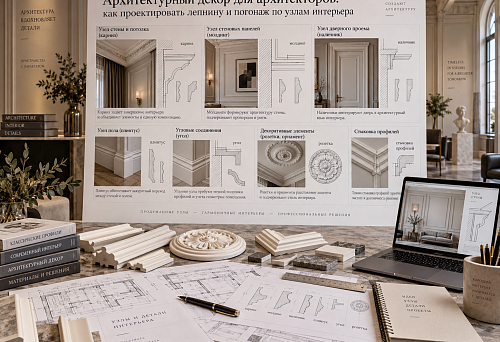
Moldings and cornices
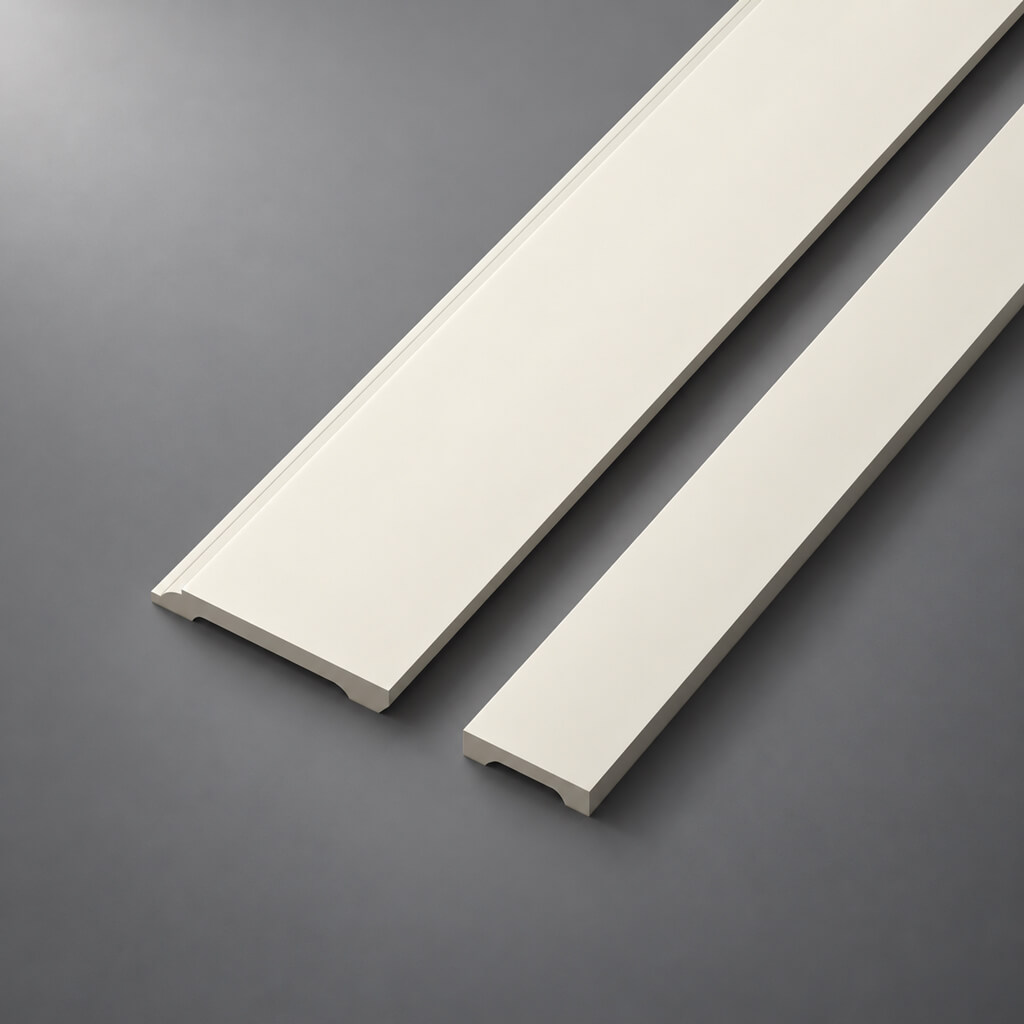
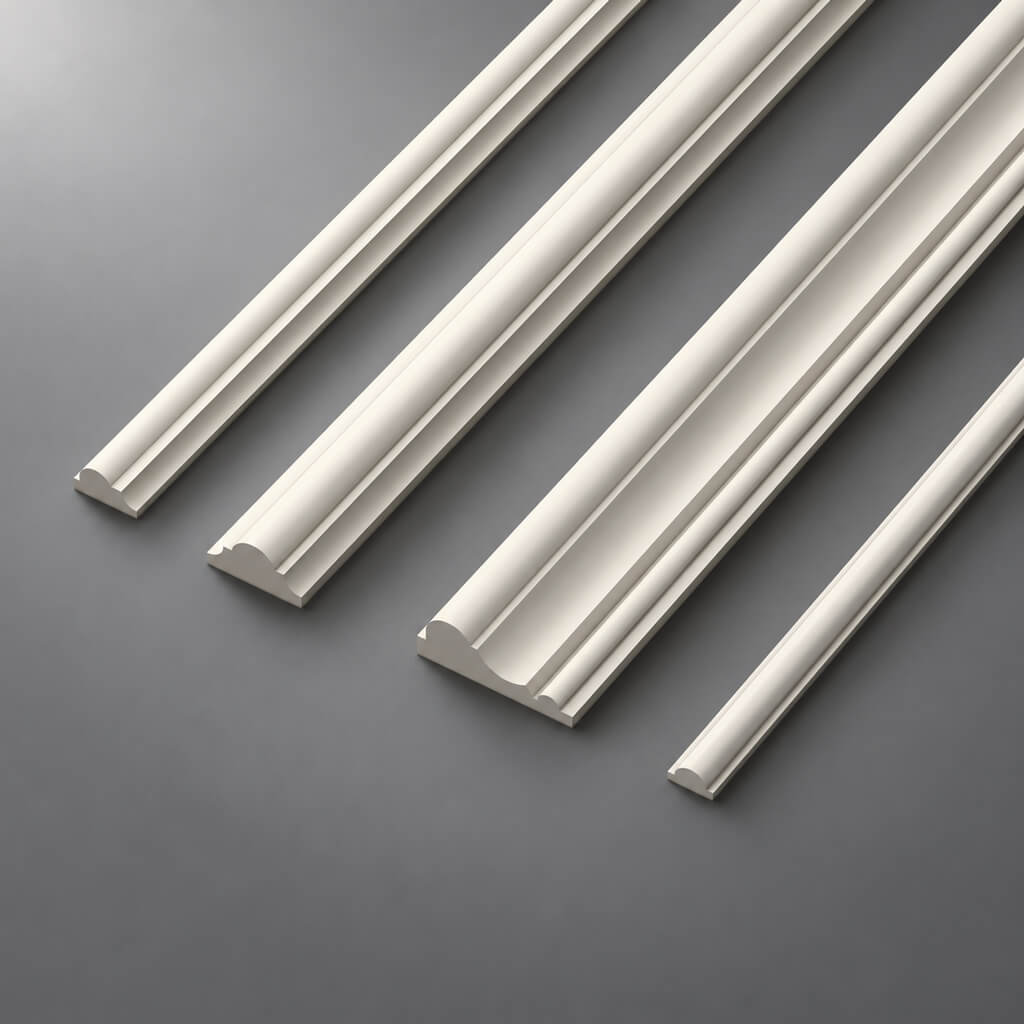
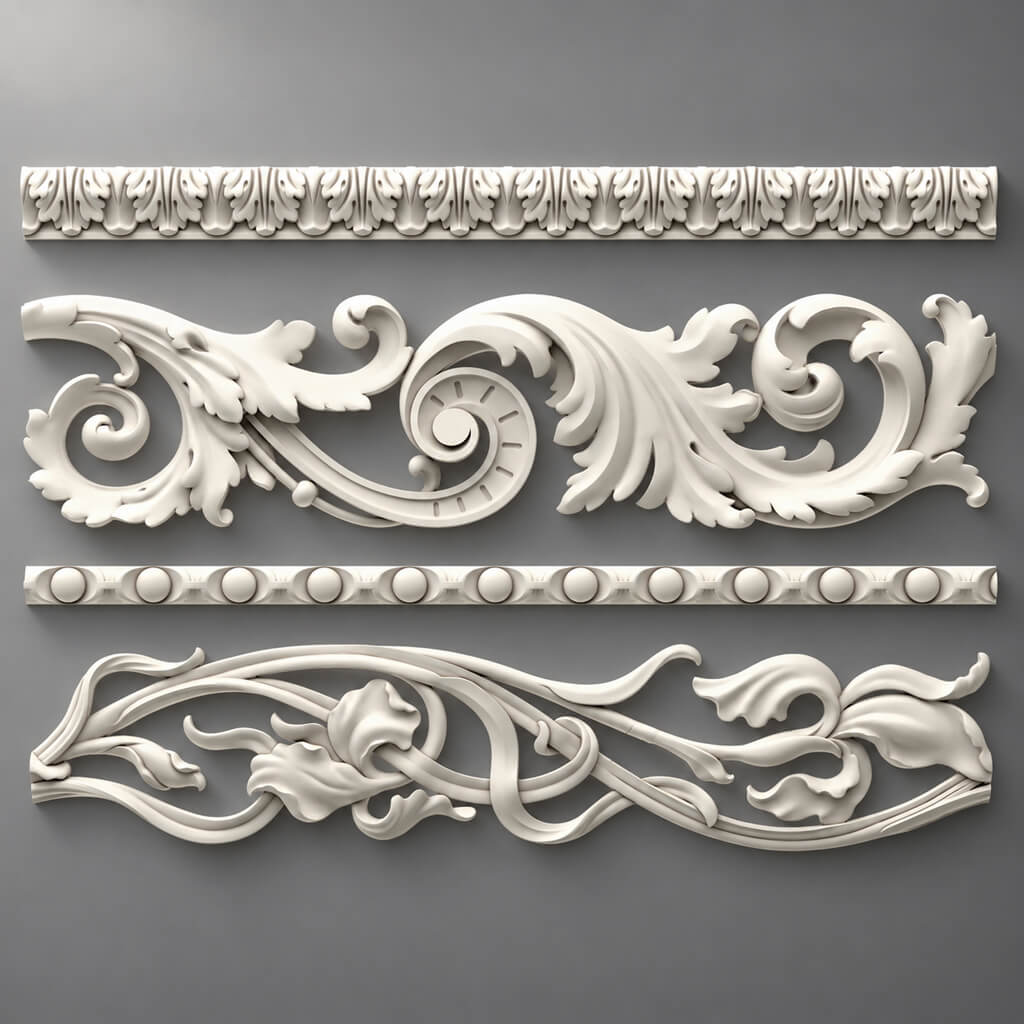
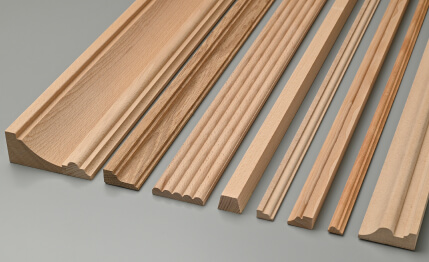
Moldings are the first and essential tool when working with a slatted wall. The top molding acts as the 'cap' of the composition: it fixes the upper boundary, creates a shadow, and visually anchors the panel in space. The bottom molding or wide baseboard does the same at the floor.
The molding profile should echo the geometry of the slats. If the slats have a rounded bead, it's better to choose a molding with soft transitions as well. If the slats are strict, with a rectangular cross-section, choose a minimalist-style molding without extra curls. This rule of profile coordination is one of the key principles in working with interior decor.
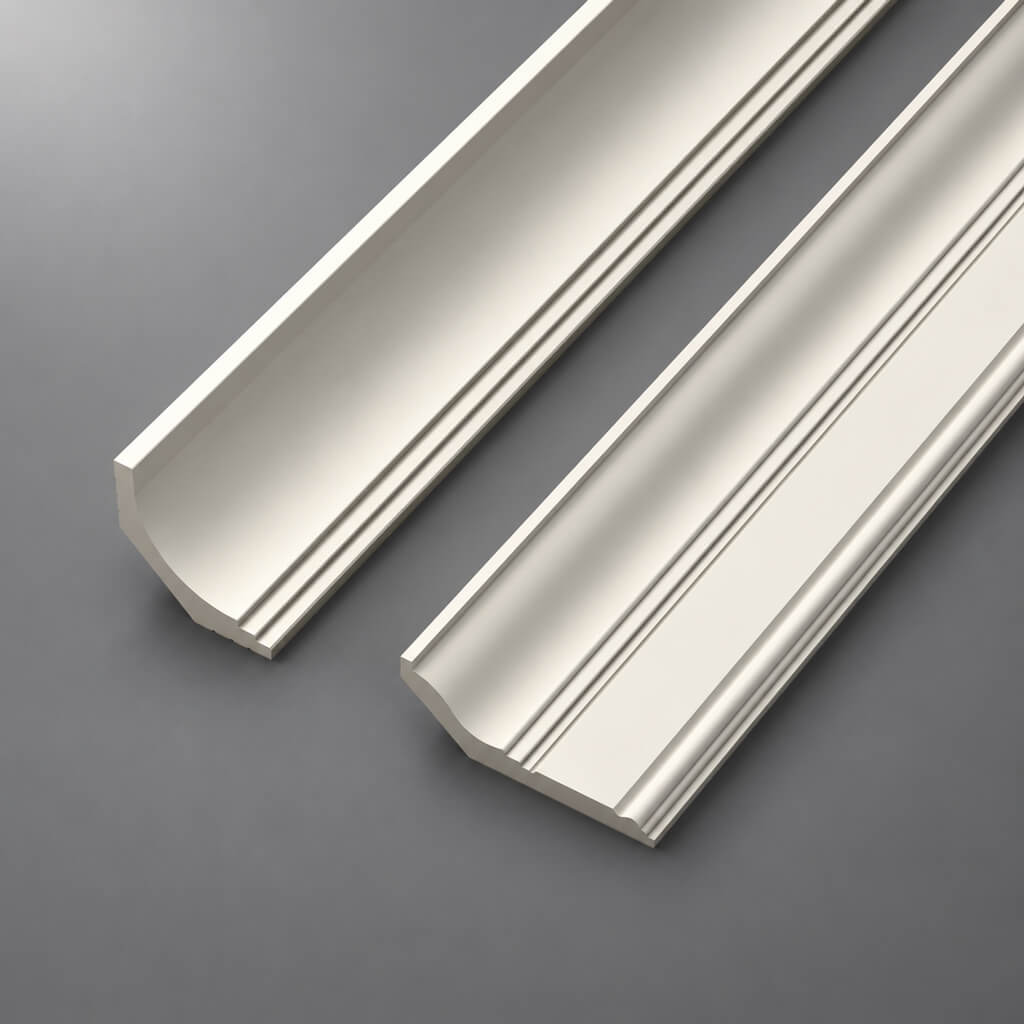
Polyurethane Crown Molding— an especially advantageous solution for those who want to achieve a classic or neoclassical look. Polyurethane can be easily painted to match the panels or in a contrasting color, is moisture-resistant, doesn't crack with temperature fluctuations, and can be installed without hiring construction crews.
Pilasters and vertical frames
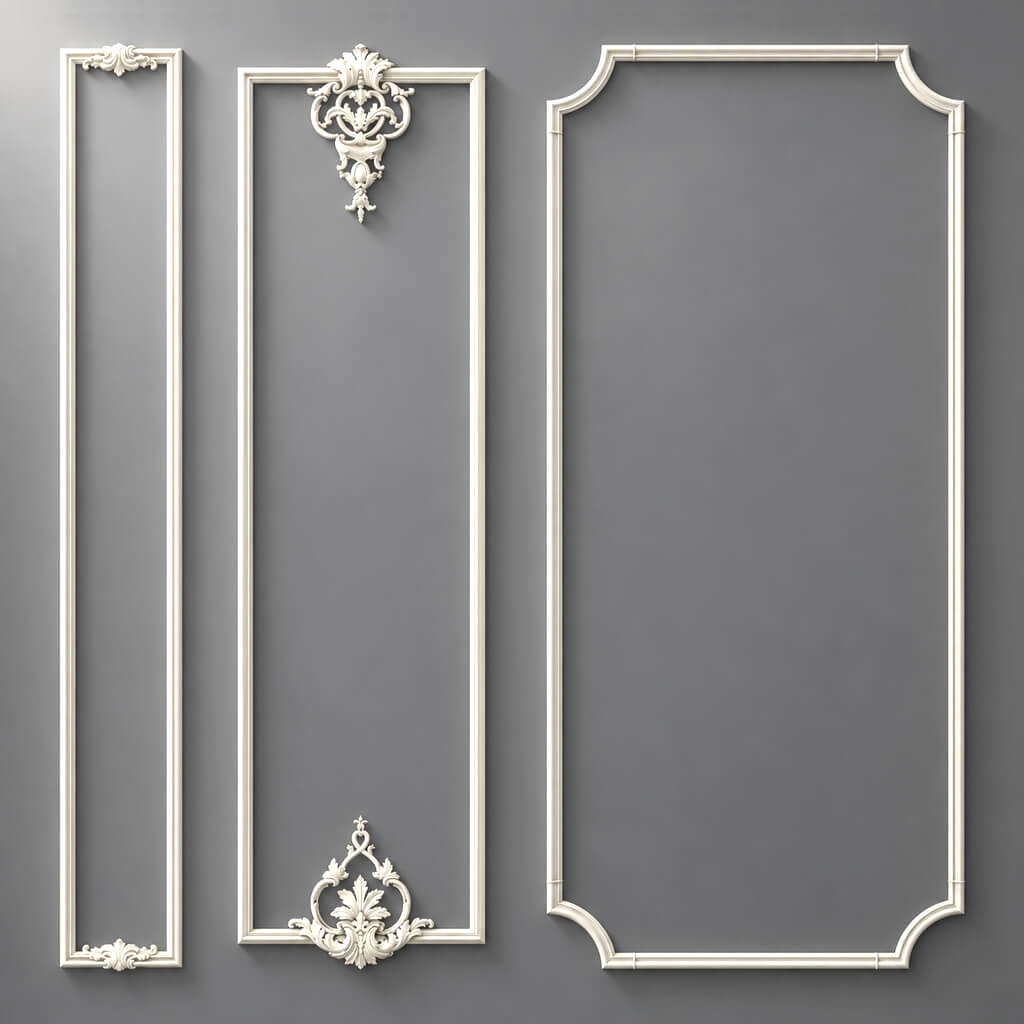
Where a slat panel occupies only part of a wall, vertical pilasters or thin frames made of molding define its boundaries and turn a wall fragment into a complete architectural form. This is especially relevant for living rooms where the panel frames a TV or fireplace: pilasters on the sides transform the functional zone into a full-fledged niche-altar — the main focal point of the room.
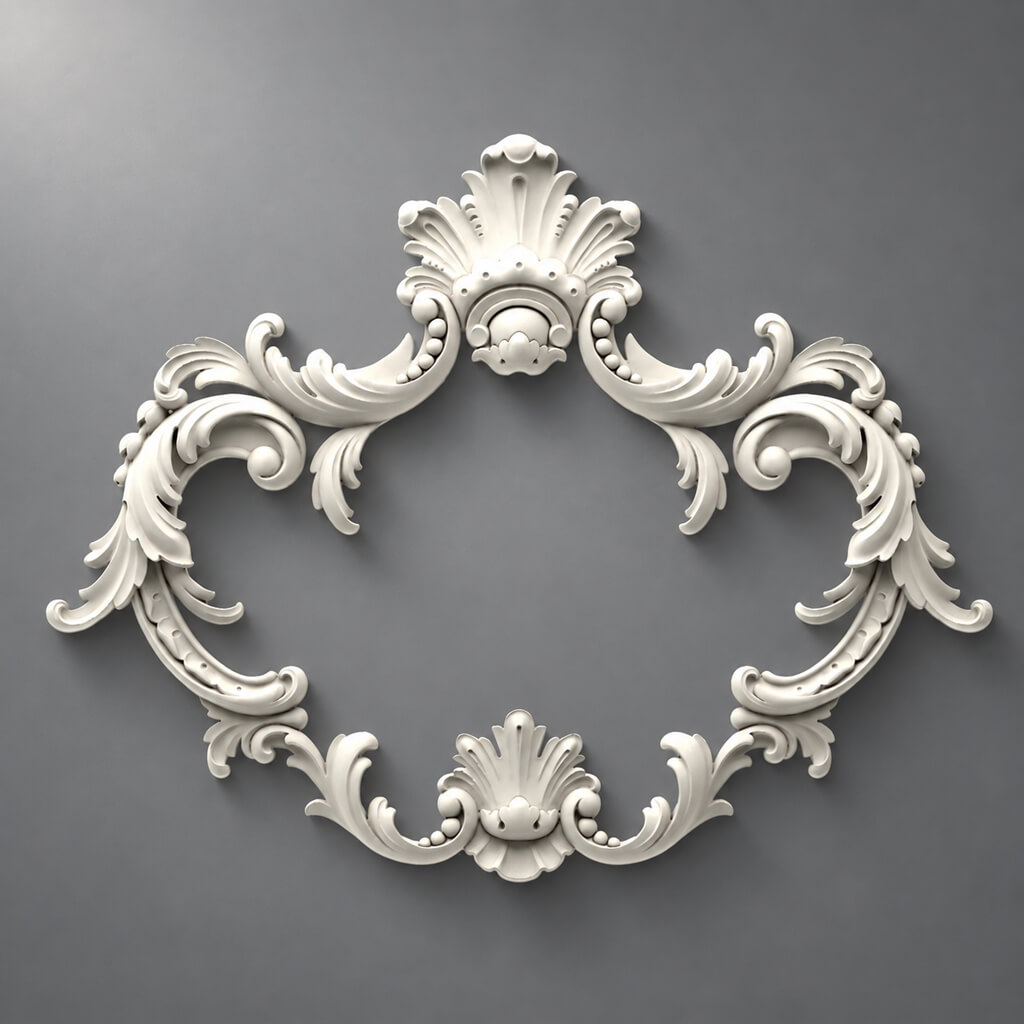
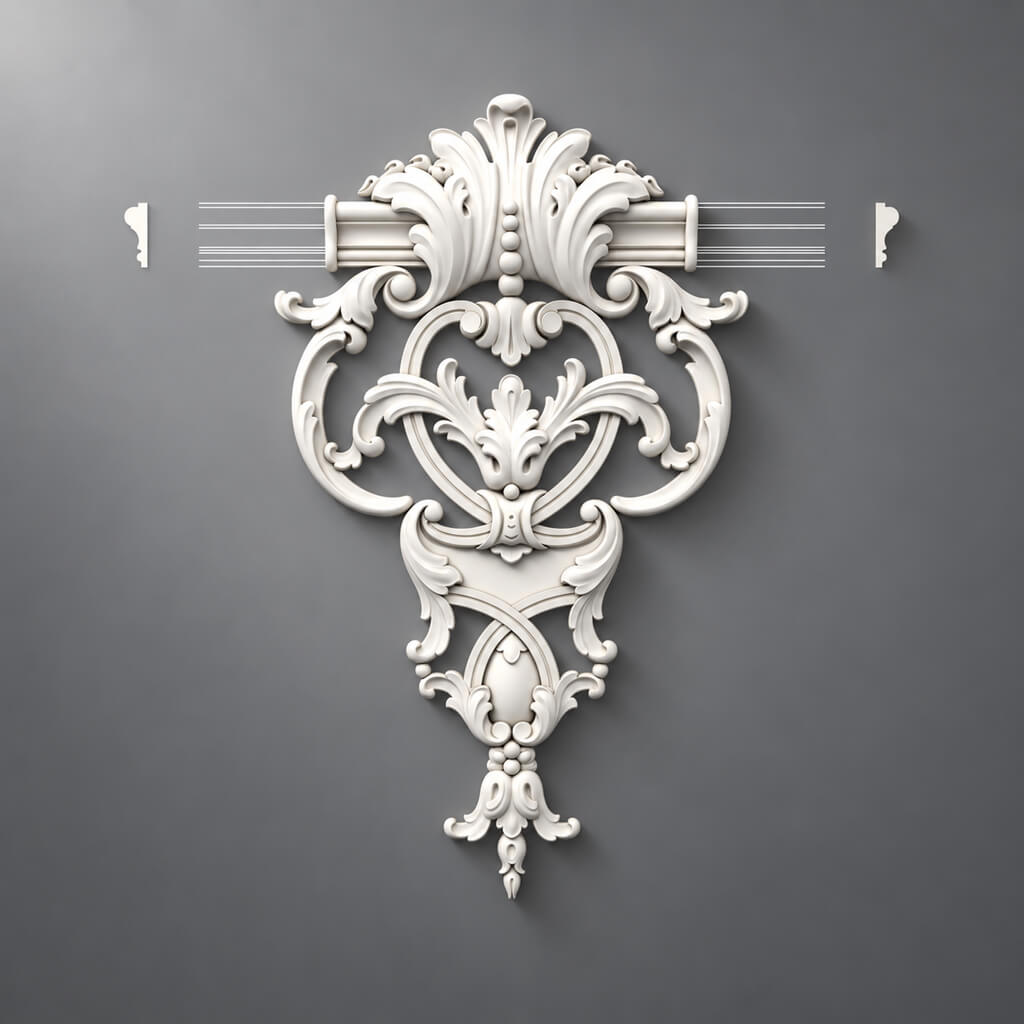
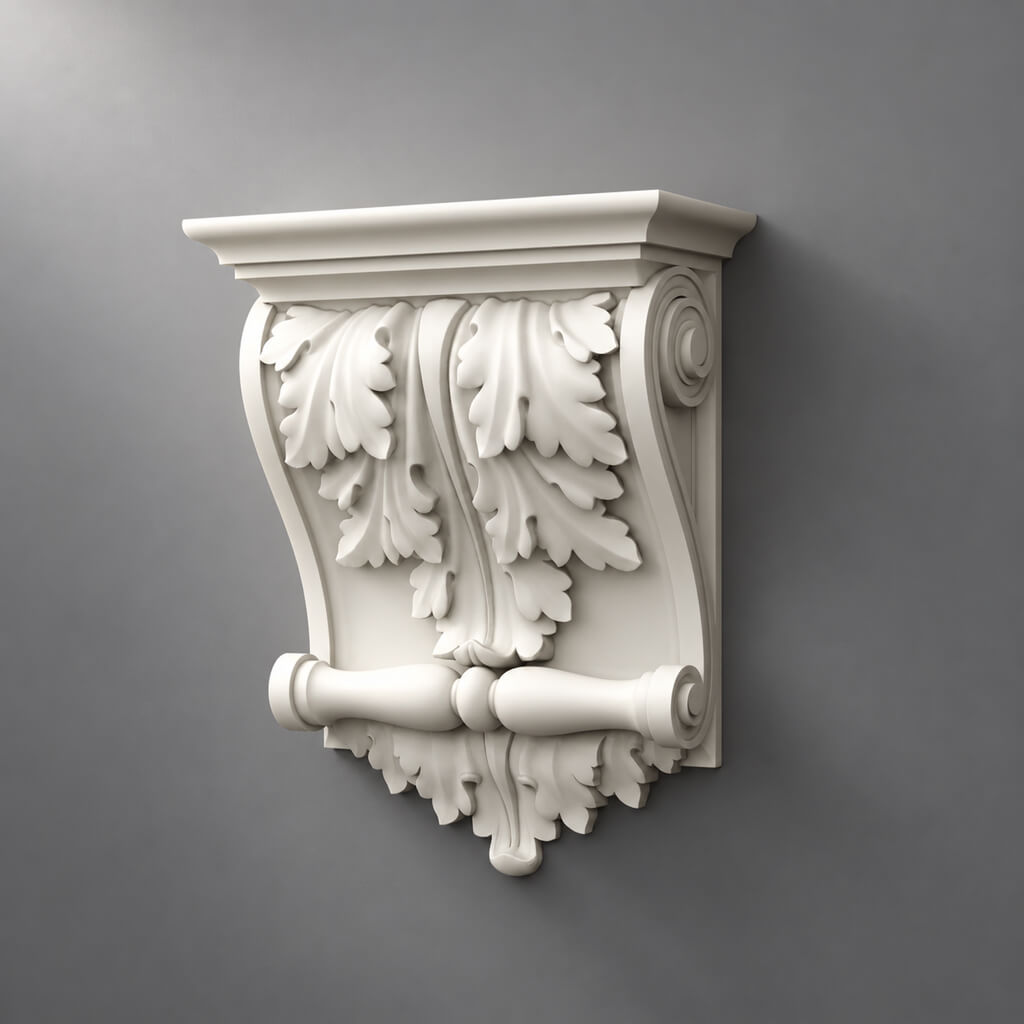
For this roledecorative polyurethane elementsare perfectly suited: they can be sawn, trimmed, glued at any angle, painted, or imitated to look like stone, plaster, or gilding.
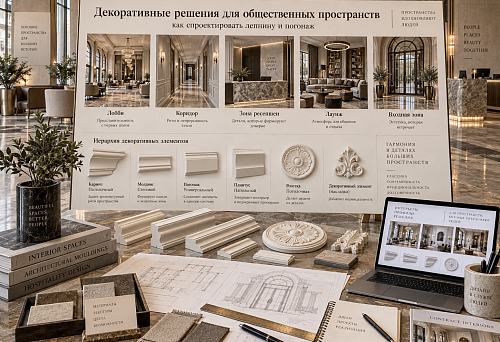
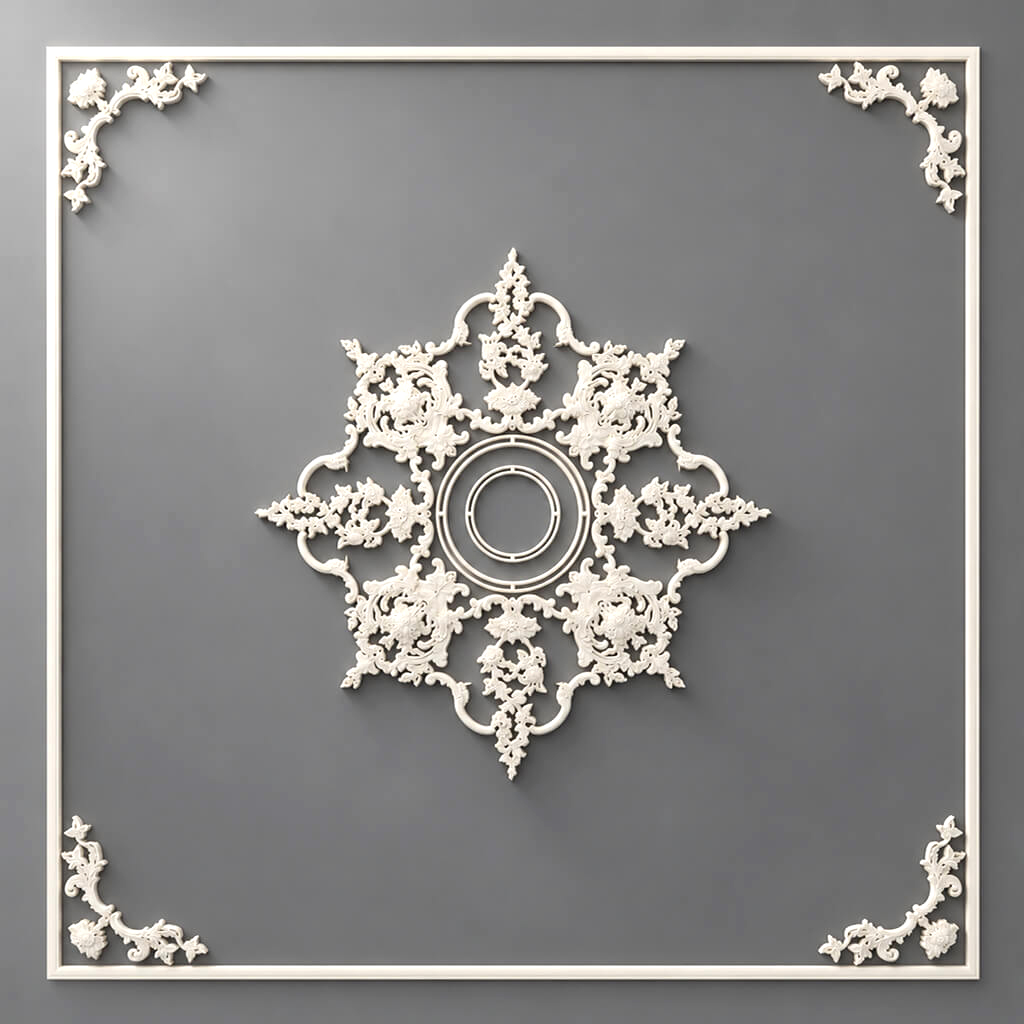
Ceiling Rosettes and Medallions
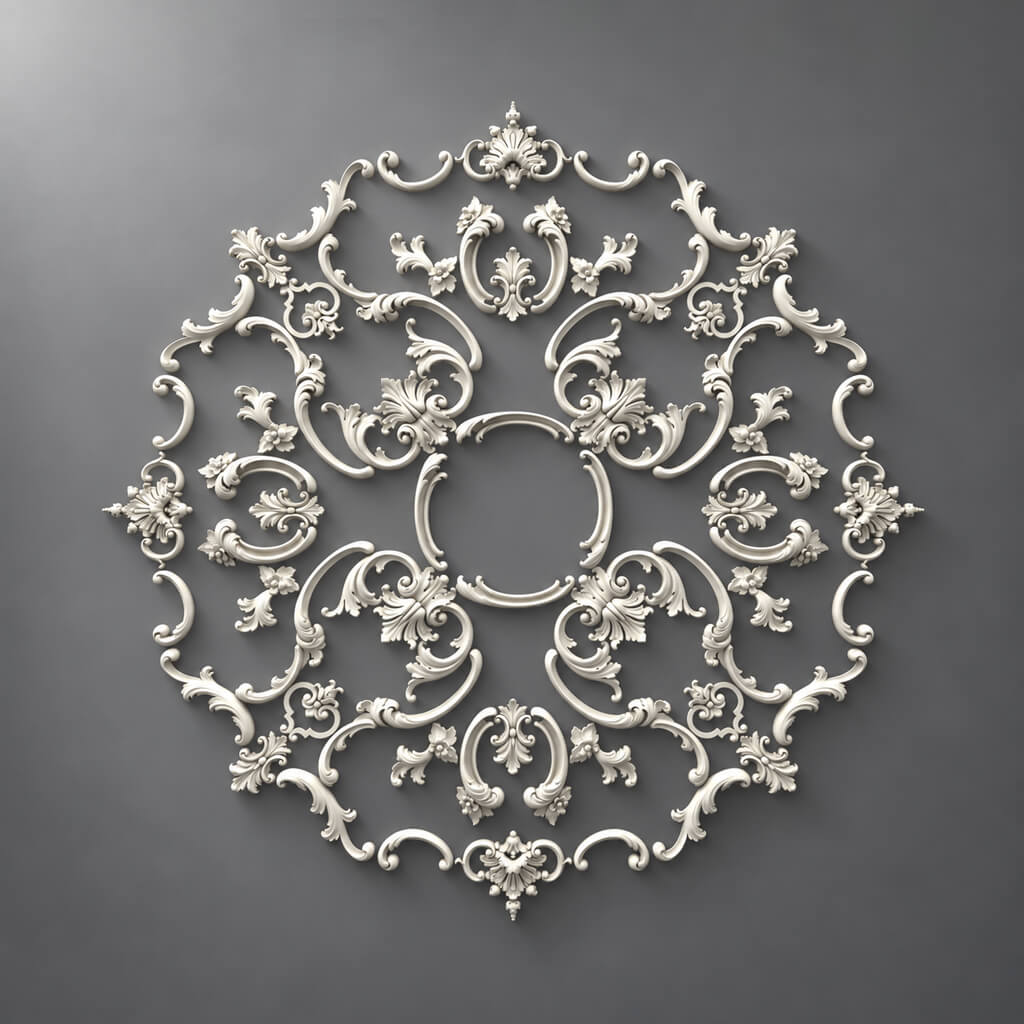
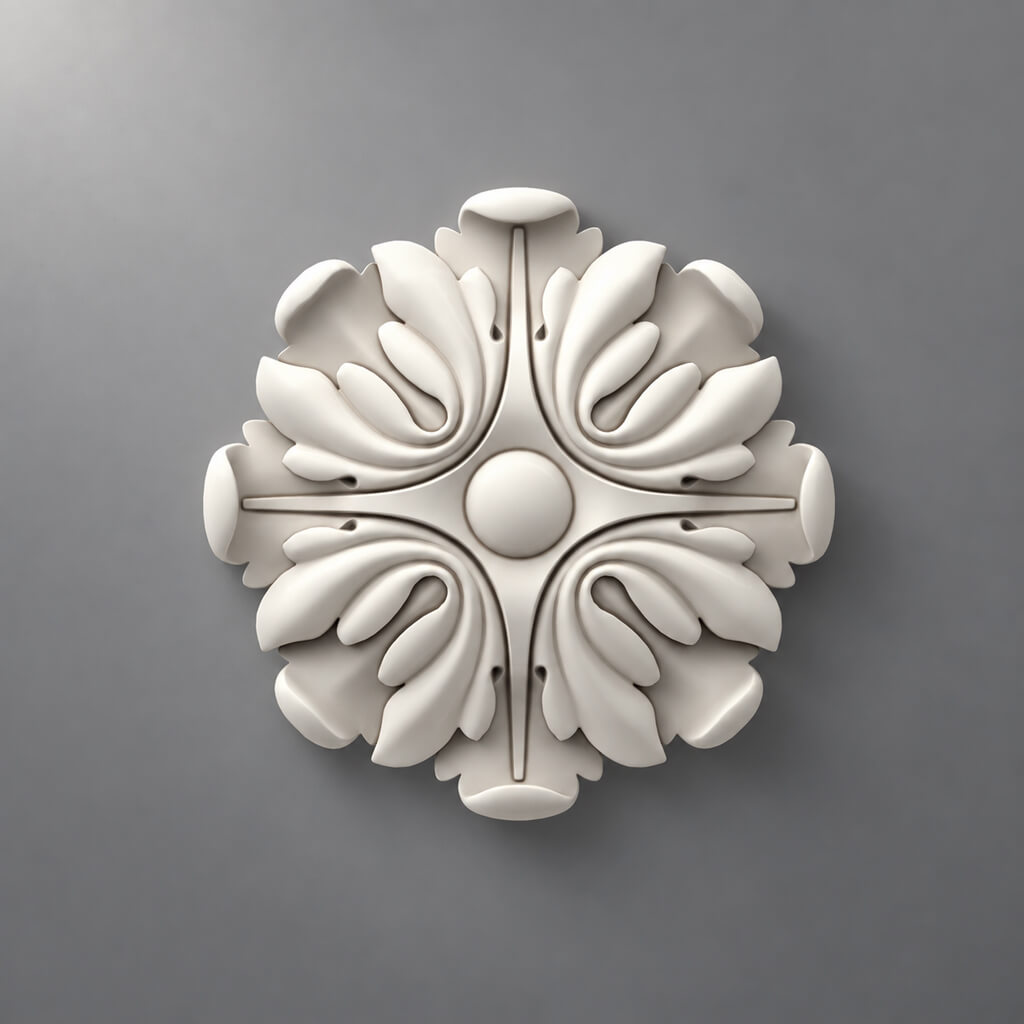
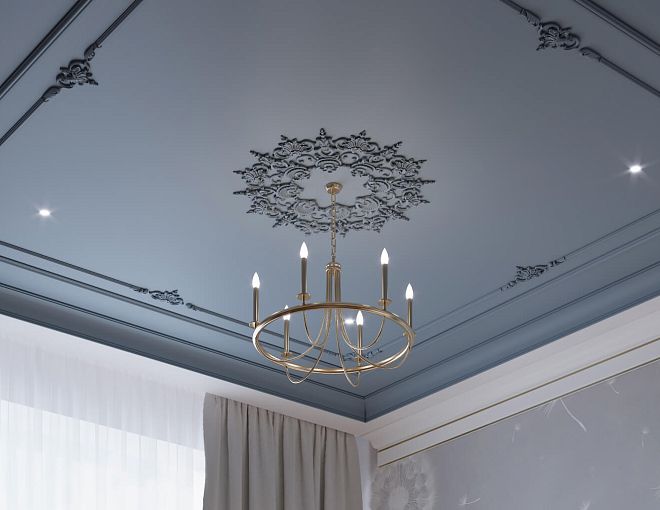
If the slatted accent wall is opposite or beneath a decorative ceiling — a ceiling rosette or medallion at the intersection of sightlines adds a level and a sense of completion. This technique works especially well in classic or neoclassical interiors. In modern minimalism, the role of the rosette can be played by a light point — a spotlight or a recessed light fixture with simple geometry.
Door decor
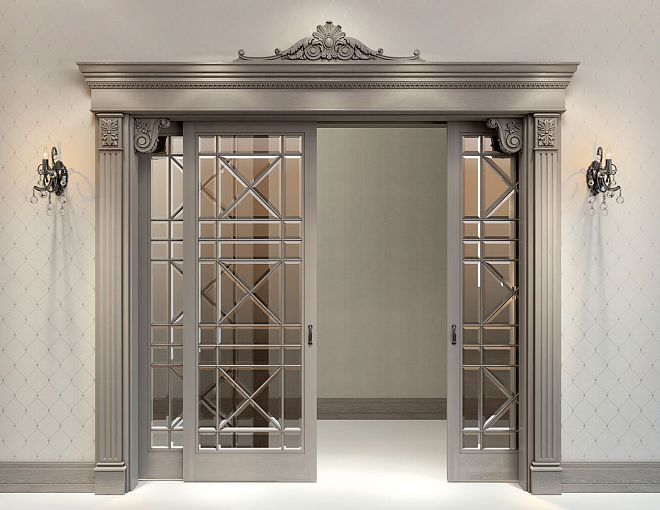
A frequently overlooked but critically important element is Door Decoration. When slat panels run along a wall and reach a doorway, a seamless transition is essential. A door casing, molding trim, or portal element becomes the bridge between the architecture and the wall decor. Without it, the door 'breaks' the pattern and disrupts the integrity of the design.
Polyurethane casings and door trims are painted to match the slat panels or executed in white as a neutral separator—both options work depending on the concept.
Lighting as a decorative element
Lighting is perhaps the most transformative tool when working with slats. Slatted panels with lighting—it's a whole universe of effects. Hidden LED strips behind a cornice create soft, diffused light that 'lifts' the ceiling. Backlighting behind the slat surface (when the strip is attached to the supporting base in front of the wall, with the slats positioned in front) creates a floating plank effect—one of the most popular techniques in modern TV zone design.
Spotlights directed along the slat surface from top to bottom create a dramatic play of light and shadow—each slat casts a shadow on the next, transforming the surface from flat to sculptural.
How to design a TV zone, bedroom, hallway, and study
Each room imposes its own requirements on the composition of decorative elements and the logic of their arrangement.
TV zone in the living room
The TV zone is the most popular application area for slatted panels. And the most demanding: here the maximum number of gazes gather, here lives the main object of the living room — the screen, here light, furniture, and decor compete.
Slatted panels in the living room interiorIn the TV zone, they primarily work as a background, emphasizing the screen and unifying the entire wall into a single object. A classic technique: slats from floor to ceiling, in the center — a cabinet or floating console for the TV, above it — the screen, on the sides — hidden niches or built-in shelves.
Decorative elements here serve as architectural framing:
-
The upper cornice with hidden lighting defines the ceiling contour;
-
The lower molding or baseboard with a wide profile fixes the lower boundary;
-
Vertical pilasters on the sides of the cabinet create a semblance of an alcove or portal;
-
A horizontal shelf-bridge separates the screen area from the decorative area above it.
The color of the slats in the TV zone is chosen based on the desired effect: dark slats (wenge, anthracite, graphite) create cinematic contrast and reduce the visibility of the screen when turned off. Light slats (white, ivory, linen) visually expand and are suitable for small living rooms.
Bedroom: headboard as the center
slatted panels in the bedroom— this is the headboard zone as the first and main point of application. Here, slats perform a completely different function than in the living room: they create an atmosphere of coziness, warmth, and natural presence.
Solid oak slats in natural or softly tinted finishes above the bed evoke the feeling of a country house, natural tactility, and quiet dignity. MDF slats in white or gray-beige tones bring Scandinavian softness, purity, and conciseness.
To complete the look in the bedroom:
-
Ceiling molding or cornice at the wall-ceiling transition level;
-
Side frames or pilasters defining the width of the headboard (especially important for wide beds 160 and 180 cm);
-
Bedroom door decor coordinates with the slat profile or remains neutrally white;
-
Soft diffused lighting — sconces on the sides of the bed or hidden LED strips behind the slats — completes the look without unnecessary drama.
Interior decor in the bedroom should not overwhelm. The rule of subtraction applies here: remove the excess — and what remains is exactly what is needed.
Entryway: First Impression and Function
Slatted panels in the hallway interiorThey solve several tasks at once: they make a narrow corridor visually wider or taller, create a sense of quality design right from the threshold, and form a deliberate transition zone between the street and the home.
The hallway requires a pragmatic approach to decor. What's important here:
-
Surface resistance to stains (MDF slats under varnish or oak under a lacquered coating are easy to wipe clean);
-
Proper door decor: architraves, polyurethane door frame trims give the entrance space architectural weight;
-
Moldings at the level where the wall transitions into a sliding wardrobe or built-in wardrobe — they hide technical seams and create a sense of a single architectural volume;
-
Ceiling molding with a niche for lighting — a hidden LED strip creates a 'pathway' along the corridor, visually elongating the space.
In the hallway, slats are most often placed vertically — this works to optically increase the height in corridors with standard ceilings. Horizontal slats in the hallway are a rare but interesting technique for non-standard narrow spaces where visual expansion is needed.
Study: Strictness and Concentration
The home office is a special case. Here, the interior should simultaneously inspire and help concentrate.slatted wall panels for interior finishingIn the office, they are most often applied behind the desk or on the wall opposite — as an accent surface that sets the work focus.
Decorative elements in the office are restrained and functional:
-
Built-in shelves in a slatted wall — for books, folders, collection items;
-
Moldings as zone separators (work area / relaxation area for negotiations);
-
Furniture decor — small overlays, handles, profiles on polyurethane cabinets create unity of the furniture line with wall finishing;
-
Dark tones of slats (anthracite, wenge, mocha) create an atmosphere of concentration.
Where an accent is needed, and where it's better to leave clean geometry
This is one of the subtlest issues in working with slatted surfaces. An experienced designer knows: you cannot place accents everywhere. If the accent is everywhere — it is nowhere.
Logic of accent placement
The rule is simple: one wall in the room is accent, the others are neutral. The accent wall gets slats, decorative elements, lighting, volumetric components. Adjacent walls remain in clean geometry: paint, textured plaster, uniform neutral tone.
Where slats work as a background (large wall in the living room, an entire wall in the bedroom), there should be less decor — and it should be restrained. Where slats work as an expressive architectural object (niche, alcove, portal-like frame), the decor can be richer.
When clean geometry is preferable
There are several scenarios where adding decorative elements to slats would be a mistake:
-
Minimalist interior in the Japanese wabi-sabi or Scandinavian flat design style: here, slats carry meaning on their own; adding moldings and stucco will ruin the concept.
-
Small spaces with low ceilings: every additional decorative element 'eats up' space and creates a feeling of tightness.
-
Industrial style (loft, industrial): here, metal details are appropriate instead of stucco decor—tubular cornices, steel corners, bolted connections.
-
Children's room: slats plus minimal neutral molding—and stop. A child's room lives through furniture, textiles, and accessories, not decorative stucco.
How to avoid overload
An overloaded interior is not one with a lot of things. It's one without hierarchy. When the eye has nowhere to land, when everything screams at once—visual noise sets in.
With slatted panels and decorative elements, overload most often occurs in three cases:
1. Mixing decorative styles
Classical polyurethane cornices with rich ornamentation plus strict rectangular slats in a minimalist style—this is a conflict of languages. They speak different dialects and don't hear each other. Choose decor that belongs to the same stylistic family as the slats.
2. Too many accent planes
Three walls out of four in slat design plus a decorative ceiling plus a molded frieze — this is already architectural theater, which requires exclusively professional direction. For a living space, the rule of one accent wall is not a whim, but a tool for psychological comfort.
3. Large-scale imbalance
Thin slats 20 mm wide and a massive cornice 120 mm high — a mismatch of scales. Large decor requires large slats and vice versa. Scale is one of those non-obvious parameters that the brain reads instantly and unmistakably, although the apartment owner often cannot formulate 'why something is wrong.'
Simple rules against overload
-
No more than one 'complex' decorative element per surface (either a cornice, or a rosette, or a pilaster — not all three together).
-
The color solution of the decor should not add a third independent tone: if the wall is white and the slats are oak, the cornice is white or oak, but not a third color.
-
If in doubt — remove it. Laconicism is always better than excess.
What to look for when selecting color and scale
Color and scale are two parameters that determine the success or failure of any wall composition. Let's examine both in detail.
Color: three strategies
Monochromatic strategy. Reeds, cornice, baseboard, and moldings in one color. One of the most powerful techniques in modern interior design. Monochrome creates a sense of volume and architectural integrity: various profiles in a single color are perceived as a unified surface relief, not as a collection of disparate elements.
Contrast strategy. Reeds in one tone, decorative elements in a contrasting one. Classic: white reeds on a dark gray wall with white molding. Or dark oak reeds with a white cornice and white baseboard. Contrast makes decorative elements legible and adds graphic quality.
Nuanced strategy. Reeds and decor in similar but not identical shades of the same family. For example, warm beige reeds and cool cream molding. This strategy is the most complex to execute, but with the right selection, it is the richest visually.
Scale: proportions and spacing
The spacing between reeds (distance from the center of one to the center of the next) defines the character of the surface. Close spacing (40–60 mm) creates a dense, almost fabric-like texture—the surface is perceived as a single material. Wide spacing (100–150 mm or more) is rhythmic architecture, a clear graphic pattern with pronounced gaps and shadows.
The width of decorative elements should correlate with the reed spacing:
-
For close spacing—thin, delicate moldings (height 30–50 mm);
-
For wide spacing—moldings with a larger cross-section (60–100 mm);
-
Pilasters in width should not be narrower than three reeds with their gaps—otherwise, the proportion is lost.
The height of the panel relative to the room also matters. A panel at one-third of the wall height (so-called 'high chair rail') plus a border molding along the edge is a classic solution that works in any style. A floor-to-ceiling panel is a maximal architectural statement, requiring strict control of the other surfaces.
Wood and polyurethane decor color
One practical question: how to match the color of polyurethane decor to solid oak slats?
The answer depends on the concept:
-
Natural harmony: cornices and moldings are tinted to the same tone as the oak—this creates a sense of a unified wooden volume;
-
Architectural contrast: the decor is painted white or light gray—the oak slats serve as a warm natural accent, while the decor maintains a clean architectural line;
-
Graphic effect: dark oak plus black molding—a bold, expressive, very modern combination.
Furniture decor: connecting the wall and furniture row
An often overlooked aspect is coordinating the slatted wall with furniture decor.decor for furniturePolyurethane decor—overlays, handles, front frames, profile overlays on drawers—allows synchronizing wall and furniture spaces into a unified interior ensemble.
Imagine a wardrobe in a bedroom with a slatted accent wall. If the wardrobe fronts are flat and neutral—this creates a break in the image. But if vertical molding frames are added to the fronts, repeating the rhythm of the slats, or a horizontal profile crosspiece in the same color as the cornice—the wardrobe becomes part of the architectural concept, not just a functional object.
This is interior decor in the broad sense: not individual beautiful objects, but a system of relationships between surfaces, volumes, and details.
Decorative kitchen fronts
Slatted inserts in kitchen fronts have been one of the main trends in recent years.Slatted panels in the kitchenThey can be used as a backsplash, as an accent side wall of an island, or as a decorative element on the fronts of wall cabinets. Combined with polyurethane moldings on the perimeter of the kitchen set, this creates a complete architectural kitchen scene.
Practical scenarios: from idea to result
Let's examine several specific interior scenarios to give the principles described above a practical dimension.
Scenario 1: 20 m² living room, style — modern neoclassicism
Task: a slatted TV wall with a sense of architectural completeness.
-
Material:solid oak slatted panel, 'tobacco' tint, slat spacing 70 mm;
-
Upper cornice: polyurethane, profile with soft heel line, painted white;
-
Lower baseboard: polyurethane, height 100 mm, matching the cornice;
-
Side pilasters: polyurethane, width 80 mm, from floor to ceiling;
-
Lighting: hidden LED strip in the upper cornice, warm white;
-
Furniture: TV stand with slatted fronts of the same spacing, handles — matte gold.
Result: the wall looks like a built-in architectural niche. The slats, cornice, baseboard, and furniture speak the same language.
Scenario 2: Bedroom 16 m², style — Scandinavian minimalism
Task: headboard made of slatted panels with a feeling of natural silence.
-
Material:Painted MDF plank panels, color — warm gray-beige, slat spacing 50 mm;
-
Upper element: thin molding, 30 mm, in the same color;
-
Side restraints: thin vertical moldings along the width of the bed;
-
Lower element: wide 80 mm skirting board, same tone;
-
Furniture decor: bedside tables with a rail on the front in the tone of the wall panel.
Result: the headboard is perceived as a built-in architectural form, soft and warm. No unnecessary decor, only rhythm and color.
Scenario 3: Hallway 4 m², style — modern urbanism
Task: make a narrow corridor visually wider and create the first impression of the house.
-
Material:Slatted wall panels, MDF, vertical orientation, color — dark gray anthracite;
-
Ceiling cornice: polyurethane, minimalist profile, matte white;
-
Lower skirting board: 80 mm, in the tone of anthracite;
-
Doorway decor: polyurethane architraves in white, coordinated with the cornice;
-
Lighting: ceiling strip along the corridor in a cornice niche.
Result: the corridor appears wider due to the contrast between the dark slatted wall and the light ceiling; the lighting 'stretches' the space.
Modular panels: rhythm without installation risks
slatted modular wall panel— a separate category worthy of attention. The modular format allows creating slatted surfaces without complex frame installation: each module is fixed independently, panels join edge-to-edge with precise slat spacing alignment.
For decorative finishing, modular panels are especially convenient: they can be combined with niches, shelves, built-in lighting without prior engineering preparation. Decorative elements—cornices, moldings, baseboards—are installed over the finished slatted surface at the final stage.
Flexible slatted panels: decor on non-standard surfaces
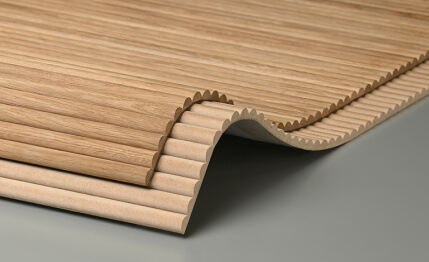
Worthy of special attention areFlexible slatted panelson a fabric base. They allow extending slatted decor beyond flat walls—onto columns, arches, rounded corners, curved partitions.
On radius surfaces, decorative elements are selected with particular care: moldings must either have a radius profile or be cut into small fragments with precise fitting along the curve. Polyurethane is the optimal material for this task: it can be cut by hand, bent when heated, and painted seamlessly.
Wall finishing with slatted panels: common mistakes and how to avoid them
Wall finishing with slatted panels— a process that requires not only quality installation but also proper final finishing. Here are the most common mistakes:
-
Saving on cornice and skirting. This is not the place to save: it is the framing that makes the panel complete.
-
Uncoordinated color. Three shades of white on slats, cornice, and ceiling is the most common problem. White colors should be from the same group: cool with cool, warm with warm.
-
Ignoring the scale of decor. Too thin molding on a wall with wide slat spacing gets lost and looks random.
-
Lack of transition to adjacent surfaces. Joining a slatted panel with a painted wall without molding is a visual break that is difficult to fix after installation.
-
Decorative elements of different styles. Classic cornice plus industrial slats — this combination requires exceptionally fine work with color and proportions, and in most cases does not work with DIY decoration.
Slatted panels with lighting: decorative light as an architectural layer
Slatted panels with lighting— a separate topic that cannot be overlooked when talking about decorative elements. Light in a slatted structure plays several roles simultaneously: it emphasizes texture, creates volume, sets the mood, and functionally illuminates the area.
Main options for light integration:
-
Backlighting (tape behind the substrate, slats backlit): creates a floating plank effect, especially effective in dark interiors;
-
Top lighting (cornice with hidden tape): soft diffused light down the surface of the slats;
-
Bottom lighting (floor strip or skirting light fixture): upward glow, dramatic effect, used for accent zones;
-
Edge lighting (strip along the edge of a shelf or niche in a slatted wall): graphic light line.
Important: the type and color temperature of the light should coordinate with the finish. For wood — warm white (2700–3000 K), for MDF slats in neutral tones — neutral white (3500–4000 K).
Slatted panels for interior finishing: final selection system
When you approach the final selection of materials for wall finishing, use the following algorithm:
-
Determine the accent wall — one, no more.
-
Choose the slat material — solid oak for warmth and naturalness, MDF for color play and strict geometry.
-
Fix the style concept — classic, neoclassical, Scandinavian minimalism, modern urbanism, loft.
-
Select decorative elements in accordance with the style: polyurethane cornices and moldings — for classic and neoclassical; thin metal profiles — for loft; minimalist wooden planks — for Scandinavian style.
-
Coordinate the scale — the width of the decor is proportional to the slat spacing.
-
Choose a lighting solution — type of lighting and color temperature.
-
Coordinate furniture decor — with at least one common element (color, profile, material).
This algorithm helps avoid decision-making chaos at the final stage and ensures a systematic approach to interior design.
FAQ: Answers to popular questions
Can slatted panels be combined with stucco decor?
Yes, but with caveats. In classical and neoclassical interiors, this is an organic combination. In minimalist styles — no. The key condition: decorative elements must belong to the same stylistic vocabulary as the slats.
Which cornice is suitable for MDF slatted panels for painting?
The optimal option is a polyurethane cornice with a minimalist profile, painted in the same color as the slats. This creates a monochrome relief effect.
Do panels need to be removed for repainting?
No. MDF slats are repainted locally right on the wall — sanding, priming, enamel. Polyurethane decorative elements are also repainted without dismantling.
How to match door decor to a slatted wall in a hallway?
Casing is chosen to match the tone of the slatted panels or in a neutral white/cream. It is advisable to coordinate the casing profile with the profile of the cornice and baseboard — then all elements are perceived as a unified architectural system.
Are slatted panels suitable for bathrooms?
Moisture-resistant MDF slats under varnish — yes, provided the ventilation regime is maintained. Solid oak in the bathroom requires enhanced varnish coating and good exhaust. An alternative is slatted panels made of DPC or PVC for areas with direct contact with water.
How long does it take to install a slatted wall with decorative elements?
For a wall of 12–15 m², on average 1–2 days: panel installation + installation of cornice, baseboard, moldings + lighting. The timeline depends on the complexity of the configuration and the need for installation on a frame.
How to avoid mistakes with the scale of the decor?
Practical rule: the width of the molding or cornice should not exceed the total width of three slats with gaps. This provides a proportional scale for most slatted solutions.
Is a frame needed for slatted panels?
A frame is needed for significant wall irregularities (more than 10 mm) or when it is necessary to lay sound-absorbing material behind the panels. In other cases — installation directly on a leveled surface.
About the company STAVROS
All products described in this article are —Slatted wall panels— made of solid oak and MDF, as well as the full range —decorative elements made of polyurethane— are presented in the STAVROS company catalog.
STAVROS is a Russian manufacturer and supplier of solid wood products and polyurethane decor for interiors and facades. The company works with professional designers, architectural bureaus, construction companies, and private clients across Russia. The assortment includes —slatted panels made of MDF and solid oak, moldings, cornices, and baseboards, molding decor, decor for furniture and doors — everything needed to create a complete interior composition.
STAVROS manufactures custom slatted panels with the option to choose wood species, slat spacing, plank width, and type of finish coating. For each project, professional consultation on material selection and decorative elements is available. See for yourself: a properly selected set of slatted panels with framing decor is not just a beautiful wall. It is the architecture of your space.