








































Article Contents:
- Why the bedroom is the perfect space for slat panels
- Accent wall behind the headboard: the architectural center of the bedroom
- Parameters of the slat wall behind the headboard
- The role of ceiling molding in a bedroom interior with slat panels
- Types of ceiling molding for a bedroom with slat panels
- Why polyurethane molding is the best choice for the bedroom
- Materials for slat panels in the bedroom: wood, MDF, veneer
- Natural oak: a living material for living sleep
- MDF with matte enamel: color as the main tool
- Veneered MDF: natural pattern without risk
- Ash: an alternative to oak with a more neutral character
- Bedroom color schemes: slatted panels + molding + everything else
- Scheme "White and natural oak": timeless classic
- Scheme "Beige and tobacco": cozy without limits
- Scheme "Gray-milky and bleached oak": Nordic tranquility
- Scheme "Dark ash and white ceiling": contrasting accent
- Scheme "Wood + natural linen": flatbed of naturalness
- How to make a bedroom interior look expensive without overload: five principles
- Principle one: One accent — one 'voice'
- Principle two: Color unity from top to bottom
- Principle three: Quality of joints and finishes
- Principle four: Lighting as part of architecture
- Principle five: Silence of materials
- Technical solutions: slatted wall and molding in a unified system
- Installation sequence: what comes after what
- Gap between slats and cornice
- How to install slatted panels in a bedroom
- Molded ceiling cornice: dimensions and installation
- Five ready-made bedroom concepts: slats + molding
- Concept 1: 'Scandinavian Morning' – lightness and naturalness
- Concept 2: 'Japandi Meditation' – dark accent and silence
- Concept 3: 'Warm Classic' – oak and molding belt
- Concept 4: 'Gray-Milk Neutrality'
- Concept 5: 'Natural Grotto' – wood and molding from top to bottom
- Mistakes that kill the idea: what not to do
- Frequently asked questions about slat panels in the bedroom and ceiling molding
- Can slat panels be installed in the bedroom independently?
- What height of molding cornice is suitable for a bedroom with a 2.6 m ceiling?
- Slat panels in the bedroom — is a frame needed or is glue enough?
- What is the optimal finish for wooden slats in a bedroom?
- Ceiling molding — plaster or polyurethane?
- Can slat panels behind the headboard be combined with a slat ceiling in the bedroom?
- Conclusion

There are rooms you want to enter. Not because they are 'beautiful' in the banal sense of the word — with trendy furniture, fashionable lamps, and perfectly matched curtains. But because you can breathe properly in them. Because your gaze doesn't search for something to rest on — it simply relaxes. Because the space itself says: you can slow down here.
The bedroom is the only room in the apartment to which this requirement applies absolutely. Not 'it would be nice,' but mandatory. A person spends a third of their life in the bedroom. The quality of this space is not a question of aesthetics; it is a question of physiology and psychology. An anxious interior disrupts sleep. An interior overloaded with details prevents the brain from 'switching off.' Cold, impersonal surfaces do not provide a sense of security.
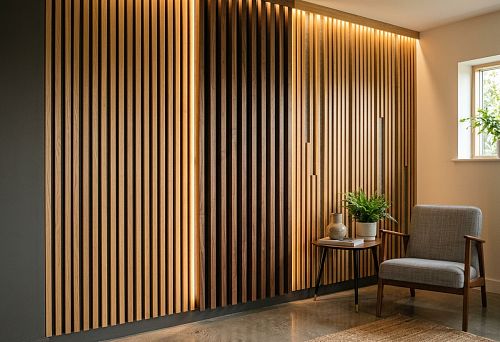
Slatted panels in the bedroom interiorcombined with ceiling molding — is about something else. About the architecture of tranquility. The vertical natural rhythm of wooden slats behind the bed's headboard and the restrained decorative band of a molded cornice under the ceiling — two elements that together create a space with character: warm, complete, expensive in the best sense of the word. Not shouting, but speaking in a low voice — exactly what a room for sleep needs.
But how exactly does this work? Why does this particular combination — slats and molding — create that very effect of 'expensive tranquility'? And how to implement it correctly, without mistakes that turn a good idea into disappointment? We will analyze everything — in detail, professionally, with respect for your time and for your bedroom.


Why the bedroom is the ideal space for slat panels
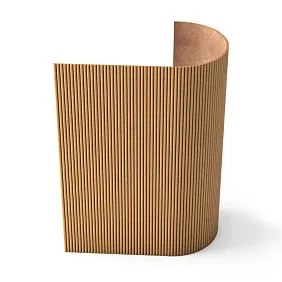
First of all — about the nature of perception. The bedroom is a room with a special lighting regime. There is rarely uniform bright light here: subdued evening light, a floor lamp by the headboard, diffused daylight through thick curtains dominate in the bedroom. It is precisely in such lighting thatWooden slat panelsunfold to their full potential.
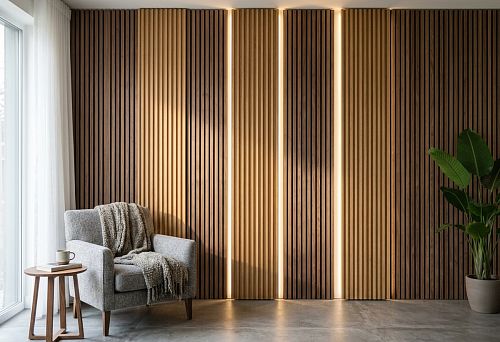
With side or subdued lighting, the gaps between the slats create expressive shadows. Each slat is a separate light object with its own highlight and its own penumbra. The surface ceases to be 'flat' and becomes textured, alive. The wood grain 'plays' in the warm light of the floor lamp—amber and brown oak tones in soft lighting appear deeper and warmer than in daylight. This is not a coincidence—it's the physics of the material.
The second argument: silence. The acoustics of a bedroom are fundamentally different from those of a living room. Here, you don't need the full sound-reflecting 'hall effect'—you need a soft, absorbing environment. Wooden slats with a felt backing behind them absorb high-frequency sounds, soften echoes, and reduce the level of household noise.soft slat panelswith a soft backing for the bedroom is both a visual and acoustic solution. A physically quieter space means higher quality sleep.
The third argument: the psychology of natural material. Wood is the only building material that humans perceive as 'alive' at a reflex level. The natural grain pattern, warm tactile surface, light woody aroma (especially with oil finishes)—all this activates the parasympathetic nervous system, reduces cortisol levels, and creates a sense of safety. A bedroom with a wooden slatted wall behind the headboard is literally a healthier space from the perspective of sleep neurology.




Accent wall behind the headboard: the architectural center of the bedroom
The wall behind the headboard of the bed is the main wall of the bedroom. It's the first thing a person sees upon waking and the last thing when falling asleep. It is this wall that sets the 'tone' for the entire interior: if it is lively, natural, with character—the entire bedroom becomes so. If it is white and bland—no furniture can compensate for that.
Slatted panels in the bedroom interioron the accent wall behind the headboard is not just 'beautiful'. It is an architectural technique that solves several tasks at once.
First task: Visual 'grounding' of the headboard. A bed without an architectural background looks like a piece of furniture 'parked' against a wall. A slatted wall behind the headboard becomes a natural architectural backdrop—the bed gets a 'foundation', support, context. The interior becomes cohesive, not assembled from separate pieces.
Second task: Scale and proportions. Vertical slats from floor to ceiling visually 'raise' the ceiling. In bedrooms with ceilings 2.6–2.8 m high (typical new construction), this technique increases the perceived height of the room without construction work.
Task three: Natural warmth. The tree behind the headboard is a symbolic and quite real 'natural screen' behind the sleeping person. Psychologically, it gives a feeling of security and shelter.
Our factory also produces:



Parameters of the slatted wall behind the headboard
Format 1: 'Full wall' — from floor to ceiling, from edge to edge. Maximum architectural effect. Recommended for bedrooms from 16 sq. m.
Format 2: 'Panel behind the bed' — a slatted field with a width equal to the width of the bed plus 50–80 cm on each side, height from floor to ceiling. For bedrooms of 12–16 sq. m — a self-sufficient accent without 'total' slatted coverage.
Format 3: 'Wainscoting' — a slatted field at a height of 110–130 cm from the floor (up to the level of the bed headboard). The upper part of the wall is a neutral paint or wallpaper. For bedrooms with non-standard proportions or when desiring a 'light' wooden accent without full slatted coverage.
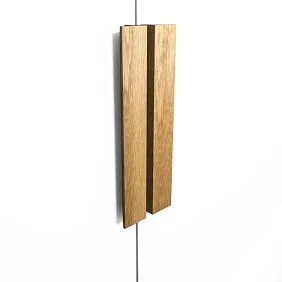
Slat width for the bedroom: 20–35 mm. The bedroom is an intimate and private space. Narrow slats create a more delicate, 'gentle' rhythm compared to the wide panels of a living room. Gap: 10–15 mm. The slat/gap ratio is about 2:1 — a natural, non-'grid-like' rhythm.
Orientation: vertical — for height and dynamics. Horizontal — for a 'low' Scandinavian interior with a wide headboard and a feeling of 'sprawling' space.
Get Consultation
The role of ceiling molding in a bedroom interior with slatted panels
Now — about the second participant in this architectural dialogue.Ceiling moldingIn the bedroom — it is not a 'ceiling decoration'. It is a boundary. An architectural stitch that finishes the wall, separates the vertical surface from the horizontal, and gives the space completeness and 'weight'.
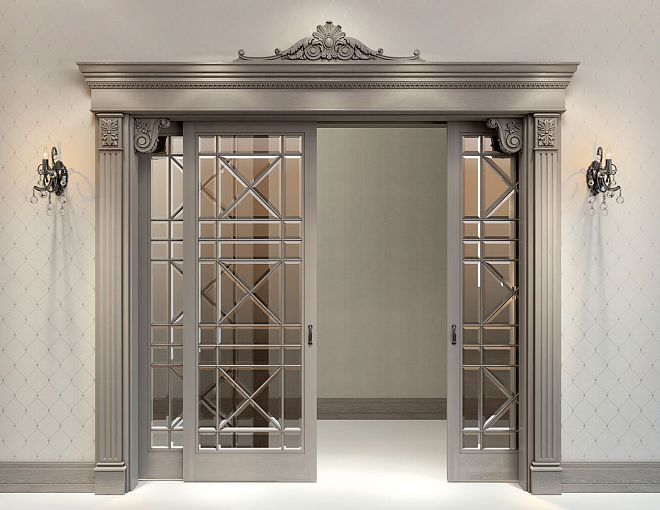
Imagine a slatted wall behind the headboard without a plaster cornice: the slats meet the ceiling, and this transition point is unfinished, 'raw'. Now imagine the same slatted partition witha plaster ceiling cornicealong the top edge: the boundary between wall and ceiling is defined, the space is 'pulled together', the slatted field receives a professional finish.
This is the difference between 'renovation' and 'interior design'. Between 'bought slats and nailed them up' and 'created architecture'.
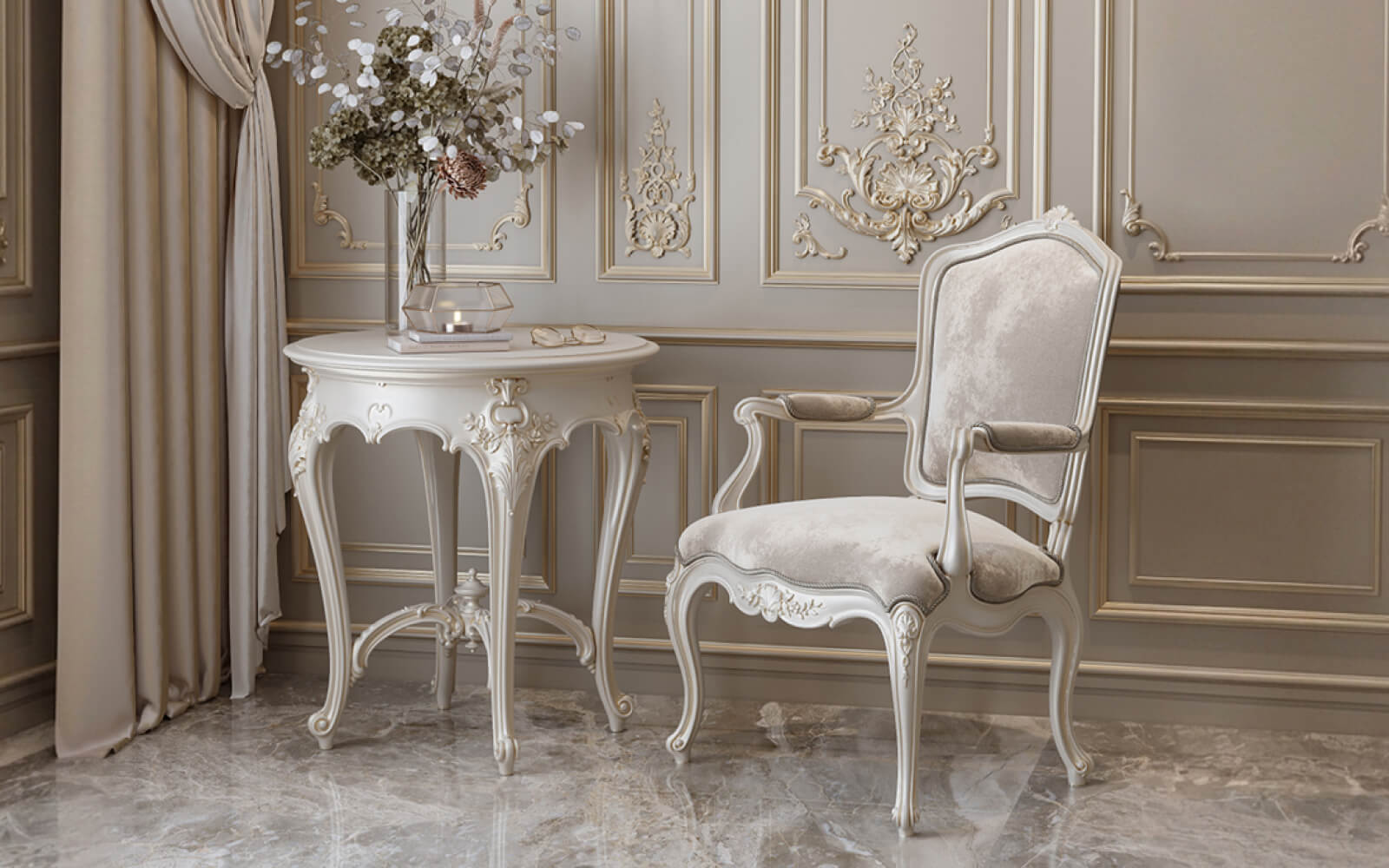
But plasterwork in the bedroom requires tact. The bedroom is a space without opulence and without excessive decor. Here, restrained, classically refined profiles work, not ornate Baroque plasterwork with scrolls. The rule is one: plasterwork in the bedroom should be 'audible', but not 'shout'.
Types of ceiling plasterwork for a bedroom with slatted panels
Cornice with a straight profile (40–60 mm high). A minimalist ceiling skirting with a smooth geometric cross-section — an absolute choice for modern concepts and Japandi bedrooms. The straight line of the plaster cornice as the final 'point' of the slatted wall. Strict, clean, professional.
Cornice with one profiled step (60–80 mm). A delicate classical profile with one small 'step' — a universal solution that works in modern interiors with wooden slats and in interiors with historical context. Creates a shadow near the ceiling without excess.
Cornice with an LED groove.Ceiling moldingwith an integrated or formed groove for an LED strip — allows creating a 'floating' ceiling: warm light from behind the cornice flows down the slatted wall. In the bedroom — one of the most atmospheric lighting effects.
Cornice with an 'egg-dart' or 'ovolo' profile. A classic profile with natural biomorphic forms — for interiors referencing traditional architecture. A restrained version of classicism, suitable even in a modern bedroom with wooden slats — if the profile is small (70–90 mm) and painted the same color as the wall.
Medallion on the ceiling above the bed. Not a perimeter cornice, but a single moldedceiling medallionabove the center of the bed — an architectural accent that 'marks' the bed's place on the ceiling. Paired with the slatted wall behind the headboard — the vertical axis of the bed is defined both from above (medallion) and from behind (slats). The bed receives a full-fledged architectural 'throne'.
Why polyurethane molding is the best choice for a bedroom
PolyurethaneMoldings— a modern alternative to gypsum and cement products. For a bedroom, where the weight of ceiling elements and ease of installation are important — this is the definitive choice.
Key advantages for the bedroom:
-
Light weight (8–10 times lighter than gypsum) — does not create a load on the ceiling
-
Installation with liquid nails without additional dowels
-
Does not crumble or crack due to building settlement (relevant for new constructions)
-
Accepts any paint (acrylic, matte, decorative)
-
Precise geometry — even joints with professional installation
-
Resistance to deformation with changes in humidity and temperature
For the bedroom, where the ceiling is a 'quiet' zone without intensive mechanical impact, polyurethane molding works flawlessly for decades.
Materials for slatted panels in the bedroom: wood, MDF, veneer
The bedroom is a 'quiet' zone in terms of material requirements. There is no moisture, no intensive mechanical loads, no chemical exposure. This opens maximum freedom of choice — the decision is determined by aesthetics and budget.
Natural oak: a living material for living sleep
Natural oak is the absolute aesthetic leader. In a bedroom with subdued evening lighting, the pattern of oak grain literally 'comes to life': amber and brown shades, texture shimmer, barely perceptible tone variations from slat to slat — create a surface that doesn't 'repeat' at any point. This is fundamentally important for the bedroom: a living, non-boring, yet calm surface that you can look at endlessly without fatigue.
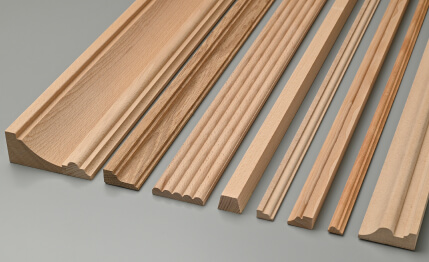
Solid natural oak molding— the foundation for a slatted wall in the bedroom with maximum natural expressiveness.
Recommended finish for bedroom: hard oil-wax. This is the most natural finish — the surface is tactilely warm, matte, not 'plastic'. With oil finish, oak slats retain their natural aroma. Varnish is acceptable but creates a more 'closed', lacquered surface which is less appropriate in a bedroom.
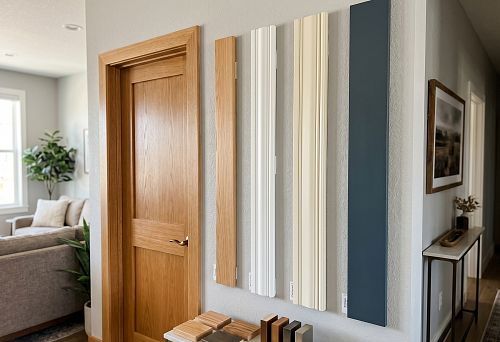
Oak stains for bedroom:
-
'Natural' (no stain, oil only) — warm amber tone, maximum naturalness
-
'Milky' / 'Bleached' — neutral light, for Scandinavian concepts
-
'Grey-white' / 'Ash White' — cool neutral, for Japandi and contemporary minimalism
-
'Tobacco' — warm medium-brown, for 'cozy' concepts with warm tones
-
'Smoky' — restrained grey-brown, for meditative concepts
MDF with matte enamel: color as the main tool
MDF slatted panelIn bedroom — for monochrome concepts with precise color solutions. Matte enamel RAL creates even saturated color across the entire surface without natural variations — perfect for interiors where color is the main expressive means.
For bedroom with MDF slats, shade selection is important:
-
Light neutrals (RAL 9001 cream white, RAL 9010 white, RAL 7035 light gray) — delicate texture on a light background
-
Greenish grays (RAL 7009, RAL 7033) — natural 'floral' tones, calming
-
Warm beiges (RAL 1013, RAL 1015) — maximum coziness without natural wood grain
-
Dusty pinks (RAL 3014, RAL 3017 in a light version) — a delicate feminine accent
paintable slatted wall panelsMDF allows repainting the bedroom in a new color concept in a few years without dismantling the slat system.
Veneered MDF: natural grain without risk
MDF base with natural oak or walnut veneer 0.6–1.2 mm — a compromise between the natural aesthetics of oak and the technical stability of MDF. Natural wood grain on the face surface, no seasonal movement. For the bedroom — one of the most balanced options.
Ash: an alternative to oak with a more neutral character
Natural ash in the bedroom — a more neutral natural surface compared to oak: less pronounced grain, straighter fiber, slightly cooler in tone. In the 'ash grey' tint — a natural material with an almost neutral 'gray-white' character, ideal for Scandinavian and Japandi bedrooms.
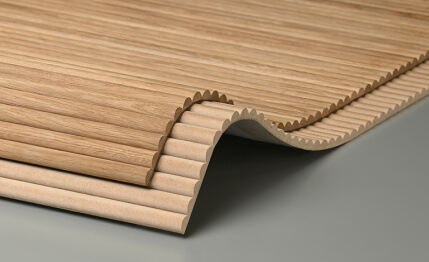
Wooden slat panelsAsh and oak — a detailed comparison of materials in terms of aesthetics and application.
Bedroom color schemes: slatted panels + molding + everything else
Color in the bedroom is the subtlest tool. Too saturated — it excites the nervous system. Too cold — it creates a feeling of discomfort. The right bedroom color scheme works imperceptibly: a person doesn't think about the wall colors, they simply feel good.
Scheme 'White and natural oak': timeless classic
White walls (RAL 9010 or 9001) + natural oak in an amber tone on the accent wall behind the headboard + white or cream molding cornice around the perimeter of the ceiling.
This is the most common and most stable scheme precisely because it has no contradictions: white is neutral, oak is warm and natural. The molding cornice in white 'dissolves' into the white ceiling, creating a smooth architectural transition to the light ceiling.
Details: bedding in natural tones (linen, ivory cotton), wooden bedside tables, a floor lamp with a white fabric shade, warm white linen curtains. No bright accents — only warm neutrality.
Lighting solution: 2700K track spotlights on the slatted wall + adjustable brightness sconces by the headboard.
Scheme 'Beige and tobacco': boundless coziness
Warm beige walls (RAL 1015 or 1013) + 'tobacco' oak (medium-dark brown) on the accent slatted wall + cornice matching the wall color.
This scheme creates the most 'enveloping' effect: warm beige walls + warm brown oak + warm cornice — a monochromatic natural palette with shades of earth, bark, autumn leaf. Such a bedroom literally 'hugs'.
Details: bedding in dark beige and brown tones with a soft texture, a warm beige-colored rug, copper or gold accents in the lighting fixtures.
Scheme "Gray-Milk and Whitewashed Oak": Nordic tranquility
Gray-milk walls (RAL 7044 or 'warm grey' shade) + whitewashed oak or 'ash white' ash on an accent slatted wall + snow-white cornice along the ceiling.
This scheme is about restraint and modernity. A cool-neutral background, the delicate natural pattern of whitewashed wood—the surface is almost monochrome but alive. The cornice is snow-white—maximally neutral.
Details: bedding in cool white and gray tones, chrome or matte nickel in hardware, minimalist furniture without ornaments.
Scheme "Dark Ash and White Ceiling": contrasting accent
Light walls (almost white) + dark 'smoky' ash on an accent slatted wall + snow-white molding along the ceiling.
The most 'graphic' scheme: a dark slatted wall against a light background—strong contrast, Japanese in spirit. White molded cornice on a white ceiling against dark slats—a delicate architectural accent that 'holds' the ceiling above the dark wall surface.
Details: bedding predominantly white or light gray—contrast to the dark slatted wall. No colored accents.
Scheme "Wood + Natural Linen": flatbed of naturalness
Walls in a warm linen tone (not white, not beige — specifically 'linen': RAL 1019 or the closest shade) + natural oak without tinting + cornice in the color of the wall.
This scheme is about absolute naturalness: linen, wood, natural shades without synthetics. The plaster cornice in the tone of the wall is not a 'cornice', but a boundary in the same color palette, an architectural detail without pronounced contrast.
Details: bed linen made of natural linen, a rug made of jute or wool, plants in ceramic pots, wooden or woven accessories.
How to make a bedroom interior look expensive without overloading: five principles
The word 'expensive' in relation to interior design does not mean the cost of materials, but the quality of the impression. You can spend a huge amount of money and get an overloaded, 'shouting' result. You can work with a limited budget and create a space that takes your breath away.
Slatted panels in the bedroom interior combined with ceiling molding — a system that, when applied correctly, gives exactly that: an expensive impression without overload. But the system only works if several principles are followed.
First principle: One accent — one 'voice'
A bedroom is not a living room, where several accent elements are possible. In a bedroom, there should be one main 'voice': the slatted wall behind the headboard. Everything else is its accompaniment, not a competitor.
This means: no accent wallpapers on adjacent walls. No bright print on the curtains. No multiple textures simultaneously on different walls. The slatted wall — takes the solo. The plaster cornice — completes. Everything else — a neutral background.
Second principle: Color unity from top to bottom
A luxurious interior is when colors don't 'compete' but 'converse'. The tone of the parquet, the tone of the slats, the tone of the molding cornice, the tone of the walls—all should be connected by a single color logic.
Not necessarily identical—necessarily coordinated. Warm palette to warm: amber parquet—amber oak slats—beige walls—cream cornice. Cold to cold: light ash—gray-milky walls—snow-white cornice—white ceiling.
Mixing warm and cold palettes in one space is precisely what creates a sense of cheapness even with expensive materials.
Principle three: Quality of joints and finishes
In a 'luxurious' interior, not only the materials themselves are perfect, but also the points where they meet. The joint of the slatted wall with the baseboard—a wooden baseboard matching the slats. The top edge of the slatted field—a molding cornice without a visible gap. The side edges of the slatted field—molding from the same solid wood.Solid wood moldingsaround the perimeter of the slatted wall transform 'attached slats' into a complete architectural panel.
A baseboard made from the same oak as the slats is a detail that most people don't consciously notice, but which subconsciously creates a feeling of 'everything is done right.'
Principle four: Lighting as part of the architecture
A slatted wall in a bedroom without thoughtful lighting is potential realized only halfway. Lighting for a slatted bedroom is a system, not a chandelier on the ceiling.
Three levels: track spotlights 2700K on the slatted wall (directional light, 'revealing' the wood texture), sconces by the headboard with brightness adjustment (task light for reading), LED behind the cornice or behind the slats (ambient diffused light for evening relaxation).
Slatted panels with lighting— 2700K LED strip behind accent wall battens. In the bedroom, this technique works especially subtly: with the main light off, the soft warm glow from the gaps creates an atmosphere that literally 'transmits' a signal to the brain: time to rest.
Fifth principle: The silence of materials
In an expensive bedroom interior, there should be no 'random' materials. Every surface is a conscious choice. Wooden battens. Linen curtains. Natural carpet. Ceramics in details. Metal — one type: either copper, or matte nickel, or brass. No plastic parts 'because it just turned out that way'.
Wall finishing with slatted panelsas part of the system for selecting the right materials for each surface.
Technical solutions: batten wall and molding in a unified system
Aesthetics without technology is a beautiful idea that ends badly. Let's consider the technical issues without which a batten bedroom with molding will not turn out as it should be.
Installation sequence: what comes after what
The correct installation sequence is the key to clean joints and a quality result.
-
Rough work (wall leveling, running electrical wiring for lighting and LEDs).
-
Installation of the ceiling molding cornice. The cornice is mounted on a leveled wall BEFORE installing the battens — this allows the lower edge of the cornice to serve as a straight guide for the upper boundary of the batten field.
-
Installation of wooden skirting board around the perimeter of the floor (or after the slats — depends on the installation method).
-
Installation of battens for the slatted wall (if wall leveling is necessary).
-
Installation of accent wall slats from bottom to top. First slat — using a level, strictly horizontal. Top slat — in the gap under the cornice.
-
Installation of side moldings.
-
Installation of LED strip behind the cornice and/or behind the slats.
-
Final finishing: painting of the cornice and decorative elements.
Under no circumstances should the cornice be installed over already mounted slats: then the lower edge of the cornice will 'float' over the relief of the slats, creating an uneven visible gap.
Gap between the slats and the cornice
The upper end of the slatted wall must overlap the lower edge of the decorative cornice by at least 5 mm — the cornice conceals the ends of the slats. Optimal: 8–10 mm overlap. This ensures a clean lower edge of the cornice without visible wood ends.
If the cornice has an LED groove — the LED strip is installed in the groove, light from behind the cornice flows onto the slatted surface. Distance from the strip to the slatted surface: 60–100 mm for uniform light diffusion.
How to install slatted panelsin the bedroom
For smooth walls in new builds: adhesive method (solvent-free mounting adhesive). Fast, clean, no battens required.
For walls with irregularities exceeding 3 mm/2 m: battening with 25×40 mm wooden battens spaced 400–500 mm apart, leveled with a laser level. Panels are attached to the battens with finishing nails or clips.
Acclimatization of panels: 72–96 hours in the room at working temperature and humidity. In the bedroom, where humidity is usually stable, this is sufficient for the material to fully adapt.
DetailedStep-by-step guide for DIY installation of slatted panels— for those undertaking installation themselves.
MoldedCeiling cornice: dimensions and installation
Cornice height for the bedroom: 40–80 mm. Proportion rule: cornice height in mm ÷ ceiling height in mm = 1.5–2.5%. For a 2.7 m ceiling — cornice 40–67 mm. For a 3.0 m ceiling — 45–75 mm. A cornice smaller than this ratio gets lost. Larger — feels oppressive.
Installation of polyurethane cornice:
-
Laser level line marking
-
Applying 'liquid nails' mounting adhesive to the back surface of the cornice
-
Pressing against the wall while holding for 10–15 seconds according to the level
-
Additional fixation with finishing nails or tape until the adhesive polymerizes
-
Joints between cornice sections: ends at 45° (for straight corners) or at a right angle with joint putty
-
Puttying nail holes and joints after installation
-
Priming and painting to match the ceiling or walls
Painting the cornice: matching the ceiling – the cornice 'dissolves' into the ceiling, creating a smooth transition. Matching the walls – the cornice 'belongs' to the wall. In a contrasting color (dark cornice with a light ceiling) – a graphic architectural accent. For bedrooms – the first two options, the third – only for bold monochrome concepts.
Five ready-made bedroom concepts: slats + molding
Theory only works in a specific image. Five completed concepts – for bedrooms of different sizes, characters, and budgets.
Concept 1: "Scandinavian Morning" — lightness and naturalness
Accent wall: whitewashed oak "milk", 22 mm slats / 11 mm gap, vertical, floor to ceiling.
Base: white wall (RAL 9010).
Molding: 50 mm straight profile cornice, painted RAL 9010 (white).
Other walls: RAL 9010 white.
Floor: light ash parquet "natural".
Baseboard: natural ash, height 80 mm.
Bedding: ivory-colored linen.
Curtains: natural white linen.
Style: an airy, light-filled bedroom. Whitewashed slats on a white background — a delicate natural texture without dark accents. Mornings in such a bedroom are soft and bright.
Concept 2: "Japandi Meditation" — Dark Accent and Silence
Accent wall: "smoky" ash (gray-dark), 20 mm slats / 10 mm gap, vertical, full wall.
Underlay: dark anthracite felt.
Molding: 45 mm straight-profile cornice, painted to match walls (gray-white, RAL 7044).
Other walls: warm light beige (RAL 1015).
Floor: dark "walnut" parquet.
Bed: low, without headboard, natural oak veneer.
Image: meditative silence. Dark slatted wall on a light background — contrast without tension. Japanese principle of "ma" — emptiness as a design element.
Concept 3: "Warm Classic" — Oak and Molding Belt
Accent wall: natural "tobacco" oak, 30 mm slats / 14 mm gap, vertical.
Substrate: wall painted RAL 7044 (warm gray).
Molding: 70 mm cornice with one step + medallion above bed Ø 500–600 mm. Paint: cream-white (RAL 9001).
Other walls: warm beige RAL 1013.
Floor: oak parquet 'nut'.
Baseboard: oak 'tobacco' matching the slats, height 100 mm.
Lighting: brass sconce with matte shade.
Style: 'luxurious' classic bedroom without excess. Warm oak + cream molding + warm beige walls — monochromatic earth and amber palette. Medallion above bed 'marks' the resting place with an architectural gesture.
Concept 4: 'Gray-Milk Neutrality'
Accent wall: MDF with matte enamel RAL 7044 (gray-milk), slat 25 mm / gap 12 mm, vertical.
Substrate: wall matching the slats (monochrome surface).
Molding: 55 mm straight profile cornice, painted white RAL 9010.
Other walls: RAL 9010 white.
Floor: light parquet, matte lacquer.
Bedding: white, gray, gray-blue.
Style: calm, neutral, modern bedroom. MDF slats in gray-milk color on a white background — monochrome rhythm without natural wood grain. White cornice — a light architectural accent.
Concept 5: "Natural Grotto" — wood and molding from top to bottom
Accent wall: natural amber oak, 35 mm slat / 16 mm gap, vertical, full wall.
Ceiling above the bed:slatted panels on the ceiling— horizontal slats made of the same oak on the ceiling above the bed area (2–2.5 m from the wall, zone width = bed width + 40 cm on each side).
Molding:plaster ceiling cornicearound the perimeter of the slatted ceiling zone — frames the wooden "island" on the ceiling.
Other walls: warm creamy white.
Concept: "natural grotto" — a wooden cocoon over the bed. Vertical slats at the back + horizontal slats on top + plaster cornice around the perimeter of the ceiling island — an architectural "canopy" made of natural wood. The most intensive concept — requires a bedroom of at least 20 sq. m.
Mistakes that kill the idea: what not to do
Forewarned is forearmed. Let's list the typical mistakes that undermine the potential of a slatted bedroom with moldings.
First mistake: Too many focal points at once. Slatted wall + accent wallpaper on an adjacent wall + bold textured curtain + printed bedding = visual chaos. A bedroom should have one dominant statement, not several competing ones.
Second mistake: Incorrect cornice height. A plaster cornice 120+ mm wide in a bedroom with a 2.7 m ceiling — feels oppressive, creates a sense of a "looming" ceiling. The rule of proportion is essential.
Third mistake: Wide slats in a small bedroom. Slats 50–60 mm in a 12 sq. m bedroom — the scale doesn't match the space. For a small bedroom — use slats 20–25 mm with a 10 mm gap.
Fourth mistake: Different materials on adjacent walls. Oak slats on one wall + pine wood paneling on another + laminate "wood-look" flooring = three competing "woods." Rule: one wood species, one tone, one format.
Mistake five: Skimping on the baseboard. A beautiful slatted wall, topped with a molded cornice — and a white plastic baseboard at the bottom. The effect is ruined.solid wood baseboard— matching the slats — is an essential finishing element.
Frequently Asked Questions about Slatted Panels in the Bedroom and Ceiling Molding
Can slatted panels be installed in the bedroom by yourself?
Yes, with basic carpentry skills: a laser level, a miter saw, and mounting adhesive. The main difficulty is precisely aligning the first slat. A detailedstep-by-step guideallows you to perform the installation yourself with a professional result.
What height of molding cornice is suitable for a bedroom with a 2.6 m ceiling?
For a 2.6 m ceiling — a cornice 40–55 mm high. This is 1.5–2.1% of the ceiling height — an 'invisible' level: the cornice is present as an architectural detail but does not feel oppressive.
slatted panels in the bedroom— is a frame needed or is adhesive sufficient?
In a bedroom with even walls in a new building (tolerance 3 mm/2 m) — adhesive installation without battens. In old housing stock with uneven walls — battens are mandatory. If you wish to add acoustic felt backing behind the slats — battens are also needed.
What finish for wooden slats is optimal in a bedroom?
Hard oil-wax — a natural matte finish, warm to the touch, with a light natural scent. For a bedroom — optimal. Polyurethane varnish — more practical, less natural. For a bedroom without special requirements for coating durability — oil-wax is definitely preferable.
Ceiling molding— plaster or polyurethane?
For a bedroom — polyurethane. Lightweight, installed with adhesive without dowels, does not create load on the ceiling, does not crack during building settlement. Plaster — heavier, requires dowel fastening, cracks during settlement. Polyurethane molding in appearance is no different from plaster with quality execution.
Can slatted panels behind the headboard be combined with a slatted ceiling in a bedroom?
Yes — and this is one of the strongest design techniques.slatted panels on the ceilingSlatted ceiling above the bed + vertical slats behind the headboard + molded cornice along the border of the slatted ceiling 'island' — a 'natural canopy' over the sleeping area. Requires careful planning and ceilings no lower than 2.7 m.
Conclusion
A bedroom with slatted panels behind the headboard and a molded cornice on the ceiling — this is not a seasonal trend or a designer's whim. It is the architecture of tranquility: thoughtful, natural, complete. The vertical rhythm of wooden slats creates a warm, living backdrop for sleep. The molded cornice line finishes the wall, giving the space a sense of completion. Light reflected from the wooden surface makes the bedroom warmer. The natural material behind the headboard creates a feeling of shelter and safety.
When all these elements work together — in the right proportions, in a coordinated color scheme, with neat joints and wooden finishes — the result is a space you want to feel physically. Enter, close the door, and simply stay.
Wooden slat panelsmade of natural oak and ash for an accent wall behind the headboard,Pogonazh iz massivafor skirting boards and moldings,Polyurethane Ceiling Moldingsfor cornices and medallions — the full range for a natural bedroom of any style and format is presented in the STAVROS company catalog.
STAVROS is a Russian manufacturer of slat systems, millwork, and decorative moldings made from high-quality materials. Full-cycle production: from drying and processing wood to applying finishing coatings and manufacturing polyurethane molded profiles. Professional consultation on material selection, parameters, and concept for your bedroom — because a sleeping space deserves as careful an approach as any other architectural task. Even more so.