








































Article Contents:
- Why the living room is the best place for slatted panels in an apartment
- Anatomy of a slatted living room: what makes up the look
- Materials for slatted panels in the living room: what to choose and why
- Natural oak: the absolute leader of the living room
- Ash: Scandinavian nervousness
- MDF: precision and practicality
- Solid wood moldings: from pine to birch
- Parameters of slatted panels for the living room: a detailed breakdown with numbers
- Slat width: scale and character
- Gap between slats: air as a design element
- Slat thickness: volume and shadow
- Height of the slatted field: from floor to ceiling — is it mandatory?
- Zoning the living room with slatted panels
- Slatted wall as a zone boundary
- Slatted column as a spatial accent
- Slatted ceiling 'island' for zoning
- Five concepts for a slatted living room: precise parameters and images
- Concept 1: 'Northern Light' — Scandinavian minimalism
- Concept 2: 'Dark Forest' — depth and shelter
- Concept 3: "Natural Amber" - oak and warmth
- Concept 4: "Japandi" - eastern emptiness
- Concept 5: "Neoclassicism" - natural aristocracy
- TV on a slatted wall: how to combine technology and naturalness
- Lighting a slatted wall in the living room: theater of shadows and light
- Track spotlights: the main tool
- LED behind rails: glow from within
- Cornice with hidden LED: "pouring" light
- Wall sconces: side accent
- Finishing a slatted wall in the living room: moldings, cornices, baseboards
- Installing slatted panels in the living room: three methods
- Frequently Asked Questions About Slatted Panels in the Living Room
- How Many Walls Should Have Slatted Panels in the Living Room?
- Can Slatted Panels Be Installed in a Living Room Combined with a Kitchen?
- Should Slatted Panels Be Removed When Selling an Apartment?
- How to Combine Slatted Panels with Wallpaper in the Living Room?
- How to Care for Slatted Panels in the Living Room?
- How to Install Slatted Panels in the Living Room Yourself?
- Are slatted panels suitable for a small living room?
- Conclusion

The living room is the room with the most complex mission in the house. It simultaneously hosts guests and shelters from them. The family gathers here in the evenings and scatters for business in the mornings. Here, movies are watched, politics are debated, and silence is shared in good company. The living room is the only space that must work for everyone and always: for a formal dinner and for a lazy Sunday morning in pajamas.
That is why finishing the living room is the most responsible task in an apartment. Making a mistake here means creating a space that doesn't 'work': too cold or too loud, too empty or too cluttered. Balance is the only word that accurately describes the perfect living room.
Slatted panels in the living room interior are a solution that ensures this balance with architectural precision. The natural rhythm of vertical slats adds volume and depth to the wall without cluttering the space. The warm tone of wood creates coziness without kitsch. The play of light and shadow in the gaps under side lighting transforms an ordinary wall into a living architectural surface. And all this—without a single unnecessary item, without patterns or decorations.
But the living room is not a bedroom. Here, the requirements for scale are different, the zoning logic is different, and the approach to lighting is different. The article you are reading is not a general overview of slatted panels, but a targeted discussion specifically about the living room: about its specifics, about specific parameters and ready-made concepts that work.

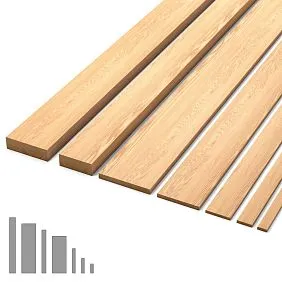
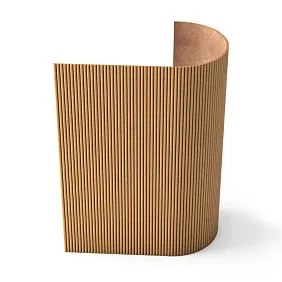
Why the Living Room is the Best Place for Slatted Panels in an Apartment
The question is not rhetorical. Slatted panels are appropriate in many rooms—in the bedroom, nursery, hallway, study. But it is in the living room that they truly shine. Why?
Scale. The living room is typically the largest room in an apartment. It is here that slatted panels can fully unfold: a wall from floor to ceiling, three, four, five meters wide—this is an architectural statement impossible in a small bedroom or narrow hallway.
The function of an accent wall. In a living room, there is always a 'main' wall—the one opposite the sofa, the one your gaze falls upon when entering the room. This wall requires a visual 'anchor'—something expressive enough to become the center of the composition.Slatted panels in interior design—is precisely such an anchor: strong, but not loud.
Lighting. The living room typically has the most well-thought-out lighting system: multiple sources, track spotlights, sconces, floor lamps. This arsenal 'activates' the slatted surface: side lighting creates shadows in the gaps, directed spotlights 'reveal' the natural wood grain. In rooms without considered lighting, slatted panels lose half their effect.
Social function. The living room is a space for making an impression. It is here that you want to create an interior that elicits a reaction from guests: 'How nice it is here.' A slatted wall is one of the most powerful ways to achieve this effect without an expensive design project.




Anatomy of a Slatted Living Room: What Comprises the Look
Before moving on to specific parameters, it's necessary to understand what elements make up a slatted living room interior as a system.
A slatted wall is not just 'slats on a wall'. It is a system comprising several interconnected components: the slats themselves with chosen parameters (width, thickness, gap), the substrate (the wall surface or a special material behind the slats), lighting (natural and artificial), perimeter finishing (skirting boards, cornices, moldings), and the surroundings (color of adjacent walls, furniture, textiles).
The mistake of most non-professional approaches is to think only about the slats. Meanwhile, it is the interaction of all elements of the system that determines whether the result will be 'just slats on a wall' or a full-fledged architectural interior.
Wall slat panels in interiorIn the living room, they work precisely as a system. Understanding this is the first step towards a result that will bring joy for years.
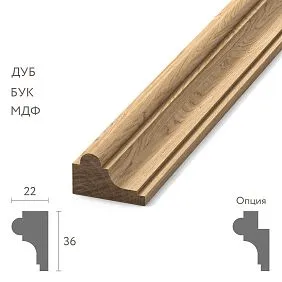
Our factory also produces:



Materials for slatted panels in the living room: what to choose and why
The living room is a 'dry' room with moderate mechanical loads on the walls. This means a wide choice of materials. The decision is determined not by technical limitations, but by aesthetic priorities and budget.
Get Consultation
Natural oak: the absolute leader for the living room
Oak is the most in-demand material for slatted panels in the living room. There are several reasons for this, and each one is significant.
The visual character of oak is expressive, 'mature', with a large natural grain pattern and a warm amber tone. It is precisely this character that makes oak universal: it is appropriate in Scandinavian minimalism (whitewashed oak), in classic interiors (toned dark oak), and in modern concepts (natural oak without toning).Wooden slat panelsIn the living room, oak is a material that does not require additional 'justification': its naturalness is self-sufficient.
Oil finish for oak in the living room — a natural matte finish, open pores, a living tactile surface. Lacquer finish — more practical, easier to care for, but less 'natural' to the touch. For the living room, where the wall is a decorative element without intensive tactile contact, an oil finish is an aesthetically stronger choice.
Oak finishes for the living room: natural (amber, universal), bleached (Scandinavian, light), 'tobacco' (warm brown, for classic concepts), 'smoky' (gray-brown, for modern neutral interiors), 'dark walnut' (rich, for deep dark concepts).
Ash: Scandinavian nervousness
Ash is a species with a more dynamic, 'nervous' grain pattern compared to oak. Narrow dark lines on a light background create an expressive natural pattern. With a bleached oil finish, ash produces one of the most 'Scandinavian' looks among all wood species.
Ash is slightly softer than oak in density—but for wall panels in the living room, this is not significant. Ash with a 'dark walnut' finish is unexpectedly elegant: a dark background with a contrasting fine grain pattern.
MDF: precision and practicality
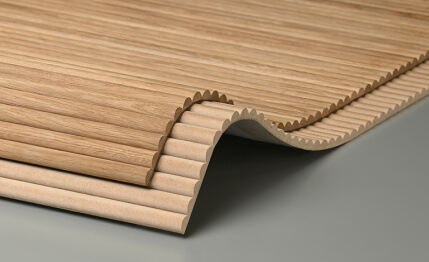
MDF Slatted Wall Panelin the living room—a choice for those who value a precise color concept. MDF with matte enamel provides a rich, even color across the entire surface without natural tonal variations. For monochrome living rooms in dark green, anthracite, or blue tones—MDF is more practical than natural wood: precise RAL color, perfect matching with other surfaces.
paintable slatted wall panelsMade of MDF — for living rooms where a concept update is planned in a few years: repaint the slats, change the curtains and cushions — the living room is refreshed without demolition.
Solid wood molding: from pine to birch
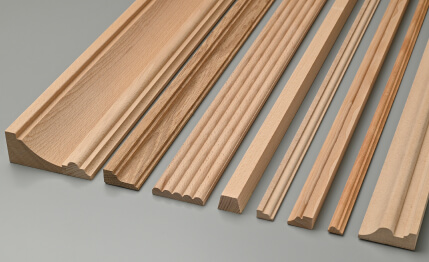
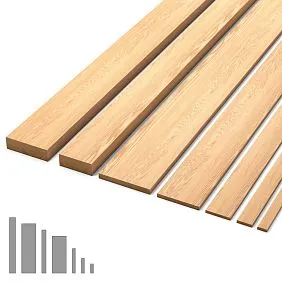
Pogonazh iz massivain various species—oak, ash, birch, pine—for slatted panels in the living room. Each species has its own natural character. Birch with an 'oak-like' finish—looks like oak but is more affordable. Pine—softer, with large knots, creates a 'rustic' natural look.
Parameters of slatted panels for the living room: detailed breakdown with numbers
Panel parameters are not technical abstractions. Each number directly determines the visual outcome.
Slat width: scale and character
Slat width is the first thing the eye 'reads' when looking at a slatted wall. It sets the rhythm and 'scale tone' of the surface.
| Batten width | Character | Living room area | Ceiling Height |
|---|---|---|---|
| 20–25 mm | Delicate, jewel-like | Up to 18 sq. m | 2.4–2.6 m |
| 30–35 mm | Balanced, neutral | 18–25 sq. m | 2.5–2.8 m |
| 40–50 mm | Expressive, architectural | 25–35 sq. m | 2.7–3.0 m |
| 55–70 mm | Monumental, sculptural | 35+ sq. m | 3.0+ m |
| 80–100 mm | Epic, high-end | Large spaces | 3.5+ m |
A rule that is never broken: the smaller the room, the narrower the batten. A 70 mm batten in a 16 sq. m living room 'presses' and reduces the space. A 25 mm batten in a 40 sq. m living room 'gets lost' and looks too small.
Gap between battens: air as a design element
The gap is not a technical space between battens, but an active visual element. Its width determines the 'density' of the surface and the degree to which the substrate is present in the overall image.
Gap 10–12 mm (with a 30 mm batten): 'dense' field. Battens dominate, the substrate is barely visible in the gaps. The surface is almost solid, with delicate lines. In a light finish — airy; in a dark finish — 'velvety'.
Gap 15–18 mm (with a 30–40 mm batten): balanced rhythm. Batten and gap in approximately a 2:1 ratio. Standard for most living rooms. The substrate participates in the color scheme: dark substrate behind light battens — a contrasting play; dark behind dark — monolithic depth.
Gap 20–25 mm (with a 40–50 mm batten): 'airy' field. Battens are perceived as separate elements on a common background, not as a single surface. The substrate is a full participant in the composition. For large living rooms with high ceilings.
Gap 30+ mm (with a 50–70 mm batten): wide-air rhythm. Between the battens — 'windows' of substrate. Sculptural, architectural effect. For loft-format spaces or apartments with ceiling heights from 3.5 m.
The batten/gap ratio is optimal in the range of 2:1 to 3:1. Less — the surface 'compresses'. More — the rhythm is lost.
Slat thickness: volume and shadow
Thickness is a less obvious but critically important parameter for a living room where the lighting is thoughtful and multidirectional.
Batten 12–15 mm thick: flat silhouette. Minimal shadow in the gap. Under frontal lighting — almost flat surface with lines. Under side lighting — barely noticeable relief.
Batten 18–22 mm: optimum for residential interiors. Shadow in the gap — 15–20 mm. With a track spotlight at a 35° angle — expressive chiaroscuro, surface is 'alive' and three-dimensional.
Batten 28–35 mm: deep volume, sculptural relief. Each batten is a noticeable three-dimensional element. For large living rooms and architectural concepts. Under lighting — the surface acquires almost theatrical expressiveness.
Height of batten field: from floor to ceiling — is it mandatory?
In the living room, the batten field most often runs from floor to ceiling — this maximizes the effect of 'raising' the ceiling and architectural completeness. But there are exceptions.
Wainscoting (batten field at a height of 90–120 cm from the floor) with molding at the border — a classic architectural solution. Lower third of the wall — battens, upper — neutral paint or wallpaper. For classic concepts and living rooms with high ceilings (2.8+ m), where a full batten field would be 'heavy'.
Batten panel (limited width: batten accent 2–3 m wide on an accent wall, with neutral side parts) — for living rooms where an accent is needed, but not 'total' batten coverage.
Batten 'island' above the TV — a batten fragment 20–40 cm wider than the TV zone, height from the top edge of the console to the ceiling. Highlights the media zone as an architectural element.
Zoning the living room with batten panels
In modern apartments, the living room is often combined with the kitchen or serves several functions simultaneously: relaxation zone + dining area + work corner. Batten panels are a tool for visual zoning without physical partitions.
Slatted wall as a zone boundary
A slatted wall behind the sofa group serves as the 'backdrop' of the relaxation zone. It visually separates it from the dining area or kitchen. The feeling of a 'separate' space is created without a single partition.
If the living room is combined with the kitchen: a slatted wall behind the sofa + a contrasting kitchen facade = two visually independent spaces in one volume. This technique works provided there is a unified color scheme: the slats and kitchen facades are in harmonizing, not competing tones.
Slatted column as a spatial accent
In large living rooms (from 30 sq. m) — a freestanding slatted 'column' or a slatted screen not adjacent to a wall. A double-sided slatted structure that demarcates zones. This is an architectural element, not just a finish.
slatted modular wall panelIn this case — a ready-made module of the required width and height, which is mounted as a separate structure with double-sided decor.
Slatted ceiling 'island' for zoning
Batten panels for ceilingsIn the living room — a ceiling 'island' above the sofa group or above the dining table. Visually 'covers' the zone, creating a feeling of a separate space under a 'natural sky' made of wood. One of the most sophisticated and effective techniques for large open living rooms.
Ceiling slats are perpendicular to wall slats — if both are present in the interior. This creates a dynamic of 'intersecting' rhythms, which looks professional.
Five concepts for a slatted living room: precise parameters and images
Moving from theory to practice. Five concepts — each with specific numbers and a precise description of the image.
Concept 1: "Northern Light" — Scandinavian minimalism
Material: ash with bleached oil coating or E1 MDF with matte RAL 9010 (white) enamel.
Parameters: slat 25 mm, gap 12 mm, thickness 18 mm, vertical orientation, from floor to ceiling.
Backing: white wall or natural felt in a light gray tone.
Accent wall: behind the sofa group, the full width of the wall.
Adjacent walls: white (RAL 9010) or light gray (RAL 7035).
Floor: light laminate or "bleached oak" parquet.
Lighting: 2700K track spotlights, linear ceiling light fixture, minimalist wall sconces.
Furniture: light gray or cream sofa, solid wood coffee table, simple metal legs.
Image: a quiet Scandinavian living room. Clean, airy, natural. In the evening under warm track spotlight lighting, the slatted wall 'glows' — the whitewashed slats turn amber. In the morning under daylight — snow-white, fresh.
This interior is for those who understand: beauty lies in the absence of excess.
Concept 2: "Dark Forest" — depth and shelter
Material: MDF with matte enamel in anthracite (RAL 7016) or dark green (RAL 6005).
Parameters: slat 40 mm, gap 20 mm, thickness 22 mm, vertical, floor to ceiling.
Backing: black matte material or a wall painted to match.
Adjacent walls: warm light gray or creamy white — contrast with the dark accent wall.
Lighting: essential — warm light 2700K. Track spotlights on the dark wall create sculptural chiaroscuro. LED behind the slats (ultra-warm 2200K) — soft glow from the gaps.
Furniture: sofa in neutral tones (cream, gray, white) — contrast with the dark background. Wooden elements — in natural tone, without tinting.
Image: a living room-shelter. Dark slats create a feeling of a 'den' — a protected, deep, intimate space. For evening movie watching, for long conversations, for those who need a living room-'refuge' after a stressful day.
Concept 3: "Natural Amber" — oak and warmth
Material: natural oak with oil finish, "natural" or "honey" tone.
Parameters: slat 35 mm, gap 18 mm, thickness 22 mm, vertical, floor to ceiling.
Backing: dark gray matte felt — contrast that "reveals" the amber tone of the oak.
Adjacent walls: warm beige (RAL 1015) or "clay" (warm terracotta neutral).
Lighting: warm 2700K spotlights, subdued wall sconce with warm tint.
Furniture: sofa in olive, dark blue, or terracotta — rich natural tones. Rug with natural pattern.
Image: warm, "natural," "earthy" living room. Oak with dark backing creates a natural contrast: amber against a dark background. In the evening under warm track lighting, the amber tone of the oak turns golden. This is a living room where you want to stay.
Concept 4: "Japandi" — eastern emptiness
Material: tinted oak "tobacco" (warm dark brown) with oil finish or MDF in "mocha" shade.
Parameters: slat 20–25 mm, gap 10–12 mm, thickness 18 mm, vertical orientation, floor to ceiling.
Underlay: dark anthracite felt.
Adjacent walls: warm light beige — 'sand' or 'clay'.
Furniture: low, without legs or on thin legs. Natural ash in furniture surfaces, white or cream textiles. No patterns.
Lighting: only spot and subdued lighting. Not a single source of general bright light.
Image: meditative emptiness. Japanese aesthetic principle 'ma' — the value of unfilled space. Narrow dark slats on an anthracite background create a delicate rhythm that does not 'fill' the gaze but allows it to 'rest'.
For those tired of saturated interiors and seeking a space where 'nothing extra' is not a flaw but a virtue.
Concept 5: 'Neoclassicism' — natural aristocracy
Material: natural oak with 'dark walnut' or 'tobacco' tint, matte lacquer finish.
Parameters: slat 40 mm, gap 20 mm, thickness 25 mm. Vertical orientation + slat wainscoting (110 cm from floor) with profiled wooden molding at the border.
Backing: painted wall in oak tone — warm dark beige.
Adjacent walls: warm cream (RAL 1013) with profiled moldings.
Floor: herringbone oak parquet.
Lighting: chain-hung chandelier with warm light + wall sconces in classic style.
Completion:Solid wood molding along the upper edge of the slatted field — a mandatory architectural element in a neoclassical solution.
Concept: a living room as a statement of taste and time. Wood, moldings, herringbone parquet — natural materials in a classic 'language'. Not pompous, not ostentatiously expensive, but dignified.
TV on a slatted wall: how to combine technology and naturalness
In the living room, a TV is almost a mandatory element. How to combine it with a slatted wall without destroying the natural image?
TV 'in' the slatted wall. An OLED or QLED TV is mounted on the slatted wall using a special bracket. Wires are hidden in a cable channel or pre-installed in the wall before mounting the slats. The TV's black screen on a dark slatted wall is almost invisible. On a light wall — a contrasting but acceptable element.
TV 'between' the slats. With a slatted field featuring wide gaps (20+ mm) and wide slats (50+ mm), the TV is mounted so that the slats visually 'frame' it. The screen becomes part of the slatted composition.
TV on a separate console in front of the slatted wall. The slatted wall is the background, the TV is a separate element in front of it. The simplest and most common option. A console made from the same material as the slats (or a contrasting one) creates a unified system.
Important: Concealed wiring in a slatted wall for a TV is installed BEFORE mounting the slats. A corrugated pipe, fixed in the framing, with an outlet at the desired point.
Lighting a slatted wall in the living room: a theater of shadows and light
Lighting is perhaps the most important decision after choosing the material. In the living room, where the lighting system is typically the most well-thought-out, a slatted wall can reveal its full beauty.
Track spotlights: the main tool
A track spotlight directed at the slatted wall at a 30–45° angle from vertical creates the very reason to make slatted walls: shadow in the gaps. With such lighting, each slat is a three-dimensional object casting a shadow onto the backing. The surface 'comes alive'.
Color temperature: only warm light 2700K or ultra-warm 2200K. Cool white (4000–5000K) kills the natural tone of wood — amber oak becomes pale gray.
Number of spotlights: one spotlight for every 1.5–2 m of slatted wall width. Uniform illumination without 'hot spots'.
LED Behind Slats: Glow from Within
LED strip on the backing behind the slats creates a soft glow from the gaps. Warm light (2700K) 'flows' from the gaps onto the floor and ceiling. Effect: the slatted wall 'breathes' with its own light.
For the living room: LEDs behind the slats are not the only light source, but the 'lower' layer of the lighting scene. Main lighting — track spotlights, additional — LEDs behind the slats. In the evening, with dimmed main lighting, LEDs behind the slats create an atmospheric 'evening mode'.
Technical requirements: strip with a density of at least 60 diodes/meter, protection class IP20 (dry room), mandatory dimmer — brightness from 0 to 100%.
Cornice with hidden LED: "flowing" light
a polyurethane corniceWith a groove for an LED strip along the top edge of the slatted wall—light "flows" from top to bottom along the slats. The light source is hidden, only the result is visible: a warm glow cascading down the wooden surface. One of the most cinematic lighting effects in a residential interior.
Wall sconces: side accent
Wall sconces installed on the side edges of the slatted field or directly between the slats provide side lighting—expressive chiaroscuro. For living rooms in classic and neoclassical styles, sconces are an essential element of the lighting system.
Finishing a slatted wall in the living room: moldings, cornices, baseboards
Professional execution of a slatted living room lies in the details. Unfinished edges of the slatted field "ruin" the look: even the highest-quality slats appear incomplete without proper perimeter finishing.
Baseboard.solid wood baseboardIn the same tone as the slats—bottom finishing. For the living room: baseboard height 80–100 mm for ceilings 2.6–2.8 m, 100–120 mm for ceilings 3+ m. Profile: straight (modern style), beveled, profiled (classic).
Cornice.a polyurethane corniceAlong the top edge of the slatted field—top finishing. With or without a groove for an LED strip. For a neoclassical living room—a profiled polyurethane cornice creates an architectural "crown" for the slatted field.
Molding.Solid wood moldingAlong the side edges of the slatted field—a "frame" that turns the slatted wall into an architectural panel. In the living room, moldings around the perimeter of the slatted field are a hallmark of professional execution.
Corner element. When the slatted field is in a corner (two adjacent walls)—a wooden corner profile hides the ends of the slats. A clean corner without visible cuts is a sign of high-quality installation.
Installing slatted panels in the living room: three methods
installation of slatted panelsIn the living room — a task that can be done independently if you have the skills.
Adhesive method: for a flat wall (tolerance 3 mm/2 m). Solvent-free mounting adhesive — applied to the back surface of the slat. Fixation with painter's tape during polymerization (24 hours). Fast, clean, no battens. Does not allow placement of LED lighting or sound insulation behind the slats.
Batten method: wooden battens 40×20 mm with a spacing of 400–500 mm. Leveled using a laser level. Slats are attached to the battens with finishing nails or clips. Universal for any walls. Allows hiding wiring and sound insulation.
Modular system:slatted modular wall panelinstalled as a single panel. Slats are already factory-fixed with precise gaps. Installation is fast and accurate — ideal for living rooms with large, flat walls.
Detailedstep-by-step installation guide for DIY— in the professional guide.
Frequently asked questions about slatted panels in the living room
How many walls to cover with slatted panels in the living room?
One accent wall — a classic and most advantageous option. Two walls (typically adjacent or parallel) — acceptable in large living rooms (25+ sq. m). Three and four walls — a "cage"; even in a spacious living room, it creates a feeling of confinement.
Can slatted panels be installed in a living room combined with a kitchen?
Yes, and it's one of the best ways to visually separate zones without partitions. A slatted wall behind the sofa group 'cuts off' the relaxation area from the kitchen zone. Important:Wall finishing with slatted panelsin the area adjacent to the kitchen — only with a varnish finish (not oil-based): varnish is more resistant to grease splashes and moist vapors.
Do slatted panels need to be removed when selling an apartment?
No. A slatted wall in the living room is an element that increases the apartment's appeal when selling. Most buyers perceive a quality slatted living room as an advantage, not a burden.
How to combine slatted panels with wallpaper in the living room?
Slatted accent wall + wallpaper on adjacent walls — a classic combination. Wallpaper: solid-colored or with a delicate pattern, not competing with the rhythm of the slats. Wallpaper color: harmonious with the tone of the slats — in the same warm or cool palette.
How to care for slatted panels in the living room?
Natural wood with varnish: damp microfiber cloth, neutral cleaner. With oil finish: the same + maintenance oil once a year. MDF with enamel: damp wiping. Dust on horizontal slat ends — removed with a soft dusting brush every 1–2 weeks. A cornice along the top edge of the slatted field covers the ends and eliminates dust collectors.
How to install slatted panelsin the living room independently?
For even walls — adhesive method. For uneven walls — battens. In both cases: laser level for aligning the first slat (vertical "beacon"), miter saw for precise trimming, painter's tape for temporary fixation. The first slat is the vertical reference for the entire field: if it's "off," the whole field will be "off." That's why the first slat is installed exclusively using a level.
Are slatted panels suitable for a small living room?
Yes — if the scale rule is followed. For a living room up to 16 sq. m: slat no wider than 25–30 mm, light tones (whitewashed oak, white MDF), vertical orientation. Vertical light slats visually "raise" the ceiling and expand the space. Dark wide slats in a small living room are undesirable.
Conclusion
Slatted panels in a living room interior are not a finishing material in the conventional sense. It's an architectural solution that transforms an ordinary room into a space with character and depth. The natural rhythm of wooden slats, the play of light and shadow in the gaps, the warm tone of wood in subdued evening lighting — a living room with a slatted wall ceases to be "just a room" and becomes a place where you want to be.
The right choice of material, precisely selected slat and gap parameters, a well-thought-out lighting system, high-quality perimeter finishing —decorative slatted wall panelsa living room executed in this way works for decades, remaining relevant and beautiful regardless of changing trends.
Naturalmoldings made of oak and ash, moldings, baseboards, cornices for finishing the slatted field,Furniture wooden handlesfor furniture in a unified natural style — a complete system for a slatted living room is presented in the STAVROS company catalog.
STAVROS — manufacturer of slatted systems and moldings from solid natural wood for residential and commercial spaces. Professional consultation on selecting parameters, finishes, and components for a living room of any scale and style. Because a good living room is not about money. It's about understanding what a space needs to come alive.