













































Article Contents:
- Children's room: why natural materials on walls matter
- Safety first: which materials are acceptable in children's rooms
- MDF in children's rooms: emission class E1
- Natural solid wood: the safest option
- PVC in children's rooms: with caution
- Slatted panels in children's rooms by child's age: four stages
- Children's room from 0 to 3 years: tranquility and naturalness
- Children's room from 3 to 7 years: play and structure
- Children's room from 7 to 12 years: personality and space
- Children's room from 12 to 16+ years: teenage space
- Color solutions for slatted panels in children's rooms: palette by meaning
- White and bleached: neutral natural base
- Pastel tones: warmth without shouting
- Natural wood tones: for a growing person
- Saturated tones: for teenagers and bold decisions
- Where to place slatted panels in children's rooms: zoning by function
- Wall behind the bed: sleeping area
- Wall by the desk: study area
- Play zone wall: a territory of imagination
- Children's room ceiling: a 'sky' above the child's head
- Specific images of slatted children's rooms: five ready-made concepts
- Concept 1: 'Scandinavian Forest' — for children aged 0 to 5
- Concept 2: 'Mint Morning' — for a girl aged 4–8
- Concept 3: 'Blue Depth' — for a boy aged 6–12
- Concept 4: 'Forest Edge' — unisex, ages 3–10
- Concept 5: 'Dark Studio' — teenage room
- Functional integration: slatted panels + shelves + lighting in a children's room
- Shelves in a slatted system
- Hooks in the slat system
- LED lighting in a child's room: modes and temperature
- Installation of slat panels in a child's room: specifics and work order
- Care for slat panels in a child's room
- Table: comparison of slat panel materials for a child's room
- Frequently asked questions about slat panels in a child's room
- Are MDF panels harmful in a child's room?
- From what age can dark slat panels be installed in a child's room?
- Slat panels in a child's room — is it safe if a child falls?
- Can you buy slat panels for wall finishing in a child's room and install them yourself?
- How long will slatted panels last in a nursery?
- Do I need special permission to install slatted panels in a nursery?
- How to combine slatted panels with wallpaper in a nursery?
- Conclusion
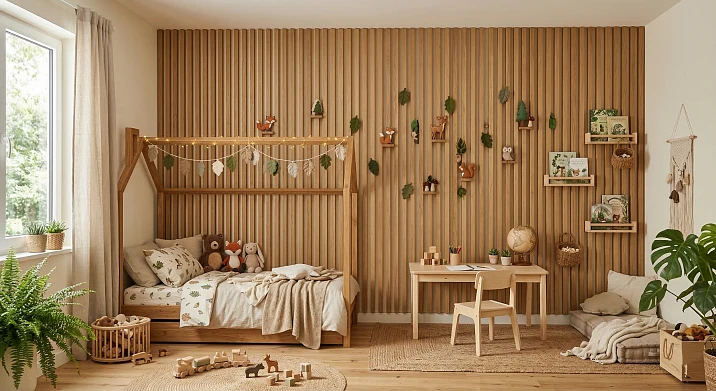
A nursery is a space with a dual mission. On one hand, it's a place for sleep and recovery: here, a child should fall asleep easily and wake up rested. On the other hand, it's a territory for play, creativity, exploring the world, first discoveries, and first independent decisions. Two functions that, at first glance, contradict each other, in reality require the same thing: a natural, warm, safe space without visual aggression.
That's why slatted panels in a nursery interior are a solution that professional designers are choosing more and more often. Not because it's 'trendy.' But because the natural rhythm of wooden slats on the wall meets the deep needs of a child's psyche: structure without pressure, naturalness without clutter, warmth without excess.
But a nursery is a room with special requirements for materials. Here, the safety of finishes, resistance to mechanical damage, and ease of care are important. Therefore, talking about slatted panels in a nursery is a conversation about both aesthetics and responsibility. About beauty that does no harm.
This article is a complete practical guide: which materials are safe, which parameters to choose, how to create a slatted nursery for a child from 0 to 16 years old. With specific examples, numbers, and honest answers to the main questions.
Nursery: why natural materials on the walls matter
Let's start with a question that all responsible parents ask: why have slatted panels in a nursery at all? Isn't cheerful wallpaper with cartoon characters or bright paint enough?
It's enough for a 'picture.' It's not enough for an environment where a child spends a third of their life.
A child's psyche develops under the constant influence of the environment. Visual chaos, overloaded patterns, and garish colors are not 'fun'—they are stressors for a nervous system still learning to filter information. The natural rhythm of wooden slats—ordered, repetitive, calm—creates the opposite effect: structure without pressure, visual order without boredom.
Research in child neuropsychology shows that children surrounded by natural materials and organic forms demonstrate lower anxiety levels and better sleep quality.Wooden slat panels— a biophilic element that works on a level the child doesn't consciously perceive but feels.
And one more argument—a practical one. Wooden and MDF slats with quality coating are significantly more durable than wallpaper. In a child's room, where walls are a legitimate 'territory' for accidental ball impacts, pencil touches, and marker experiments, the durable lacquered surface of slat panels maintains its appearance incomparably longer than any wallpaper.


Safety first: which materials are permissible in a child's room
The main question for parents is safety. Any material in a child's room must meet requirements for volatile organic compound (VOC), formaldehyde, and other potentially harmful substance content.
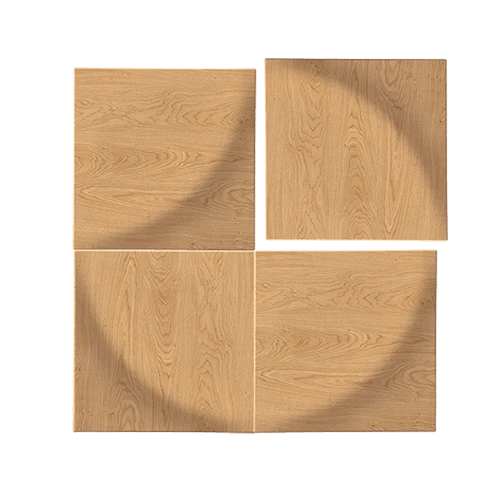
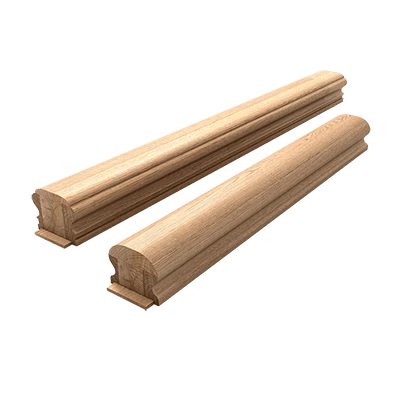
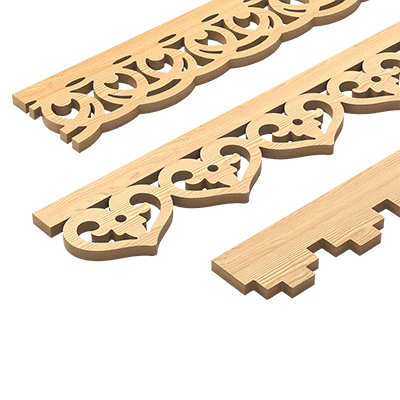
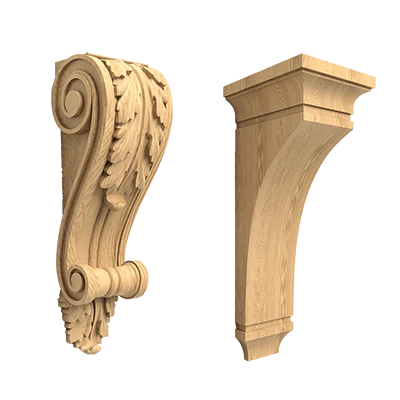
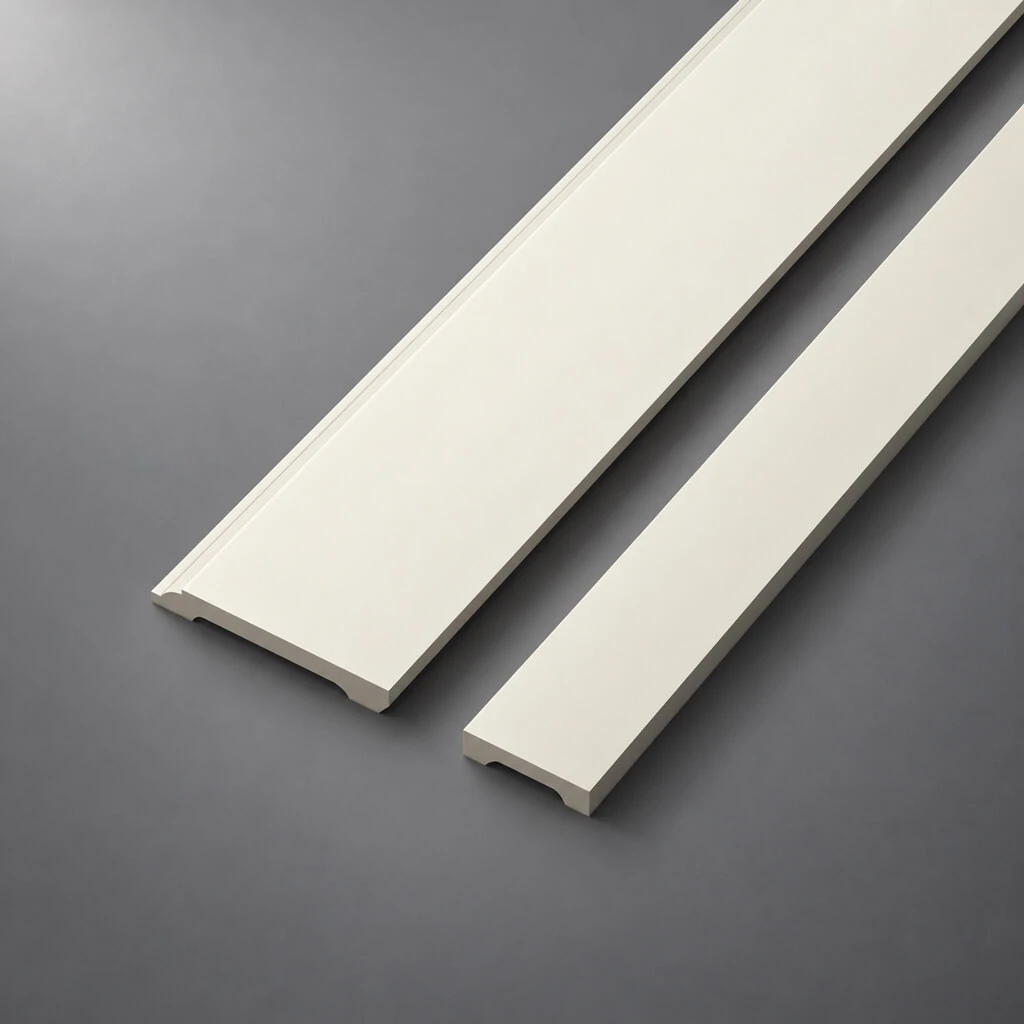
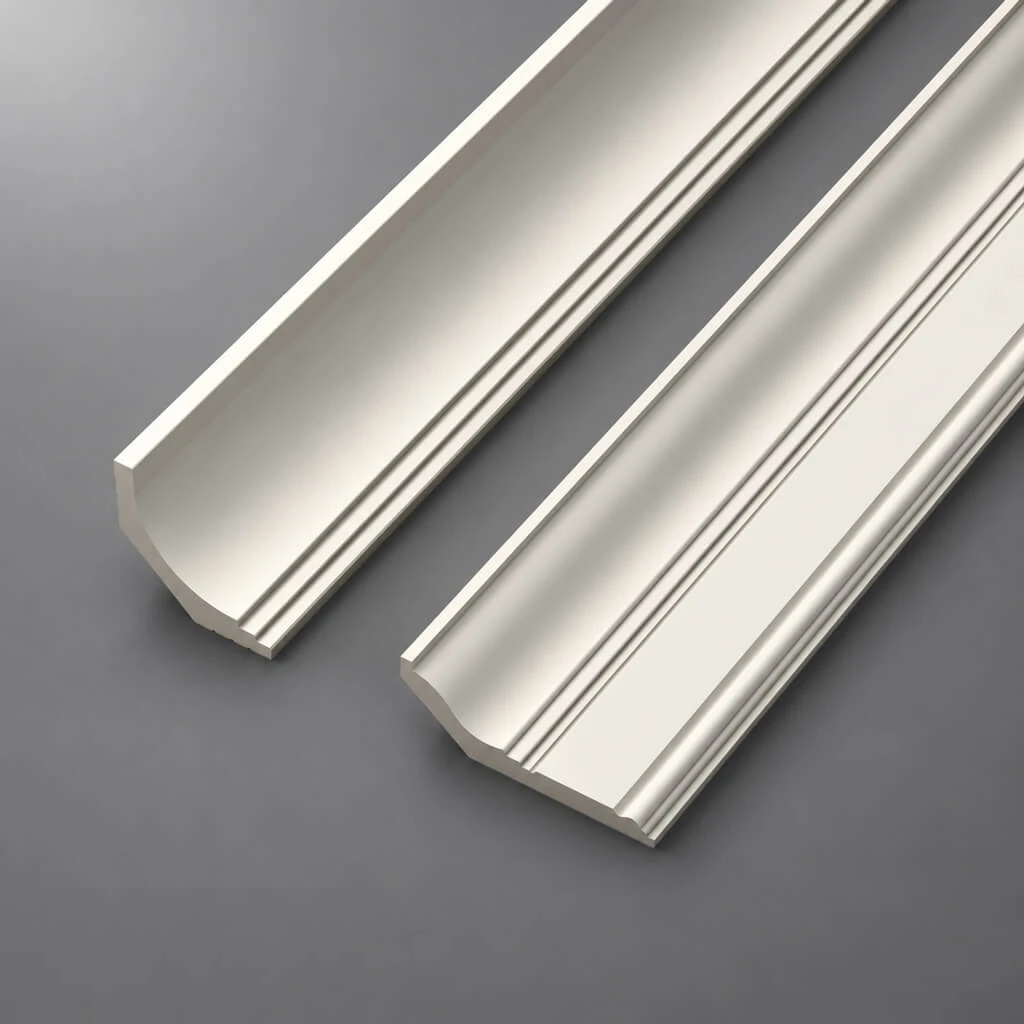
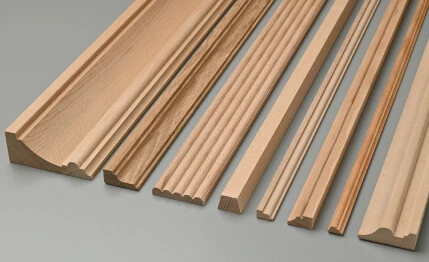
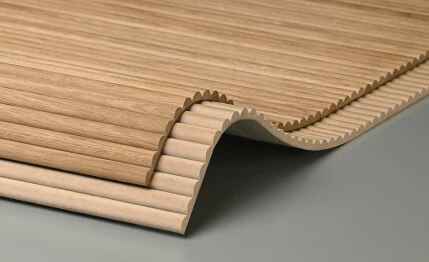
Our factory also produces:




MDF in a child's room: emission class E1
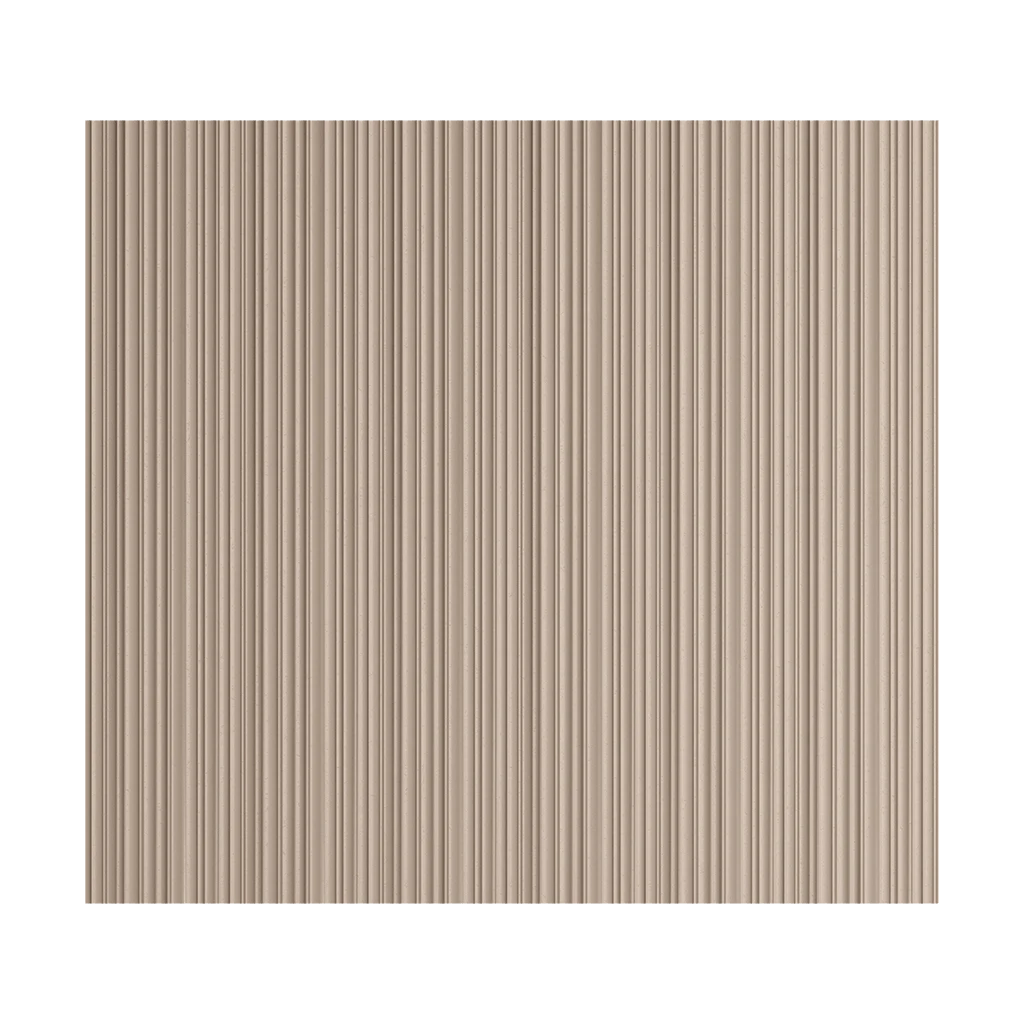
MDF Slatted Wall Panelis permissible in a child's room only with formaldehyde emission class E1 (formaldehyde content no more than 8 mg/100 g) or E0 (no more than 3 mg/100 g). Class E2 is not allowed in residential spaces, especially children's rooms.
Coating for MDF slats in a child's room: only water-based or acrylic paints and varnishes without solvents. Matte or semi-matte coating—prevents glare that strains vision. Fully dried coating (48–72 hours after application)—does not emit volatile substances.
Rule: before installing slats in a child's room—ensure the presence of an E1/E0 class certificate. Request documentation from the manufacturer.
Get Consultation
Solid wood slats: the safest option
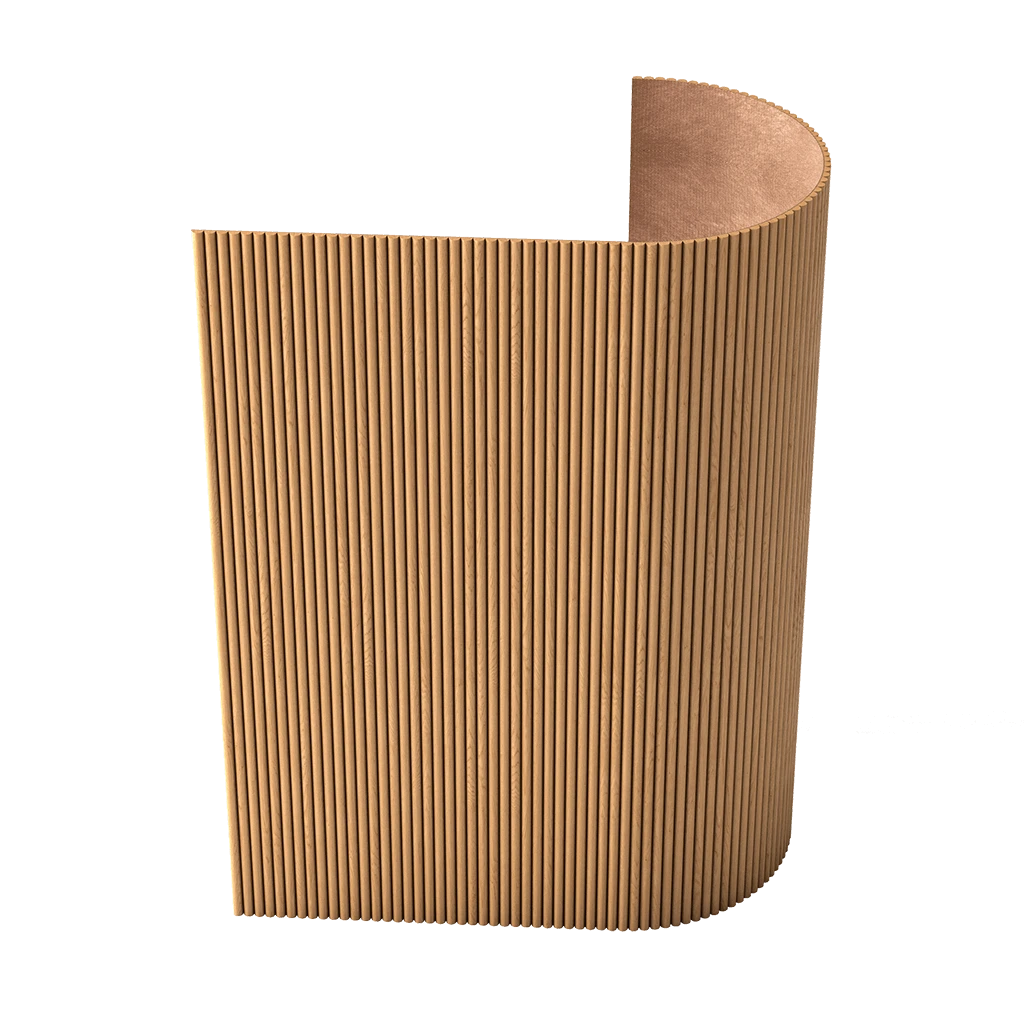
Wooden slat panelsSolid wood slats with a water-based oil or wax finish are the safest option for a child's room. Natural wood contains no synthetic binders. Water-based oil is non-toxic and solvent-free.
An additional benefit of solid wood in a child's room: the natural antibacterial activity of oak. The tannins in oak have natural antiseptic properties. This doesn't mean an oak slat wall replaces cleaning, but it is an extra natural 'bonus' for a child's space.
Finishes for wooden slats in a child's room: water-based oil-wax (solvent-free), hard wax, water-based polyurethane varnish. Under no circumstances—nitrocellulose lacquers and alkyd enamels with a strong odor.
PVC in a child's room: use with caution
PVC slat panels are technically safe if they have a sanitary certificate. However, PVC can release trace amounts of volatile substances when heated (in summer, under direct sunlight). They are undesirable for a child's room, except for an en-suite bathroom connected to the child's room.
Slat panels in a child's room by the child's age: four stages
A child's room changes along with the child. Slat panels are one of the few finishing elements that 'live' with the child through all stages of growing up, changing only in color scheme and functional content.
Child's room from 0 to 3 years: calm and naturalness
An infant and a child under three spend the maximum amount of their day in the child's room. The most important things here are: sleep quality, the absence of irritating factors, and the naturalness of the environment.
Slatted panels for nursery 0–3 years:
-
Material: natural birch or ash with bleached oil finish
-
Color: white, ivory, bleached oak — light natural tones
-
Slat width: 20–25 mm — delicate rhythm, not overwhelming perception
-
Gap: 12–15 mm
-
Slatted field height: from floor to ceiling on one wall (behind the crib)
-
Backing: light natural felt
Acoustic function is especially important for a nursery up to 3 years: felt backing behind the slats absorbs sound, reducing external noises that may wake the infant.
Nursery from 3 to 7 years: play and structure
A preschool-age child is an active explorer of space. Walls are subjected to mechanical loads: pencils, balls, accidental impacts. Here, slatted panels must be durable and easy to maintain.
Slatted panels for children's room 3–7 years:
-
Material: E1 class MDF with matte acrylic enamel
-
Color: warm pastel tones (mint, powder pink, dove gray, warm beige) — not loud, but 'colorful'
-
Slat width: 25–30 mm
-
Gap: 15 mm
-
Slatted field height: from floor to 150–160 cm (child's growth zone) or from floor to ceiling
-
Coating: matte enamel — can be written on with pencil, wiped off with a damp cloth
Important detail for this age: MDF slatted panelsFor painting— can be repainted in a different color without dismantling after a few years. The children's room 'changes mood' — the slats remain.
Children's room from 7 to 12 years: personality and space
School age is a time of personality formation and first independent aesthetic preferences. A child begins to have their own opinion about their room. Slatted panels at this age serve as a backdrop for self-expression: shelves, hooks, drawing boards can be mounted on them.
Slatted panels for children's room, ages 7–12:
-
Material: MDF with matte enamel or natural oak with lacquer finish
-
Color: more saturated — dark green, midnight blue, terracotta, graphite (one accent)
-
Slat width: 30–40 mm
-
Gap: 15–20 mm
-
Integration of functional elements: shelves between slats, hooks, magnetic boards
slatted modular wall panelAt this age, they are a practical choice: modules can be easily added or rearranged when changing the layout of the children's room.
Children's room from 12 to 16+ years: teenage space
A teenager is almost an adult with distinct aesthetic preferences. The children's room transforms into a personal office, studio, or 'headquarters'. Here, slatted panels function as a full-fledged design element.
Slatted panels for a teen room:
-
Material: MDF with matte enamel or natural tinted oak
-
Color: dark and rich tones chosen by the teen — anthracite, dark green, plum
-
Slat width: 35–50 mm — an 'adult' scale
-
Gap: 18–25 mm
-
LED backlighting behind the slats — an essential element for teen aesthetics
Wall slat panels in interiorfor a teen room — a solution that the teen perceives as 'serious' and 'adult'. Not childish decor, but a real architectural element.
Color solutions for slatted panels in a child's room: a palette with meaning
Color in a child's room is not just about aesthetics. It's an environment that affects mood, concentration, sleep quality, and the child's emotional background. Let's analyze colors not by 'pretty/not pretty,' but by functional purpose.
White and bleached: a neutral natural base
White slatted panels are a universal solution for a child's room of any age. White doesn't 'press down' or set the mood—it allows everything else (toys, textiles, drawings) to be the main characters. White slats are a 'quiet' background for an active child's life.
Whitewashed oak is lighter than natural, with a barely noticeable natural grain. Scandinavian style for a child's room: light, natural, airy. For children's rooms without a window or with a small window—white and whitewashed slats are critically important for creating a feeling of a bright space.
Pastel tones: warmth without shouting
Mint (RAL 6019), powder pink (RAL 3015), lavender (RAL 4009), pigeon gray (RAL 7035)—pastel tones of MDF slats for preschool and elementary school-age children's rooms.
These colors are 'soft'—they don't shout, excite, or overload. At the same time, they are not neutral—they create the 'color mood' of the room: mint—freshness and naturalness, pink—warmth and coziness, lavender—calmness.
Important principle: pastel slats—on one accent wall. The remaining walls are white or cream. Pastel slats on all walls are overkill even for a child's room.
Natural wood tones: for a growing person
Natural oak, ash, birch—natural tones without additional color. They work in children's rooms of any age because they 'don't go out of style': five years ago, the natural tone of wood was beautiful, in five years it will be beautiful. A child's room with natural wooden slats grows with the child without losing relevance.
Wooden slat panelsNatural oak slats behind the bed—a natural 'backdrop' that is equally appropriate in the room of a three-year-old toddler and a fifteen-year-old teenager.
Saturated tones: for teenagers and bold solutions
Dark green (RAL 6005 or RAL 6009), midnight blue (RAL 5004), terracotta (RAL 3022), anthracite (RAL 7016) — for older children's rooms and for bold design solutions.
Rule for saturated tones in a child's room: only one accent wall. When using a dark color on the wall behind the desk or bed — the other walls are light. This creates a 'focus' without a feeling of confinement.
Dark green in a child's room is one of the most psychologically justified 'bold' choices. Green is associated with nature, forest, safety. At moderate saturation — it does not excite, but calms.
Where to place slatted panels in a child's room: zoning by function
A child's room is a multifunctional space. Correct placement of slatted panels takes functional zoning into account.
Wall behind the bed: sleep zone
The wall behind the headboard of a child's bed is the main candidate for a slatted accent. Here, the slats work as a 'natural canopy,' creating a psychological feeling of security for the sleep zone.
Parameters for the sleep zone:
-
Light tones: white, whitewashed oak, pastel
-
Acoustic underlay (felt) — reduces external sounds
-
LED strip lighting behind slats on a dimmer: night mode at minimum brightness — a delicate night light
-
Slat width: 20–30 mm — a delicate rhythm for the relaxation zone
Wall finishing with slatted panelsIn a child's sleep zone — this is not a decorative detail, but a functional element of the environment for the child's quality rest.
Wall by the desk: study zone
Wall behind the desk — concentration zone. Here, slatted panels serve a dual function: a visual backdrop for the work area and a base for shelves, magnetic boards, hooks for backpacks.
Parameters for the work zone:
-
Saturated neutral tone: dark green, blue, anthracite — stimulates concentration
-
Slat width: 30–40 mm — a more 'adult' scale
-
Built-in functional elements: shelves made of the same material between groups of slats
-
Magnetic board: mounted behind the slat system before installing the slats, 'peeks out' from the gaps
A dark slatted wall behind a white desk creates a striking contrast that clearly defines the 'work zone'. The child psychologically understands: this is for studying.
Play zone wall: territory of imagination
The play zone is a space of freedom. Here, slatted panels can be bolder in color and parameters. Bright pastel slats, wide gaps, integration of play elements.
Idea: a slatted panel 'theater' on the play wall. MDF slats with a wide gap (20–25 mm). Behind the slats — backlighting that the child can turn on and off themselves. The children's 'wall' becomes an interactive lighting element.
Alternative:decorative slatted wall panelsin the play zone with integrated hooks for dressing up (playing 'princess', 'knight'), shelves for toy collections, a small drawing board.
Children's room ceiling: 'sky' above the child's head
Batten panels for ceilingsin a child's room is a bold and very effective solution. A child, lying in bed before sleep, looks at the ceiling. A wooden slatted ceiling above the child's bed creates the image of a 'house', 'hut', natural shelter — precisely the atmosphere that helps them relax and fall asleep.
A slatted 'island' above the bed (30–40 cm wider than the bed) with warm LED lighting is one of the most beautiful and functional elements of a child's room. It is both decor, a night light, and a psychological 'lullaby'.
Important: a slatted ceiling in a child's room must only be made from E1/E0 class materials. Solid wood or MDF with a water-based coating. Ceiling height with a slatted system: not lower than 2.5 m after installation.
Specific images of a slatted children's room: five ready-made concepts
Moving from theory to practice. Five ready-made slatted nursery concepts — with exact parameters.
Concept 1: 'Scandinavian Forest' — for children from 0 to 5 years old
Wall behind the bed: natural birch with white oil finish, slat 20 mm, gap 12 mm, floor to ceiling, natural-toned felt backing.
Other walls: white.
Floor: light laminate 'whitewashed oak'.
Ceiling: white.
Lighting: warm LED strip behind slats (2700K) with dimmer + white wall sconce nightlight.
Accents: wooden toys, natural textiles (linen, cotton), potted plants.
Image: a quiet Scandinavian forest. A natural environment where the child feels safe.
Concept 2: 'Mint Morning' — for a girl 4–8 years old
Wall behind the bed: E1 MDF with mint-colored matte enamel (RAL 6019), 25 mm slats, 15 mm gap, floor-to-ceiling, white backing.
Other walls: white.
Floor: warm laminate "natural oak".
Accents: white furniture, linen curtains matching the slat color, wooden accessories.
Vibe: fresh, natural, light. A nursery where you want to draw, sing, and fall asleep with a smile.
Concept 3: "Blue Depth" — for a boy aged 6–12
Accent wall (behind the desk): E1 MDF with "midnight blue" matte enamel (RAL 5004), 35 mm slats, 18 mm gap, floor-to-ceiling height.
Wall behind the bed: natural ash with white oil, 25 mm slats, 12 mm gap.
Other walls: white.
Accents: world map on a slatted background, natural oak shelves between the slats of the work wall, track spotlights.
Vibe: serious, smart, masculine space. Where you want to think, explore, and create.
Concept 4: "Forest Edge" — unisex, 3–10 years
Accent wall: dark green MDF (RAL 6005), 30 mm slats, 15 mm gap, LED behind slats (2700K). Other walls — white.
Ceiling 'island' above the bed: natural oak, 25 mm slats, across the bed axis, warm LED.
Floor: natural parquet or 'oak' laminate.
Accents: wooden shelves on a slatted background, soft toys in natural tones, potted plants in clay pots.
Theme: natural sanctuary. A nursery that inspires but does not overstimulate.
Concept 5: 'Dark Studio' — teenage room
Accent wall (behind the desk/play area): anthracite MDF (RAL 7016), 45 mm slats, 22 mm gap, LED behind slats (2700K + optional colored RGB for the teenager).
Wall behind the bed: natural oak with oil finish, 30 mm slats, 15 mm gap.
Other walls: warm light gray.
Accents: floating shelves on an anthracite background, track spotlights, minimalist furniture.
Image: an adult, conceptual space. A teenager perceives it as 'their own' — serious and beautiful at the same time.
Functional integration: slatted panels + shelves + lighting in a child's room
Slatted panels in a child's room are not just decor. This is a system into which functional elements are organically integrated.
Shelves in a slatted system
A shelf mounted directly in the slatted system is an elegant and practical technique. The shelf brackets are attached to the batten behind the slats, and the shelf board 'protrudes' from the slatted field.
The material of the shelf board matches the slats or contrasts — according to the concept. A natural oak shelf against an anthracite slatted background is an expressive natural counterpoint.
In a child's room: shelves for books on the work wall, shelves for toy collections on the play wall, shelves for decor by the bed.
Hooks in a slatted system
Hooks for clothes, backpacks, hats, mounted directly into the slats — a practical element for a child's room. The hook 'grows' out of the slatted rhythm without disrupting it.
Hook materials: wooden (matching the slats), matte metal (copper, brass, matte silver), painted RAL (in an accent color).
LED Lighting in a Child's Room: Modes and Color Temperature
LED lighting behind slatted panels in a child's room operates in several modes:
-
Night mode (5–10% brightness, 2200K): a soft night light that doesn't disturb sleep
-
Evening mode (30–50% brightness, 2700K): cozy lighting for bedtime
-
Play mode (80–100% brightness, 3000K): bright enough for active activities
-
Teen RGB mode: colored backlighting behind the slats, chosen by the child
Control: smart switch or voice control. For young children, a dimmer is mandatory.
Installation of slatted panels in a child's room: specifics and work sequence
installation of slatted panelsin a child's room has a number of features compared to other rooms.
Installation before occupying the room. Installing slatted panels, especially MDF panels with adhesive, is accompanied by the smell of glue and paint materials. The child's room must be well-ventilated for at least 48–72 hours after installation before the child moves in.
Hidden wiring before slat installation. Wiring for LED lighting, sconces, wall lights — laid before installing battens and slats. After installation — access is closed.
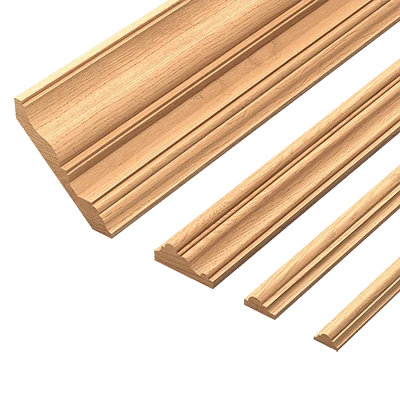
Height of the lower skirting board. In a children's room with active floor play —solid wood baseboard80–100 mm high protects the lower end of the slats from impacts with toys and accidental damage.
Corner covers. In a children's room with an active child — wooden or silicone corner covers on all external corners. A wooden corner profile protects the ends of the slats and simultaneously prevents the child from being injured by a sharp corner.
Material acclimatization. Natural wood — 48–72 hours in the room before installation. MDF — 24 hours.
FullStep-by-step guide for DIY installation of slatted panels— in the professional guide.
Care for slatted panels in a children's room
Children's room — a zone of increased 'creative' contact with walls. Care for slatted panels should be simple and effective.
MDF with matte enamel: damp microfiber cloth. Pencil and most markers — wipe off with a damp cloth. Permanent markers — neutral cleaning agent without abrasives. Matte surface is less 'friendly' to cleaning than semi-matte — for a children's room, semi-matte enamel is recommended.
Natural wood with varnish: damp wiping, neutral agent. Scratches from toys — local polishing with special wax.
Natural wood with oil: regular maintenance with oil once a year. Stains — remove immediately. For a child's room, lacquer coating is recommended over oil — more practical under active use.
Table: comparison of slatted panel materials for a child's room
| Parameter | Natural oak (oil) | MDF E1 (enamel) | PVC |
|---|---|---|---|
| Safety | ★★★★★ | ★★★★☆ | ★★★☆☆ |
| Coating durability | ★★★☆☆ | ★★★★★ | ★★★★☆ |
| Ease of care | ★★★☆☆ | ★★★★★ | ★★★★★ |
| Naturalness | ★★★★★ | ★★★☆☆ | ★★☆☆☆ |
| Repaintability | ✗ | ✓ | ✗ |
| Recommended age | 0–16 (accent wall) | 3–16 | Toilet |
Frequently Asked Questions about Slatted Panels in Children's Rooms
Are MDF Panels Harmful in Children's Rooms?
MDF of emission class E1 or E0 with water-based varnish or enamel coating is safe for children's rooms. Request a certificate when purchasing. MDF class E2 is not permitted in residential premises.
From what age can dark slatted panels be installed in a children's room?
Dark slats (anthracite, dark green) are for children aged 6–7 and older. Before this age, dark tones can create a psychologically oppressive environment. For young children, only light and pastel tones.
Slatted panels in a children's room – is it safe if a child falls?
MDF and wooden slats with oil-based coating are softer and less injury-prone than tile or glass. Corner protectors on the external corners of the slatted field are mandatory. The bottom baseboard protects the lower end of the slats.
Can it beBuy slatted panels for wall finishingin a children's room and install it yourself?
Yes, with basic construction skills. The adhesive method on a flat wall is relatively simple. Installation on a frame requires a laser level and a miter saw. Detailed instructions are in theguide to self-installation.
How long will slatted panels last in a nursery?
MDF with high-quality lacquer coating, with proper care — 10–15 years. Natural oak with lacquer — 15–25 years or more. If you wish to refresh the room's look — MDF slats can be repainted without dismantling.
Is special permission required for installing slatted panels in a nursery?
No. Slatted panels are decorative finishing that does not require approval. The only requirement is that materials comply with sanitary standards (E1/E0 class for MDF, non-toxic coatings).
How to combine slatted panels with wallpaper in a nursery?
Classic combination: a slatted field on one accent wall, wallpaper — on the others. The border between the slats and wallpaper is covered with a corner molding. Color solution: wallpaper matching the tone of the slatted field's substrate or a neutral tone that does not compete with the slats.
Conclusion
Slatted panels in a nursery interior — this is not a tribute to the fashion for Scandinavian style or an attempt to 'make it like on Pinterest.' It is a conscious decision in favor of a natural environment that literally helps a child grow: sleep better, concentrate more deeply, play more calmly. The natural rhythm of wooden slats on the wall, warm light in the gaps, safe natural material — this is a nursery where you want to be. Not just for the child. For everyone.
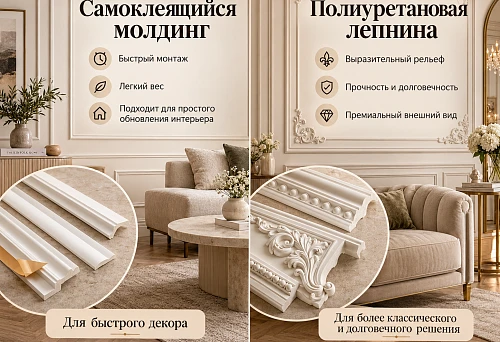
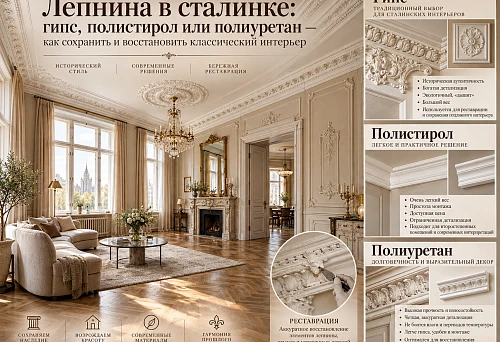
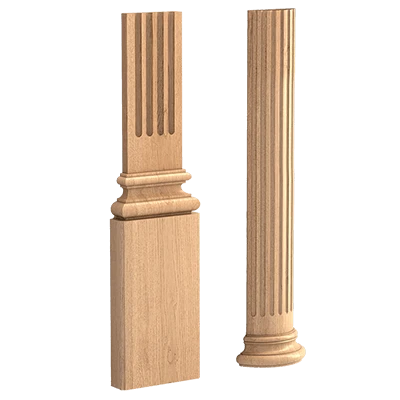
slatted wall panels for interior finishingof the nursery,Pogonazh iz massivato complete the perimeter,Wooden baseboardanda polyurethane cornice— the complete system of natural finishing for the nursery is presented in the STAVROS company catalog.
STAVROS — production of slatted panels from natural oak, ash, birch, and pine with safe E1 class coatings, recommended for children's rooms. Professional consultation on material selection, color, and parameters for a nursery of any age. Because a nursery is not just a room. It is the first environment a child calls their own. And it deserves the most careful approach.