








































Article Contents:
- Why perforated panels are needed: sound as a building material
- Physics of a perforated panel
- Diffusion as an independent value
- Where acoustic slatted panels with perforation are used
- Home theater and media zone
- Home office and workspace
- Meeting rooms and office spaces
- Music rooms and home studios
- Children's rooms
- How to combine technical function and decorativeness: the main principle
- Selection of front surface finish
- Shape and pattern of perforation
- Which polyurethane elements do not interfere with acoustics
- Hard surface is not an enemy
- Relief surfaces as a source of diffusion
- Placement principle: where absorption, where diffusion
- Approach for offices: strict form and quiet function
- Acoustic solutions for the office
- Polyurethane decor in the office
- Mediazone: When Sound and Image Work Together
- Mediazone Architecture with Acoustic Panels
- Decorative Frame and Panel Integration into Design
- Public Spaces: Offices, Lobbies, Waiting Areas
- Open Plan Office Spaces
- Lobbies and Waiting Areas
- Errors in Combining Perforation and Decor
- First Error: Perforation Without Sound-Absorbing Backing
- Second Error: Perforation on Only One Wall
- Third Error: Too Much Absorption
- Error four: conflict between decor and panel sizes
- Error five: different stylistic languages
- Table: acoustic solutions by room type
- Practical steps for a DIY project
- Step 1: define the acoustic task
- Step 2: calculate panel area
- Step 3: choose the construction
- Step 4: choose finish and decor
- Step 5: design panel framing
- FAQ: Answers to Popular Questions
- About the Company STAVROS

There is a question rarely asked when planning an interior, but which affects the feeling of a space no less than wall color or furniture choice: how does the space sound here? Not in the sense of music—in the sense of physics. How does a voice behave in the room? How is silence perceived—soft or ringing? How comfortable is it to work, talk, and relax in this specific volume?
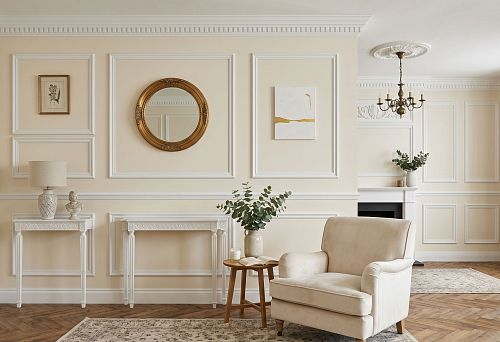
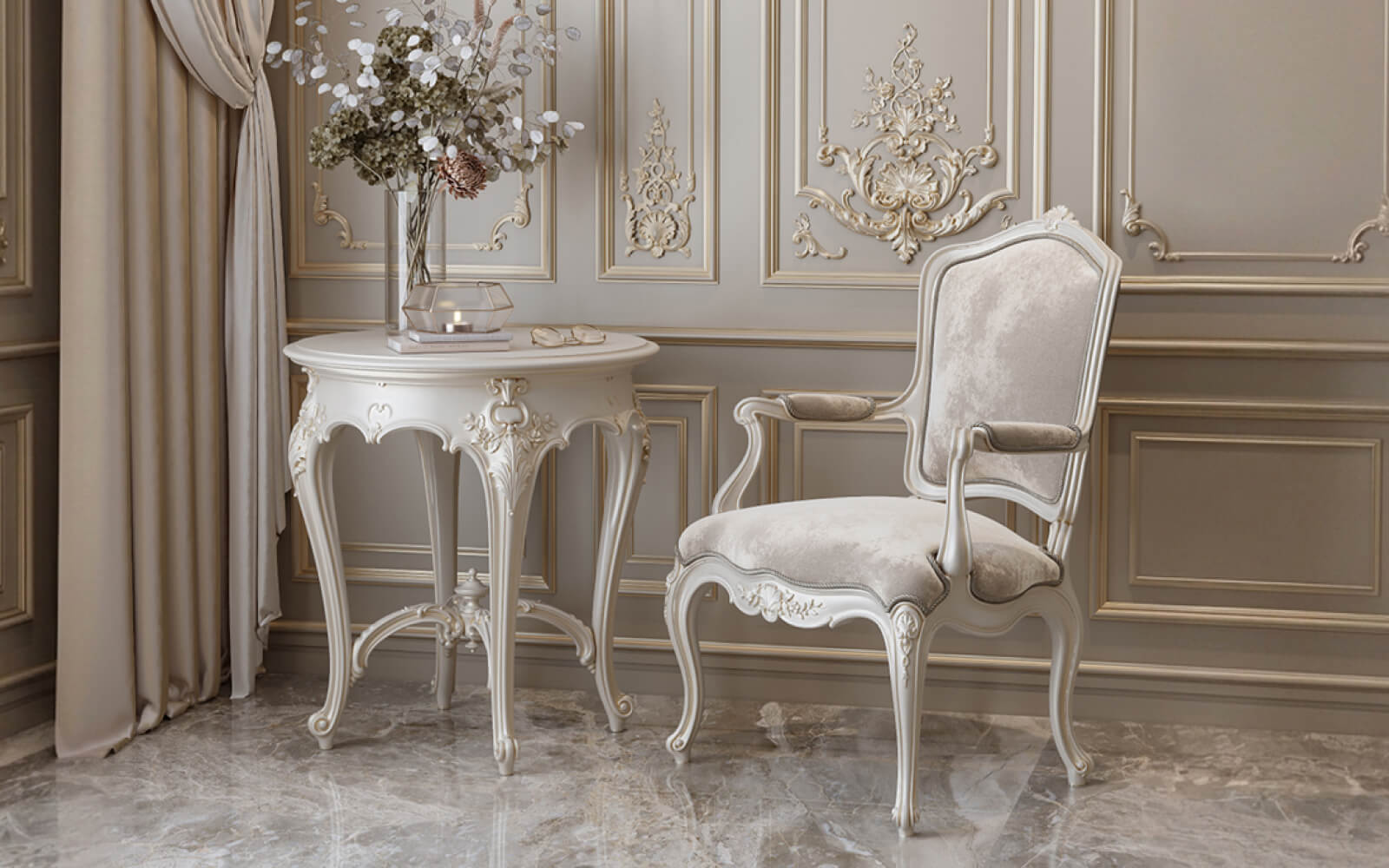
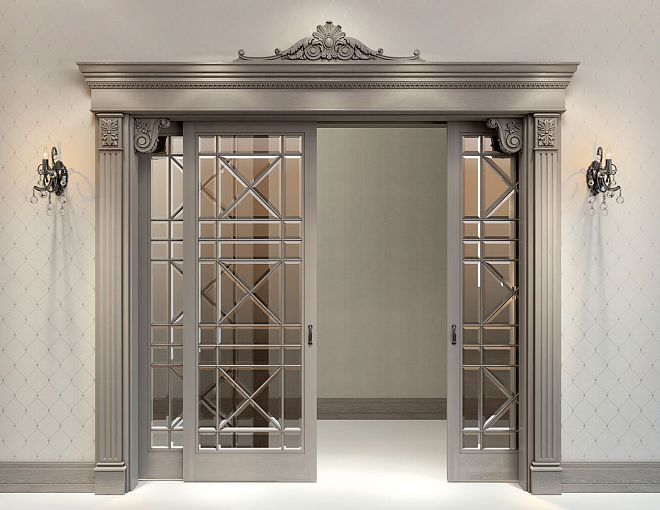
This is whereslotted panels with holes— a product where technical function and decorative logic are combined in a single design. And alongside them —Polyurethane decor for interiors: cornices, moldings, overlays that don't interfere with acoustics but create the architectural structure of the space.
How to work with this combination skillfully — without compromising either acoustics or aesthetics? Let's break it all down honestly and to the point.



Why perforated panels are needed: sound as a building material
Most people think of interior design in terms of the visible: color, shape, light. The sound environment is not seen — it's felt. Poor acoustics cause fatigue, create tension, reduce concentration. Good acoustics are unnoticeable — in the best sense: it's simply comfortable to be in the room, and a person doesn't understand why.
The key concept here is reverberation time. This is the interval during which sound fades to the level of silence after the source stops. In an empty room with hard surfaces — concrete, glass, plaster — reverberation time can reach 2–4 seconds. The voice 'floats,' words overlap each other, music loses clarity. In a room with properly selected sound-absorbing surfaces, reverberation time decreases to 0.4–0.8 seconds — and the space 'sounds' calm and clear.
It is precisely for managing this parameter thatacoustic slat panelswith perforation and a sound-absorbing layer behind them are used.




Physics of a Perforated Panel
A perforated panel is not just a sheet with holes. It is an acoustic system that works in tandem: a face plate with holes — an air gap — sound-absorbing material (usually mineral wool or acoustic foam with a density of 40–80 kg/m³).
When a sound wave reaches a perforated surface, part of the energy is reflected (creating diffusion — scattering sound through space), part passes through the holes into the structure and is absorbed by the layer of mineral wool or foam, converting into heat. The ratio of reflected to absorbed sound is determined by the percentage of open perforation area:
-
Perforation 5–10% of the area — minimal openness, emphasis on diffusion. Sound is scattered, the space 'sounds' livelier and richer. Suitable for music living rooms where acoustic 'liveliness' is important.
-
Perforation 10–18% — a balance of diffusion and absorption. The optimal range for offices, meeting rooms, home theater media zones.
-
Perforation 18–30% and above — emphasis on absorption, significant reduction of reverberation. For recording studios, professional media zones, conference halls.
Without a sound-absorbing layer behind the face plate, the holes hardly work: sound passes through them and reflects off the load-bearing wall back. This is one of the most common installation mistakes — beautiful perforation without acoustic filling.
Our factory also produces:


Diffusion as an independent value
It is worth mentioning diffusion separately — an effect provided by a perforated or slatted surface even without an absorbing layer. Sound waves, encountering an irregular surface (alternating slats and gaps, holes of different diameters), scatter in different directions instead of forming standing waves and parasitic reflections.
Standing waves are an acoustic defect where sound of a certain frequency 'hangs' between two parallel planes. In rectangular rooms, they are particularly pronounced and create a feeling of 'booming' at low frequencies. A slatted panel on one of the parallel walls breaks the symmetry of reflections — and this is often enough for a noticeable improvement in acoustics even without additional absorption.
Get Consultation
Where are perforated acoustic slat panels used?
Acoustic slat panelis used where sound control is a deliberate task—not a random bonus, but a project requirement.
Home theater and media zone
This is perhaps the most obvious application. In a media zone with hard surfaces—parquet flooring, drywall walls, a large screen or TV—sound from the audio system reflects multiple times, creating 'echo' that blurs movies and music.
Acoustic wall slat panelson the side walls of the media zone reduce parasitic reflections and standing waves. A panel on the front wall (behind or around the screen) absorbs direct reflections and improves speech intelligibility in films. The result—sound doesn't 'splash' around the room but is precisely localized in space. This is exactly the sensation created by an expensive cinema: every sound comes exactly from where it should.
For a media zone, panels with 12–18% perforation and 50 mm thick mineral wool with a density of 60 kg/m³ behind the face plate are optimal. An air gap of 20–30 mm between the wool and the load-bearing wall improves low-frequency absorption.
Home office and workspace
In an office, acoustics directly affect concentration and fatigue. A room with poor acoustics forces the brain to constantly 'filter' parasitic sounds—and by the middle of the workday, a person gets significantly more tired than in an acoustically comfortable space.
Slatted panels with perforations on the wall behind the workstation or on the side walls of the office reduce reverberation, improve speech intelligibility during video calls, and create a sense of focus. An added bonus—with the right finish choice (dark oak, tinted ash), the panels create a strict, business-like atmosphere that matches the room's function.
Meeting rooms and office spaces
In meeting rooms, reverberation time directly impacts communication effectiveness. With high reverberation, the speech of several people simultaneously turns into noise—meeting participants are forced to raise their voices, and fatigue accumulates quickly. The optimal reverberation time for a meeting room is 0.3–0.5 seconds.
Perforated slatted panels covering 30–40% of the wall area achieve this indicator without additional solutions. At the same time, they look like architectural finishes, not 'acoustic materials'—an important consideration for representative spaces.
Music rooms and home studios
For music spaces, acoustic design is a professional task that goes beyond simply 'hanging panels.' But even without a special project, slatted perforated panels on reflective walls noticeably improve the situation.
For music rooms, the balance of diffusion and absorption is especially important. Excessive absorption (lots of soft materials, a high percentage of perforation) makes the sound 'dead'—without volume and atmosphere. Moderate perforation combined with diffuse surfaces gives that very 'live' sound, which in professional studios is called controlled ambience—a controlled acoustic environment.
Children's rooms
This is an application that is talked about much less often—and completely undeservedly. In a children's room with a hard floor and bare walls, the sound pressure level during children's play reaches significant levels. Parents hear this as 'noise' from the children's room. The children themselves, although they don't realize it, are under constant acoustic load.
Slatted panels with perforation on one or two walls of a children's room solve this problem elegantly and aesthetically. The right choice of finish—light wood, pastel tinting—makes the panels an organic part of the children's interior.
How to combine technical function and decorativeness: the main principle
This is where the most challenging—and most interesting—part begins. A perforated panel that effectively absorbs sound doesn't have to look like acoustic foam in a recording studio. Modern slatted panels with perforation are full-fledged designer products that serve both acoustic and decorative functions.
Choice of front surface finish
The front surface of a perforated slatted panel can be:
-
Natural wood veneer—the highest category. Natural grain pattern, tactile warmth, authentic natural feel. Oak, ash, walnut, birch—each species speaks its own visual language.
-
MDF for painting—absolute freedom in color choice. White, gray, graphite, any pastel shade. Perfect for interiors where panels should 'blend' into the color scheme or, conversely, become a bright accent.
-
MDF with film or laminate—an economical option with imitation wood texture or solid-color coating. Durable enough for use in residential interiors.
Shape and pattern of perforation
Perforation is not just a function; it's also decor. The pattern of holes forms a visual surface pattern:
-
Uniform grid of round holes—a strict, technological look. Works well in loft, minimalist, and industrial styles.
-
Checkerboard pattern—a denser pattern that creates a sense of fabric or perforated metal. Modern, restrained.
-
Decorative pattern — geometric designs, ornaments created by the arrangement of holes. This is no longer just an acoustic solution, it's an artistic object.
-
Microperforation — holes with a diameter of 0.5–2 mm, practically invisible from a distance. The panel looks like a smooth surface while retaining acoustic properties. A maximally delicate solution.
Which polyurethane elements do not interfere with acoustics
This is a question that is important to understand correctly:decorative polyurethane elements— cornices, moldings, overlays — are not acoustic materials. They do not absorb sound and do not create significant diffusion. But they also do not interfere with acoustics if applied skillfully.
Hard surface — not an enemy
A common misconception: 'everything hard reflects sound, so you need to get rid of it.' In fact, proper acoustics is a balance of absorption and reflection. A completely 'soft' space with maximum absorption sounds 'dead' and uncomfortable. Polyurethanedecorative polyurethane elements— cornices, moldings, pilasters — occupy a relatively small area of surfaces and contribute insignificantly to the acoustics of a room in the direction of reflection.
Textured surfaces as a source of diffusion
And this is a non-obvious but important property: texturedPolyurethane decor for interiorswith a pronounced profile—a cornice with deep projections, rich molding, applied pilasters—creates a diffuse surface on the ceiling and walls. Each projection scatters the sound wave sideways, breaking the straight-line reflection.
This property was known even to Baroque architects: rich stucco ceilings in European palaces and churches created not only a visual but also an acoustic effect—halls with stucco sounded better than halls with smooth ceilings of the same geometry. The use ofpolyurethane decorative elementswith pronounced relief on the ceiling—is essentially creating natural diffuse surfaces that work together with perforated absorbing panels.
Placement principle: where absorption, where diffusion
For residential interiors, a simple zoning rule works:
-
Walls with perforated panels—absorption zones. Placed where direct reflections need to be reduced: side walls of the media zone, the wall opposite the window in the study, the back wall of the meeting room.
-
Ceiling with stucco decor—diffusion zone. Rich relief ceiling decor scatters sound, creating a uniform sound field without parasitic reflections.
-
Smooth walls—neutral zones. Walls with standard plaster or panels without perforation provide moderate reflection.
Such three-zone distribution—absorption / diffusion / neutral reflection—creates an acoustically balanced space without special calculations.
Approach for studies: strictness of form and silence of function
The office is a space where acoustics determine productivity, and where aesthetics must convey a specific idea: order, concentration, professionalism.
Acoustic solutions for the office
For an office with an area of 15–25 sq. m, it is sufficient to place perforated slatted panels on 25–35% of the wall area. Optimal surfaces: the wall behind the desk (the largest plane), a side wall. The wall with a window is traditionally not used for panels — daylight and architectural logic dictate different solutions here.
Behind the slatted panels — a sound-absorbing underlay 50 mm thick, density 40–60 kg/m³. An air gap of 25–30 mm between the underlay and the load-bearing wall.
Polyurethane decor in the office
Ceiling cornice made ofpolyurethane trim productswith a moderate geometric profile — is an essential element. It creates a horizontal boundary in the upper part of the room, visually 'closes' the office, and adds severity.
Moldings that divide the ceiling into geometric fields — an additional source of diffusion on the ceiling plane. Simple rectangular coffers in a geometric layout without ornamentation — a correct choice for a modern business interior.
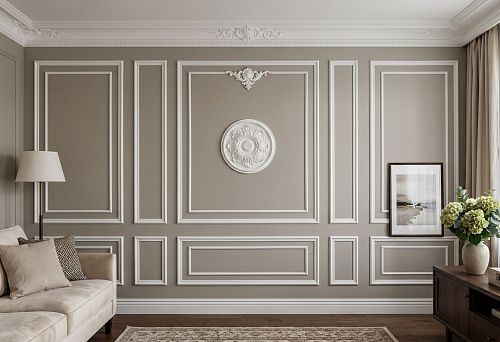
On the walls — a restrained architectural structure: molding around the perimeter of the perforated panel zone, which frames them as a finished architectural element. No excessive ornamentation — only clear horizontals and verticals.
Media zone: when sound and image work together
The media zone is a space where the audiovisual experience is the primary value. Here, acoustics and design must work in complete harmony.
Media zone architecture with acoustic panels
The front wall (behind the screen or TV) is acoustically key. Direct reflections from this wall create 'echo' after each sound from the speaker system. Slatted panels with 15–20% perforation provide maximum effect here: sound reflected from the screen area is partially absorbed.
Important nuance: slatted panels should not cover the acoustic speakers themselves if they are built into the wall or wall-mounted. Sound must exit freely — panels are placed adjacent and above, not directly in front of the drivers.
Media zone side walls are the second priority. Here, reflections create an expanded stereo sensation. A small percentage of absorption on side walls (panels covering 20–30% of the area) improves soundstage focus.
Decorative frame and panel integration into design
In media zones, perforated slatted panels integrate organically into design with proper framing. Molding or wooden framing around the panel area transforms the acoustic solution into an architectural element — a panel perceived as a complete designer object.
Ceiling cornice above the media zone and around the entire perimeter creates a horizontal architectural frame that unites all elements into a single space.
Public spaces: offices, lobbies, waiting areas
In public spaces, acoustics are a comfort issue for large numbers of people simultaneously. Here, the scale of perforated solution application is fundamentally different.
Open-plan office spaces
Open space is an acoustic problem by definition. Multiple sound sources (conversations, keyboards, phone calls), hard floor and ceiling surfaces — and sound spreads throughout the room without obstacles.
Perforated slatted panels on the ceiling (as part of a suspended system) are a classic solution for open space offices. On the walls — vertical panel zones, acoustic partitions between work areas.
Lobby and waiting areas
In lobbies with high ceilings and an abundance of hard surfaces (marble, glass, metal), acoustics without special measures are catastrophic: the noise of conversations turns into a hum, background music becomes unintelligible. Perforated panels on part of the wall surfaces are a delicate solution that does not compromise the representative appearance and significantly improves the acoustic climate.
In such spacesPolyurethane Decoron the ceiling — an ornate plaster cornice, coffered moldings — works as a diffusive element, scattering sound from the high ceiling. The combination of sound-absorbing perforated panels on part of the walls and a diffusive plaster ceiling is a professional balance used in the architecture of representative spaces.
Errors in combining perforation and decor
Let's examine the most common miscalculations that negate all efforts to create the correct acoustic and decorative balance.
First error: perforation without a sound-absorbing backing
A perforated panel without a layer of mineral wool or acoustic foam behind it practically does not absorb sound. The holes allow the sound wave to pass through — but if there is a load-bearing wall behind them, the wave simply reflects back. There is a decorative effect, but no acoustic one.
Correct construction: load-bearing wall → 20–30 mm air gap → sound-absorbing material (mineral wool 40–80 kg/m³, 50 mm thickness) → glass cloth (acoustically transparent barrier, holding wool fibers) → frame → perforated panel.
Second mistake: perforation on only one wall
One perforated panel in a room is an incomplete solution. For real reverberation control, acoustic materials must be distributed across multiple surfaces: at least on two walls, optimally on two walls and part of the ceiling.
The point solution 'one panel on one wall' may provide slight improvement but does not create a systemic acoustic effect.
Third mistake: too much absorption
The opposite extreme is covering too large a proportion of surfaces with perforated panels. In a residential interior, 'dead' sound is no less uncomfortable than excessive reverberation. The room begins to feel oppressive, isolated, unnatural.
The optimal proportion of absorbing surfaces for residential spaces is 25–40% of the total wall area. For professional media zones — up to 50%. The rest should be reflective or diffusive surfaces.
Fourth mistake: conflict between decor and panel sizes
Wide cornices and moldings do not combine with narrow perforated slats in the same volume: the scale conflict is glaring. If slatted panels have a 15 mm gap, the cornice should be delicate — 50–80 mm wide, without baroque details. If panels are large — slat width 80–100 mm — the cornice can be more pronounced.
Fifth mistake: different stylistic languages
slotted panels with holesDark oak in a brutalist loft style + classical acanthus cornices = a stylistic disaster. Perforated white MDF panels in a Scandinavian interior + a lush Baroque rosette = the same thing. Unity of stylistic language is an absolute requirement.
Table: Acoustic solutions by room type
| Room | Perforation (% of wall area) | Sound-absorbing layer | Polyurethane decor |
|---|---|---|---|
| Home theater | 35–50% | Mineral wool 60 kg/m³, 50 mm | Delicate cornice, without ornament |
| Office | 25–35% | Mineral wool 40 kg/m³, 50 mm | Geometric cornice, coffered moldings |
| Meeting room | 30–40% | Mineral wool 60 kg/m³, 50 mm | Minimal cornice, no ornament |
| Living room | 20–30% | Acoustic foam, 40 mm | Moderate cornice, moldings |
| Children's room | 20–30% | Mineral wool 40 kg/m³, 40 mm | Delicate cornice, without ornament |
| Lobby/waiting area | 20–30% | Mineral wool 60 kg/m³, 50 mm | Rich cornice, coffers (diffusion) |
Practical steps for a DIY project
Step 1: define the acoustic task
First and foremost — honestly answer the question: what exactly is unsatisfactory about the room's sound? Voice echo? Music reverberation? Sound penetration from adjacent rooms? The latter (soundproofing) is a fundamentally different task that perforated panels do not solve: it's a matter of load-bearing structures, not finishing materials.
Step 2: calculate the panel area
For a living space, take 25–35% of the total wall area (excluding openings). For a media zone — up to 45%. Distribute across several walls.
Step 3: choose the construction
The construction determines the result. Front panel → glass cloth → sound-absorbing layer → air gap → load-bearing wall. Do not skimp on the sound-absorbing layer — it is what provides the acoustic effect.
Step 4: choose the finish and decor
Finish of the front panel — in accordance with the interior style.polyurethane decorative elements— in accordance with the scale of the room and style. A unified shade for all surfaces.
Step 5: design the panel framing
Even a simple wooden or polyurethane molding around the area of perforated panels transforms it from a 'stuck-on acoustic solution' into an architectural element. This is a small detail with a big visual effect.
FAQ: Answers to popular questions
How does a perforated slatted panel differ from a regular slatted panel?
A regular slatted panel creates diffusion through its relief (alternation of slats and gaps), but does not have significant absorption. A perforated panel has holes in the body of the slat or MDF base, which, in combination with the sound-absorbing layer behind it, create real absorption of sound energy.
Can slatted panels without holes be used to improve acoustics?
Yes, due to the diffusion effect. A slatted surface scatters sound better than a smooth wall. However, significant absorption without perforation will not occur. If the goal is only to reduce 'booming' through diffusion, standard slats will suffice.
Can perforated panels be painted?
Yes, provided the paint is applied by spraying, not with a brush. A brush partially clogs the holes with paint, reducing acoustic effectiveness. A spray gun applies a thin layer without blocking the holes.
How difficult is it to install an acoustic structure yourself?
Installing a basic structure (frame → mineral wool → glass cloth → panels) is feasible for a careful non-specialist. The difficulty lies in maintaining gaps, joining panels, and ensuring the structure fits tightly against walls and ceiling. Breaks in the structure significantly reduce the acoustic effect.
Is special adhesive needed for installing polyurethane decor near acoustic panels?
Standard adhesive for polyurethane decor (acrylic or polyurethane foam adhesive) is sufficient. Additional mechanical fastening with dowels is recommended for elements with a projection of more than 50 mm.
How long does it take to install acoustic panels in a 20 sq. m room?
With materials and tools available: frame + mineral wool + glass cloth — 1 working day. Installing the face panels — another day. Decorative framing and painting — 1 day. Total 3 working days for two walls in a 20 sq. m room.
How to check if acoustics have improved after installation?
Simple test: clap your hands in the center of the room and listen to the decay of the clap. Before installation — long, 'ringing' decay. After — short, muffled. The difference is noticeable without special equipment.
About the company STAVROS
Acoustics and design are not opposites to choose between. They are two sides of one professional task: to create a space where you want to be — because it is beautiful, and because it is comfortable.
The company STAVROS manufacturesRafter panelsmade of solid oak and MDF — including perforated versions for acoustic applications. Precise geometry, consistent spacing, high-quality surface finish.decorative polyurethane elements— cornices, moldings, overlays, trim products for creating an architectural structure of space that works in harmony with acoustic solutions.
STAVROS offers a complete system for creating interiors where function and form do not compete but enhance each other. Because true quality of space is what is felt simultaneously by the eyes, ears, and body.
STAVROS — for those who design with an understanding of all dimensions of space.