










































































Article Contents:
- What is wall stucco and why is it needed in the interior
- What wall stucco provides
- Which elements to use for wall stucco
- Moldings — a line that creates structure
- Decorative overlays — a relief accent
- Corner elements — finishing frames
- Rosettes — a central accent
- Decor for moldings — precision in details
- Polyurethane stucco decor is a system, not a set
- Moldings and stucco: how to create a beautiful composition on a wall
- Molding frames: a basic wall decor technique
- Symmetrical compositions
- Vertical panels: structuring height
- Decorating the wall behind the sofa with moldings
- Bed headboard: molding frame instead of a backrest
- Where to use stucco on walls
- In the living room
- In the bedroom
- In the hallway and corridor
- In the TV area
- How to choose wall stucco to match interior style
- Classic: a complete system with ornament
- Neoclassical: frames, lines, tranquility
- Modern interior: molding as graphics
- Art Deco: geometry, rhythm, contrast
- Japandi and minimalism: barely noticeable relief
- Mistakes when choosing wall molding
- Wall molding and ceiling decor: how to connect two levels
- Wall preparation and installation: basics you can't ignore
- Surface Preparation
- Marking
- Cutting and joining
- Adhesive and Fixation
- Where to buy polyurethane wall molding
- FAQ: popular questions about wall molding
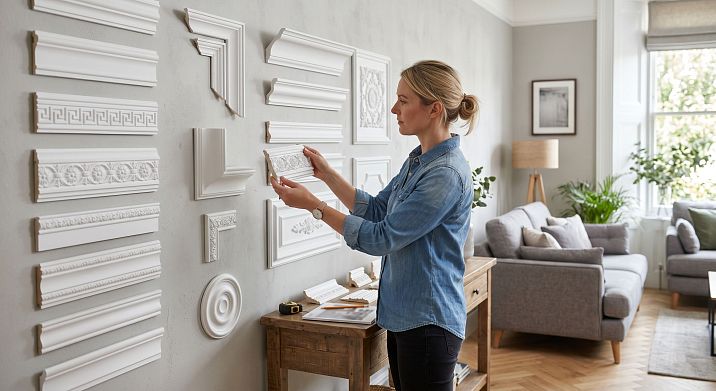
There is a question many people ask themselves when renovating: why does one interior look finished, while another does not, even if both have expensive furniture, good paint, and quality parquet? The answer is almost always the same: the walls. It's not the furniture that makes an interior rich. It's the walls. Their architecture, their structure, their relief.
Wall molding is not archaic, not an attribute of palace style, and not a privilege of expensive renovation. It is a tool. Precise, flexible, applicable in a variety of contexts: from a classic living room with high ceilings to a modern bedroom in neutral tones.Polyurethane molding on wallsgives what no paint, wallpaper, or plaster can: spatial relief that works in any lighting and at any time of day.
polyurethane wall decoris suitable for the living room and bedroom, for the hallway and study, for the TV area and the wall behind the sofa. It allows you to highlight the desired plane, give it weight, create a focus — or, conversely, subtly structure the space through thin molding lines. We will discuss in detail how this works and how to choose the right elements.



What is wall stucco molding and why is it needed in the interior
Imagine an empty white wall. Three and a half meters wide, two seventy high. Nothing. Just a surface. Now imagine the same wall with a horizontal molding belt at a height of one meter twenty, two symmetrical vertical frames above, and an ornamental overlay in the center. This is no longer just a wall. This is architecture.
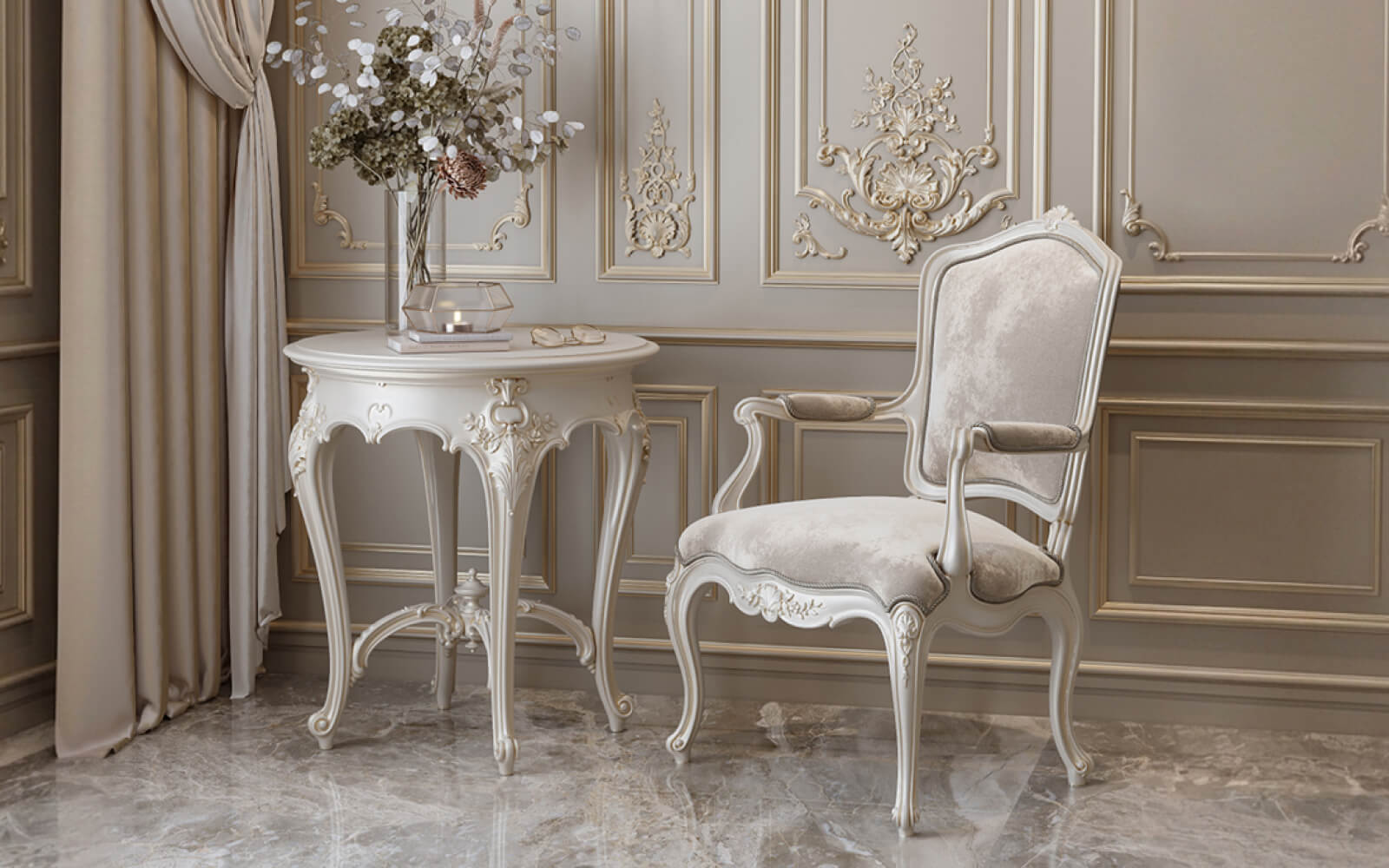
wall moldingis a broad concept. It includes moldings, ornamental overlays, rosettes, and corner inserts. They are united by one thing: they all create relief on a flat surface. Relief is depth. Depth is the play of light. The play of light is what makes a wall alive.
Why specifically polyurethane? Because classic gypsum stucco, for all its beauty, has several practical limitations: it is heavy, fragile, requires professional installation, and is significantly more expensive. PolyurethaneDecorative wall moldinglacks all these drawbacks: it is lightweight, precise in relief, mounted with glue, can be painted any color, and is not afraid of moisture. And visually, it is indistinguishable from gypsum. Even up close.




What stucco molding on the wall provides
Let's break down specifically what tasks wall stucco molding solves in the interior:
-
Creates relief and depth. Even the most laconic molding on the wall creates a play of shadows — especially with side lighting or directional spotlights. The wall ceases to be just a plane.
-
Accentuates the accent wall. Every room should have a "main" wall. Molding makes one wall visually heavier than the others, thereby setting the hierarchy of the space.
-
Replaces expensive finishes. Complex handmade wooden panels, marble inlays, expensive embossed wallpaper — all of this costs significantly more thanPolyurethane wall decor, but the visual result is comparable.
-
Suitable for any style. This is not a "classic" theme. Polyurethane profiles for Japandi, laconic frames for modern interiors, rich ornamentation for neoclassicism — the range of applications is wide.
-
Painted in the color of the wall. A classic technique: white molding on a white wall. The decor is present but invisible. The relief works without creating visual noise.
-
Conceals defects and unevenness. A horizontal molding belt hides the line of wall height difference. A frame system covers cracks and uneven transitions in paint.
Important note:polyurethane wall decorin STAVROS is structured by collections — "Neoclassic", "Neoclassic Light", "Versailles", "Peterhof", "Petersburg", "Tsarskoye Selo", "Pavlovsk", "Japandi", "Botanical Garden" and others. Choosing a collection is the first step. Everything else is details.
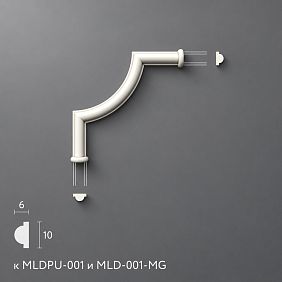
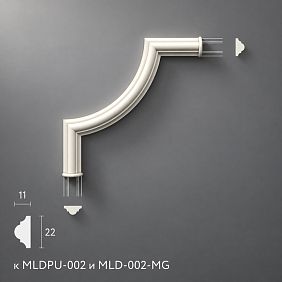
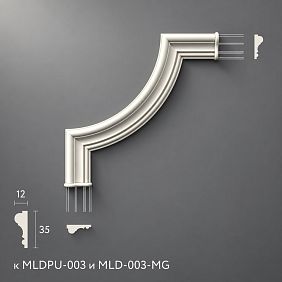
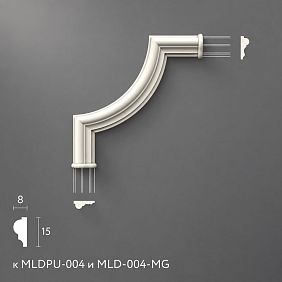
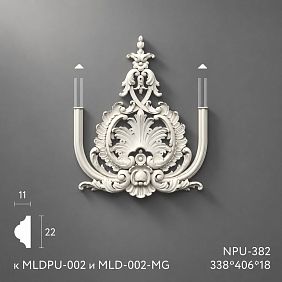
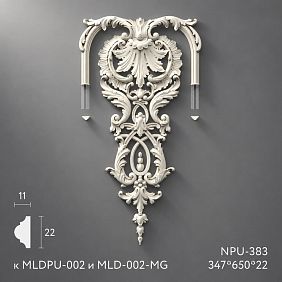
Our factory also produces:


Which elements to use for wall molding
Before going to the catalog and choosing specific items, you need to understand what "building blocks" the wall decorative system is assembled from. Each element plays its role, and knowing these roles allows you to avoid mistakes when planning.
Get Consultation
Moldings — the line that creates structure
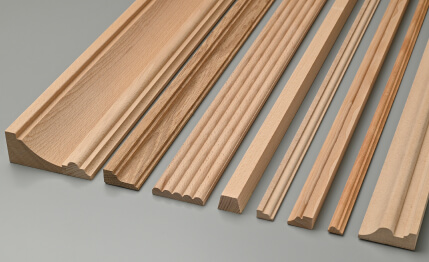
Molding is a profile strip: a long linear element with a specific cross-section. Horizontal moldings divide the wall by height. Vertical ones — by width. Four moldings assembled into a rectangle create a frame. Frames create a panel system. The panel system turns the wall into an architectural element.
Moldings vary in profile height: thin (20–35 mm) — for minimalist interiors and Japandi, medium (40–70 mm) — a universal range for neoclassicism and modern classic, wide (80 mm and more) — for rooms with high ceilings and full classic.
Decorative overlays — a relief accent
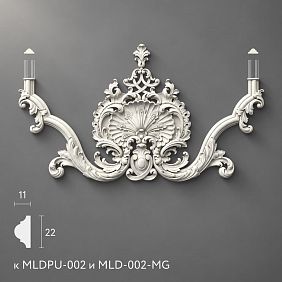
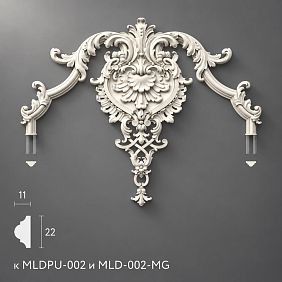
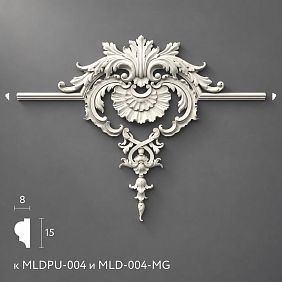
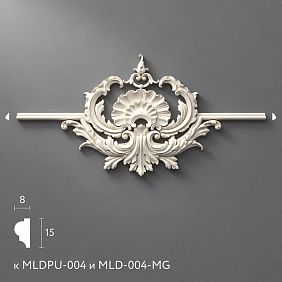
Decorative elements for the wall made of polyurethane — these are three-dimensional ornamental overlays: cartouches, ornamental fragments, acanthus leaves, geometric ornaments, medallions. They do not create a line — they create an accent. They are mounted as standalone elements or inside molding frames.
Usage principle: one overlay in the right place — a powerful accent. Ten overlays in a chaotic order — visual noise. Stucco decor on the wall works only where it is expected.
Corner elements — finishing frames
Corner inserts are small but critically important details. In each corner of a molding frame, two profiles meet. Without a corner insert, it is just a 45° joint — normal, but not beautiful. A corner ornamental overlay covers the joint and creates a decorative finish — exactly what distinguishes a professional result from an amateur one.
Rosettes — central accent
Rosettes are round or polygonal relief overlays with a symmetrical ornament. Their purpose is a focal point. A rosette in the center of the wall above the sofa, in the center of the frame above the bed, in the center of the TV area — this is the "eye" of the decorative composition around which everything else is built.
Decor for moldings — precision in details
Decor for Molding— a separate category: corner and intermediate decorative inserts, specially designed for installation directly on the molding profile. Corner inserts cover the intersections of moldings in frames. Intermediate inserts create rhythm on long horizontal runs.
This is the category that is bought 'at the last moment' and later regretted not buying immediately. Without it, the decor looks unfinished. With it, it seems as if the entire interior was done by one master according to a single plan.
molded decoration made of polyurethane— a system, not a set
It is important to understand: stucco on the wall is not a collection of individual beautiful elements. It is a system. The elements must be selected from one collection, installed according to a single modular principle, and follow one logic of proportions. That is why the STAVROS collection approach is not marketing, but a practical necessity.
Moldings and stucco: how to assemble a beautiful composition on the wall
This is perhaps the most practically important section. Knowing what moldings are is one thing. Understanding how to assemble a beautiful wall from them is another. Let's break down the basic techniques.
Frames from moldings: a basic technique of wall decor
A frame made of moldings on the wall is a rectangle of four profile runs. It seems simple. In reality, this is the most powerful technique in wall decor. Why? Because the frame creates a 'field' — a limited plane within a plane. And this field can be filled: with a different color, texture, ornament — or left empty, allowing the relief of the frame to speak for itself.
polyurethane wall moldingsin STAVROS are divided by profile width, which simplifies selection for a specific interior. The rule of proportions when creating frames:
-
The distance from the edge of the frame to the edge of the wall (or to the adjacent frame) is at least 15–20% of the width of the frame itself;
-
The proportion of the vertical frame is width to height as 1 to 1.3–1.6 (classic vertical panel);
-
The distance from the top frame to the ceiling cornice is at least 15–20 cm.
Symmetrical compositions
Symmetry is the basic law of classic and neoclassical decor. Two elements to the left and right of the central axis. An even number of frames of the same size. Identical margins on both sides. Symmetry creates calmness — exactly the quality that overloaded interiors often lack.
Decorative wall moldingIn symmetrical compositions, it is mounted strictly according to the markings. A deviation of 5 mm due to incorrect measurement creates a noticeable visual skew — especially noticeable precisely because everything else is symmetrical.
Vertical panels: structuring height
Vertical zoning of the wall with moldings is a classic French technique. Vertical rods running from the baseboard to the cornice divide the wall into "pilasters." Between the pilasters is a field with decor or accent paint. Creates a feeling of height, makes a low ceiling visually higher.
Moldings made of polyurethaneFor vertical zoning, profiles of medium height are chosen — 45–65 mm. A too thin molding on a high vertical "gets lost." A too wide one creates a feeling of a fence-like partition.
Decorating the wall behind the sofa with moldings
The wall behind the sofa is the main focal point for wall decor in most living rooms. The design logic is based on function: the sofa is the horizontal center of the room. Therefore, the decor on the wall behind it should support this horizontal line and create a visual background that "holds" the sofa in the space.
Three working schemes:
-
A system of two to three vertical frames spanning the full height of the wall from the baseboard to the ceiling cornice is a classic panel solution;
-
One wide horizontal frame across the entire width of the wall at the height of the sofa back — creates a "backdrop" for the sofa and highlights the area;
-
The combination of a lower molding belt with a system of frames above — creates a two-level structure characteristic of rich classical interiors.
Wall decor with moldingsBehind the sofa, it is often complemented by one central ornamental accent — a rosette or overlay in the center of the upper horizontal of the frame. This is the "point" around which all symmetry is built.
Bed headboard: molding frame instead of a backrest
A bedroom without a bed headboard is not a bedroom, but just a room with a bed. A molding frame on the wall behind the bed creates a headboard — visual, architectural, regardless of whether the bed has a physical backrest.
Construction principle: the width of the frame equals the width of the bed plus 25–35 cm on each side. The lower molding is at the level of the top edge of the backrest or mattress. The upper one is 40–60 cm higher. The frame proportion is horizontal (wider than tall).
Inside the frame: a neutral accent. A different color — one shade lighter or darker. Textured wallpaper. Panels. Nothing extra.
Where to use molding on walls
Each room has its own logic. The same type of decor gives different results in a living room and a bathroom. Let's break it down by room.
In the living room
The living room is the widest field for wall decor. Here there is space, height, and the need to create a representative interior.Stucco molding on the wall in the living roomsolves several tasks simultaneously.
First: create a main wall. In most living rooms, this is the wall opposite the entrance or the one where the sofa is located. It receives the main decor — molding frames, ornamental overlays, a ceiling cornice with a rich profile.
Second: highlight the TV area. Decorating the wall behind the sofa with moldings is the most popular technique in modern interior decor. A molding system around the TV turns the "screen on the wall" into an architectural element of the room. A horizontal molding under the TV, vertical strips on the sides, corner inserts — and the TV area transforms from technical to decorative.
Third: create perspective. In spacious living rooms, vertical moldings make the ceiling appear higher. In small ones, a horizontal band at a height of 100–120 cm visually expands the space.
Decorative stucco molding in the living roomis selected based on ceiling height: up to 2.8 m — laconic profiles 40–55 mm high; from 3 m — medium and wide (60–90 mm); above 3.5 m — a full classic set with cornices, friezes, and ornamental bands.
In the bedroom
The bedroom requires a delicate approach. Excess decor here is a problem: an overloaded wall prevents relaxation. A lack of decor is another problem: the bedroom looks faceless and unfinished.
Stucco molding on the wall in the bedroomin most cases is one frame system behind the bed and, possibly, a light molding band around the perimeter of the walls. That's it. Anything more is overkill, unless it's a deliberately classic interior.
Moldings behind the bed: minimal profile, color close to the wall, no ornamental overlays with deep relief — only clean lines. A central rosette above the bed is acceptable if it fits the collection's style.
Wall decor at the headboard in a color scheme: stucco in the same tone as the wall — the calmest option. White stucco on a dusty pink, gray-blue, or warm gray wall — soft contrast. Dark stucco on a light wall in the bedroom — uncommon but striking in a modern classic style.
In the hallway and corridor
The hallway is a small space with high traffic: guests are welcomed here, and the first impression of the home is formed here.Wall stucco in the hallwayworks primarily as a structural element, not as an ornamental one.
A horizontal molding belt at a height of 90–100 cm is the main tool for the hallway. It does several things at once: visually expands a narrow space, creates a "panel-wall" division, allows the use of two different colors or materials. The lower part is a dark tone (practical: hides dirt), the upper part is light (expands and lifts).
Wall decor in the hallwayis complemented by a frame around the mirror. A molding frame for the mirror is an elegant and functional solution that turns an ordinary mirror into an "integrated" architectural wall element. No mirror frame is needed — the molding profile replaces it and simultaneously integrates the mirror into the wall system.
Ornament in the hallway — only accent pieces. One overlay above the mirror or in the center of the molding belt. Overloading a small space with stucco decor creates a feeling of pressure, not richness.
In the TV area
Decorating the TV zone with polyurethane is a separate design request that is gaining popularity. The TV has become part of the interior — and the wall around it should match.
The stucco molding around the TV zone is built on the principle of an architectural niche: molding rods form a rectangle around the screen and media equipment area. This can be one large frame covering the entire TV with a 15–20 cm indent on each side. Or a system of several rectangles creating a multi-level niche.
Moldings on the wall under the TV are selected with an emphasis on geometric clarity: minimal ornament on the profile, smooth chamfers, clean corners. A laconic molding with correct proportions gives the best result here, rather than a complex classical profile with an ornamental frieze.
Inside the TV zone frame, accent finishing is appropriate: stone panels, dark paint, wooden planks. The stucco creates the framing — the finishing inside creates the content.
How to choose stucco molding on the wall to match the interior style
Style determines everything: the molding profile, depth of ornament, density of decor, color scheme. Let's break down the main directions.
Classic: full system with ornament
Full classic is a multi-level decor system. A ceiling cornice with a complex profile. A horizontal molding belt with an ornamental ribbon at a height of 90–120 cm. Vertical rods dividing the wall into fields. Frames with corner ornamental inserts. Central medallions or cartouches inside the frames.
Polyurethane molding on wallsIn the classic style from the collections "Versailles", "Peterhof", "Petersburg" — rich relief with deep ornament, plant and geometric motifs, acanthus leaves and cartouches. Color — white or cream on light walls, gold patination as an accent.
Classic requires planning: you can't just take a few beautiful elements and attach them to the wall. A scheme is needed. A calculation of proportions is needed. Logic is needed.
Neoclassical: frames, lines, calmness
Neoclassicism is the most popular trend of recent years. It is classicism filtered through modernity: less ornament, more geometry, calm proportions.Polyurethane wall decorIn neoclassicism, this primarily means moldings. Frames. Horizontal bands. No garlands, no plant friezes — only clear rectangles and simple profiles.
The "Neoclassic" and "Neoclassic Light" collections by STAVROS are designed specifically for this style. "Neoclassic Light" is an even more minimalist version for those who want structure without any ornamental hints.
Moldings in neoclassicism are painted in the color of the wall or slightly lighter. The color of the decor never contrasts sharply — only subtle light on light. Frames are proportional, symmetrical, without unnecessary details.
Modern interior: molding as graphic design
in modern interiorsWall Decorative ElementsThey are used differently: as graphic elements, not as historical ornaments. A wide molding in a dark color on a light wall is not classicism, it is art. An asymmetrical system of several rectangles of different sizes is not panel decor, it is intentional geometry.
Moldings in modern interiors are often painted contrastingly: black on white, dark gray on cream, anthracite on light gray. This makes the decor graphic rather than architectural — a different function, a different effect, a different atmosphere.
Art Deco: geometry, rhythm, contrast
Art Deco is a style with character. Geometric ornament, rhythmic repetitions, clear horizontal and vertical lines, contrasting coloring.Polyurethane moldingsIn the Art Deco style, this means moldings with straight edges and minimal chamfers, geometric overlays, diamonds and rectangles instead of floral ornament.
Color in Art Deco: gold, bronze, black, white. Contrast is mandatory. An emerald wall with white moldings — that's exactly the type of solution.
Japandi and minimalism: barely noticeable relief
Japandi is a style where 'less' is always better.Decorative elements for the wall made of polyurethaneHere, it's the thinnest profile (15–25 mm), no ornament, only a clean line. One horizontal strip at a height of 110–120 cm. Possibly a thin frame behind the sofa with a 3–4 cm gap from the wall edge. That's all.
In Japandi, molding is not decor, but an architectural gesture. One line that you notice only if you know it's there. That is the hallmark of high-class work.
The 'Japandi' collection at STAVROS is created with this philosophy in mind: minimal relief, neutral profiles, compatibility with natural materials.
Mistakes when choosing wall molding
Let's talk about what most often goes wrong. Mistakes in wall decor are painful: they are hard to fix without redoing. So it's better to know them in advance.
Too small elements on a large wall. A common mistake for first-timers with molding: they choose a 'thin and neat' molding that simply gets lost during installation. A wall 4 meters wide and 3 meters high requires a corresponding scale of decor: a profile of 60–80 mm, frames with a gap of at least 20–25 cm from the edges.
Overload of ornament in a small space. A small room of 12–14 sq. m with four walls covered in stucco ornament is not luxury, it's claustrophobia. In small spacesmolded decoration made of polyurethaneonly on one "main" wall, and only in a concise version.
Incorrect frame height. Frames that are too flattened vertically (wide and low) create a feeling of pressure. Frames that are too elongated look unstable. The correct vertical frame has a width-to-height ratio of 1:1.3–1.6.
Lack of symmetry in a classic design. Three frames on the wall — a central one and two side ones, but of different sizes — is a mistake in a classic interior. Three frames means one in the center and two symmetrical "fields" on the sides. Otherwise, disharmony.
Mixing collections. A molding from the "Versailles" collection and an overlay from the "Japandi" collection in one frame is a conflict of plastic language. All elements on one wall should be from the same collection. Period.
Buying without a layout diagram. You want to order quickly and start installation. Understandable. But without a diagram calculating the linear meters of molding, number of corner inserts, and frame placement, you'll end up short of something and have leftovers.Wall Decorative Elementsneeds to be calculated in advance, on paper or in a program.
Installation on an unprepared surface. Loose plaster, fresh paint without primer, damp wall — a poor base. The adhesive won't provide proper adhesion, and after a few months, the moldings will start to come off. The surface must be dry, clean, and primed. For detailed and clear installation techniques, see the article oninstallation of polyurethane moldingand the article oninstalling polyurethane molding: corners, joints, painting — a complete practical breakdown.
Different shades of white from different manufacturers. Moldings from one brand, overlays from another — and their "white" is different. After painting with the same paint, the difference is smoothed out. But only if you paint with the same paint from the same batch. AllPolyurethane Items— from one catalog. Painting — with one paint from one bucket.
Stucco on the wall and ceiling decor: how to connect two levels
A separate topic that is often overlooked: the connection between wall and ceiling decor. The wall and ceiling are not two independent planes, but a single architectural space. And the decor on them should be connected.
The main connecting element is the ceiling cornice. The cornice is the transition from the wall to the ceiling. It belongs to both at the same time. A cornice from the same collection as the wall moldings creates unity. A cornice from a different catalog breaks it.
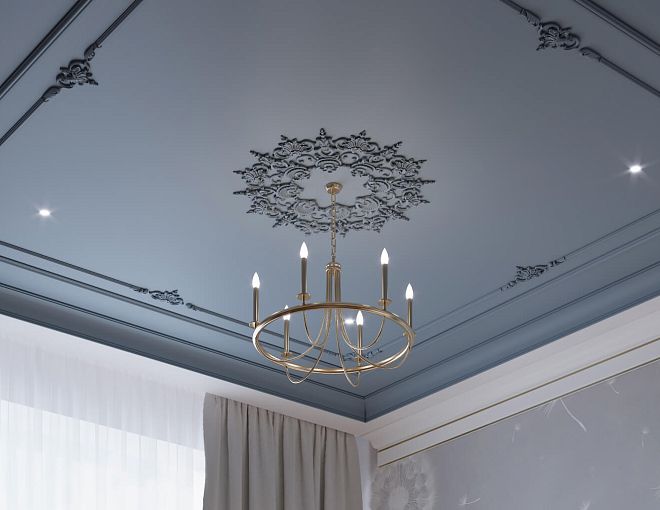
Ceiling rosettes combined with wall frames made of moldings are another way to create a vertical axis. A rosette on the ceiling strictly above the center of the wall behind the sofa creates an imaginary vertical line that "holds" the entire wall composition.
ceiling decorand wall decor in STAVROS are selected by collections precisely with this logic: the elements are designed as a system, not as separate products.
Wall preparation and installation: fundamentals that cannot be ignored
Installationpolyurethane molding decoration— a procedure that seems simple but has several critically important nuances. Ignoring any of them gives a predictable result: after six months, the decor begins to peel off the wall.
Surface preparation
The wall must be:
-
dry — no residual moisture from recent repairs or leaks;
-
clean — free of dust, oil stains, remnants of old wallpaper;
-
Primed — the primer creates an adhesive layer for the mounting glue. Without primer, the glue seeps into the porous surface and fails to provide the necessary adhesion.
If the wall is painted with oil-based paint, it needs to be sanded before installation. A smooth oil-painted surface prevents the glue from "grabbing."
Marking
Before installation — mark the wall with a pencil or painter's tape. All frames, all horizontal rods, all vertical moldings are marked strictly by level. A bubble level is a mandatory tool. A laser level is even better: it provides perfectly straight horizontals across the entire length of the wall.
Cutting and joining
Moldings made of polyurethaneare cut with a miter saw at the required angle. For frame corners — 45°. For straight joints — 90°. Polyurethane cuts easily and cleanly, without chipping — unlike gypsum, which requires special tools and experience.
Joints in corners are sealed with acrylic sealant after installation and painted. With proper sealing, the joints become invisible.
Adhesive and fixation
Mounting glue for polyurethane is applied in a zigzag line to the back of the product. For long moldings — additional glue dots every 30–40 cm. The element is applied to the wall, pressed, and held for 1–2 minutes. Excess glue is immediately removed with a damp cloth.
Heavy elements are additionally secured with mounting nails or screws, which are later puttied and painted over.
Where to buy polyurethane wall moldings
STAVROS — manufacturer of architectural decor for interiors and facades. Full range of elements for wall decor, structured by collections and categories.
Buy wall molding — in the "Wall Decor" section: collections for neoclassicism, classic, modern interior, japandi. Ready-made solutions with matched compatible elements.
Buy polyurethane wall decor— a full range of wall decorative elements for any style and any room.
Buy Molded Decoration— ornamental overlays, rosettes, cartouches, corner inserts for frames, medallions, and ornamental fragments for wall compositions.
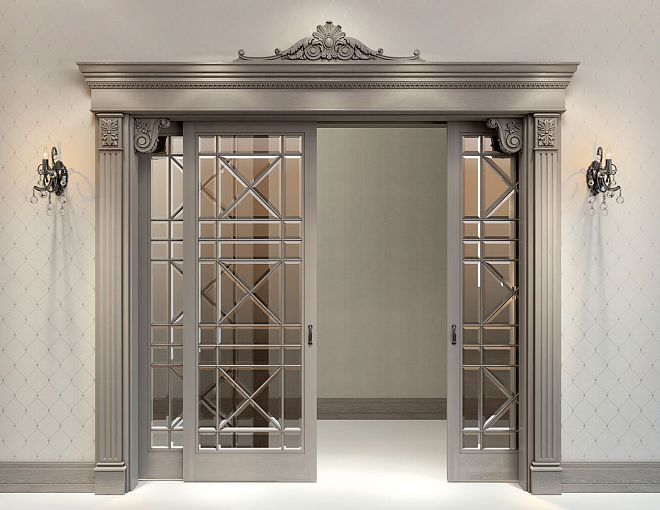
Buy polyurethane wall moldings— profile rods with filtering by width, profile height, and style direction. For frames, horizontal belts, vertical rods, and door frames.
FAQ: popular questions about wall stucco
Can stucco be installed on walls with wallpaper?
It's better not to. Wallpaper is an unreliable base for mounting glue: when the glue dries, the wallpaper may peel off the wall along with the stucco. The optimal base is a painted wall with acrylic primer.
How much does polyurethane stucco weigh compared to plaster?
3–5 times lighter. A polyurethane rosette with a diameter of 400 mm weighs 300–400 g. A plaster analog weighs 1.5–2 kg. That's why polyurethane is installed without anchor fastening.
Should polyurethane stucco be painted before or after installation?
Both options are acceptable. It is more convenient to paint after installation: then the joint between the molding and the wall is painted with a single layer without borders.
How to choose the size of the molding for creating frames?
Principle of proportions: the height of the molding profile is 1/50 of the ceiling height. For a ceiling of 2.7 m — a profile of 54 mm. For 3 m — 60 mm. For 3.5 m — 70 mm.
Can moldings of different widths be combined on one wall?
Yes, but carefully. Different profiles create different 'levels' of decor: a wide one for the main horizontal line or frame, a narrow one for details inside the frame. If the width ratio exceeds 1:2, the contrast is too noticeable.
What to do if the molding starts to come off the wall?
The reason is insufficient adhesive adhesion or a damp wall. Remove the element, sand and dust the surface, apply primer, after drying — reinstall with fresh glue.
How to choose a color for stucco on the wall?
Rule of three options: 1) tone-on-tone with the wall — relief without contrast; 2) 2–3 shades lighter than the wall — soft contrast; 3) white/cream on a dark wall — pronounced contrast. The fourth option — metallic patination (gold, bronze) — only for classic style.
Are there ready-made kits for wall decoration?
STAVROS collections are essentially ready-made sets: in each collection, all elements (moldings, overlays, corner inserts, cornices, rosettes) are designed as a compatible system. This greatly simplifies selection and eliminates style conflict between elements.


