Article Contents:
- Why painting-ready MDF is not a compromise, but a distinct choice
- Construction: what's inside a painting-ready slatted panel
- Rigid Panel on MDF Backing
- Flexible fabric-based panel for painting
- Slat profile: three images of one surface
- Rectangular profile: strictness and architectural graphics
- Semicircular profile: softness without saccharinity
- Trapezoidal profile: active relief
- Color as a tool: what painting-ready slatted panels can do
- Monochrome: relief through shadow only
- Accent color: panel as the main object
- Tonal combination: slats slightly darker than the wall
- Two-tone systems: slats and backing in different tones
- Color scenarios by interior styles
- Minimalism
- Japandi
- Neoclassicism
- Modern classicism
- Loft
- Office and commercial spaces
- Application in Residential and Commercial Interiors
- Living Room
- Bedroom
- Entry Hall
- Office
- Children's room
- Kitchen and kitchen island
- Restaurant and cafe
- Office and meeting room
- Finishing system: how paintable slat panels work in combination
- Technical Parameters: What to Check When Choosing
- Painting MDF slatted panels: what is important to know
- Mistakes to Avoid
- Installation of slatted panels for painting: key points
- Choosing slatted panels for painting in the STAVROS catalog
- About the Company STAVROS
- FAQ: Answers to Popular Questions

There are things that seem simple — until you start looking into them. A slatted panel for painting is exactly like that. On the outside — a few slats on a backing. On the inside — a well-thought-out structural system that, with the right choice of color, profile, and lighting, turns an ordinary wall into an architectural object. And without extra money, without complicated installation, and without the need to hire a famous designer.
Why specifically for painting, and not for natural oak? Because oak speaks with its own voice — living, natural, warm. And MDF for painting remains silent until you give it a voice yourself: white, anthracite, olive, smoky gray, powdery. This material does not impose a style — it accepts it. It is precisely in this plasticity that its main value lies.slatted panels for painting.
The article is written for those who are already looking towards slatted panels and want to understand: what exactly to choose from, how not to make a mistake with color, profile, and application, and why MDF for painting is not a 'budget option', but a full-fledged design solution with its own logic and advantages.

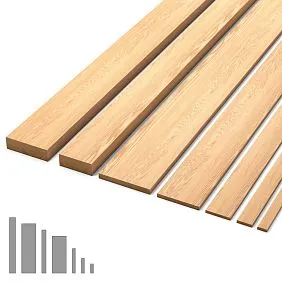
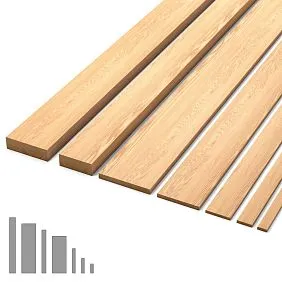

Why MDF for painting is not a compromise, but a separate choice
Let's start the conversation about the material with a truth that is not always spoken out loud. MDF for painting is often perceived as a 'second choice' after natural wood. As if oak is good, and MDF is for when you don't have enough money. This is a misconception that should be dispelled immediately.
MDF with a density of 750–850 kg/m³ is a material with defined, controlled properties. Its structure is homogeneous from edge to edge: no knots, resin pockets, fibrous protrusions, or directional anisotropy. The surface after sanding is an ideal plane with a roughness Ra of no more than 1.6 µm. This is precisely what makes MDF an ideal material for painting: the paint lays evenly, without 'revealing' the subsurface structure, without absorption into areas with different density.
Oak is an excellent material. But it has its own voice: the fiber texture, natural color, natural variation from slat to slat. This voice cannot be silenced by painting — under white paint, oak will 'show through' in the texture, which some like and others find distracting. If you need a pure color without a textural undertone — paintable MDF is the only correct choice.
The second fundamental advantage: precise color reproducibility. A professional interior project often works with an agreed palette: a specific RAL, a specific NCS. Paintable MDF allows you to achieve this color exactly — from the first panel to the last, from the first batch to the next. Oak does not provide such precision: natural variation means that the same tinting composition yields a slightly different shade in different slats.
The third advantage is future flexibility.Paintable lath panelsIt can be repainted without dismantling: update the color for a new concept, refresh the coating after a few years, change the interior solution. For commercial objects that change their design for rebranding — this is a practically important property.




Construction: what's inside a paintable slatted panel
Understanding the construction means understanding exactly how the product works and what mistakes to avoid.
Our factory also produces:


Rigid panel on MDF backing
Classic solution: MDF slats are fixed to an MDF backing with adhesive and mechanical fasteners with factory precision of spacing. The panel is absolutely flat, rigid, with a geometrically precise structure.
This solution is for flat surfaces: walls, furniture fronts, partitions, niche fronts. Here, rigidity is not a limitation but an advantage: the flat backing ensures perfectly even adhesion to the wall, seamless joining of modules, precise horizontality and verticality of the slats.
Seamless joining is a key quality parameter. With correctly maintained factory spacing, the slats of one module continue without offset into the slats of the adjacent one. The wall is perceived as a monolithic surface. This is a property of the construction, not the installer's skill — therefore, the factory precision of the manufacturer is critical here.
Get Consultation
Flexible paintable panel on a fabric base
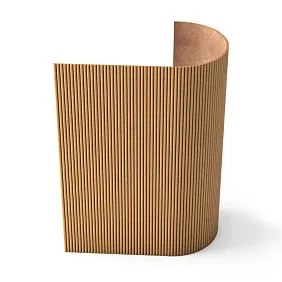
Innovative design for curved surfaces: battens are fixed on a fabric mesh base, which allows the module to bend without deformation of the battens. The flexible batten panel for painting wraps around columns, arched spans, rounded corners — with a radius from 100–150 mm.
Critically important: MDF for painting works here exactly as on a flat surface. The RAL color on a curved column is the same as on a straight wall. The geometry of the batten is preserved. The pattern flows through the curvature without interruption.
Batten profile: three images of one surface
Choosing a profile is choosing the character of the wall. The same color with a different profile will yield a different result.
Rectangular profile: strictness and architectural graphics
The sharp edges of a rectangular batten create clear linear shadows under any side lighting. The surface is strict, disciplined, with almost architectural precision. No softness, no organic feel — only geometry.
Batten panels for painting with a rectangular profile — a choice for minimalism, studies, meeting rooms, office spaces, lofts, neoclassicism in a black-and-white interpretation. A white rectangular profile on a white wall is one of the most sophisticated minimalist solutions: the relief is perceived only through shadow, the color dissolves into the surface.
Semicircular profile: softness without sweetness
Rounded edges diffuse light along an arc — without sharp shadows, without rigid graphics. The surface is warm, plastic, with an organic character — even with a geometrically precise rectangular pattern spacing.
Batten panels made of semicircular battens for painting — the right choice for living spaces with a cozy atmosphere. A white or cream bedroom with semicircular battens is a fundamentally different image than the same bedroom with a rectangular profile. Softer, warmer, more natural — with the same material and the same color.
Trapezoidal profile: active relief
The section expanding towards the substrate creates a more pronounced, voluminous relief. The shadow is complex, multi-layered. The surface is dynamic.
Trapezoidal profile for painting — for commercial spaces with pronounced decorative intensity: restaurant halls, showrooms, lobbies. Where an accent with character is needed.
Color as a tool: what a paintable slatted panel can do
This is the main theme. Because it is precisely color that transforms paintable slatted panels from a technical product into a design tool.
Monochrome: relief only through shadow
The panel is painted the same color as the wall. No contrast — only relief. The eye distinguishes the rhythm of the slats exclusively through the play of light and shadow. With frontal lighting, the surface is almost uniform. With side lighting — the surface comes to life.
This is one of the most sophisticated and professional interior techniques. Maximum effect with minimal color. Monochrome white paintable slatted panels in a white interior — the most popular monochrome scenario. Purity and depth simultaneously.
Accent color: panel as the main object
Walls — neutral. Slatted panel — in a deep saturated color. This works opposite to monochrome: the panel comes to the foreground, becomes the semantic center of the space.
Anthracite behind the TV in a white living room. Dark green (Bottle Green) behind the bed in a neutral bedroom. Terracotta in a hallway with white walls. Each of these scenarios is a strong visual accent achieved with a single surface.
Tonal combination: slats slightly darker than the wall
An intermediate option between monochrome and accent. Wall — light gray. Panel — medium gray. Or wall — off-white, panel — soft warm greige. The relief is perceived through both color and shadow. The look is restrained, mature, professional.
Two-color systems: slats and backing in different tones
Slats — in one color, the backing visible in the gaps — in another. This creates an optical effect of depth: the gaps between the slats are perceived not as voids, but as dark (or colored) planes. The surface gains an additional dimension.
White slats on a black backing — a maximally graphic, almost print-like look. Gray slats on a dark blue backing — an unexpectedly nautical character. Beige slats on dark terracotta — warm, earthy, natural depth.
Color scenarios by interior styles
MDF slatted panels for painting are one of the most stylistically versatile materials. Here's how they work in specific styles.
Minimalism
White or light gray monochrome. Rectangular profile. Minimal gap between slats. The entire effect is created by light and shadow. Nothing superfluous.
In minimalism, paintable slatted panels often replace wallpaper and decor: a single surface carries all the decorative weight. This is a fundamental technique: fewer elements — more impact from each.
Japandi
Soft neutral tone — baked milk, light linen, pale sage. Horizontal installation — for calm natural linearity. Semi-circular or thin rectangular profile. Space between slats — moderate. No tension.
Japandi — a style where 'soft paintable slat panels' in a neutral tone work as meditation in material.
Neoclassicism
Warm neutral tone: cream, sandy, soft gray-beige. Rectangular profile with classic proportions. Molding along the upper perimeter fromwooden trim— a horizontal 'lid' completing the slatted surface.wooden moldingpainted to match the panel tone creates an architectural system that reproduces the logic of classic wooden panels without literally reproducing historical forms.
Modern classic
Two-tone solution: slats — in a light tone, backing — in a dark tone. Rectangular profile. Moldings around the perimeter. Strict proportions. This is a modern version of palace panel systems — without stucco, without gilding, but with the same architectural logic.
Loft
Dark tone: anthracite, graphite, charcoal black. Aggressive rectangular profile. Large spacing. Metal fixtures with exposed bulbs. Paintable slat panel in a loft — not a decorative element, but a structural accent. Dark, brutal, confident.
Office and commercial spaces
Corporate RAL — precisely in the brand's corporate color. Paintable slat panels in the office: reception, meeting room, lounge area. This is branding through architecture — without prints, banners, or stickers. The surface speaks the company's color.
Application in residential and commercial interiors
Living Room
Accent wall behind the sofa or TV zone — the main scenarios. In a white interior, white paintable slat panels on the TV wall create depth without color overload. An anthracite panel behind the sofa in a neutral living room — a strong accent that changes the entire space with one decision.
Bedroom
Headboard wall. This is the most delicate scenario. The color should not excite—it should calm. Soft sage, smoky blue, lavender, warm gray. A semicircular profile for organic soft chiaroscuro. An LED strip along the lower perimeter of the panel provides soft diffused light that accentuates the relief.
Entryway
The first and most honest point. A paintable slatted panel in the hallway is an architectural signal about the character of the entire interior. A dark tone on the end wall 'stops' an overly deep perspective. A light tone on the side wall increases the width of a narrow corridor. Horizontal slats are the most effective technique for visual expansion.
Office
Anthracite, dark blue, bottle green. Rectangular profile. This is a space of status and concentration. A paintable slatted panel behind the desk simultaneously creates a professional background for video calls and partially reduces acoustic reverberation—which is critical for a workspace.
Children's room
MDF for painting with non-toxic water-based enamels. Pastels for younger ages, more active tones for teenagers. Semicircular profile—without sharp edges. Here, paintable slatted panels are especially convenient: the child has grown, preferences have changed—repaint without dismantling.
Kitchen and kitchen island
Slatted facade of the island or lower part of kitchen cabinets. MDF for painting allows matching the exact kitchen color—coordinated with the facades, countertop, and backsplash. Horizontal installation on the lower part of the island visually 'stretches' it in length.
Restaurant and cafe
Paintable slatted panels in the establishment's corporate color—this is branded architecture. Dark green, terracotta, deep blue. Vertical rhythm creates atmosphere. Acoustic effect reduces reverberation in the hall.
Office and meeting room
Branded RAL on the reception desk, accent wall behind the meeting table, facade of a zoning partition. A paintable slatted surface is not just a finish. It is a tangible expression of the company's identity.
Finishing system: how paintable slatted panels work as a complex
A slatted panel is part of a system. And it is the system that determines the final quality.
Molding along the upper perimeter. A horizontal strip above the slatted panel completes the textured surface. Without molding, the panel 'breaks off' into a smooth wall. Withwooden moldingpainted the same color — a complete architectural system. In neoclassicism, molding is mandatory. In minimalism — optional, but architecturally precise.
Paintable skirting board.Baseboard MDFin the tone of the slatted panel — the lower horizontal frame, completing the vertical axis of the wall. White slatted panel + white MDF skirting board: a clean, unified, architecturally refined surface.buy MDF skirting boardpainted in the same production standard — means obtaining a coordinated finishing system from floor to cornice.
Concealed doors. A door leaf with paintable slatted panels in the tone of the main slatted wall 'disappears' into the surface. The pattern of the slats continues across the door — the wall remains monolithic even with a functional opening. This is one of the strongest and most professional techniques with paintable slatted panels.
Furniture fronts. Paintable slatted cabinet fronts in the tone of the wall panels — the furniture dissolves into the architecture. A built-in wardrobe becomes an architectural object, not 'a piece of furniture placed against a wall'.Furniture Handlesmade of metal in a contrasting tone — the only accent that 'reveals' the furniture against the unified surface.
Lighting. Directional spotlights with a side angle create sculptural shadows on the relief of rectangular slats. LED strip along the top or bottom perimeter provides a soft halo. Recessed lights in the gaps offer architectural backlighting from inside the panel. For paintable panels, lighting is planned simultaneously with color selection: dark color + warm light, light color + neutral or cool light.
Wooden skirting in a classic space. If the slatted panel is paintable and accent, while the rest of the room is in wood —Wooden baseboardpreserves the natural character of the room.wooden skirting board purchasesolid wood in a natural tone next to a white slatted panel creates a contrast between the natural and the geometrically precise, which works in modern classic and organic minimalism.
Technical parameters: what to check when choosing
Before purchasing paintable MDF slatted panels — seven parameters to clarify.
-
MDF substrate density — not less than 750 kg/m³. Loose MDF holds fasteners worse and is less stable under humidity fluctuations.
-
Density of MDF slats — same requirements. Thin slats made of loose MDF mean fragility and risk of cracks during installation.
-
Accuracy of slat spacing — deviation no more than 0.5 mm. This is critical for seamless module joining.
-
Quality of surface sanding — the slat surface should be ready for painting without additional priming from scratch. Check by hand: surface is uniform, without waves or transitions.
-
Edge treatment — MDF edges are hygroscopic. Edges must be sealed (primed or covered with film) at the factory. Open edges absorb moisture and swell.
-
Primer layer availability — some manufacturers supply MDF panels with a thin primer layer already applied, ready for final painting. Clarify: this saves time and material during painting.
-
Module size — standard or custom. Important for non-standard openings.
Painting MDF slatted panels: what's important to know
Correct painting technology is half the result. MDF for painting is not the same as painting drywall or plastered walls.
Priming the edges — mandatory. MDF edges are hygroscopic: without priming, they absorb paint unevenly and can swell. Special primer for MDF edges (shellac or acrylic) is applied in 2–3 coats with intermediate drying.
Priming the face surface. Professional MDF primer evens out absorption, creating a uniform base for the finish coat. Without primer, paint applies unevenly, consumption increases, and color appears 'muddy'.
Paint — only by spraying. The best result on MDF slatted panels is achieved only with pneumatic or airless spraying. Using a roller on installed slats — almost never good: gaps between slats don't get painted evenly. The correct option: painting before installation in the workshop, or removed modules vertically in a spray booth.
Acrylic or polyurethane enamels. For residential spaces — water-based acrylic. Eco-friendly, dries quickly, minimal odor. For commercial spaces with high traffic — two-component polyurethane. Abrasion resistance is significantly higher.
Number of coats. Minimum: 1 primer + 2 finish coats. Optimum: 1 primer + 3 finish coats with interlayer sanding using P400 abrasive. Intermediate sanding ensures adhesion of the subsequent layer and eliminates micro-irregularities.
Mistakes to avoid
Buying panels for painting without checking MDF density. Cheap MDF with density of 650–700 kg/m³ absorbs paint unevenly, holds fasteners worse, and may delaminate at the edges. Saving on material will result in rework.
Painting after installation with a roller. A classic mistake. Gaps between slats remain unpainted, coating applies unevenly. Result — a 'homemade look' instead of professional. Panels are painted before installation.
Ungrounded edges. Exposed MDF edges are an entry point for moisture. After a month or two, edges swell, detach from the substrate, creating a 'delamination' effect. Edge priming is a mandatory step.
Too dark a color in a small room. A dark slatted panel for painting in a small space compresses the room. For small rooms — light tones or monochrome with a moderate profile.
Uncoordinated baseboard. White slatted panel for painting + brown wooden baseboard — not a mistake in itself, but requires justification. White MDF baseboard for painting creates a system.with a classic profile creates a sense of solidity, reliability.in a natural tone next to a white slatted panel — this is an intentional contrast that must be skillfully used.
Frontal lighting. Slatted relief is not visible under frontal uniform light. Side, directional, or diffused light is a mandatory condition for the panel to 'work' visually.
Installation of slatted panels for painting: key points
Installation is not difficult — but there are rules, violating which yields a poor result.
Base:
-
Clean, dry, degreased;
-
Variation not exceeding 3–5 mm — adhesive installation;
-
More than 5 mm — frame installation on metal profiles;
-
Drywall — mandatory priming before applying adhesive.
Adhesive installation: mounting adhesive is applied in a zigzag or dotted pattern on the substrate. The panel is pressed and held for 5–10 minutes until it sets. For reliability — finishing nails along the top and bottom perimeter in inconspicuous places.
Frame installation: metal profiles on the wall with a spacing of 400–600 mm. Panels are fastened with self-tapping screws through the substrate into the profile. The plane is leveled independently of the wall curvature. A gap can be created for hidden wiring or sound-absorbing material.
Joining: modules are joined butt-to-butt. No gaps, no masking strips. The slat pattern continues without offset with the correct factory spacing.
Important: install panels 24–48 hours before final painting. This allows for treating joints and eliminating any minor connection irregularities before applying paint.
Selection of paintable slatted panels in the STAVROS catalog
The catalog is presented on the pageSTAVROS slatted panelsRigid MDF-backed modules, flexible fabric-based panels, panels made of semi-round battens — all in MDF finish for painting.
To create a finishing system, I recommend also considering:
-
wooden moldingMDF for painting — for the top finishing of the slatted panel;
-
Wooden baseboard— if you combine a paintable slatted panel with natural wooden elements;
-
Furniture Handles— for paintable slatted furniture fronts.
About the company STAVROS
Perfect flatness, precise spacing, uniform paint coverage without 'sinking' at the ends — this is not a given. It's the result of production discipline.
STAVROS is a Russian manufacturer of MDF and solid wood products for interior finishing and furniture production. Full production program: slatted panels (rigid and flexible), millwork — moldings, baseboards, cornices, casings, decorative overlays, hardware. Over 4000 models, 20,000 modifications, 39 product groups.
STAVROS production standards: MDF from European factories with a density of 750–850 kg/m³, wood drying to normative humidity, control of slat spacing accuracy in each batch, two-level quality system (Standard and Prestige), manual processing of decorative elements.
Shipment from one piece. Delivery across all of Russia. Professional consultation on selection — before placing an order.
FAQ: Answers to popular questions
How does an MDF slatted panel for painting differ from an oak slatted panel?
MDF for painting provides an exact color according to any RAL/NCS without natural texture variation. Oak has a living wood grain pattern, the tactile feel of natural material, and a limited range of tints. The choice depends on the task: color freedom and monochrome — MDF; natural expressiveness — oak.
Can MDF slatted panels be painted after installation?
A professional result is only possible when painting before installation (in a spray booth). Painting after installation with a roller will inevitably lead to unevenness in the gaps. If painting after installation is necessary — only by spraying, with thorough protection of adjacent surfaces.
What paint should I choose for MDF slatted panels?
For residential spaces — water-based acrylic enamel (matte or satin). For commercial facilities with high traffic — two-component polyurethane. Essential: preliminary priming of the MDF surface and edges.
How to calculate the number of panels for painting for a wall?
Wall area (width × height) ÷ area of one module. Round the result up. Add 10–15% for trimming at edges, corners, and window openings.
Do MDF panels need additional priming before painting?
Yes, it is essential — especially the edges. Special MDF primer (acrylic or shellac-based) is applied in 2–3 coats. The face surface — 1–2 coats of primer before the finish paint.
Can MDF slatted panels be repainted a different color after several years?
Yes — and this is one of the key advantages of paintable MDF. Light sanding of the old coating, priming, applying the new color. Without dismantling, without replacing panels.
Which slat profile to choose for a white slatted panel in a bedroom?
Semi-circular — for soft organic light and shadow, a warm cozy look. Rectangular — if a more strict, geometric surface is needed. In a bedroom, the semi-circular profile is more often chosen.