








































































Article Contents:
- Why painting-ready solutions offer more freedom
- Advantages of MDF as a painting base
- Which slatted panels are suitable for painting
- By slat orientation
- By width and spacing
- By slat profile
- By surface preparation
- Polyurethane wall moldings: architectural graphics in service of interior design
- Types of polyurethane moldings by cross-section shape
- Polyurethane ceiling molding: ceiling-wall transition
- How moldings create architectural wall division
- Molding frame panels: 'boiserie' without historical quotation
- Combination of molding frames and slatted panels on one wall
- Color scenarios: monochrome, contrast, tone-on-tone
- Monochrome: when color is the only thing
- Contrast: maximum graphics
- Tone-on-tone: nuanced color
- Color block: accent slatted wall
- Design approach for apartments, offices and commercial spaces
- Apartment: balance of coziness and architecture
- Office: Architecture of Efficiency
- Commercial Spaces: Restaurant, Hotel, Showroom
- Common Mistakes in Painting and Installation
- Mistake 1: Painting MDF Without Primer on Edges
- Mistake 2: One Coat of Paint on Slatted Field
- Mistake 3: Molding Frames 'Not Level'
- Mistake 4: Silicone-Based Adhesive Under Molding
- Mistake 5: Slatted Field Without Perimeter Finish Molding
- Mistake 6: Mismatch in Scale of Molding and Slats
- Mistake 7: Acclimatization of Slats Ignored
- Five ready-made concepts: slats + moldings in different styles
- Concept 'White Cabinet'
- Concept 'Dark Hall'
- Concept 'Green Living Room'
- Concept 'Loft with Frames'
- Concept 'Classic Apartments'
- FAQ: Answers to Popular Questions
- What is the difference between MDF moldings and polyurethane moldings?
- Can you paint paintable slat panels after installation?
- How much does it cost to repaint installed slats and moldings?
- Do you need to putty the joints of moldings before painting?
- Can wall slatted panels for painting be installed in a bathroom?
- How to choose the width of molding for frame panels on a wall?
- Conclusion
There are interiors that last one season and then become outdated along with trends. And there are interiors that never become outdated — because they are created not from trends, but from principles. Color, proportion, rhythm, architectural graphics of walls. It is these concepts that stand behind two solutions that, in combination, yield a stunning result:Paintable lath panelsandpolyurethane wall moldings.
Why exactly in combination? Because battens are rhythm, movement, linear dynamics of a surface. Moldings are an architectural 'frame,' geometric division, ornamental boundary. The former 'accelerate' the wall in one direction, the latter 'stop' it, creating cells, panels, accents. Together, they transform an ordinary plastered surface into an authorial statement—without a single expensive material, without imported stone, without designer wallpapers that will go out of style in three years.
And the main thing that makes this combination universal: bothWall slatted panels for painting, andMoldings made of polyurethanecan be painted any color from any catalog. Today — RAL 9010 white. Tomorrow — deep Hunter Green. The day after tomorrow — soft Dusty Rose. You don't change the structure. You only change the color. And you get a different interior.



Why paint-ready solutions offer more freedom
The question sounds simple: why choose a surface 'for painting' if there are panels with a ready-made finish — veneer, eco-veneer, film? The answer lies in the nature of choice and time.
A panel with a ready-made oak veneer looks exactly like 'oak veneer'. Nothing more, nothing less. It cannot be repainted matte anthracite. It cannot be made white like enamel. It cannot be adapted to a new concept in five years — only dismantled and replaced. It's beautiful, but it's a dead end in terms of flexibility.
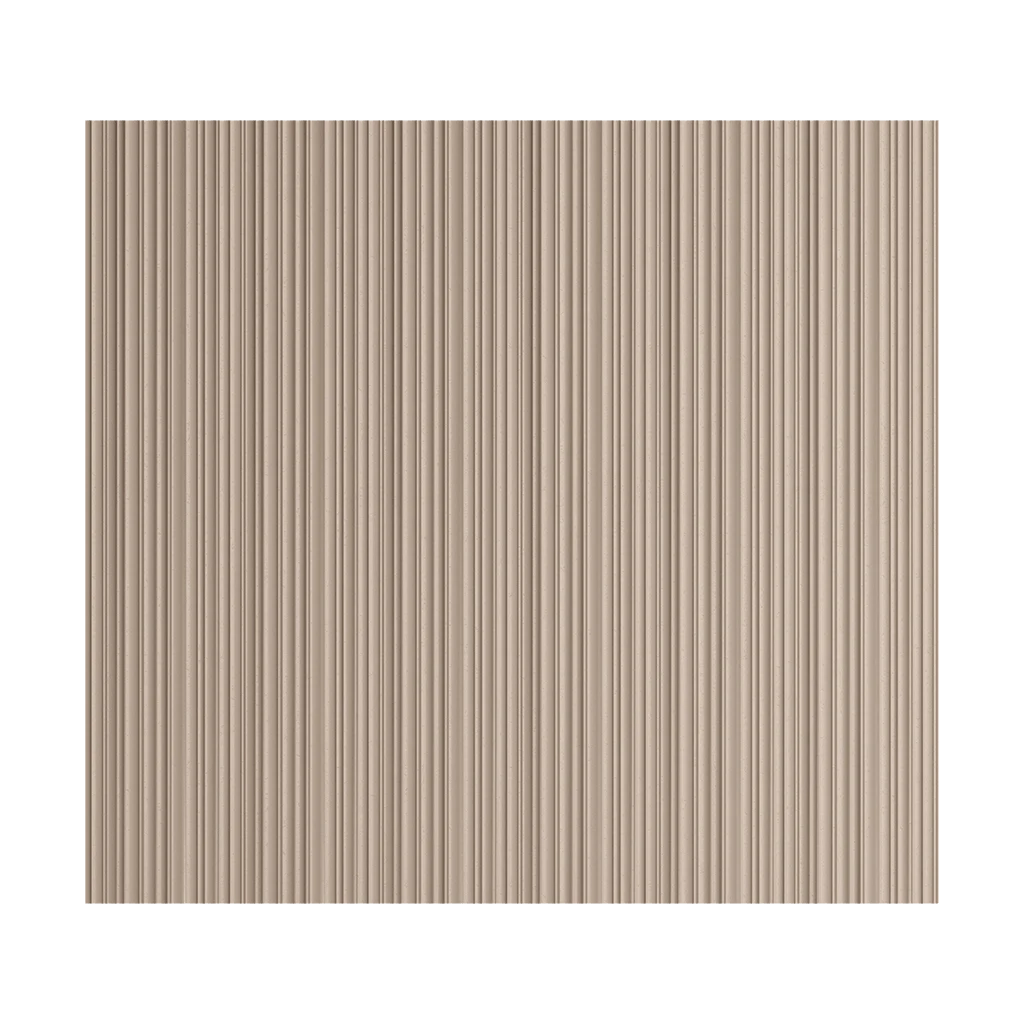
Batten panel for paintingmade of MDF is a pure 'canvas'. It accepts any tint, any paint texture: matte, satin, semi-gloss. It allows combining slats in two colors: some — creamy, others — matching the wall color. It opens possibilities for multi-layered decoration — a base layer of paint, on top — an aging effect, patina, rustic blending.
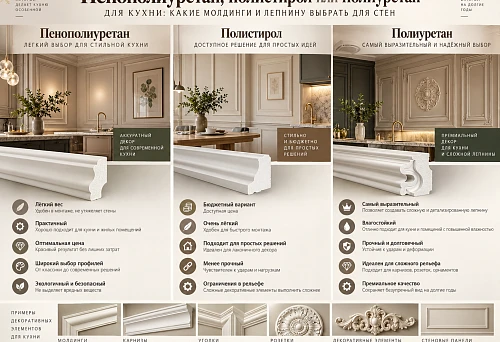
The same principle works forof polyurethane moldingsPolyurethane is easily painted with acrylic paints and holds the coating without special primer (although priming is still recommended). Molding in the wall color is 'invisible' architectural graphics, visible only through shadow. Contrast-colored molding is an accent, a frame, a historical ornament. 'Metallic' molding with decorative paint is a luxurious accent on a minimal budget.
Freedom of color choice is not just aesthetics. It's interior economics: a once-installed system is updated by repainting in one day.




Advantages of MDF as a base for painting
MDF – medium-density fiberboard at 750–850 kg/m³ – has properties that make it an ideal 'canvas':
-
Uniform structure. No knots, cracks, or density variations. Paint applies evenly across the entire surface, without 'spots' or absorption differences.
-
Geometric precision. The dimensions of MDF battens are maintained with a tolerance of ±0.2–0.5 mm. Battens from the same batch are identical, gaps are predictable.
-
Zero deformation with proper end protection. With primed ends, MDF does not absorb moisture or deform under normal living conditions.
-
Ease of milling. Profiled battens – with chamfers, grooves, rounded edges – are milled from MDF with high cutting purity. For comparison: the same from natural wood is significantly more expensive.
Our factory also produces:





Which batten panels are suitable for painting
Here it's important to understand the classification, because 'batten panels for painting' is not one product, but a family of solutions with different parameters.
Get Consultation
By orientation of slats
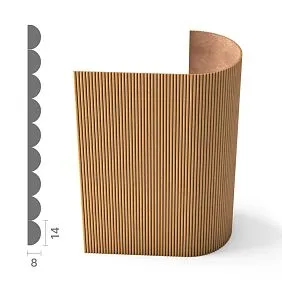
Verticalslatted panels for painting— classic. Vertical rhythm 'lifts' the ceiling, creates dynamics, organizes the wall as a single 'canvas'. For rooms with ceilings below 2.7 m — the most effective technique for 'visual growth'.
Horizontal slats — visually expand the space. For narrow corridors, hallways, elongated kitchens. A horizontal slat 'belt' in the lower third of the wall (90–120 cm) — a modern interpretation of classic wainscoting.
Diagonal systems — a bold architectural solution for accent zones. Slats at 45° create dynamics and 'movement' on the surface. Used pointwise — on one accent wall, not around the entire perimeter.
By width and spacing
| Format | Batten width | Gap | Character |
|---|---|---|---|
| Graphic | 25–35 mm | 10–15 mm | Frequent rhythm, 'hatching' |
| Standard | 40–60 mm | 15–25 mm | Balanced, universal |
| Monumental | 70–100 mm | 25–40 mm | Large scale, high ceilings |
| Wide | 110–150 mm | 40–60 mm | Architectural, commercial scale |
For residential apartments with 2.7 m ceilings — standard format (40–60 mm). For office spaces with 3+ m ceilings — monumental or wide. For small rooms (up to 12 m²) — graphic format with a 10–12 mm gap.
By slat profile
The profile of the slat determines the type of shadows and the overall character of the surface:
-
Rectangular profile — clear edges, sharp shadows, modern graphic quality. For minimalism and loft.
-
Profile with bevels (45°) — chamfered edges soften the shadow, creating 'soft' clarity. A universal profile.
-
Rounded profile — smooth shadows, no sharp edges. For Scandinavian and natural concepts.
-
Decorative profile with grooves — slat with milled ornament. For modern classic and neoclassical styles.
On surface preparation
The best option for painting is slats with factory primer. They come pre-coated with acrylic primer — the surface is even, pores are sealed, MDF fibers are 'flattened'. Finish painting: 1–2 coats of acrylic or latex paint without additional preparation.
Raw slats (without primer) require self-priming in 1–2 coats with intermediate sanding. This is extra work but allows choosing a primer for a specific paint type.
Polyurethane wall moldings: architectural graphics in service of interior design
Let's clarify the terminology, because 'molding' in everyday speech is a broad term. It can refer to a narrow decorative strip 20×15 mm or an elaborate classical cornice 100×80 mm. To understand the task, you need to know which type of molding is being discussed.
polyurethane wall moldingsIn the STAVROS classification, these are decorative trim elements with rectangular, profiled, or ornamental cross-sections, used for dividing walls into 'panels,' creating framed decorative panels, framing architectural details (doors, windows, niches), and forming horizontal 'belts' on walls.
Key properties of polyurethane moldings:
-
Lightweight (3–8 kg/m³ compared to 700–800 kg/m³ for wood) — the element is fixed with adhesive without mechanical fasteners.
-
Water resistance — does not absorb moisture, does not deform.
-
Paintability — accepts any acrylic or latex paint.
-
Flexibility — slight bending allows it to follow minor wall curvatures.
-
Dimensional stability — does not warp with temperature and humidity fluctuations.
Types of polyurethane moldings by cross-sectional shape
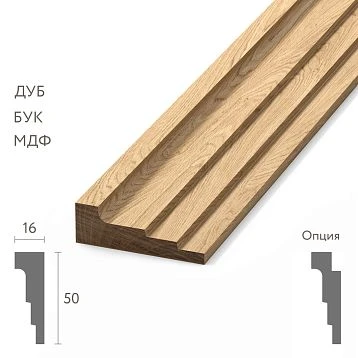
Flat molding — a simple rectangular strip 20–60 mm wide, 8–15 mm high. Used for creating straight-lined framed panels on walls. The most neutral and universal type. In wall color — 'invisible' geometry. In a contrasting color — a clear graphic line.
Profile molding – cross-section with steps, bevels, roundings. Classic profiles: 'straight ogee', 'reverse ogee', 'ovolo', 'cyma reversa'. Each profile creates its own 'shadow': soft or sharp, wide or narrow. For modern interiors – molding with one step. For classic – multi-step profile.
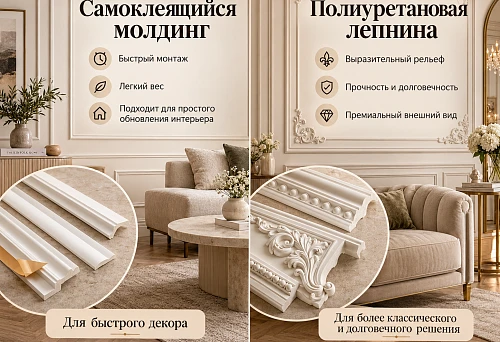
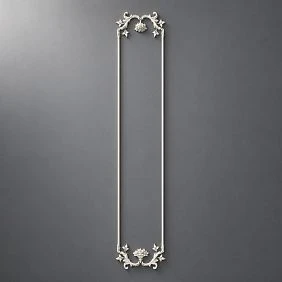
Ornamental molding – with a relief pattern along its entire length. 'Egg and dart', 'meander', 'laurel branch', 'acanthus'. For neoclassical and historical concepts. A striking architectural accent when used to frame doorways or as a horizontal belt course.
Corner molding – cross-section in the shape of a 'checkmark' for internal or external corners. Hides the joints of slat panels in corner areas, ensures a clean transition between two planes.
Ceiling molding made of polyurethane: ceiling–wall transition
A separate and important task is the design of the wall and ceiling joint. Ceiling molding is the most 'noticeable' molding in a room: it runs along the entire perimeter at eye level and forms the 'upper boundary' of the wall.
In slat wall finishing, ceiling molding simultaneously solves three tasks:
-
Hides the upper ends of the slats and their joint with the ceiling
-
Creates an architectural 'frame' for the slat field from above
-
Forms a horizontal 'horizon' above the slat rhythm
Size of ceiling molding for a slat wall: width (height of visible cross-section) = 40–80 mm for a ceiling 2.5–3 m. For a ceiling 3+ m – molding 80–120 mm. A larger molding in a low room visually 'lowers' the ceiling.
Color: With a slatted wall, the ceiling molding is painted to match the ceiling (not the wall) — this visually 'expands' the ceiling plane. Exception: concepts with a monochrome unified surface 'wall + molding + ceiling' in one color.
How moldings create architectural wall division
This is perhaps the most underrated technique for working with moldings. Most people think of them as a 'decorative strip.' But molding is a tool for creating architectural order on a wall.
The classic Western European wall is divided by moldings into three horizontal zones:
Plinth (up to 90–100 cm) — the lower zone, often highlighted with a darker or more saturated color. It is finished with a horizontal molding-'belt'.
Main field (from 90–100 cm to 200–220 cm) — the central zone with framed molding panels. This is where the slatted fields are placed.
Frieze (from 220 cm to the ceiling) — the upper zone, finished with a ceiling molding-cornice.
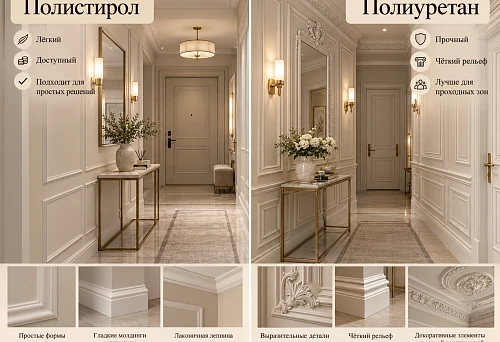
This technique of three-zone division works in any architectural style — from neoclassical to modern eclecticism. It creates 'order' on the wall, a sense of refinement and luxury even when using the most budget-friendly materials.
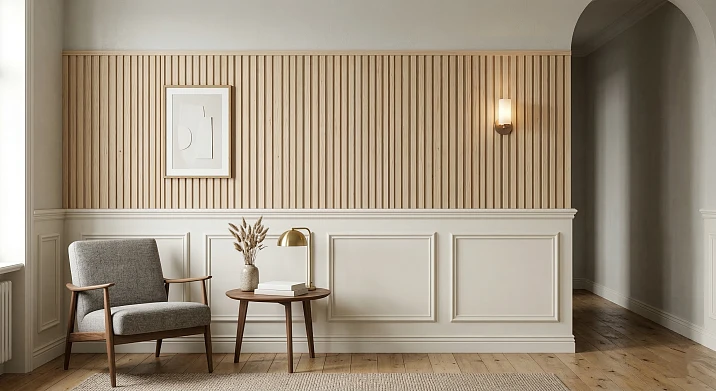
When combined with slatted panels — the slats are placed in the 'main field' between two horizontal molding 'belts'. The lower belt fixes the lower edge of the slatted field, the upper belt + ceiling molding — the upper edge. The slatted 'canvas' is enclosed in an architectural frame.
Framed molding panels: 'boiserie' without historical quotation
Boiserie — classic wooden wall panels with molding framing — were historically used in French palace interiors of the 17th–18th centuries. Today they are adapted for modern apartments, offices, restaurants — with polyurethane moldings instead of wood.
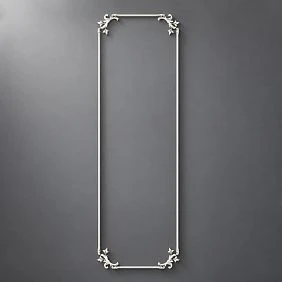
Principle:Moldings made of polyurethaneare mounted as rectangular frames directly on the wall (or over a slatted field). The frame dimensions follow the wall proportions: frame width = 40–60% of the distance between windows, frame height = 55–65% of the wall height in that zone.
The classic 'golden rule': the distance from the frame to the ceiling molding = the distance from the frame to the floor. That is, the wall 'field' not occupied by the frame is the same at the top and bottom. This creates a sense of 'correct' proportions without any additional effort.
Frame panel execution options:
-
Molding in the wall color — an 'invisible' frame, visible only through the profile's shadow. A delicate architectural solution.
-
Molding one shade darker than the wall — nuanced contrast. The frame is clearly 'readable' but doesn't 'shout'.
-
Molding in a contrasting color — white molding on a dark wall, dark molding on a white one. A graphic architectural accent.
-
Molding 'under metal' — decorative paint with a metallic effect (gold, bronze, copper). For luxurious concepts.
Combination of molding frames and slatted panels on one wall
This is the most interesting and complex technique. How to place battens and molding frames on the same surface so they don't compete?
Option 'battens inside the frame': molding frames are mounted on the wall, with a batten mini-field inside each frame. The frame defines a 'cell', and the battens fill it. The batten 'canvas' does not cover the entire wall but exists within architectural 'cells'. A very expressive technique.
Option 'battens below, frames above': the lower third of the wall is vertical batten panels (analogous to wainscoting). The upper part of the wall features molding rectangular frames. A horizontal molding 'belt' separates the lower batten zone from the upper frame zone.
Option 'battens as a background for the frame': the entire wall is covered with a fine batten field (batten 25–30 mm / gap 10 mm) in a monochrome color. Molding frames are placed over the batten field. The frames 'lie' on the batten background, creating an expressive contrast between the rhythm of the battens and the geometry of the frame.
Color scenarios: monochrome, contrast, tone-on-tone
Color is the main 'lever' when working with paintable surfaces. And the main mistake is choosing a color intuitively, without understanding how it interacts with the relief of the battens and moldings.
Monochrome: when color is the only thing
A monochrome solution means all surfaces in the room (walls, battens, moldings, ceiling) are in one color or in close shades of the same tone.
Effect: the relief of the battens and moldings is visible only through shadows—thin, soft, and dependent on the angle of light. In the morning, one play of shadows; in the evening, another. The room changes throughout the day.
Best colors for monochrome with batten panels:
-
RAL 9010 (pure white) — maximum lightness, the architectural 'zero'
-
RAL 9001 (cream white) — warm, natural, 'homely' monochrome
-
RAL 7044 (silk grey) — neutral, 'urban' monochrome
-
RAL 7016 (anthracite) — dark monochrome, space 'recedes' into depth
-
Dulux Perfectly Taupe — beige-grey 'greige', natural monochrome
Contrast: maximum graphic effect
Battens of one color — the wall behind the battens and moldings of another. This is a 'strong' technique that creates visual tension and a clear architectural pattern.
Classic contrasting pairs:
-
White battens / dark blue (Farrow & Ball Hague Blue) wall
-
Black battens / white wall — a 'hatching' effect, maximum graphic
-
Cream battens / deep forest green background (British Racing Green)
-
Gray battens / white wall — soft contrast, "architectural neutrality"
With a contrasting solution, molding frames are painted the color of the battens (not the wall) — they "belong" to the same "team" in the color composition.
Tone-on-tone: nuanced color
Nuanced technique — battens slightly darker or lighter than the wall. Not contrast, not monochrome, but a subtle color difference perceived as "richness" of the surface.
Examples:
-
Wall RAL 9001 (cream white) + battens RAL 1013 (pearl white, slightly warmer)
-
Wall Farrow & Ball Elephant's Breath (gray-beige) + battens of the same base, but 20% darker
-
Wall RAL 7044 (silk gray) + moldings RAL 7035 (light gray)
A nuanced color pair creates a sense of surface depth, "layeredness," which is difficult to convey in words and impossible to achieve with uniform painting without relief.
Color block: accent batten wall
One wall in a saturated color. The other three are white or light. The slat and molding system is on the accent wall.
The '60–30–10' principle in color interior design: 60% neutral base color (walls, ceiling), 30% intermediate color (furniture, textiles), 10% accent color (accent wall with slats and moldings).
Slats on the accent wall: matching the accent color for a 'quiet' architectural texture. Or in white for a 'neutral' rhythm against a saturated background. Moldings match the ceiling (white) or the wall color for a 'quiet' or 'pronounced' architectural solution.
Design approach for apartments, offices, and commercial spaces
Paintable slat panels and moldings are not just a residential solution. It's a system that scales from a bathroom to a retail space.
Apartment: a balance of coziness and architecture
In an apartment, the priority is warmth, coziness, and personal character. Slats and moldings should not 'overwhelm'—they should create a sense of 'lived-in' and thoughtfulness.
Rules for an apartment:
-
Slat field—no more than one or two walls in a room (accent wall + possibly an end wall)
-
Molding frames—on a non-saturated color, without sharp contrasts in the bedroom
-
The height of the slatted field is not 'up to the ceiling', but with a cornice-finishing element
-
Children's room — horizontal slats (psychologically safer, no pressure from vertical lines), pastel colors
Installation of slatted wall panelsIn an apartment, it usually doesn't require complex permits and can be done independently with basic tools.
Office: The Architecture of Efficiency
Office spaces today compete for staff no less than for clients. An environment that is comfortable to work in is a competitive advantage. Slatted panels and moldings create the feeling of a 'luxury' office without expensive renovation.
For the office:
-
Vertical slats in meeting rooms — 'representativeness' of the background wall behind the negotiation table
-
Accent walls in reception areas — the brand's signature color
-
Molding frames in executive offices — 'serious' classical architecture
-
Acoustic slatted panels with felt filling behind the slats — a functional and aesthetic result
Commercial spaces: restaurant, hotel, showroom
In restaurants, cafes, and hotels, slatted walls with moldings are the standard for quality design. The material is durable, can be refreshed with repainting, and creates the desired atmosphere.
For a restaurant:
-
Dark slats (wenge, anthracite) — evoke a feeling of 'evening,' intimacy
-
Light slats with a dark background — 'Mediterranean' or 'Scandinavian' character
-
Molding frames with a custom pattern — branding through architecture
For a showroom:
-
Monochrome white slats — a neutral 'gallery' background for displayed goods
-
Molding sections — zoning of exhibition 'niches'
Common mistakes in painting and installation
Error 1: Painting MDF edges without primer
MDF edges are the most porous part. Without additional edge priming, the paint 'sinks' into the pores, forming dark streaks. It may seem like the slat is 'bad' — in reality, the technology has been violated.
Solution: edges are primed separately, in 2–3 coats, before installation. After installation — final painting.
Error 2: One coat of paint on a slatted field
One coat of paint on slats results in uneven coverage: gaps, varying color density on front and side faces. Especially noticeable with dark colors.
Solution: minimum two coats of paint with intermediate drying (2–3 hours at +20°C). First coat — 'base', thin, to seal the pores. Second — finishing, with full coverage.
Error 3: Molding frames 'not level'
Molding installed without a laser level, 'by eye'. After a month, it becomes noticeable that horizontal moldings are slightly 'tilting'. Especially critical in framed panels: a skewed frame is visible immediately.
Solution: laser level — a mandatory tool when installing molding frames. Marking all four sides of the frame before applying adhesive.
Error 4: Silicone-based adhesive under molding
Using silicone sealant as glue for moldings is a common mistake. Silicone cannot be painted: silicone squeezed into the joint remains a glossy spot after painting.
Solution: use only acrylic sealant (white, paintable) or polyurethane construction adhesive for sealing joints. Silicone is for bathrooms and kitchens in areas potentially exposed to water, but not in visible areas intended for painting.
Mistake 5: Slatted panel without a finishing molding around the perimeter
The slats are installed, but without side, top, and bottom framing molding. The ends of the slats at the walls and ceiling are exposed. The slatted panel looks 'unfinished'.
Solution: finishing moldingceiling moldingat the top, baseboard at the bottom, vertical moldings along the side edges. This is the architectural 'frame' for the slatted 'canvas' — without it, the 'canvas' does not exist.
Mistake 6: Mismatch in scale between the molding and the slats
Narrow slats (30 mm) with thick, monumental molding (80 mm) — a scale conflict. The heavy molding 'crushes' the delicate slatted rhythm.
Scale rule: the visible cross-section width of the molding ≤ double the width of the slat. Slat 35 mm — molding up to 70 mm. Slat 60 mm — molding up to 120 mm.
Mistake 7: Acclimatization of slats ignored
MDF battens were delivered and installed immediately. When room humidity changes, the battens swell slightly—gaps have changed. Where it was 15 mm, it became 12 mm. Where it was 15 mm—it became 18 mm.
Solution: acclimatization for 48–72 hours. MDF stabilizes faster than wood, but a minimum holding period in the room is necessary.
Five ready-made concepts: battens + moldings in different styles
Concept 'White Office'
-
MDF battens: 40 mm / 18 mm gap, vertical, on accent wall (behind the desk)
-
Moldings: flat molding 30 mm in wall color, rectangular frames on two side walls
-
Color: RAL 9010 monochrome throughout the room—walls, battens, moldings, ceiling
-
Baseboard: MDF for painting 80 mm RAL 9010
-
Image: 'White architecture'—relief is visible only through shadows. A calm, focused atmosphere for work.
Concept 'Dark Hall'
-
MDF battens: 55 mm / 20 mm gap, vertical, on three walls
-
Moldings: profile molding 50 mm with offset, horizontal "belt" at 100 cm height around perimeter
-
Color: battens and moldings RAL 7016 anthracite, ceiling RAL 9010 white
-
Accent: warm LED in cornice above battens (2700K)
-
Style: "Nightclub without vulgarity" — dark battens, warm overhead lighting, white ceiling "floats".
Concept "Green Living Room"
-
MDF battens: 35 mm / 12 mm gap, vertical, one accent wall
-
Moldings: flat molding 25 mm, framed panels on three remaining walls
-
Batton color: Farrow & Ball Calke Green (muted green)
-
Molding color: RAL 9001 cream-white
-
Wall color: RAL 9001 cream white
-
Image: Accent green slatted wall against cream-white framed surfaces. Natural color + classic architecture.
Concept: 'Loft with frames'
-
MDF slats: 70 mm / 25 mm gap, horizontal, lower third of the wall (90 cm)
-
Moldings: Ornamental molding 40 mm with 'meander', horizontal 'belt' along the top of the slatted field
-
Color: Slats and moldings RAL 7022 umber (dark gray-brown), wall above — exposed brick or plaster in a matching tone
-
Image: Industrial plinth made of dark horizontal slats with ornamental finishing.
Concept: 'Classic apartments'
-
MDF slats: 45 mm / 20 mm gap, vertical, within the 'fields' of molding frames
-
Moldings: Profiled 60 mm classic profile, frame panels with a 3:5 proportion (width:height)
-
Ceiling molding: 90 mm with two steps, RAL 9001
-
Color: battens RAL 9001, moldings RAL 9001, wall between frames — warm pigeon gray (Dulux Chic Shadow)
-
Style: "Modern Classic" — white classic molding frames on a warm gray background with white vertical battens inside.
FAQ: Answers to popular questions
How do MDF moldings differ from polyurethane moldings?
MDF moldings are denser, sand well, and give a "wooden" feel. They require precise 45° cutting (a miter saw is essential).Moldings made of polyurethane— lighter, more flexible, installed only with adhesive, moisture-resistant. For ceiling installation — polyurethane is more convenient. For wall frame panels — both options work, choice based on preference.
Can you paintslatted panels for paintingafter installation?
Yes. Moreover, a two-step painting process is recommended: 1–2 coats before installation (for even coverage), a final coat after installation (to paint over joints and fasteners). The result is a monolithic painted surface without transitions.
How much does it cost to repaint installed battens and moldings?
Repainting a slatted field of 6–8 m² takes 1–2 working days when done independently. Paint consumption: 300–400 ml per 1 m² of slatted field (more than for a smooth surface due to the relief). The repainting budget is minimal compared to material replacement.
Is it necessary to fill the joints of moldings before painting?
Absolutely. Acrylic sealant is applied to corner joints and connection points of sections. After drying (1–2 hours) — sanding and painting. Unfilled joints 'open up' during painting — and a gap becomes visible through the paint.
Can Wall slatted panels for painting be installed in a bathroom?
Only from moisture-resistant MDF (HMR) with a moisture-protective varnish coating. The ends must be treated with a special edge varnish or primer in 3 layers. Gaps between the slats must allow moisture evaporation. Direct contact with water is excluded.
How to choose the width of molding for frame panels on a wall?
The width of the molding depends on the size of the frame and the height of the ceiling. Guideline: molding width = 1.5–3% of the room height. For a 2.7 m ceiling — molding 40–80 mm. Also: the molding should not be wider than 1/15 of the frame width. For a 600 mm frame — molding up to 40 mm.
Conclusion
Painting-ready slatted panels and polyurethane wall moldings are not two separate products. This is an architectural system where the rhythm of the slats and the geometry of the moldings work as tools of the same language. This language is called 'architectural order on the surface' — and it is precisely what distinguishes a random interior from an authored one.
The main advantage of this system is absolute freedom in color solutions. Today — everything is white, tomorrow — slats in deep green, the day after — a contrasting monochrome pair. The structure remains, only the paint changes. This is the most economically sound investment in an interior: create a high-quality architectural base once — and manage its character with color for many years.
MDF slatted panels for painting— vertical, horizontal, with different profiles and formats — and a complete assortmentof polyurethane moldings— flat, profiled, ornamental, corner, ceiling — are presented in the STAVROS company catalog.
STAVROS is a Russian manufacturer of slat systems and decorative elements with a full production cycle. Own production of factory-primed MDF slats, a wide range of polyurethane moldings and cornices, professional consultation on wall system design and color solutions. For those who create an interior once and for a long time — not "until the next renovation," but as an architectural statement that will outlive any trends.