








































































Article Contents:
- How to choose slatted panels to match the interior style: a breakdown without fluff
- Step one: determine the style — and immediately narrow down the choice
- Step two: the room and its conditions
- Step three: slat parameters
- Polyurethane moldings: when they are needed, and when they are not
- When moldings are necessary
- When moldings are excessive
- Typology of moldings: from simple to complex
- How to combine reiki and frame wall geometry: a practical guide
- Scheme "slatted field in a molding frame"
- Scheme "two-level wall"
- Scheme "vertical division with pilasters"
- Table: moldings for styles and types of rooms
- Where the combination of slats and moldings works best
- Living room: accent wall with molding system
- Study: environment and concentration through architecture
- Corridor with slatted panels and molding belt
- Bedroom headboard: delicate system
- Niches and built-in structures
- What to consider when ordering: a practical checklist
- On slatted panels
- On polyurethane moldings
- On system compatibility
- Polyurethane molding price: what it consists of
- Overloaded finishing mistakes: when more is not better
- First mistake: too many molding frames on one wall
- Second mistake: moldings too large for the room
- Third mistake: mixing profiles of different styles
- Mistake four: slatted panels on all four walls
- Mistake five: different wood tones in one room
- Mistake six: moldings without painting
- Mistake seven: wooden slats without acclimatization when installing in winter
- Delivery to Nizhny Novgorod: what you need to know practically
- About the Company STAVROS
- FAQ: Answers to Popular Questions
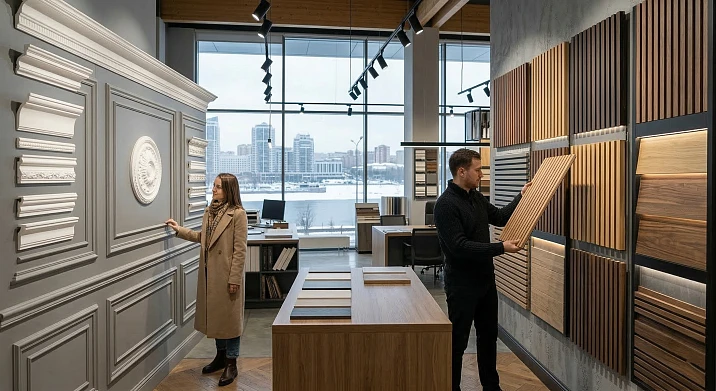
Nizhny Novgorod is a city that knows how to value solidity. Here, historical buildings stand alongside modern residential complexes, and residents clearly understand the difference between finishing 'until the first renovation' and finishing 'for decades'. When a Nizhny Novgorod buyer enters the query 'buy slatted panels in Nizhny Novgorod' — there is a specific task behind it: to create an interior with character, not just cover the walls with whatever is available. And this is where Moldings made of polyurethane comes into play — that architectural tool that turns a set of slats into a complete, visually refined system. Let's examine how these two materials work separately and what happens when they combine in a single project.
How to choose slatted panels for interior style: breakdown without fluff
Talking about choosing slatted panels 'in general' means talking about nothing. The choice is always specific: interior style → room type → material requirements → slat parameters. This is a four-step filter that works flawlessly.

Step one: define the style — and immediately narrow down the choice
Interior style is not a matter of taste; it's a system of constraints that makes material selection manageable. Each style has its own 'slat archetype':
Minimalism. Slats 40–60 mm made of MDF, white or neutral gray enamel, rectangular profile without bevel, gap 10–12 mm, dark backing. No ornaments, no elaborate cornice profiles — only pure rhythm and strict geometry.
Scandinavian style. Light wood — oak or ash in natural or bleached tone, oil finish, slats 50–70 mm. Delicate straight cornice, light moldings. The entire system in a light, airy palette.
Modern classic. Oak with medium-tone oil, slats 60–80 mm, vertical orientation. Cornice with ogee profile 80–100 mm, baseboard with torus, molding frames. White decor contrasts with warm wood — this is the most popular combination.
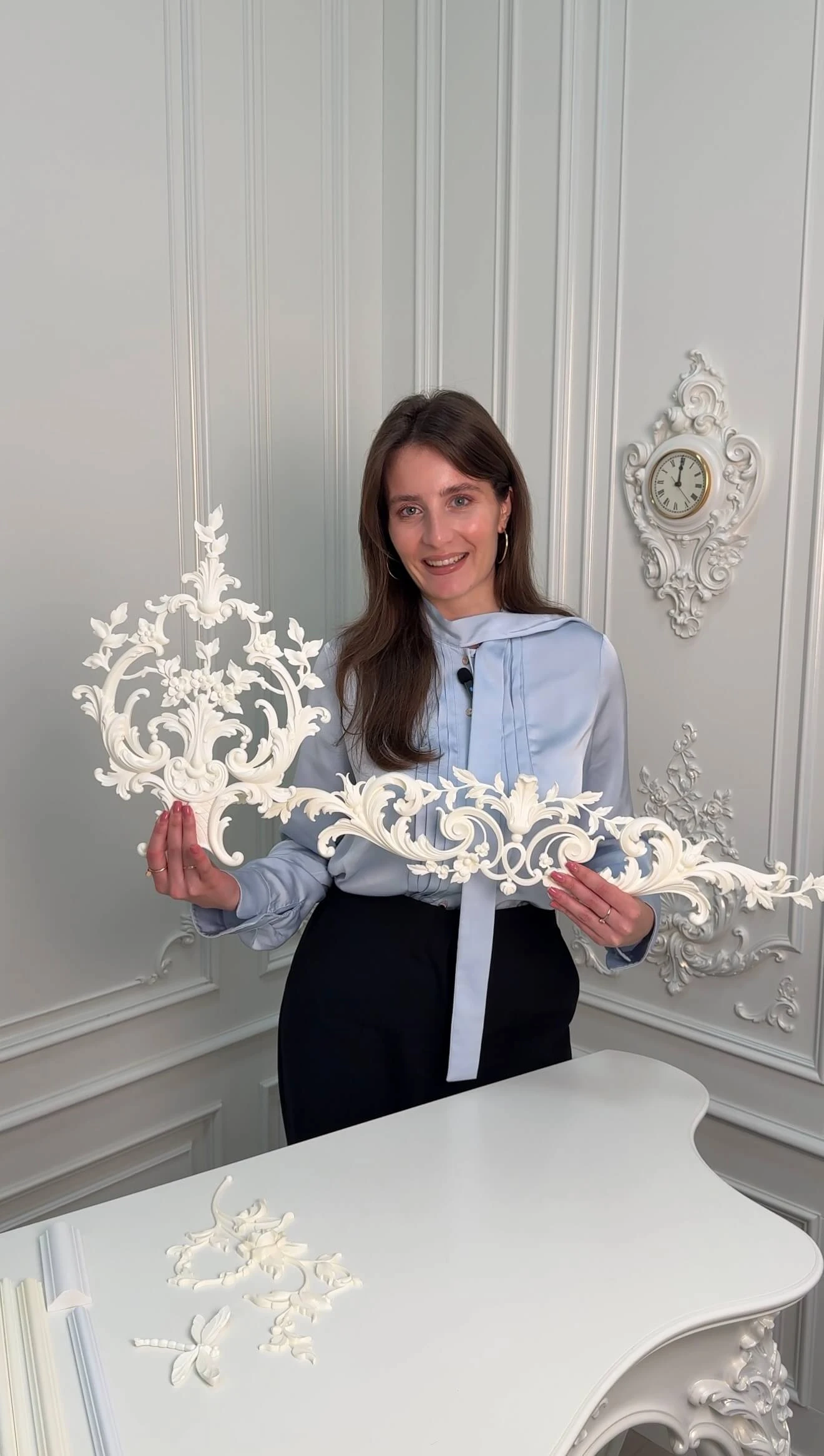
Neoclassical. Slats with bevel or milled profile 70–90 mm, oak or walnut in dark tone.Moldings made of polyurethaneCornice with developed profile (ogee + shelf + torus), horizontal bands, rosettes. A rich architectural system.
Loft. Slats 60–90 mm in dark tone (wenge, graphite, brushed oak), horizontal orientation or vertical without frames. Straight moldings — only basic (cornice + baseboard), without ornamentation.
Country / rustic. Solid wood with knots, aged finish, slats 80–120 mm. Beams on the ceiling. Moldings are restrained, textured — matching the wood tone or terracotta.
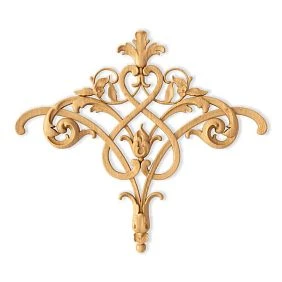
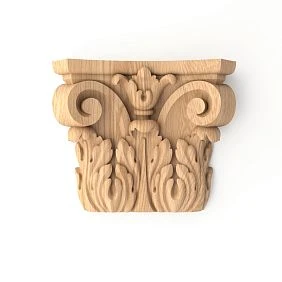
Our factory also produces:

Step two: the room and its conditions
After style — the room. This determines the material requirements.
Living room: standard conditions. Any wood species, any finish, slats 60–80 mm. Accent wall + cornice + baseboard — minimal system.
Bedroom: delicate slats 40–60 mm, neutral warm tone. Oil finish or acrylic enamel without volatile compounds. Not dark tones — the bedroom requires warmth, not gloom.
Hallway: hardwoods (oak, ash), wear-resistant lacquer finish. Slats 30–50 mm vertically to visually expand the space.
Study: dark tones, slats 60–80 mm. Acoustic panel (slats on felt backing) — reduces echo in the workspace.
Kitchen: only MDF with two-component lacquer or moisture-resistant HDF. Areas: wall behind the dining table, side walls. Not near the stove and sink.
Children's room: emission class E0 or E1, water-based oil or acrylic enamel. Light and pastel tones.
Get Consultation
Step three: slat parameters
When style and room are determined — move on to specific parameters.
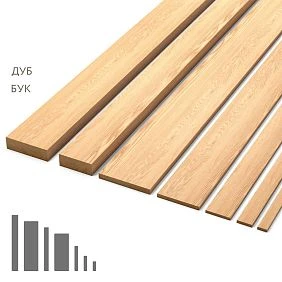
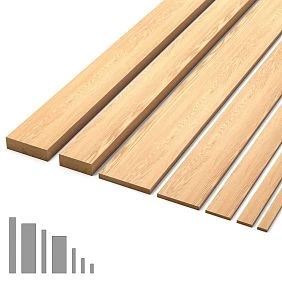
Width. From 25 mm (thin decorative stroke) to 150 mm (monumental cladding). Working range for most living spaces: 40–90 mm.
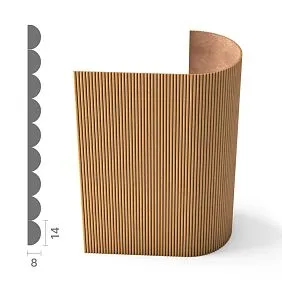
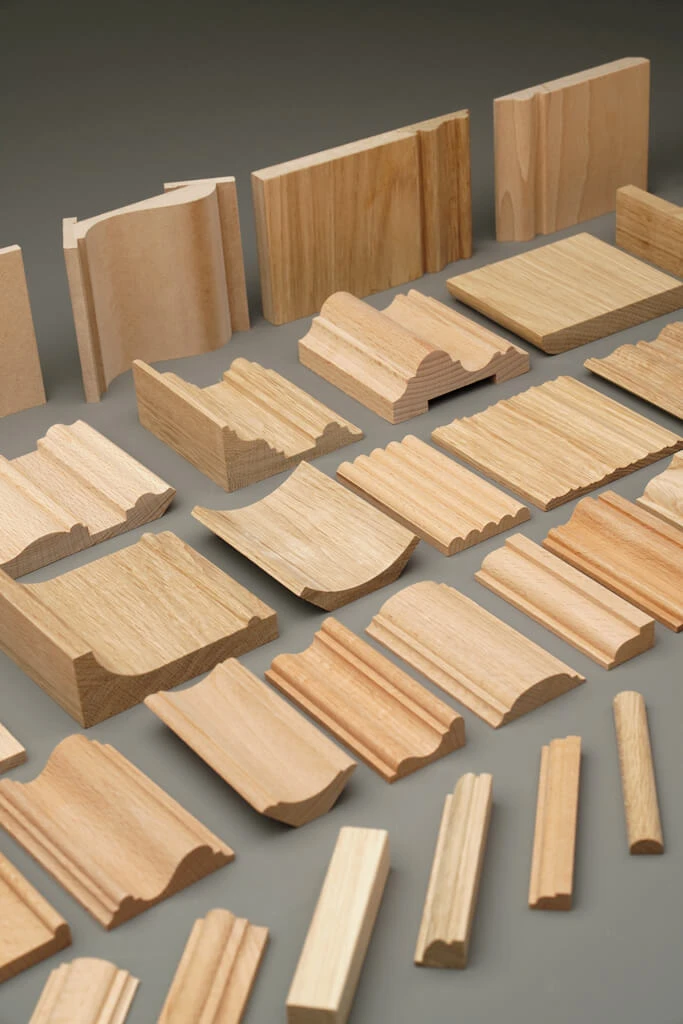
Profile cross-section. Rectangular (modernity), with a chamfer (lightness, movement), semicircular (softness, classicism), trapezoidal (dynamism, deep shadows).
Gap. 8–10 mm — tight 'fabric' effect. 12–15 mm — pronounced rhythm. 18–22 mm — emphasized individuality of each slat, maximum shadow depth.
Length. Standard 2400–3000 mm. With a room height up to 2.7 m — the standard covers the full height with a margin for trimming.
Orientation. Vertical — for most living spaces (lifts the gaze, increases perceived height). Horizontal — for visual expansion of space, for loft style, for horizontal facade systems.
Polyurethane moldings: when they are needed, and when they are not
This is an honest question, and it deserves an honest answer. Moldings are not a mandatory element for every slatted interior. But where they are needed — their absence is acutely felt.
When moldings are necessary
Modern classic and neoclassicism. These are styles where architectural completeness is not an option, but a condition. A slatted wall without a cornice, without a baseboard, without molding frames in a classic interior — it's like a tailcoat without a tie. Technically possible, but the feeling that 'something is wrong' does not leave.
High ceilings (from 2.8 m). With significant height, a wall without molding articulation turns into a monotonous field. Horizontal belts divide it into readable registers — and the space becomes proportionate to a person.
When there is a chandelier on the ceiling. A chandelier mounting point without a rosette is a technical defect visible to everyone. A polyurethane rosette is not a decoration but an architectural necessity.
When a slatted panel does not cover the entire wall. If the panel occupies part of a wall (e.g., a headboard wall without side walls) — a molding frame around the perimeter of the slatted field transforms it from an 'unfinished fragment' into an architectural object with its own boundaries.
When moldings are excessive
Minimalism and Scandinavian style. Here, moldings are either not needed at all or are needed in the most delicate, straightforward execution. At most — a rectangular cornice 50–60 mm and a similar baseboard. No ornamented profiles.
Loft and industrial style. Moldings destroy the austerity and 'rawness' of a loft. A straightforward cornice is sufficient here — and even that is not always needed.
Small rooms with low ceilings. With ceilings up to 2.4 m, elaborate moldings enhance the feeling of a low, oppressive ceiling. Only the most delicate profile — no wider than 50–60 mm.
Molding typology: from simple to complex
buy polyurethane molding— means choosing from several functional categories:
Ceiling cornice. The upper boundary of the wall. Mounted at the wall-ceiling junction. Width: 50–180 mm. Profiles: straightforward, with a round, with a cavetto, complex classical.
Floor baseboard. The lower boundary. Height: 50–130 mm. The same principle of coordination with the cornice.
Horizontal belt. Register divider. Width: 20–60 mm. Mounted at a height of 1.0–1.2 m.
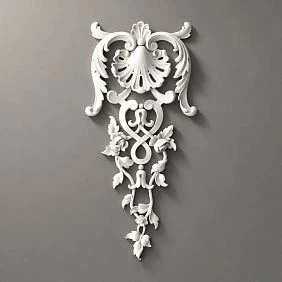
Corner blocks. Decorative elements at the corners of molding frames — solve the problem of joining molding on external and internal corners.
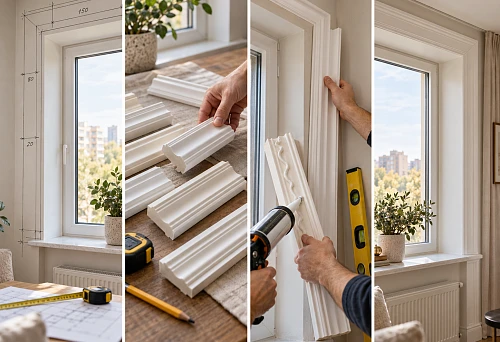
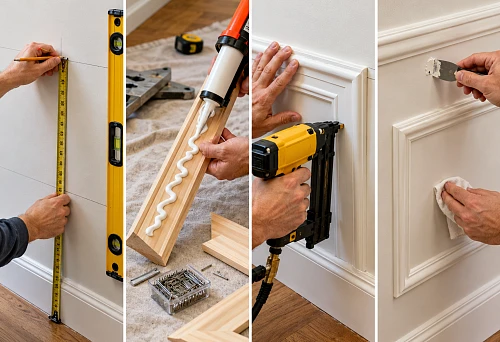
Decorative molding frame. Used to create molding frames — rectangular frames on the wall, inside which a slatted field or another decorative element is placed.
How to combine slats and framed wall geometry: a practical guide
Framed wall geometry is a system of molding frames on the wall, creating an architectural rhythm of divisions. In combination with slatted panels, this is one of the most expressive and yet relatively affordable design techniques.
Scheme 'slatted field in a molding frame'
This is the most common and elegant technique. The essence: the slatted panel occupies a strictly measured field on the accent wall, and a molding frame made of a 30–50 mm belt is mounted along its perimeter.
How it works visually: the frame creates a 'mat' for the slatted field — similar to how a picture frame separates the canvas from the wall. The slatted block ceases to be 'just wall cladding' — it becomes an architectural object.
Frame parameters:
-
Molding 30–50 mm, straight or with a minimal profile.
-
Indent from the edge of the slatted field: 0 (frame flush with slats) or 30–50 mm (frame with a gap creating a double contour).
-
At frame corners: corner blocks 30–40 mm matching the molding color.
Two-level wall scheme
A horizontal belt divides the wall into lower and upper zones. The lower zone is a slatted field. The upper zone is a neutral surface (plaster, paint, wallpaper).
Division height: 1.0–1.2 m from the floor — classic option. 1.3–1.5 m — for high rooms.
Belt width: 25–50 mm — enough to create a clear horizontal line, but not so wide as to dominate the slatted field.
Color: white belt on a neutral wall — contrasting, legible. Belt in wall color — delicate, works only as relief.
Vertical division with pilasters scheme
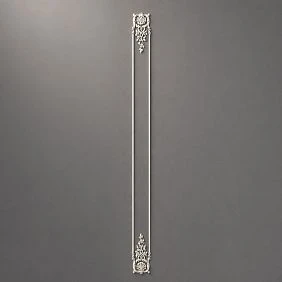
In a long corridor or on an extended wall, vertical molding-pilasters divide the slatted field into sections. Each section is an independent 'rectangle' 80–100 cm wide. A pilaster made of molding 40–60 mm wide is mounted vertically on the slatted field or between slat sections.
This technique turns a long, monotonous wall into a system of architectural cells — rhythmic, large-scale, expressive.
Table: Moldings for Styles and Room Types
| Style | Crown Molding | Skirting board | Additional Elements |
|---|---|---|---|
| Minimalism | 50–65 mm, straight | 50–65 mm, straight | Perimeter only |
| Scandinavian | 55–70 mm, straight | 55–70 mm | Cornice + baseboard |
| Modern Classic | 80–100 mm, ogee | 75–90 mm | + molding frame, rosette |
| Neoclassical | 100–140 mm, developed | 90–120 mm | + belts, pilasters, rosette |
| Loft | 60–80 mm, straight | 60–80 mm | Perimeter only |
| Country / rustic | 90–130 mm, textured | 80–100 mm | + beams, decorative overlays |
Where the combination of slats and moldings works best
Theory is good. But the real choice is made based on specific rooms and specific tasks. Let's go through the most advantageous scenarios.
Living room: accent wall with molding system
The living room is the main stage of the apartment. An accent wall with slatted wall panels purchased in Nizhny Novgorod with delivery, + perimeter molding system = an architectural result that was previously only available with expensive design work.
Specific scenario: wall 3.4 m × 2.6 m behind the sofa. Oak oil slats 65 mm, vertical, dark backing. Around the perimeter of the wall — 88 mm cornice with a round, 80 mm baseboard with a heel. 40 mm molding frame around the perimeter of the slatted field. 300 mm rosette for the chandelier in the center of the ceiling. LED behind the cornice box.
Result: an interior that at first glance reads as a professional design project—because it is exactly that: simply implemented by the buyer independently based on correctly chosen materials.
Study: environment and concentration through architecture
The study is the only room in the apartment where slatted walls are justified functionally, not just aesthetically. Wood creates a vibration-absorbing and sound-absorbing environment—especially acoustic panels on a felt backing. The horizontal molding strip at a height of 1.2 m visually anchors the 'work zone' of the wall. The dark tone of the slats works for concentration—it eliminates visual distraction.
Moldings in the study: cornice 90–100 mm, baseboard 85 mm, horizontal molding strip 40 mm. No ornaments—only architectural geometry.
Hallway with slatted panels and molding strip
A long hallway—a space that slatted panels transform radically. Vertical slats 35–50 mm covering the full height of the walls + vertical molding pilasters every 90–100 cm = a series of architectural cells that make a narrow hallway resemble a gallery.
A horizontal molding strip at a height of 1.1 m divides the hallway wall into a slatted lower register and an upper neutral zone for paintings or mirrors.
Bedroom headboard wall: a delicate system
The headboard wall is the most delicate application of slatted panels. Here, the molding system should be minimalist: cornice 55–70 mm, baseboard 60 mm. No strips or frames—only the basic perimeter. Slats 40–55 mm in a light warm tone. LED lighting behind the cornice box—for nighttime illumination.
Niches and built-in structures
A niche with a slatted back wall is one of the most expressive design techniques. The slats behind the shelves create depth and texture inside the niche. A molding frame around the perimeter of the niche (along the front edge) frames it as a separate architectural element.
What to consider when ordering: a practical checklist
Buying slatted panels and moldings online is convenient but requires attention to detail. Here's what to check before clicking the 'Place Order' button.
Regarding slatted panels
-
Exact specification of wood species: solid wood or veneer, or MDF with film. Three different products.
-
Type and composition of coating: oil, varnish (one- or two-component), enamel. For wet areas — only water-resistant coatings.
-
Emission class: for children's rooms and bedrooms — E0 or E1.
-
Geometric tolerances: ±0.3–0.5 mm in width. Deviation over 1 mm — unstable gap in the finished wall.
-
Ends sealed with coating: unsealed ends — risk of deformation from humidity.
-
Length and custom option availability: for room heights over 3 m — clarify availability of lengths from 3000 mm.
On polyurethane moldings
-
Material density: not less than 280–300 kg/m³. Lower — a soft, flexible batten that will warp after installation.
-
Batten rigidity: when lightly pressing the middle of a 2-meter batten — it should not bend.
-
Flatness of the back (mounting) surface: waves on the back side = gaps after installation.
-
Profile clarity: blurred transitions on the front profile — a sign of a poor-quality mold or insufficient filling.
-
Batch uniformity: all battens of the same article number are one color within one order.
On system compatibility
-
Scale correspondence: cornice width = 80–130% of batten width.
-
Style correspondence: cornice and baseboard profiles — of the same architectural language.
-
Uniform decorative color: all molding elements — one color.
-
Material stock: battens +10%, moldings +15%.
-
Acclimatization: 48–72 hours before installation.
Polyurethane moldings price: what it consists of
Pricing for polyurethane moldings is determined by several factors, and understanding them is important for a justified comparison of market offers.
Polyurethane density. A denser material (from 300 kg/m³) is more expensive but stiffer, more durable, and holds its profile more precisely. Cheap molding made of porous polyurethane is soft, deforms during installation, and quickly loses shape with temperature fluctuations.
Profile complexity. A simple rectangular profile has minimal cost. A complex classical profile with several elements (ogee + fillet + torus + bead) is more expensive due to its more intricate shape.
Width. Wider means more material and a higher price. Linear dependence.
Manufacturer. Domestic producers are on average cheaper with comparable quality. Imported brands are higher in price, but not always in quality.
Stick length. Standard 2000 mm is the base price. Non-standard lengths incur a surcharge.
Average price range for polyurethane moldings of Russian production: from 80 to 400 rub./linear m depending on width and profile complexity. This is affordable — especially compared to gypsum analogues with comparable aesthetics.
Errors of Overloaded Finishing: When More Is Not Better
This is a special conversation. In interior design, there is a golden rule: 'add while it's good — and stop.' Violating this rule when working with slatted panels and moldings yields a predictable result: an interior that looks heavy, fussy, 'overfed.'
First mistake: too many molding frames on one wall
One molding frame around a slatted field — excellent. Three molding frames of different sizes on one wall — visual chaos. Rule: on one wall — one dominant molding system. Maximum — cornice + baseboard + one frame or one frieze.
Second mistake: moldings too large for the room
A 150 mm cornice with a ceiling height of 2.5 m and a room area of 12 sq.m. — that's an architectural scandal. The scale of the decor must match the scale of the room. The smaller the room and the lower the ceiling — the more delicate the decor should be.
Third mistake: mixing profiles of different styles
A straight minimalist cornice + an ornate Baroque-style molding + a modern slatted wall = three different interiors in one room. Stylistic unity is not a designer's whim but a condition of visual coherence.
Fourth mistake: slatted panels on all four walls
Slattedwall panels purchased in Nizhny Novgorod— is an accent tool. On an accent wall — perfect. On all four walls — texture overload, a 'wooden box' feeling, psychological tension. Battens should contrast with neutral surfaces — only then do they work as an accent.
Mistake five: different wood tones in one room
Light honey-colored battens on an accent wall + dark walnut parquet + red cherry wardrobe — three warm but conflicting wood tones. Wood in an interior requires tonal consistency. One dominant tone + one neutral + one contrasting. No more than three.
Mistake six: moldings without painting
Polyurethane molding in basic white is a blank, not a finished element. Without final acrylic paint, the surface looks like 'construction material.' Acrylic painting in 1–2 coats — that's 30 minutes of work and a fundamental difference in the result.
Mistake seven: wooden battens without acclimatization when installing in winter
Nizhny Novgorod is a city with noticeable winters. Material brought in from the cold, if installed immediately in a warm room, expands — and the installed system deforms. 48–72 hours of acclimatization in the room is a mandatory condition that cannot be ignored even under tight deadlines.
Delivery to Nizhny Novgorod: what you need to know practically
Whenbuy batten panels in Nizhny NovgorodThrough a federal manufacturer — logistics is solvable and clear.
Transport companies for long cargo: SDEK Cargo, Delovye Linii, PEK, Baikal-Service. Rails 2400–3000 mm long are accepted as oversized long cargo. Delivery cost from Moscow to Nizhny Novgorod: 500–1500 rub. per item (depends on weight and volume). Time: 1–3 business days.
Packaging: professional packaging — wrapping film, protective corner pieces on ends, spacers. Upon receipt — mandatory check of completeness and integrity of each item.
Winter acclimatization: critical for Nizhny Novgorod. Material from the vehicle → into the room → 48–72 hours without installation.
About the company STAVROS
Those who are looking for wherebuy slatted panels in Nizhny Novgorodand simultaneously thinking aboutmoldingsfor the architectural completion of the system — will find at STAVROS the answer to both questions in one place.
STAVROS is a Russian manufacturer that combines solid wood and MDF slatted panels with a full range of polyurethane moldings and cornices into a single collection. Slatted panels: width 25–150 mm, all profiles, all tones, all finishes — oil, wax, varnish, enamel, RAL tinting. Polyurethane moldings and cornices: over 200 profiles from rectilinear minimalist to developed classic, material density from 300 kg/m³, white base color for painting in any shade.
All elements of the STAVROS system — slatted panels and polyurethane decor — are developed as a coordinated collection: scales are thought out, profiles are stylistically compatible, color solutions are worked out. The buyer receives not a heterogeneous set from different sources, but a system ready for application as a single kit.
Delivery to Nizhny Novgorod — through reliable transport partners with professional packaging of long cargo. Consultation with STAVROS specialists — selection of a kit for a specific room, calculation of material quantity, installation recommendations. Because the right interior is not an accident. It is the result of the right choice. And STAVROS makes this choice as simple as possible.
FAQ: Answers to popular questions
Can I buy slatted panels in Nizhny Novgorod with next-day delivery?
If the product is available at a regional warehouse or delivered from Moscow by transport companies, the delivery time to Nizhny Novgorod is 1–3 business days. Expedited "same-day" delivery is possible if there are local distributor partners of the manufacturer. Please clarify when placing your order.
Why is polyurethane molding better than plaster molding?
Polyurethane molding is 3–5 times lighter than plaster molding. It does not absorb moisture—so it does not crack or crumble in rooms with humidity fluctuations. It is mounted with acrylic adhesive without anchor fasteners. It can be cut with a regular handsaw—the miter cut at 45° is precise. It is generally cheaper with comparable aesthetics. Acrylic paint is used—no special primer for plaster is required.
What gap between slats is considered optimal?
There is no single "correct" gap—there are ranges for different purposes. 8–10 mm—a dense "fabric" effect, minimalism. 12–14 mm—a pronounced rhythm, standard for most interiors. 16–20 mm—maximum play of shadows, emphasis on individual slats, loft and rustic styles. The gap is chosen based on the width of the slat: gap = 15–20% of the slat width.
Do I need to prime polyurethane moldings before installation?
Primer is not required for installation—acrylic adhesive works without it. But before final painting—sanding with 180–220 grit and acrylic primer will ensure even paint application and better adhesion. Without primer, paint may apply unevenly on surfaces with complex profiles.
Can slatted panels be used in a sauna or steam room?
In a steam room—no. Temperatures up to 90–100°C and extreme humidity are incompatible with any decorative wood coating. For steam rooms, special untreated cladding made from heat-resistant wood (aspen, abachi, linden) is used. For the anteroom with moderate humidity—moisture-resistant HDF or thermally modified wood with a suitable coating is used.
How to calculate the amount of molding for a cornice?
Room perimeter (sum of all wall lengths) + 10–15% allowance for corner cuts and fitting. Example: a room 4×5 m → perimeter 18 m → with a 15% allowance → 20.7 m → 11 pieces of 2000 mm each. If there are door openings — subtract their width from the perimeter (the cornice is not installed above the opening unless there is an extension).
Which acrylic paint is suitable for painting polyurethane moldings?
Any acrylic paint for interior work. Preferably: semi-matte or satin — hides minor surface irregularities better than gloss. Gloss emphasizes all installation and painting defects. Application: synthetic bristle brush for complex profiles, roller for straight sections. 1–2 coats with intermediate drying of 2–4 hours.