



































Article Contents:
- When a wooden ceiling is truly justified
- Ceiling height as a starting point
- Interior style as context
- Room function as a criterion
- How slats work on the ceiling: the physics of visual space
- Slat direction: a choice with consequences
- Slat width and spacing: proportions that decide everything
- Gaps between slats: air as a design element
- Wood Species: From Character to Color
- Why You Need a Ceiling Rosette: The Organizing Center
- Polyurethane vs. plaster: why the choice is obvious
- Rosette Size: The Mathematics of Proportion
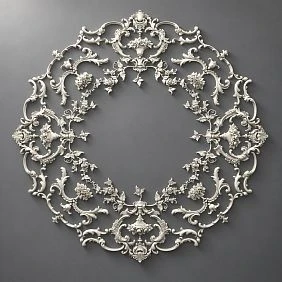
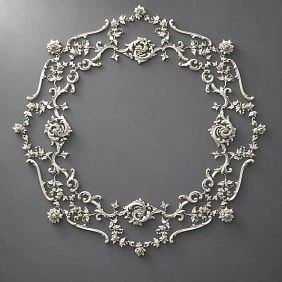
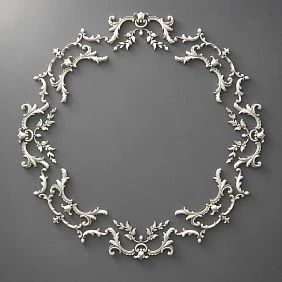
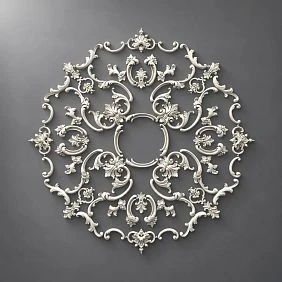
- Rosette Ornament: From Laconic to Baroque
- How to Combine Wood Grain Rhythm and a Central Decorative Element
- The Contrast Principle as a Unifying Force
- Layout Geometry and Rosette Placement
- Moldings as Transitional Elements
- Approach for Each Room: Bedroom, Living Room, Study
- Bedroom: A Forest Overhead
- Living room: architectural statement
- Office: concentration and status
- Installation: what to understand before starting work
- Frame as the foundation of everything
- Wiring and lighting
- Installing the Rosette
- Scale and lighting mistakes: what to avoid
- First mistake: dark slats in a low room
- Second mistake: outlet of the wrong scale
- Third mistake: slats parallel to the window
- Fourth mistake: incorrect artificial lighting
- Fifth mistake: lack of wood finishing
- Combined solutions: when slats are not on the entire ceiling
- Zonal ceiling division
- Ceiling island
- Wood finishing and treatment: color as a tool
- Lighting integration: light as the fourth material
- Recessed Spotlights
- Backlighting behind slats
- Chandelier via socket: the rule of one center
- Materials in detail: what to choose for a durable result
- Solid wood vs engineered species
- Polyurethane: quality parameters
- Practical scenarios: three real cases
- Case 1: Bedroom 16 m² with a 2.8 m ceiling
- Case 2: Living room 28 m² with a 3.2 m ceiling
- Case 3: Home office 12 m² with a 2.9 m ceiling
- Additional ceiling solutions: what else polyurethane offers
- Frequently Asked Questions (FAQ)
- STAVROS: when quality is backed by a name
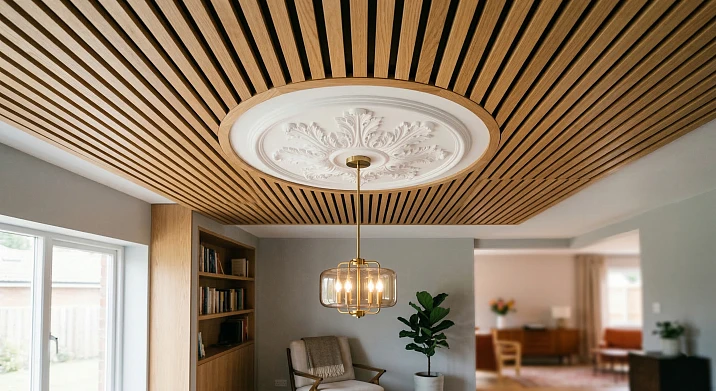
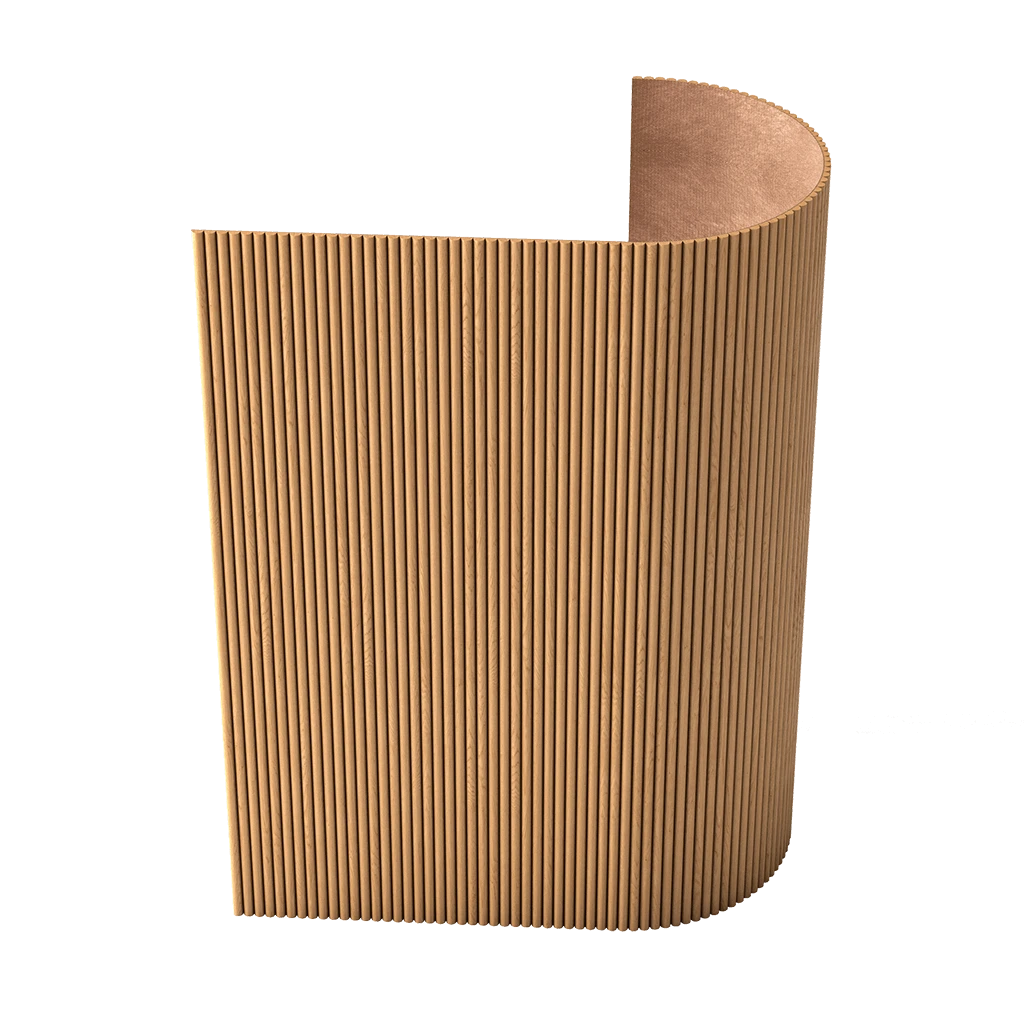
A ceiling is not just a covering. It is the fifth wall, which most people ignore, leaving it white, flat, and faceless. Meanwhile, it is the upper plane that sets the scale of the space, shapes its character, and determines whether the interior will be memorable or remain another standard renovation. When in one solution meetwood slatted panels for the ceilingandpolyurethane rosette— architecture is born, not just finishing. Two completely different natures of material, two different characters, and yet — a perfect union that works in the bedroom, living room, office, children's room, and even in the hallway with high ceilings.
Why exactly like this? Because wood is rhythm, warmth, natural irregularity. And polyurethane is precision, whiteness, classic ornament. One sets the movement. The other sets the center. Together they turn the ceiling into a full-fledged design statement.
When a Wooden Ceiling Is Truly Justified
Not every room can handle wood overhead. This is the first thing a person undertaking ceiling design must understand. Wooden slats are a material with character, and it requires space, proportions, and respect for context.


Ceiling Height as a Starting Point
The minimum comfortable height for a wooden slatted ceiling is 2.7 meters. At a height of 2.4 meters, the slats begin to feel oppressive, especially if they are dark and wide. This is because the horizontal rhythm of the slats visually lowers the ceiling. This is not a drawback—it's a tool. With ceilings of 3 meters and higher, wooden slats make the space proportionate to a person, remove the feeling of an airless expanse, and add coziness. For ceilings below 2.7 meters, choose light wood with narrow slats and wide gaps—then the rhythm will be light, not heavy.
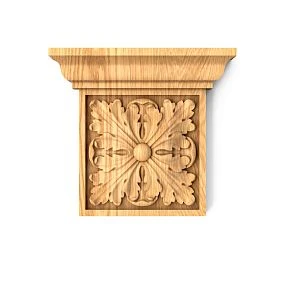
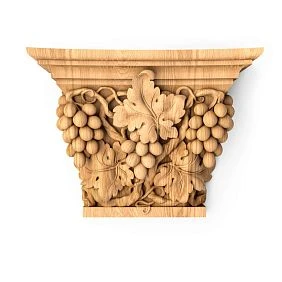
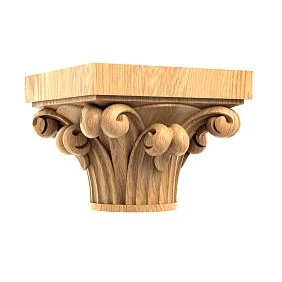
Our factory also produces:


Interior Style as Context
A wooden ceiling is organic in Scandinavian minimalism, loft, eco-style, Japanese wabi-sabi, in modern classic and neoclassical styles. It is out of place in high-tech with metal and glass, in a harsh industrial interior with exposed reinforcement, and in spaces with plastic furniture from the budget segment. Wood is an element that requires surroundings of the same class.
Get Consultation
Room Function as a Criterion
In a bedroom, a wooden ceiling creates a feeling of a canopy, a shelter, a natural cocoon—and this works flawlessly. In a living room, it becomes the main decorative statement around which the entire interior is built. In a study, wood overhead forms an atmosphere of concentration, evoking a library aesthetic. In a kitchen, wooden slats are acceptable but require protective impregnation and good ventilation—steam and grease do their work. In a bathroom, wood on the ceiling is rare, and there it requires special heat treatment or the use of WPC.
A fundamental point:wooden slatted panels for the ceilingJustified where you're ready to make the ceiling the main element, not the background. If the ceiling is a neutral plane for you, choose other solutions. Wood cannot be inconspicuous.
How ceiling battens work: the physics of visual space
A batten ceiling is not just a set of boards. It's a graphic system that controls the perception of space through rhythm, direction, and chiaroscuro.
Batten direction: a choice with consequences
Battens laid along the long wall stretch the room lengthwise, making it corridor-like. Battens across widen the space, adding dynamism. Diagonal battens create movement, suitable for non-standard layouts and add energy to the room. The most unexpected solution — battens fanning out from the center — creates a dome or sunbeam effect and requires a rosette at the vanishing point.
Here begins the first point of contact between wood and polyurethane: the rosette in the center of a diagonal or fan layout becomes an architectural anchor, without which the entire system would look unfinished.
Batten width and spacing: proportions that decide everything
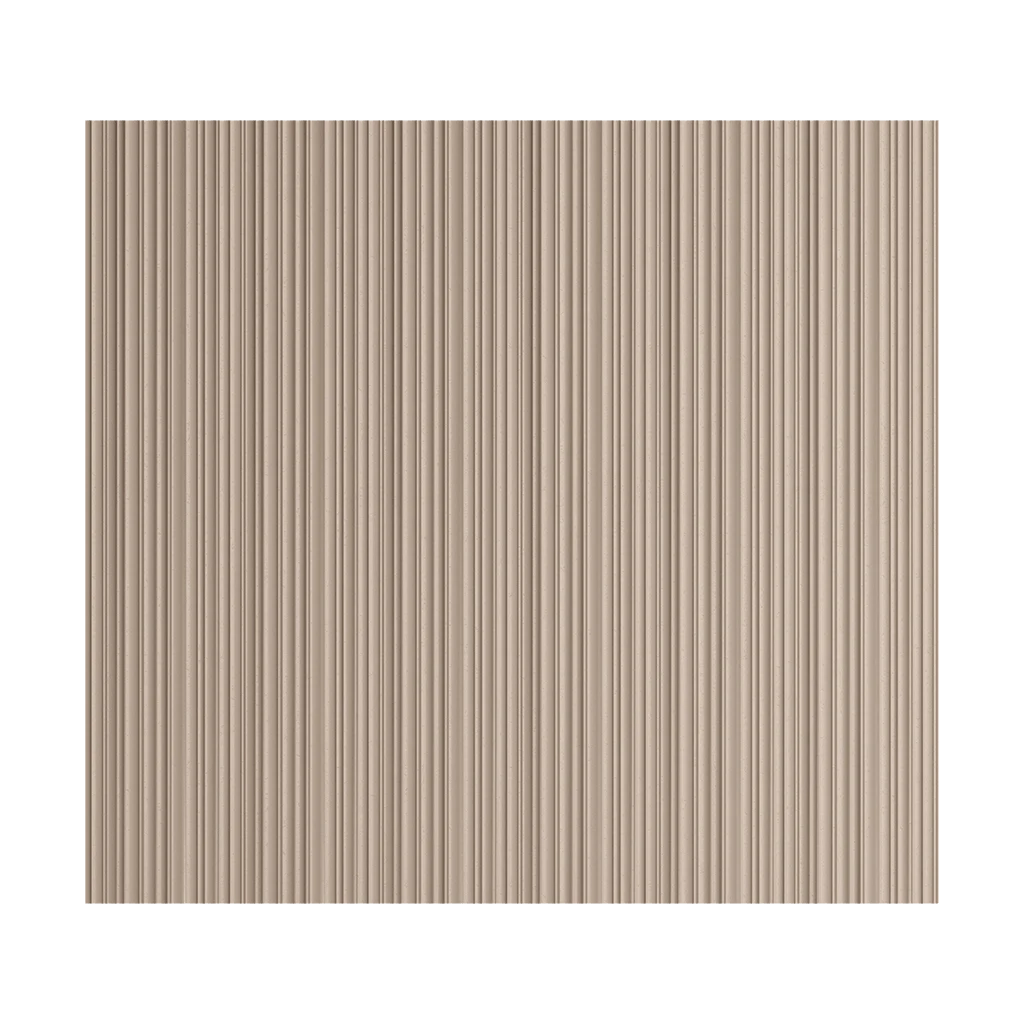
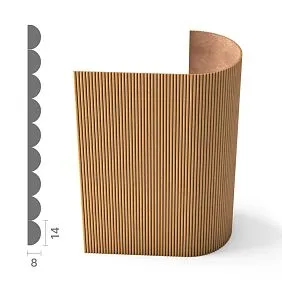
Narrow battens (30–50 mm) with small spacing create a dense, almost woven effect. Wide battens (80–120 mm) with large spacing give a calmer, furniture-like character. Mixed rhythm — alternating wide and narrow battens — creates visual music, interesting and unpredictable. This is precisely the approach used by designers who understand: uniformity calms, non-uniformity captivates.
Gaps between battens: air as a design element
The gap is not just a technical interval. It's a space through which light penetrates, wires are hidden, and spotlights are installed. A 20–30 mm gap between battens creates lightness, especially if behind the battens there is a black base that absorbs the gaze and makes the structure visually floating. A gap of less than 15 mm — a solid plane with thin grooves, dense and heavy. A gap of more than 50 mm — an open lattice, a through structure, working well in a loft.
Wood Species: From Character to Color
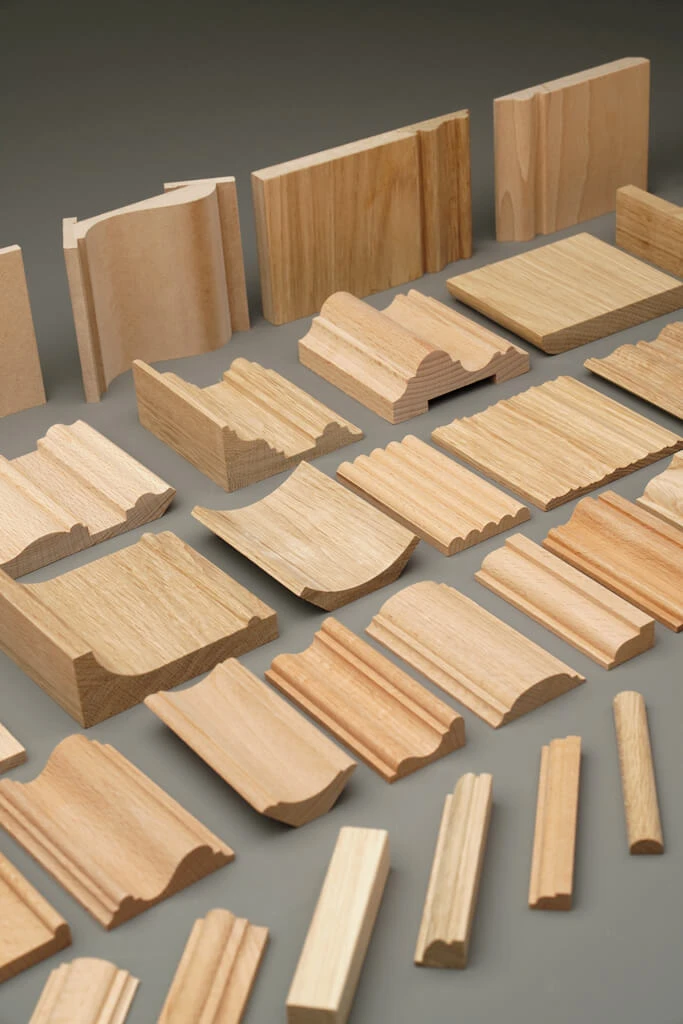
Oak — a noble texture with pronounced grain, warm golden or light brown tone. Pine — affordable, resinous, smells like the forest. Ash — grayish-beige, neutral, great for Scandinavian style. Walnut — dark, luxurious, for classic and art deco interiors. Thermowood — steam-treated, almost chocolate-colored, with increased moisture resistance.
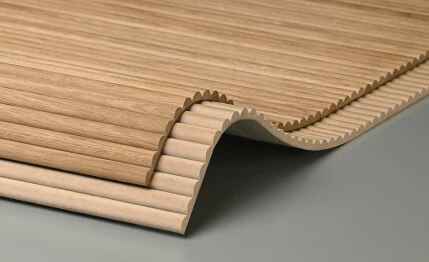
Wooden Slat Panels for CeilingsSolid wood panels win over MDF and PVC in one fundamental aspect: the living texture of natural wood is irreproducible by any print. When light glides over the oak fibers, it creates a play that no synthetic panel can imitate.
Why You Need a Ceiling Rosette: The Center That Organizes Everything
Imagine a ceiling with wooden slats without a central element. Beautiful? Perhaps. But complete? No. The rhythm of the slats creates movement, and this movement needs a point of rest — an anchor around which the entire composition unfolds.
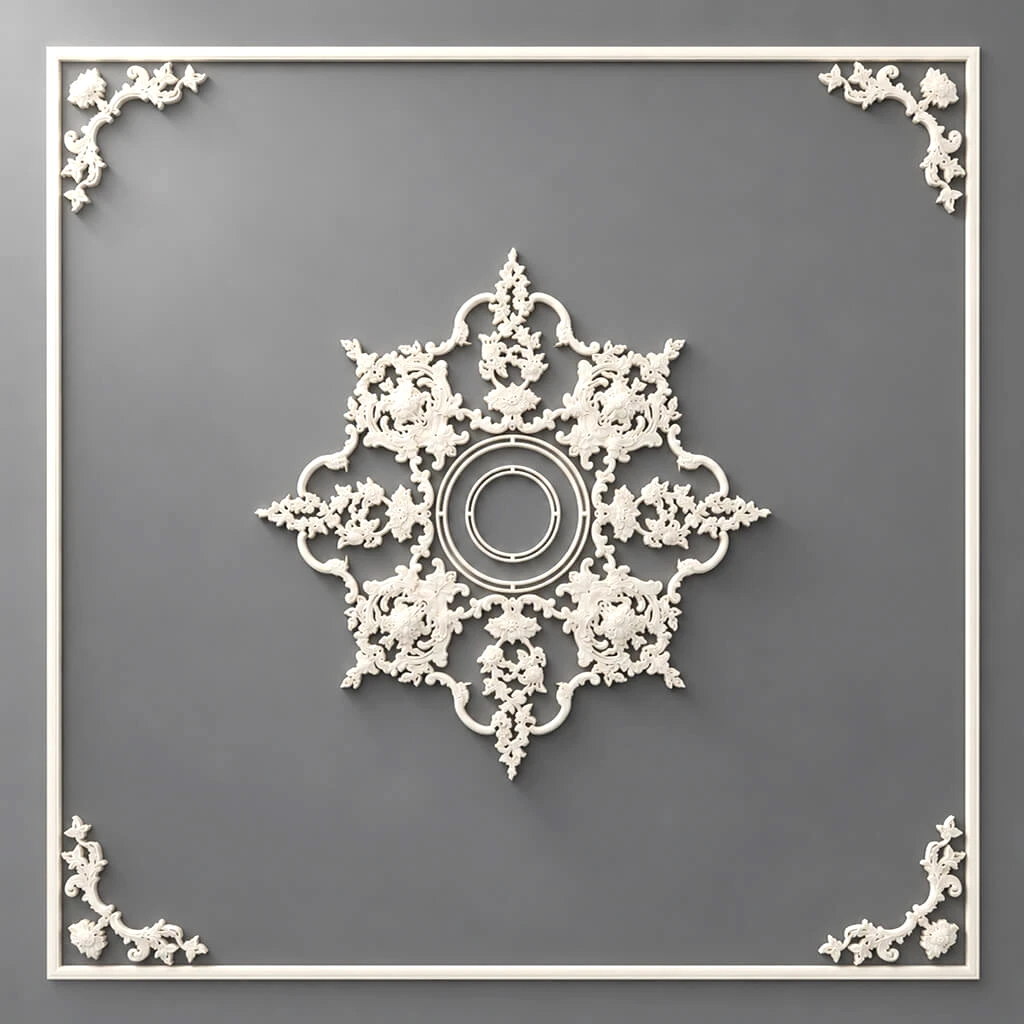
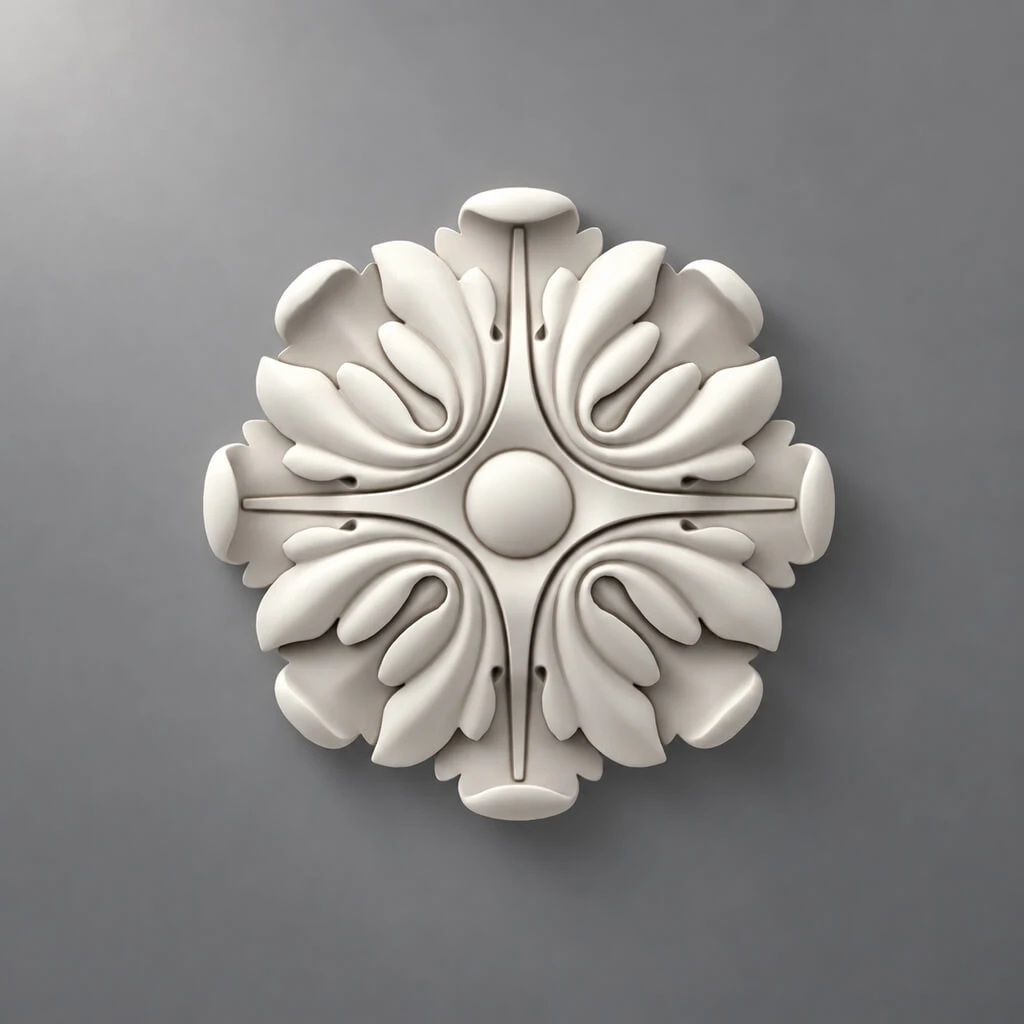
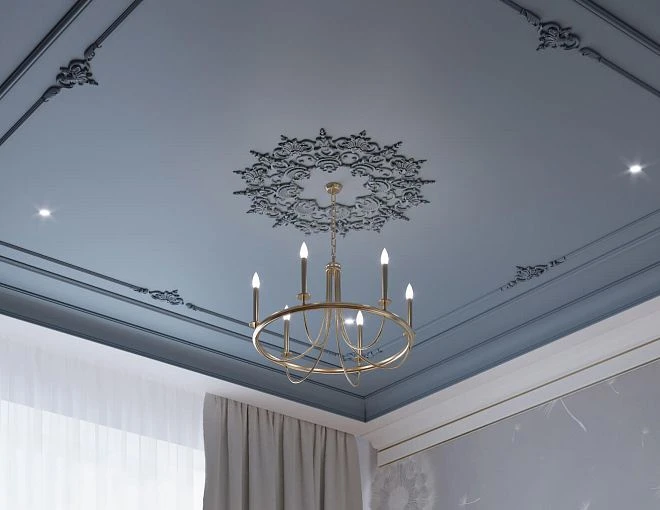
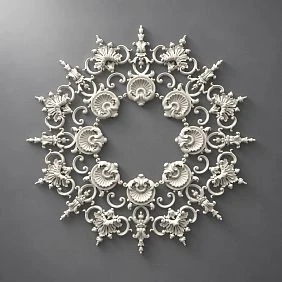
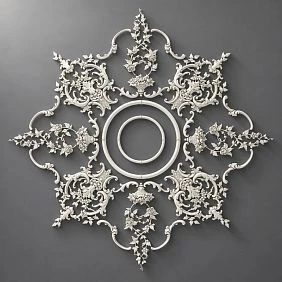
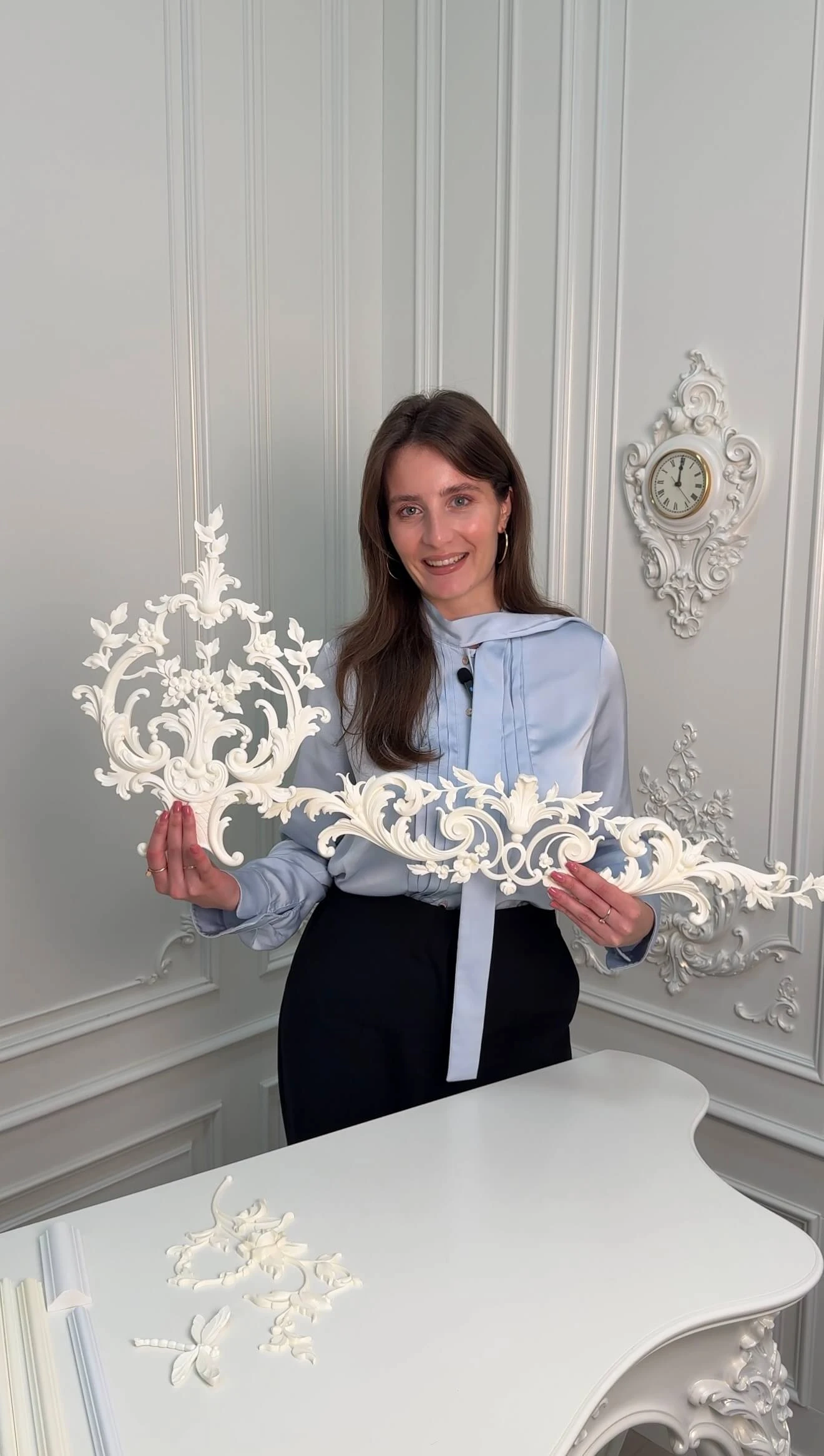
This is precisely the role performed bypolyurethane rosette. It's not just a decorative element for the chandelier — it's an architectural accent that organizes the ceiling space just as the main square organizes a city.
Polyurethane vs. plaster: why the choice is obvious
Traditional plaster molding is heavy, fragile, requires reinforced mounting, and is expensive both to produce and install. A polyurethane rosette is free of all these drawbacks. It weighs 5–8 times less than its plaster counterpart, doesn't crumble during transport, cuts easily, adheres with any polymer-compatible glue, and takes any paint excellently — from white acrylic to gold leaf.
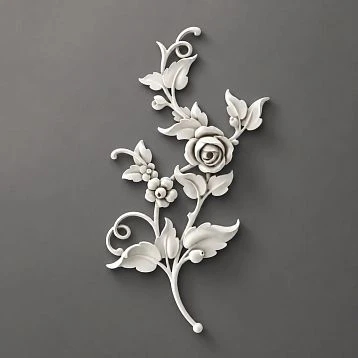
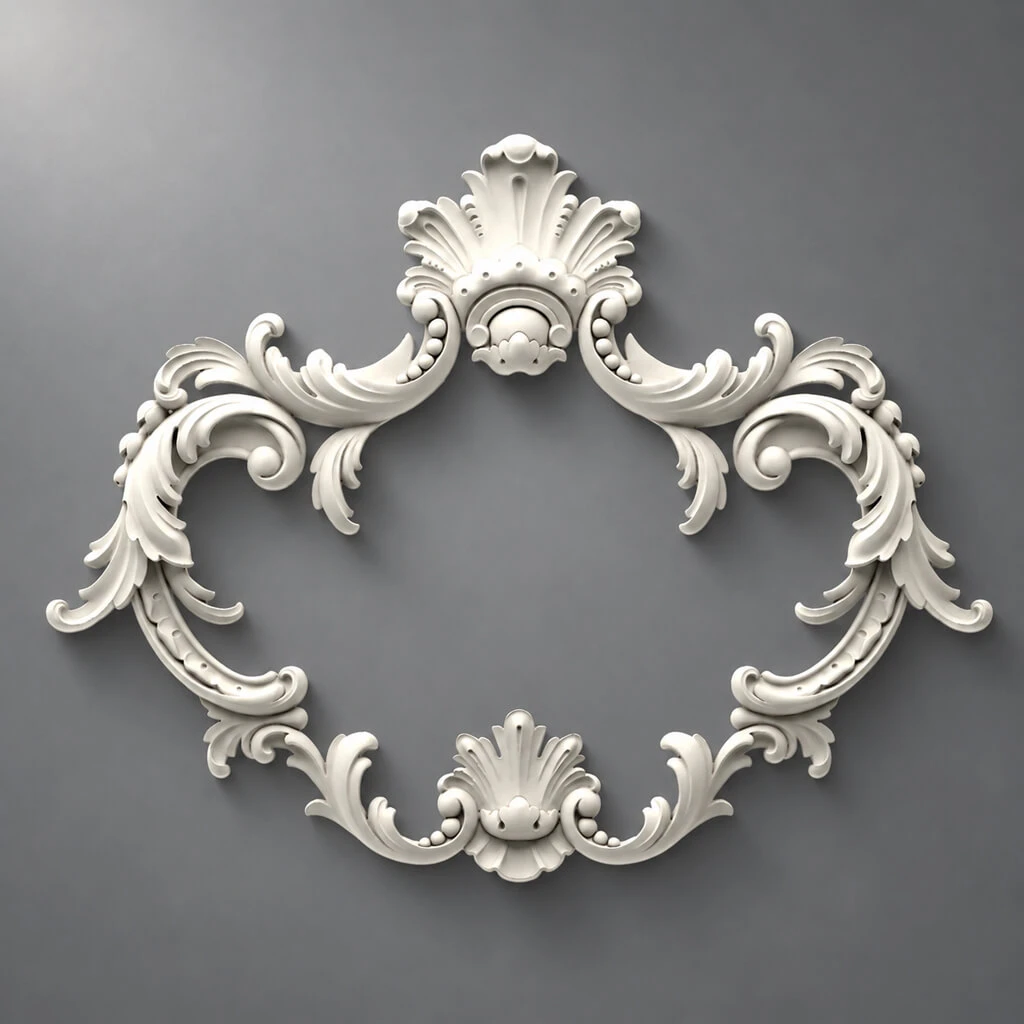
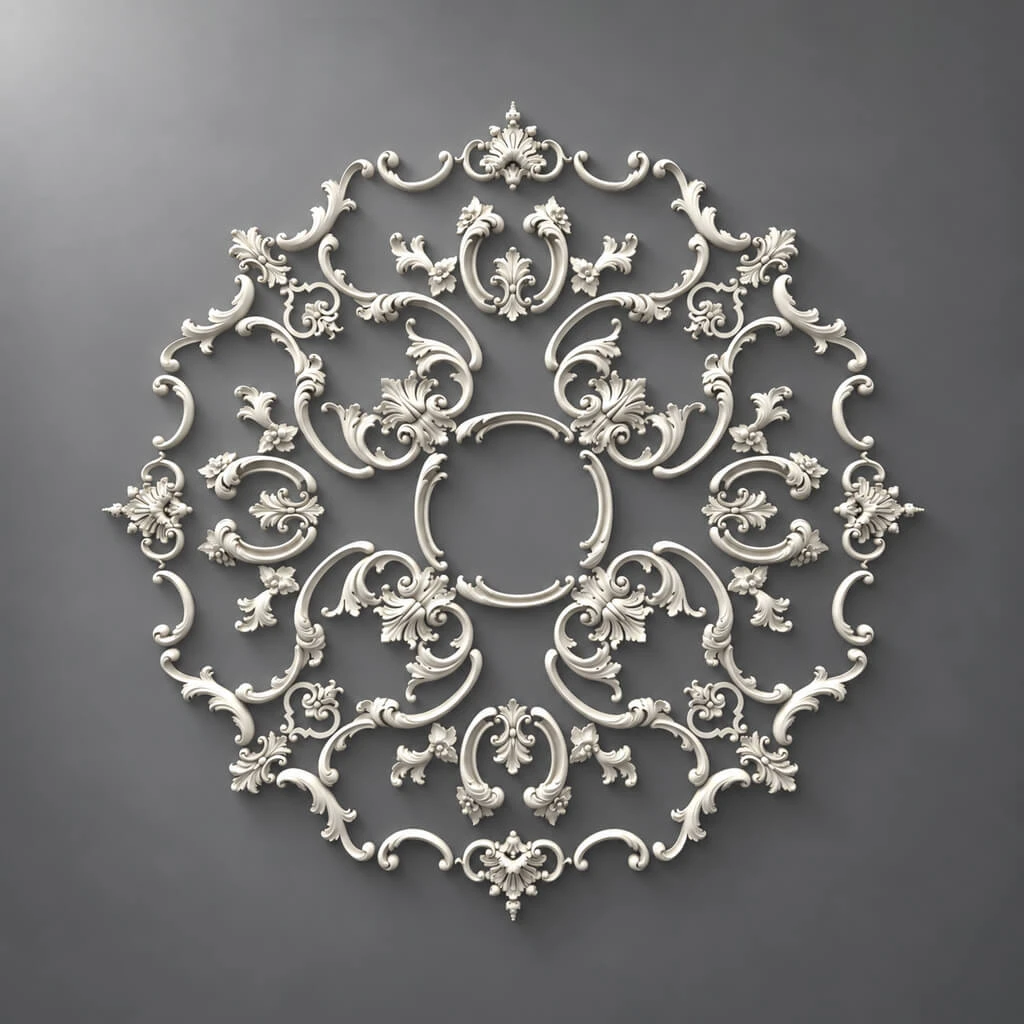
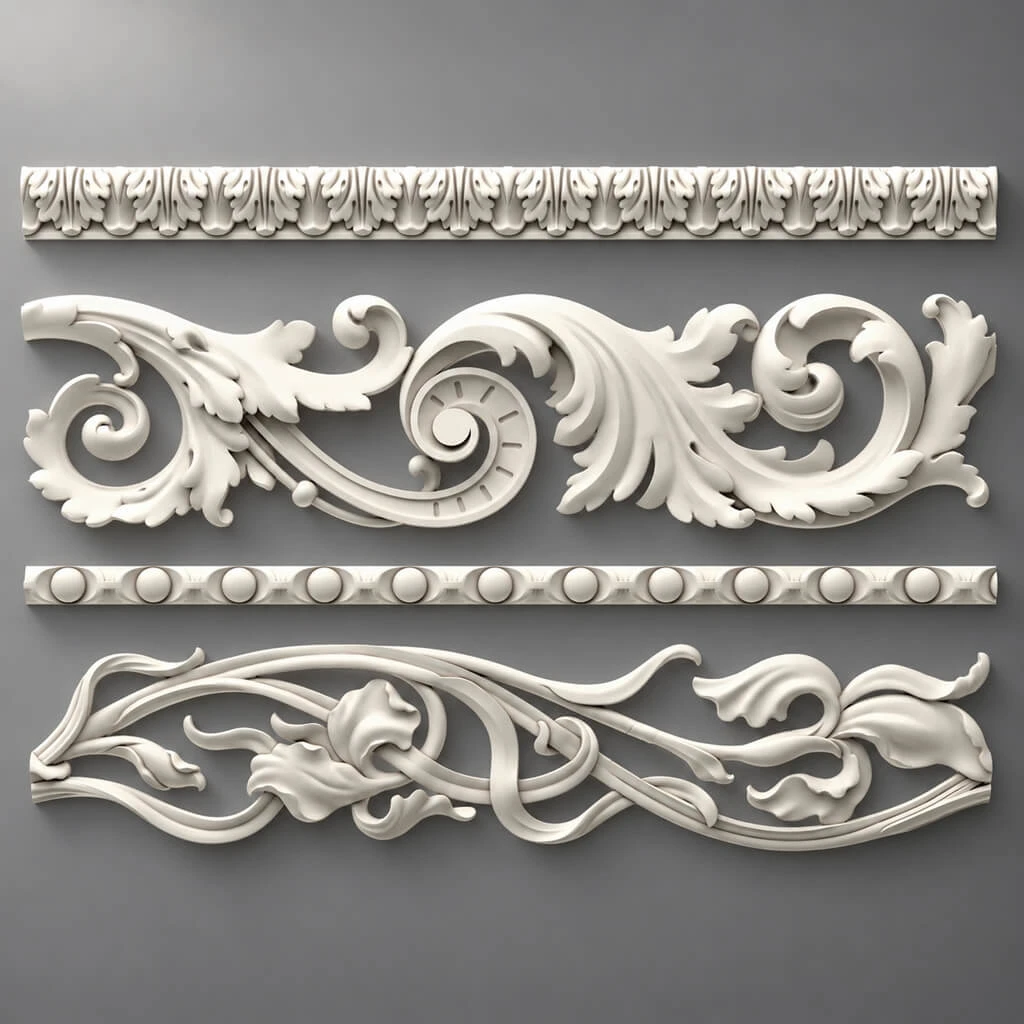
At the same time, the detailing of a polyurethane rosette is not inferior to plaster. Modern technologies allow reproducing the finest ornaments — acanthus leaves, volutes, pearl strings, meanders, and laurel wreaths. The result looks like classic molding. To the touch — like a pliable, lightweight material.
Ceiling medallion size: the mathematics of proportion
The main mistake when choosing a ceiling medallion is the mismatch between its diameter and the size of the room. The medallion should be proportionate to the room and the chandelier. A general rule: the diameter of the medallion in centimeters is approximately equal to the sum of the length and width of the room in meters. For a 4x5 meter room, a medallion about 90 cm in diameter. For a small 3x3 meter study, 60 cm will suffice.
But this is just a guideline. The interior style adjusts the formula. In a minimalist space, a medallion of a smaller diameter looks more elegant. In lush neoclassicism, it can be larger than the norm.
Ceiling medallion ornament: from laconic to baroque
Polyurethane molding under the chandelierexists in a huge range of styles. At one end are simple concentric circles with minimal relief, suitable for a modern interior. At the other end are multi-tiered compositions with acanthus leaves, figured medallions, and openwork borders for classic and baroque styles.
In combination with wooden slats, medallions of medium complexity work best: not completely smooth, but not overloaded either. The ornament should create a contrast with the linearity of the wood, but not compete with it.
How to combine the rhythm of wood and the central decorative element
This is the most subtle question of the entire topic. Wood is a textured, warm, natural material. Polyurethane is smooth, white, architectural. How to make sure they don't argue, but converse?
The principle of contrast as a union
Design wisdom says: combine not the similar — combine the complementary. Warm wood and cool white polyurethane — this is not a conflict, it's a dialogue of two elements. One material is warm and alive, the other is clear and structural. That is precisely why they work together better than two equally warm or two equally cold elements.
Fundamental condition: the ceiling medallion must be white or match the ceiling plane's tone. A colored polyurethane medallion combined with wooden slats creates visual overload. Exception: a patinated medallion in gold or silver for classic interiors with dark wood species.
Layout geometry and medallion placement
If the slats run parallel—the medallion is placed at the geometric center of the ceiling or above the center of the relaxation zone (above the sofa, above the bed). If the slats are diagonal—the medallion is placed at the point of their visual convergence or at the center of the ceiling plane, interrupting the diagonal rhythm with a vertical accent.
There is also a non-standard technique: the medallion is not centered but shifted toward the edge of the zone—it works in long rooms where the chandelier does not align with the geometric center of the room.
Moldings as a transitional element
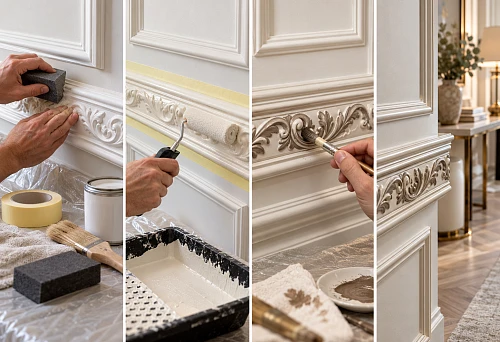
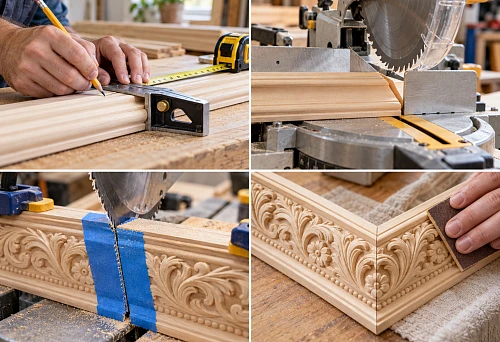
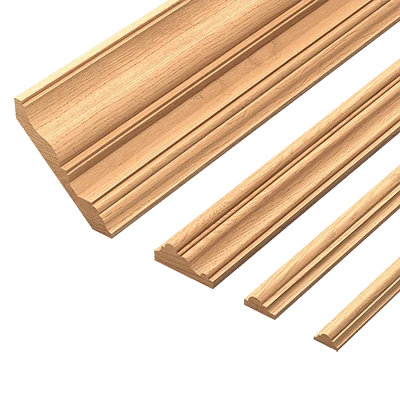
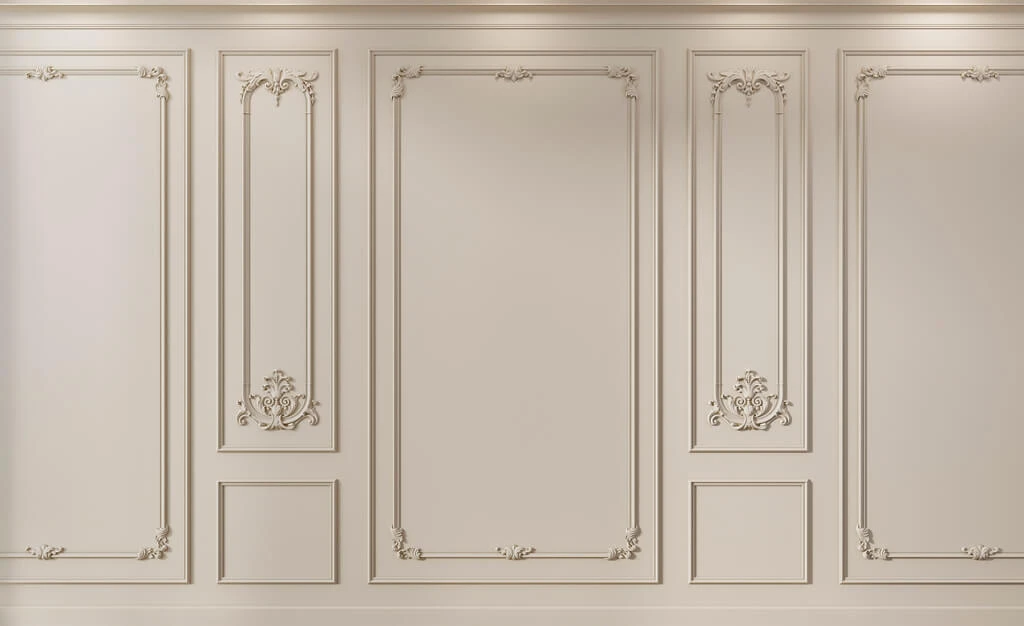
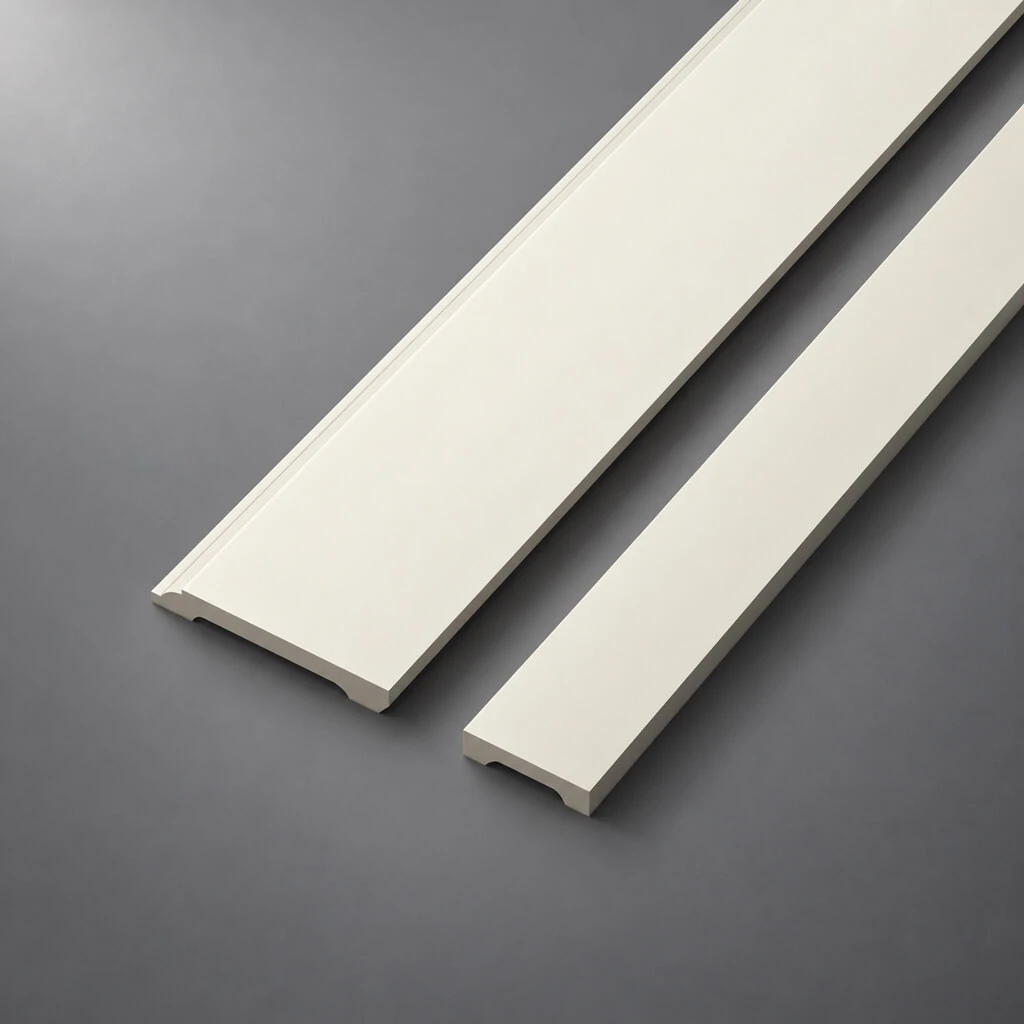
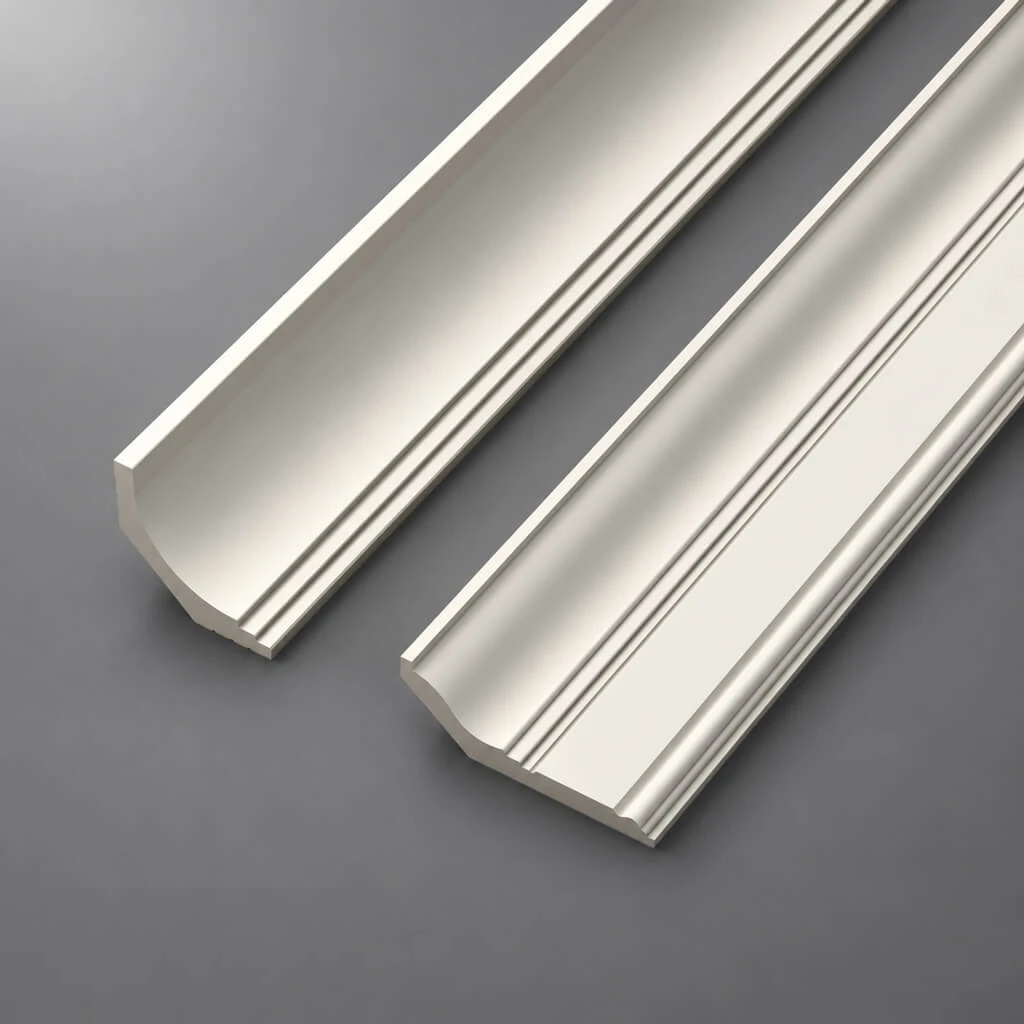
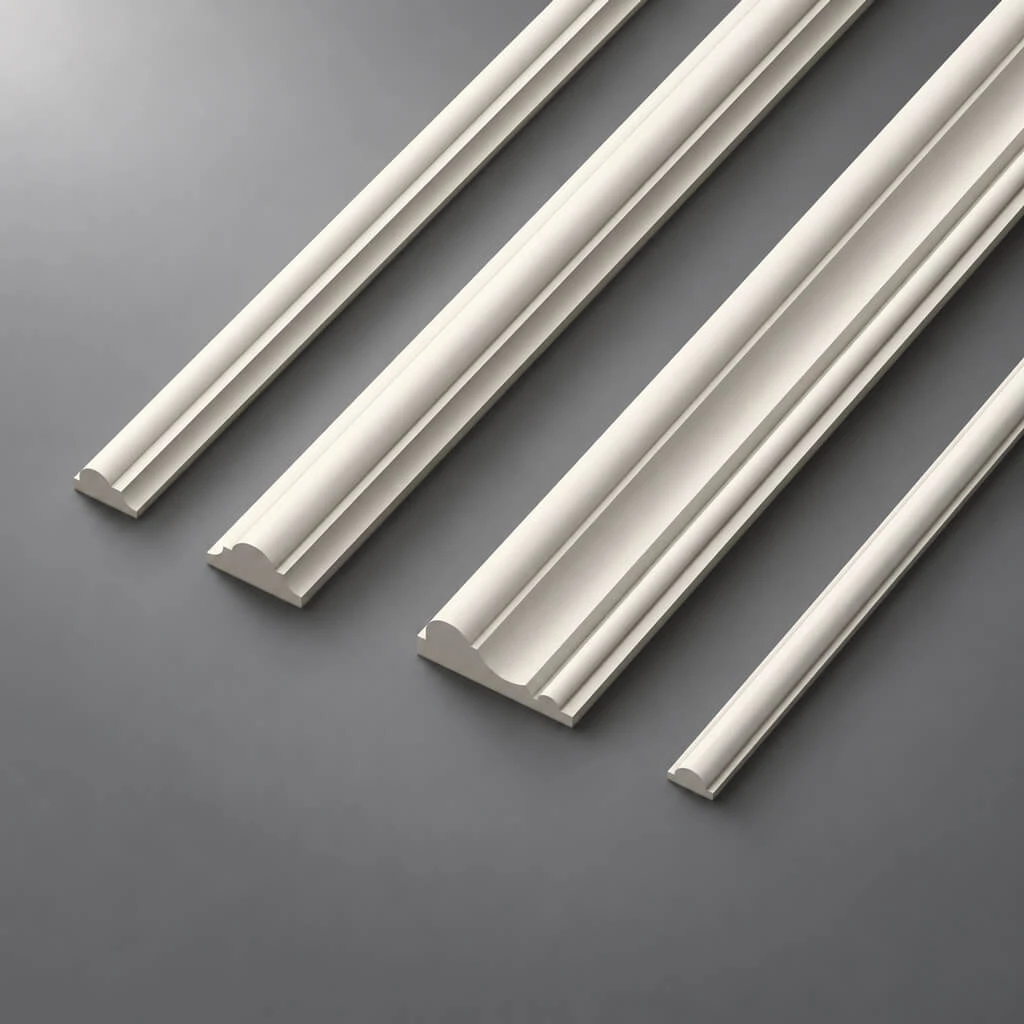
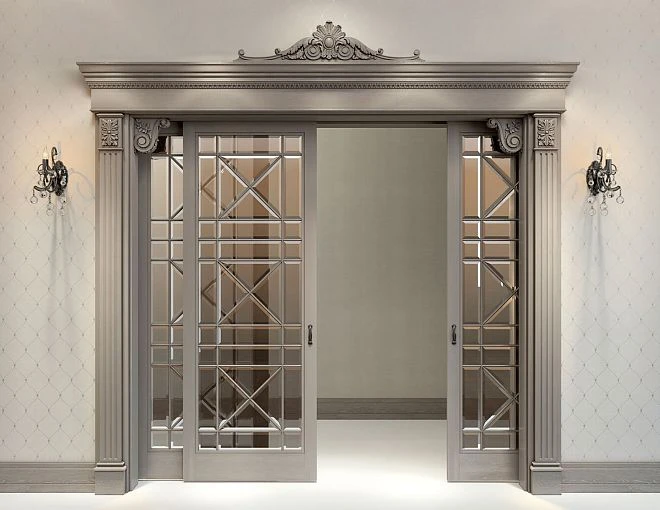
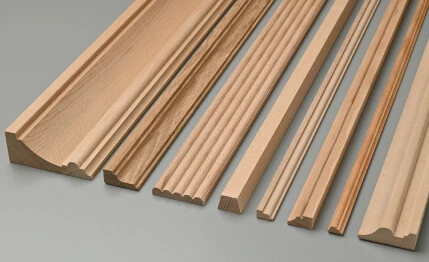
Often, a visual transition is needed between the area of wooden slats and the clean white plane. Here, polyurethane moldings and wooden slats as a unified composition—framing the slatted zone, creating a frame around the wooden field. The white molding acts like a mat in a painting: it delineates the pattern area from the neutral background, giving the entire solution completeness.
Approach for each room: bedroom, living room, study
One technology, three different characters. Each space sets its own conditions—and smart design knows how to adapt to them.
Bedroom: forest overhead
In the bedroom, the ceiling is what you look at while falling asleep. It's an intimate space that requires silence and warmth. Here, wooden slats work perfectly. Recommended scheme: light wood (ash, birch, light oak) with a small spacing, layout along the long wall above the bed, partial coverage — not the entire ceiling, but the headboard area.
A ceiling medallion in the bedroom — small diameter (50–70 cm), with a delicate pattern. It doesn't hold a luxurious chandelier, but a delicate light fixture or even serves as a decorative element if the main lighting is recessed or wall-mounted.
Living room: an architectural statement
Living room — a place where the ceiling can be maximally expressive. Full coverage with slat panels or zoning: a wooden area above the sofa and TV, a clean white ceiling above the dining area. A large medallion (80–120 cm) with an elaborate pattern above the main relaxation area, with a chandelier underneath that sets the tone for the entire interior.
The living room allows working with dark wood species — walnut, dark oak, thermowood. Dark slats on a white ceiling create a graphic effect, similar to Japanese calligraphy: each line is weighty, meaningful.
Office: Concentration and Status
In a study, wood creates an atmosphere of seriousness. This is a space for decisions, and its ceiling should speak to the owner's character. Wide slats with large spacing work well here — a calm, confident rhythm. The medallion — medium-sized, with a classic pattern, for a strict pendant lamp or an Art Deco-style chandelier.
An important detail for a study: acoustics.Wooden slat panelsWooden slats on the ceiling diffuse sound, reduce echo in the room — this is especially relevant for meeting rooms and home studios.
Installation: what you need to understand before starting work
Installing a slatted ceiling requires precision at every stage — from marking to final fastening. The most common mistake is starting work without acclimatizing the wood. Wooden slats must lie in the room for at least 48–72 hours to absorb the ambient humidity. Otherwise, after installation, the slats will begin to deform: warp, develop cracks at the joints, change the spacing.
Frame as the foundation of everything
The frame for a slatted ceiling is mounted from metal profiles or wooden beams. Metal profiles are preferable: they do not deform from humidity, provide a perfect plane, and allow for precise leveling. The spacing of the frame crossbars is 40–60 cm, depending on the width of the slats. The slats are attached to the frame using hidden or exposed methods.
Hidden fasteners—clips—create a clean surface without visible hardware. Exposed fasteners—screws with caps—have their own aesthetic charm in loft and rustic styles. More aboutinstalling slatted panels—is a separate discipline that requires strict adherence to technology.
Wiring and lighting
Before installing a slatted ceiling, all wiring must be laid in corrugated pipes and secured behind the frame line. The locations for cable outlets for recessed lights are marked in advance—after installing the slats, changing their position is extremely difficult. The wire for the chandelier is routed strictly to the center of the planned socket position.
Mounting the medallion
polyurethane rosetteis attached after installing the slatted field but before final painting and mounting the chandelier. Algorithm: find the geometric center of the socket, apply mounting adhesive to the back side, press it to the ceiling, secure with painter's tape until it sets (4–6 hours), fill the joint with a thin layer of putty, sand, and paint to match the ceiling color. The wire for the chandelier is routed through the central hole of the socket.
Scale and lighting mistakes: what to avoid
Interior mistakes in ceiling design, as a rule, come at a high cost—both literally and aesthetically. Let's examine the most typical ones.
First mistake: dark slats in a low room
Dark wood absorbs light and visually lowers the ceiling. In a room with a height of 2.4–2.6 meters, this creates a feeling of pressure and discomfort. If the ceilings are low, choose light wood species or use bleached, stained, or wood painted gray or white. Dark wood is only suitable for ceilings from 2.9 meters high.
Second mistake: an outlet of the wrong scale
A small outlet in a large room looks lost. A large outlet in a small room looks aggressive. Scale is not a matter of taste, it's mathematics. Neglecting proportions ruins even the most expensive solution.
Third mistake: slats parallel to the window
When slats are positioned parallel to the source of natural light, shadows do not form between them—the light glides along, not across. The ceiling looks flat, and the relief is not visible. Slats should be positioned perpendicular to the main light source so that each one casts a shadow and creates volume.
Fourth mistake: incorrect artificial lighting
A central chandelier provides uniform light that does not emphasize the relief of a slatted ceiling. To make the wood 'come alive,' directional light sources are needed—spotlights built into the gaps between the slats, wall sconces that cast light at an angle to the ceiling. It is the grazing light that creates the play of shadows, which is the reason for choosing a wooden slatted ceiling.
Fifth mistake: lack of wood finishing
Unfinished wood on the ceiling is a future problem. Oil, wax, or varnish protect against dust, moisture, and ultraviolet light. Without a finish, the wood darkens unevenly, accumulates dirt, and loses its original beauty within a year. A finishing coat is not an option but a mandatory step.
Combined solutions: when slats are not on the entire ceiling
One of the most sophisticated approaches is the partial use of wooden slats on the ceiling. Not the entire ceiling is wooden, but only a zoned part. This works on several levels at once.
Zonal division of the ceiling
In an open-plan living-dining room, wooden slats define the relaxation area, while a clean white ceiling is maintained above the dining table. The boundary between zones is framed with polyurethane molding or cornice—this creates a clear transition line without visual chaos.
This technique allows the use of darker wood species—they don't feel oppressive because they occupy only part of the space. And at the same time, they create an accent zone that organizes the furniture arrangement.
Ceiling island
A 'ceiling island' is a wooden slat insert framed by molding, lowered 10–15 centimeters below the main ceiling. In the center of the island is a rosette and a chandelier. Around the island, on the main ceiling, is a clean plane. This is a powerful design solution that works in high rooms (from 3 meters) and creates a sense of architectural complexity without overload.
Wood finishing and treatment: color as a tool
Natural wood does not necessarily have to be left in its natural color. Painting, staining, bleaching, charring—each treatment method changes the character of the material while preserving its texture.
Bleached wood—slats treated with a special peroxide-based compound—give a warm, milky, Scandinavian tone. They combine natural texture with lightness and airiness. They pair perfectly with a white rosette and a light ceiling—the boundary between the slat and the ceiling almost disappears, creating a monochrome, calm picture.
Tinted slats — stained in wenge, dark walnut, or charcoal gray — create a powerful visual accent. This is a solution for confident, stylistically established interiors. A white socket on a dark wooden background is like the moon in the night sky: a separate, clear, memorable image.
Painted slats — in the color of the walls or ceiling — create the illusion of a textured plane where relief is present but there is no color contrast. This is a delicate, clever technique for those who want to add volume without excessive expressiveness.
Lighting integration: light as the fourth material
Lighting in a slatted ceiling is not a technical issue, it's a design one. Light is a full participant in the composition, on par with wood, polyurethane, and space.
Recessed spotlights
Spotlights in the gaps between the slats create a trail of lights — a theatrical lighting effect. With a gap diameter of 30 mm or more, miniature spot lamps on a track system can be fitted inside. Warm white light (2700–3000 K) emphasizes the golden hue of the wood. Cool white (5000 K) neutralizes the warmth of the wood and creates a more modern, business-like mood.
Backlighting behind the slats
If the slats are mounted on a frame with sufficient clearance from the ceiling (5–8 cm), an LED strip can be placed in this space. Light filtering through the gaps from below creates the effect of an illuminated grid — a warm, diffused, almost magical glow. This solution is for bedrooms and meditative spaces.
Chandelier through a socket: the rule of one center
When a socket is installed in the center of a slatted ceiling, the chandelier should match it in scale and style. A small chandelier under a large socket looks orphaned. A large modern chandelier under a classic socket is eclectic, but sometimes appropriate. The ideal ratio: the diameter of the chandelier is 50–70% of the socket diameter.
Materials in detail: what to choose for a long-lasting result
Solid wood vs engineered wood
Solid wood — solid timber — is the most honest and durable material. It breathes, changes size with the seasons (and this must be considered during installation), and has a living, unique grain. Its downsides are price and the need for proper drying.
Thermowood — solid wood treated with steam at high temperature — is more stable than regular wood, practically does not deform with humidity changes, and has an anthracite-brown color without painting. This is the ideal material for challenging spaces.
MDF battens with veneer — a more affordable alternative. Natural wood veneer is glued onto an MDF base, which does not warp. Visually indistinguishable from solid wood, but lighter and cheaper. The downside — it does not like moisture and mechanical damage.
Polyurethane: quality parameters
Quality polyurethane for rosettes and moldings should be dense (does not dent when pressed), have a smooth cut without voids or bubbles, and take paint well without priming. Cheap polyurethane is soft, easily deforms from touch, and yellows over time. Check the stiffness of the product when purchasing — this is the main indicator of quality.
Practical scenarios: three real cases
Case 1: Bedroom 16 m² with a 2.8 m ceiling
Task — to create a cozy, natural space. Solution: battens made of light oak, 40 mm wide with a 20 mm spacing, layout across the room above the bed area, covering — a 2×3 meter zone from the headboard wall. The rest of the ceiling — white. Border — white molding. A rosette 60 cm in diameter with simple relief above the center of the bed. Lighting — recessed spotlights in the gaps and wall nightlights. Result: a light, warm, natural ceiling, not oppressive or overloaded.
Case 2: Living room 28 m² with a 3.2 m ceiling
Task: create a strong architectural image. Solution: 70 mm wide thermowood slats with a 30 mm pitch, layout across the entire ceiling perpendicular to the window, dark chocolate color. A 100 cm diameter rosette with a neoclassical style ornament, painted white. A chandelier with gold elements, 70 cm in diameter. Lighting is complemented by directional spotlights around the perimeter. Result: a powerful, status ceiling that became the main element of the entire interior.
Case 3: 12 m² home office with a 2.9 m ceiling
Task: a serious atmosphere without heaviness. Solution: 60 mm wide ash slats with a 40 mm pitch, layout along the long wall, painted graphite gray. A 55 cm diameter rosette with a minimalist geometric ornament, white. Lighting — an LED strip behind the slats and one art deco style pendant lamp. Result: an office with character, combining modernity and classicism in one ceiling solution.
Additional ceiling solutions: what else polyurethane offers
The rosette is just one of the polyurethane elements that can work in tandem with wooden slats. Polyurethane cornices around the perimeter of the ceiling create a smooth transition from wall to ceiling. Coffered frames made of polyurethane molding, fitted between the slats, make the ceiling even more architectural. Polyurethane ceiling beams — an imitation of massive wooden beams — add volume without the real weight of load-bearing structures.
All this is part of a unified systempolyurethane productsthat allows for the formation of complex, multi-level ceiling solutions without involving highly skilled builders.
Frequently Asked Questions (FAQ)
Can wooden slatted panels be installed on the ceiling independently?
Yes, with basic construction skills. Key conditions — a properly leveled frame, acclimatized wood, and reliable fasteners. A detailedstep-by-step guide for walls and ceilingswill help you get everything right the first time.
What diameter ceiling medallion should I choose for a room with an area of 20 m²?
For a 4×5 meter room, the recommended ceiling medallion diameter is 80–90 cm. This corresponds to the formula: the sum of the length and width in meters equals the diameter in centimeters.
Do wooden slats need to be treated before installing them on the ceiling?
Absolutely. Finishing oil, wax, or varnish protects against dust and humidity. Apply the treatment before installation—it's much more convenient than working with a brush on the ceiling.
How is a polyurethane ceiling medallion attached to a wooden ceiling?
Using mounting adhesive like 'liquid nails' or special polyurethane adhesive. Additional fixation with painter's tape for 4–6 hours. For heavy medallions with a diameter over 100 cm—additional anchors around the perimeter.
Wooden slat panels for the ceiling—how much do they weigh?
Depends on the wood species and slat cross-section. A pine slat 40×20 mm weighs about 500–700 g/m². Including the frame, the load on the floor slab is 8–12 kg/m²—within the norm for any interfloor slabs.
Are wooden slat panels suitable for a ceiling in a child's room?
Yes, provided non-toxic coatings are used (water-based oil, natural wax). Wood in a child's room creates a natural, calm atmosphere and offers good acoustics.
Can wooden slats on the ceiling be combined with a stretch ceiling in part of the room?
Yes, this is a popular solution for open-plan layouts. A stretch ceiling is used in the kitchen area, wooden slats in the relaxation area. The boundary is finished with molding.
STAVROS: where quality stands behind the name
When it comes to the ceiling — the plane you see every day, falling asleep and waking up, working and resting — the quality of materials is of fundamental importance. Saving on slats or a rosette results in deformation after a season, yellowed polyurethane after two years, and general disappointment with a solution that could have been excellent.
STAVROS is a manufacturer for whom wood quality and precision of polyurethane casting are not subjects of compromise. Every slat undergoes moisture and geometry control. Every rosette is cast preserving the finest ornamental details. Every element — from molding to coffer frame — is designed for decades of use without loss of shape or color.
STAVROS understands the ceiling as an architectural element — and this very perspective is embodied in every product. Here you will findBatten panels for ceilingsin a wide range of species and formats, a full catalog of polyurethane rosettes — from laconic to baroque, and a complete line ofpolyurethane productsfor creating a unified, well-thought-out ceiling composition.
The ceiling is not what remains after renovation. It is what renovation should begin with. And STAVROS will help make it strong, not accidental.