







































Article Contents:
- A bedroom is not a living room. Different spatial logic
- Slatted panel at the headboard: architecture instead of decor
- What a slat does to a headboard
- Panel width and height
- Which classic furniture does not conflict with slatted walls
- Beds with a soft headboard
- Beds with a wooden headboard
- Bedside tables: size and shape
- Chests of drawers and dressing tables
- Light scenario: air, milk, and oak slat
- Color foundation of the light scenario
- Why the light scenario works
- Light in the light scenario
- Dark scenario: depth, status, nocturnal character
- Color foundation of the dark scenario
- White classic furniture on a dark background
- Light in the dark scenario
- Cornices, baseboards, and decor: details that make all the difference
- Cornice and slatted panel: two approaches
- Baseboard in a bedroom with slatted panels
- Moldings as a connecting element
- Slatted panel materials: what to choose for a classic bedroom
- Solid oak: a living surface
- MDF for painting: color as architecture
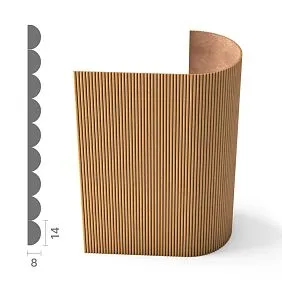
- Flexible slatted panels: for non-standard architectural solutions
- Scenario "neutral classic": when you don't need to choose a pole
- Layout: where to place slatted panels in a bedroom
- One accent wall
- Two adjacent walls
- Slatted ceiling in the bedroom
- Mistakes that make a bedroom feel heavy
- Too many carved details
- Heavy floor-length curtains with a valance
- Dark furniture plus dark walls without a white accent
- Overloading decor on bedside tables
- Cold light
- Practical plan: how to furnish a bedroom with slatted panels and classic furniture
- Slatted panels in living room and bedroom interiors: a systematic approach
- FAQ: Answers to Popular Questions
- About the Company STAVROS
The bedroom is the only room in the house where a person allows themselves vulnerability daily. Guests are not received here, impressions are not made, status is not displayed. Here, one recovers. And that is precisely why mistakes in bedroom interiors cost more than anywhere else: an overloaded space brings no peace, visual chaos prevents the brain from switching off, and poorly chosen materials turn the night into an irritating experience.
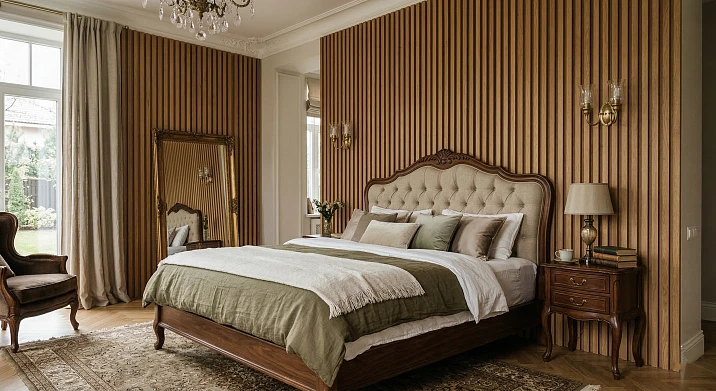
Combinationof slatted panelsandclassic bedroom furniture— one of the few design unions that operates on multiple levels simultaneously: architectural, emotional, material. It combines the modern rhythm of slats with the refined plasticity of classical form—and, when executed correctly, creates a space that is simultaneously calm, status-driven, and profound in meaning.
A bedroom is not a living room. Different spatial logic.
Before discussing materials and furniture, it's important to distinguish the tasks. The living room is a representative space, a place for dialogue with the world. Accents, contrasts, and strong visual statements are appropriate there. The bedroom operates on a different principle: it should lower the tone of the nervous system, not sustain it.
This doesn't mean the bedroom should be boring or devoid of character. It should be composed. Every element of the interior—in its place, with a clear function, without excess. It is precisely here that the feeling designers call 'quiet luxury' arises. It's not a lack of quality, but its concentration without ostentation.
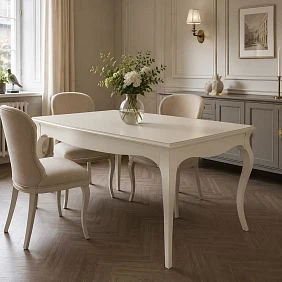
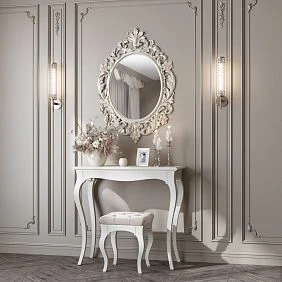
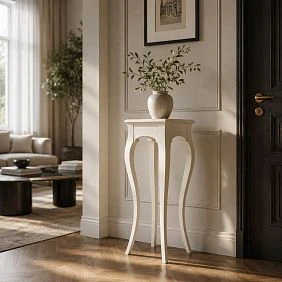
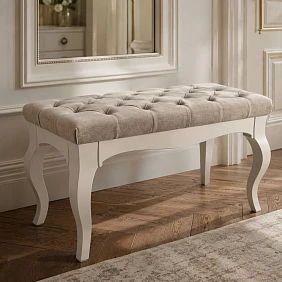
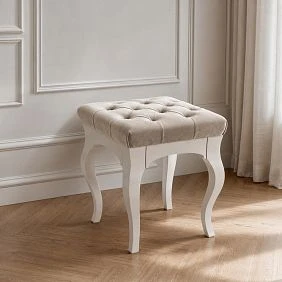
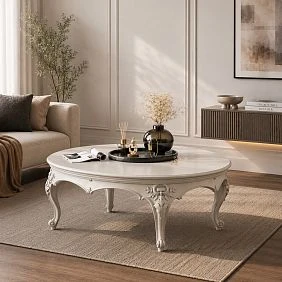
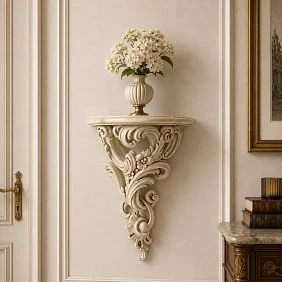
classical bedroom furniture—a bed with a headboard, nightstands, a dresser or vanity with a mirror—carries this logic inherently. The classical form is restrained in its pretensions: it doesn't shout, it is present. Add a slatted panel behind the headboard, and the space gains architectural depth without a single superfluous decorative gesture.
The question is how not to ruin this union. How not to turn a bedroom with classical furniture and slatted walls into either a faceless hotel room or a historical interior overloaded with details. The answer lies in understanding the logic of each element and their interaction.


Slatted panel behind the headboard: architecture instead of decor
The wall behind the headboard is key in the bedroom. It is the first thing that comes into view upon entering, it shapes the image of the space. And it is precisely hereslatted panels for wallsthat they work with the greatest effectiveness.
Our factory also produces:
What does the slat do with the headboard
The slatted panel at the headboard serves several functions at once, which would otherwise require separate design solutions.
-
Zoning — it delineates the sleeping area as an architecturally independent volume, separated from the rest of the space. This is especially important in large bedrooms where the bed might get lost in the space.
-
Scaling — the vertical rhythm of the slats draws the eye upward, visually increases the height, and makes the space feel more airy.
-
Background — it creates a neutral, textured background against which the bed's headboard stands out as an independent form, without blending into the wall.
-
Acoustics — slatted panels with a backing of mineral wool or polyester foam reduce the level of reverberation in the room, which directly impacts sleep quality.
The last point is rarely discussed in design articles, but it is critically important.slatted panels in the bedroomWith acoustic backing — it is not only an aesthetic but also a functional solution that makes the room quieter, softer in sound, and physically more comfortable.
Get Consultation
Width and height of the panel
The slatted panel at the headboard can be executed in several formats:
The entire wall from floor to ceiling. The most architectural option — it transforms the wall into a single volume. Works well with ceilings from 2.7 m and in bedrooms with an area from 16 m², where the slatted surface does not overwhelm the space.
Headboard panel - "frame". The slatted panel occupies only part of the wall - exactly behind the bed, with a slight indentation from the ceiling and sides. This is a more delicate option, creating a niche-niche around the bed. It is organic in medium-sized bedrooms and pairs especially well with classic furniture that has a high headboard: the bed "enters" the slatted niche as if into a frame.
Panel at headboard height plus 30–40 cm. The most laconic option - works as a decorative belt at bed height. Suitable for modern classics with a moderate headboard.
What classic furniture does not conflict with slatted walls
Not every classic form works equally well next to a slatted panel. There are categories of furniture that are organic in this union, and those that require careful consideration.
Beds with a soft headboard
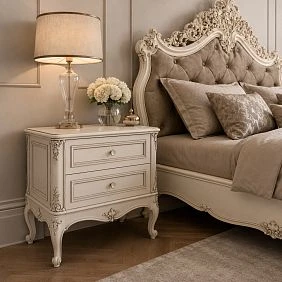
A soft headboard in a classic shape - rectangular with rounded corners, arched, with button or channel tufting - is perhaps the most harmonious option for pairing with a slatted wall. The soft form contrasts with the rigid geometry of the slats, and this contrast is tactile: wood versus upholstery, straight lines versus soft ones.
Furniture for bedrooms in classic stylewith a soft headboard upholstered in linen, velvet, or genuine leather fits organically into a space with a slatted wall. The upholstery adds warmth and softness, the slats add structure and rhythm.
Beds with a wooden headboard
A wooden headboard with classic details - milled panels, moldings, carved elements - creates a material dialogue with the slatted wall. If the headboard is made of oak or walnut, and the slatted panel is also oak - this is a material rhyme that makes the space cohesive. It is important that the wood tone of the headboard and the tone of the slatted panel are either identical or differ enough not to seem like a random mismatch. Tonal unity or deliberate contrast - there is no third way.
Bedside tables: size and shape
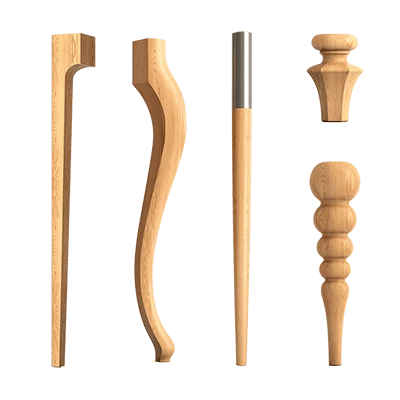
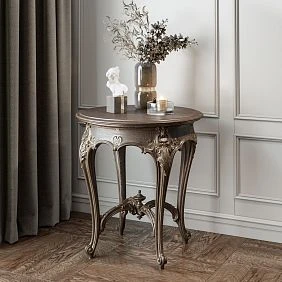
Classic bedside tables with small legs on curved supports, featuring one drawer and an open lower shelf, are the perfect scale for a bedroom with a slatted wall. They do not cover the slats, do not compete with them in complexity, but also do not get lost against their background.
Avoid bedside tables that are too bulky—massive tables in a classic shape, especially those with tall carved fronts, can compete with the slatted wall for the dominant role in the headboard area. There should be one leader in the space—either the bed or the wall. The tables should be allies, not contenders.
Dressers and vanities
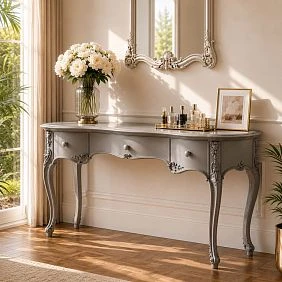
A dresser in a classic form—with profiled fronts, on legs, with brass or bronze hardware—works as an independent accent on a wall without a slatted panel. On a wall with a slatted panel, it works even more convincingly: the slats create a background, and the dresser reads as a sculpture, not just a 'storage item.'
A vanity with a mirror is a separate story. Ifclassic bedroom style interior furniturea vanity is planned, it is better to place it against a wall without slatted panels or by a window. The vanity mirror is an independent decorative element, and proximity to a slatted surface can create an excess of textures.
Light scenario: air, milk, and oak slats
A light-colored bedroom interior with classic furniture and slatted panels is the most in-demand and versatile scenario. It works in apartments with moderate natural light, in medium-sized bedrooms, in interiors without pretensions to theatricality—and at the same time creates a feeling of quiet, mature elegance.
Color foundation of the light scenario
Slatted panel: MDF in a warm white color (RAL 9001, RAL 9010, or similar tones), or solid oak with minimal light tinting that preserves the natural grain pattern.
Furniture:Light classic furnitureIn the colors of milk oak, beige ash, crème brûlée. Headboard upholstery — natural linen, warm cashmere, fine-textured cotton in ecru or soft sand.
Floor: light parquet or laminate in a natural oak tone, a light carpet with a barely noticeable texture.
Textiles: bed linen in white or ecru, a soft blanket in cashmere or gray-beige tone.
Ceiling: white, matte, without moldings.
Why the light scenario works
A light space maximizes the impact of every architectural element.Slatted wall panelsIn a light tone with side lighting, they create a subtle play of shadows in the gaps between the slats — this is the very 'living surface' that cannot be achieved with painted walls or wallpaper. Classic furniture in a light finish against such a background looks weightless and noble.
The key condition for a light scenario is tonal unity without complete identity. If the slatted panel is in warm white, the furniture should not be in cold white. If the oak slats have a slight tint, oak furniture should be in a similar but not identical tone. A slight tonal variation within the light palette gives life to the space. Complete monotony is sterility.
Light in the light scenario
Warm light 2700–3000 K is an absolute rule for a light classical bedroom. Cold shades at 4000+ K turn warm neutrals gray, kill the golden hue of oak, and make white surfaces bluish.
Recessed ceiling spotlights, aimed at the slatted wall at a 30–45 degree angle, will provide that very play of shadows in the gaps between the slats. Table lamps with fabric shades will give soft diffused light by the bed.
Dark scenario: depth, status, nocturnal character
A dark bedroom with classic furniture and slatted panels is a completely different statement. This space is not for air and light, but for depth and silence. It creates a feeling of refuge, protection—physiologically it is closer to a cave, and that is precisely why some people sleep significantly better in dark bedrooms.
Color foundation of the dark scenario
Slatted panel:Painted MDF plank panelsin a dark saturated tone—deep gray-green, dark blue (e.g., Hague Blue or similar), anthracite, dark plum, or swamp. OrWooden slat panelsmade of oak with a finish resembling bog oak or tobacco.
Furniture:classical bedroom furniturein a dark finish—walnut, dark oak, wenge with a classic profile. Or white or cream furniture as a deliberate contrast against a dark background—this is a very powerful technique.
Floor: dark parquet with a matte finish, a dense carpet in a dark tone.
Textiles: white or light gray bedding — maximum contrast that works as a source of visual light in a dark space. Curtains — dense, dark, blackout.
White classic furniture against a dark background
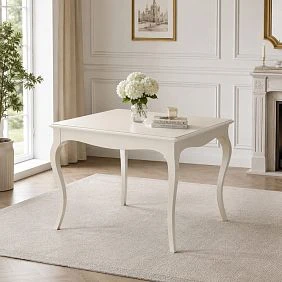
A special and very effective option —White classic furnitureagainst a dark slatted wall. A bed with a white lacquered headboard or upholstery in snow-white linen against a wall of deep blue or anthracite — this contrast works like light in darkness.
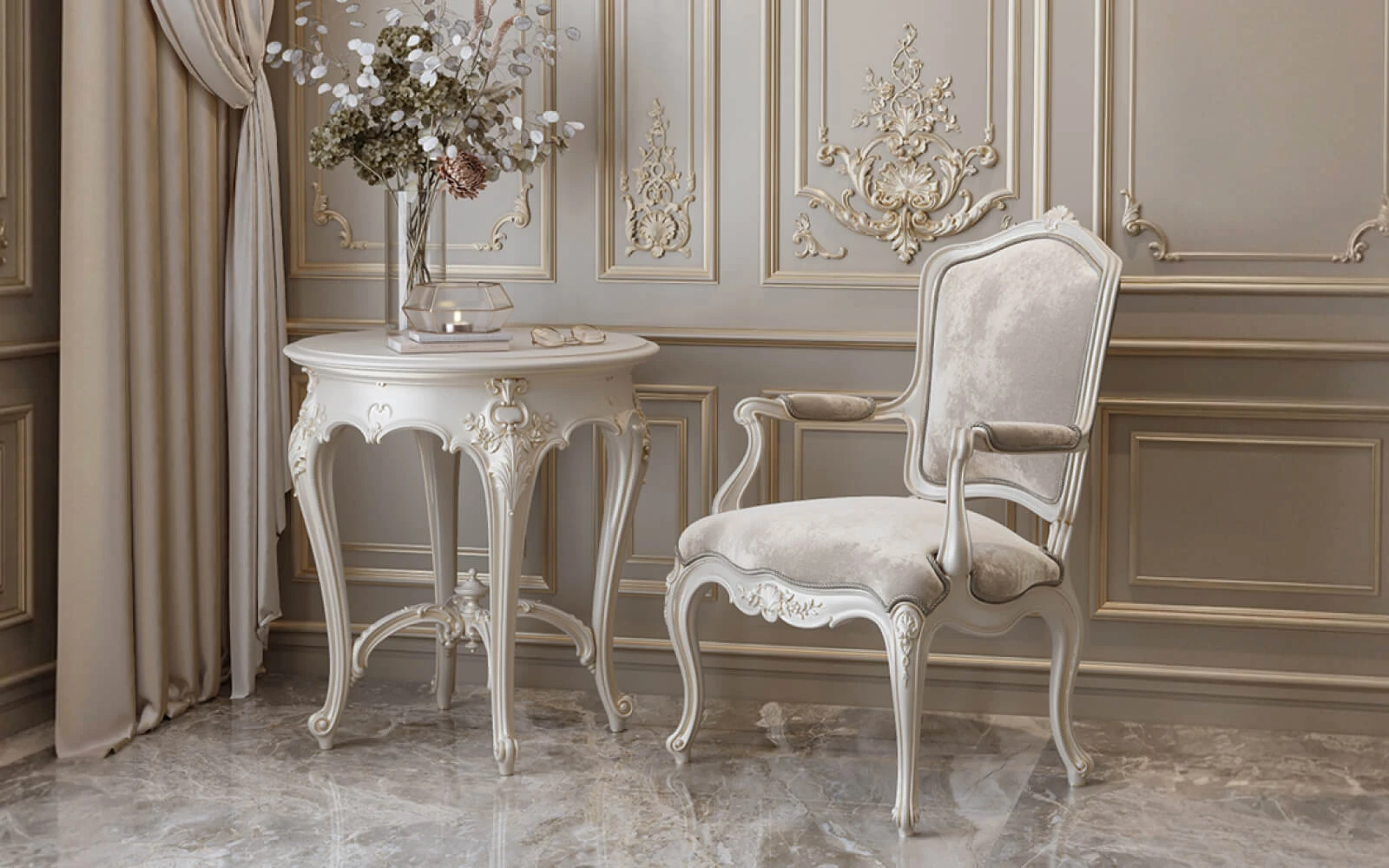
White Baroque or Neoclassical furniture is traditionally associated with French interiors — Louis XVI, Directoire, Empire styles. In the context of a modern dark space, this whiteness takes on new meaning: it doesn't seem provincial or old-fashioned, it seems intentional and strong.
That's why, if you're planning to buy classic bedroom furniture with a white finish and looking for the right background for it, a dark slatted panel is one of the most convincing answers.
Light in a dark scenario
In a dark bedroom, light is not a source of general illumination, but a tool for accentuation. Minimal overhead lighting, maximum spot and local lighting. LED strip behind the slatted panel —Slatted panels with lighting— creates an effect of glowing wall depth that looks truly magical in a dark space. Warm glow of 2700K, hidden behind the slats, turns the wall into a source of atmospheric, diffused light.
Bedside table lamps — with opaque shades that direct a cone of light downward — will provide task lighting for reading without disrupting the dark atmosphere.
Cornices, baseboards, and decor: details that make all the difference
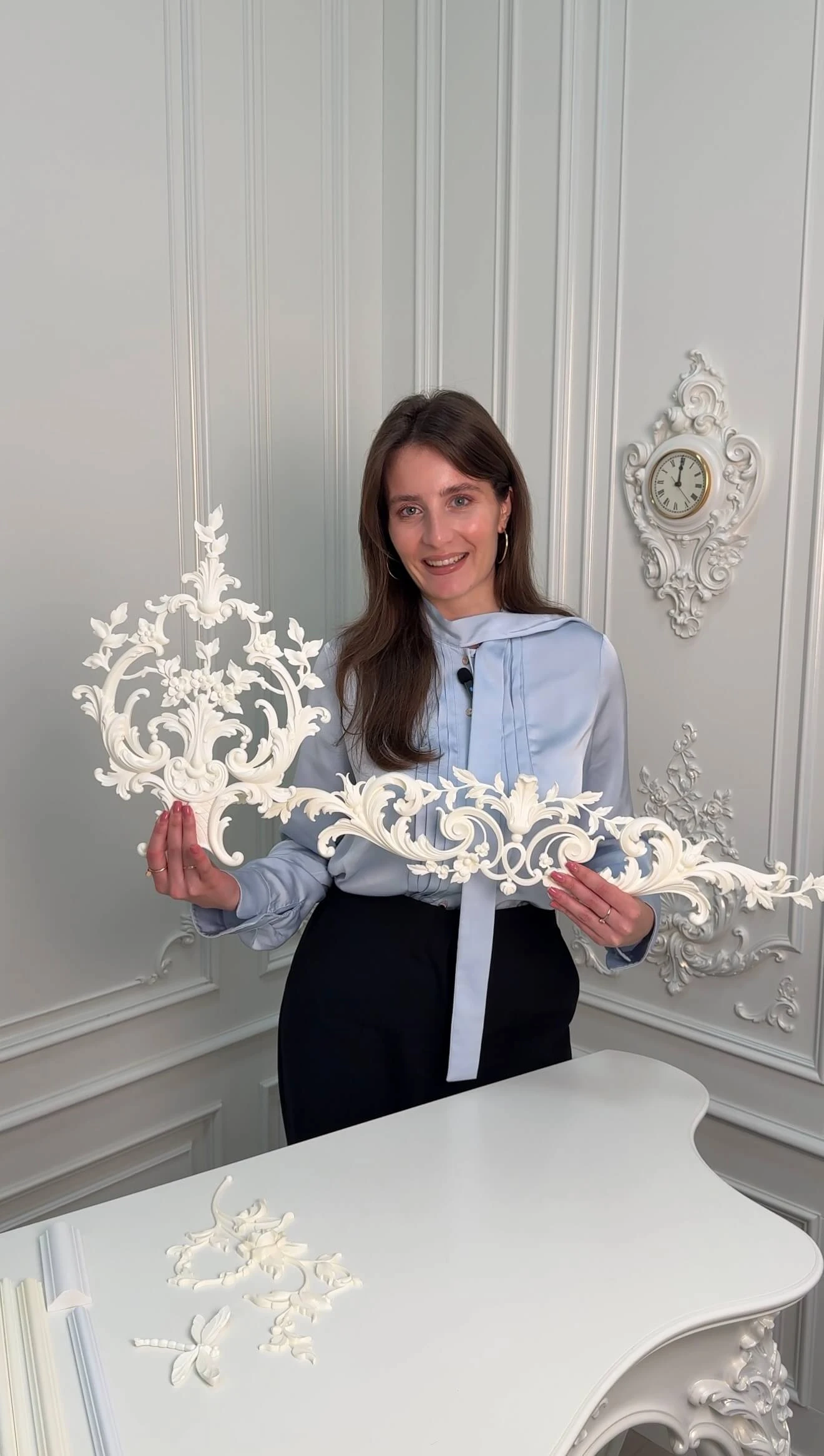
In a classic interior, details of architectural framing—cornices, baseboards, moldings—carry a function comparable in importance to the furniture itself. They organize the space, define its scale and stylistic affiliation. Paired with slatted panels, these elements require special attention.
Cornice and slatted panel: two approaches
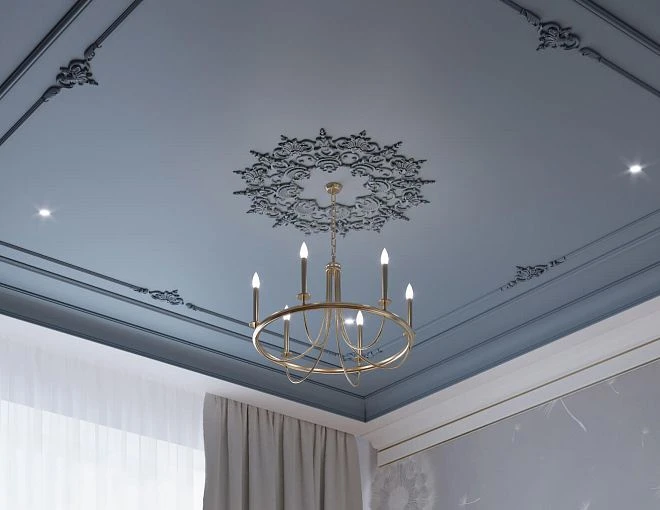
First approach: slat up to the cornice. The slatted panel runs from the floor to the lower plane of the ceiling cornice. The cornice is executed in a classic form—profiled, in the color of the ceiling or furniture—and completes the slatted surface like a box lid. This approach preserves the classic character of the space and is particularly organic with ceilings of 2.8 m and higher.
Second approach: slat up to the ceiling without a cornice. The slatted panel runs from the floor directly to the ceiling without a transition. This is a more modern, minimalist solution. There is either no cornice or it is very thin, almost unnoticeable. This approach emphasizes the modern character of the slatted surface, while classic furniture plays the role of a historical detail in a more restrained frame.
The choice of approach depends on which pole—classic or contemporary—should dominate. If the furniture is richly profiled, with carved details, a cornice will support its language. If the furniture is in a modern classic style with minimal details, a slat running to the ceiling will create a unified volume without unnecessary historical rhetoric.
Baseboard in a bedroom with slatted panels
The baseboard is a detail often underestimated. In a bedroom with slatted panels and classic furniture, the baseboard serves as a transition between two surfaces: the slatted wall and the floor. Here, two options work:
-
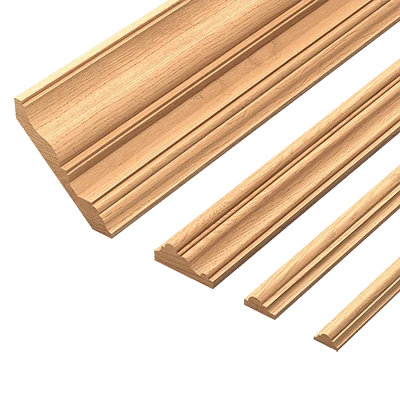
A wide classic baseboard (80–100 mm) in the color of the slatted panel or furniture—supports the classic architecture.
-
A thin baseboard (40–50 mm) in the color of the floor—'disappears,' not overloading the bottom of the wall, and emphasizes the slat.
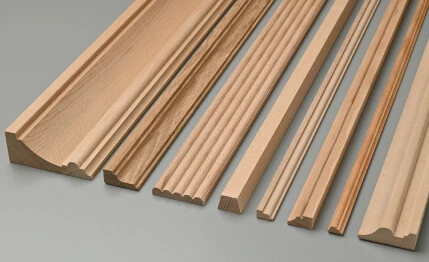
An intermediate option is a skirting board with a simple profile (one bead) in the color of the panel, 60–70 mm high — a universal solution that works with both classic furniture and modern slatted surfaces.
Moldings as a connecting element
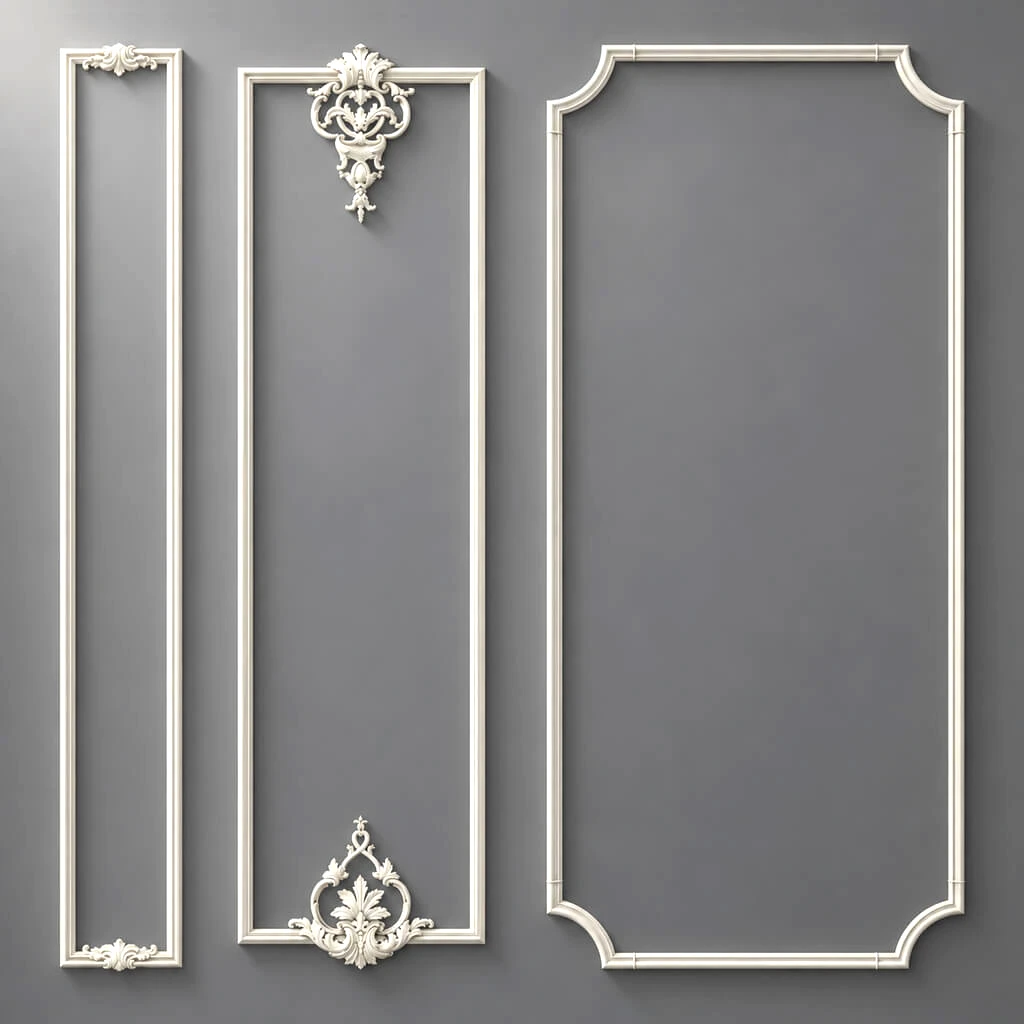
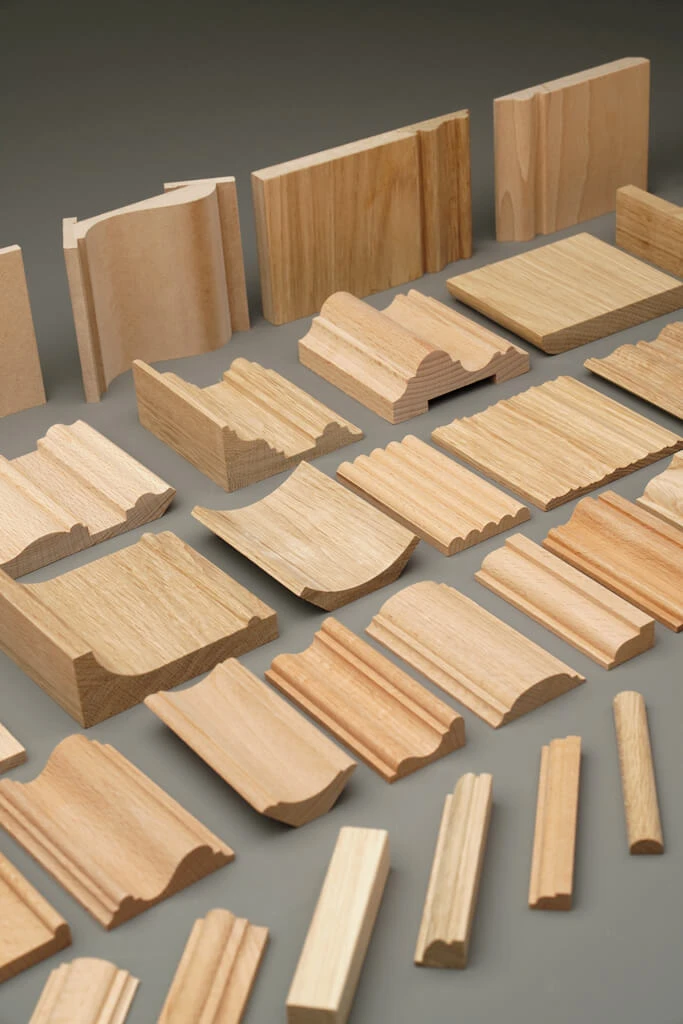
A horizontal molding at the level of the upper third of the slatted panel is another tool for working with classic space. It visually divides a high wall into belts and adds architectural scale to it. Paired with classic furniture, this technique creates a sense of a historical interior, refined with modern material.
Wooden slat panelsmade of oak with a molding from the same material — this is a solution that is difficult to distinguish from the work of a professional architect with years of experience in implementing classic interiors.
Materials for slatted panels: what to choose for a classic bedroom
Choosing the material for a slatted panel in a bedroom with classic furniture is primarily a question of attitude towards naturalness and color.
Solid oak: a living surface
Solid oak slat panelsis a material with character. The natural grain pattern of oak is unique in each board: one slat is lighter, another has a pronounced pattern, a third is almost uniform. This living pattern is exactly what distinguishes natural material from any imitation.
In a classic bedroom, oak slats create that very feeling of 'aged' luxury that cannot be bought in a mass-market store. A walnut chest of drawers against a wall with oak slats in a tobacco tint is a material conversation between two noble wood species, each carrying its own history.
Technically, solid oak in a bedroom is an optimal choice: oak is stable, does not deform at normal humidity of 40–60%, and does not require special care except for periodic application of protective oil or polish.
MDF for painting: color as architecture
MDF slatted panelopens up a color space inaccessible to natural wood. Any shade — warm white, deep blue, soft gray-green, saturated anthracite — is reproduced on the MDF surface with perfect evenness and depth. This is especially important for dark tones: wood under dark tinting often looks 'closed,' with the natural grain appearing uneven. MDF accepts dark color without these nuances — the surface remains smooth and velvety.
For a classic bedroom in a light version, MDF in warm white is a clean, neutral background that doesn't distract attention from the furniture. For a dark version — a deep, matte field on which classic furniture looks like a jewel in a velvet case.
Flexible slatted panels: for non-standard architectural solutions
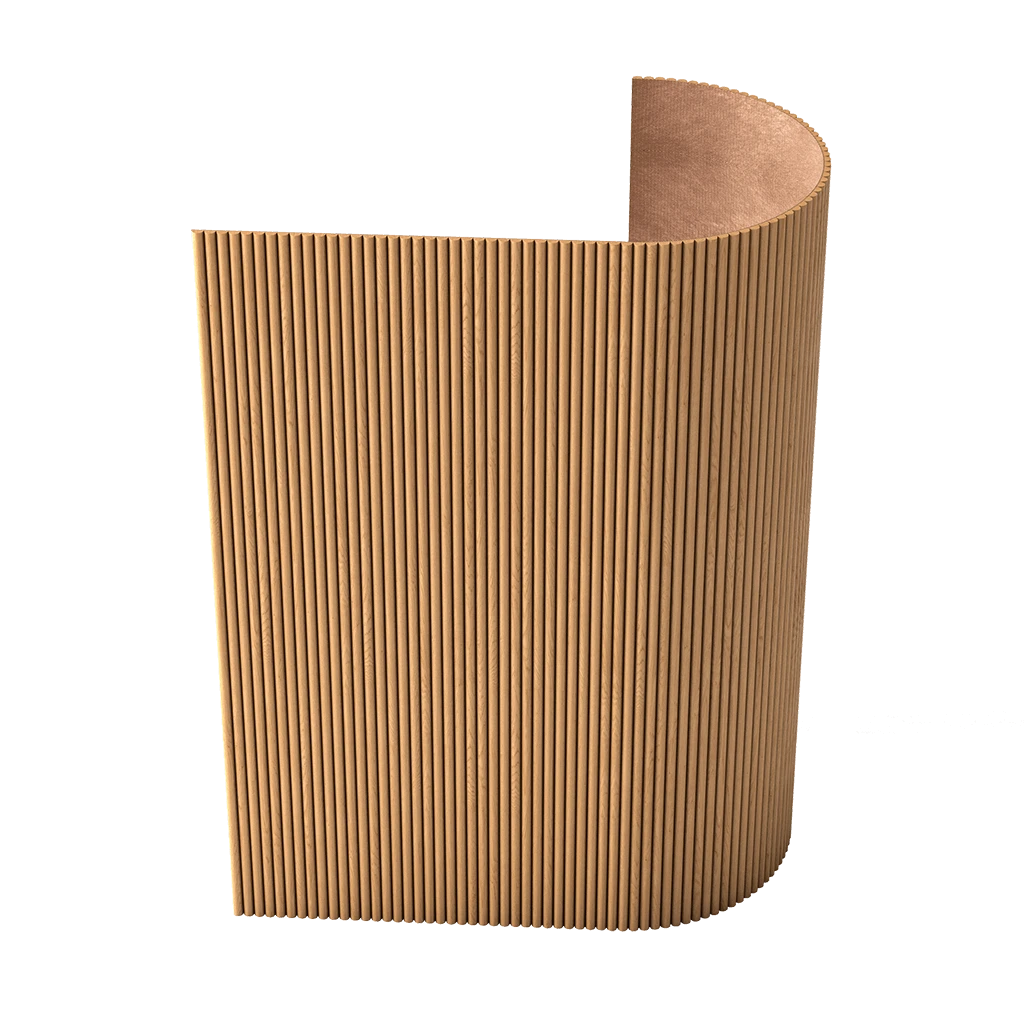
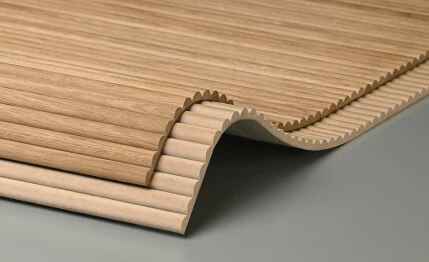
If the bedroom has arched niches, radius walls, or rounded architectural elements,Flexible slatted panelsallows them to be navigated without losing surface unity. This is especially relevant in classic interiors of old buildings — St. Petersburg houses with high ceilings and historical arched openings, where a standard rigid panel would require complex fitting.
Scenario 'neutral classic': when you don't need to choose a pole
Between the light and dark scenarios, there is a third way — neutral classic. This is a space without a pronounced tonal accent: neither lightened nor darkened. Slatted panels in warm gray-beige or gray-lilestone, furniture in the same range, floor in the natural tone of parquet, textiles in restrained shades.
This scenario requires maximum skill in working with tone: so that neutral doesn't become bland, each element must have a clear texture. Slats with pronounced gaps, upholstery with embossing or quilting, textiles with woven structure, floor with a brushed surface. All work is done through tactile diversity with tonal unity.
Layout: where to place slatted panels in the bedroom
Not only the wall at the headboard can be slatted. Let's consider layout solutions from the perspective of how a slatted panel works in a classic bedroom.
One accent wall
A classic genre and the safest approach. The wall at the headboard is slatted. The other three walls are solid-colored, in a neutral or contrasting tone relative to the slats. The slatted panel concentrates attention in the bed area, while the other walls remain 'quiet'. Classic furniture is placed against different walls, not competing for dominance.
Two adjacent walls
A bolder option: slatted panels on the wall at the headboard and on the adjoining side wall—usually the one where the dresser or vanity is located. This creates a corner volume, wrapping the bed area with two architectural surfaces. It's important that the corner joint of the panels is executed precisely—butt-jointed at 45 degrees or using a special corner profile.
Slatted ceiling in the bedroom
Batten panels for ceilingsIn a bedroom with classic furniture, this is a non-trivial solution, but when executed correctly, it's incredibly powerful. A slatted ceiling, especially with widely spaced slats and backlighting behind them, creates a sense of a canopy, a tent—a primal feeling of protected space, which is psychologically associated with safety. Classic furniture under a slatted ceiling looks like interior items in a wooden library—substantial and confident.
Mistakes that make a bedroom feel heavy
Even with the correct choice of materials and furniture, incorrect decisions in details can ruin the space. Here are the most common mistakes in bedrooms with slatted panels and classic furniture.
Too many carved details
A carved headboard plus a carved dresser plus a carved mirror frame plus a molded cornice—and the space turns into a catalog of joinery work. Ornamental overload in a bedroom doesn't allow for peace: the brain continues to process the complex form even in semi-darkness, preventing complete relaxation.
Solution: one item with carved details—a bed or a chest of drawers—maximum. Other items should have a simple profile.
Heavy floor-length curtains with a valance.
Heavy drapes with ruffles, pleats, tassels, and tiebacks in a classic bedroom with slatted panels are a direct path to an antique shop, not a sleeping space. Slatted panels are modern in spirit, and heavy historical textiles disrupt their logic.
Solution: dense solid-color curtains made of linen or velvet without decorative elements. Length—strictly to the floor, without extra centimeters. Curtain rod—ceiling-mounted, hidden, or thin metal.
Dark furniture plus dark walls without a white accent.
A dark slatted wall plus dark furniture, in the absence of light accents, turns the bedroom into a cave with no exit. This is not 'atmosphere,' it's oppression. White bedding, light textiles, a mirror with a reflective surface—mandatory light accents for a dark color theme.
Overloading decor on bedside tables.
Several candles, a stack of books, a houseplant, a lamp, a photo frame, a vase with dried flowers—all at once on a small bedside table. In a classic bedroom with a slatted wall, such chaos ruins all the work of creating a cohesive space.
Solution: bedside table—a lamp and one additional item. Nothing more. Everything extra—in the drawer.
Cold light.
Already mentioned in relation to the light scenario, but for a classic bedroom this rule is absolute: no cold light. Neither in the main lighting nor in the accent lighting. Warm LEDs 2700–3000 K are the only acceptable range.
Practical plan: how to furnish a bedroom with a slatted panel and classic furniture
To translate theory into practice, let's consider a step-by-step algorithm for creating a bedroom.
Step 1. Determine the scenario — light, dark, or neutral. This is a fundamental choice on which all subsequent decisions depend.
Step 2. Choose the main piece of furniture — the bed. It is the bed that determines the scale, style, and tonality of the entire space.Buy classic bedroom furnitureshould be done before the final selection of the slatted panel, because the size, shape, and color of the bed determine the parameters of the slatted background.
Step 3. Choose the slatted panel — material, format, color. Focus on the bed: a tonal rhyme or a deliberate contrast.buy wall slat panelstaking into account the wall dimensions — width and height — to calculate the amount of material.
Step 4. Select the remaining furniture — nightstands, dresser, mirror. They should follow the same stylistic logic as the bed but not overload the space with additional complexity.
Step 5. Choose lighting — main (warm spotlights or a chandelier without cold light) and local (bedside table lamps, possible backlighting behind the slatted panel).
Step 6. Textiles — curtains, bedding, a throw blanket, a rug. All decisions are made after selecting furniture and panels, as the final layer.
Step 7. Installation —installation of slatted panelsis performed on a prepared wall: leveled, primed, with installed backings for heavy mirrors or light fixtures. Installation is the final stage of renovation, after finishing work and before arranging furniture.
Slatted panels in the living room and bedroom interior: a systematic approach
If you plan to use slatted panels not only in the bedroom but also in other rooms, it is important to build a system.Slatted panels in the living room interiorand in the bedroom can use the same material — for example, oak slats in the same tone — creating a sense of a unified architectural solution throughout the apartment. Or, conversely, use oak slats in a natural tone in the living room, and MDF for painting in a dark shade in the bedroom, creating different emotional climates between the rooms while maintaining a unified stylistic logic.
Systematic solutions enhance the feeling of professional interior design. An apartment where each room speaks with its own voice, but all voices belong to the same ensemble — that is the highest goal of design.
FAQ: Answers to popular questions
Can MDF slatted panels be used in a bedroom with classic furniture if the ceilings are low — 2.4 m?
Yes, but with adjustments: choose a light panel tone and thin slats with a narrow gap — this will visually stretch the space upward. Avoid horizontal moldings that divide the wall into parts and reduce the perceived height. Mount the panel up to the ceiling without a cornice — this maximizes the use of height.
How to combine slatted panels with wallpaper in a classic bedroom?
A slatted panel at the headboard and wallpaper on the other three walls is a workable option provided the wallpaper is neutral: solid-colored, with a subtle, barely noticeable pattern, or with a thin stripe matching the panel's tone. Avoid large ornamental patterns on the wallpaper—they will compete with the slatted texture.
What is the optimal height for a slatted panel in the headboard area?
The standard solution is a panel 30–50 cm above the top edge of the headboard. If the headboard is 120 cm high and the bed base is 30 cm high, the bottom edge of the headboard is about 150 cm from the floor. The panel should end at a height of 180–200 cm, which, with a ceiling height of 2.5–2.7 m, leaves a free upper section of the wall. An alternative is a floor-to-ceiling panel if the room's proportions allow it.
Do oak slatted panels in a bedroom require special care?
Oak with an oil finish requires renewal every 2–3 years with special furniture oil. Oak with a lacquer finish is practically maintenance-free. MDF under paint does not require special care, only careful handling to avoid mechanical impact. In a bedroom, where there is no high humidity or mechanical stress, both surfaces last for decades without losing their appearance.
What is better—to buy ready-made classic bedroom furniture or order custom-made?
Ready-made collections of classic furniture allow you to see the actual item before purchase and receive it faster. Custom-made furniture offers the ability to adapt dimensions to a specific layout and choose a non-standard finish color. If your bedroom has non-standard dimensions or you care about an exact tone to pair with a slatted panel, ordering to individual parameters will yield a more precise result.
How to position a mirror in a bedroom with a slatted panel at the headboard?
It is not recommended to hang a mirror opposite the bed—in some cultures, this is considered undesirable, but even from a design standpoint, a mirror opposite the bed creates a sense of doubled space that prevents the room from feeling cohesive. Optimal positions: above a dresser on a side wall, in a wardrobe opening, on a door. If the mirror is in a carved classic frame, it can become an independent accent on a neutral wall—without a slatted background.
Can you combine slatted panels and parquet made from the same wood in a classic bedroom?
Yes, and it's one of the most elegant solutions. Oak parquet and oak slats create material continuity: the wood flows from the floor to the wall, making the space literally wrapped in one material. It's important that the tone of the floor and the tone of the slats don't match exactly: the floor should be slightly lighter or darker, and the slats should have a different tint. Complete color identity deprives the space of depth.
About the company STAVROS
A bedroom interior is not a shopping list. It's a system of decisions where each element works towards a unified result. And STAVROS is a company that understands this system.
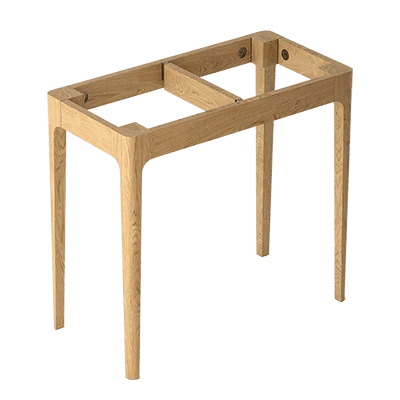
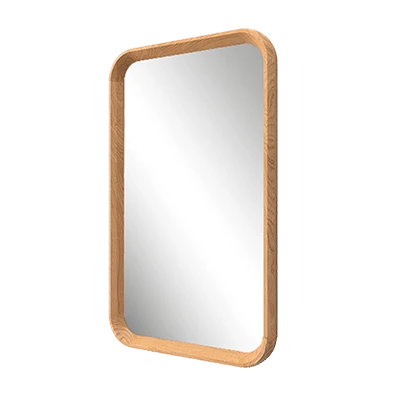
STAVROS producesslatted panels made of MDF and solid oakwith a full range of formats: rigid and flexible, paintable and tinted, in standard and custom sizes. Here also —classical bedroom furniture: beds, bedside tables, dressers, dressing tables, mirrors in custom frames — items where classic form is combined with modern production quality.
When working with STAVROS, you get both key elements of the space from one manufacturer. This means the ability to coordinate the color of slatted panels and furniture finish at the ordering stage, receive consultation on materials and proportions, and most importantly — be confident that the two elements of the space speak the same language because they are created with a shared understanding of what a real interior should be.