










































































Article Contents:
- The bathroom as an environment: why everything is different here
- The three main enemies of any finishing material in the bathroom
- Slatted panels in the bathroom: what really works
- Thermowood and thermoash: wood that is not afraid of steam
- WPC in the bathroom: practice without compromises
- Moisture-resistant MDF: does it exist?
- PVC slats: an unloved but honest option
- Aluminum slatted panels: minimalism and reliability
- Bathroom Zoning: Where Slatted Finishes Are Justified and Where They Are Not
- Zone 0: Inside the Bathtub and Shower Enclosure
- Zone 1: Immediate Proximity to Water (up to 60 cm from the edge of the bathtub or shower)
- Zone 2: The Remaining Bathroom Space (more than 60 cm from the water source)
- Wall Opposite the Shower: The Golden Zone for Slatted Decor
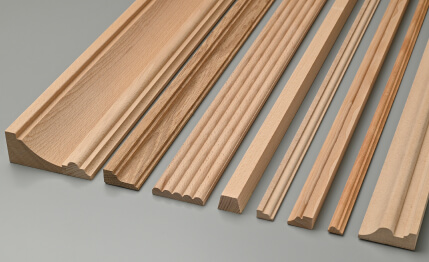
- Polyurethane Molding in the Bathroom: What Will Survive and What Will Not
- What Polyurethane Decor Is by Its Nature
- Three Conditions Under Which Polyurethane Decor Works in the Bathroom
- Where Decorative Polyurethane Molding Is Appropriate in the Bathroom
- Where Polyurethane Decor in the Bathroom Is a Bad Idea
- How to work with moisture and ventilation: technology is more important than design
- Ventilation standards for a bathroom with wooden materials
- Ventilated gap behind slatted panels in the bathroom
- Processing ends and joints: three vulnerability points
- When decor is needed and when it is harmful: a designer's view without illusions
- Small bathroom: less decor, more air
- Large bathroom: here decor works to its full potential
- Combined bathroom: zoning through materials
- Combining slatted panels and polyurethane decor in the bathroom: working schemes
- Scheme one: "Japanese bath"
- Scheme two: "Classic boudoir"
- Scheme three: "Modern minimalism"
- Typical bathroom mistakes with pretensions to "luxury"
- Mistake one: MDF in a bathroom without ventilation
- Mistake two: ordinary (non-facade) molding on the wall near the sink
- Mistake three: dark slats in a small dark bathroom
- Mistake four: rich decor in a functional bathroom
- Mistake five: installation without a ventilated gap
- Mistake six: incompatible decor styles
- Care for slatted panels and polyurethane decor in the bathroom
- Care for wooden slats in the bathroom
- Care for polyurethane decor in the bathroom
- Slatted panels and polyurethane decor: visual solutions for different bathroom styles
- STAVROS: everything for a bathroom with character
- FAQ: popular questions about slatted panels in the bathroom and polyurethane molding
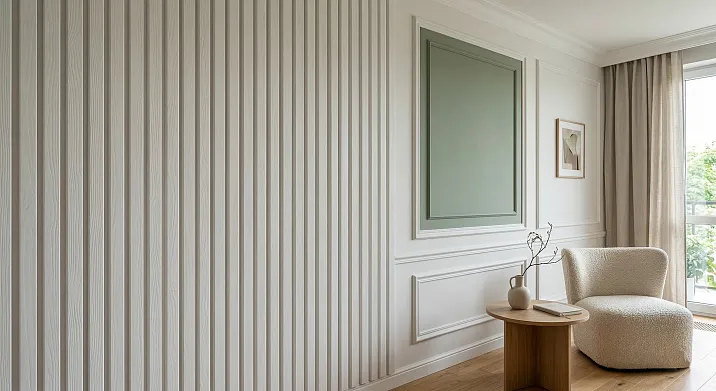
The bathroom is a space where every material is put to the survival test. It forgives no technological errors: moisture condenses on every surface, temperature swings from +18 to +55°C within an hour when the shower is on, ventilation either works properly or turns the space into a tropical greenhouse. That's why discussing slatted panels for the bathroom and polyurethane molding in the bathroom isn't a conversation about beauty. It's first and foremost a conversation about common sense.
Two materials, two characters, one environment. Slatted panels for the bathroom is a query rapidly gaining popularity in the interior segment.Polyurethane moldingsin bathrooms is a trend that came from luxury hotels and private mansions. But behind the beautiful photos on social media lies a multitude of nuances that separate a successful result from a disaster that reveals itself after a year of use. Let's break it all down honestly, with numbers and without illusions.


The bathroom as an environment: why everything is different here
Before discussing specific materials, it's necessary to understand exactly what they'll have to face. The bathroom isn't just a 'wet room'. It's a combination of several aggressive factors acting simultaneously.




Three main enemies of any finishing material in the bathroom
Cyclic humidity. During showering or bathing, the relative humidity in the room rises to 90–100%. Afterwards — with ventilation running — it gradually decreases to 50–60%. This cycle repeats daily. Materials not designed for such conditions begin to deform not immediately — precisely due to the cyclical nature. Each swelling and drying cycle leaves a trace.
Direct water exposure. In the shower area and near the bathtub, water comes into direct contact with surfaces. This is fundamentally different from simply high air humidity. Here, a hydrophobic surface is needed, capable of not absorbing water even upon direct contact.
Temperature fluctuations. Hot water, steam, cold air from ventilation — all of this creates thermal stress for materials. Expansion and contraction, albeit small, over time destroy seams, joints, and adhesive connections.
Understanding this triad is the key to making the right choice. Now let's see how slatted panels for bathrooms andPolyurethane decor for interiorshandle each of these factors — or fail to handle them.
Our factory also produces:




Slatted panels for the bathroom: what really works
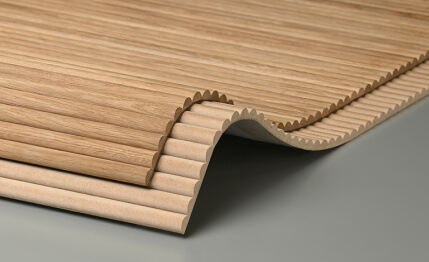
The search query 'slatted panels for the bathroom' combines fundamentally different materials that behave completely differently in bathrooms. You can't just buy 'beautiful slats' and expect a good result. The result is determined by the material — and only by it.
Get Consultation
Thermowood and thermoash: wood that is not afraid of steam
Thermowood is natural wood that has undergone thermal modification at a temperature of 180–220°C in an oxygen-free environment. During this process, sugars and resins, which serve as a breeding ground for mold and fungus, are removed from the wood, and hygroscopicity is reduced by 40–60% compared to untreated wood.
This makes thermowood the only natural wood that can be used in bathrooms without major reservations — provided it is installed correctly.Wooden slat panelsThermowood in the bathroom offers natural texture, warm tones, and a spa-like atmosphere. Japanese and Scandinavian interiors have long used this approach: wood near water is not a contradiction, it's a philosophy.
Conditions for using thermowood in the bathroom:
-
Installation on a ventilated batten with a gap of at least 15–20 mm from the wall.
-
Final treatment with water-repellent oil or wax specifically for wet areas.
-
Mandatory room ventilation: forced exhaust with a capacity of 50–80 m³/h.
-
Not recommended in areas of direct water exposure (near the shower head, by the bathtub edge). Use tile or special waterproof coating here. Slatted panels are for walls outside the wet zone.
WPC in the bathroom: uncompromising practicality
Wood-polymer composite was originally created for outdoor conditions: it is not afraid of water, does not swell, rot, or succumb to mold. In the bathroom, WPC operates with a safety margin — bathroom conditions are milder for this material than the open outdoors.
DCP slatted panels— a technically flawless solution for any bathroom zone, including the area near the bathtub (not inside the shower cabin — this is fundamental). The only aesthetic nuance: WPC looks like an imitation of wood, and at close range in a private interior, this imitative nature is noticeable. For a bathroom in a modern minimalist style — good. For a bathroom aspiring to spa-class — thermowood is better.
Moisture-resistant MDF: does it exist?
An important clarification is necessary here. There are moisture-resistant MDF boards (marked HMR or 'moisture-resistant') that contain special binders that reduce water absorption. Such MDF withstands short-term exposure to moisture better than standard MDF.
But! Moisture-resistant MDF is not waterproof. With systematic condensation, insufficient ventilation, or water getting into the edges (edges are the most vulnerable spot of any type of MDF), it will still swell.Slatted wall panel made of MDFin a bathroom is only permissible under three simultaneous conditions: good ventilation, placement exclusively in a dry zone (no closer than 80–100 cm from a bathtub or shower), and reliable treatment of the edges with hydrophobic primer or silicone before installation.
Standard MDF without moisture-resistant marking is prohibited in bathrooms. This is non-negotiable.
PVC battens: an unloved but honest option
Polyvinyl chloride is completely indifferent to water. PVC batten panels do not swell, do not rot, and are easy to clean. They do not require special ventilation and are not afraid of direct splashes. In terms of technical characteristics for a bathroom, this is an ideal material.
Aesthetically, it's more complicated. PVC remains plastic, and in a modern interior with high demands on appearance, it loses to wood and WPC. But in a budget bathroom, in a Khrushchyovka apartment where the area is 3.5 m² and the goal is simply to make it neat and practical — PVC batten panels perform honestly and last a long time.
Aluminum batten panels: minimalism and reliability
Aluminum battens are moisture-resistant, hygienic, and durable. They are used in bathrooms of modern apartments, in high-tech and loft style bathrooms. Limitation: with insufficient ventilation, moisture actively condenses on cold aluminum — and if the gap behind the panels is not ventilated, this becomes a source of dampness on the wall.
Bathroom Zoning: Where Slatted Cladding is Justified and Where It's Not
Not all bathroom space is equally aggressive. The ability to read zoning is the ability to properly distribute materials. Roughly speaking, the bathroom is divided into three zones based on the degree of water exposure.
Zone 0: Inside the bathtub and shower enclosure
This is the only zone where slatted panels are never used. Here, only tile, acrylic, glass, special waterproof coatings are suitable. No wood, no MDF, no WPC—not even moisture-resistant ones.
Zone 1: Immediate proximity to water (up to 60 cm from the edge of the bathtub or shower)
Only tile or fully waterproof materials are possible here. If slatted panels are used in this zone—only PVC or aluminum. Wood, WPC, MDF—no.
Zone 2: The remaining bathroom space (more than 60 cm from the water source)
Here, slatted panels for the bathroom work fully. WPC, thermally modified wood with proper treatment, moisture-resistant MDF provided there is good ventilation—all of this is acceptable. It is precisely in this zone that that decorative effect is created: an accent wall opposite the bathtub, niche finishing, a vertical slatted accent by the mirror.
Wall opposite the shower: the golden zone for slatted decor
The wall opposite the shower or bathtub is the best place for slatted panels in the bathroom. There are no direct splashes, the visual effect is maximum (this is the wall a person sees while lying in the bathtub or taking a shower). Verticalslatted panels for wallsFrom thermally modified wood or WPC on this wall — it's a spa effect achieved with relatively modest means.
Polyurethane molding in the bathroom: what will survive, and what won't
Now for the most debatable question:Polyurethane moldingsin the bathroom — is it real or is it an illusion of an expensive interior that falls apart after a season?
The honest answer: it is real — if the conditions are met. And it's a disaster — if they are ignored.
What polyurethane decor is by its nature
Polyurethane is a polymer material consisting of two components and characterized by zero water absorption in its structure. Polyurethane itself is not afraid of water. This fundamental property of the material makes it potentially suitable for wet rooms — fundamentally more suitable than plaster molding, which crumbles from moisture and cracks with temperature fluctuations.
Polyurethane decorative molding for wallsin the bathroom — is not a designer's fantasy. It is a working technique used in 5* category hotels, in private spa areas of country houses, in bathrooms of elite apartments. But in these cases, behind the beautiful result lies a correctly executed installation technology.
Three conditions under which polyurethane decor in the bathroom works
The right adhesive. Standard mounting adhesive for polyurethane decor in interiors — is not for the bathroom. Here you need a moisture-resistant or waterproof composition: polyurethane adhesive-sealant, neutral silicone, or special compounds for wet rooms. When using ordinary adhesive, the seams between the decor and the wall surface get wet, the adhesive loses adhesion, and the decor begins to peel off.
Sealing joints. Every joint betweenpolyurethane interior decorationand the wall surface, and between individual decorative elements — must be sealed with moisture-resistant neutral silicone. Without this, moisture penetrates under the decor, and although the polyurethane itself is not affected by it, the wall surface beneath it begins to mold.
Room ventilation. Decor in a bathroom without proper ventilation is collecting problems. Moisture that is not removed from the room settles on all surfaces, including the decor, and creates conditions for mold development in the joints. Forced exhaust is a necessary condition for any decorative solution in a bathroom, not just for polyurethane.
Where decorative polyurethane molding is appropriate in a bathroom
Not throughout the entire bathroom — this is the first and most important limitation. Polyurethane decor in a bathroom is used in a targeted manner, in dry zones.
Ceiling perimeter. A ceiling cornice around the perimeter of the bathroom is a classic application. The ceiling in a bathroom is outside direct water exposure; condensation here is minimal with working ventilation. A thin polyurethane ceiling skirting board creates completeness of the space and provides a visual frame for the ceiling height.
Mirror framing. A mirror in a bathroom is the semantic center of the space. A frame made ofmoldings from polyurethanearound the mirror or decorative framing of a mirrored cabinet is an accent that creates class. Provided that the mirror is at a sufficient distance from the sink and splashes do not systematically get on it.
Decorative shelf niche. Built-in niches in bathroom walls are a modern functional element. Framing a niche with polyurethane molding creates architectural completeness.
Wall-ceiling transition in a dry zone. In bathrooms of sufficient area (from 6–8 m²), the area near the door is essentially a dry zone. Here, decorative moldings work fully.
Where polyurethane decor in the bathroom is a bad idea
Direct shower area — no. Bathtub rim — no. Wall with a sink in close proximity — only with strict adherence to sealing. Ceiling above the shower — extremely risky.
And another honest point: rich classical stucco with ornamentation, acanthus leaves, and complex profiles in a small bathroom of 4–5 m² is not 'luxurious.' It's overload. A small, enclosed space with a low ceiling does not benefit from excessive decor—it weighs down on a person. Common sense should prevail over aesthetic ambitions.
How to handle moisture and ventilation: technology is more important than design
Talking about decor in the bathroom without discussing ventilation is like discussing a car's paint job without making sure the body isn't rotten. Ventilation is the foundation of any successful interior solution in the bathroom.
Ventilation standards for a bathroom with wooden materials
The standard sanitary norm for air exchange rate in a bathroom is 8 room volumes per hour. For a bathroom of 5 m² with a ceiling height of 2.5 m, that's 100 m³/h. Most standard ventilation grilles in apartment buildings provide 30–50 m³/h—that is, 2–3 times less than the norm.
If you plan to install wood or DCP slatted panels in the bathroom—install a forced exhaust fan with a timer or humidity sensor. The timer should ensure the fan runs for another 20–30 minutes after leaving the room. This is an investment of around 2000–5000 rubles, which extends the lifespan of expensive wooden finishes by years.
Ventilated gap behind slatted panels in the bathroom
installation of slatted panelsIn the bathroom—only on battens with an air gap. Direct mounting of slatted panels to the wall in the bathroom is a mistake that blocks the path for condensation removal. Moisture accumulating between the wall and the back of the panel has nowhere to evaporate and destroys both the panel and the wall.
Minimum gap: 15 mm. Optimal: 20–25 mm. Battens — made of moisture-resistant material: aluminum profile or antiseptic-treated wood.
Treatment of ends and joints: three vulnerable points
In slatted constructions in the bathroom, three zones are critically important:
-
The lower end of the panels — is maximally vulnerable to capillary moisture absorption from below. Between the floor and the lower edge of the slatted system — a gap of 10–15 mm, covered with a moisture-resistant baseboard.
-
Joints between panels — must be sealed with neutral silicone, resistant to moisture and mold.
-
The junction with the tile — a transition zone between the tile finish of the wet area and the slatted panels. Here — a mandatory expansion joint with silicone, which compensates for the different expansion of materials.
When decor is needed, and when it is harmful: a designer's view without illusions
The bathroom is not a living room. The space is limited, the function is specific, interaction with a person is short-term but daily. The principles of decoration here are different.
Small bathroom: less decor, more air
A bathroom with an area of up to 5 m² is a space where every extra element of finish visually reduces it even more. Here, slatted panels are used only on one accent wall — typically, the one farthest from the entrance. Completely covering all walls with slats in a small room creates the effect of a wooden box — cramped and dark.
Slat color: in a small bathroom — light tones, natural light oak, ash, thermally modified ash with light processing. Dark slats — only with very good lighting and in a room of at least 6–8 m².
Polyurethane decorative molding for wallsIn a small bathroom: only a thin ceiling plinth 30–50 mm wide. No cornices, rosettes, complex moldings — they will overload the space.
Large bathroom: here the decor works to its full potential
A bathroom with an area of 8–10 m² is a completely different story. Here there is room for a full slat solution and for richer polyurethane decor. It is in such spaces that real spa bathrooms are created with warm wooden walls, polyurethane ceiling decor, and a freestanding bathtub as the sculptural center of the interior.
In a large bathroom, slattedwall panels for interior finishingcan occupy an entire wall or even two. A wooden ceiling made of thermally modified wood creates a completely different feeling of space — intimate, cozy, enveloping. Combined with polyurethane ceiling molding around the perimeter — this is already an architectural interior, not just a 'finished bathroom'.
Combined bathroom: zoning through materials
In a combined bathroom, slatted finishing performs not only a decorative but also a zoning function. Tiles — the sink and shower area. Slatted panels — the area by the bathtub and mirror. The transition between materials creates clear zoning without physical partitions, which is especially important in limited spaces.
This approach is described in materials aboutZoning of complex corridor and hall areas— and it applies in the bathroom exactly the same way: slatted rhythm as a tool for spatial delineation.
Combination of slatted panels and polyurethane decor in the bathroom: working schemes
How exactly to combine these two materials to achieve a unified visual image, rather than a collection of disparate solutions?
Scheme one: 'Japanese Bath'
Wooden slats of thermo-ash on three walls (except the wet area), light tone. Ceiling — white with a thin ceiling skirting boardpolyurethane40 mm wide, painted white. Tile in the wet area — large format in a neutral tone (gray, beige, dark khaki). Mirror — frameless or with a thin metal frame. No ornament, no classic elements.
This is a laconic, restrained image. The wood and polyurethane skirting work together as a unified system: the wood provides warmth, the skirting fixes the upper boundary of the space.
Scheme two: 'Classic Boudoir'
Marble-look tile on all walls up to a height of 140–160 cm (horizontal belt). Above — painted surface or decorative plaster. Ceiling cornicemoldings from polyurethane80–100 mm wide with a classic profile. The mirror in a polyurethane frame is the central element. Slatted panels are on one side wall in the bathtub area, made of dark-toned thermowood. The contrast of warm wood and cold marble is an archetypal combination of luxury.
Scheme three: 'Contemporary Minimalism'
Large-format tiles or slabs on all walls. Slatted inserts — only in one niche or as a vertical accent 40–60 cm wide on the end wall. No ceiling decor — only a flat stretch or painted ceiling. If polyurethane — then only a horizontal profile as a dividing strip on the wall, painted to match the tile color.
Here, decor works as an accent, not as a system. One wooden slat on a white or gray background says more than a wall entirely clad in wood.
Typical mistakes in bathrooms aspiring to look 'expensive'
Here is the most important thing — what ruins an expensive renovation and makes it resemble anything but a well-thought-out interior.
Mistake one: MDF in a bathroom without ventilation
A person chooses beautifulMDF Plank Panels, installs them in a bathroom without forced ventilation. It looks magnificent for six months. By the end of the first year — swelling of the ends, bulging of the lower rows, a characteristic mold smell from behind the wall. Demolition, restoration work, reinstallation. The cost of the mistake — double the renovation plus psychological losses.
Mistake two: ordinary (non-facade) molding on the wall next to the sink
A person chooses a beautiful polyurethane molding to decorate the wall above the sink. They attach it with regular mounting adhesive. After a few months of systematic splashes, the adhesive gives way, the decor starts to 'bubble' and peel off. Splashes get under the decor, moisture accumulates there, and after six months, mold appears on the wall.
The solution is simple: moisture-resistant adhesive, silicone sealing of all seams—and no problems. But you need to know this in advance, not after the fact.
Mistake three: dark slats in a small, dark bathroom
Dark wood is beautiful. In a small bathroom with a single low-power light source, dark slatted panels turn the space into a well. This is exacerbated by the fact that the slats create additional shadows due to their relief.
DarkWooden slat panelsin a bathroom—only with a lighting design that includes multiple sources, including side lighting. Or only in a large bathroom where darkness doesn't feel oppressive.
Mistake four: ornate decor in a functional bathroom
A bathroom with an intricate cornice, a ceiling rosette, double molding on the walls, and wooden slats on all available surfaces. But: the bathroom is 4 m² in area, the ceiling is 2.4 m high, without a separate sink (the toilet is right there), and a bare light bulb on the ceiling. The decor conflicts with function. The result is not 'luxurious' but 'confusing.'
Polyurethane decor for interiorsin a bathroom works only when the basic spatial solutions—proportions, lighting, plumbing, tiles—are already correct. Decor enhances what is already there. It does not fix poor layout or cheap plumbing.
Mistake five: installation without a ventilated gap
Slatted panels are glued directly to the wall. Between the wall and the back surface of the slat—zero millimeters. Condensation from the air penetrates this gap (or doesn't—because there isn't one, but then a 'cocoon' of humid air forms), and the wall slowly absorbs moisture. After a year—stains, after two—mold.
The correct technology isinstallation of slatted panels on the wallthrough battens with a mandatory air gap. In the bathroom, this is not an option—it's a requirement.
Mistake six: incompatible decor styles
Scandinavian light slats + a classic cornice with egg-and-dart molding + Italian onyx-look tile + industrial-style plumbing. This isn't 'eclectic.' It's stylistic chaos. Each element on its own isn't bad—but together they say nothing except the owner's confusion.
Unity of stylistic language in the bathroom isn't a formality. It's what creates the feeling of a well-thought-out interior even on a modest budget. The rule is simple: choose one style and one direction—and stick to it.
Caring for slatted panels and polyurethane decor in the bathroom
Proper care significantly extends the lifespan of any finish in high-humidity conditions.
Caring for wooden slats in the bathroom
Wooden slatted panels in the bathroom require annual renewal of the protective coating—oil or wax. Frequency depends on usage intensity: if the bathroom is used daily with hot showers—once a year. If it's a guest bathroom with rare use—once every two years.
Cleaning: soft damp cloth, neutral detergents. No aggressive chlorine-based cleaners—they damage the protective coating.
If darkening appears (water stain, light mold) — immediate treatment with a special wood antiseptic for damp areas. Delay worsens the problem many times over.
Caring for polyurethane decor in the bathroom
Polyurethane moldingsIn the bathroom, it can be cleaned with almost any neutral cleaner. The polyurethane surface is non-porous — moisture does not penetrate the material's structure. The main task is to regularly check the condition of the silicone seams where the decor meets the wall. Silicone ages after 5–7 years and begins to crumble. At the first signs of seam deterioration — immediate replacement: careful removal of old silicone, degreasing, application of new silicone.
If mold appears on the decor (possible with insufficient ventilation) — the surface is treated with an antiseptic solution, after which the silicone sealing of the seams is checked and renewed if necessary.
Slatted panels and polyurethane decor: visual solutions for different bathroom styles
We'll conclude with a practical visual guide — how the same materials work in different stylistic contexts.
| Style | Slat panels | Polyurethane decor | Color Palette |
|---|---|---|---|
| Japanese minimalism | Light-toned thermowood, vertically | Thin skirting board without profile | Beige, gray, cream |
| Classic | Thermowood dark oak or moisture-resistant MDF for painting | Cornice with profile, mirror frame | White, ivory, gold |
| Scandinavian | Light ash, horizontal slats | Only thin skirting board | White, gray, natural wood |
| Modern loft | Dark DPK or aluminum | None or minimal horizontal profile | Anthracite, black, concrete |
| Provence | Thermowood or moisture-resistant MDF for painting in white | Cornice with a simple profile | White, cream, dusty rose |
Choose the combination consciously — based on the overall design code of the apartment or house. The bathroom is part of a unified space, and its style should continue, not interrupt, the overall interior story. For inspiration, see how slatted solutions workin the living room interiororin the bedroom— and build a unified line.
STAVROS: everything for a bathroom with character
When it comes to properly selected materials for wet areas, STAVROS is the resource to turn to first. The assortmentslatted wall panelscovers formats from classic interior MDF solutions to moisture-resistant systems made of solid wood and WPC. The collectionpolyurethane decor for interiorsincludes elements for any stylistic solution — from a strict minimalist profile to a classic cornice with detailed craftsmanship.
STAVROS is not just a materials supplier. It is expertise in application: knowing which product works in which conditions, which combinations yield results, and which lead to disappointment. By choosing STAVROS, you choose materials with an understanding of their nature — and that is the foundation of any interior solution that lasts.
FAQ: Popular Questions About Slatted Panels in Bathrooms and Polyurethane Molding
Can slatted panels be glued directly onto tiles in the bathroom?
Technically possible, but not advisable. Tiles are a perfectly smooth surface, and adhesive adhesion to them is lower than to plaster or drywall. Additionally, with direct mounting on tiles, it is impossible to create a ventilated gap. The best solution is installing battens over the tiles or removing the tiles and replacing them with a proper base.
How long does polyurethane decor last in a bathroom if all conditions are met?
With proper installation, sealing, and normal ventilation—at least 15–20 years. Polyurethane is not susceptible to moisture, does not rot, and does not crumble. The only thing that requires periodic renewal is silicone seams every 5–7 years.
Do slatted panels made of WPC (Wood-Plastic Composite) need special treatment in the bathroom?
No. WPC does not require additional protective treatment—it is inherently hydrophobic. Regular cleaning with neutral detergents is sufficient.
Are slatted panels in the bathroom a trend or a long-term style?
It is a long-term trend, driven by the desire for a spa-like atmosphere in home interiors. Wood near water is an archetypal image that never goes out of style. When executed correctly, slatted panels in bathrooms look relevant now and will remain so for 10 years.
Can slatted panels made of different materials be combined in one bathroom?
Yes, but with caution. Combination is possible in different zones: WPC in wet areas, thermally modified wood in dry areas. They should be of the same color tone or similar shades. Different textures within the same tonal register create surface richness; different tones create a stylistic break.
Which slatted panels are better for a small 3 m² bathroom?
Light-colored, vertical, on one accent wall. Material - WPC or light-toned thermally modified wood. Slat width - no more than 60-80 mm: wider slats break up a small wall. Polyurethane decor - only a thin ceiling skirting board 30-40 mm in white.
Is approval required for installing slatted panels in the bathroom of an apartment building?
Installation of decorative finishes inside your own apartment does not require approval. Exception - if the work involves changing the wall structure, relocating plumbing, or altering ventilation ducts: this is already a redevelopment requiring approval.