





























Article Contents:
- When a slatted ceiling is the right solution and when it is not
- Three scenarios for using a slatted ceiling
- Which panels are suitable for ceiling installation: materials and parameters
- Natural wood for ceilings
- MDF slats for ceilings
- Formats of slatted ceiling panels
- Rosette and polyurethane molding for chandeliers: why a central decorative element is needed
- Types of polyurethane decor for chandeliers
- How to choose the size of a ceiling medallion for a slatted ceiling
- Combining the linearity of slats with central ceiling decor
- Architectural language 'minimalism': slats + ring
- Architectural language 'natural nordic': slats + minimalist ceiling medallion
- Architectural language 'modern classic': slats + molding frame + classic ceiling medallion
- Architectural language 'japandi': slats without a ceiling medallion or with a minimal ring
- Architectural language 'neoclassical': slats as a 'field' for a classic medallion
- How lighting, ceiling height, and pattern scale are interconnected in a unified system
- Ceiling height and the scale of the slatted pattern
- Axial lighting: chandelier, spotlights, hidden lighting
- How to correctly position an outlet and chandelier relative to the slats
- Polyurethane ceiling decor: full range for slatted ceilings
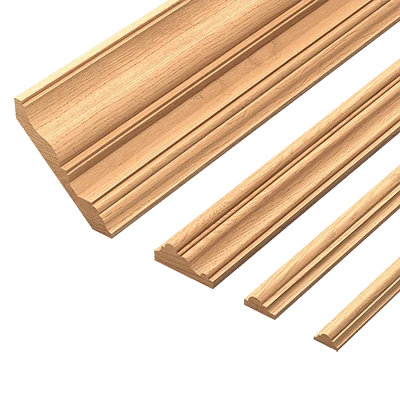
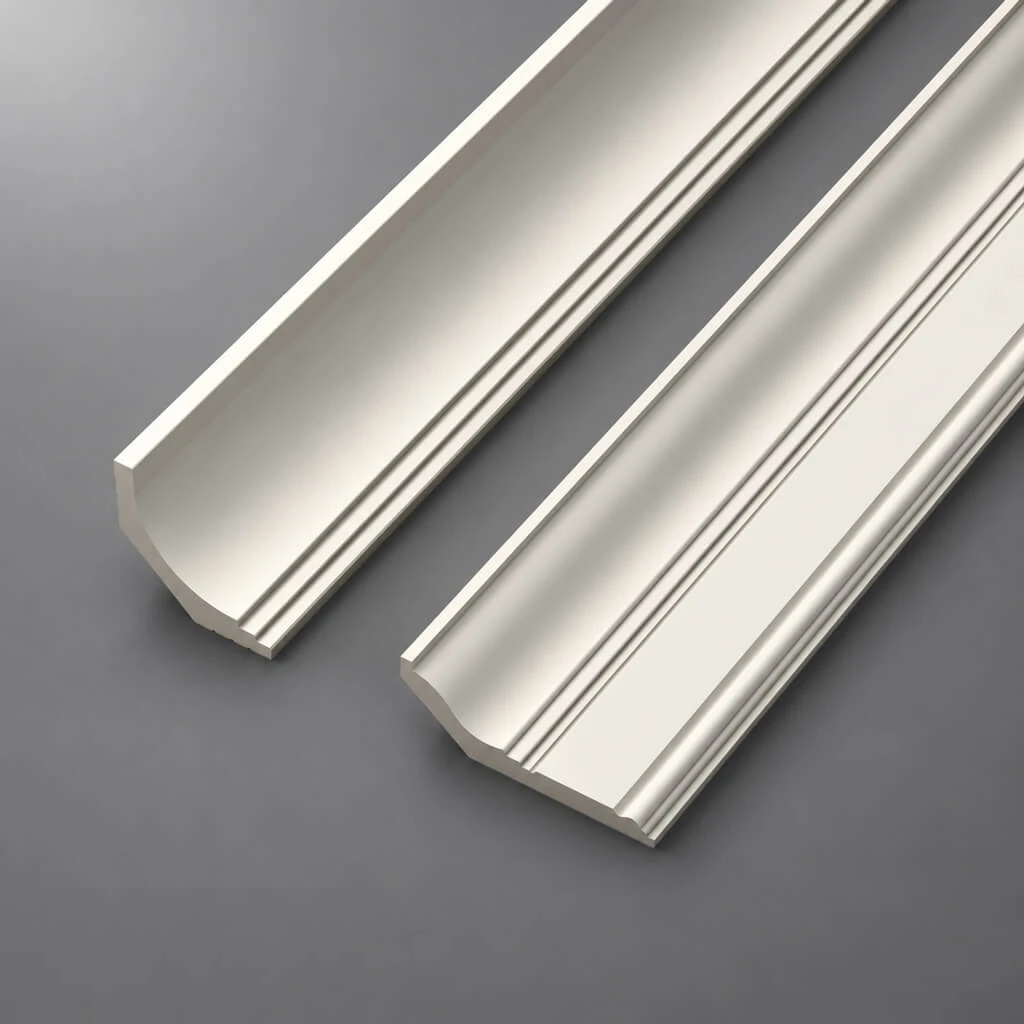
- Ceiling cornice: perimeter framing
- Decorative beams: horizontal rhythm across the slats
- Ceiling rosettes: assortment by style
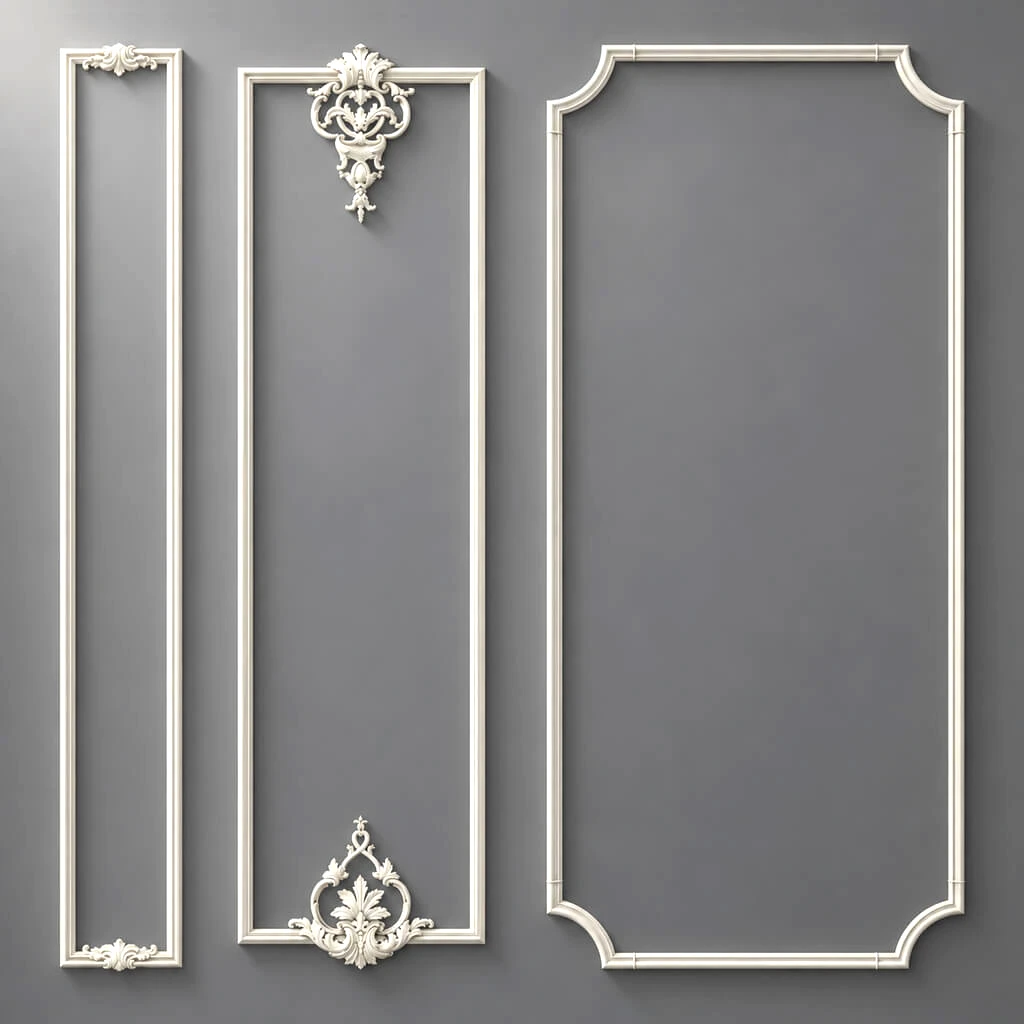
- Molding frames on the ceiling: geometry around the slats
- Mistakes in proportions and placement: what never to do
- Mistake 1: Rosette "off-center"
- Mistake 2: Too large a rosette with small slats
- Mistake 3: Slats "cut off" on the rosette unattractively
- Error 4: Different shades of wood slats and 'wooden' polyurethane beams
- Error 5: Cornice is too small for the room height
- Error 6: Lack of ceiling cornice with slatted ceiling
- Error 7: Chandelier of inappropriate size
- Five ready-made ceiling concepts: slats + molding
- Concept "White Forest"
- Concept 'Dark Scandinavian'
- Concept 'Mediterranean Terrace'
- Concept 'City Apartment'
- Concept 'Country House in the City'
- Frequently asked questions about ceiling slat panels and chandelier molding
- How much height does a slatted ceiling 'take up'?
- Can ceiling slatted panels be installed in a bathroom?
- How to choose a polyurethane rosette for a slatted ceiling?
- Is a perimeter cornice needed for a slatted ceiling?
- Polyurethane molding on the ceiling under a chandelier — how is it installed with already mounted slats?
- Can a slatted ceiling be combined with a stretch ceiling in the same room?
- Slatted panels for the ceiling — is acclimatization needed?
- Conclusion
The ceiling is the most honest surface in an apartment. You can't hide it with furniture, you can't 'distract' the eye with a rug or a painting. It exists in full force — or doesn't exist at all. A white plaster plane overhead is not a 'neutral background'. It's a missed opportunity. Because it is the ceiling that sets the scale of the space, defines its 'weight', and creates that sense of completeness which distinguishes an interior from just a 'furnished room'.
Batten panels for ceilings— is the answer to the question 'how to make a ceiling alive'. The natural rhythm of wooden verticals (or horizontals) overhead changes the character of the entire room: adds warmth where concrete dominates, creates scale where it is lacking, introduces natural texture where the eye expects it. AndPolyurethane molding under the chandelier— a rosette, medallion, decorative band — is the architectural 'center' of the ceiling composition: the point around which the entire pattern of slats, all the light, all the space overhead is organized.
This article is about how these two elements work together. Not separately, but as a system. How the linearity of the slat rhythm and the centrality of the stucco medallion create a ceiling scenario where there are no random decisions—only architectural logic and natural beauty.
When a slatted ceiling is the right solution, and when it is not
Before choosing slats for the ceiling, it's worth honestly answering three questions. Not because a slatted ceiling is a solution 'not for everyone,' but because it has optimal conditions for application—and conditions under which it works against the interior.
Ceiling height. A slatted ceiling 'takes away' height. The structure of the battens + slats 'eats up' from 40 to 80 mm. With a ceiling of 2.5 m—this is noticeable. With a ceiling of 2.7 m and above—the loss of height is compensated by the architectural effect of linear rhythm, which visually 'pulls' the gaze along the slats—creating a sense of movement and space.
Vertical slats on the ceiling (across the short wall of the room)—'expand' the space: the gaze moves along the slats, the room is perceived as longer. Horizontal slats (along the long wall)—'shorten' and 'lower,' creating coziness. The choice of slat direction is an architectural decision, not an arbitrary one.
Area and shape of the room. Ceiling slat panels are most effective in rooms from 16 m². In a small room (kitchen 8 m², bathroom 4 m²), a slatted ceiling over the entire area can create a 'pressing' effect. For small rooms—a partial slatted ceiling: an 'island' of slats above the work area or dining table.
Type of room. Ceiling slat panels made of natural wood—for dry rooms with normal humidity. For bathrooms—only MDF with moisture-resistant coating or special moisture-resistant wooden slats with oil-wax coating. For kitchens—slats with varnish coating resistant to steam.

Three scenarios for using a slatted ceiling
Scenario 'full ceiling': slats occupy the entire ceiling plane. Maximum architectural gesture. Requires a height of at least 2.7 m. Requires a clear decision on the central decorative element—Polyurethane moldingsfor a chandelier in the center or LED lighting behind the slats.
Scenario "Ceiling Island": A slatted panel occupies part of the ceiling — above the sofa, above the dining table, above the bed. The remaining surface is plaster or paint. Polyurethane ceiling decor frames the border of the slatted "island" with moldings. Works well with a ceiling height of 2.5–2.6 m.
Scenario "Zonal Ceiling": Each zone of the room has its own ceiling scenario. Above the kitchen area — transverse slats (expand the space). Above the dining area — a slatted "island" with a molded rosette for the chandelier. Above the sofa in the living room — a white ceiling with a cornice. Different "chapters" of one ceiling narrative.
Our factory also produces:

Which panels are suitable for ceiling installation: materials and parameters
The ceiling is a fundamentally different load environment than the wall. On the wall, slats "stand" — gravity helps them. On the ceiling — they "hang": each fastening element works on pull-out, not on compression. This means increased requirements for the slat material and the fastening system.
Get Consultation
Natural wood for the ceiling
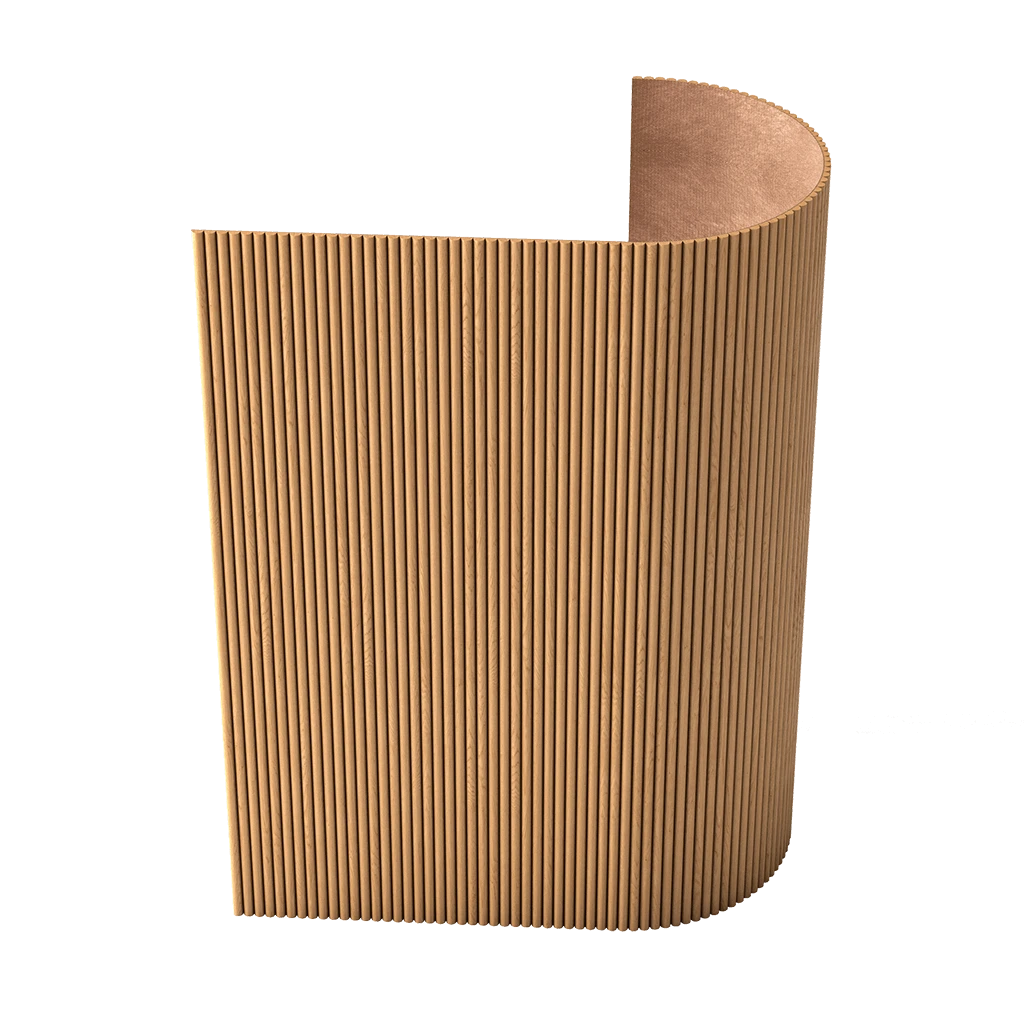
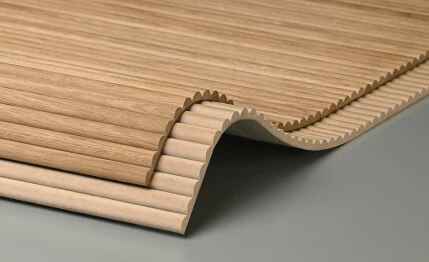
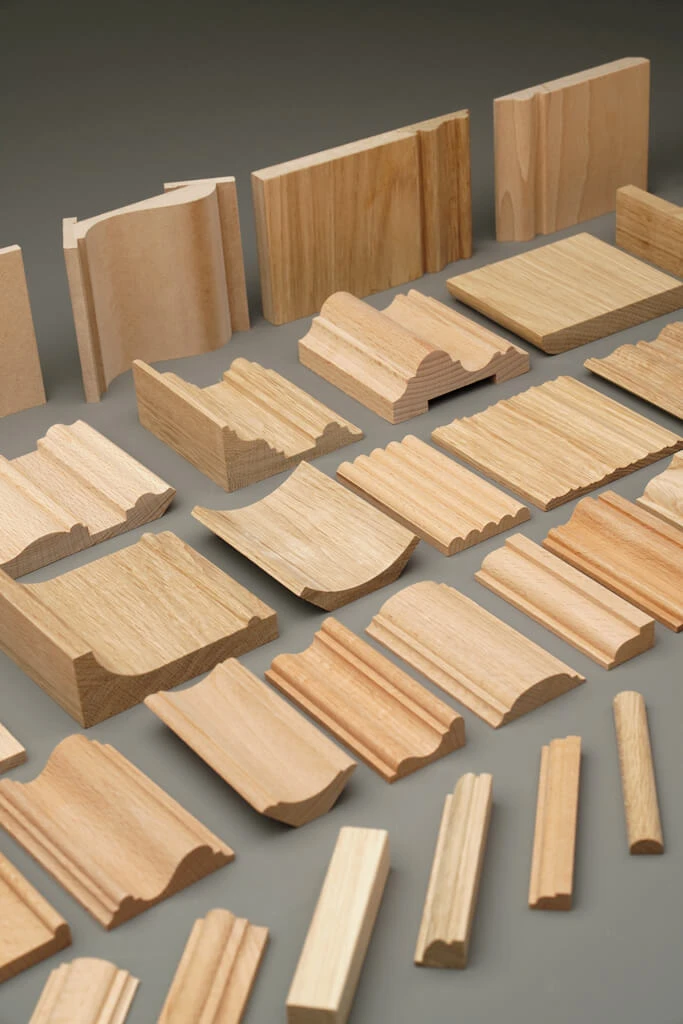
Wooden slat panelsMade of oak, ash, pine — the most natural and warm choice for the ceiling. Wood "lives" overhead — the warm amber tone of oak, the light gold of ash, the Scandinavian whiteness of whitewashed pine — all this creates a feeling of a natural "canopy" over the space.
Parameters for ceiling installation:
-
Slat width: 25–50 mm (optimum 30–40 mm)
-
Slat thickness: 15–20 mm (for the ceiling — sufficient, heavy slats are undesirable)
-
Weight per linear meter: up to 1.2 kg/m (with greater weight — reinforced lathing is mandatory)
-
Finish: oil-wax or varnish — moisture protection against temperature fluctuations
Wood species optimal for ceilings:
-
Oak — classic, amber or whitewashed. Heavier than ash, but more durable
-
Ash — lighter than oak, takes well to staining 'in Scandinavian style'
-
Pine — the lightest, looks good whitewashed or natural, affordable price
-
Thermowood is wood treated with hot steam, dark in color, and stable in humidity. Suitable for bathroom and kitchen ceilings
MDF slats for ceilings
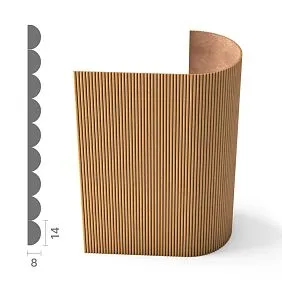
Lath MDF Panelswith paintable coating or decorative film — lightweight (0.6–0.8 kg/m), geometrically precise, don't deform with humidity changes. Ideal for ceilings in modern concepts requiring precise monochrome color: anthracite, matte black, snow-white.
MDF slats matching ceiling color (e.g., white slats on white ceiling) create almost invisible architectural relief — shadows from slats are only visible with side lighting, ceiling is 'quietly' structured without obvious 'wooden' element.
Limitation: MDF doesn't tolerate prolonged moisture exposure. For kitchen and bathroom ceilings — only moisture-resistant MDF (HMR) with waterproof varnish coating.
Slatted ceiling panel formats
| Format | Batten width | Gap | Character |
|---|---|---|---|
| Delicate | 20–28 mm | 8–12 mm | Subtle graphic rhythm, lightness |
| Standard | 30–40 mm | 12–16 mm | Balanced natural rhythm |
| Large-scale | 45–60 mm | 16–22 mm | Monumental, "rustic" character |
| Wide | 65–80 mm | 20–30 mm | Brutal, architectural gesture |
For a standard living room with a 2.7–3 m ceiling: standard format, 30–40 mm slats. For high ceilings (3+ m): large-scale or wide format. For a hallway or bathroom: delicate format.
Polyurethane rosette and molding for a chandelier: why a central decorative element is needed
Here is the key question that many ignore when planning a slatted ceiling: what to do with the center? With the chandelier mounting point?
The chandelier is the "entry point" of the entire ceiling scenario for the gaze. A person entering a room looks at the chandelier first. Then at the ceiling around it. Then at the walls. If the chandelier mounting point is just a "hole in the slat" with wires sticking out—the ceiling scenario is destroyed at its center. All the architectural effort of the slatted ceiling is "nullified" by a carelessly resolved center.
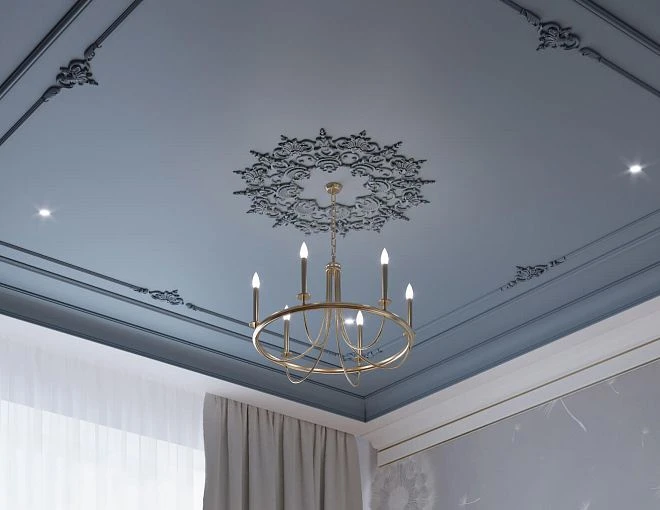
Polyurethane molding under the chandelier— a rosette, medallion, or ring solves this problem. A decorative element around the suspension point creates an architectural 'accent': the center of the ceiling composition is designed, finished, important. The gaze 'lands' on it and through it—'reads' the entire ceiling: the battens run from this center or parallel to it, the cornices frame the entire plane along the perimeter.
Types of polyurethane decor for chandeliers
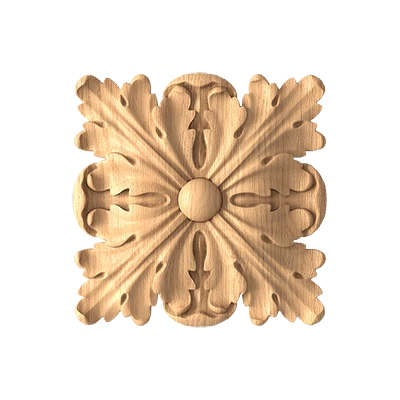
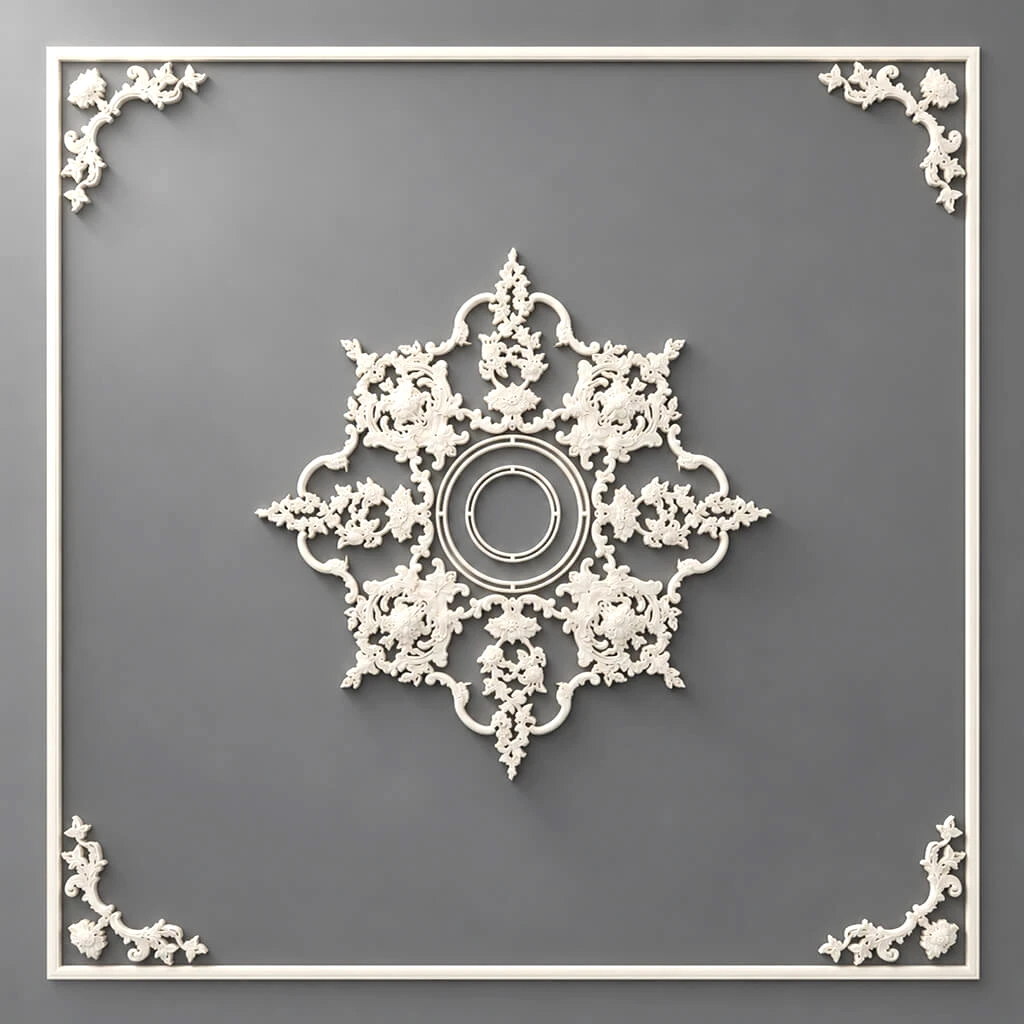
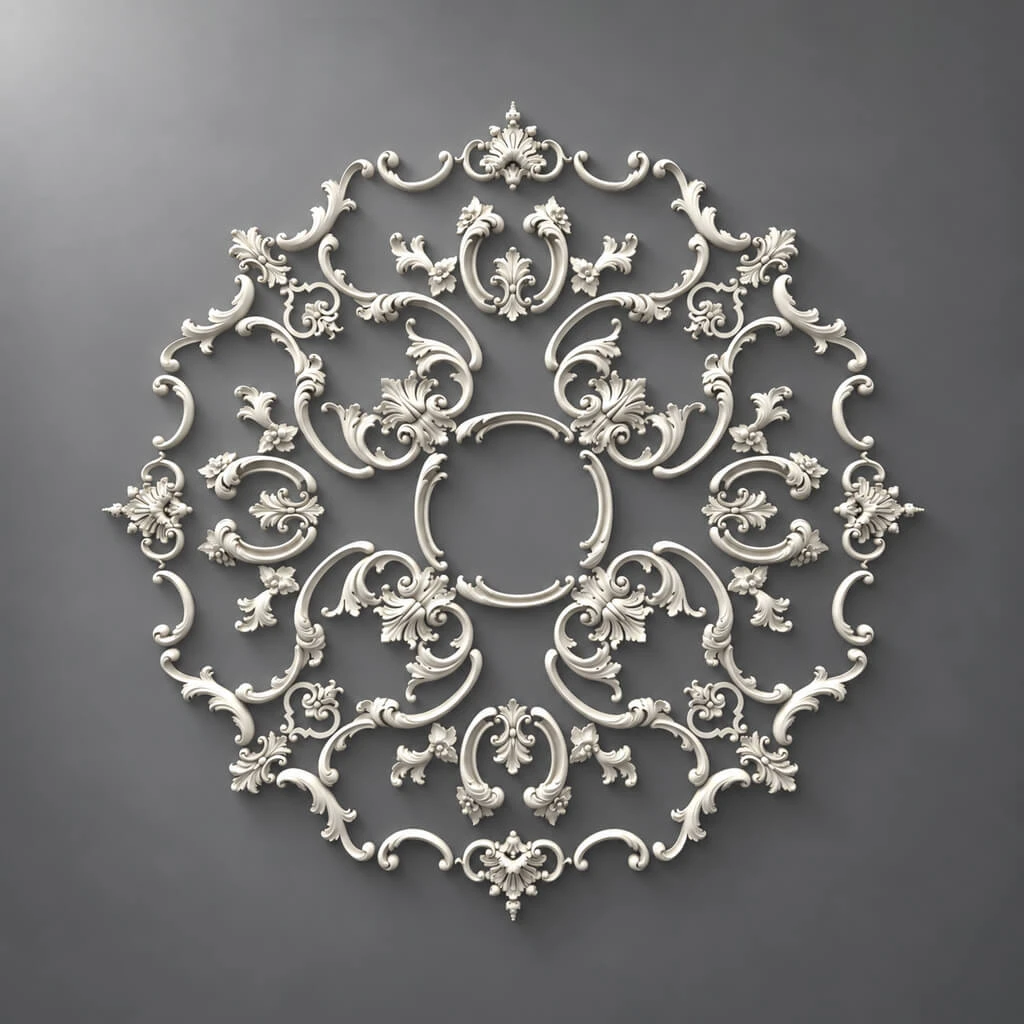
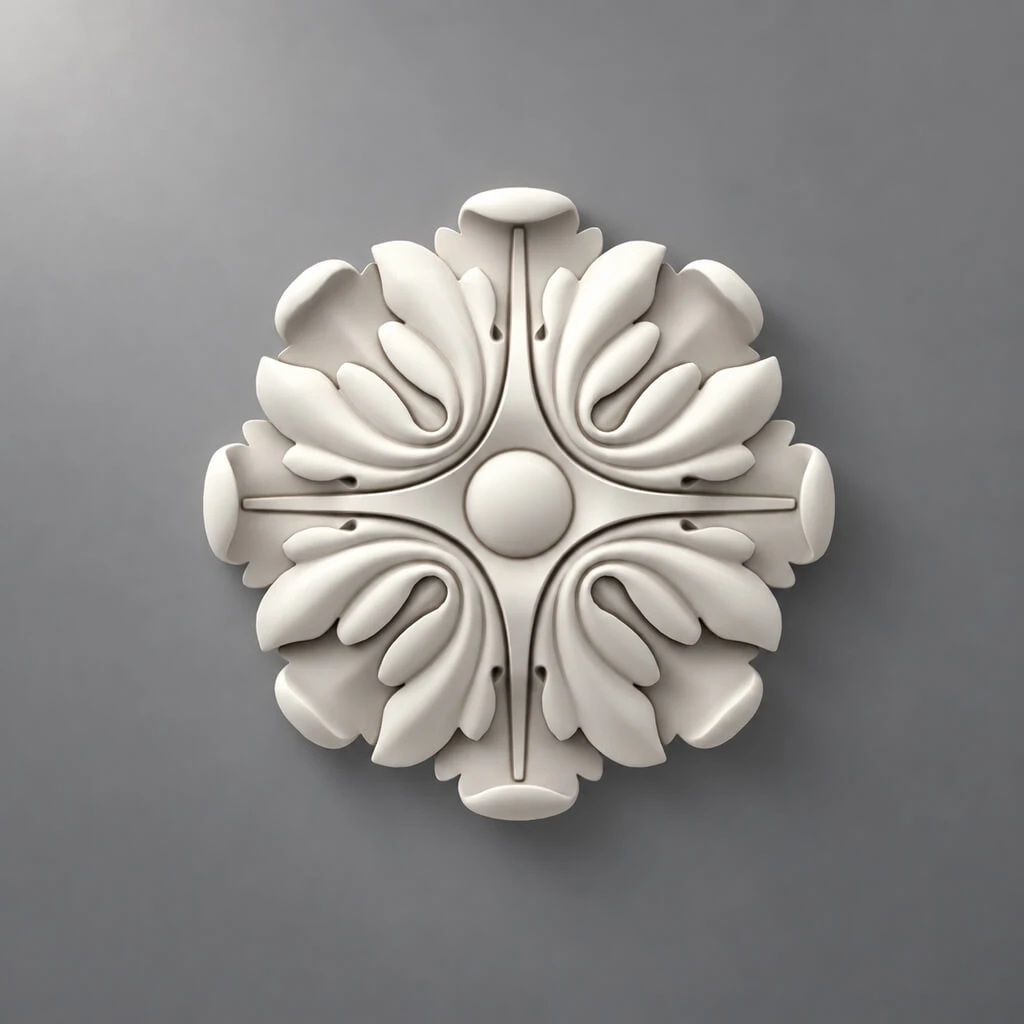
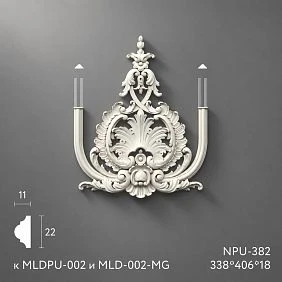
A ceiling rosette is a circular decorative element centered around the suspension point. Diameter: from 150 to 800 mm. Profile: from a minimalist 'ring' to a complex multi-tiered medallion with ornamentation.
polyurethane molding— the most common element. Mounted on the ceiling directly around the chandelier's mounting box. Weight: from 80 to 500 g depending on diameter. Installation: mounting adhesive + finishing nails around the perimeter.
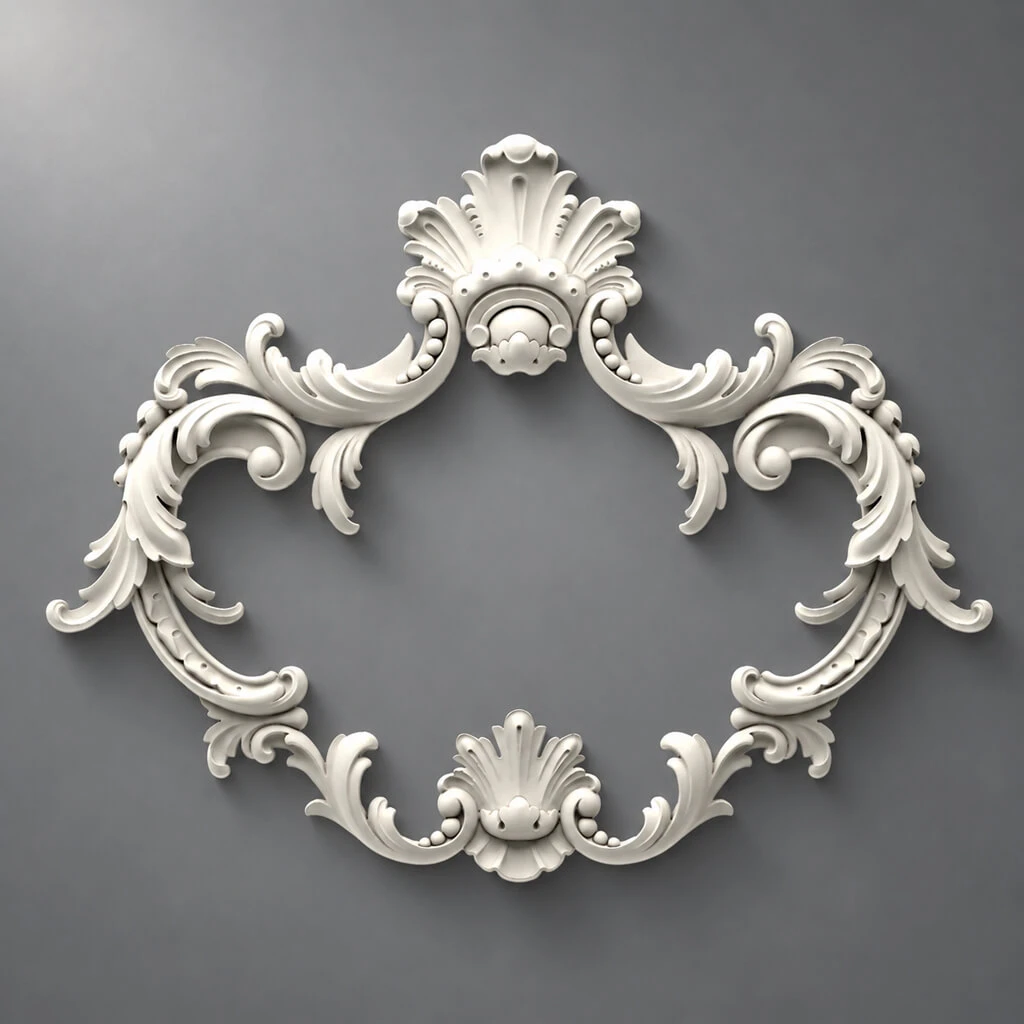
A decorative medallion is a larger element (diameter 600–1000 mm) with developed ornamentation: acanthus leaves, geometric bands, classic profiles. For rooms with high ceilings (from 3 m) and classic or neoclassical interiors.
A framing ring is a minimalist element: a simple ring with a diameter of 120–200 mm around the suspension point. For modern and minimalist concepts.Polyurethane moldings on the ceiling under the chandelierin the form of a simple ring—a 'quiet' architectural finish without historical references.
A ceiling rosette with an LED groove—a rosette with a circular groove for an LED strip. Circular warm light around the chandelier—the effect of a 'glowing medallion'. LED 2700K in the circular groove, dimmable—a separate lighting scenario for the evening.
How to choose the size of a rosette for a slatted ceiling
Standard recommendation: rosette diameter = 1/6 — 1/8 of the room's width (or length). For a room 4×5 m: optimal rosette 500–650 mm.
But with a slatted ceiling—correction: the ceiling medallion must align with the rhythm of the slats. If the slat width is 35 mm + a 15 mm gap = a 50 mm pitch, then the medallion diameter must be a multiple of 50 mm: 500, 550, 600 mm. Then the edge of the medallion will 'land' on the center of a slat or the center of a gap—not in a random spot.
This is a subtle technique of professional design, noticeable not as 'this is well done,' but as 'why does it feel so good here?'—that is, exactly how a true architectural solution should work.
Combining the linearity of slats and a central ceiling decorative element
The main visual question for a ceiling with slats and molding—how to combine the linear and the centered? Slats are rhythm, repetition, infinity in one direction. A medallion is a center, concentration, a point. They are opposite in nature. How to make them not compete but complement each other?
The answer is through architectural language. If the slats and medallion 'speak' the same architectural language—they are harmonious. If in different ones—they conflict.
Architectural language 'minimalism': slats + a ring
White MDF slats on a white ceiling. 10 mm gap. A minimalist framing ring 180–220 mm in diameter around the suspension point, matching the slats' tone. Chandelier—a thin metal frame or concrete shade.
Neither the medallion nor the slats 'shout.' The ceiling is quiet, geometric, 'architectural.' The ring denotes the center without decorative pomp.
Architectural language 'natural Nordic': slats + minimalist medallion
Whitewashed oak slats 30 mm / 13 mm gap. Medallion 450–500 mm in diameter with a simple profile—'ogee' or a straight setback. Painted to match the ceiling (RAL 9010 white). Chandelier—natural rattan, linen shade, or Japanese paper.
The ceiling rosette is 'recessed' into the white surface—its shadow is visible, but not the molding itself as decoration. Whitewashed battens create a natural rhythm, the rosette—a delicate center.
Architectural language 'modern classic': battens + molding frame + classic rosette
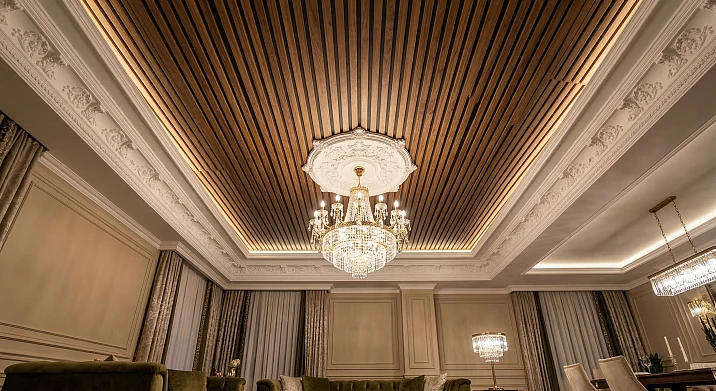
Natural oak 35–40 mm / gap 15 mm. Molded perimeter around the batten field made of polyurethane cornice 55–65 mm, painted white.Ceiling rosette550–650 mm in diameter with profiled ornament—'leaves', 'wave', classic bands. The rosette is painted to match the cornice (white).
The wooden rhythm of the battens is 'enclosed' in a white classic frame. In the center—a white classic medallion. The natural authenticity of wood + white classic architecture: this contrast creates 'modern classic'.
Architectural language 'Japandi': battens without a rosette or with a minimal ring
Dark 'smoky' ash, batten 22 mm / gap 10 mm. Suspension point—a minimal framing ring 160 mm, matching the battens. Or without any framing at all—the chandelier wires exit through a neat hole between the battens, finished with a thin wooden insert ring.
Japanese approach: decoration—minimum, function—maximum. Dark battens overhead—like the wooden decking of a platform in a Japanese house.
Architectural language 'neoclassical': battens as a 'field' for a classic medallion
The batten field is only in the side zones of the ceiling (in 60–80 cm wide strips along the walls). The central zone of the ceiling (40–50% of the area)—without battens, a clean white plane. In the center of this plane—a classic medallion 700–900 mm with ornament. Around the entire perimeter of the ceiling—a cornice 80–100 mm of classic profile.
Here, the battens are not the main character, but an 'architectural backdrop' on the periphery. The center belongs entirely to classical molding.
How lighting, ceiling height, and pattern scale are integrated into a unified system
The ceiling is not just a surface. It is a lighting environment. Everything on the ceiling—battens, rosette, cornice, beams—interacts with the lighting. And how this interaction is structured determines the final character of the interior.
Ceiling height and the scale of the batten pattern
Principle: the higher the ceiling, the larger the scale of the batten pattern can be. The lower the ceiling, the more delicate it should be.
-
Ceiling 2.5–2.6 m: battens 20–28 mm / gap 8–12 mm. Delicate rhythm, the ceiling 'does not feel oppressive'. Rosette—small, 350–450 mm.
-
Ceiling 2.7–2.9 m: battens 30–40 mm / gap 12–15 mm. Standard rhythm. Rosette 450–600 mm.
-
Ceiling 3.0–3.5 m: battens 40–55 mm / gap 15–20 mm. Large-scale rhythm. Rosette 600–800 mm.
-
Ceiling 3.5+ m: battens 55–80 mm / gap 20–30 mm. Monumental rhythm. Medallion 800–1000 mm.
Mismatch between pattern scale and ceiling height is the most common mistake. Large battens on a low ceiling 'feel oppressive'. Small battens on a high ceiling 'get lost', creating a feeling of a 'fine mesh'.
Axial lighting: chandelier, spotlights, hidden light
Central chandelier. A chandelier suspended from a polyurethane rosette is the 'axis' of the ceiling composition. The form and character of the chandelier should correspond to the architectural language of the slatted ceiling. For wooden slats — a chandelier with natural materials (wood, rattan, fabric, metal with a matte finish). Chrome-plated glossy chandeliers on a wooden ceiling are a stylistic conflict.
Track spotlights. With a slatted ceiling, track lights are mounted in the gaps between the slats or on the front surface of a special 'track' slat. Spotlights are directed at walls, art objects, and the dining table. In this case, the central chandelier is decorative, not functional.
Hidden LED lighting.Slatted panels with lightingon the ceiling — LED strip behind the slats. Warm light 'flows' down from the gaps, creating a feeling of 'smoldering embers overhead'. This effect when dimmed to 10–15% is one of the most atmospheric ceiling lighting solutions.
Cornice with LED groove. A polyurethane cornice around the perimeter of the ceiling with LED — a 'floating' slatted ceiling. Light from the cornice illuminates the ends of the slats from below, creating a 'halo' around the perimeter of the ceiling plane. The slatted ceiling 'detaches' from the walls — it seems to float.
How to correctly position the rosette and chandelier relative to the slats
Classic mistake: the chandelier is hung 'where the hook was' — not in the geometric center of the ceiling and not in the rhythmic center of the slatted pattern. Result: the rosette is offset, its edges fall asymmetrically on the slat, then on the gap.
Rule: the chandelier suspension point is moved to the geometric center of the ceiling plane before installing the slats. A new hook (or mounting platform) is installed in the required location. Then — the slats, taking this point into account.
The rosette is mounted around the suspension point strictly centered, before hanging the chandelier. The chandelier wires pass through the central hole of the rosette, which should be fitted to the diameter of the ceiling mounting of the chandelier.
Polyurethane Ceiling Decor: Full Range for Slat Ceilings
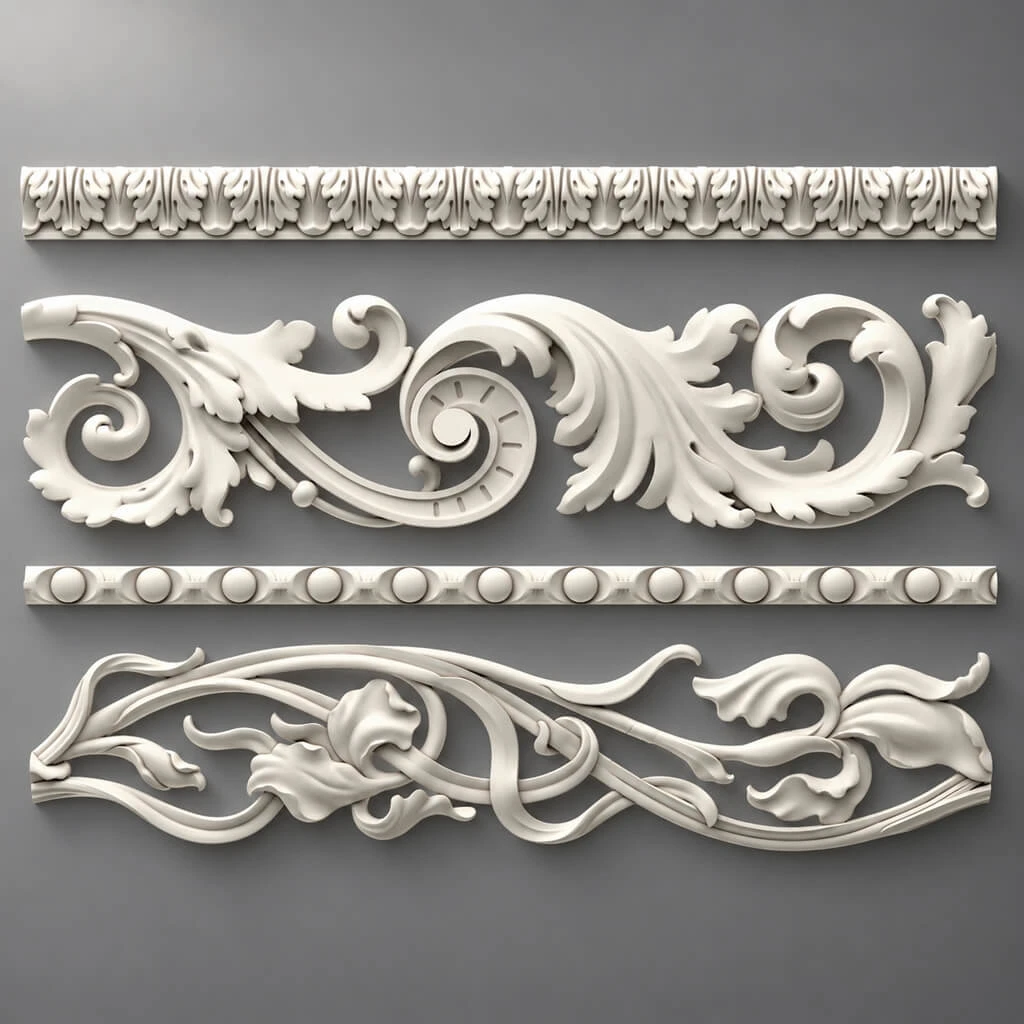
Polyurethane ceiling decor for slat ceilings is not just rosettes. It is a system of elements, each solving its own architectural task.
Ceiling Cornice: Perimeter Framing
Polyurethane ceiling decorationin the form of a perimeter cornice is a mandatory finishing element of a slat ceiling. The cornice solves several tasks at once:
-
Conceals the joint between the ends of the slats and the wall
-
Creates an architectural 'frame' for the slatted ceiling field
-
If equipped with an LED groove — creates a 'floating' lighting effect
-
Visually fixes the ceiling height — sets the 'horizon'
The cornice profile for a slat ceiling is chosen according to the concept: a straight profile for minimalism, a profile with a step for modern classic, a complex multi-band profile for neoclassicism.
Cornice size: width (height) = 1.5–2.5% of the room height. For a 2.7 m ceiling — a cornice of 40–67 mm. With a slat ceiling, the cornice height is also determined by the 'visible' gap — how much of the slat end remains open before the cornice (usually the cornice overlaps the slat ends by 15–20 mm).
Decorative beams: horizontal rhythm across slats
Decorative polyurethane beams, mounted across the direction of the slats, are a technique for creating a 'double rhythm' on the ceiling. Vertical rhythm of slats + horizontal rhythm of beams = a 'coffer-like' effect without a real coffered ceiling.
Beams are mounted with a spacing of 600–900 mm — depending on the scale of the room and ceiling height. Beam tinting: to match the slats ('wooden' ceiling), to match the cornice (white beams on a wooden ceiling — 'framing' effect), to match the walls (neutral beams, barely noticeable relief).
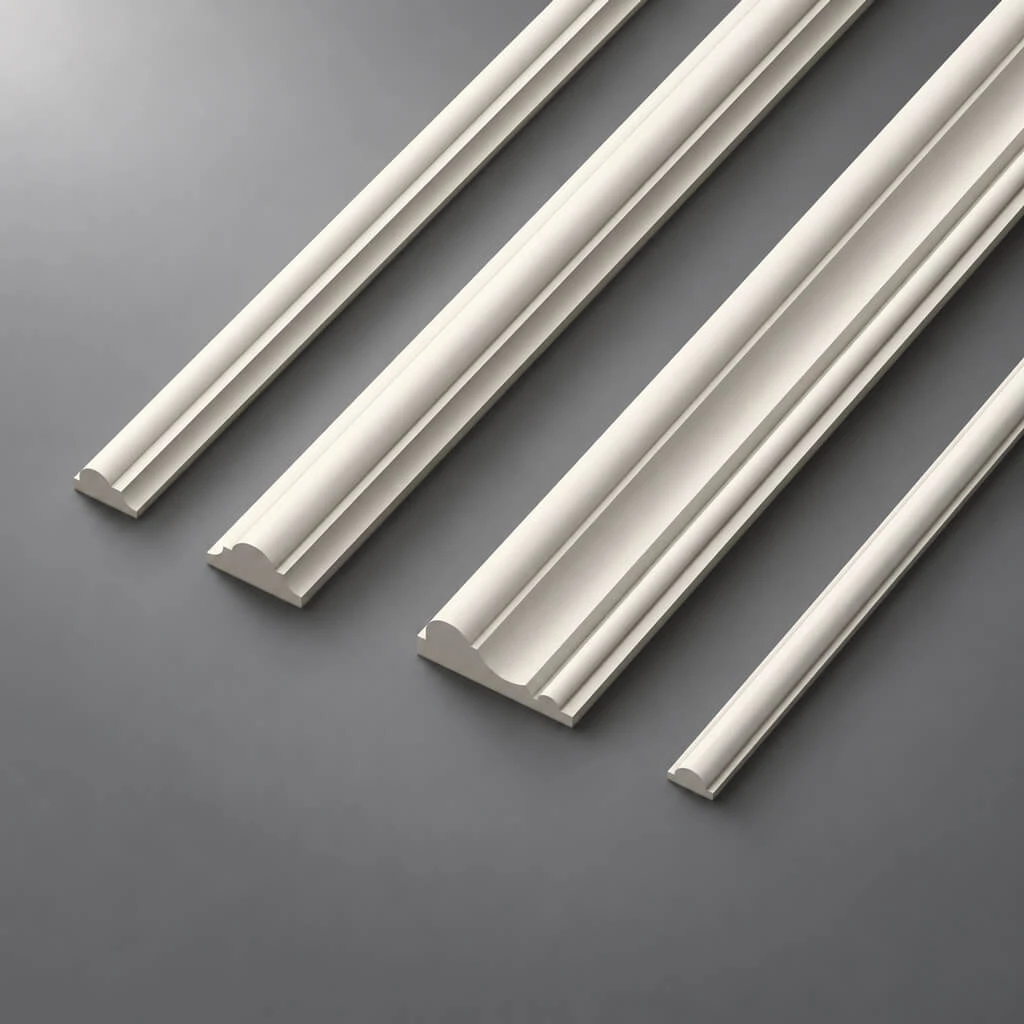
installation of polyurethane moldingin the form of decorative beams — a standard procedure with a wooden base beam, onto which a polyurethane shell is fitted.
Ceiling rosettes: assortment by style
For a slatted ceiling, three types of ceiling rosettes are most relevant:
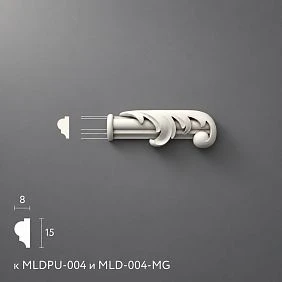
Type 'minimal' — a ring or disc with minimal relief. Diameter 150–300 mm. Profile: straight step 8–12 mm. For modern and Scandinavian concepts. Painted to match the ceiling.
Type 'classic-light' — a rosette with one or two ornamental bands: geometric bands, a thin 'border', light floral ornament. Diameter 350–550 mm. For 'soft classic' and modern classic.
Type 'medallion' — developed ornamental pattern: acanthus leaves, cartouche, Ionic border. Diameter 550–900 mm. For neoclassical and classic interior. With a slatted ceiling — contrast of 'natural wood' and 'classical stucco': a bold and expressive technique.
Molding frames on the ceiling: geometry around the slats
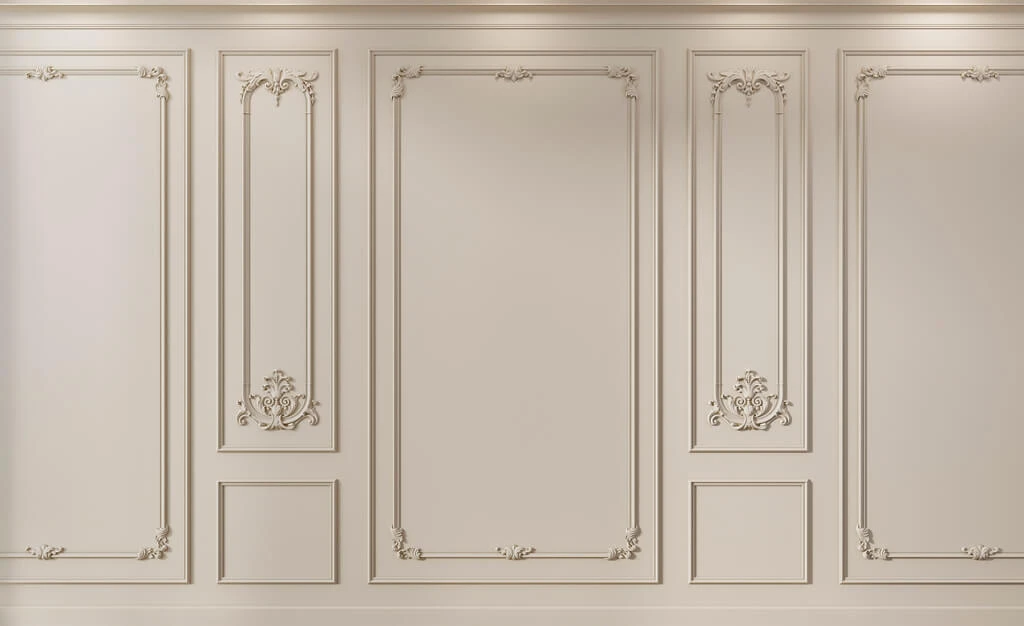
Molding rectangular frames made of polyurethane profile, mounted on the ceiling inside a slatted field or along its perimeter, are a technique for adding a geometric 'grid' to the ceiling.
Option 1: 'Frame around the entire slatted field' — molding along the perimeter of the slatted island. The slatted field within a molding frame looks like an 'insert' in the ceiling — an architectural 'picture' overhead.
Option 2: 'Frames inside the slatted field' — several rectangular molding frames inside the slatted field. The slats 'read' through the frames — creating an effect of architectural 'sections' on the ceiling.
Option 3: 'Frame around the rosette' — a rectangular or square molding frame 800×800 mm around the ceiling rosette. The rosette is a 'picture' in a molding frame, suspended on a slatted ceiling.
Errors in proportions and placement: what never to do
A slatted ceiling with molding is a space where errors are immediately and permanently visible. Let's examine the most critical ones.
Error 1: Rosette 'off-center'
A shifted ceiling rosette means a 'crooked' chandelier. Even if the chandelier itself is perfectly symmetrical, a shifted rosette signals: 'something is wrong here.' The brain perceives deviation from the center as an error.
Solution: mark the center before installing the slats. The suspension point should be at the geometric center of the room (or at the center of the functional zone — above the dining table, above the bed). The wiring is relocated if necessary.
Error 2: Too large a rosette with small slats
A 700 mm ceiling rosette on 20 mm battens with an 8 mm gap creates a scale conflict. The large, monumental rosette 'crushes' the delicate rhythm of the battens. Solution: the rosette should be no more than 1/7 of the room's width when using a fine batten pattern.
Mistake 3: Battens are 'cut off' at the rosette in an unattractive way
Battens approaching the rosette are cut flush—and their ends meet the edge of the rosette unevenly, with varying gaps. Solution: the rosette is mounted on the ceiling before installing the battens. Battens are trimmed with a 5–8 mm setback from the rosette's edge. This gap is concealed by the rosette itself (it 'overlaps' the batten ends around the entire circle).
Mistake 4: Different wood tones between the battens and 'wood-look' polyurethane beams
Polyurethane beams with a 'wood-look' finish—imitating wood grain—create a conflict between 'real' and 'imitation' when used in the same space as natural wooden battens. Solution: polyurethane elements on the ceiling with wooden battens should only be painted (white, cream, gray), without wood imitation.
Mistake 5: Cornice is too small for the room height
A 30×25 mm cornice with a 3 m ceiling creates an invisible 'wire-like' outline. Visually, it doesn't function as an architectural element, only creating an uneven 'line' at the ceiling-wall junction. Rule: for a 3 m room height, the cornice should be at least 55–60 mm.
Mistake 6: Absence of a ceiling cornice with a batten ceiling
The ends of the battens at the wall junction lack a finishing element. All irregularities in the cuts are visible, and the batten gaps are 'open' towards the wall. The ceiling looks 'unfinished'. A perimeter cornice is a mandatory finishing element for any batten ceiling.
Mistake 7: Chandelier of inappropriate size
A 250 mm diameter chandelier over the dining table in a 4×5 m room with a slatted ceiling visually 'got lost'. The slatted ceiling increases visual density — the chandelier needs to be 'stronger' than with a regular white ceiling. Guideline: chandelier diameter in centimeters ≈ sum of room dimensions in meters. For a 4×5 m room — an 80–90 cm diameter chandelier.
Five ready-made ceiling concepts: slats + molding
Concept "White Forest"
-
Slats: bleached pine 'snow', 28 mm / 12 mm gap, across the room's long axis
-
Cornice: straight profile 50×35 mm, white RAL 9010
-
Rosette: diameter 480 mm, 'classic-light' with one geometric band, white RAL 9010
-
Chandelier: natural rattan, beige-milky palette
-
Ceiling walls: RAL 9010 white
-
Image: White 'birches' overhead. Delicate natural rhythm — almost invisible when harmonious. The white rosette 'grows' from the white ceiling — only its shadow is visible.
Concept 'Dark Scandinavian'
-
Slats: ash 'smoky', 22 mm / 10 mm gap, along the long axis
-
Cornice: straight profile 40×30 mm, RAL 7016 anthracite — matching the slats
-
Rosette: 180 mm ring, anthracite
-
LED: behind slats 2700K, 8% brightness — night lighting
-
Chandelier: matte black metal, industrial minimalism
-
Image: «Night Sky» — dark ceiling with warm light «slits». Anthracite framing ring — almost invisible. Black metal chandelier — focal point.
Concept «Mediterranean Terrace»
-
Slats: thermowood «dark walnut», 40 mm / gap 15 mm, across
-
Cornice: 70×50 mm cornice with LED groove, white RAL 9001 — «floating» slatted ceiling
-
Rosette: 620 mm, medallion with floral ornament, white RAL 9001
-
Chandelier: woven metal «antique gold»
-
Image: 'Pergola over a Mediterranean courtyard' — dark wooden slats in a white architectural frame. The slatted ceiling 'floats' thanks to LED lighting in the cornice. A classic white medallion serves as the central ornamental accent.
Concept: 'Urban Apartment'
-
Slats: MDF RAL 7044 (silk gray), 35 mm / 13 mm gap, lengthwise
-
Cornice: straight profile 55×40 mm, RAL 7044 — matching the slats
-
Ceiling rose: 'minimal', diameter 300 mm, RAL 7044
-
Chandelier: concrete shade or 'bare' glass
-
Image: a gray monochrome ceiling with a barely noticeable slatted relief. A minimalist gray ceiling rose acts as a 'quiet' center. A concrete chandelier provides a restrained industrial accent.
Concept: 'Suburban House in the City'
-
Slats: natural oak 'amber', 45 mm / 18 mm gap, crosswise
-
Decorative beams: polyurethane 'oak-look' — 4 cross beams spaced 900 mm apart
-
Cornice: 80×55 mm, classic profile, cream-white RAL 9001
-
Rosette: 680 mm, medallion with 'leaves', cream-white RAL 9001
-
Chandelier: forged metal, 'rustic', 'aged' brass
-
Style: 'country house' in a city apartment. Amber oak slats + cross beams = 'wooden ceiling'. White classic medallion and white beams — architectural 'order' in the natural 'chaos' of wood.
Frequently asked questions about slatted ceiling panels and ceiling medallions for chandeliers
How much height does a slatted ceiling 'take up'?
Battens structure (30×40 mm timber) + 15–20 mm slat = total 45–60 mm from the original ceiling. When mounting slats directly on the ceiling (without battens, using a clip system) — only 15–20 mm. The minimum 'height loss' option for a slatted ceiling is 20 mm.
Can Ceiling batten panels be installed in a bathroom?
Yes, under the following conditions: slats made of moisture-resistant MDF (HMR) with varnish coating or thermowood with wax coating. LED strip — IP44 or IP65. Room ventilation — forced. Direct contact of slats with water (shower) — excluded.
How to choosepolyurethane rosettefor a slatted ceiling?
Diameter = 1/7–1/8 of the room width (maximum). Profile style = architectural language of slat rhythm. For small slats (20–28 mm) — delicate profile. For large slats (40–55 mm) — more developed ornament. Color = color of ceiling finish (cornice).
Is a cornice needed around the perimeter with a slatted ceiling?
Mandatory. The cornice conceals the slat ends at the walls, provides architectural 'framing' of the ceiling field, creates a visual 'completion' of the entire ceiling plane. Without a cornice — the slatted ceiling looks unfinished.
Polyurethane moldings on the ceiling under the chandelier— how is it installed when slats are already in place?
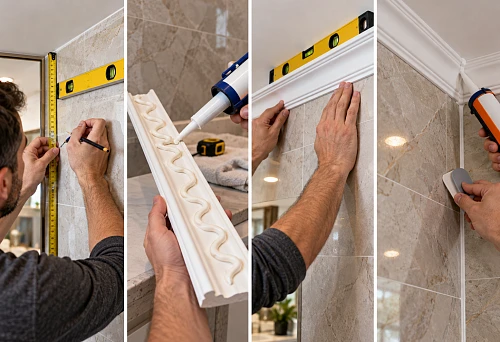
The rosette is installed after the slats. Slats around the suspension point are trimmed with a 10–12 mm offset from the future edge of the rosette. The rosette is glued to the ceiling around the mounting box — it overlaps the ends of the trimmed slats and the gaps between them. Adhesive — polyurethane mounting or MS-polymer.
Can a slatted ceiling be combined with a stretch ceiling in one room?
Yes — in the logic of a 'ceiling island': stretch ceiling for the main area + slatted 'island' above the functional zone (dining, sofa, sleeping). The border between the stretch ceiling and the slatted 'island' is finished with a polyurethane molding — a clear geometric 'frame' for the transition between the two types of ceiling finish.
Slatted panels for the ceiling — is acclimatization needed?
Mandatory — for wooden slats. 72–96 hours in the installation room at operating temperature and humidity. MDF slats — 48 hours acclimatization. Violating this requirement for ceiling installation is especially critical: slats may 'sag' during shrinkage — the load from their own weight increases deformation.
Conclusion
A ceiling with wooden slats — this is not a 'fashionable trend'. It is an architectural solution with deep nature. The natural rhythm of wooden lines overhead creates a sensation that cannot be achieved by any other means: warmth, scale, living texture where a neutral white plane usually dominates. Polyurethane molding under the chandelier completes this ceiling scenario — gives it a center, an architectural 'note', around which the entire pattern of slats is read.
Batten panels for ceilingsmade of natural oak, ash, and pine,Polyurethane ceiling rosettes— from minimalist rings to classic medallions,Polyurethane ceiling decoration— cornices, beams, molding frames — all of this is presented in full assortment in the STAVROS company catalog.
STAVROS is a Russian manufacturer of slat systems made from natural wood and polyurethane products with a full production cycle. Own production of wooden slat panels and polyurethane decor, professional consultation on material selection and element scale selection — for those who create a ceiling scenario consciously, not by accident.