Article Contents:
- Why slatted panels are a finishing method, not just decor
- How slatted wall panels differ from other solutions
- What materials are slatted wall panels made of
- MDF slatted wall panels
- Solid oak wooden slatted wall panels
- Which constructions are best suited for wall finishing
- Rigid slatted panels on MDF backing
- Flexible slatted wall panels on fabric backing
- Panels made of half-round battens
- Where slatted wall panels are used in interior design
- What do slatted panels provide besides a decorative effect?
- How to choose slatted panels for wall finishing for a specific task
- Installing slatted panels on a wall: what is important to consider in advance
- Mistakes when selecting and installing slatted panels for walls
- Why MDF and solid oak are different products, not just different prices for the same thing
- Slatted panels in interior design: different styles — different approaches
- Additional decorative elements for a comprehensive solution
- Where to buy slatted panels for wall finishing
- FAQ: answers to popular questions about slatted panels for wall finishing
- About the Company STAVROS


Why slatted panels are a finishing method, not just decor
The difference between decor and finishing is fundamental. Decor is added on top of a finished wall. Finishing is the wall itself in its final form. Wall slatted panels belong precisely to the category of finishing, and this needs to be understood from the very beginning.
A flat painted surface is a neutral background without character. A wall with a slatted structure is an architectural object that lives in the light, creates shadows, forms rhythm, and sets the mood for the entire space. The rhythm of vertical slats visually stretches the ceiling. Horizontal installation expands the room. Diagonal installation adds dynamism. This is not just 'beautiful,' it's working with the geometry of space — and that's exactly why architects, not just renovation trend enthusiasts, choose slatted wall finishing.
Furthermore, behind the slatted structure, you can hide utilities, level the base using a frame without expensive plastering, and incorporate a sound-absorbing layer to improve acoustics. Wall finishing with slatted panels is an engineering-decorative solution, not just a surface overlay.




How slatted panels for walls differ from other solutions
The market for finishing materials is huge, and the question 'why slats specifically?' is completely justified. The answer must be honest, through comparison.
Paint provides a clean, flat surface, is easily refreshed, and is inexpensive — but it offers no relief, depth, or volume. The light character of such a wall is zero: morning or evening, it's the same. Decorative plaster creates texture, but it's chaotic, uncontrollable. A slatted structure is fundamentally different: its light pattern is precise, predictable, and architectural — shadows fall strictly into the gaps, protrusions are evenly illuminated.
Smooth wall panels made of PVC or MDF sheet cover irregularities, but the surface remains flat — no relief, no depth. Individual slats for piece-by-piece installation provide the same visual effect as a panel solution, but take much longer to install: each slat needs to be individually leveled, fixed, and the spacing maintained. Wall slatted panels on a backing are a ready-made module with precise geometry, which installs quickly and covers large areas in minimal time.
Result:Slatted wall panelsThey outperform most competitors precisely due to the combination — aesthetics, engineering function, and installation practicality in one solution.
Our factory also produces:
What types of slatted panels for walls exist by material
Material is not a secondary parameter, but a fundamental choice. It determines the final visual effect, finishing possibilities, durability, and appropriateness in a specific interior.
Get Consultation
MDF slatted wall panels
MDF is not a compromise or a 'budget alternative to wood.' It is a deliberate, technological choice for specific tasks. MDF slatted wall panels are made from fine wood particles under high pressure. The surface is perfectly smooth, devoid of texture, with precisely calibrated profile geometry—no knots, no density variations, no wood grain pattern.
It is this uniformity that makes MDF an ideal material for painting. Paint applies evenly, without stains or tonal variations. You can choose any shade from the RAL, NCS, or Pantone catalog—and get exactly the color envisioned in the project. Want the panels to blend with the wall? Paint them the same tone. Want a contrasting accent? Choose a saturated or dark shade. This variability is unattainable with natural wood.
Slatted wall panels for paintingare especially in demand in minimalist interiors, neoclassicism, contemporary, and modern classic—where the wall should be an architectural statement, not a display of material. MDF panels are dimensionally stable, do not warp with proper use, and maintain precise profile lines for many years.
Solid oak slatted wall panels
Oak is a different story. There is no neutrality here. Solid oak slatted wall panels carry a living texture, the warmth of natural material, and a tactile depth that cannot be artificially reproduced. Each slat is a unique element with an inimitable wood grain pattern. Even within the same batch, no two slats are identical—and this creates the feeling of an expensive, handcrafted surface.
Oak slatted wall panelscan be treated with oils, stains, white or black lacquer, wax, brushed to emphasize texture, or tinted to the desired shade. Open pores under oil give a sense of natural closeness. Dense glossy lacquer—brutal elegance. Each finishing option is a distinct interior image.
Oak is one of the hardest and most durable types of wood. Solid wood slatted panels withstand mechanical loads, do not deform in stable climate conditions, and only gain nobility over time. They can be sanded, refreshed with oil, and have their finish tone changed—and the wall will look different each time.
Wooden slatted wall panels fit perfectly into Scandinavian style, Japandi, loft, eco-style, neoclassicism with a warm palette, and any interiors where natural material is not an accident but a conscious design choice.
Which constructions are better suited for wall finishing
The structural solution is no less important a parameter than the material. It determines which surfaces the panels can be mounted on and the visual result you will achieve.
Rigid Slat Panels on MDF Backing
This is the basic and most common construction. The slats are fixed to a rigid MDF base with equal spacing—resulting in a monolithic module of a given size. Rigid slatted wall panels are ideal for flat vertical and horizontal surfaces: main walls, accent fragments, TV zones, hallways, niches, ceilings.
This construction provides a precise geometric pattern and allows working with large areas—installation is quick, and seams between panels can be hidden or made a functional design element. Mounting is done with construction adhesive, finishing nails, or screws along guides, depending on the task and base type.
Flexible slatted wall panels on a fabric base
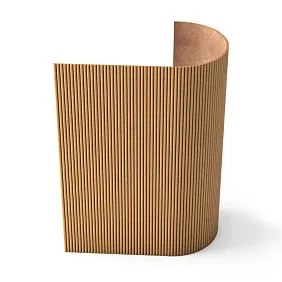
Where rigidity becomes a limitation—flexibility comes into play.Flexible slatted panelsare assembled on a fabric backing: the slats are fixed with gaps sufficient for the entire structure to bend along a curve. This opens up fundamentally different possibilities—columns, arches, rounded corners, radius walls, any surfaces with curvilinear geometry.
The flexible panel wraps around the surface smoothly, without seams or pattern breaks—the slats run continuously along the entire curve. The result looks like expensive custom fabrication, although essentially it is a standard product applied intelligently. Slatted panels for radius surfaces are exactly such a solution.
Panels made of half-round molding strips
The third constructive type, undeservedly overshadowed by more obvious solutions. The slats feature a semicircular cross-section instead of the standard rectangular one—and this fundamentally changes the play of light and shadow. There are no sharp edges, no clear geometric shadows. Light flows smoothly along the rounded surface, creating a soft, almost painterly pattern.
Panels made of semicircular battens are suitable for spaces where warmth and coziness are desired: bedroom, children's room, study, relaxation area. Where you need not strict architectural graphics, but a delicate, tactilely appealing surface—the semicircular profile works better than the rectangular one.
Where are slatted panels used for wall finishing in interiors
There are significantly more application scenarios than it seems upon first acquaintance with the product. Slatted wall panels have long moved beyond the 'accent wall in the living room'—although this scenario remains one of the strongest.
In the living room, slatted finishing on an accent wall behind the sofa or in the TV area is a classic of modern design. Slatted panels for the TV area solve several tasks at once: they create an architectural backdrop for the screen, hide cables and wiring, and form a niche for equipment. Dark oak slats covering the entire height of the wall behind the TV are an absolute designer standard in the above-average segment.
In the bedroom, slatted panels behind the bed headboard give the effect of an expensive hotel without expensive renovation. Vertical solid wood slats with oil impregnation, raised to the full height of the wall—this is no longer a detail, it's the central accent of the interior. Slatted panels on the wall behind the bed are especially effective when combined with hidden perimeter lighting along the top.
In the hallway, every centimeter works to create a first impression. A narrow corridor with vertical slats visually stretches in height—and this works even in small apartments. Wall slatted panels for the hallway are often combined with mirrored surfaces and built-in lighting, creating the effect of a significantly larger space.
In a study, meeting room, or home office, slatted finishing works to create a work mindset—the structured rhythm of lines creates a sense of order and concentration. This is confirmed both by the psychology of spatial perception and by the practice of designing commercial interiors.
In restaurants, hotels, offices, and showrooms, slatted panels for commercial interiors have long become part of the professional designer's language. They manage acoustics in hall spaces, zone open layouts without partitions, and create a premium atmosphere without an excessive budget. This is precisely why slatted finishing is so widespread in the HoReCa segment—where first impressions are worth money.
On the ceiling, slatted panels work in a horizontal direction, creating an additional decorative layer, allowing lighting to be hidden in the gaps between the slats, and visually lowering a too-high ceiling or, conversely, 'raising' a low ceiling through the color and direction of the slats.
On furniture fronts — cabinets, sideboards, bar counters, kitchen sets — slatted cladding gives standard modules individuality and volume. Slatted panels for furniture work especially convincingly when combined with smooth matte fronts: the contrast of texture and plane creates an interesting visual play.
What do slatted panels offer besides a decorative effect?
This is the block that distinguishes expert conversation from catalog description. Because the functional side of slatted wall panels is no less important than the aesthetic one.
Zoning without permanent partitions is one of the key functions. A slatted 'screen' between the living room and dining room, a fragment of a slatted wall in the bedroom, marking a relaxation area — this is architectural demarcation without losing light, air, and a sense of spaciousness. Slatted panels for zoning work as a semi-transparent filter: they mark boundaries but do not create enclosure.
Concealing utilities and base defects is another pragmatic function. When mounted on a guide frame, a gap forms between the wall and the panel, where pipes, cables, wires — everything that usually has to be chased into the wall — can be routed. Slatted panels for hiding wall irregularities allow you to avoid costly leveling: the panel is mounted level, and the wall becomes geometrically perfect regardless of what lies beneath it.
Acoustic comfort is an important parameter often underestimated when choosing finishes. Flat walls actively reflect sound, creating echo and increasing reverberation. The textured slatted surface scatters sound waves, reducing unwanted reflections. Acoustic slatted wall panels with an additional sound-absorbing layer behind the slats are already a serious acoustic solution for meeting rooms, home theaters, studios, and open-plan living rooms. Mineral wool or a specialized acoustic mat placed in the gap between the wall and the panel multiplies the effect.
Working with light is perhaps the most underrated property of a slatted wall. The rhythm of protrusions and recesses creates dynamic chiaroscuro, which changes throughout the day and reacts to shifts in lighting angles. Such a wall is not the same at different times of day — it lives along with the interior. Textured wall cladding with slats and properly placed spot or track lighting turns an ordinary room into a stage-like space.
Visual space correction is another function provided by a slatted wall. A low ceiling is raised by the vertical rhythm of the slats. An overly wide room is corrected with horizontal installation. A long, narrow corridor looks more proportional with the correctly chosen panel spacing. This is not designer magic — these are the laws of visual perception used by professionals.
How to choose slatted panels for wall finishing for a specific task
A practical selection algorithm is not a checklist table. It's a sequence of questions you need to answer honestly.
First question: Is painting in a specific color needed? If yes — MDF. Only MDF accepts paint evenly and allows precise color matching. No finish treatment of natural wood will give you such color accuracy.
Second question: Is natural texture important? If yes — solid oak. Oil, wax, stain, varnish — any treatment reveals the living wood grain and creates a surface with tactile depth.
Third question: What is the surface geometry? If the wall is flat — rigid panels on a substrate. If there is a radius, column, or arch — only flexible slatted wall panels on a fabric base.
Fourth question: Is strict architectural graphics or soft plasticity needed? A rectangular slat profile creates a sharp shadow — strict, graphic, modern. A half-round bead gives soft, smooth chiaroscuro — cozy, warm, delicate.
Fifth question: Is an acoustic function needed? If yes — plan a mounting frame with a gap and sound-absorbing material in the project. Simply placing panels on the wall is insufficient for serious acoustic correction.
Sixth question: Where will the panels be placed — in a residential space or commercial area? For residential interiors, both materials are equally suitable. For commercial spaces with intensive use — solid oak is preferable for its resistance to mechanical impact.
By answering these six questions, you will narrow down the choice to one or two specific options — and then we'll only discuss dimensions, spacing, and color.
Installation of slatted wall panels: what's important to plan in advance
Installation is the stage where a good product can be ruined by carelessness, and an average solution can become an excellent result through meticulousness. Several key points worth knowing before starting work.
The condition of the base is the starting point. For installing rigid panels with adhesive, the wall must be leveled, cleaned of dust and grease, and have an allowable plane deviation of no more than 3–5 mm over the panel length. If deviations are greater — a frame of metal profiles or wooden beams is needed.
Mounting frame (hidden lathing) is a universal solution for any walls. Profiles or timber are attached level with the required spacing, panels are fixed with self-tapping screws to the lathing. A gap forms between the wall and the panels — cables, pipes, and sound-absorbing material if necessary, go there. This is the most reliable and technologically correct installation method.
Installation with adhesive — a fast and clean option for even walls. Mounting adhesive is applied in dots or along the perimeter of the substrate, the panel is pressed against the wall and fixed until it sets. This method is good for rigid panels on MDF substrate in residential spaces.
Finish nails — point fastening, practically invisible on the surface. Often used in combination with adhesive as additional fixation — especially during vertical installation, where the panel may pull away from the wall while the adhesive sets.
Installation direction: vertical slats are mounted from bottom to top or from one corner to another depending on the joint pattern. Horizontal — from floor to ceiling. In both cases, the first element is set strictly level — this guarantees the geometry of the entire plane.
Joints between panels: in most modern designs, they are resolved either butt-jointed with a minimal seam, or via a decorative separating element. In the case of natural wood, joints are slightly more noticeable due to variations in texture — and this is part of the aesthetic, not a defect.
Lighting in gaps: when installing slatted panels on the ceiling or in a niche, LED strip lighting in the space between the slats is often provided. This creates a soft lighting effect that accentuates the relief and makes the surface even more expressive in the evening.
Mistakes when choosing and installing slatted wall panels
An honest conversation is impossible without analyzing mistakes. Most of them can be prevented — it's worth knowing exactly where people stumble.
Choosing only by photo — the most common mistake. A photograph conveys color, but does not convey tactility and the real lighting effect. Panels that look perfect in a render can produce a completely different result in the live light of a specific room. Always request samples and view them under real lighting conditions.
Ignoring the material in favor of 'similarity' — is also a mistake. MDF and oak are visually similar only in photos, but fundamentally differ in behavior in an interior: texture, tactility, processing method, reaction to light, sense of value. Replacing one with the other is not 'the same thing, but cheaper,' it's a different product with a different result.
Installing rigid panels on an uneven wall is a guaranteed failure. A rigid structure does not adapt to the curves of the base. If the wall 'moves' along the plane, the differences will be visible in how the panel fits. The solution is a frame, and only a frame.
Ignoring lighting when choosing panel colors. Dark slats in a room without a side light source lose all the effect of light and shadow and simply 'eat up' space. A slatted surface only reveals itself with directed or side lighting—consider this when planning.
Confusing decorative function and acoustic task. Standard slatted panels diffuse sound but do not absorb it to a significant degree. If you face a serious sound correction task—you cannot do without a sound-absorbing layer behind the panels. These are different technical solutions, and one does not replace the other.
Buying without a reserve. The standard reserve for trimming and joining is 10–15% of the calculated area. When working with natural wood, it's better to increase the reserve to 15–20%, because selection by texture and pattern is inevitable.
Choosing color separately from the overall interior scheme. Panels are not an independent object; they are part of a system. The color of the floor, ceiling, furniture, lighting—all this affects the perception of the slatted wall. Look at the panel sample in context, not separately.
Why MDF and solid oak are different products, not different prices for the same thing
This question deserves a separate section because this is where confusion most often arises. People see a similar shape and ask: 'Does it really matter what it's made of?' No, it does matter.
Visual depth. An MDF slat under paint is a uniform color and shape. An oak slat is color plus grain pattern plus density variations plus pore play. Two externally identical profiles made from different materials are perceived fundamentally differently in an interior.
Working with color. MDF accepts any paint with precise color matching. Oak under varnish or oil has its own hue, which overlays the finish and affects the final color. Precise color matching in RAL is only possible on MDF.
Tactility. Under the hand, MDF is smooth, neutral, uniform. Oak is warm, with slight roughness, 'alive'. For a bed headboard or panels in an area of human contact, this difference is felt physically.
Repairability. Oak can be sanded, refreshed with oil, and its finish tone can be changed—it can be restored. MDF is more difficult to repair locally in case of serious damage, although with proper use, this is not an issue.
Perception of value. This is subjective but significant. Natural wood in an interior is associated with solidity, nature, and durability. MDF is associated with technological precision. Some tasks require the former, others the latter. There is no universal 'better'—there is the right choice for a specific project.
Cost. Yes, solid oak is more expensive than MDF. But this is not an overpayment for show—it's payment for a material with different physical and aesthetic properties. Where a living texture and tactility are needed, MDF does not replace oak, and where precise painting is needed, oak does not replace MDF.
Slatted panels in interior design: different styles—different approaches
Slatted wall panels are organic in a wide variety of styles, but they work differently in each—with different materials, profiles, spacing, and finishing methods.
In Scandinavian style, light oak slats with a matte oil finish on a vertical accent wall create a sense of natural closeness and concise warmth. The spacing is small, the profile is rectangular, the color is neutral—everything follows the principle of 'nothing superfluous.'
In Japandi style—these are thin slats with minimal spacing in a neutral palette, often made of light oak or MDF for painting in colors like 'white stone' or 'linen.' The rhythm is almost meditative. Here, panels made of half-round battens are especially appropriate—their soft chiaroscuro perfectly aligns with the philosophy of the style.
In loft style—dark brushed oak slats with pronounced texture, large spacing, and a deliberately industrial character. Sometimes, fastening elements are left visible as a design technique.
In neoclassical style, slatted MDF panels painted white or champagne, with a wide slat profile, work as a modern interpretation of classic panels with moldings. Strict, elegant, impeccable. They pair well withwood and MDF millwork— with cornices, baseboards, and moldings in a unified style.
In minimalism, MDF slats in the same shade as the wall create an almost invisible yet tangible relief. The wall seems to 'breathe'—without accent, without showcasing the material, only form and shadow.
Additional decorative elements for a comprehensive solution
Slatted wall panels work even more powerfully in combination with other interior decor elements made from the same material and in the same style. If you choose oak slats for the wall, it's logical to consider other solid wood products to create a unified environment.
Solid wood millwork— moldings, cornices, baseboards — frame the slatted wall and create a complete architectural solution. This works especially well in neoclassical and modern classic interiors, where detailing matters. A baseboard and cornice made from the same oak as the slatted wall turn a fragment of finishing into a well-thought-out system.
MDF moldings and cornices for paintingperfectly complement MDF wall slatted panels in minimalist and neoclassical interiors. A unified material, a unified finish—and the entire interior begins to look designed, not assembled from disparate solutions.
Where to buy slatted panels for wall finishing
The final and most practical question. The market for slatted panels is broad today, but product quality varies widely. Geometric precision, stability of slat spacing, substrate quality, uniformity of the profile—all are critical for the final result. Panels with a 2–3 mm error in slat spacing will create a 'shaky' pattern over a large area—and it will be noticeable.
slatted panels for wallsin the STAVROS catalog include a full range for residential and commercial projects: MDF for painting with a perfectly smooth surface and precise profile geometry, solid oak with natural texture and the possibility of any finishing treatment, rigid constructions on an MDF substrate for flat walls and ceilings, flexible panels on a fabric base for curved surfaces and non-standard geometry, as well as panels made from half-round beading for soft, delicate light and shadow. This is not an abstract catalog—these are specific products with clear technical characteristics and defined application scenarios.
Before purchasing, it's worth requesting samples, evaluating them in the actual lighting of your space, and comparing them with other interior elements. A good supplier is always ready to provide samples — because they are confident in their product.
FAQ: answers to popular questions about slatted panels for wall finishing
Can slatted panels be glued over wallpaper or old paint?
Not recommended. The base must be strong and stable. Old paint or wallpaper may peel off along with the panel. Before installation, the base should be cleaned down to the load-bearing layer or a frame method should be used.
What slat spacing is optimal for a small room?
The smaller the room — the smaller the spacing. A dense rhythm of thin slats creates a textural effect without weighing down the space. Large spacing in a small room looks coarse and overloads the wall.
Are slatted panels suitable for wet areas?
MDF without special treatment is not recommended for bathrooms. Oak with a dense varnish coating handles moderate humidity significantly better, but it also requires protection. For bathrooms, it's better to consider specialized solutions with moisture-resistant impregnation.
How many panels need to be purchased for a 20 sq.m. room?
Wall area is calculated individually: perimeter multiplied by ceiling height, subtracting doors and windows. Add 10–15% reserve to the calculated area. It's better to do an exact calculation based on the specific dimensions of the chosen panel.
Can you install slatted panels yourself without experience?
Installation with adhesive is quite accessible for DIY with a basic set of tools and care. Installation on a frame requires understanding how to work with a level and a hammer drill. Ceiling solutions are better entrusted to professionals.
How to care for slatted panels after installation?
Painted MDF - wipe with a slightly damp cloth, no abrasives. Oak with oil finish - renew the oil layer once every year or two. Varnished surfaces - standard care without aggressive chemicals. Neither option requires special complex care.
Can panels be removed without damaging the wall?
For installation with adhesive - removal is possible, but with a risk of damaging the wall's finish layer. For installation on a frame - panels are removed cleanly, the wall remains untouched.
How does the color of panels affect the perception of a room?
Light panels - expand and brighten. Dark ones - add weight and coziness, but can 'eat up' space in small rooms. Matching the wall color - creates an architectural effect without emphasizing the material. Contrasting - make the wall the main statement of the interior.
About the company STAVROS
Concluding this material, it's worth saying a few words about the manufacturer - because behind every product there is a specific production culture and specific people.
STAVROS is a Russian manufacturer of solid wood and MDF products for residential and commercial interiors. The company specializes in the production of slatted panels, millwork, and decorative elements from oak and MDF. Production is focused on precision: profile geometry, pitch stability, base quality, uniformity of surface treatment - all of this is controlled at every stage.
STAVROS offers MDF panels for painting and solid oak panels in several structural designs: rigid on a backing, flexible on a fabric base, with rectangular and semi-circular slat profiles. This allows covering almost any project — from apartments to restaurants, from accent walls in bedrooms to curved lobby designs in hotels.
If you are looking for a supplier with a real assortment, clear technical specifications, and experience in slatted finishing — STAVROS deserves the top spot on your list.