


































Article Contents:
- Why the slatted partition has become a basic zoning tool
- Openness as a value of modern housing
- Psychology of zoning: why 'delineating' is enough
- Wood as a partition material: why not metal or glass
- Slatted panel on the wall and slatted partition in space: one geometry, two functions
- Wall panel: a two-dimensional statement
- Slatted partition: a three-dimensional object in space
- When a panel is needed, and when a partition is needed
- When the panel and partition work together
- Structural basics of a slatted partition: how it's made
- Load-bearing frame: the foundation of the structure
- Attachment to floor and ceiling
- Slats: parameters and installation
- DIY slatted partition: what you need to know
- How to link wall panels and partitions: principles of a unified system
- Unity of pitch and slat width
- Unity of wood species and finish
- Unity of slat orientation
- Floor and Ceiling Level: Boundary Coordination
- Use Cases: From Studio to Country House
- Studio: Slatted Partition as the Main Zoning Element
- Living Room: Slatted Panels in Living Room Interior and Zoning Without a Partition
- Hallway: Slatted Panels in Hallway Interior and Wardrobe-Partition
- Bedroom: Slatted Panels in the Bedroom and Mini-Partition for Privacy
- Kitchen: Slatted Partition as an Island-Boundary
- Light, Air, and Depth: How Slats Manage Space
- Gap Transparency: How Much Openness is Needed
- Shadow as a Volume Element
- Slat partition lighting: the slat as a light object
- Color behind the partition: depth through contrast
- Choosing slat spacing in a partition: calculation, not intuition
- Spacing calculation formula
- Gap and partition function
- Slat height and its strength
- Typical mistakes in designing slat partitions
- Mistake 1: partition without attachment to the floor slab
- Mistake 2: inconsistent slat spacing in the partition and wall panels
- Mistake 3: spacing too tight in a small room
- Error 4: unprotected slat ends
- Error 5: partition blocking the only light source
- Error 6: incorrect slat scale for ceiling height
- Error 7: partition in a passage area without sufficient clearance
- Error 8: mismatched wood species without a concept
- Slatted partition in different styles: how to adapt to the interior
- Modern minimalism
- Scandinavian Style
- Modern classicism
- Loft
- Japanese minimalism (wabi-sabi, japandi)
- Slatted panels in zoning: scenarios without a partition
- Accent wall as a zone boundary
- Rhythmic contrast of zones
- Different slat tones in different zones
- Table: choosing between a slat partition and a slat panel
- STAVROS: slat panels and zoning systems made of natural wood
- FAQ: Answers to Popular Questions
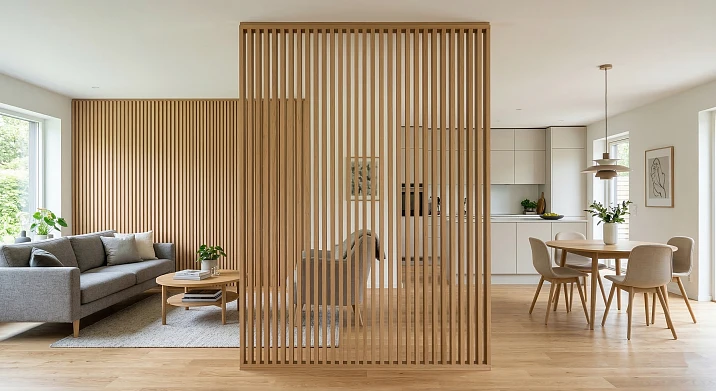
Closing off a space with a wall is simple. Any builder can do it in a day. But closing off a space so that it remains open — that's an art. This is precisely where the slat partition occupies a place that no other architectural tool can.
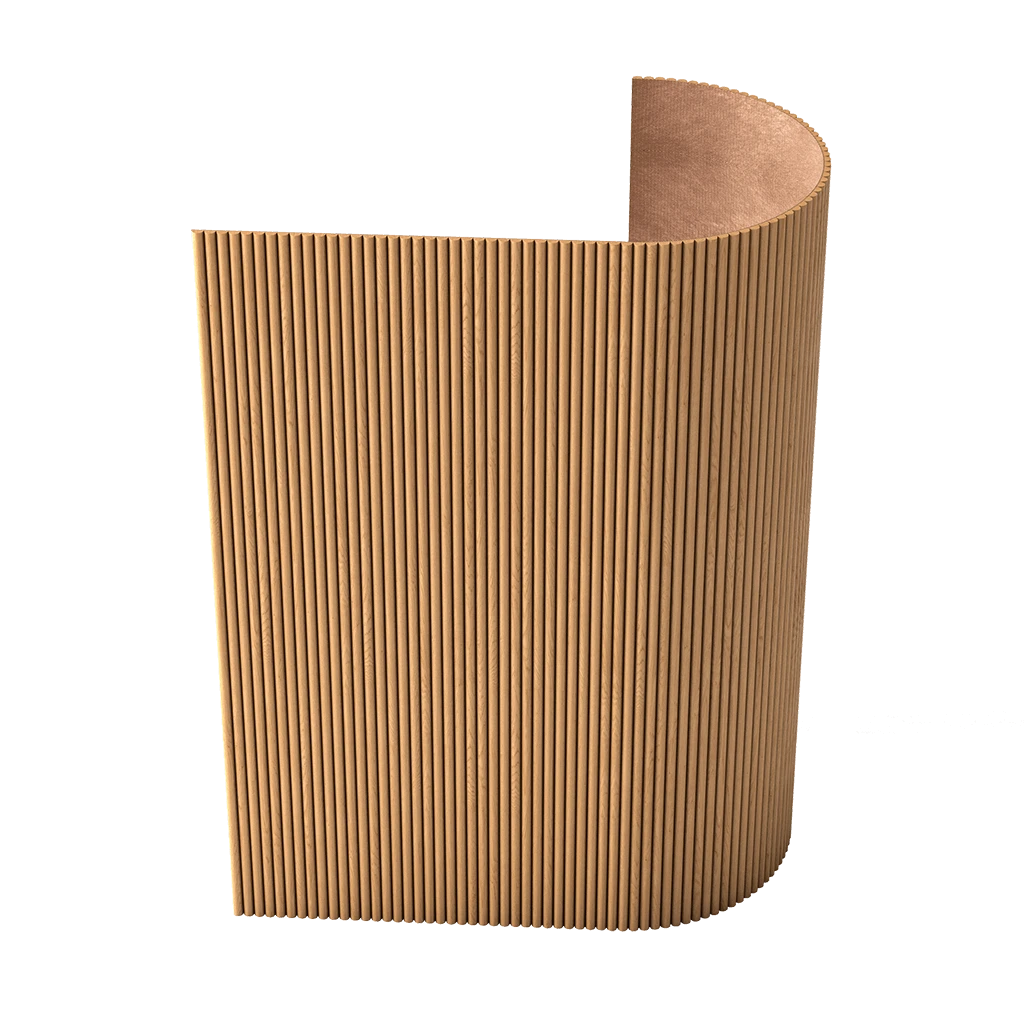
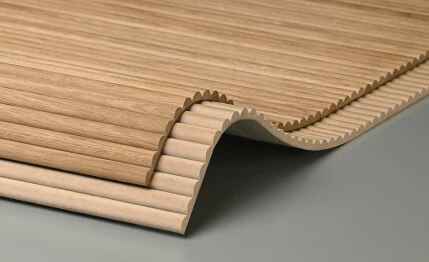
It's about a structure that simultaneously divides and connects. It marks a zone boundary — and doesn't block light. It creates a sense of separate space — and doesn't weigh down the square footage. A slat partition paired withplank panelson the walls — is a holistic zoning system where wall and spatial geometry speak the same language.
Let's break it down in detail: how it works, where it's used, what to avoid, and how to make the right decision for a specific room.
Why the slat partition has become a basic zoning tool
Slat partitions didn't appear in interiors yesterday. Japanese shōji — paper partitions with a wooden frame — have been used for hundreds of years for flexible space division. Scandinavian and Danish architecture actively used wooden lattices and slats in interior structure. What is now called a 'slat partition' is a synthesis of these traditions in a modern form.

Openness as a value of modern housing
A modern apartment is a space with high functional density. Within 40–60 m², you need to fit a bedroom, a workspace, a living room, a kitchen, and an entryway. Solid walls steal light, air, and square meters.slatted panels for zoningand slatted partitions are a solution that divides space without taking it away.
The principle is simple: a slatted partition marks a zone boundary visually and tactilely, but does not block light, air, or the visual connection between zones. A person in the kitchen sees the living room through the slats—yet still feels they are in a separate zone.
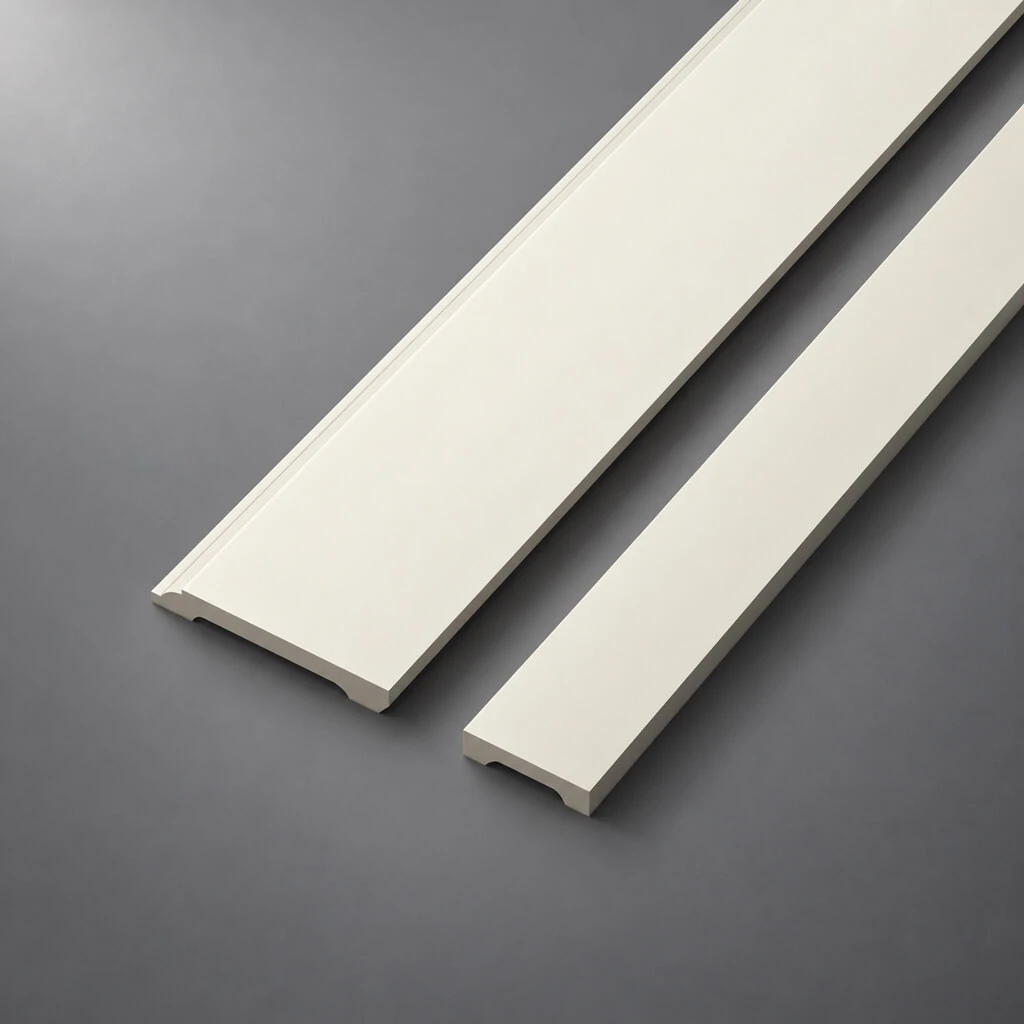
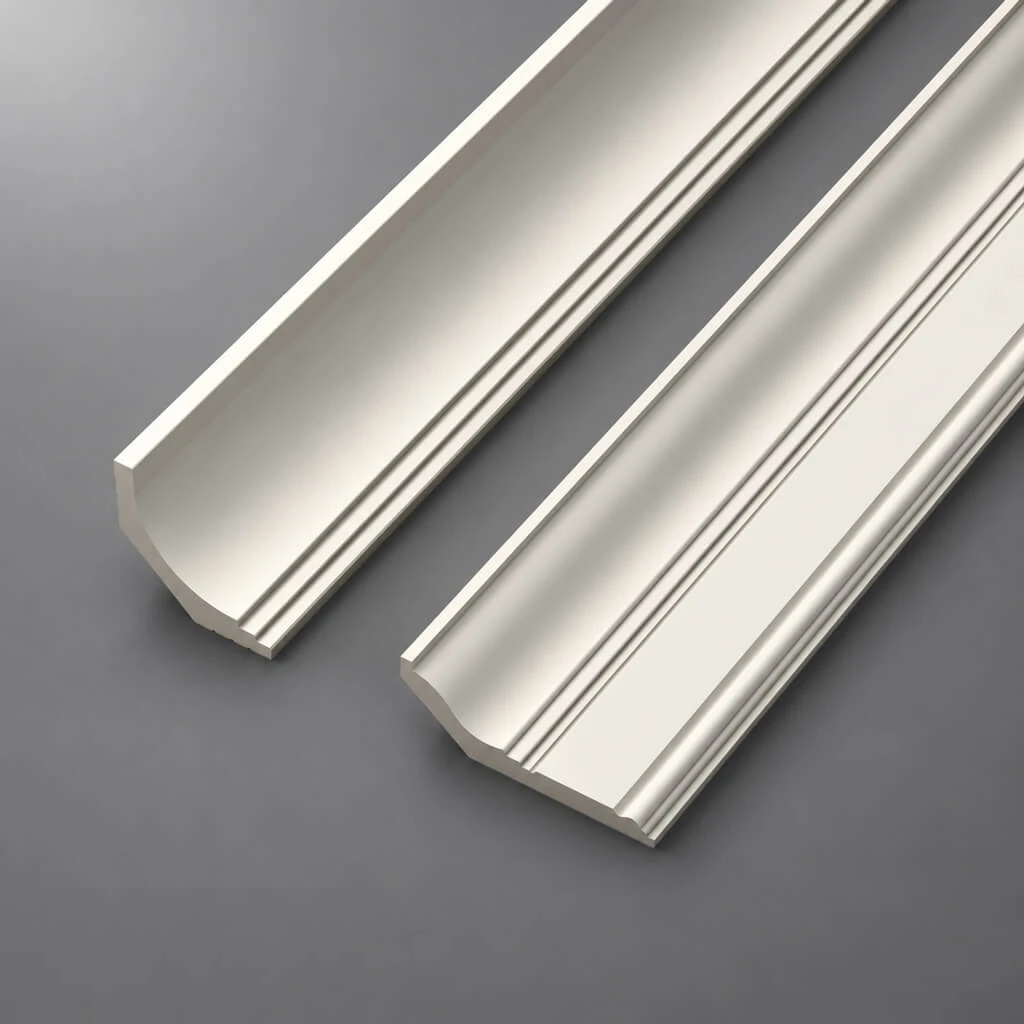
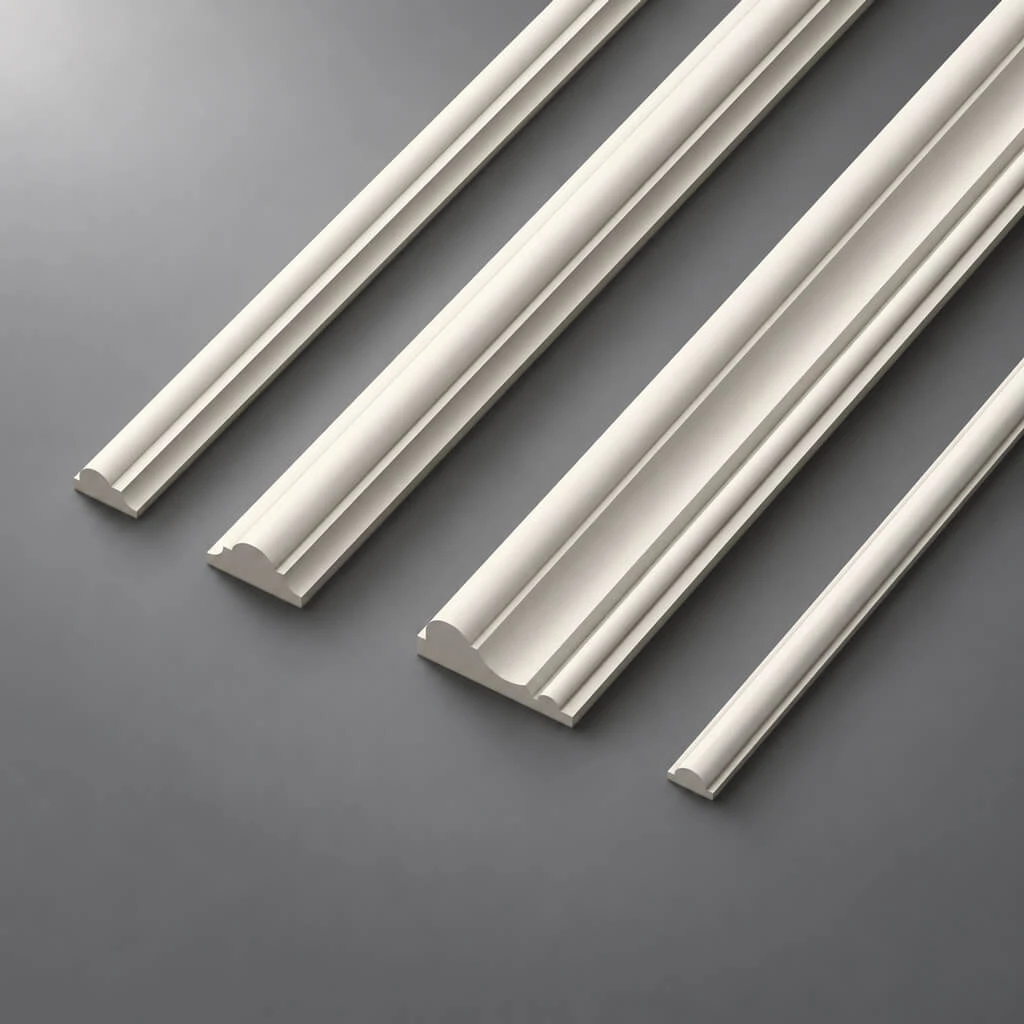
Our factory also produces:
The Psychology of Zoning: Why 'Marking' is Enough
Research in architectural psychology confirms: a person does not need a physical wall to feel a 'separate space.' A visual cue is sufficient—a change in material, rhythm, height, or lighting level. A slatted partition provides this cue with utmost clarity: here is a different zone. And it does not create the claustrophobia of an enclosed room.
This explains why slatted partitions have become a standard tool in projects for studios, open-plan layouts, and apartments with combined kitchens and living rooms.
Get Consultation
Wood as a Partition Material: Why Not Metal or Glass
Metal partitions are cold, industrial, loft-style. Glass ones are transparent, neutral, 'office-like' in feel. A wooden slatted partition is warm, natural, with a living texture.
In a residential interior, wood creates a sense of coziness and homeliness that neither metal nor glass can replicate. Natural oak, ash, or thermally modified wood in a partition is a tangible 'I'm home' signal, perceived even at the level of peripheral vision.
A Slatted Panel on a Wall and a Slatted Partition in Space: One Geometry, Two Functions
Before discussing 'what to choose' — it's essential to understand the fundamental difference between these two tools and how they work together.
Wall panel: a two-dimensional statement
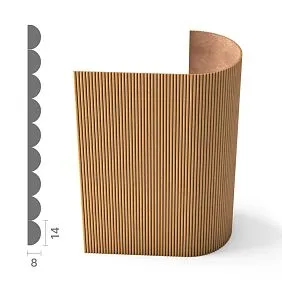
Slatted wall panels— it's a vertical rhythm on the wall plane. They operate in two dimensions: width and height. The third dimension (depth) is minimal — 12–25 mm protrusion from the wall.
Function of a wall slat panel: accent, architectural character of the surface, tactile and visual richness of the wall. Zoning is indirect: an accent wall with slats signals that this is a special area (area behind the sofa, headboard area, work area).
Slat partition: a three-dimensional object in space
A slat partition is an independent structure standing in space. It operates in three dimensions: width, height, and depth. Depth is determined by the thickness of the frame or supporting profile (usually 50–80 mm) + the thickness of the slat.
Function of a partition: physical and visual separation of zones. It stands between zones, not on their boundary. It's visible from both sides, and both sides should be finished and beautiful.
When a panel is needed, and when a partition is needed
One question decides everything: is a boundary in space needed or an accent on the surface?
-
Living room with a designated relaxation area → accent wall withdecorative slatted panels
-
Studio with a designated sleeping area → slatted partition between zones
-
Hallway with a separated wardrobe area → slatted partition
-
Home office with an accent wall behind the desk → wall panels
-
Kitchen separated from the living room → slatted partition (full or partial)
The answer is obvious when you understand the difference: a panel is about working with a surface, a partition is about working with space.
When a panel and a partition work together
The most convincing design scenario:Slatted partitionin the space — and the same slat on the accent wall behind it. The partition stands in the space, the wall 'continues' its rhythm behind it. The eye sees a unified geometric system: the slats of the partition — the slats of the wall. The space gains depth and architectural coherence.
This is not just beautiful — it's a professional design technique that creates a sense of a thoughtful, bespoke interior.
Structural Basics of Slat Partitions: How It's Made
A slat partition can be made independently — or a ready-made system can be ordered. In both cases, the construction follows the same principles.
Load-bearing frame: the foundation of the structure
The frame of a slat partition is a rigid carcass to which the slats are attached. Frame materials:
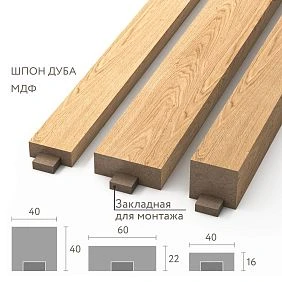
Wooden beam (40×60 or 50×80 mm) — warm, natural, mounted with self-tapping screws and metal brackets. More challenging in terms of precision: wood has tolerances. Requires antiseptic treatment.
Metal profile (steel pipe 40×40 or 50×50 mm, stainless steel profile) — precise, rigid, not subject to biological degradation. Slats are attached via wooden inserts or directly with screws. Visually — a more contemporary character.
Combination — metal load-bearing structure, wooden slats. The most technological option: the precision of metal + the warmth of wood.
Attachment to floor and ceiling
A slat partition is attached to the floor and ceiling. This is a mandatory condition: a freestanding partition without attachment to the slabs is an unstable structure.
Attachment to concrete slab — anchor bolts or dowels. The lower and upper horizontals of the frame are fixed to the floor and ceiling.
Floor profile — a metal or wooden channel into which the bottom part of the frame is inserted. Allows the partition to be dismantled without damaging the floor.
Adjustable legs — allow leveling the partition on an uneven floor without trimming.
Slats: parameters and installation
Slats are attached to the frame perpendicular to the horizontal crossbars. The spacing of the horizontal crossbars of the frame is 400–600 mm (determined by the height of the partition and the strength of the slat).
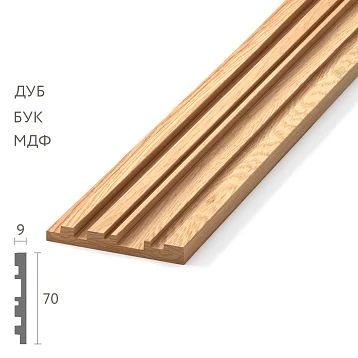
Slat width for the partition: 40–80 mm. Narrow slats (40–55 mm) — light, transparent character. Wide slats (65–80 mm) — more monumental, less 'see-through'.
Gap between slats: 40–80 mm. Large gap — more transparency, less visual separation. Small gap — a more 'closed' partition.
Partition height: from floor to ceiling — maximum zoning. From floor to a height of 130–150 cm — a 'hint' at zoning without losing space. Asymmetric partition of varying heights — a designer technique.
DIY slatted partition: what you need to know
A DIY slatted partition is an achievable task with minimal carpentry skills and the right tools. Key steps:
-
Design — determining dimensions, slat spacing, frame construction
-
Material cutting — miter saw for precise cuts
-
Frame assembly — first horizontals and verticals, leveling with a spirit level
-
Slat installation — with a template for uniform gaps (same principle as during installation)slatted wall panels)
-
Finishing — oil or varnish on all surfaces, including ends
-
Room installation — attachment to floor and ceiling
Typical DIY mistake: uneven slat spacing. Without a template, gaps "wander" — and the partition looks sloppy. A plywood template is a mandatory tool.
How to link wall panels and a partition: principles of a unified system
If the room has both a slatted partition andslatted panels on the walls— they should be part of one system. Uncoordinated elements create visual chaos.
Unity of slat width and spacing
The slat width and gap spacing in the partition and wall panel must be coordinated. This does not mean they must match exactly: the partition can have a wider gap (more transparency), and the wall panel can have a tighter rhythm. But the proportion must be systematic: if the slat is 60 mm in the panel, the slat in the partition should be 60 or 70 mm, not 40 or 100.
Unity of wood species and finish
The partition and wall panels should be made from the same wood species with the same finish. Or — a deliberate contrast: dark slats for the partition (thermo-treated oak) and light wall panels (ash with white oil). But this contrast must be intentional and consistent.
Unity of slat orientation
Vertical slats in the partition + vertical slats on wall panels = a unified architectural statement. Horizontal slats in the partition + vertical slats on the wall = stylistic dissonance. Slat orientation is a language, and it must be consistent.
Floor and ceiling level: aligning boundaries
The top edge of the slatted partition (if it doesn't reach the ceiling) should align with the top edge of the wall panels (if they don't reach the ceiling). Or — with a horizontal molding on the wall. A horizontal line that unites the partition and wall panels creates a sense of architectural order.
Application scenarios: from studio to country house
Studio: slatted partition as the main zoning element
The studio is the most obvious place for a slatted partition. One room, multiple functions: kitchen, living room, bedroom, possibly a workspace. Solid walls are inappropriate here: they destroy the sense of space.
Scenario 1: Bedroom zoning. A floor-to-ceiling slatted partition between the bed and the living area. Slat width 55–70 mm, gap 50–70 mm. On one side — the sleeping area, on the other — the living area. Light passes through the gaps. Sound — partially absorbed. Visually — two zones. On the accent wall behind the bed — the sameWooden slat panelswith the same spacing.
Scenario 2: Workspace zoning. A corner slatted partition that highlights a work corner. The partition in plan is L-shaped or U-shaped. The workspace is 'inside' the slatted pocket: psychologically separate, physically not isolated.
Scenario 3: Demarcating kitchen and living room. A slatted partition 130–150 cm high (not to the ceiling) along the line between the kitchen and living room. Function — a visual boundary, hiding the kitchen backsplash and work countertop from the view from the living room. The space above the partition is open.
Living room:Slatted panels in the living room interiorand zoning without a partition
In a large living room, a slatted partition may be excessive — wall panels that 'designate' the zone are enough. An accent wall behind the sofa withdecorative slatted panelsvisually highlights the relaxation area. A rug, furniture arrangement, and lighting direction complete the zoning.
But if the living room is combined with a work area or a children's area — a slatted partition is needed. It creates a psychological distance between the 'working' and 'resting' person in the same space.
Living room layout with a partition: the sofa area and the work corner are separated by a slatted partition from floor to a height of 160–180 cm. The slats are of the same wood species and tone as the wall panels behind the sofa. Lighting: in the work area — directed light from above, in the sofa area — warm diffused light. The partition between them serves as both a spatial and a light divider.
Entryway:Slatted panels in the hallway interiorand a partition-wardrobe
The entryway is an area that traditionally suffers from a lack of thoughtfulness. Most often, it is a 'pass-through' space without character. A slatted partition here solves several problems at once.
Scenario 1: hidden wardrobe area. A slatted partition separates a sliding wardrobe or coat rack from the entrance area. The view from the door doesn't immediately hit the clothes — it meets the wooden rhythm of the partition. Behind the partition is a functional area. Slatted panels on the entryway walls continue the rhythm.
Scenario 2: boundary between the entryway and living room. An open floor plan with the entryway flowing into the living room. A slatted partition along the axis of the entryway serves as a visual boundary. It doesn't close off the space but indicates: here is the entrance, there is the living area.
Scenario 3: decorative partition as an interior object. A small slatted partition in the entryway is not a zoning element but an architectural object. Hooks for outerwear and a small shelf are attached to it. A functional slatted partition-hanger.
Bedroom:slatted panels in the bedroomand a mini-partition for privacy
In a large bedroom or a master bedroom with an en-suite bathroom, a slatted partition can delineate a dressing area or a bathroom zone. It doesn't completely isolate these areas — but creates a visual and psychological boundary.
A slatted partition at the head of the bed is an unconventional yet effective technique in a double bedroom where it's necessary to delineate each person's 'personal space.' A partition from the floor to the height of the headboard, only on one side of the bed, is a delicate and functional detail.
Kitchen: slatted partition as a boundary island
In a large kitchen, a slatted partition can serve as an 'island': not reaching the ceiling, but at the height of the kitchen countertop (85–95 cm) plus another 40–50 cm. The top part is open. On the slatted 'wall' of the island, there are holes for light fixtures and holders for utensils.
This solution combines the functionality of a kitchen island with the decorative character of a slatted partition.
Light, air, and depth: how slats manage space
A slatted partition is not just a visual divider. It is a tool for managing light and the perception of space.
Gap transparency: how much openness is needed
The degree of 'transparency' of the partition is determined by the ratio of the slat width to the gap width:
| Slat/gap ratio | Transparency | Application |
|---|---|---|
| Slat wider than gap (60/30) | Low — 'closed' partition | Private zones (bedroom) |
| Slat = gap (60/60) | Medium — balance | Universally |
| Gap wider than slat (50/80) | High — 'transparent' partition | Light zoning in a studio |
The greater the transparency — the less physical separation, but more preservation of space and light.
Shadow as an element of volume
The slats of the partition cast shadows on the floor, ceiling, and adjacent surfaces. With side or directional lighting, these shadows create a 'moving' striped texture on the floor—a living, changing pattern. This is especially expressive with sunlight or directional fixtures.
The shadow of a slatted partition is not a random effect. It is a controlled tool: the angle of the partition relative to the light source determines the angle of the shadows.
Backlighting the partition: the slat as a light object
Slatted panel with backlighting— and a partition with backlighting are fundamentally different lighting accents. In a partition, backlighting can be:
Top-down — a light fixture above the partition is directed downward along the slats. Reveals the wood texture, creates a 'falling' effect.
Bottom-up — an LED strip at the base of the partition is directed upward. The slats glow from below, shadows go upward. A dramatic, evening effect.
Inside the structure — LEDs in the partition frame, filtered through the gaps. The partition itself becomes a source of warm, diffused light. This is the most atmospheric option.
Color behind the partition: depth through contrast
The wall behind a slatted partition is a separate design opportunity. If the wall behind the partition is painted in a contrasting tone, the partition slats turn into a 'grille' through which another color is visible. A dark blue wall behind light slats is an exquisite contrast. A saturated green behind dark slats is an unexpected depth.
Choosing the batten spacing in a partition: calculation, not intuition
The question of batten spacing in a slatted partition is one of the most practical. And one of the most often solved intuitively, not by calculation. Intuition here is a poor advisor.
Formula for calculating the spacing
Let's say the partition width is 2400 mm. Batten width is 60 mm, desired gap is 60 mm. Module = 120 mm. 2400 / 120 = 20 battens. An even number is good, the partition is symmetrical.
If the result is not a whole number — you need to either adjust the gap or make the outer battens slightly narrower. A symmetrical partition (identical outer battens) is always better than a random outer margin.
Gap and partition function
If the partition separates a sleeping area — a gap of 40–50 mm (more privacy). If it separates a living room and kitchen in a studio — a gap of 60–80 mm (preserving the feeling of a single space). If the partition is decorative — the gap can be 80–100 mm or more.
Batten height and its strength
A batten 2700 mm high (from floor to ceiling) with a width of 60 mm and a thickness of 20 mm is a thin element. At such a height, a 20 mm batten can resonate when walking, creating a visual 'play'. For high partitions, a batten thickness of 25–30 mm is recommended, or an additional horizontal brace in the middle part of the frame.
Typical mistakes in designing slatted partitions
Error 1: partition without attachment to the floor slab
A freestanding slatted partition without attachment to the floor and ceiling is a potentially hazardous structure. Under lateral load (accidental push, movement of people nearby), it may tilt. Attachment to floor slabs is mandatory.
Error 2: inconsistent slat spacing in the partition and wall panels
Partition with 70 mm spacing +Wall Panelswith 110 mm spacing — a different rhythm that visually 'clashes'. Either coordinate the spacing or use different orientations (horizontal in the panel and vertical in the partition) — but that is an intentional contrast requiring an authorial concept.
Error 3: spacing too dense in a small room
A slatted partition with a 20–30 mm gap in a 20 m² room is almost a solid wall. The main advantage of slats — transparency — is lost. In small rooms, the gap should be at least 50–60 mm.
Error 4: unprotected slat ends
The ends of wooden slats in a partition — at the top and bottom — must be treated with oil or varnish before installation. An unprotected end absorbs moisture, darkens, and delaminates. This is especially critical for the lower end, close to the floor.
Error 5: partition blocking the only light source
A slatted partition placed across the direction of natural light (between the window and the living area) is a mistake. Even with a wide gap, it reduces the illumination of the far zone. The partition should be positioned parallel to the light flow, not across it.
Mistake 6: incorrect slat scale for ceiling height
A 40 mm slat in a room with a 3.5 m ceiling is too thin, it gets lost. A 90 mm slat in a studio with a 2.5 m ceiling is too massive, it feels oppressive. The proportion of the slat should correspond to the scale of the space.
Guideline: slat height in mm ÷ 40 = optimal slat width in mm. For a height of 2700 mm → slat 67–70 mm.
Mistake 7: partition in a passage zone without sufficient clearance
If a slatted partition is located in a passage zone — the minimum passage width should be at least 900 mm (optimally 1000–1200 mm). A partition that narrows the passage to 700 mm or less creates discomfort for daily use.
Mistake 8: mismatched wood species without a concept
An oak wall panel and a pine partition in the same room create a material dissonance. Pine and oak have different characters, different 'value', different textures. They do not harmonize without special tonal treatment. One wood species in a space or an intentional, systematic contrast of species.
Slatted partition in different styles: how to adapt to the interior
Modern minimalism
Thin slats (40–50 mm), wide gap (70–100 mm), finish — gray oil or natural light. No decorative elements. Metal frame, concealed in the structure. Maximum simplicity.
Scandinavian style
Bleached ash or oak with white oil. Moderate gap (50–65 mm). Light frame. The partition 'dissolves' in the light space, creating a light, airy effect.
Modern classic
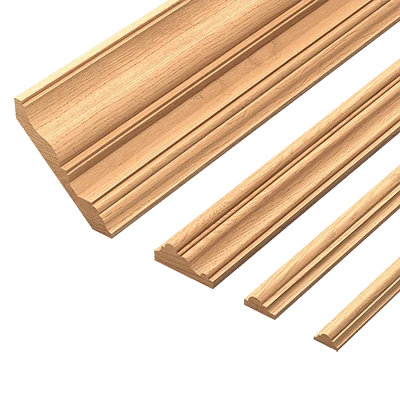
Natural oak (golden tone). Moderate slat width (60–70 mm). Wooden frame with cornice or molding finish along the top edge. The frame can be decorated withpolyurethane profilealong the top horizontal element — a cornice on the partition. A classic and sophisticated technique.
Loft
Thermo-oak or brushed dark-toned oak. Metal frame made of exposed steel pipe or angle iron. Vertical slats with a wide gap. Metal + dark wood = industrial character with natural warmth.
Japanese minimalism (wabi-sabi, japandi)
Slats made of light ash or bleached oak. Very thin (30–40 mm). Frequent rhythm with a small gap (25–35 mm). Creates an effect close to traditional Japanese shōji. The partition is semi-transparent, almost 'fabric-like' in feel.
Slatted panels in zoning: scenarios without a partition
A partition is not always needed. Sometimes zoning is achieved only with wall panels — and this is a fundamentally simpler and more accessible solution.
Accent wall as a zone boundary
Slatted panels in interior designOn one of the living room walls, they visually 'stop' the space. The area in front of this wall is for the sofa, relaxation, and living. The area behind it is different. The boundary is created without a single partition.
Rhythmic contrast of zones
Wall panels with vertical rhythm in one zone + horizontal wooden molding or a neutral wall in another zone. The contrast of rhythms signals a change of zone. This is a subtle, non-obvious tool—but it works.
Different slat tone in different zones
In an open plan: warm natural oak on the kitchen zone wall + gray ash on the living room wall. One material, different tones—soft zoning that doesn't cut up the space.
Table: choosing between a slatted partition and a slatted panel
| Task | Wall slatted panel | Slatted partition |
|---|---|---|
| Accentuate a zone | ✓ | — |
| Physically separate zones | — | ✓ |
| Do not block light | ✓ | ✓ (with wide gap) |
| Mark boundary without wall | ✓ (indirectly) | ✓ (directly) |
| Create architectural volume | — | ✓ |
| Hide functional zone | — | ✓ |
| Create background for furniture | ✓ | — |
| Use in rental housing | ✓ (wall mounting) | ✓ (with floor mounting) |
STAVROS: slatted panels and zoning systems made of natural wood
Zoning is an architectural task. And it should be solved with architectural tools, not random elements from different sources.
STAVROS producesSlatted wall panelsmade of natural oak, ash, thermowood — in a wide range of widths, gaps, and finishes. The same slats, the same material, the same finish — available for making slatted partitions. A unified material code for the wall and the space.
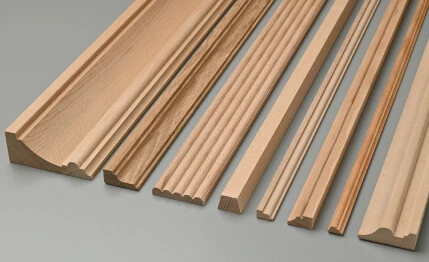
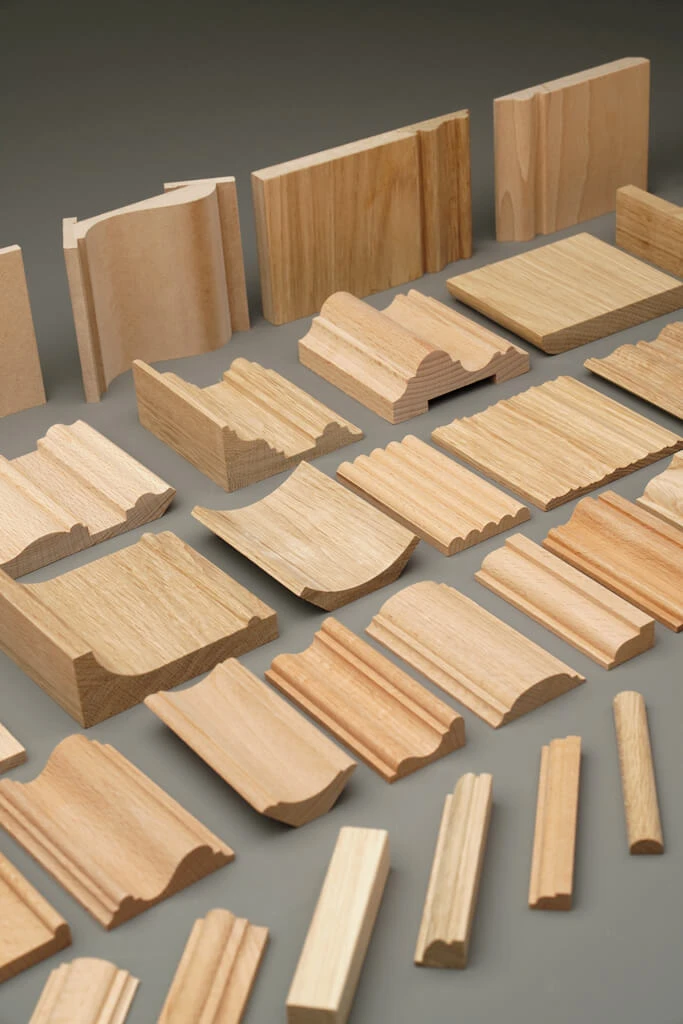
Solid wood moldings —Cornices, moldings, baseboards, architraves — coordinated in species and tone with the slatted panels. The system becomes cohesive: from wall panel to partition, from baseboard to cornice. Everything — from a single source, with proven compatibility.
Consultation on selection and calculation, finish samples, Contact us to confirm shipping to your destination.
Zoning space without heavy walls is not a compromise. It's a smarter way to work with space.
FAQ: Answers to popular questions
Is approval from the management company required to install a slatted partition?
A slatted partition, which is not a capital structure (not on a foundation, not made of concrete or brick), generally does not require approval. It is classified as furniture or decorative elements. Check with the management company of your building.
How to calculate the number of slats for a partition?
Partition height × number of slats + 10–15% margin. Number of slats = partition width / (slat width + gap width). Detailed calculation — during consultation with the manufacturer.
Can a slatted partition be disassembled and moved to another location?
Yes, if demountable fasteners are provided. With a floor profile with anchors — the partition is dismantled without damage. For rental housing, this is a fundamental advantage.
What is the optimal height for a slatted partition in a studio?
For maximum space preservation — 140–160 cm (the zone boundary is marked, but light and air are not blocked). For full zoning of the sleeping area — from floor to ceiling.
Can a slatted partition be made by yourself without special tools?
Minimally required tools: miter saw (or cutting service in a store), drill, level, tape measure, mounting brackets. With careful approach and precise cutting — feasible.
How to care for a wooden slatted partition?
Wipe with a damp cloth without abrasives. With oil finish — renew with a thin layer of the same oil every 3–5 years. Avoid prolonged contact with water.
Where to buy slatted panels for a partition or wall in St. Petersburg?
STAVROS producesslatted panels made of solid woodand implements with Contact us to confirm shipping to your destination., including St. Petersburg. Calculation for your project — before placing an order.