Article Contents:
- What is a Slatted Modular Wall Panel and Why 'Modularity' Matters
- Design Solutions: Three Types of Modular Slatted Panels
- Rigid Panel on MDF Backing
- Flexible Panel on Fabric Base
- Panels made of half-round battens
- Material as the Language of Interior
- MDF: A Precise Tool for Color and Geometry
- Solid Oak: A Living Material with a Natural Voice
- How Profile and Pitch Define the Character of a Wall
- Spatial Effect of a Modular Slatted Wall
- Where Slatted Modular Wall Panels Are Used
- In Residential Interiors
- In Commercial Spaces
- Compatibility with Other Finishing Elements
- Installation: What You Need to Know Before Starting Work
- Slatted Modular Wall Panels and Interior Styles
- Mistakes That Ruin the Result
- Technical Parameters: What to Check When Choosing
- Where to View Slatted Modular Wall Panels
- About the Company STAVROS
- FAQ: Frequently Asked Questions
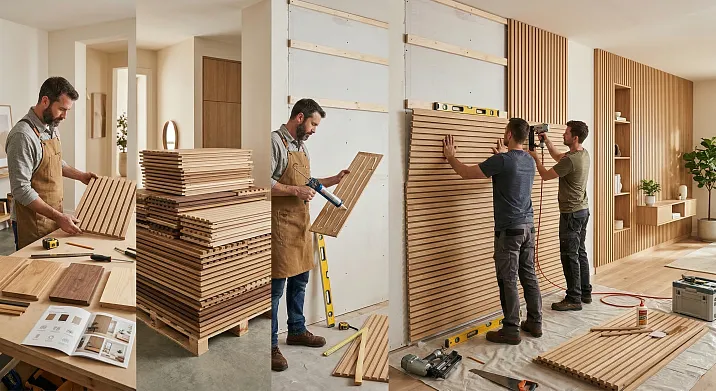
The word 'modularity' in the world of finishing is not just a technical term. It's a philosophy: a wall is built from repeating elements that together create something greater than the sum of its parts. This is exactly how aslatted modular wall panelworks — a construction where each module carries its own rhythm, and together they form an architectural surface with depth, character, and meaning.
Discussion about modular slatted systems often devolves into technical descriptions: 'slats on a backing,' 'such-and-such pitch,' 'MDF or oak material.' And that's all correct — just boring and not very useful for someone facing a real choice. Because behind the dry specifications lies a question that truly matters: what role will this wall system play in your space, how will it change its perception, and why does the modular principle deliver a result that cannot be achieved with individual slats or smooth cladding?
This article answers these questions. Without fluff, with specifics — and with respect for your time and level.


What is a Slatted Modular Wall Panel and Why 'Modularity' Matters
Let's start with a definition that is usually given in passing — yet it determines everything.
A slatted wall panel is a construction of parallel strips (slats, battens) of identical cross-section, fixed at a specified equal pitch on a rigid backing or fabric base. The result is a flat module with a textured surface: the backing is the base, the slats are the texture.
The word 'modular' in this context carries a specific meaning: the wall is assembled from several such modules, which are joined edge-to-edge. The slat pattern, with properly manufactured modules, continues across the joint without offset and is visually perceived as a single continuous surface.
Why is this important? Because this is the fundamental difference between a modular system and manually installing individual slats on a wall.
With manual installation, each slat is fixed individually with independent pitch control. This is time-consuming, labor-intensive, and requires high skill. The slightest deviation in pitch accumulates as installation progresses and by the middle of the wall can already cause a noticeable disruption of rhythm. Corner joining is a separate headache.
Modular slat panel is factory precision. The slat spacing is fixed during production, once and for the entire batch. The module is installed as a single unit — quickly, predictably, with a guaranteed result. Seamless connection is not a matter of installer skill, but a property of the design.
This is not just convenience — it's professional quality of the result, which distinguishes a finished interior from amateur work.




Design solutions: three types of modular slat panels
Not allmodular slat wall panelsare identical in design. There are three fundamentally different types, each solving its own tasks.
Our factory also produces:
Rigid panel on MDF backing
Classic design solution: slats made of MDF or solid wood are fixed to a rigid MDF backing with glue and mechanical fasteners. The panel has a strictly flat shape and does not deform during installation.
Advantages:
-
Maximum geometric precision — the flatness of the backing ensures even adhesion to the wall;
-
Consistency of slat spacing across the entire module area;
-
Possibility of installation with adhesive, finish nails, or screws on guides;
-
Easy module joining — the slat pattern continues without offset.
Application area: straight walls without bends or radius sections. This covers 90% of residential and commercial projects, making the rigid panel a universal and most in-demand solution.
Get Consultation
Flexible panel on fabric base
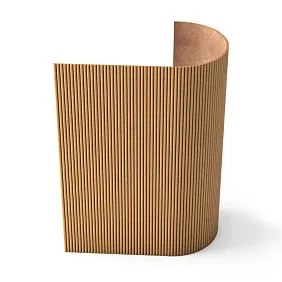
Innovative solution for complex geometry. Slats are fixed not to a rigid backing, but to a fabric mesh base. Sufficient gap remains between the slats, allowing the panel to bend without deformation or tearing.
Flexible modular slat wall panels conform to any surface: cylindrical columns, arched spans, rounded interior corners, wavy partitions. The slat pattern continues through the bend seamlessly — without breaks, without disrupting the rhythm.
This is the only way to correctly and beautifully clad a column with slat panels or create a wavy slat screen in an interior. With a rigid construction, such tasks are either unsolvable or require complex manual fitting with inevitable compromises.
Panels made of half-round molding strips
A separate category — not by backing construction, but by slat profile. Quarter-round (semi-circular) cross-section slats create a fundamentally different decorative effect compared to a rectangular profile.
The rounded surface of the slat scatters light along an arc — without sharp shadows, without rigid graphics. Under any lighting, a surface made of semi-circular quarter-rounds looks soft, pliable, warm. The wall 'breathes' — visually alive, without mechanical linearity.
For living spaces with a warm atmosphere — bedrooms, living rooms, home libraries — this is often the most precise choice. A modular slat wall panel made of semi-circular quarter-rounds in natural oak is one of the most natural and tactilely rich solutions for a wall.
Material as the language of interior
The choice between MDF and solid oak is not a question of budget or 'what is better'. It's a question of interior language: what exactly you want your wall to say.
MDF: a precise tool for color and geometry
MDF with a density of 750–850 kg/m³ is a homogeneous engineered material without natural defects. Its surface is ideal for painting: paint applies evenly, without absorption into wood fibers, without revealing texture. The result is pure, precise geometry in any specified color from the RAL, NCS catalog, or a custom sample.
MDF modular slat wall panels are the right choice when:
-
You need monochrome: a panel in the exact shade of the wall — the relief is read only through shadow, without color contrast. This is one of the most sophisticated minimalist techniques.
-
Color accuracy is important: project work with an agreed palette requires color reproducibility from batch to batch — paintable MDF is the only reliable option.
-
You need a white slat wall — the most popular solution for light modern interiors: depth without unnecessary load.
-
Interior style is minimalism, Japandi, modern classic, neoclassical: pure geometry without the natural variability of the material.
Paintable MDF is also the ideal material for commercial projects with a brand color: office reception areas and meeting rooms in corporate RAL, showrooms in a brand's signature palette.
Solid oak: a living material with a natural voice
Oak is one of the densest domestic species, with a density of 700–750 kg/m³ and high wear resistance. But the main thing is that it is a material with its own decorative language. The grain pattern on each slat is unique. The tactile feel of the open pore under oil cannot be replicated by MDF, laminate, or veneer.
Modular oak slat wall panels create a living surface — it changes color depending on the lighting angle, diffuses light differently in the morning and evening, is tactilely rich and naturally expressive.
Oak toning opens a wide range:
-
Light natural tone under oil — for Scandinavian style and Japandi;
-
Scandinavian gray — for a cold Nordic look;
-
Honey and golden — for warm organic minimalism;
-
Tobacco and cognac — for classic and neoclassical;
-
Dark wenge and graphite — for loft and strict modern interiors.
Solid wood modular wall panels are the choice of those for whom natural material is the main theme of the interior.
| Parameter | MDF for painting | Solid oak |
|---|---|---|
| Color flexibility | Any RAL/NCS | Limited to toning |
| Natural texture | No | Yes, unique for each slat |
| Tactile | Homogeneous | Living, warm, open pore |
| Wear resistance | Depends on coating | High (species) |
| Coating repair | Local painting | Oil/varnish renewal |
| Recommended style | Minimalism, neoclassical, office | Scandinavian, Japandi, loft, organic |
How profile and spacing define the character of a wall
Two parameters that are rarely discussed — and which influence the result no less than the material.
Slat profile — the cross-section of the batten:
-
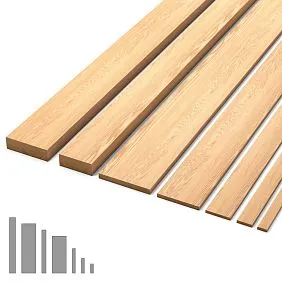
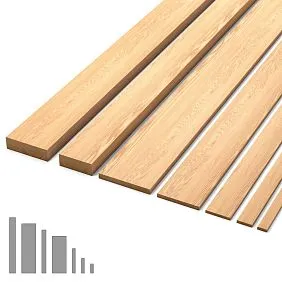
Rectangular profile — sharp edges, clear geometry. Creates hard linear shadows with side lighting — an expressive graphic pattern. A strict, architectural, cohesive look. For minimalism, studies, office spaces, loft.
-
Semicircular profile — rounded edges, soft light diffusion. Shadows are smooth, without sharp lines. The wall is warm, plastic. For living spaces with a cozy atmosphere.
-
Trapezoidal profile — a cross-section that widens toward the substrate. A more active, voluminous relief. Complex, multi-level shadow. For commercial spaces, restaurants, showrooms with a dynamic character.
Spacing between slats — the distance between the axes of adjacent battens:
-
Small spacing (15–25 mm gap): dense, rich, graphically active rhythm. The wall 'works' intensely. Suitable for large areas, accent walls in large rooms.
-
Medium spacing (25–40 mm gap): balanced rhythm, a universal solution for most living spaces.
-
Large spacing (40 mm and larger gap): airy, monumental surface. Less tension, more calm. For small rooms and delicate accents.
Scale rule: the smaller the room, the more delicate the spacing and profile should be. Aggressive relief in a small room creates a oppressive effect.
Spatial effect of a modular slatted wall
This is a section to read not for general knowledge, but for specific understanding: what will happen to your room if you install a modular slatted panel.
Vertical slats raise the ceiling. This is not a metaphor — it's an optical pattern. The eye follows vertical lines from bottom to top. In a room with a standard height of 2.7 m, a vertical slatted wall visually 'stretches' the space. The most valuable technique for apartments with low ceilings.
Horizontal slats widen a narrow room. The gaze moves left and right along horizontal lines. A narrow corridor with horizontal slats on the end wall becomes wider. Visually — noticeably, physically — unchanged.
Dense rhythm creates tension, sparse rhythm — calm. A wall with frequent slats is 'active' — it attracts the eye, holds attention, creates interior tension. This is good where a strong accent is needed. A wall with sparse slats is calm, almost meditative.
Relief and light create an illusion of greater volume. A slatted surface under side lighting looks deeper than it actually is. Each slat casts a shadow into the gap, and the eye perceives the surface as more voluminous. A flat wall never creates such an effect.
Acoustics. A relief surface scatters sound waves. This is a documented property of slatted systems: they reduce reverberation in rooms with hard reflective surfaces. In open-plan living rooms, meeting rooms, restaurant halls, home theaters — slatted panels partially solve the acoustic task without special sound-absorbing structures.
Where modular slatted wall panels are used
In residential interiors
Living room. Accent wall behind the sofa or TV area — the main application.Modular slatted panels for wallscreate an architectural center here: the gaze is fixed, the space gains a focal point. Oak in a natural tone with side lighting — a classic genre that never gets old. MDF in anthracite behind the TV — a strict, laconic look. White slats on a white wall — weightlessness and purity.
Bedroom. Wall behind the bed headboard — the second most popular scenario. Semi-circular profile, neutral warm tone, moderate spacing. Built-in LED strip along the lower perimeter of the panel — soft accent lighting that creates a 'hotel' effect. This is one detail that changes the perception of the bedroom entirely.
Hallway. First impression. A vertical modular slatted panel on the wall opposite the entrance door — immediately sets the level of the interior. For a narrow hallway: horizontal slats on the end wall widen the space. Material — oak under hard varnish or MDF in a durable coating: the hallway is a high-traffic zone.
Study. Slatted wall behind the desk — it's not just aesthetics. It's a conveyed status, spatial organization, and partial acoustic improvement for video calls. Rectangular profile, dark tone — the image of a serious professional place.
Children's room. MDF in non-toxic matte enamel or oak under water-based oil. Semi-circular profile — without sharp edges. Pastel tones for younger ages, neutral — for teenagers.
In commercial spaces
Restaurant and cafe. HereSlatted wall panelsthey solve two tasks simultaneously: atmosphere and acoustics. Oak slats under warm directional lighting create an interior image that guests return for. The relief surface reduces reverberation in the hall — important for comfortable conversation.
Office and meeting room. MDF in corporate RAL color — branding through architecture. Slatted surface in the meeting room reduces acoustic noise, making meetings more comfortable.
Showroom and boutique. Slatted wall — a professional neutral background for exposition. A lively textured surface creates an expensive context without competing with the merchandise. MDF or oak — according to the brand concept.
Hotel and lobby. Modular slatted panels for walls in a hotel lobby — a classic of hotel design. Large scale, natural oak or oak with tinting under directional lighting — an instant impression of level and quality.
Compatibility with other finishing elements
Modular slatted panel — not an isolated element. It works in conjunction.
With baseboard. Slatted panel made of oak +Wooden trimbaseboard from the same wood species — a unified material system. The baseboard completes the vertical axis of the wall, creates an architectural boundary between the panel and the floor. An uncoordinated baseboard (plastic under an oak slatted wall) — the most common mistake that destroys integrity.
With moldings and wooden trims. The molding above the top edge of the slatted panel is a horizontal 'cap' that completes the textured surface. Without molding, the panel 'abruptly ends' into a smooth wall without transition. WoodenDecorative InsertsandCarved Mouldingsin the same tone as the panel create a complete architectural system, particularly convincing in neoclassical and modern classic styles.
With furniture fronts. Slatted wall + slatted cabinet fronts — a material rhyme. Condition: the slats must be coordinated in profile, spacing, and tone. Different profiles on the wall and furniture create architectural noise. A unified rhythm ensures architectural integrity.
With lighting. LED strip along the top perimeter of the modular panel — a soft, diffused halo. Directional spotlights with a side angle — expressive sculptural shadows on the relief. Recessed lights in the gaps — architectural lighting from within the panel. Lighting is not an 'addition' to the slatted panel — it is part of the system, without which the decorative potential is only partially realized.
With stone and ceramic surfaces. A slatted panel next to porcelain stoneware or natural stone — a contrast of soft linearity with monolithic stone texture. Works in kitchens, bathrooms with wooden accents, lobbies with stone floors.
Matte brass, brushed steel, black metal in lighting fixtures andhandlecreate an expressive contrast with oak slats. This is one of the most popular material combinations in contemporary premium interiors.
Installation: What You Need to Know Before Starting Work
Installing modular slatted wall panels is one of the simplest types of finishing work. But there are nuances, ignorance of which leads to rework.
The ceiling must be flat, strong, and dust-free. Height variations exceeding 5 mm over the socket area are not allowed — the element will not fit tightly and gaps will remain.
-
The wall must be clean, dry, and degreased;
-
Plaster or putty should not be crumbling;
-
Plane deviation up to 3–5 mm is acceptable for adhesive installation;
-
More than 5 mm — frame installation is recommended.
Two installation methods:
Adhesive installation — the panel is fixed with mounting adhesive or liquid nails directly onto the wall. Fast, clean, suitable for flat substrates. Downside: removal without damaging the wall is difficult.
Frame installation — a metal profile or wooden batten is secured to the wall, panels are attached to the frame with screws or finishing nails. Allows precise leveling of the plane regardless of wall condition, creates a technical gap for wiring or sound-absorbing material. This is a professional method that ensures the highest quality result.
A crucial point — module joining:
The main requirement for a high-quality modular slatted panel is precise slat spacing, which guarantees seamless connection. With properly manufactured modules, the slats of one module continue the rhythm of the adjacent one without visible gaps or misalignment. The wall is perceived as a monolithic surface, not a set of separate sections.
If modules are manufactured with spacing deviation — joints will be visible, and no installer's skill can fix this. Therefore, modular slatted panels should be purchased from manufacturers with factory precision control.
Slat orientation:
Vertical orientation — standard installation, substrate horizontal. Horizontal orientation — the panel is rotated 90°. For rigid panels, this is technically equally simple. For flexible panels — orientation must be considered when ordering so the fabric backing is correctly oriented.
Modular Slatted Wall Panels and Interior Styles
The uniqueness of the modular slatted solution lies in its stylistic range: it is one of the few finishing materials that works organically in diametrically opposite styles — simply in different material and color scenarios.
Minimalism. MDF for painting in monochrome — panel matching the wall color. Rectangular profile. Relief only from shadow. No natural materials, no warm tones. Pure geometry.
Japandi. Oak with gray tinting or light natural. Horizontal installation — for calm linearity. Semi-circular or thin rectangular profile. Minimalism + naturalness.
Scandinavian style. Light oak with oil finish, white MDF panels. Vertical orientation. Warm, delicate, homely look.
Neoclassicism. MDF for painting in warm neutral tones. Rectangular profile with classical proportions. Moldings on top,Wooden Mouldingsin the same tone. Architectural order without literal reproduction of historical forms.
Loft. Dark oak with matte varnish. Rectangular profile. Metal light fixtures with exposed bulbs. This is a brutal, masculine look with character.
Contemporary premium interior. Solid oak or MDF in deep, saturated colors. Integrated lighting. Expensive adjacent materials: stone, brass, leather. Modular slatted panel as a marker of quality and level.
Organic minimalism. Oak in a natural tone. Semi-circular profile. Linen, stone, plants. Slatted surface as part of a natural material theme.
Mistakes that ruin the result
An expensive panel can look bad — if applied incorrectly. Here are the real mistakes that are repeated over and over again.
Too many slatted surfaces in one room. One accent wall is an architectural technique. Four slatted walls in 15 sq.m. is claustrophobia and overload. One surface for every three to four neutral ones is the correct proportion.
Large aggressive profile in a small room. Deep relief with a small pitch in a small room feels oppressive and creates excessive visual tension. For small rooms — a thin profile, moderate gap.
Uncoordinated adjacent materials. Oak slatted panel + white plastic skirting board + PVC ceiling. Material discontinuity destroys any decorative idea. Trim products — skirting boards, moldings — must be coordinated with the panel.
Flat frontal lighting. Without side or directional lighting, the relief is not visible. This is the most common disappointment: 'looks beautiful in pictures, but I just see slats on my wall.' The reason is incorrect lighting, not the panel.
Mismatched slat pitch at the joint. If modules are manufactured with deviation — joints are visible. Solution: a quality manufacturer with factory precision control.
Attempting to paint an MDF panel after installation yourself. MDF requires professional surface preparation and spray equipment for a smooth result. Achieving quality paint with a roller or brush on installed slats is practically impossible. The panel should be obtained in the finished color or painted before installation in a workshop.
Technical parameters: what to check when choosing
When choosing a modular slatted wall panel, request or check these parameters:
-
The density of MDF underlayment is from 750 kg/m³. Looser MDF holds fasteners less effectively and is less stable under humidity fluctuations.
-
Slat pitch accuracy — deviation no more than 0.5 mm. This is critical for seamless joining.
-
Quality of edge finishing — edges must be finished the same as the front surface. Unfinished edges on a visible joint are a defect.
-
Fabric base of a flexible panel — sufficient density to hold slats during bending, and sufficient flexibility for a radius of 100–150 mm.
-
Slat coating — oil, varnish, primer for painting, clean surface for painting. Clarify the 'as is' condition and recommended finishing coatings.
-
Possibility of custom module size — important for precisely covering non-standard openings without cutting the slats.
Where to look for modular slatted wall panels
If you've read this far — the choice is already largely made.slatted modular wall panel in the STAVROS catalog is presented in all the versions described in this article:
-
Rigid panels on an MDF substrate — for straight walls;
-
flexible panels on fabric backing — for columns, arches, radius surfaces;
-
panels made of semi-circular battens — for soft, delicate chiaroscuro;
-
MDF for painting — for precise color;
-
Solid oak — for natural texture.
The system can be complemented with solid wood millwork — skirting boards, moldings, and wooden trims in the same wood species. And for furniture fronts, decorative niches, and interior details — decorative inlaysandfurniture handles from the same production program. A unified material system is not a marketing thesis, but a real opportunity to assemble an interior from coordinated elements of a single manufacturer.
About the company STAVROS
The precision with which the slats join at the seam of two adjacent modules is not accidental. Behind it lies production culture: wood moisture control, milling precision, pitch stability in every unit of a production run.
STAVROS is a Russian manufacturer of MDF and solid wood products for interior finishing and furniture production. The company produces a complete line for creating a unified interior system: slatted panels, trim products, decorative overlays, furniture decor, and hardware. Over 4000 models, 20,000 modifications, 39 product groups.
The STAVROS production standard includes drying wood to the required moisture content, controlled microclimate in production (temperature 20–24 °C, humidity not less than 40%), a two-level quality system (Standard and Prestige), manual sanding of decorative elements.
Shipment from 1 piece. Delivery across all of Russia. Pre-order selection consultations — a professional conversation, not an automatic sales department.
FAQ: Frequently Asked Questions
How does a modular slatted panel differ from individual slats installed piece by piece?
The main difference is factory precision of spacing. In a module, the slats are fixed during production with accuracy down to fractions of a millimeter. During piece-by-piece installation, the spacing is controlled manually, which inevitably leads to cumulative deviations. Furthermore, the module installs significantly faster, and the joining of adjacent modules ensures a seamless result.
Can modular slatted panels be used in damp rooms?
MDF is not intended for direct contact with water and high humidity. For bathrooms, moisture-resistant MDF (MR-MDF) with appropriate coating is required. For saunas and steam rooms — only natural wood of specific species (linden, alder). Oak, with regular contact with water without special treatment, deteriorates.
How to determine the required number of modules?
The wall area (width × height) is divided by the area of one module. The result is rounded up. Add 10–15% for trimming at edges, corners, and window openings.
Is special wall primer needed before adhesive installation?
For concrete and plaster — universal acrylic primer is recommended to improve adhesion. For drywall — priming before applying adhesive is mandatory. For painted walls — the surface needs to be sanded to remove gloss.
Can vertical and horizontal slats be combined in one room?
Technically — yes. Design-wise — with caution. Two different slat orientations on different walls of the same room create a geometric conflict. If this is an intentional design technique — it must be justified and not random. In most residential interiors, a uniform orientation creates a more cohesive and convincing result.
How long will modular slatted panels made of oak last?
With proper care and regular coating renewal (oil — every 3–5 years, varnish — as wear occurs), solid oak maintains its appearance for decades. Oak is one of the most durable domestic species with high resistance to mechanical wear.
Can a non-standard module size be ordered?
Check with the manufacturer. STAVROS works both with standard formats from the stock program and with non-standard sizes on individual order with sufficient volume.