Article Contents:
- Anatomy of decorative trim: from function to form
- Trim in door constructions: how glass becomes decoration
- Wall panels: when surfaces gain architecture
- Furniture fronts: how trim creates character
- Trim and skirting boards: creating a unified system
- Wood species for trim: selection based on purpose
- Processing and finishing: from raw wood to final coating
- Trim installation: technical nuances for flawless results
- Trim in various classic styles
- Trim and lighting: how light reveals form
- Economics of trim application: investment in durability
- Frequently Asked Questions
- What's the difference between trim and glazing bead?
- Which wood species is best for painted trim?
- Can trim be used in wet areas?
- How to calculate the required amount of trim?
- Is trim installed before or after wall painting?
- How to care for wooden trim?
- Can trim be made independently?
- Solid wood vs MDF trim — what's the difference?
- How to match trim profile to interior style?
- How much does trim installation work cost?
- Conclusion: details that create the whole
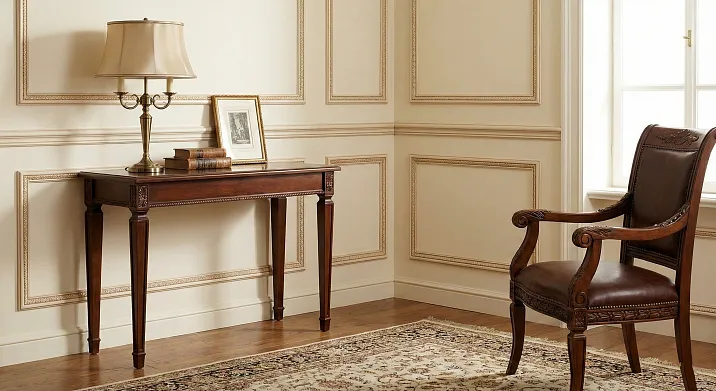
The language of classic interiors is built not on bold statements, but on details.Decorative wooden molding— is one such element that speaks softly but convincingly. It frames glass inserts in doors, creates wall panels, connects furniture fronts with room architecture. These slender solid wood profiles serve as visual syntax — they structure space, create rhythm, guide the eye, transforming disparate elements into a unified composition.
Why does classic style never die, despite endless trend cycles? Because it's based on principles tested over centuries. Proportions, symmetry, hierarchy of elements — these laws worked in Renaissance palazzos and work in modern apartments.wooden veneer with a decorative profilein combination withclassic furniturecreates interiors that never become outdated because they follow not fashion, but archetypal concepts of beauty and harmony.




Anatomy of decorative trim: from function to form
What turns a simple wooden strip into a decorative element? The profile. Flat trim serves a technical function — covering joints, securing glass. But when its surface gains shaped relief — beading, fluting, stepped recess — the strip becomes a decorative element. Light glides across these micro-reliefs, creating shadow play that brings surfaces to life.
The cross-section of the glazing bar determines its visual weight. Thin profiles of 8×12 mm are delicate, almost weightless—they are suitable for small inserts, elegant panels, and fine furniture details. Profiles of 15×20 mm have medium weight—versatile soldiers that work in most situations. Massive glazing bars of 20×30 mm and larger create a sense of monumentality—they are used in spacious rooms with high ceilings, where an appropriate scale of detail is needed.
The shape of the profile can be infinitely varied. A simple rounded glazing bar creates a soft, classic look. A profile with a central bead adds volume. A stepped glazing bar with multiple levels of relief works in Baroque and Neoclassical interiors, where plasticity and expressiveness of details are important.
Material matters no less than shape. Oak, with its expressive texture and hardness, is ideal for elements subjected to mechanical stress. Beech, with its uniform structure and light shade, is suitable for painted surfaces. Linden, soft and pliable, is indispensable for carved glazing bars with complex relief.Furniture layoutfrom STAVROS is made from all these wood species, allowing you to choose the optimal option for any task.




Glazing bars in door constructions: how glass becomes decoration
A door with glass inserts is a classic of the genre. But the difference between a banal and an elegant construction often lies precisely in the glazing bar. A simple rectangle of glass inserted into a door leaf is utilitarian. Glass framed by a shaped glazing bar with a finely crafted profile is already art.
Technically, the glazing bar secures the glass in the door opening, pressing it against the rabbet and sealing the joint. But aesthetically, it creates a frame that turns the glass into a painting. The choice of glazing bar profile determines the character of this frame. A narrow glazing bar emphasizes the glass itself, especially if it is decorative—with a bevel, sandblasted pattern, or stained glass. A wide glazing bar with active relief itself becomes the accent, and the glass becomes the background.
The geometry of the inserts also matters. One large rectangular insert creates a sense of spaciousness and light. Several vertical narrow inserts visually elongate the door, making it appear taller. Horizontal division widens the proportions, which is useful for wide double doors. Complex geometry with arched or trapezoidal elements adds architectural quality, turning the door into an independent object of attention.
Joining glazing bars at corners requires skill. A simple butt joint at a right angle looks crude. A miter joint at 45° creates a clean frame where the eye glides continuously without stumbling over the joints. This requires precise cutting and fitting, but the result is worth it.Wooden glazing bar beadfrom STAVROS is supplied with perfect geometry, simplifying the achievement of flawless joints.
Our factory also produces:


Wall panels: when a surface acquires architecture
A smooth painted wall is a plane. A wall divided by glazing bars into panels is architecture. Paneled wall decoration has deep historical roots. In classical interiors, it served not only a decorative function but also a structural one—protecting walls from damage, concealing irregularities, and compensating for thermal expansion of wooden panels.
Modern paneled decoration is pure aesthetics. Glazing bars are attached to a prepared painted wall, creating a relief structure. Panels can be of any size and proportion—from large vertical rectangles to small squares forming a regular grid. The choice depends on the scale of the room and the stylistic concept.
The height of panels often corresponds to the height of door leaves—this creates a visual connection between walls and doors. Placing panels along the axes of windows, fireplaces, and furniture creates symmetry, which calms the eye and structures the space. Arbitrary, asymmetrical placement works in a modern interpretation of classicism, where dynamics and individuality are important.
The color scheme determines the degree of expressiveness of the panels. Glazing bars painted the same color as the wall create a subtle relief that only appears under side lighting. Glazing bars in a contrasting color—white on a gray background, gold on blue—create a graphic structure that dominates the interior. Glazing bars in the color of the furniture connect the walls with the furnishings, forming a unified system.
Get Consultation
Furniture fronts: how glazing bars create character
A cabinet with smooth fronts and a cabinet with paneled doors are two different worlds. The first is modern, minimalist, neutral. The second is classic, expressive, artistic. The difference often boils down precisely to the glazing bar. Rectangular frames created from shaped wooden glazing bars divide the front surface, create a play of planes and volumes, and turn a simple door into an architectural detail.
The technical execution of paneled fronts can vary. A true panel is a construction of a frame and an inserted panel, which allows the wood to expand and contract without deformation. An imitation panel is a glazing bar glued onto a smooth base. Visually, the result may be identical, but structurally, these are different solutions.
Glazing bars on furniture fronts are not necessarily rectilinear. Curvilinear, arched elements create a softer, more decorative look. Glazing bars can form complex geometric patterns—diamonds, octagons, stars. In Baroque furniture, glazing bars are often supplemented with carved appliqués in the corners and centers of panels, creating lush, solemn decoration.
Combining glazing bars with other materials expands possibilities. Inside a glazing bar frame, there may be not a wooden panel, but glass, a mirror, metal mesh, leather, or textile. These combinations create textural diversity, making furniture more interesting and multifaceted. Glass fronts with glazing bars protect contents from dust while keeping them visible. Mirror inserts in glazing bars visually expand space, making furniture lighter.
Glazing bars and baseboards: creating a unified system
A classic interior is a system of interconnected elements. Glazing bars on doors echo glazing bars on walls. Wall panels relate to furniture fronts. Baseboards, cornices, and casings are executed in a unified stylistic key. This creates a sense of thoughtfulness, completeness, and high-quality execution.
The glazing bar profile can repeat the baseboard profile in a simplified form. If the baseboard has a complex shape with several beads and recesses, the glazing bar may contain one or two main elements of this profile. This creates a visual connection without direct copying. Repeating one characteristic element—for example, a specific bead shape or fluting—is enough for the eye to perceive the kinship of forms.
Color unity is even more important than formal unity. When glazing bars, baseboards, casings, and furniture fronts are painted the same color or made from the same wood species with identical treatment, the space gains integrity. This does not mean monotony—contrasts with wall color, textiles, and decor create variety. But the basic wooden elements, united by color and texture, form the skeleton of the interior, onto which everything else is strung.
The scale of elements must correspond to the size of the room. In small rooms, thin glazing bars and low baseboards are used—they do not overload the space. In spacious halls with high ceilings, massive baseboards 120-150 mm high and glazing bars of corresponding scale are appropriate. A mismatch of scales destroys harmony—thin glazing bars get lost in a large room, and massive ones overwhelm a small one.
Wood species for glazing bars: selection considering the task
Oak—a material for those who value strength and expressive texture. Its density of 650-750 kg/m³ makes oak glazing bars resistant to mechanical stress. This is important for door glazing bars that come into contact with hands when opening doors, and for furniture elements subjected to operational loads. The color of oak varies from light golden to dark brown; the texture with pronounced annual rings makes each strip unique.
Beech—the golden mean between strength and workability. Its density of 650-680 kg/m³ is close to oak, but the structure is more uniform, without large pores and sharp transitions. This makes beech an ideal material for painted glazing bars—the smooth surface evenly absorbs paint, creating a flawless coating. The light pinkish-cream shade of beech is good for natural oil finishes in Scandinavian and modern interiors.
Linden—the choice for carved glazing bars with complex profiles. Its softness allows the creation of fine details impossible in hardwoods. Linden glazing bars are often used in the restoration of historical interiors, where complex historical profiles need to be reproduced. The disadvantage of linden is lower strength, but for decorative elements not subjected to loads, this is not critical.
Ash has a texture similar to oak but more contrasting. Light and dark bands create an active pattern that can be both an advantage and a disadvantage—it depends on the interior concept. Ash is slightly less dense than oak but more elastic, which is important for bent elements. Ash moldings are suitable for interiors where the expressiveness of wood texture is important.
Processing and Finishing: From Raw Wood to Final Coating
Solid wood molding begins its life as a roughly processed plank after milling. Its surface is rough, contains tool marks, and fuzz. The first processing stage is sanding with abrasives of increasing fineness from P120 to P240-320. This creates a smooth surface ready for coating application.
The choice of finish determines the appearance and performance characteristics. Oil coating penetrates the wood structure, emphasizing its texture and creating a matte, velvety surface. Oil does not form a film, so the wood remains tactilely pleasant and warm to the touch. This coating requires periodic renewal every 3-5 years but is easily restored locally.
Varnish coating creates a protective film on the wood surface. Varnish can be matte, semi-matte, glossy—the choice depends on the interior style. Matte and semi-matte varnishes are universal; gloss is suitable for luxurious, formal interiors. Modern polyurethane varnishes form a durable coating resistant to abrasion and moisture. Varnished molding lasts for decades without renewal.
Painting hides the wood texture, creating an even colored coating. For classic interiors, white, cream, and gray shades of moldings are typical. Painting to match the wall color makes the molding part of the architecture. Contrast painting—black, graphite, dark blue—creates a graphic effect. Quality painting requires preliminary priming, application of several layers with intermediate sanding.
Special finishing techniques expand possibilities. Patination creates an aged effect—paint is partially worn off the protruding parts of the relief, exposing the wood or the underlying paint layer. Gilding—traditional or imitation—turns the molding into a jewelry element suitable for luxurious interiors. Brushing reveals the annual ring structure, creating an expressive textured surface.
Molding Installation: Technical Nuances for a Flawless Result
Installation quality determines whether the molding will be an ornament or a source of disappointment. Surface preparation is the first condition for success. The base must be level, clean, and dry. Irregularities are compensated by puttying and sanding. Dust is removed thoroughly—even a thin layer interferes with adhesive adhesion.
Moldings can be attached with adhesive or mechanical fasteners—nails, screws. Adhesive installation creates a clean front surface without visible fasteners. PVA wood glues or polyurethane compounds are used. Adhesive is applied evenly, the molding is pressed and fixed during setting time. Excess adhesive is immediately removed with a damp cloth.
Mechanical fasteners are used for moldings that may be subjected to loads—door moldings, furniture facade elements. Thin finishing nails or screws of minimal diameter are used. Fasteners are installed with pre-drilling to avoid splitting the wood. Heads are countersunk, holes are filled with furniture wax matching the wood color or putty for painting.
Joining moldings at corners is the moment of truth. Cutting accuracy at 45° determines the joint quality. Even a small angle error creates a noticeable gap. Professional carpenters use miter saws with precise angle setting and fine-toothed blades for a clean cut. After trimming, elements are dry-fitted, adjusted if necessary, and only then finally installed.
Molding in Various Classic Styles
Classicism requires strictness and symmetry. Moldings here are rectilinear, proportions are rational, profiles are restrained. Simple rectangular panels on walls and doors, minimal decor, emphasis on purity of lines and correctness of geometry. Colors are calm—white, beige, gray, natural wood under varnish. This style is elegant without excess.
Empire adds solemnity and formality. Moldings here are more massive, profiles are more complex. Additional decorative elements are used—carved rosettes in panel corners, overlays with laurel wreaths, military symbolism. Gilding, contrasting combinations of dark wood with gold, deep saturated colors—burgundy, emerald, sapphire. Empire is the style of victors; it must impress.
Baroque is the apotheosis of decorativeness. Moldings can be curvilinear, forming complex patterns. Carving, gilding, an abundance of details create a sense of luxury and abundance. Panels often have a convex shape, moldings are complemented by three-dimensional overlays. The color palette is rich—gold, bronze, white with gold, pastel shades with gilding. Baroque knows no measure; this is its essence and charm.
English classic is restrained and solid. Preference is given to natural wood—dark oak, mahogany, walnut. Moldings are of simple, laconic forms, without excess. Panels are rectangular, often vertical, emphasizing room height. Processing is high-quality—varnish or wax coating preserving the wood texture. English classic is about material and work quality, not about displaying wealth.
Molding and Lighting: How Light Reveals Form
The molding relief is visible only with proper lighting. Flat ceiling light kills volume, turning figured molding into a flat line. Side lighting reveals the relief, creates shadows in the profile recesses, highlights on protruding parts. This enlivens the surface, making it dynamic.
Natural lighting changes throughout the day, and moldings react to this. In the morning, when the sun is low, oblique rays strongly emphasize the relief. At noon with overhead light, volume is less pronounced. In the evening, artificial lighting again reveals the form. This makes the interior alive—it changes, not remaining static.
Artificial lighting requires thoughtfulness. Wall sconces placed so that light glides along the wall with panels emphasize their volume. Directional spotlights accent individual elements—a door with particularly beautiful molding, a furniture facade. Hidden lighting can be integrated into cornices, baseboards, creating a soft glow that delicately reveals details.
Light color temperature affects perception. Warm white light (2700-3000K) enhances warm wood tones, creates a cozy atmosphere. This is the optimal choice for classic interiors. Cool white light (4000-5000K) makes colors more neutral, which may be appropriate in a modern interpretation of classic. It is important to use one color temperature throughout the room for visual harmony.
Economics of Molding Application: Investment in Durability
The cost of decorative solid wood molding is higher than plastic or MDF analogues. But this is a one-time investment that pays off with durability and restorability. Solid oak molding lasts 50-100 years. Plastic yellows and loses appearance after 10-15 years. MDF fears moisture; if the protective layer is damaged, it quickly deteriorates.
Restorability is a key economic advantage. Wooden molding can be sanded, repainted, and the coating renewed. It lives in cycles, adapting to interior changes. If after ten years you decide to change the color of walls and furniture, moldings are repainted to a new color. MDF and plastic can only be thrown away and new ones bought.
The influence on interior perception is not measured in money, but it is real. Quality details create a sense of solidity, reliability, and taste. An interior with solid wood moldings reads as expensive, even if the rest of the furnishings are budget. Cheap details, on the contrary, cheapen the entire interior, no matter how expensive the furniture is.
When selling real estate, finishing quality affects the price. Buyers pay attention to details—if doors have beautiful moldings, if walls have panels, if furniture is high-quality, the price can be 10-15% higher. This compensates for the initial investment in quality materials.
Frequently asked questions
What is the difference between molding and glazing bead?
Terminologically, these are synonyms, but in the professional environment, glazing bead more often refers to simple rectangular strips for fixing glass, while molding refers to profiled decorative elements. Glazing bead performs a purely technical function; molding performs both decorative and technical functions simultaneously.
Which wood species is better for painted moldings?
Beech is the optimal choice. Its homogeneous fine-pored structure ensures even paint application without visible pores or transitions. Linden is also good but less durable. Oak with large pores requires preliminary pore filling for a perfectly smooth painted surface.
Can layout be used in wet rooms?
Yes, with proper treatment. The wood is treated with moisture-resistant primers and coated with varnish or special oils for wet rooms. Quality ventilation is important — stagnant humid air is harmful to any wood. In bathrooms, it's better to place layouts on walls away from direct contact with water.
How to calculate the required amount of layout?
Measure the perimeters of all elements to be framed — panels, glass inserts. Sum them up and add 15-20% for cutting and possible defects. Layout is sold in linear meters, standard strip length is 2-3 meters. Consider that each corner joint requires additional length for cutting.
Is layout attached before or after wall painting?
Depends on the technology. If the layout will be painted the same color as the wall, it is attached before painting and painted together with the wall — this creates a seamless transition. If the layout is contrasting, painted separately, it is mounted on a finished painted wall, sealing the joints with a thin layer of putty or sealant.
How to care for wooden layout?
Weekly dry cleaning with a soft cloth or vacuum with a soft brush. Damp wiping with a slightly moist cloth as needed. Oil finishes are renewed every 3-5 years — the surface is lightly sanded, a fresh layer of oil is applied. Varnish finishes last 10-15 years without renewal.
Can layout be made independently?
Technically possible with a milling machine or handheld router with appropriate bits. But achieving perfect geometry is difficult — experience and precise equipment are needed. Savings are questionable — the cost of equipment and time spent may exceed the price of ready-made layout from a manufacturer.
Solid wood and MDF layout — what's the difference?
Solid wood can be restored multiple times — sanded, repainted. It is stronger, more eco-friendly, lasts longer. MDF is cheaper, has a perfectly smooth surface without knots, but fears moisture, if the coating is damaged it deteriorates, cannot be restored. MDF suits temporary solutions, solid wood suits major renovations.
How to match layout profile to interior style?
Classicism — simple rectangular or slightly rounded profiles. Baroque — complex multi-step profiles with carving. English classic — moderately profiled layouts in dark wood. Neoclassicism — elegant thin profiles with delicate relief. Easiest to match existing moldings and baseboards in the interior.
How much does layout installation work cost?
Cost depends on complexity. Simple installation of rectangular panels on walls — from 300-500 rubles per linear meter. Installation of layout on doors with 45° cutting — from 500-800 rubles. Creating complex geometric compositions, joining carved elements — from 1000 rubles and above. Quality work costs more but guarantees results.
Conclusion: Details that Create the Whole
Great interiors are not created by a single decision — luxurious furniture or expensive finishes. They are composed of many correct details, each playing its role.Decorative wooden moldingLayout is one such detail. It is small in size, modest in price, but immense in its influence on overall perception. Correctly chosen and installed layouts transform a set of furniture and finishes into an interior — a system of interconnected elements where everything works towards a single idea.
Classical style is not about copying palaces of the past. It's about understanding the principles that made those palaces beautiful and applying those principles in a modern context. Proportions, symmetry, material quality, attention to detail — that's what creates classicism.wooden veneer with a decorative profileLayout, combined with thoughtful furniture and architectural elements, creates a space that will not become outdated because it is based not on fashion, but on eternal laws of beauty.
Company STAVROS has specialized for over two decades in manufacturing decorative elements from solid wood for classical and neoclassical interiors. Own production, equipped with modern European machinery, allows producing layouts of any complexity — from simple glazing beads to carved profiles with fine detailing. Quality control at all stages guarantees perfect geometry, smooth surface, precise dimensions.
STAVROS's assortment includes layouts of various cross-sections and profiles made of oak, beech, linden, ash. Standard profiles are available in stock for immediate shipment. Non-standard profiles are manufactured according to customer drawings — this opens possibilities for implementing unique design solutions, creating exact copies of historical profiles for restoration projects.
The option to order layouts with finish processing saves time and guarantees quality. Painting in chosen colors from RAL or NCS catalogs, varnishing with specified gloss level, oil tinting, patination, gilding — all performed at the factory using professional materials and technologies. Finished layouts arrive at the site fully prepared for installation.
STAVROS provides technical support at all project stages — from profile selection and quantity calculation to installation consultations. Experienced specialists help choose the optimal solution for a specific task, considering interior style, budget, implementation timelines. Delivery is organized throughout Russia and CIS countries with cargo safety guarantee.
Choosing decorative layouts from STAVROS means choosing quality that will serve for decades, beauty that will not become outdated, and the opportunity to create an interior reflecting your understanding of good taste and true luxury — the luxury of quality, not ostentatious display.