Article Contents:
- New interior philosophy: when furniture becomes art
- Wooden frames: from framing to architectural space
- Frame as architectural accent
- Layering and depth
- Furniture handles: sculptural miniature in everyday use
- From function to sculpture
- Material and finish
- Stylistic directions 2026: from neoclassicism to bio-futurism
- Neoclassicism with a modern interpretation
- Organic modern
- Minimalist architectural quality
- Ethno-eclecticism
- Practical aspects: how to create a gallery space in your own home
- Step one: define visual axes
- Step two: create visual connections
- Step three: work with scale
- Step four: consider functionality
- Step five: don't be afraid to mix styles
- Technology and tradition: how modern wooden frames and hardware are made
- Wood selection and preparation
- Design and modeling
- Processing and carving
- Assembly and final finishing
- Psychology of space: how details affect perception of interior
- Tactile experience and emotional connection
- Visual complexity and depth
- Narrative and identity
- Combining with other materials and decorative elements
- Wood and metal
- Wood and stone
- Wood and glass
- Wood and textile
- Space zoning using frames and decorative elements
- Frame structures as visual boundaries
- Vertical elements and visual axes
- Horizontal lines and paneling
- Color, toning, and patination: nuances of finishing
- Natural tones and their preservation
- Toning: expanding the palette
- Patination and artificial aging
- Care and preservation of wooden items
- Regular Cleaning
- Protection from moisture and temperature fluctuations
- Recoating
- How to choose a manufacturer: quality criteria
- Experience and Reputation
- Quality control at all stages
- Product range and possibility of custom orders
- Transparency and professional consultation
- Ecological and sustainable: ethical aspects of wood selection
- Legal timber and forest certification
- Local species and short logistical chains
- Durability as an ecological value
- Trends of the future: where is wooden decorative design heading?
- Personalization and customization
- Technology integration
- Biomimetic Design
- Circular economy and reuse
- Frequently Asked Questions
- How to choose a frame for a mirror to match the existing interior?
- Which wood species are best suited for furniture handles?
- Can wooden frames and hardware be used in a bathroom?
- How to care for carved wooden frames?
- How much do quality wooden frames and furniture handles cost?
- How to combine wooden elements of different shades in one interior?
- Can old wooden frames be restored?
- How to determine the quality of a wooden item when purchasing?
- Conclusion: creating space for life
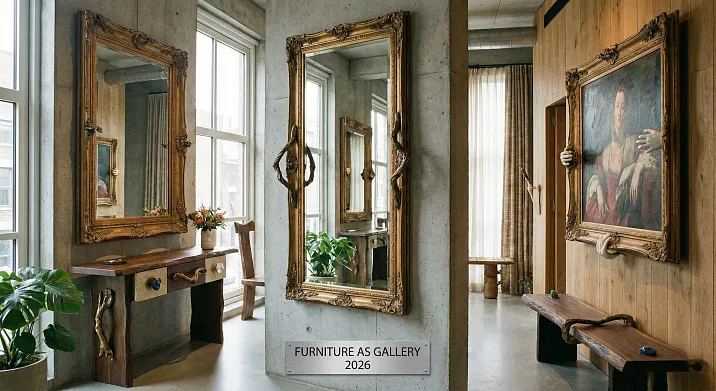
What happens when classicalframe for a paintingmeets architectural decor, and familiar furniture transforms into art objects? In 2026, interior design is experiencing an era of fusion — boundaries between functional items blur, giving rise to a new aesthetic where every detail carries artistic weight. Mirror frames, picture frames, furniture hardware — all become part of a unified gallery space, where the home transforms into a personal exhibition of style and taste.


New interior philosophy: when furniture becomes art
Imagine a space where a chest of drawers is not just a storage system, but a sculptural composition, where eachMirror wooden frameThis approach is based on the principle of curating one's own space. You are no longer simply arranging furniture — you are creating an exhibition where each element is carefully selected and thoughtfully placed.
The foundation of this approach lies in the principle of curating one’s own space. You are no longer simply arranging furniture — you are creating an exhibition where each element is carefully selected and thoughtfully placed.Furniture HandlesThey cease to be utilitarian hardware — they become miniature sculptures, pleasant to hold and pleasant to look at.
Why is this trend gaining momentum now? Because after decades of minimalism and cold functionality, people crave warmth, individuality, and emotional richness in interiors. Wood returns not as nostalgia for the past, but as a material of the future — alive, textured, capable of conveying complex artistic messages.




Wooden frames: from framing to architectural space
When we talk about frames in 2026, we are referring to much more than just picture molding. Modernwooden frameis an architectural element that structures space, creates visual axes, and establishes hierarchy among objects in the interior.
Our factory also produces:


Frame as an architectural accent
A massive carved frame around a mirror in the entryway can set the tone for the entire house. It acts as a portal, a transition between zones, a focal point for the gaze. It is important that its design harmonizes with other wooden elements in the interior — for example, withdecorative inlayson furniture facades or door portals.
It is here that modern design demonstrates its skill: the ability to create a visual dialogue between different elements without resorting to literal copying. A picture frame may share the same ornamental motif as furniture handles, but interpreted in a different scale and rhythm. This creates a sense of thoughtfulness and intentional design in every detail.
Get Consultation
Layering and depth
An interesting 2026 technique — using frames not only for their intended purpose, but also as independent decorative panels. Several frames of different sizes but unified style create a composition on the wall reminiscent of an installation in a contemporary gallery. Inside them may be mirrored inserts, textile panels, textured wallpaper, or simply a wall painted in contrasting colors — the frame becomes a means of zoning the plane, a tool for creating visual layers.
Material and finish matter. Solid oak with pronounced texture gives the frame weight and solidity, making it a central element of the composition. Beech, with its fine-grained structure, allows for more delicate, detailed carving, suitable for small frames and miniature compositions.
Furniture handles: sculptural miniatures in daily interaction
If frames set the large architectural rhythm of space, thenFurniture Handlesoperate with details, tactile experience, micro-interaction between human and object. In 2026, designers realized: it is precisely these small elements, which we touch dozens of times a day, that shape our emotional relationship to the interior.
From function to sculpture
A modern designer’s furniture handle is a small work of art. It may replicate the form of an acanthus leaf from a classical capital, abstract organic shapes from nature, or represent a geometric composition of smooth lines and sharp edges. The key is that it must be comfortable to use and visually harmonize with the overall interior concept.
Imagine a dresser in the bedroom, where each handle is a carved composition echoing the motif of the mirror frame above it. Or a kitchen set, where surface-mounted handles in solid oak harmonize with wooden picture frames in the dining area. This creates a sense of cohesion, thoughtfulness, and visual coherence in the space.
Material and finish
The quality of the handle is determined not only by its shape but also by its surface finish. Modern technologies allow achieving perfect smoothness, pleasant to the touch, while preserving the natural wood texture. Polishing, toning, lacquering — each stage of processing affects the final perception of the product.
Unfinished wood with natural tone creates a sense of eco-friendliness, closeness to nature, authenticity. Toned handles allow integrating wooden hardware into a broader interior color palette. Lacquered surfaces give the item a formal, ceremonial quality, making it more formal and representative.
Stylistic directions 2026: from neoclassicism to bio-futurism
Modern design does not recognize rigid stylistic boundaries. Picture and mirror frames, furniture handles can combine elements from different eras and directions, creating unique hybrid forms.
Neoclassicism with a modern interpretation
This is, perhaps, the most popular direction in working with wooden decorative elements. Classical motifs — acanthus, meander, rosettes, volutes — are interpreted with modern minimalism. Carving becomes less deep, more graphic, silhouettes are simplified, yet retain recognizability and elegance.
A mirror frame in neoclassical style may have traditional profiling, but without excessive gilding or patination. The natural color of the wood, enhanced by matte lacquer, looks fresh and current.Surface-mounted handlesFor furniture, they repeat the same language of forms, creating a visual connection between different pieces of furniture.
Organic Modern
Modernism has always drawn inspiration from natural forms, and the contemporary interpretation of this style continues this tradition. Smooth, flowing lines, asymmetrical compositions, botanical motifs — all of this finds expression in wooden frames and furniture hardware.
Frames for mirrors in the modern style look especially effective in bathrooms and bedrooms, where the natural organic forms create a relaxing, harmonious atmosphere. Furniture handles may have the shape of stylized flowers, leaves, or abstract biomorphic compositions, pleasant to the touch and visually interesting.
Minimalist Architecture
Paradoxically, but wood works beautifully even in minimalist interiors. A simple geometric frame made of solid oak, without carving or ornamentation, with a pronounced natural texture — this is a powerful visual element that does not require additional embellishments.
Furniture handles in a minimalist style are pure geometric forms: cylinders, parallelepipeds, simple brackets. But even here, the quality of the wood, its processing, and the finish play a decisive role. Ideal smoothness, precise fitting, thoughtfully proportioned dimensions — this is what creates the feeling of high-quality, refined design.
Ethno-Eclecticism
Using traditional ornaments from various cultures in a modern context — another popular direction. Carved frames may include Scandinavian carving motifs, Eastern geometric patterns, African rhythmic compositions. However, it is important not to fall into literal ethnographic copying, but to create a modern interpretation adapted to the current language of forms.
Furniture handles in an ethno-style may have a distinctive texture imitating handcrafted work, tool marks, and intentional imperfection, which creates a sense of authenticity and uniqueness for each piece.
Practical Aspects: How to Create a Gallery Space in Your Own Home
Theory is wonderful, but how to bring these ideas to life in a real interior? Here are specific steps and principles that will help you transform your home into a thoughtfully designed gallery space.
Step One: Define Visual Axes
Begin with an analysis of the space. What do you see upon entering the room? Where does the gaze naturally lead? These focal points should become locations for placing key decorative elements. A large mirror in a solid wood frame opposite the entrance to the hallway, a composition of several frames on a wall in the living room, an eye-catching painting above the fireplace — all of these create visual anchors for the space.
Step Two: Create Visual Connections
After identifying key points, consider how they will relate to each other. Perhaps the mirror frame in the hallway and the picture frame in the living room will be executed in the same style, made from the same type of wood? AndFurniture Handleson the wardrobe in the bedroom will repeat the ornamental motif of these frames?
It is important not to overdo it — connections should be subtle, suggestive, not literal copies. Simply repeating one ornamental motif, one type of wood, one principle of surface treatment is enough to create visual harmony.
Step Three: Work with Scale
Playing with scales — a powerful tool for creating a dynamic, interesting interior. A large monumentalmirror framein the living room may contrast with a group of small photo frames on an adjacent wall. At the same time, stylistically they should be coordinated, so that the difference in size is perceived as an intentional technique, not a coincidence.
The same applies to furniture hardware: large, expressive handles on a dresser in the bedroom can be paired with more miniature, delicate handles on bedside tables. The key is to maintain proportions and ensure that the size of the hardware matches the scale of the furniture.
Step Four: Consider Functionality
No matter how beautiful a decorative element may be, it must be convenient to use. A furniture handle should comfortably fit in the hand, and a mirror frame should not be so bulky that it visually overwhelms the space. The balance between aesthetics and functionality — a hallmark of mature, thoughtful design.
Step Five: Don't Fear Mixing Styles
Modern interiors allow for combining elements from different eras and styles. A classic carved picture frame can beautifully complement minimalist furniture, if chosen appropriately. This contrast creates visual tension, making the interior more dynamic and interesting.
The main rule — maintain moderation and pay attention to overall visual balance. If minimalism dominates the interior, one or two classical accents will create intrigue. If you are creating an eclectic space, it is important to find a unifying element — color, material, proportions — that will tie disparate items into a cohesive composition.
Technologies and Traditions: How Modern Wooden Frames and Hardware Are Made
Behind the external simplicity and elegance of wooden items lies a complex technological process that combines centuries-old craftsmanship traditions with modern manufacturing technologies.
Selection and Preparation of Wood
Everything starts with the right choice of material. For making frames and furniture hardware, noble wood species — oak, beech, ash, birch — are used. Each species has its own characteristics: oak is distinguished by its pronounced texture and high strength, beech — by its fine-grained structure, ideal for detailed carving, ash — by its flexibility and elasticity.
The wood must be properly dried to 8-12 percent moisture. This is critically important for the stability of the finished product — under-dried wood may crack or warp, while over-dried wood becomes brittle. Modern drying chambers allow precise control of the process, but require time — quality drying can take several weeks.
Designing and modeling
Creating a complex carved frame or ergonomic furniture handle begins with design. Modern designers use computer modeling, which allows visualizing the product, checking proportions, and assessing how it will look in an interior.
It is important to understand the limitations of the material and technology. Not every sophisticated computer design can be realized in wood, especially when it comes to small details and complex geometry. An experienced craftsman always adjusts the project according to the real possibilities of wood processing.
Processing and Carving
Modern production uses high-precision CNC milling machines, which can perform complex 3D carving with repeatable accuracy. This allows creating high-quality series products, where each unit is identical to the standard.
However, for exclusive, especially complex elements, hand carving remains indispensable. A master carver can create a unique ornament or individual composition, working with complex curved surfaces and fine details inaccessible to machines.
Often, a combined approach is used: the main shape is created on the machine, while final detailing and refinement are done by hand. This is the optimal combination of productivity and artistic quality.
Assembly and Final Finishing
After carving, parts undergo sanding — a multi-stage process that makes the surface perfectly smooth, pleasant to the touch, and ready for final finishing. Various grit abrasives, from coarse to fine, are used, with work performed both mechanically and manually on complex areas.
Final finishing can vary: natural oil, which highlights the wood texture and gives a matte, noble sheen; varnish, which creates a protective film and allows achieving different gloss levels; wax coating, which provides a silky surface and a subtle aroma.
For frames, staining, gilding, and patination techniques can be applied — methods that give the item historical depth, create an effect of noble antiquity, or, conversely, modern graphic appeal.
Psychology of Space: How Details Influence Perception of Interior
Why are seemingly minor details — carving on frames, shape of furniture handles, wood texture — so important? Because our perception of space is formed by many details, most of which we process subconsciously.
Tactile Experience and Emotional Connection
Every time you open a cabinet door or grasp a furniture handle, you receive tactile information. A pleasant, warm, smooth wooden surface creates a positive emotional response, fostering attachment to the object. Cold metal or plastic does not provide such an effect.
One reason why wooden furniture hardware is becoming increasingly popular, especially in living spaces where comfort and coziness matter, is that wood is a living material — it breathes, has natural warmth, and creates a sense of connection to nature, even in an urban apartment.
Visual Complexity and Depth
An interior consisting only of smooth, uniform surfaces is perceived as flat, dull, and lacking character. Carved frames, texturedWooden Inlaysand detailed hardware add visual complexity, create play of light and shadow, and make the space multi-layered and interesting to perceive.
At the same time, balance is important: too much decoration creates visual noise and fatigues the eye. A designer’s skill lies in finding the right measure — when details are sufficient to create richness and depth, but not so many that the space remains clear and structured.
Narrative and Identity
Every detail in an interior is a visual element of the story about the homeowner. Choosing classic carved frames conveys one message, minimalist geometric ones — another, eclectic mixes — a third. Through details, we convey our values, tastes, and cultural identity.
In 2026, people increasingly value the opportunity to create a unique, personalized space, unlike impersonal magazine interiors. Wooden frames and hardware, especially custom-made or selected from a wide range of options, make this possible — creating an interior that truly reflects the owner’s personality.
Combination with Other Materials and Decorative Elements
Wooden frames and furniture hardware do not exist in a vacuum — they interact with other materials and decorative elements in the interior. Understanding these interactions helps create harmonious, balanced spaces.
Wood and metal
This is a classic combination that can be interpreted differently. Brass or bronze elements combined with dark wood create a traditional, slightly formal look. Matte black steel with natural light wood — a modern minimalist option. Copper with stained oak — a warm, organic mix.
It is important to pay attention to proportions: if the main volume is wood, metal is used as an accent. Conversely, in modern interiors dominated by metal structures, wooden elements create warmth and coziness.
Wood and stone
Natural stone or its imitations — marble, granite, travertine — combine beautifully with wood, creating a sense of naturalness, authenticity, and eco-friendliness. This combination is often used in bathrooms, where a stone countertop or cladding is complemented by wooden frames for mirrors, creating a spa atmosphere.
It is important to consider moisture resistance: wood in the bathroom must be treated with special protective compounds, and the species should be selected according to the conditions of use.
Wood and glass
The transparency of glass and the texture of wood create an interesting visual contrast. The wooden frame around the mirror is the most obvious example of this combination, but you can go further: glass cabinet doors with wooden handles, glass inserts in wooden panels, stained glass in wooden frames.
Glass adds lightness and airiness, visually expanding the space. Wood grounds the space, creating a sense of reliability and stability. Together, they form a balance between openness and protection.
Wood and textile
The softness of fabrics beautifully complements the hardness and structure of wood. Textile panels in wooden frames, upholstery matching the color of wooden hardware, draperies framed by wooden cornices — all of this creates layering and tactile richness in the interior.
Natural fabrics — linen, cotton, wool — are especially effective, as their inherent organic nature resonates with wood, creating an eco-friendly, cozy atmosphere.
Zoning space using frames and decorative elements
One of the most interesting techniques in modern design is using decorative wooden elements for visual zoning of space. This is especially relevant for studios and studio apartments, where there is no desire or possibility to build solid partitions.
Frame constructions as visual boundaries
Several large frames mounted on the wall can mark the boundary between the living and dining areas, creating a visual separation without physically blocking the space. Inside the frames, you can have contrasting wall colors, mirror inserts, textile panels — any solution that creates visual depth.
This technique allows maintaining the openness and accessibility of the space, while clearly structuring it and creating a clear logic for organizing functional zones.
Vertical elements and visual axes
pilastersAnd wooden columns — another tool for zoning. They create vertical accents, mark transitions between zones, and form the architectural structure of the space. At the same time, a modern interpretation of these classical elements can be very minimalist, without excessive decoration.
It is important that vertical elements harmonize with other wooden details in the interior — frames, hardware — creating a unified visual language. Then the space is perceived as a cohesive, thought-out, architecturally sound whole.
Horizontal lines and paneling
Wooden panels on walls with integrated frames for pictures or mirrors create a complex horizontal structure, visually expanding the space, making it more static and dignified. This is a classic technique that can look fresh and current in a modern interpretation.
Attached decorative elements, handles, frames become part of the overall paneling system, creating a complex, richly detailed surface that is interesting to perceive and photogenic.
Color, toning, and patination: nuances of finishing
The natural color of wood is beautiful on its own, but sometimes additional processing is required to achieve a specific effect or to match a particular interior color palette.
Natural shades and their preservation
A modern trend is to preserve the natural color and texture of wood as much as possible. Transparent oils and varnishes protect the surface, add a subtle sheen, but do not hide the natural beauty of the material. Light beech, honey oak, warm birch — these shades create a bright, airy interior, visually expanding the space.
Such finishing is especially relevant for Scandinavian, Japanese, and eco-friendly interiors, where simplicity, naturalness, and closeness to nature are valued.
Staining: expanding the palette
Toning compositions allow you to change the color of wood while preserving its visible texture. You can darken light wood, giving it a noble walnut or wenge tone. You can create unusual color effects — gray or graphite wood for modern interiors, pastel-toned for Provence or shabby chic.
Toning is especially effective for frames, allowing you to precisely match their color to the existing color scheme of the interior, to the shade of walls, upholstery, or textiles.
Patina and Artificial Aging
For classic, vintage, eclectic interiors, patination — creating an effect of noble antiquity — is relevant. Patina emphasizes the depth of carving, creates color play, adds visual depth and history to the object.
It is important that patination be done professionally, not look artificial or intrusive. A light, delicate patina in the recesses of carving creates the feeling of an authentic antique item, while excessive, rough aging looks theatrical and unnatural.
Care and preservation of the beauty of wooden items
Wood is a living material that requires certain care to preserve its beauty and functionality for many years.
Regular cleaning
Wooden frames and furniture hardware should be regularly cleaned of dust with a soft dry cloth. For more thorough cleaning, you can use a slightly damp cloth, but it is important to immediately dry the surface thoroughly to avoid moisture penetrating the wood.
Do not use aggressive chemical cleaners, abrasive sponges, or stiff brushes — they may damage the finish and the wood itself.
Protection from moisture and temperature fluctuations
Wood is sensitive to changes in humidity and temperature. Excessive humidity may cause swelling, cracking, and mold growth. Too dry air causes shrinking, deformation, and cracking.
The optimal air humidity for wooden items is 40-60 percent, temperature — 18-24 degrees. In rooms with extreme conditions — bathrooms, kitchens, unheated cottages — it is advisable to use specially treated wood or completely avoid wooden elements in favor of more durable materials.
Recoating
Over time, the finish may wear out and lose its luster, especially on frequently used elements such as furniture handles. Periodic refreshment of the finish — applying a new layer of oil or varnish — will help preserve the item's beauty and protective properties.
This can be done independently or by professionals. It is important to use compounds compatible with the original finish; otherwise, peeling, clouding, or other defects may occur.
How to choose a manufacturer: quality criteria
The market for wooden decorative items is broad and diverse. How to choose a reliable manufacturer that guarantees quality, durability, and compliance with stated specifications?
Experience and reputation
A manufacturer with long-standing experience, a solid reputation, and positive customer reviews is a guarantee of quality. Companies that have operated for decades accumulate expertise, refine their technological processes, and understand all nuances of materials and processing.
Quality control at all stages
A quality manufacturer controls the entire cycle — from wood procurement to final packaging. Checking the moisture content of raw materials, verifying geometry after processing, inspecting the final finish — all these stages ensure that the customer receives a defect-free product.
Product range and possibility of custom orders
A wide catalog of ready-made items allows finding a suitable option for most projects. However, the ability to execute custom orders — manufacturing frames and hardware according to the client’s sketches, taking into account specific dimensions and stylistic requirements — demonstrates flexibility and customer orientation.
Transparency and professional consultation
A good manufacturer does not hide its technology and is ready to provide detailed information about materials, processes, and product characteristics. Professional consultants will help select the appropriate solution, advise on how best to integrate wooden elements into a specific interior, and how to care for them.
Ecological and sustainable aspects: ethical considerations in choosing wood
By 2026, ecological awareness — not a passing trend, but a fundamental value for an increasingly large number of people. When choosing wooden items, it is important to understand their ecological footprint and ethical aspects.
Legal timber and forest certification
Wood must be sourced from legal sources, in compliance with forestry regulations. Certification by FSC or PEFC guarantees that the forest from which the raw material is obtained is managed sustainably, with care for ecosystem preservation, rights of local communities, and future generations.
Local species and short logistical chains
Using local wood species grown in the same region where the items are produced reduces transportation footprint, supports local economy, and allows better control over the entire cycle from forest to finished product.
Durability as an ecological value
A quality wooden item that will last for decades is far more ecological than a cheap disposable item that will need to be discarded within a few years. Investing in durable, quality frames and hardware is a contribution to reducing consumption, minimizing waste, and a more mindful relationship with objects.
Trends of the future: where is the design of wooden decorative elements headed?
What awaits picture and mirror frames, furniture hardware in the coming years? What trends will shape the development of this design segment?
Personalization and Customization
Mass production is giving way to individualized solutions. Digital design and flexible manufacturing technologies allow creating unique items according to the client’s sketches without significant cost increases. Everyone can get a frame or handle specifically designed for their interior, reflecting personal taste and style.
Integration of technologies
Smart elements integrated into wooden items are already a reality. Mirrors in wooden frames with built-in lighting that changes color temperature depending on the time of day. Furniture handles with biometric sensors. Frames with integrated displays, transforming a plain wall into a dynamic art gallery.
Biomimetic Design
Design inspired by natural forms and structures will continue to evolve. Not merely stylized botanical motifs, but a deep understanding of natural principles of form creation, applying mathematical algorithms that describe plant growth, shell structures, and butterfly wing patterns.
Circular economy and reuse
Design considering the entire life cycle of the product — from production to disposal. Modular constructions that can be disassembled and reassembled. Possibility of repair, refreshment, and repurposing. Programs for collecting old items for recycling, using reclaimed wood to create new items.
Frequently asked questions
How to choose a mirror frame to match the existing interior?
Start by analyzing the dominant interior style and materials used. If the space contains wooden elements, choosewooden frameof the same species or similar tone. For classic interiors, frames with carving and ornamentation are suitable; for modern interiors — minimalist geometric shapes. Consider scale: a large mirror requires a substantial frame, while a small one — delicate and slender.
Oak and beech are the optimal choice for furniture hardware. Oak is distinguished by its high hardness, durability, and expressive grain, making it ideal for frequently used elements. Beech has a more uniform structure, allowing for detailed carving and complex shapes. Ash and birch are also used, but less frequently, for specific design solutions.
Can wooden frames and hardware be used in a bathroom?
Can wooden frames and hardware be used in a bathroom?
Yes, but with certain limitations. The wood must be treated with moisture-resistant compounds — special oils and varnishes that create a protective barrier. Good ventilation in the room is essential to prevent excess moisture from lingering. Avoid direct contact of wooden elements with water. When these conditions are met,wooden mirror framesthey work excellently in bathrooms, creating a warm, cozy atmosphere.
How to care for carved wooden frames?
Regularly clean the surface with a soft dry cloth or a special brush for carved elements, which can reach into recesses. Avoid wet cleaning unless specified by the finish type. Once a year, you can renew the protective coating by applying a new layer of oil or wax. Protect the frame from direct sunlight, which may cause fading, and from sharp temperature and humidity fluctuations.
How much do quality wooden frames and furniture handles cost?
Price depends on the type of wood, complexity of processing, size of the item, and type of finish. A simple beech frame without carving may cost several thousand rubles, while an exclusive carved oak frame can cost tens of thousands. Furniture handles range from several hundred rubles for simple models to several thousand for designer versions with detailed carving. Quality items are an investment for decades, so do not compromise quality for cost savings.
How to combine wooden elements of different shades in one interior?
Use the 'three-color rule': up to three different wood shades can harmoniously coexist in an interior if properly distributed and balanced. Choose one dominant shade (e.g., light oak for furniture), a second accent shade (dark walnut for frames), and a third for small details (medium beech tone for hardware). Ensure the shades differ noticeably, avoiding the impression of random mismatch.
Can old wooden frames be restored?
Yes, quality wooden frames can be restored. The process includes removing old finishes, repairing damaged areas, restoring carving if necessary, sanding, and applying a new finish. Often, antique frames feature unique hand-carved details that cannot be replicated with modern methods, making their restoration particularly valuable. Entrust this work to experienced restoration specialists.
How to determine the quality of a wooden item when purchasing?
Pay attention to several points: uniform color and texture without dark spots or cracks; smooth finish without chips or unevenness; quality of the final coating — even, without streaks or gaps; clarity of carving, if present; correct geometry — the item should not be warped; absence of chemical or mold odors. A quality item feels pleasant to hold, has the right weight — not too light, not excessively heavy.
Conclusion: creating a space for life
Home is not just a set of functional rooms, but a space for life, creativity, self-expression. Every detail, every decorative element contributes to creating an atmosphere in which we spend most of our lives. Wooden frames for pictures and mirrors, carefully selected furniture hardware — this is not luxury or excess, but an investment in the quality of daily life, in beauty that surrounds us every day.
In 2026, interior design moves toward mindfulness, wholeness, and a deep understanding of how space affects our emotional state and quality of life. The concept of home as gallery space reflects this approach: we become curators of our own lives, carefully selecting the items that surround us, creating visual narratives that reflect our identity.
For many years, the company STAVROS has helped realize these ideas, offering a wide range of high-quality wooden items. From classic carved frames to modern minimalist hardware, from traditional processing techniques to innovative solutions — STAVROS combines centuries-old craftsmanship with an understanding of current design trends. Choosing STAVROS products means choosing quality, durability, beauty that will not become outdated and will delight you for many years, transforming your home into a space where every detail matters.