








































Article Contents:
- What is a Skirting Board Profile and Why It Affects the Entire Interior
- How the Profile Connects Interior Elements
- What Types of Skirting Board Profiles Exist
- Straight Skirting Board Profile
- Flat Skirting Board Profile
- Smooth Profile with Soft Edges
- Ornamental Skirting Board Profile
- Tall Skirting Board Profile
- Wide skirting board profile
- Narrow skirting board profile
- How to choose a skirting board profile based on interior style
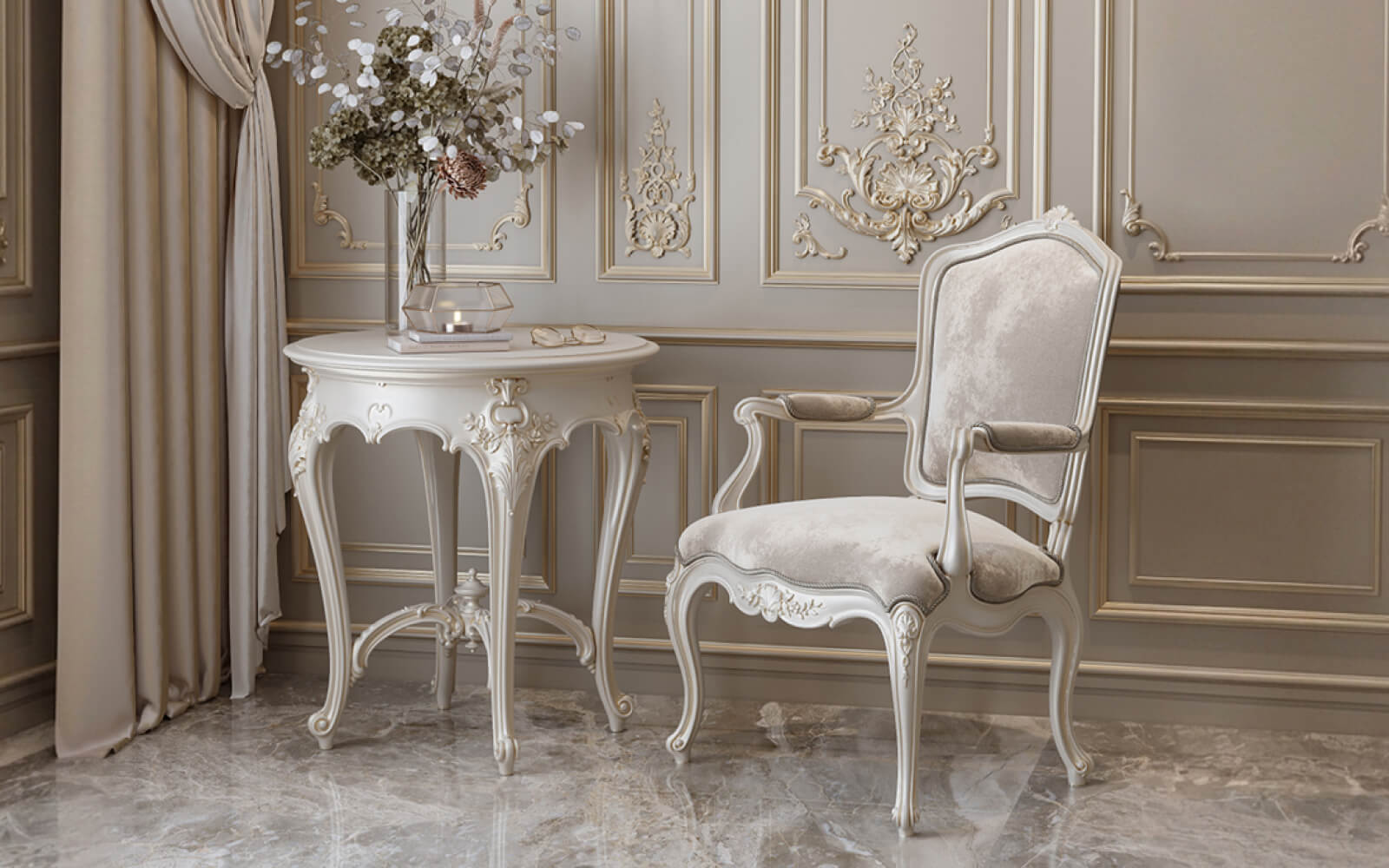
- Classic interior: ornamental profile with history
- Neoclassical: modern restraint with architectural volume
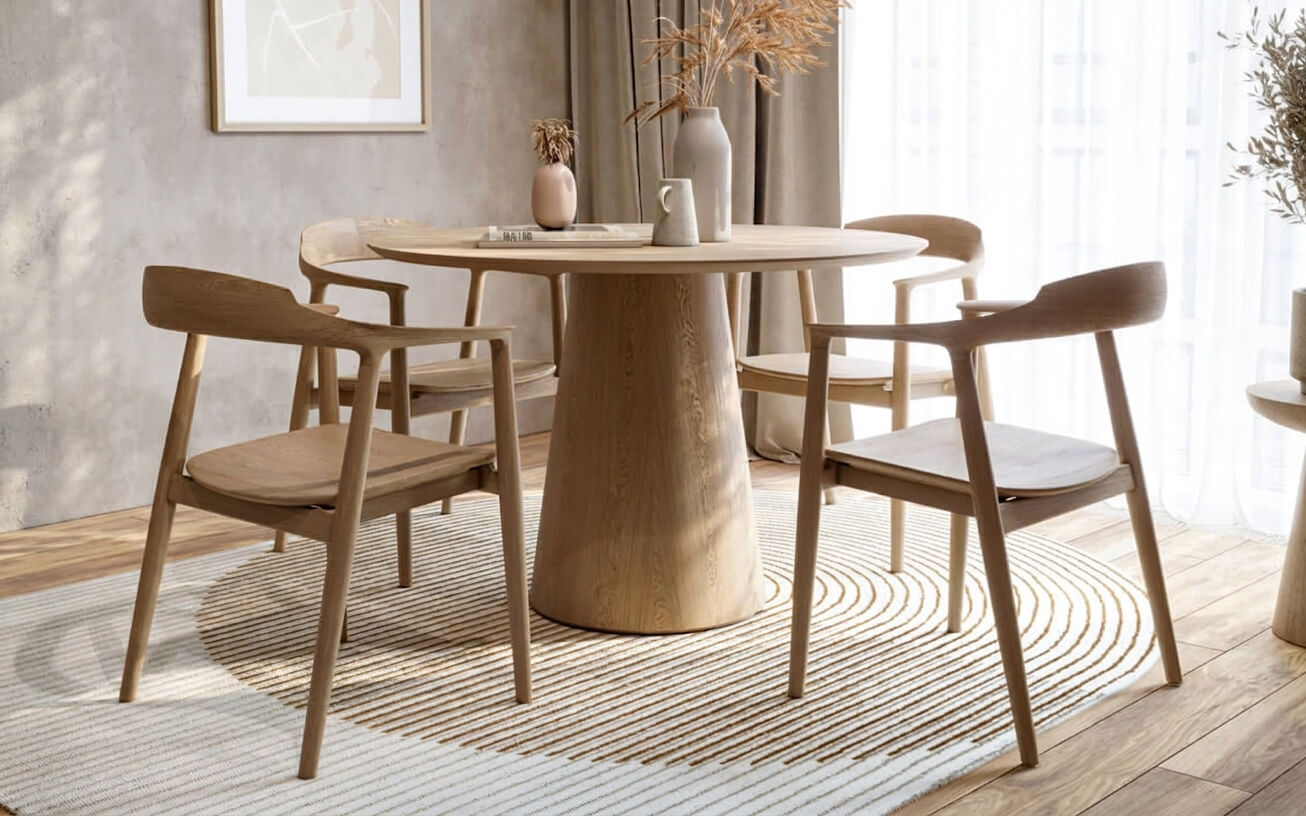
- Modern interior: straight profile 60–80 mm high
- Minimalism: flat or very narrow straight profile
- Calm light apartment: white straight or smooth medium-height profile
- MDF skirting board profile or wooden skirting board profile: which is better
- Appearance and geometric precision
- Painting: When a Paint-Ready Profile is Needed
- Naturalness and Material Value
- Moisture and Wear Resistance
- Where MDF is Better, and Where Wood is Better
- Which Skirting Profile is Best for an Apartment
- For an Apartment with Laminate
- For an Apartment with Parquet
- For an Apartment with Quartz Vinyl
- For an Entryway and Hallway with Tile
- For small spaces
- For Spacious Rooms
- How to choose a skirting board profile by height and proportions
- Low profile: up to 50 mm
- Medium profile: 60–80 mm
- High profile: 80–120 mm
- Wide profile
- How to avoid mistakes with scale
- How to match a skirting board profile to doors, walls, and floor
- Skirting board profile for white doors
- Profile matching the floor color
- White skirting board profile
- Contrasting profile
- When to choose straight, flat, or shaped profile
- Straight profile - for modern interiors
- Flat profile - for minimalism
- Shaped profile - for classic and decorative interiors
- How to match skirting board profile with interior
- Moldings: frames and panels
- Cornices: upper contour
- Wooden slats on the wall
- Wall panels made of slats
- Molding products as a system
- Where to buy skirting board profiles and ready-made solutions
- Mistakes when choosing a skirting board profile
- Mistake 1: Choosing by color, not by shape
- Mistake 2: Choosing a profile that is too low
- Mistake 3: Not considering doors and architraves
- Mistake 4: Installing too decorative a profile in a modern interior
- Mistake 5: Installing too flat a profile in a classic interior
- Mistake 6: Buying without accessories
- Conclusion: which skirting board profile to choose for you
- About the Company STAVROS
- Frequently asked questions about skirting board profiles

There is one detail in renovation that is most often underestimated—and it's the one that later catches the eye. Skirting board profile is not just 'something to cover the gap by the wall.' It's geometry, character, style. It's how the floor's contour converses with the walls, doors, and furniture. And it's surprising how many people choose skirting by color, completely ignoring the profile shape—and then feel that something is off, but can't pinpoint what exactly.
This article is an expert guide to choosing a skirting board profile. There are no empty words or general phrases here. Only specifics: which profile suits which interior, which material for which task, how not to make mistakes with proportions, and where to find the right solution. If you're choosing betweenMDF baseboard, wooden skirting boardorMDF profilefor painting—read on. You'll find the answer to your question here.
➡️ Select skirting boards and profiles for your interior in the STAVROS catalog





What is a skirting board profile and why it affects the entire interior
The word 'profile' as applied to skirting refers to the cross-section of the product—that is, its shape when viewed from the side. It is precisely the cross-section that determines how the skirting will look at the junction of the floor and wall: whether it will be almost invisible or become an expressive decorative accent, whether it will read as a detail of a classic interior or as an element of modern minimalism.
The same material—say, white MDF—in a straight, flat profile 40 mm high looks like a concise modern detail. In a shaped concave-convex profile of the same height—like a classic molding with character. And in a tall straight profile 100 mm high—like an architectural element setting the rhythm for the entire room.
This is precisely why the skirting board profile is not a technical, but first and foremost a design decision. And it should be made consciously, not based on 'what was in stock.'




How the profile connects interior elements
A baseboard is a horizontal line that runs along the perimeter of each room. It 'holds' the space from below, creating a visual boundary between the floor and the wall. But beyond that, the baseboard profile establishes a dialogue with all other decorative lines in the room:
-
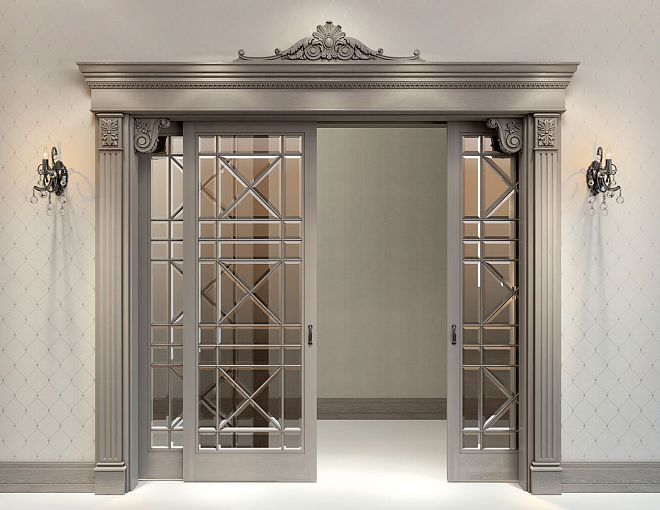
With interior doors and casings — the baseboard profile should be stylistically coordinated with the casing profile. An ornate casing and a flat baseboard is a mismatch that is felt immediately.
-
With wall moldings — if the room hasDecorative wooden moldings, the baseboard profile should be from the same 'language system': similar plasticity, similar complexity of pattern.
-
With cornices and ceiling moldings — the vertical logic of the interior is built on the principle that the top and bottom lines should be in the same stylistic register.
-
With furniture — massive facades with milling require a more decorative profile. Smooth matte facades require a simple and restrained one.
When all these elements are coordinated in profile — the room 'comes together' as if architecturally designed. When they are not — there is a feeling of something unfinished or random, even with high-quality finishes.
Our factory also produces:
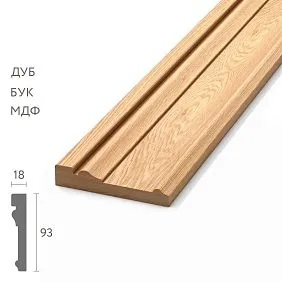

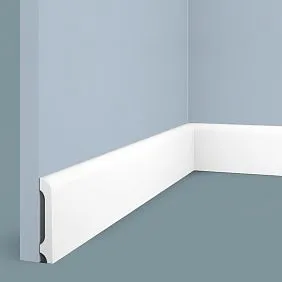
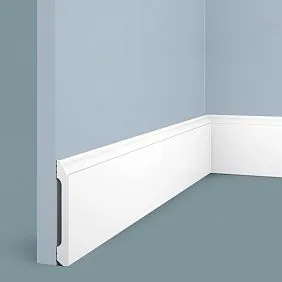
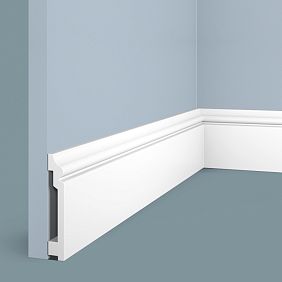
What baseboard profiles exist
Let's examine the main types of baseboard profiles — by cross-sectional shape. This is the basic typology you need to know before going to the catalog.
Get Consultation
Straight baseboard profile
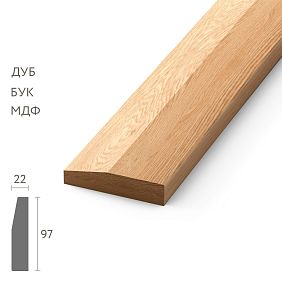
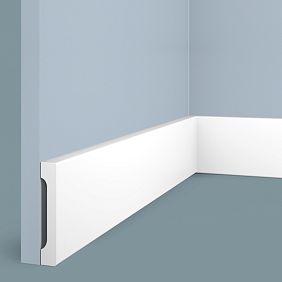
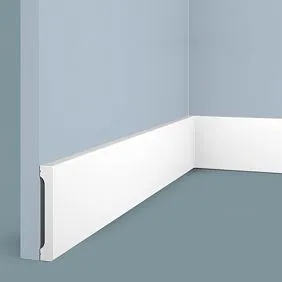
A straight profile is a cross-section with right angles and smooth edges without any protrusions, bends, or milling. The front plane is completely flat. This is the cleanest, most minimalist option.
Where it is appropriate: in modern interiors, in Scandinavian style, in minimalism, in interiors with an abundance of straight lines. A straight skirting board profile 'doesn't interfere' with the space—it simply neatly covers the joint and disappears against the wall.
Feature: it is the straight MDF profile that is most often chosen for painting—its flat surface is easily painted in the same tone as the wall, creating a 'merging' effect.
Flat skirting board profile
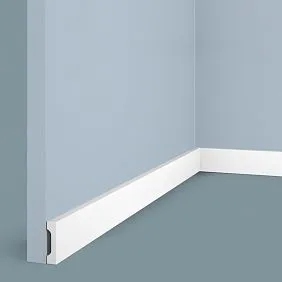
A flat profile is a very thin and low cross-section. Minimal thickness, minimal height, maximum inconspicuousness. Laconic to the limit.
A flat profile works in two scenarios: in truly radical minimalism, where any detail is superfluous, and in situations where the wall and floor are surfaces close in tone, between which no expressive boundary is needed.
Important nuance: a very flat skirting board poorly conceals the technological gap of the flooring with significant thermal expansion—laminate, parquet, and engineered board expand and contract. The lower the skirting board, the higher the risk of a visible gap appearing.
Smooth profile with rounded edges
An intermediate option between straight and shaped. The front surface is flat, but the edges are slightly rounded. The profile looks softer than a straight one and lacks the rigidity of sharp corners, but carries no decorative pattern. Works well in neutral interiors—where more warmth is needed than sharp geometry provides, but less decoration than in classic styles.
Shaped skirting board profile
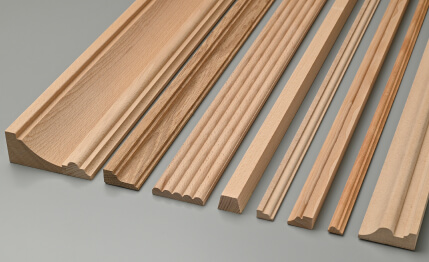
A figured profile is a cross-section with decorative elements: recesses, steps, beads, concave or convex parts. This type of profile is characteristic of classic, neoclassical, and decorative interiors.
A figured profile can be:
-
With a single bead — a soft S-shaped curve in the upper part
-
With a multi-tiered cross-section — several horizontal levels
-
With a stepped profile — clear horizontal protrusions
-
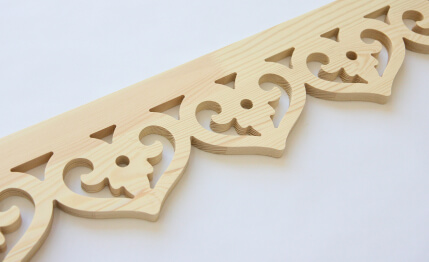
With a carved pattern — including from natural wood orwooden wall molding
High skirting board profile
A high profile is primarily about proportions, not the shape of the cross-section. Skirting boards from 80 mm and above (up to 200 mm in architectural interiors) are considered high. Such a profile creates a pronounced horizontal stripe at the floor, enhances the sense of room height, and adds a sense of status to the space.
A high skirting board profile is always a statement. You can't hide it; it's impossible not to notice. And that's precisely why it must be chosen consciously — to suit the intended interior and the room's proportions.
Wide skirting board profile
A wide profile is a skirting board with a large horizontal width (projection from the wall). It creates a more pronounced horizontal line, visually 'pressing' the space towards the ground. Works well in spacious rooms with high ceilings.
Narrow skirting board profile
Narrow profile — minimal projection and low height. Recommended for small rooms, narrow corridors, and spaces with non-standard layouts where a wide skirting board would visually 'consume' usable area.
How to choose a skirting board profile based on interior style
Interior style is the main guide in choosing a profile. Not the material, not the color, not the size — it is precisely the stylistic concept of the space that dictates the correct type of cross-section.
Classical interior: figured profile with history
Classicism is about architectural details that carry the memory of forms. Cornices, moldings, skirting boards with pronounced cross-sections — all this creates a 'living' contour of the room, rich in details.
For a classical interior, the optimal skirting board profile is a figured one, with one or several beads, with a height from 80 to 150 mm.buy wooden skirting boardwith a figured profile made of oak or ash — is exactly what creates a rich lower framing in a classical space.
Classic requires not only the correct skirting profile but also a coordinated upper contour —wooden corniceof the same species or style.
Neoclassical: modern restraint with architectural volume
Neoclassical today is one of the most sought-after styles. It takes the architectural volume of classicism but cleanses it of excesses. Skirting profile for neoclassical: tall, with one clear horizontal projection or a soft bead in the upper part. Height from 70 to 120 mm.
Here bothMDF profile for skirtingwhite for painting and wooden profile in varnish work well. MDF provides perfect geometry — without knots and irregularities. Wood provides material depth and tactile richness.
Modern interior: straight profile 60–80 mm high
Modern style is clean lines, space without unnecessary details, materials with character. The skirting profile here should be straight, without decorative projections, moderately tall. Perfectly — a straight profile 60–80 mm made of white MDF or solid wood in oil.
It is precisely the straight skirting profile in a modern interior that creates that very 'unobtrusive completeness': it is visible, it covers the joint, but does not draw attention to itself.
Minimalism: flat or very narrow straight profile
In minimalism, every detail is a choice. The skirting board here should either be completely 'dissolved' into the wall (painted to match, flat profile) or resolved as a deliberate thin line. A flat profile of 15–25 mm — or a hidden skirting board with a shadow gap — are the main solutions for this style.
Important: in a minimalist interior, any skirting board detail that looks 'standard' immediately breaks the concept. Therefore, here the choice of profile is the most crucial step.
Calm light apartment: white straight or smooth medium-height profile
The most common request is a light apartment in modern residential complexes, white or light gray walls, laminate or quartz vinyl. Here, whiteMDF Skirting Boardwith a straight or slightly shaped profile 60–80 mm high works. It is universal, neat, matches any flooring, and does not require any design decisions.
MDF skirting board profile or wooden skirting board profile: which is better
This question is one of the main ones when choosing. Let's break it down honestly, without marketing simplifications.
Appearance and geometric accuracy
MDF profilewins in geometric accuracy. MDF is a pressed homogeneous product; it has no knots, does not change shape with humidity fluctuations, and provides a perfectly straight geometry along the entire length. This is especially important for straight profiles, where any curvature is immediately noticeable.
Wooden molding is a living texture that no other material can imitate. Wood breathes, has depth, and movement in its grain. For shaped profiles made from solid wood—this sensation cannot be replaced by anything.
Painting: when you need a profile for painting
MDF profile is the optimal material for a baseboard intended for painting. Its surface evenly accepts primer and paint, has no pores or grain, and provides a perfectly smooth finish. BaseboardMDF for Painting—a standard solution for interiors where you want to paint the baseboard to match the wall or make it 'invisible'.
Wooden molding can also be painted—but it requires proper preparation (sanding, priming, accounting for wood movement with humidity changes). Wooden baseboards are more often coated with varnish or oil—this reveals the grain, rather than hiding it.
Naturalness and material value
wooden baseboard—is a material with a value that is felt tactilely. Wood is warm, alive, with a scent and a unique grain. In an interior, this is perceived as a mark of quality. Wooden baseboard molding is the choice for those who do not want to compromise on the feeling of space.
MDF is the choice for precision, whiteness, and versatility. It's not worse or better—it's different. MDF is indispensable where perfect geometry, a snow-white surface, and reproducibility over large areas are needed.
Moisture resistance and durability
MDF swells upon contact with moisture—especially at the ends. Wooden baseboards made from dense species (oak, ash, beech) are more resistant to mechanical loads. But in areas with high humidity (kitchen, bathroom), both materials require proper coating and installation with end sealing.
Where MDF is better, and where wood
| Task | Best choice |
|---|---|
| Modern interior, light walls | White MDF |
| Straight profile for painting | MDF |
| Classic or neoclassical with wood | Solid wood |
| Parquet or wooden floor | Wooden skirting board to match |
| Large areas for painting | MDF |
| The only floor with laminate or quartz vinyl | MDF or wood — according to design |
| Prestigious interior with natural materials | Solid wood |
If in doubt — take a lookMDF skirting board which is betterandwith a classic profile creates a sense of solidity, reliability.nearby — and the answer will find itself.
Which skirting board profile is better for an apartment
The question most people ask — and it's exactly the one that requires specific answers regarding the type of flooring and the nature of the room.
For an apartment with laminate
Laminate is the most common flooring in Russian apartments. For laminate, the skirting board profile is chosen based on two criteria: sufficient height (at least 60 mm, preferably 70–80 mm — for reliable coverage of the thermal gap) and color coordination.
Light laminate — whiteMDF profile for skirtingstraight or smooth. Dark laminate — wooden profile in matching tone or dark lacquered MDF. If the doors are white — match the skirting to the doors, not the laminate.
For an apartment with parquet
Parquet and parquet boards are materials with character. They require a coordinated skirting board profile. The optimal choice is woodenwooden baseboardmade from the same wood species as the parquet, or from a similar tone. A wooden skirting board for parquet creates material unity and continues the natural character of the floor.
White MDF for parquet is a contrasting solution. It works if the walls are white and the entire color scheme is built on the contrast of natural wood with white.
For an apartment with quartz vinyl
Quartz vinyl is currently one of the main flooring options. It is produced in a huge range of shades and textures. For quartz vinyl:
-
Light, imitating light wood: white MDF or a light wooden profile
-
Dark, resembling wood or stone: a wooden profile in a matching tone or dark MDF for painting
Important: quartz vinyl practically does not expand, so a skirting board with a height of 50 mm is quite sufficient for the technological gap.
For the hallway and corridor with tiles
In a hallway or corridor with tiles, the skirting board profile is approached differently. Here, the color is often chosen to match the wall, not the floor—because the tile already carries a horizontal line, and the skirting board should 'continue' the wall, not add another color plane.
Straight white or gray MDF profile with a height of 60–70 mm. Or a specialWooden corner bracketfor internal corners when installing wooden skirting boards in the hallway area.
For small rooms
Small rooms visually shrink with skirting boards that are too tall or decoratively saturated. The rule for small spaces is a narrow or medium profile (40–60 mm), straight cross-section without pronounced protrusions, color matching the wall (not contrasting). This visually elongates the space and does not create additional horizontal boundaries.
For spacious rooms
In spacious rooms, a tall skirting board profile is not an excess but a necessity. A small skirting board gets lost in a large space and looks insignificant. Optimal for living rooms with an area from 25 m²: profile height 80–120 mm, a shaped contour with moderate decorativeness is possible.
How to choose a skirting board profile by height and proportions
Profile height is the mathematics of proportions. Mismatching the skirting board height to the room height is one of the most common mistakes during renovation.
Low profile: up to 50 mm
-
For rooms with low ceilings (up to 2.6 m)
-
For small rooms
-
For minimalist interiors
-
For technical rooms
Risk: with laminate or engineered board with a large thermal gap — the skirting may not cover the gap at maximum expansion.
Medium profile: 60–80 mm
Universal height. Suitable for most apartments with ceilings 2.6–3.0 m. Covers the thermal gap of any flooring, looks proportional in any standard-sized room. This range is the designer's main tool when choosing a profile.
High profile: 80–120 mm
-
For rooms with ceilings from 2.8 m
-
For living rooms and formal spaces
-
For neoclassical and classic interiors
-
To create a sense of 'architectural presence'
With a high-profile baseboard, it's important that it coordinates with door casings and ceiling cornices—otherwise the proportions 'fall apart'.
Wide profile
A wide baseboard profile creates a large projection from the wall. It forms an expressive horizontal step at the floor. This technique comes from the arsenal of classic interiors, where the baseboard is an architectural element, not just a filler.
Important: when installing a wide baseboard, consider that it will take up a small portion of the wall area. This is noticeable in small rooms.
How to avoid mistakes with scale
Practical rule: the height of the baseboard profile should not exceed 1/20 of the wall height. So for a 2.7 m wall, the most organic baseboard is up to 135 mm. A 150–200 mm baseboard is appropriate for ceilings from 3 m.
How to match the baseboard profile to doors, walls, and floor
The baseboard profile doesn't exist in isolation. It's part of the room's decorative system—and must coordinate with it.
Baseboard profile for white doors
If the apartment has white doors and white casings—a white baseboard profile is the default solution. It creates a unified white 'frame' for the room. The profile type should match the casing: if the casing is straight—the baseboard is straight. If the casing has a bevel or molding—the baseboard should have a similar element.
When considering a systematic approach, it's worth looking atwood trim items— there you can find baseboards, door casings, and cornices made from the same material, with matching profiles.
Profile matching the floor color
A baseboard matching the floor tone is a rule for interiors where one wants to 'grow' the wall directly from the floor without a visual gap. A dark floor and dark baseboard visually expand the room horizontally. A light floor and light baseboard make the space feel airy.
White baseboard profile
A white profile is a universal, standard solution that works in 80% of apartments. A white baseboard coordinates with white doors, light walls, and most floor coverings. It doesn't require matching a specific floor tone—it simply always looks neat.
WhiteMDF Skirting Board— in a straight or slightly shaped profile—a solution that's hard to mess up.
Contrasting profile
A contrasting profile is a deliberate design decision: a dark baseboard on a light wall or vice versa. This technique works in interiors with a pronounced concept, where contrast is part of the design system. When applied thoughtlessly, a contrasting profile looks like a random mistake.
When is it better to choose a straight, flat, or shaped profile
We'll answer specifically.
Straight profile — for modern interiors
Straight skirting profile — the best choice for:
-
Interiors in modern / contemporary style
-
Scandinavian style
-
Loft with moderate details
-
Apartments where everything is resolved in rectilinear geometry
Straight profile is honesty. It doesn't try to appear as something more than it is. This is a virtue, not a flaw.
Flat profile — for minimalism
Minimalism requires either the complete disappearance of a detail or its very conscious presence. A flat profile with minimal height is the solution for the first case. A thin line at the floor, painted to match the wall — a detail you sense with peripheral vision but don't notice directly.
Figural profile — for classic and decorative interiors
A shaped profile is justified where the interior carries architectural details. This includes moldings, wall moldings, cornices with complex profiles, furniture with milled facades.
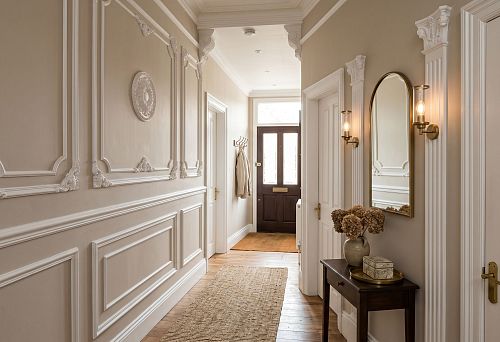
Here, the shaped profile of the baseboard is not a decorative whim, but part of the system.Decorative wooden moldingson the walls combined with a shaped wooden baseboard — this is a lively, rich interior with depth.
What to combine baseboard profile with in the interior
The baseboard is not a standalone element. It is part of the family of decorative profiles that form the architectural outline of the room.
Moldings: frames and panels
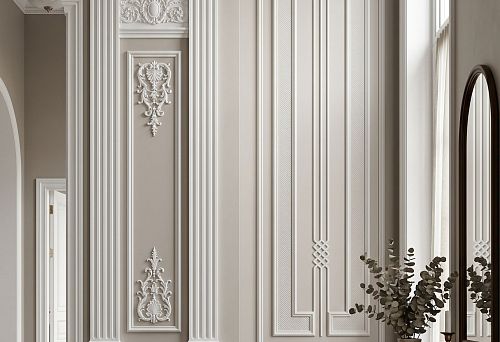
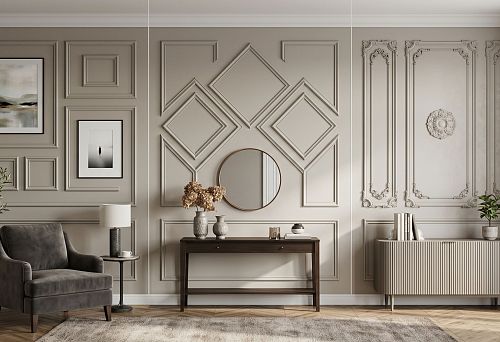
Decorative wooden moldings— horizontal and vertical profiles on the walls. They create panels, frames, divide the wall into zones. Combined with the correct baseboard profile — they form a complete architectural system for the room.
Coordination rule: if the molding is made of wood — the baseboard should be made of the same wood or MDF with the same plasticity. If the molding is straight — the baseboard should be straight.
Cornices: the upper contour
wooden cornice— the upper element of the architectural system. The baseboard and cornice are the lower and upper 'frames' of the room. Their profiles should work in the same stylistic key: both classical or both modern. Mixing a shaped cornice and a straight baseboard is acceptable with masterful design, but risky without it.
For kitchen sets and built-in cabinets —MDF Crowncreates a finished top line in harmony with the white baseboard at the floor.
Wooden wall slats
wooden planks on the wall— a modern decorative tool for accent walls. Combined with a wooden baseboard of the same wood species — they create an integrated vertical system: the slats 'grow' from the baseboard, forming an organic transition from floor to wall.
Decorative wooden stripis mounted on the wall vertically, creating rhythm. The baseboard at the base of this wall should be coordinated: wooden, of the same species or a similar tone.
Slat wall panels
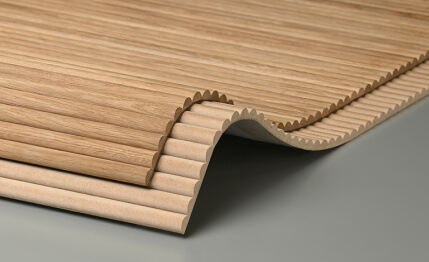
Wooden batten wall panels— a ready-made system solution for accent walls. For the correct lower transition of slat panels to the floor, a specialLath baseboardis needed, which ensures a neat joint.
Molding products as a system
Trimming Items— is a complete line of decorative profiles made from one material. Baseboard, casing, cornice, corner, molding — selected from a single catalog, from one wood species, they provide that very consistency for which a professional designer is responsible.wood trim items— is a systematic approach to finishing.
Where to buy skirting board profiles and ready-made solutions
Choosing where to buy a skirting board profile is no less important a step than choosing the profile itself.
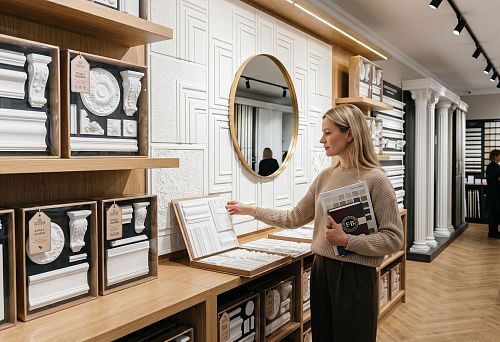
Why is it important to look not only at photos online? Because a skirting board profile is a three-dimensional object. Its shape feels different on a monitor screen and in real space. A flat photograph conveys neither the tactile sensation of wood nor the real scale of the profile relative to the room.
Why is it important to choose where there are both skirting boards and adjacent profiles? Because the skirting board profile needs to be coordinated with architraves, moldings, cornices, and battens. If all of this can be chosen from one catalog, from one material, with one style — the risk of making a mistake is minimal.
Why should the profile be chosen together with the material? Because the same shape in wood and in MDF are completely different visual results. White MDF gives clean geometry. Wood in the same profile gives a living texture. The decision depends on the task, not on 'what is cheaper.'
Mistakes when choosing a skirting board profile
Let's analyze typical mistakes — without indulgence, with specific alternatives.
Mistake 1: Choosing by color, not by shape
'A white skirting board, and that's the end of it' — no. Two white skirting boards of different profiles will create a fundamentally different feeling in the room. First decide on the profile, then on the color. Not the other way around.
Mistake 2: Choosing too low a profile
A 40 mm baseboard in a room with 3-meter ceilings looks like a decorative strip. It doesn't give a sense of completion. Don't skimp on height—this is a mistake that catches the eye every day.
Mistake 3: Not considering doors and trims
Bought a flat, straight baseboard, but the trims have a figured profile. Or vice versa. This contradiction can't be fixed without replacing one of the elements. Choose baseboards and trims simultaneously, as a system.
Mistake 4: Installing too decorative a profile in a modern interior
A figured classic baseboard in an apartment with flat white facades and minimalist furniture is a stylistic clash. The profile should match the overall style, not be chosen because it 'looked nice separately.'
Mistake 5: Installing too flat a profile in a classic interior
Classic style requires volume and detail. A flat, straight baseboard in an interior with stucco, moldings, and figured cornices is a break from the system. Classic demands a classic profile.
Mistake 6: Buying without accessories
Internal corners, external corners, connecting strips—all of these are needed for installation.Wooden corner bracketfor internal corners ensures a neat joint without trimming. Forget to buy it—you get unsightly joints or the need for an extra trip.
Conclusion: which skirting board profile to choose for you
The answer is straight. Without evasive wording.
-
Need a universal modern option—straight profileMDF Skirting Boardswhite, height 60–80 mm. Suitable for any light interior, any flooring, white doors.
-
Need a status and natural look—wooden profile made of oak or ash,wooden skirting board purchase. For parquet, classic, neoclassical, and interiors with wooden accents.
-
Need a profile for painting—MDF profilestraight or with a slight bevel. Perfect surface for paint, precise geometry, reproducibility over large areas.
-
Need a classic interior—figured wooden skirting board profile or MDF with decorative cross-section, height from 80 mm, coordinated with cornices and moldings.
-
Need a cohesive interior with a profile system — choosewood trim itemsin a unified catalog: skirting board, architrave, cornice, molding — all from the same material, with coordinated profiles.
➡️ MDF skirting board — STAVROS catalog
➡️ Buy wooden skirting board — solid wood STAVROS
➡️ Buy wooden batten — STAVROS
➡️ Wooden millwork — STAVROS catalog
About the company STAVROS
STAVROS is a Russian manufacturer of decorative products made from natural solid wood and MDF. The range includes a complete linemolding products: skirting boards with various profiles, moldings, cornices, architraves, decorative battens, batten panels, and related profile elements.
STAVROS's goal is to provide the opportunity to choose skirting board, architrave, molding, and batten from a unified system, where the profiles are coordinated in style and material. This is precisely what distinguishes an interior designed as a whole from a space assembled from random parts.
STAVROS works with private customers, designers, architects, and construction companies throughout Russia.
Frequently asked questions about skirting board profiles
What is a skirting board profile?
The skirting board profile is the shape of the product's cross-section. It determines how the skirting board looks: straight, flat, shaped, tall, or narrow. The profile is a key parameter when choosing, defining the skirting board's style.
Which skirting profile is better for a modern interior?
A straight or smooth profile without decorative protrusions, 60–80 mm in height. White MDF is a universal option for most modern apartments.
Which skirting board profile to choose for a classic interior?
A shaped profile with a bead or stepped cross-section, height from 80 mm. Solid wood or MDF for painting — both options are suitable for classic style.
MDF or wood — which is better for a skirting board profile?
MDF is better for precise geometry, painting, and a budget-friendly approach. Wood is better for natural material, tactile feel, and interiors with wooden floors. This is not a question of 'better or worse,' but a question of the task.
What height should the skirting board profile be?
General rule: for ceilings 2.5–2.7 m — height 50–70 mm; for ceilings 2.7–3.0 m — 70–90 mm; for ceilings above 3 m — 90–150 mm. The profile should not exceed 1/20 of the wall height.
Can you combine a skirting board profile with wooden slats on the wall?
Yes, this is one of the best interior techniques. A wooden skirting board made of the same wood species as thewooden planks on the wallcreates a unified decorative system from floor to wall.
Do I need to buy accessories for the skirting board profile?
Yes, definitely. For neat installation, you need internal and external corner pieces, connecting strips, and end caps.Wooden corner bracketensures neat internal corners without cutting.
Where to buy solid wood skirting board profile?
In the STAVROS catalog — a full range of solid oak, ash, and other wood skirting boards with various profiles: straight, smooth, and shaped.