Article Contents:
- Why the hallway sets the "price" of the entire interior in the eyes of a guest
- Full-length floor mirror + high baseboard around the perimeter: architecture of luxury
- Technique: mirror panel from baseboard almost to ceiling
- Option with console and mirror above it in the same wood species as the baseboard
- Ergonomics: where to place the mirror so it doesn't obstruct the passage
- Along a blank wall perpendicular to the entrance door
- Opposite the entrance door — only if there is distance
- In the corner — for small hallways
- Next to a coat rack or wardrobe
- Lighting life hacks: how to make the hallway bright and expressive
- Ceiling light — diffused but sufficient
- Mirror lighting — functionality and atmosphere
- Baseboard lighting — modern accent
- Accent lighting on console or decor
- Storage life hacks: hooks, shoe rack, bench
- Hidden storage systems — wardrobe closet
- Open coat racks — for daily clothing
- Shoe rack — closed or open
- Ottoman or bench — convenience and style
- Color palette of a boutique-style hallway: from monochrome to contrast
- Monochrome palette — elegance without excess
- Contrast of dark and light — drama and graphics
- Accent wall — color in details
- Natural wood — warmth and nobility
- Materials: what a boutique-style hallway is made from
- Solid wood baseboard — foundation of the composition
- Mirror frame made of wood or metal
- Console made of solid wood
- Floor: wood, porcelain stoneware, natural stone
- Baseboard height: how many centimeters are needed for the 'boutique' effect
- 10–12 cm — minimum for expressiveness
- 12–15 cm — optimal height for most hallways
- 15–20 cm — for high ceilings and spacious hallways
- Mirror: what frame to choose for a hallway in the 'boutique' style
- Laconic wooden frame — classic and restraint
- Carved frame in classic style — luxury and detailing
- Metal frame — modernity and strictness
- Frame with bevel — play of light
- Styles in which the 'mirror + baseboard' technique works
- Neoclassicism — symmetry and nobility
- Modern classic — conciseness with reference to tradition
- Scandinavian style — light, wood, simplicity
- Loft — brutality and honesty of materials
- Art Deco — Geometry and Luxury
- Practical examples: three hallway design scenarios
- Scenario 1: Small hallway 3–4 sq. m
- Scenario 2: Medium hallway 6–7 sq. m
- Scenario 3: Large hallway 10–12 sq. m
- Mistakes to avoid
- Mistake 1: Material mismatch
- Mistake 2: Too narrow baseboard
- Mistake 3: Mirror placed inconveniently
- Mistake 4: Lack of lighting
- Mistake 5: Overloading with decor
- Frequently Asked Questions
- Conclusion
First impressions don't happen twice. When a guest crosses the threshold of your home, the first five seconds determine everything. It is the hallway that sets the tone, establishes the value of the entire interior, and creates a sense of the owner's taste, status, and culture. A boutique is a space where every item is in its place, where the quality of materials speaks for itself, where details are refined with jewelry precision. A hallway in the 'boutique' style is not just a functional area for undressing; it is the calling card of the home, wherefloor mirrors in framesand a tall wooden baseboard create the architectural foundation of an impeccable space.


Why the hallway sets the 'value' of the entire interior in the eyes of a guest
The psychology of perception is such that the first impression becomes a filter for everything that follows. Even if the living room looks luxurious and the bedroom is furnished with impeccable taste, a dirty, cramped, and faceless hallway will negate it all. The guest will enter, see chaos, a lack of attention to detail — and subconsciously conclude: beauty is not valued here, people live superficially here.
The hallway is the first frame of the film. If it's boring, the viewer loses interest. If it's bright, captivating, and shot with quality — you want to keep watching. That's why in interior design, it's customary to invest no less effort into the hallway than into the living room or bedroom. And sometimes — even more.
The 'boutique' style is built on several principles. First, impeccable material quality: natural wood, metal, glass, leather. No cheap plastic, laminated MDF, or imitations of anything. Second, thoughtful composition: every element in its place, nothing superfluous, yet nothing lacking. Third, emphasis on details: hardware, baseboard profile, mirror frame — everything should be expressive and memorable.
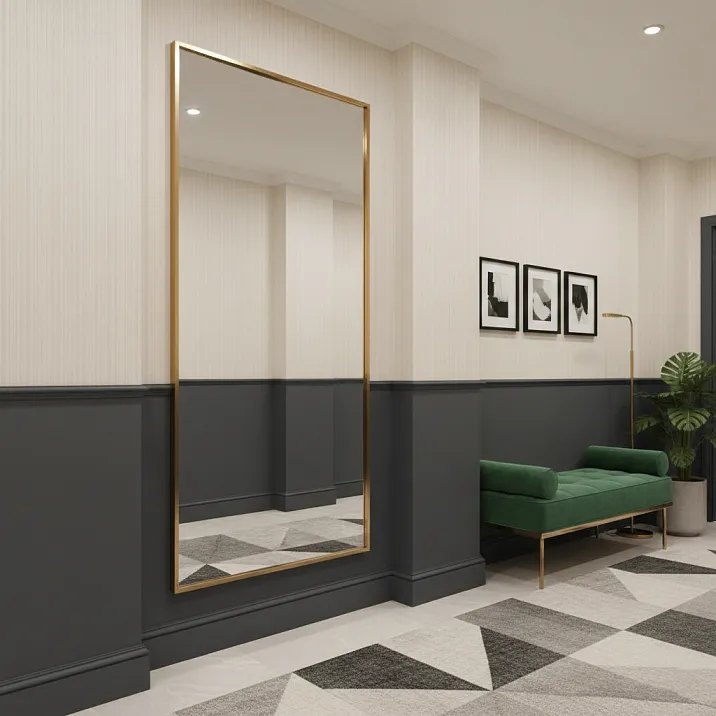
Full-length framed mirrorbecomes the focal point of a boutique-style entryway. It's not just functional — it creates volume, light, and visual depth. And a tall baseboard running along the perimeter of the room establishes architectural rigor, emphasizes verticals and horizontals, and makes the space expressive.




Full-length floor mirror + tall perimeter baseboard: the architecture of luxury
Imagine an entryway of 6–8 square meters. Narrow, elongated, with high ceilings — a typical layout in Stalin-era buildings or modern apartments in historic city centers. Such a space can easily become a dark corridor where it's inconvenient to undress and there's nowhere to put shoes. Or — it can become an elegant entry zone that sets the tone for the entire home.
The key to transformation is verticality. A floor mirror 180–200 cm tall, placed along one wall, visually elongates the space, adds light, and creates a sense of spaciousness. The mirror reflects a window from an adjacent room, multiplying the daylight; the entryway ceases to be a dark burrow and becomes a bright gallery.
And now add a tallWooden baseboard12–15 cm high, running along the entire perimeter of the entryway. A solid oak baseboard with an expressive profile, painted in graphite or white, creates a clear horizontal line. It 'grounds' the space, makes it stable and substantial. The mirror is the vertical, the baseboard is the horizontal. Two axes, two directions that together form an architectural composition.
It's important to understand: boutique style is not about brightness, not about an abundance of decor. It's about precision. Every line must be precise, every material noble, every detail in its place. A floor mirror in a simple wooden frame without excess, a tall baseboard with a laconic profile — this is enough to create an impression of luxury, quality, and thoughtfulness.
Our factory also produces:


Technique: mirror panel from baseboard almost to ceiling
If you're ready for a bolder solution, consider a mirror panel running from the top edge of the baseboard almost to the ceiling. This is a technique used in expensive boutiques, in five-star hotel lobbies, in luxury brand showrooms. The mirror isn't hung on the wall — it's integrated into it, creating an infinity effect.
Technically, this is implemented as follows. A frame or structure is mounted on the wall, into which the mirror sheet is inserted. The lower edge of the mirror rests on the baseboard or is mounted flush with its top edge. The upper edge of the mirror can reach the ceiling cornice or stop 10–15 cm from the ceiling. The gap doesn't ruin the composition — on the contrary, it creates airiness and prevents the mirror from 'weighing down' the space.
Such a mirror panel visually doubles the width of the entryway. If there's a wall with decor, a console, or a painting opposite the mirror — all of it is reflected, creating an illusion of symmetry and additional volume. The space becomes not a narrow corridor, but a full-fledged gallery.
An important point: a mirror panel requires impeccable mirror quality. Any waviness, distortion, yellow or green tint — and the effect is ruined. Choose mirrors with silver amalgam coating, at least 4–5 mm thick, with a protective moisture-resistant layer.
The frame of such a mirror can be minimalist — a narrow wooden or metal molding, painted to match the wall color. Or, conversely, contrasting — dark oak against a light wall. The main thing is that the mirror frame and the baseboard are made of the same material. If the baseboard is oak, the frame should also be oak. If the baseboard is white, the frame should be white or light wood.
Get Consultation
Option with a console and a mirror above it in the same wood species as the baseboard
The second popular technique is a console with a mirror above it. This is a classic composition that works flawlessly in entryways of any size.Wooden consoleis placed along the wall; keys, wallet, and bag are placed on it. A mirror — round, rectangular, oval — hangs above the console. Below — a tall baseboard establishing the horizontal line.
The key to the success of this composition is material unity. A console made of solid oak, a mirror in an oak frame, an oak baseboard. All in the same wood species, in the same tone — honey, walnut, bleached, graphite. This creates visual integrity, a sense of thoughtfulness and completeness.
The console in the entryway can be narrow — 30–40 cm deep, so as not to occupy the passage space. The length depends on the wall size — from 80 cm to 150 cm. Functional small items are placed on the console: a key tray, a decorative vase, a table lamp. It's important not to overload it — boutique style loves free space.
The mirror above the console can be large — 100–120 cm high, 80–100 cm wide. Or compact — 70×90 cm, if the console is small. It's important that the lower edge of the mirror hangs 10–20 cm above the console's tabletop — this creates a visual connection without crowding.
A 12–15 cm high baseboard under the console creates a supporting line. The gaze slides along the room's perimeter, along the horizontal of the baseboard, rises up the console legs, and settles on the mirror. The composition is built vertically: baseboard — console — mirror. Three levels, three elements, connected by a single material and proportions.
Ergonomics: where to place the mirror so it doesn't obstruct the passage
The entryway is a passage zone where not only beauty but also convenience is important. A poorly placed mirror will be in the way, cause irritation, and create a feeling of crampedness. How to choose the right spot?
Along a blank wall perpendicular to the entrance door
The optimal placement is along a wall that is perpendicular to the entrance. A person enters, takes a step forward, turns towards the mirror — and sees themselves at full height. Convenient, functional, doesn't hinder movement.
If the entryway is narrow (120–150 cm wide), it's better to place the mirror on the long wall, leaving a passage at least 80–90 cm wide. This is the minimum necessary for comfortable movement.
Opposite the entrance door — only if there is sufficient distance
A mirror opposite the entrance door is a common technique, but it requires caution. If the distance from the door to the mirror is less than 2 meters, the composition will feel 'in your face,' creating a sense of collision. If the distance is 2.5–3 meters or more — the mirror works excellently, reflecting the person entering and visually deepening the space.
From an ergonomic perspective, it's important that the mirror doesn't reflect chaos—an open bathroom door, clutter in the opposite room. Consider what will be visible in the reflection.
In the corner—for small entryways
If the entryway is very small (3–4 sq. m), you can place the mirror in the corner. There are corner frames specifically designed for such installation. A corner mirror saves space, doesn't obstruct the passage, yet remains functional.
Next to a coat rack or wardrobe
It's logical to place the mirror where a person removes their outerwear. Next to a coat rack, wardrobe cabinet, or bench. This is convenient: you undress, look at yourself in the mirror, fix your hair—all in one zone.
It's important to leave distance. If the coat rack protrudes 30–40 cm from the wall (with clothes), the mirror should be 50–60 cm away from it to avoid collisions.
Lighting hacks: how to make the entryway bright and expressive
Lighting in the entryway is a separate topic. Most often, this is a room without windows, completely dependent on artificial lighting. How to make sure the entryway doesn't feel like a dark cave?
Ceiling light—diffused, but sufficient
A central chandelier or built-in spotlights—the basic level of lighting. It's important that the light is bright enough but not harsh. Diffused light from several points is better than one powerful source.
If the ceiling is high (3 meters and above), you can use a pendant chandelier. If it's standard (2.5–2.7 m)—built-in spots or surface-mounted fixtures. The main thing is to avoid dark corners.
Mirror lighting—functionality and atmosphere
The mirror in the entryway should be illuminated. Ideally—wall sconces on both sides of the mirror, at face level (160–170 cm from the floor). The light falls evenly on the face, without harsh shadows—convenient for makeup, hairstyling, checking your appearance before leaving.
An alternative—built-in LED lighting around the mirror's perimeter. This is a modern solution that creates a 'floating' mirror effect, adding lightness to the space.
Baseboard lighting—a modern accent
Hidden lighting behind the baseboard or inside a special profile—a trendy technique that makes the entryway visually lighter. An LED strip installed behind the baseboard creates a soft glow at floor level, separates the wall from the floor, and makes the room feel more airy.
It's important to choose warm white light (2700–3000K), not cool. Warm light creates coziness, while cool light makes the space feel office-like and sterile.
Accent lighting for a console or decor
If there's a console with decor in the entryway, you can highlight it with directional light—a table lamp, floor lamp, or built-in spot. This creates a visual accent, draws attention, and completes the composition.
Storage hacks: hooks, shoe rack, bench
A 'boutique'-style entryway should be not only beautiful but also functional. Where to store clothes, shoes, bags, umbrellas? How to organize the space to avoid chaos?
Hidden storage systems—a wardrobe cabinet
If the entryway area allows (from 6–8 sq. m), install a floor-to-ceiling wardrobe cabinet. The cabinet can be built-in or freestanding, with hinged or sliding doors. Inside—a rod for outerwear, shelves for hats, pull-out drawers for accessories.
The cabinet facade should be laconic, matching the wall color to avoid overwhelming the space. Or—mirrored to visually expand the entryway.
Open coat racks—for daily clothing
Even if there's a cabinet, it's convenient to have several open hooks for everyday clothing—the jacket you wear every day, a scarf, a bag. Hooks can be placed on the wall next to the entrance door, at a height of 150–160 cm.
Choose quality hooks made of brass, bronze, or stainless steel. Cheap plastic hooks will ruin the entire look.
Shoe rack—closed or open
Shoes are the main problem in the entryway. How to store them so it's convenient and there's no clutter?
A closed shoe rack—a cabinet with flip-down or pull-out drawers where shoes are stored vertically. Compact, neat, not visible. The downside—it takes time to open, take out, and close.
Open shelf — a simple shelf 30–40 cm high, where shoes stand in a row. Convenient, quick, but requires order. If dirty boots are constantly scattered — it looks untidy.
Compromise — a shelf with a decorative grille or woven basket, where you can quickly put away shoes, but they remain accessible.
Ottoman or bench — comfort and style
An ottoman in the hallway is not a luxury, but a necessity. It's convenient to sit down to put on shoes, especially when lacing boots or putting on boots. An ottoman 45–50 cm high, 40–50 cm wide, 80–120 cm long — optimal dimensions.
An ottoman can have a soft seat (upholstered in fabric, leather, velour) or a hard one (wooden seat). Under the seat — a drawer for storing shoes, slippers, brushes.
Ottoman made of solid wood, in the same species as the baseboard — an ideal solution for a hallway in "boutique" style. Wood, leather, metal hardware — materials that speak of quality, of attention to detail.
Color palette of a hallway in "boutique" style: from monochrome to contrast
Color is a tool that can both enhance the composition and destroy it. What color schemes work in a hallway in "boutique" style?
Monochrome palette — elegance without excess
White, gray, beige — a classic palette for the hallway. Light walls, white or gray baseboard, mirror in a white or light frame. Floor — light plank, porcelain stoneware under marble. Everything in the same tonality, without sharp contrasts.
Monochrome creates a sense of cleanliness, spaciousness, calmness. Suitable for small hallways where it's important to visually expand the space.
Contrast of dark and light — drama and graphics
Dark walls (graphite, anthracite, dark blue) + white baseboard + mirror in a white frame. Or vice versa: light walls + dark oak baseboard + mirror in a dark frame. Contrast creates drama, expressiveness, memorability.
Dark walls in the hallway — a bold decision, but it works if there is sufficient lighting. Without light, a dark hallway will become gloomy.
Accent wall — color in details
Three walls light, one — accent, painted in deep green, blue, terracotta. On the accent wall — a mirror, console, decor. Baseboard around the entire perimeter — white or matching the accent wall.
This technique adds individuality, makes the hallway memorable, but requires courage and taste.
Natural wood — warmth and nobility
Walls painted in a neutral color (beige, gray-beige, ivory), baseboard made of natural wood without painting (honey oak, walnut), mirror in a frame made of the same wood. Floor — wooden plank matching the baseboard.
Wood creates warmth, coziness, a sense of naturalness. Suitable for classic and eclectic interiors.
Materials: what a hallway in "boutique" style is made of
Boutique style is about materials. No imitations, only genuine: wood, metal, glass, stone, leather. Let's consider the key elements.
Baseboard made of solid wood — the foundation of the composition
Wide wooden baseboard12–15 cm high made of solid oak or beech — this is the foundation. Wood has a unique texture, tactile pleasantness, durability. A solid wood baseboard can be painted any color, coated with varnish, oil, wax — there are many finishing options.
It's important to choose a baseboard with an expressive profile. A simple rectangular profile looks cheap. But a baseboard with chamfers, with slight relief, with play of light and shadow — that's already an architectural element.
Mirror frame made of wood or metal
The mirror frame should be made of the same material as the baseboard. If the baseboard is oak, the frame is oak. If the baseboard is white, the frame is white or made of light wood.
Metal frames (brass, bronze, stainless steel) are suitable for modern interiors. They are laconic, durable, not afraid of moisture. Especially effective are frames made of matte brass or black metal.
Console made of solid wood
The console in the hallway should be stable, durable, and beautiful. Solid oak or beech is an ideal choice. The tabletop can be solid (from a single piece of wood) or laminated (from glued lamellas). Legs — turned, carved, or simple, geometric.
The console can be painted to match the baseboard color or left in its natural state, coated with oil or wax to highlight the wood grain.
Floor: wood, porcelain stoneware, natural stone
The hallway floor is a high-traffic area. It should be wear-resistant, easy to clean, and moisture-resistant.
Wooden plank (oak, ash) — a classic choice. Beautiful, warm, pleasant to the touch. But requires maintenance and is sensitive to moisture.
Porcelain stoneware resembling marble or concrete — a practical option. Durable, moisture-resistant, variety of textures. Cold to the touch, but underfloor heating can be installed.
Natural stone (marble, granite, slate) — luxurious, durable, but expensive. Suitable for large hallways where monumentality is important.
Baseboard height: how many centimeters are needed for a 'boutique' effect
A baseboard in a 'boutique' style hallway cannot be narrow. Standard 6–7 cm is for typical interiors. Height is needed here. But how much exactly?
10–12 cm — minimum for expressiveness
A baseboard height of 10–12 cm is already noticeable, creating a distinct horizontal line. Suitable for hallways with ceiling heights of 2.5–2.7 meters. Such a baseboard does not overwhelm the space but also doesn't get lost.
12–15 cm — optimal height for most hallways
It is within this range that the baseboard becomes an architectural element, not just a finishing detail.A wide baseboard of 120 mmor 150 mm creates a strong horizontal line that balances the vertical of the mirror, setting the rhythm for the entire space.
15–20 cm — for high ceilings and spacious hallways
If the ceiling height is 3 meters or more, you can afford a baseboard height of 15–20 cm. This is already a monumental solution that creates a sense of palatial luxury. But such a baseboard requires a proportionally sized mirror — at least 200 cm in height.
Important: the higher the baseboard, the more expressive its profile should be. A tall, flat baseboard looks like a board placed against the wall. Whereas a tall baseboard with a figured profile looks like an architectural element.
Mirror: which frame to choose for a hallway in 'boutique' style
The mirror frame is the framing that defines the character of the entire composition. Which options work?
Minimalist wooden frame — classic and restrained
A simple wooden frame 5–8 cm wide, without carving, without gilding. The profile can have a bevel, a slight recess, or wood grain texture. Color — natural wood (oak, walnut), white, gray, graphite.
Such a frame suits modern and Scandinavian interiors where minimalism is important.
Carved frame in classic style — luxury and detailing
If the hallway is decorated in a classic or neoclassical style, the mirror frame can be carved, with floral motifs, light gilding, or patina. Frame width — 8–12 cm.
A carved frame turns the mirror into an art object, attracts attention, and emphasizes status.
Metal frame — modernity and strictness
Frame made of matte brass, black metal, stainless steel — a choice for modern interiors. Metal creates contrast with the wooden baseboard, adding graphic quality.
A metal frame can be thin (2–3 cm) — almost invisible, emphasizing the mirror itself. Or wide (6–8 cm) — expressive, dominant.
Frame with a bevel — play of light
A facet is a beveled edge of a mirror that creates light play and refraction. A mirror with a facet looks expensive and sophisticated, especially if the frame is made of quality wood or metal.
A facet can be narrow (1–2 cm) or wide (3–5 cm). A wide facet creates a more expressive effect.
Styles that work with the 'mirror + baseboard' technique
The composition of a floor mirror and a tall baseboard is universal, but it resonates differently in each style.
Neoclassicism — symmetry and nobility
Neoclassicism is a modern interpretation of classicism. Here, a floor mirror in a carved oak frame, a 15 cm high baseboard with a classic profile, a console with carved legs. Everything is symmetrical, precise, noble.
Color palette — white, beige, gray-beige, honey oak. Materials — solid wood, marble, brass.
Modern classic — conciseness with a nod to tradition
A simplified version of classicism. A mirror in a simple wooden frame, a baseboard with a minimal profile, a console on simple legs. Less decor, more purity of lines.
Suitable for those who appreciate classicism but don't want pomp.
Scandinavian style — light, wood, simplicity
White walls, light oak baseboard, a mirror in a white or light frame. Minimal furniture, maximum light. Functionality comes first.
Scandinavia loves open coat racks, simple benches, woven baskets for storage.
Loft — brutality and honesty of materials
Brick wall (or brick imitation), dark metal baseboard (or black wooden), a mirror in a black metal frame. Concrete floor or porcelain tile imitating concrete.
Loft isn't afraid of roughness, exposed utilities, industrial aesthetics. Here, the mirror is a functional object, not a decoration.
Art Deco — geometry and luxury
Art Deco loves mirrors. Large, wall-to-wall, with geometric frames. The baseboard can be painted black, emerald, gold. Floor — marble, with a geometric pattern.
Console — with inlay, with mirror inserts, with brass hardware. Everything shines, sparkles, catches the eye.
Practical examples: three hallway design scenarios
Scenario 1: Small hallway 3–4 sq. m
Narrow hallway, ceiling height 2.6 m. Goal — make it bright, not overload it.
Solution: white walls, light oak baseboard 10 cm high, a 180 cm tall floor mirror in a white frame, placed along the long wall. Opposite the mirror — an open coat rack with 3–4 hooks. Under the rack — a narrow shoe shelf. Floor — light porcelain tile. Lighting — recessed spotlights + sconces on both sides of the mirror.
Result: the hallway visually doubles due to the mirror, white adds light, the baseboard creates a clear line without overloading the space.
Scenario 2: Medium hallway 6–7 sq. m
Rectangular hallway, ceiling height 2.7 m. Goal — create a composition with a console and mirror.
Solution: walls painted gray-beige, oak baseboard 12 cm high, painted graphite. Console 120 cm long, 35 cm deep, made of solid oak, painted graphite. Above the console — an 80×100 cm mirror in an oak frame painted graphite. Next to the console — a bench with a soft seat. Floor — oak plank, tinted gray. Lighting — pendant chandelier + table lamp on the console.
Result: the composition is built vertically (baseboard-console-mirror), unity of color and material creates integrity, the hallway looks expensive and stylish.
Scenario 3: Large hallway 10–12 sq. m
Spacious square hallway, ceiling height 3.2 m. Goal — create a boutique effect.
Solution: one wall — a mirror panel from floor to ceiling (height 3 m), mirror frame — narrow, made of matte brass. Baseboard around the entire perimeter — oak, 15 cm high, natural color. Opposite the mirrored wall — a built-in wardrobe with mirrored fronts. In the center of the hallway — a bench made of oak and leather. Floor — marble porcelain tile. Lighting — recessed spotlights around the ceiling perimeter + hidden lighting behind the baseboard.
Result: the hallway looks like the lobby of an expensive hotel, mirrors multiply the space, the baseboard creates a powerful horizontal line, the materials speak of quality.
Mistakes to avoid
Error 1: Material mismatch
Plastic baseboard + mirror in a wooden frame = composition breakdown. Materials must match.
Error 2: Baseboard too narrow
A baseboard 5–6 cm high will not create a 'boutique' effect. A height of at least 10 cm is needed.
Error 3: Inconveniently placed mirror
A mirror that obstructs the passage or is positioned to reflect the entrance door to the bathroom is a failure from an ergonomic standpoint.
Error 4: Lack of lighting
A dark hallway with a mirror in shadow is a waste of money. The mirror must be illuminated.
Error 5: Overloading with decor
Boutique style is about conciseness. An excess of decor, paintings, hangers, shelves kills the idea.
Frequently asked questions
What is the minimum hallway size for installing a floor mirror?
Minimum 3–4 sq. m. In a hallway of 2–3 sq. m, a floor mirror will take up all the space and be obstructive.
Can a narrow baseboard be used in a 'boutique' style hallway?
Yes, but the effect will be weaker. A narrow baseboard (6–8 cm) suits minimalist interiors but does not create the expressiveness of a wide one.
What is the optimal mirror height for a hallway?
For a functional mirror (to see oneself full-length) — minimum 160 cm. Optimal — 180–200 cm.
How to care for a wooden baseboard in a hallway?
Wipe regularly with a dry or slightly damp cloth. Avoid excessive water. Renew the coating (wax, oil) once a year.
Can a floor mirror be installed independently?
Yes, if the mirror is lightweight (up to 20 kg) and has a support structure. Heavy mirrors (30–50 kg) require wall mounting — it's better to consult a professional.
Which baseboard to choose for a damp hallway (near the entrance with snow, rain)?
Solid wood baseboard with moisture-resistant coating (varnish, oil with water-repellent properties) or high-density MDF.
Can a mirror in a metal frame be combined with a wooden baseboard?
Yes, this works in modern and loft interiors. Metal and wood are a classic combination.
Where to buy a quality wooden baseboard and mirror frame?
From companies specializing in wooden decor. It's important to choose solid wood products, not MDF with film.
What baseboard color is universal for any hallway?
White. It matches any walls, floor, furniture, and visually expands the space.
Is a bench needed in a small hallway?
Desirable. Even a compact bench (80×40 cm) makes the hallway more convenient.
Conclusion
A 'boutique'-style hallway is a space where quality trumps quantity, where every detail is in its place, where materials speak for themselves. A full-length mirror in a noble frame and a tall wooden baseboard are two elements that create the architectural foundation of such an interior. The mirror provides verticality, light, and visual depth. The baseboard establishes horizontality, structure, and solidity. Together they form a composition that is memorable, makes an impression, and sets the tone for the entire home.
The boutique style requires investment—in materials, in the work of craftsmen, in the thoughtfulness of details. But the result is worth it. The hallway ceases to be just a corridor where shoes are removed. It becomes a calling card, a space that speaks of the owner's taste, culture, and status. A guest enters—and within five seconds understands: quality is valued here, people live with a sense of style here, every detail is considered here.
Creating such a hallway is possible in a space of any size—from three to twelve square meters. The main thing is to choose the right elements, maintain proportions, not overdo it with decor, but also not miss the important. A full-length mirror, a tall baseboard, a solid wood console, thoughtful lighting, hidden storage systems—this is enough for the hallway to come alive, to work, to become a space that is pleasant to be in.
The company STAVROS has been creating interior elements from natural wood for over twenty years—baseboards, moldings, cornices, mirror frames, furniture frames. Every STAVROS product is made from selective oak and beech solid wood that has undergone professional chamber drying, guaranteeing geometric stability, absence of deformation and cracking. STAVROS offers a wide choice of baseboard profiles—from classic to modern, with heights from 60 to 200 millimeters, with the possibility of custom manufacturing based on customer sketches. STAVROS mirror frames are not just framing; they are architectural elements created using three-dimensional milling followed by hand finishing. By choosing STAVROS, you choose quality tested by time, the eco-friendliness of natural wood, impeccable service, and the opportunity to create an interior that will delight for decades. STAVROS—the foundation of your space, the cornerstone of your style, a partner in creating an interior that speaks about you without words.