































































Article Contents:
- Why the ceiling matters in a restaurant, hotel, and grand hall
- How commercial ceiling decor differs from home decor
- Ceiling decor for a restaurant
- Ceiling decor for a hotel and lobby
- Ceiling decor for a banquet and grand hall
- How to use ceiling decor for zoning
- Decor around chandeliers in a restaurant, hotel, and hall
- How to choose decor based on ceiling height
- Ceiling 2.7–2.9 m
- Ceiling 3–3.5 m
- Ceiling above 3.5 m
- Which kit to choose: CPU-P2, CPU-P3, CPU-P4, or CPU-P6
- CPU-P2 — for a prestigious but restrained hall
- CPU-P3 — for a medium-sized restaurant
- CPU-P4 — for a banquet and ceremonial hall
- CPU-P6 — for maximum luxury effect
- How to combine ceiling decor with walls, columns, and furniture
- Contour lighting and stucco: the interaction of light and decor
- Mistakes when choosing ceiling decor for a restaurant, hotel, and hall
- Mistake 1. Choosing a home scale for a large hall
- Mistake 2. Not considering chandeliers and light
- Mistake 3. Making the same ceiling in all zones
- Error 4. Overloading a low ceiling
- Mistake 5. Not connecting the ceiling with the walls
- Where to buy ceiling decor for a restaurant, hotel, and STAVROS hall
- Frequently Asked Questions
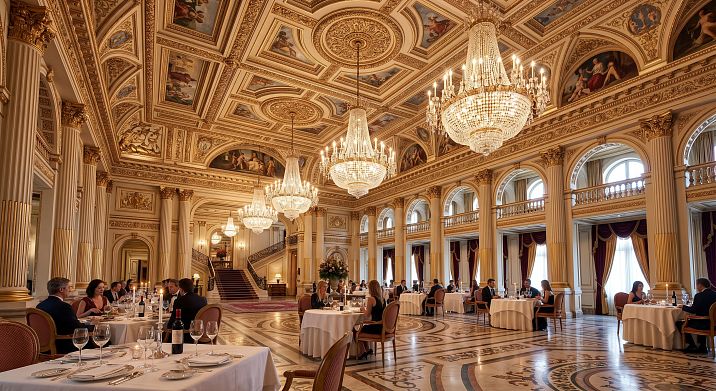
Ceiling decor for a restaurant, hotel, and hall — is a tool of architecture, not just decoration. Polyurethane stucco molding, cornices, moldings, ceiling rosettes for chandeliers, and ready-made CPU kits create that very first impression that turns a room into a space with status. How to properly select and apply this tool — we will analyze in detail.


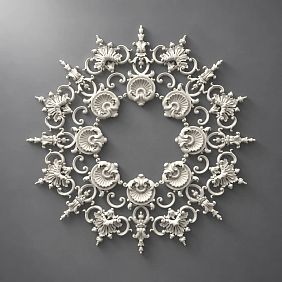


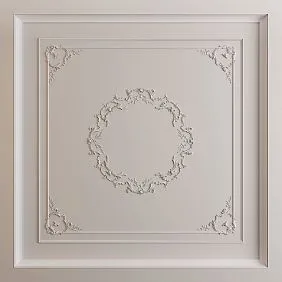
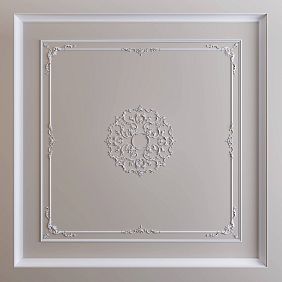

Why the ceiling is important in a restaurant, hotel, and grand hall
Ceiling decor in a restaurant and hotel solves problems that neither furniture, nor walls, nor lighting individually address. The ceiling is visible from a great distance — from 8 to 20 meters depending on the size of the hall. With such distant perception, small details disappear, but the overall architectural composition remains.
The first impression is formed in the first seconds. A guest enters a restaurant or hotel lobby — and even before they sit down, before they are brought a menu or a room key, they already read the ceiling above the reception, above the central chandelier, above the entrance area. If there is a cornice, stucco molding, a properly designed rosette for a large pendant light — the space is perceived as expensive. If the ceiling is empty — as unfinished.
Grand ceiling decor in a commercial interior performs several functions at once:
-
Creates the visual status of the room — stucco molding signals the class of the establishment
-
Accents central chandeliers — the rosette turns the light fixture into an architectural focal point
-
Helps zone the space — molding frames highlight seating areas, the bar, and the VIP zone
-
Connects the ceiling to the walls — a perimeter cornice completes the architectural logic
-
Enhances the photogenicity of the interior — stucco ceilings look great in event photos and videos
Ceiling decor for commercial interiors is an investment in perception that works every day, with every guest, and in every shoot.




How commercial ceiling decor differs from residential
This is a fundamental issue that designers and architects often overlook when first approaching a restaurant or hotel project. In a residential interior, stucco for a ceiling of 2.6–2.8 m with a rosette diameter of 280 mm is a working solution. In a 200 m² restaurant hall, the same rosette simply won't exist visually.
Stucco for public spaces must be readable from a distance. In a restaurant hall, the distance from the entrance to the far wall is 15–25 meters. The cornice ornament, rosette relief, and molding profile must all be proportionate to this distance. Fine relief at a height of 3.5 m will simply blend into the ceiling surface, creating not an architectural effect but a feeling of incompleteness.
How to choose stucco for a commercial interior — a few rules of scale:
-
Cornice height in a restaurant or hotel lobby — at least 100–130 mm; for ceilings above 3.5 m — from 140–180 mm
-
The diameter of the ceiling rosette for the central chandelier must be at least 1/2 of the luminaire diffuser diameter
-
Moldings for frames around seating areas — profile no narrower than 40–60 mm
-
Corner accents — expressive, readable, with a three-dimensional relief
Ceiling decor for high-traffic areas should not only be beautiful but also properly installed. STAVROS polyurethane products are mounted with acrylic adhesive without mechanical fasteners — this is important in commercial interiors where surfaces must have no visible dowels, marks, or seams. The correct technology is described in detail in the article aboutinstallation of polyurethane molding.
Our factory also produces:


Ceiling decor for a restaurant
A restaurant is a space where guests spend time, eat, talk, and observe. The ceiling in a restaurant hall comes into view several times during the evening — upon entry, when looking up during conversation, when gazing at the chandelier. Therefore, stucco on the ceiling in a restaurant should be thoughtful, not random.
Ceiling decor in the main hall of a restaurant is built on a clear hierarchy:
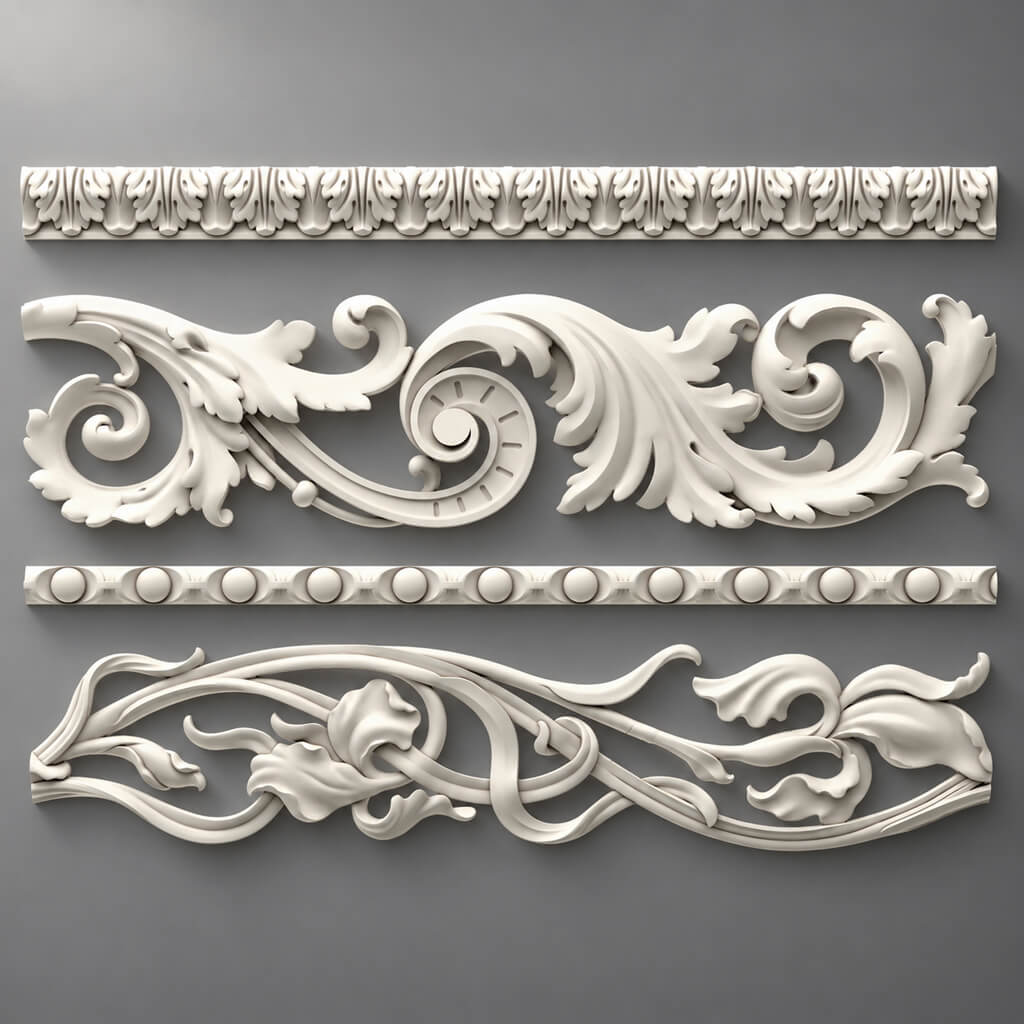
Cornice along the perimeter. It connects walls and ceiling. In a long restaurant hall, the cornice is a horizontal line that brings the entire space together and gives it completeness.Polyurethane Crown MoldingSTAVROS are available with profiles for different ceiling heights — from lightweight 70–80 mm to expressive 140–160 mm for high halls.
Molding frames above seating areas. Rectangular contours made ofof polyurethane moldingsabove groups of tables, zoning is created — without partitions, without structures, only through ceiling decor.
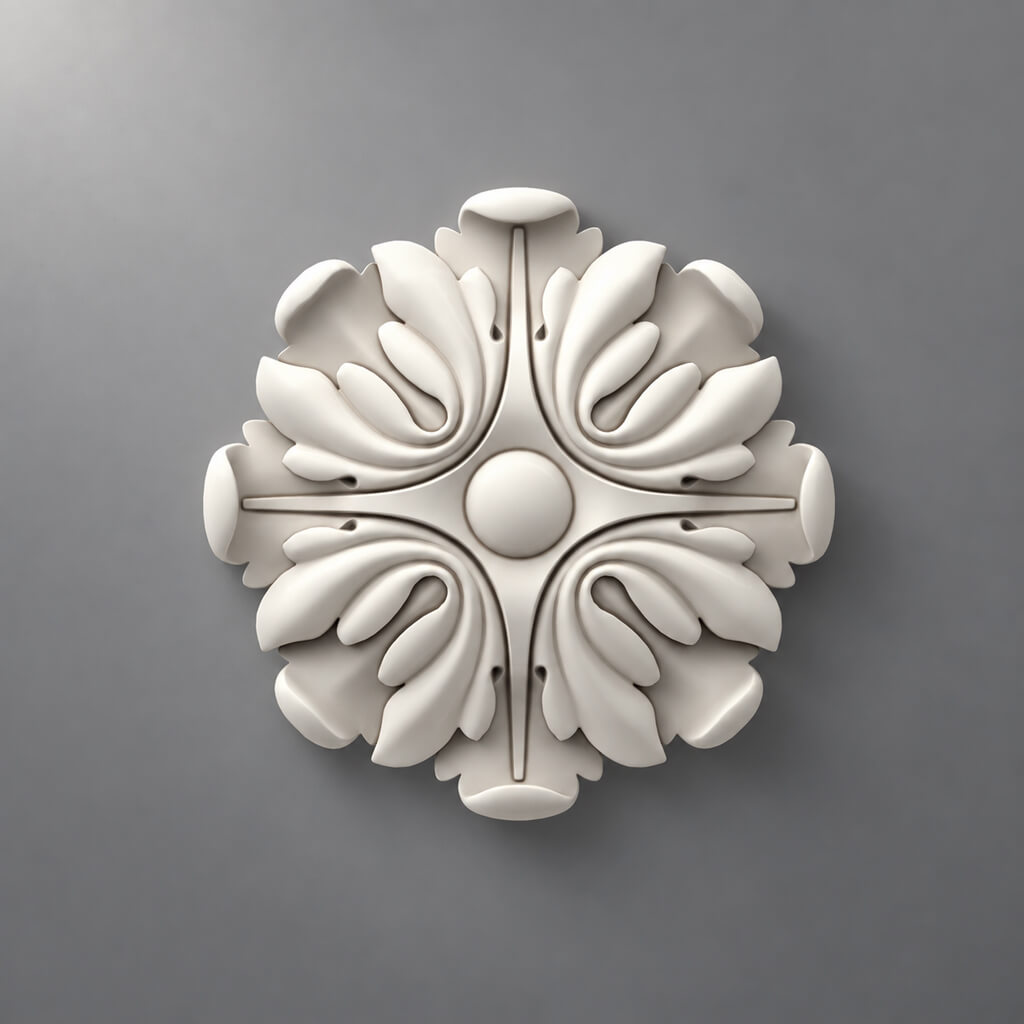
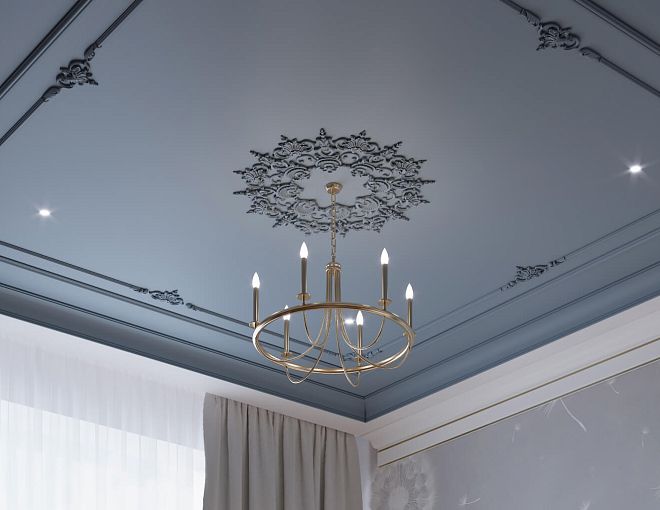
Sockets for chandeliers. Each chandelier in a restaurant hall is a light point. A ceiling socket turns it into an architectural point. There can be one (central) or several — according to the number of light groups.
Central decorative accent. In the main hall of the restaurant, this is a ready-made set of stucco decor that forms a ceiling scene above the central area.
Ceiling decor for a VIP restaurant hall: The VIP hall is a separate story. Here, not just scale is needed, but intimacy. A more detailed ornament, more subtle work with shadows, a more restrained but readable relief. For the VIP hallMolding decor set CPU-P2 — the right choice: status is present, less formality than in the main hall.
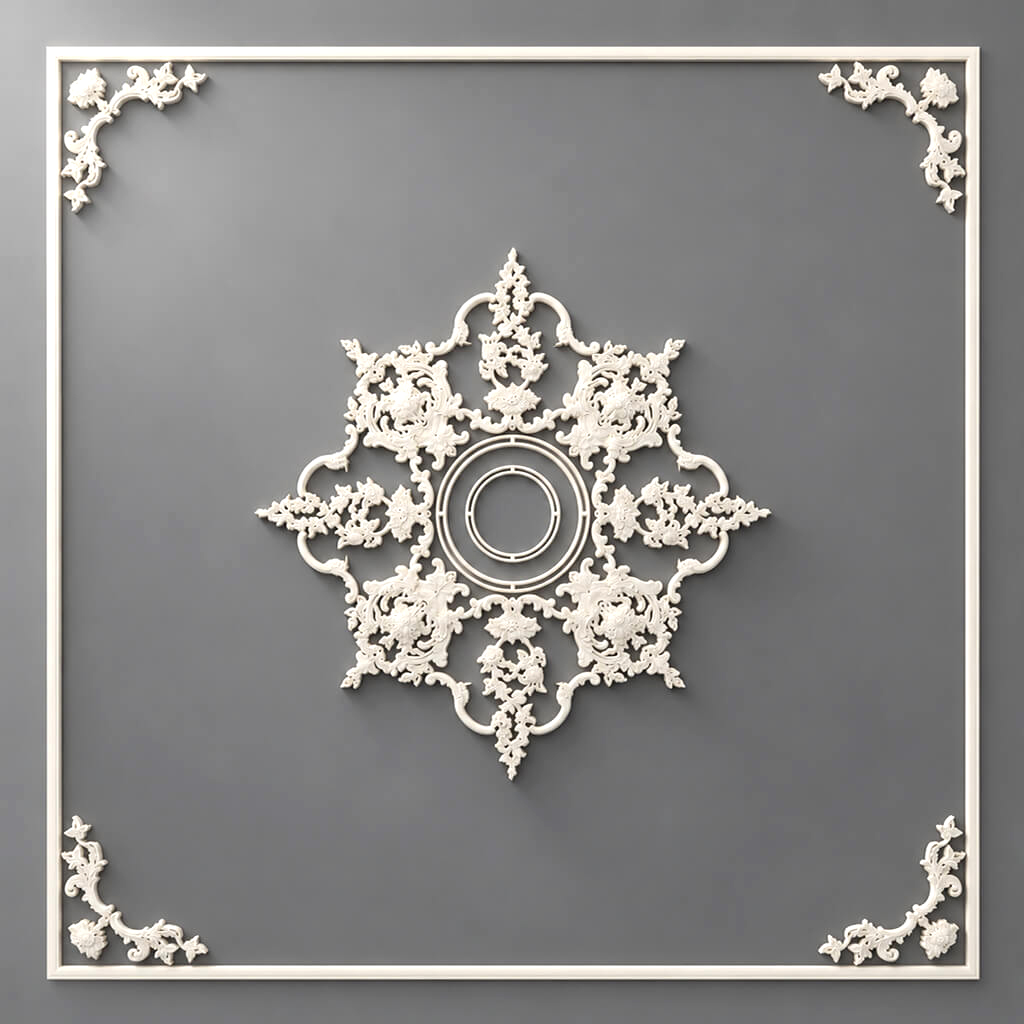
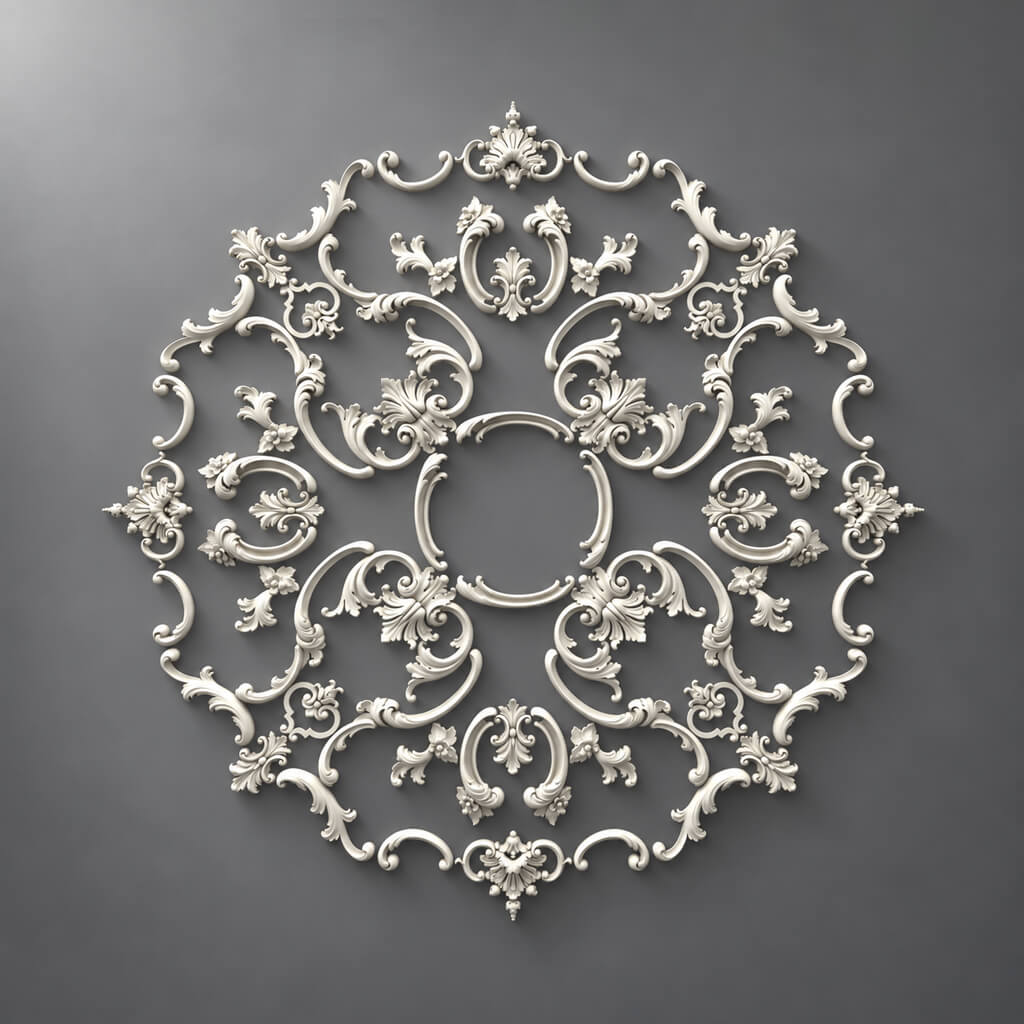
For a restaurant hall of 50–80 m² with a 3 m ceiling and a central chandelier —Molding decor set CPU-P4. A multi-level system with 21 types of products creates an architectural scene commensurate with a formal restaurant hall.
For a flagship restaurant, banquet hall, or premium-class restaurant with a ceiling of 3.2–4 m and a large hanging chandelier —Molding decor set CPU-P6 with ornamental dominants of maximum scale.
For a mid-format restaurant — a hall of 30–50 m², ceiling 2.8–3 m, one or two central chandeliers —Molding decor set CPU-P3The universal 3200 × 3200 × 83 mm zone system with corner accents and a central element is a good solution for most restaurant spaces without pretensions to a palace effect.
Get Consultation
Ceiling decor for hotel and lobby
A hotel lobby is not just a passage area. It is the point where the guest transitions from the outside world to the inside. This transition should be tangible — architectural, not just service-oriented. Ceiling decor for a hotel lobby is one of the main tools for this transition.
What should ceiling decor in a hotel lobby do:
-
Create scale — the lobby should feel larger than it is
-
Support the reception — a ceiling accent above the counter highlights the navigation area
-
Interact with the chandelier — there is almost always a central pendant light in the lobby; it needs to be properly framed
-
Connect the ceiling with walls, columns, and stairs — ceiling molding that does not 'talk' to the walls looks like a decorative insert, not architecture
Ceiling decor for the reception: the reception area in a hotel is the axis of the entrance part. A molding frame above the reception + a ceiling rosette under the chandelier + a cornice around the perimeter — a standard three-level design scheme that turns the work counter into a representative architectural accent.
Molding for a hotel lobby — by scale: -
Boutique hotel, lobby 40–60 m², ceiling 3–3.2 m —CPU-P3orCPU-P4
-
Four- or five-star hotel, lobby 80–150 m², ceiling 3.5–4 m —CPU-P4orCPU-P6
-
Luxury hotel, grand lobby, double-height ceiling, ceiling 5–6 m —CPU-P6as the basis of the central ceiling composition
Ceiling decor for hotel corridors is a separate task. In long hotel corridors, cornices and moldings create rhythm. A repeating ornamental element every 3–4 meters is an architectural intonation that turns the corridor from a mere passage into part of the interior.
Stucco for a hotel conference room: a conference room is a business space, it doesn't need the grandeur of a restaurant. But status must be present. A calm cornice 100–120 mm, a strict molding frame above the central area, a neat rosette for the main light fixture — this is enough for a conference room that should impress without distracting from the business atmosphere.
Ceiling decor for banquet and grand halls
A banquet hall is a space for events. Weddings, anniversaries, corporate parties, formal receptions — every event is photographed and filmed. Ceiling stucco for a banquet hall will be in every shot. This means it works not only for live guests but also for everyone who sees the photos.
A luxurious ceiling with stucco in the hall is not excess, but an investment in the representation of the space. The ceiling decor of a banquet hall shapes the venue's reputation. When a couple chooses a hall for a wedding or a company for a corporate event, a ceiling with stucco in photos creates a sense of status and solemnity that cannot be achieved by other means.
Principles of banquet hall design:
Symmetry is mandatory. In the banquet hall, tables are arranged in strict order. The ceiling decor must support this symmetry: if the tables are in two rows, the decor is symmetrical along the rows' axes; if there is a central aisle, the decor is symmetrical relative to it.
Multiple chandelier axes. In a large banquet hall, there are usually several chandeliers. Each one is a point on the ceiling axis. Molding frames, rosettes, and cornices should work as a single system, not as a set of separate accents.
Scale of decor. A small 300 mm rosette in a 300 m² hall is a decorative detail that will only be noticeable up close. A rosette of 500 mm or more, or a full system with molding frames, is needed.
Ceiling decor in a formal hall — which set to choose:
-
Banquet hall 100–150 m², ceiling 3–3.5 m, several classic chandeliers —CPU-P4. A multi-level system with complex corner accents creates an architectural scene proportionate to the ceremonial hall.
-
Celebration hall 200 m² or more, ceiling 4 m and higher, large crystal chandeliers —CPU-P6. The maximum scale of ornamentation possible in STAVROS polyurethane decor.
For details on the principles of decorating high halls, see the articleStucco decor for a high ceiling.
How to use ceiling decor for zoning
Ceiling zoning is one of the smartest tools in restaurant, hotel, and banquet hall design. It doesn't require walls, partitions, or different floor levels. Simply change the ceiling decor above a specific area — and the boundary becomes clear.
Zoning a restaurant with ceiling decor:
-
Central area. A larger-scale molding frame + a larger rosette + a more expressive cornice. The center is always highlighted decoratively.
-
Bar area. A separate ceiling frame above the bar — with a different molding rhythm or different corner accent patterns. Visually separates the bar from the dining area.
-
VIP area. More detailed, denser decor. A higher cornice, more ornamental overlays.
-
Entrance area. The first decorative accent the guest sees. It can be slightly more expressive than the main hall — this works as an "invitation."
Zoning a hotel lobby with ceiling decor: reception, lounge, walkway area, and waiting area in a hotel — each can have its own decorative accent. Ceiling decor above the reception area is more expressive; above the lounge, more intimate; in the walkway area, only a cornice and rhythmic overlays.
Moldings made of polyurethaneSTAVROS is available in several profiles — from strict geometric to ornamental. This allows creating different decor character in different zones of the same space, using one material and one supplier — which is important for project logistics.
Decor around chandeliers in a restaurant, hotel, and hall
A chandelier in a public interior is not just a light source. It is the visual anchor of the space. In a restaurant hall or hotel lobby, a large hanging chandelier with a diameter of 1000–1500 mm is the most noticeable element of the entire interior. Ceiling decor around a chandelier in a restaurant transforms this element from technical to architectural.
Polyurethane ceiling rosettesfor a chandelier in a commercial interior — selection principles:
-
The diameter of the rosette is at least 400–500 mm for a restaurant hall; for a hall with a large chandelier from 800 mm in diameter — a rosette from 500–600 mm
-
The relief profile is proportionate to the chandelier style. A baroque crystal chandelier — an ornamental rosette with acanthus leaves; modern classic — a concise circular frieze
-
One rosette or a system. In a large hall with several chandeliers — several rosettes, each on its own axis, in a unified style
A large rosette under a chandelier in a hall should work in tandem with a molding frame and cornice. An isolated rosette on an empty 200 m² ceiling is a decorative spot, not an architectural accent. The cornice — molding frame — rosette system is what creates a real effect.
Ceiling rosette under a chandelier in a hotel lobby: in a lobby there is usually one dominant chandelier — above the center of the entrance area or above the reception. The rosette here is an architectural point around which the entire lobby ceiling is organized. Its size should be slightly larger than the standard rule of proportionality with the chandelier suggests: in a commercial space, a margin of scale is needed.
About the principles of ceiling design around a chandelier — a detailed articleCeiling decor around the chandelier.
How to choose decor based on ceiling height
Ceiling 2.7–2.9 m
For a restaurant or hall of standard height, polyurethane stucco should be proportionate — without heavy ornaments and large profiles. Cornice 80–100 mm, moldings 35–50 mm, rosettes 300–400 mm. Emphasis on clarity of lines and neatness of relief, not its volume.
For such a height, it works wellCPU-P2orCPU-P3. A moderate saturation of the system, which provides an architectural effect without visual heaviness.
Ceiling 3–3.5 m
At this height, decor already requires a more expressive scale. Cornice 110–140 mm, moldings 50–70 mm, rosettes 400–500 mm.CPU-P4 — optimal set for this height in a restaurant, lobby, or banquet hall. A multi-level system with four levels of corner accents creates a ceiling proportionate to a 3–3.5 m space.
Ceiling above 3.5 m
For very high halls, large elements are needed. Cornice from 140–180 mm, rosettes from 500–650 mm, moldings 60–80 mm.CPU-P6 with ornamental dominants NPU-464 (300 × 420 mm) and NPU-475 (350 × 180 mm) — this is the scale that reads from 20 meters at a height of 4–5 m. How not to lose the scale of stucco in a large hall — the main answer here is one: you need to look at the hall from a distance, not up close. An element that seems huge in your hands will look right on a 4-meter ceiling above a 300-meter hall.
Which set to choose: CPU-P2, CPU-P3, CPU-P4 or CPU-P6
CPU-P2 — for a prestigious but restrained hall
Molding decor set CPU-P2 — this is classic without pomposity. An expressive architectural system with moderate ornamentation saturation. A VIP restaurant hall, a hotel meeting area, an intimate banquet hall for 30–50 people, a conference space with a claim to status — that's the right audience for CPU-P2.
Comparison of CPU-P2 with larger sets: CPU-P2 provides architectural order but does not claim a palatial effect. This is important for business spaces and intimate VIP zones where pomposity would interfere with the atmosphere.
CPU-P3 — for a medium-sized restaurant
Molding decor set CPU-P3 — a working tool for most medium-sized restaurant and hotel spaces. The 3200 × 3200 × 83 mm zone is a sufficient size for a central ceiling composition in a hall of 40–60 m². A boutique hotel lobby, an open-plan dining area, a restaurant with 60–80 seats — everywhere CPU-P3 creates the right ceiling center.
CPU-P4 — for banquet and ceremonial halls
Molding decor set CPU-P4 — an architectural solution for those who want not just a decorated ceiling, but a ceiling that is an event. A multi-level system of 21 product types, four levels of corner accents, an ornament readable from 15 meters. The main restaurant hall, a ceremonial lobby, a banquet hall with a ceiling height of 3–3.5 m — CPU-P4 is impeccable here.
CPU-P4 for a hotel lobby: if the lobby of a four-star hotel has an area of 80–100 m² and a ceiling of 3.2–3.5 m — CPU-P4 with a 130 mm cornice and 500 mm rosettes for a central chandelier will provide exactly the level of decor that a guest of such an establishment expects.
CPU-P6 — for maximum luxury effect
Molding decor set CPU-P6 — the limit of decorative saturation in the STAVROS line. Large ornamental dominants, maximally detailed corner accents, a system designed for spaces where the ceiling must be part of the architectural image of the establishment.
CPU-P6 for a high ceiling: a premium-class restaurant with a 4 m ceiling, a 300 m² celebration hall, a luxury five-star hotel lobby, a ceremonial hall of a historic mansion — this is the right context for CPU-P6. In such a space, the large ornamental dominants NPU-464 are read correctly, neither overwhelming nor getting lost.
Comparison of CPU-P2, CPU-P4 and CPU-P6 for a commercial interior — quick table:
| Set | Hall area | Ceiling Height | Room Type |
|---|---|---|---|
| CPU-P2 | 30–50 m² | 2.8–3.2 m | VIP lounge, meeting room, chamber hall |
| CPU-P3 | 40–70 m² | 2.8–3.2 m | Mid-scale restaurant, boutique hotel |
| CPU-P4 | 70–150 m² | 3–3.5 m | Banquet hall, restaurant, 4* lobby |
| CPU-P6 | 150 m² and above | 3.5 m and above | Celebration hall, luxury restaurant, 5* lobby |
Detailed breakdown of all CPU kits — in the articlewhich CPU ceiling decor set to choose.
How to combine ceiling decor with walls, columns, and furniture
One of the most challenging tasks in commercial interiors is ensuring that ceiling decor does not look like a separate "picture" glued onto a flat surface. Ceiling stucco should "converse" with the architecture of walls, columns, portals, staircases, and furniture.
Wall and ceiling decor in a restaurant: if the walls have panels, pilasters, or mirror portals, the ceiling cornice should organically integrate into the same decorative system with them.Polyurethane wall decorSTAVROS and ceiling cornices are produced in coordinated series: this means that a wall pilaster and a ceiling cornice will share a unified ornament style and proportions.
Stucco on walls and ceiling in a hotel: in the hotel lobby, columns serve as vertical accents.Polyurethane moldingsFor column capitals, perimeter cornices, and chandelier rosettes — three components that together create a unified architectural environment.
How to combine ceiling decor with walls in a hall:
-
The ornament of the cornice should repeat or develop the ornament of wall moldings.
-
Corner accents of the ceiling set should be proportionate to the cornice and moldings.
-
The ceiling rosette should be from the same decorative series as the cornice.
-
Color: a unified tone — ceiling, cornice, wall moldings. This provides architectural unity, not decorative chaos.
Installation of ceiling decor in commercial interiors: on the technology of installing moldings with clean corners —installing polyurethane molding. This is especially important in commercial spaces, where installation defects are visible from a distance.
Contour lighting and stucco: the interaction of light and decor
A cornice with lighting for a restaurant is not just beautiful. It is functional. Contour LED lighting in the cornice creates a soft light transition between the wall and ceiling — especially valuable in a restaurant, where managing the atmosphere through light is part of the establishment's concept.
Ceiling stucco with LED lighting in a commercial interior works on several levels:
-
Functional: an additional source of diffused light, controlled by a dimmer
-
Decorative: the relief of the cornice receives side lighting and looks more voluminous
-
Atmospheric: the color temperature of the lighting can change depending on the time of day and scenario (daytime cafe, evening restaurant, banquet configuration)
Polyurethane Crown MoldingSTAVROS with sufficient shelf depth allow hiding the LED strip so that the light source is not visible — only its effect. This is a professional solution for a restaurant, lobby, and banquet hall, where contour lighting is part of a lighting design project.
Mistakes when choosing ceiling decor for a restaurant, hotel, and hall
Mistake 1. Choosing a residential scale for a large hall
This is the most common mistake in commercial projects. The designer gets used to the proportions of a residential interior and chooses a 70 mm cornice, a 280 mm rosette, and 30 mm moldings for a 150 m² hall. As a result, the ceiling looks "empty" even with decor — simply because the scale is wrong.
Mistake 2. Not considering chandeliers and light
The chandelier, rosette, molding frame, cornice, and contour lighting are one system. When each of these elements is chosen independently — the rosette doesn't match the cornice in style, the moldings are not coordinated with the chandelier, the lighting works against the ornament — the ceiling looks like a decorative "compote."
Mistake 3. Making the same ceiling in all zones
In a restaurant, hotel, and banquet hall, different zones require different decorative intensity. The main hall — maximum; VIP hall — status and intimacy; bar — a different rhythm; corridor — only a cornice. The same ceiling in all zones is a missed opportunity for zoning and architectural navigation.
Mistake 4. Overloading a low ceiling
If the room height is limited to 2.7–2.8 m — heavy, large relief will feel oppressive. For such rooms: a calm cornice, thin moldings, paint the decor in the ceiling color. About stucco for limited height — in the article ceiling molding for 2.6–2.8 m ceilings.
Error 5. Not connecting the ceiling with the walls
In a commercial interior, this mistake is especially noticeable: a decorated ceiling without a cornice above finished walls looks like an unfinished project. The cornice is the final touch that makes the interior architecturally complete.
Where to buy ceiling decor for a restaurant, hotel, and hall STAVROS
The STAVROS catalog features a full range ofpolyurethane products for interior: Polyurethane ceiling rosettes, Moldings made of polyurethane, polyurethane cornices, Polyurethane moldings, Wall Decorandready-made ceiling decor kits.
Guide for commercial interior tasks:
-
Medium-scale restaurant, hall 40–60 m², ceiling 2.8–3 m —CPU-P3
-
VIP hall, intimate banquet hall, conference area —CPU-P2
-
Banquet and ceremonial hall, 4* lobby, restaurant with classic interior —CPU-P4
-
Celebration hall, luxury restaurant, 5* lobby, high ceiling —CPU-P6
Related topics:polyurethane ceiling decor, a set of stucco decor for the ceiling, ceiling decor for hallway and hall, ceiling decor for a kitchen-living room.
STAVROS produces polyurethane interior products in a wide range — from individual cornices and rosettes to comprehensive ready-made CPU ceiling decor systems. Each product is made of high-density foamed polyurethane, does not deform, is installed without dowels, and can be painted in any color. The entire range is produced in coordinated proportions: cornice, molding, rosette, and corner accents from one series form a unified architectural system — exactly what is needed for commercial interiors, where every detail contributes to the overall impression.
Frequently asked questions
Which ceiling decor to choose for a restaurant?
For a medium-scale restaurant — CPU-P3 or CPU-P2 depending on the area and ceiling height. For the main or banquet hall with a height of 3 m or more — CPU-P4. For a premium restaurant with a high ceiling and large chandeliers — CPU-P6.
Is polyurethane stucco suitable for a hotel?
Yes. Polyurethane stucco is installed without mechanical fasteners, does not deform with temperature and humidity changes, and is easy to paint. It is suitable for lobbies, halls, restaurant areas, conference rooms, and any representative spaces if the scale is chosen correctly.
How to design a ceiling in a banquet hall?
A three-level system: a cornice around the perimeter, molding frames above seating areas and along the chandelier axis, and rosettes under each chandelier. For the central architectural composition, use a ready-made CPU-P4 or CPU-P6 kit depending on the area and height of the hall.
What to choose for a hotel lobby?
Expressive cornices 120–160 mm, large ceiling rosettes 450–600 mm under the central chandelier, molding frames above the reception. CPU-P4 kit for a 4* lobby, CPU-P6 for a luxury lobby with high ceilings.
How not to overload a commercial interior with stucco?
Consider the ceiling height, hall area, number and scale of chandeliers. In low rooms, use calm cornices and thin moldings, decor in the ceiling color. In high rooms, use larger and more readable elements. The main rule: look at the ceiling from the distance from which guests will see it.