








































































Article Contents:
- Why decor around a chandelier is needed
- Ceiling rosette: the main element around a chandelier
- How to choose the size of a rosette for a chandelier
- Moldings around a chandelier: when one rosette is not enough
- Cornice and perimeter: how to connect a chandelier with the entire room
- Decor around a chandelier in the living room
- Decor around a chandelier in the bedroom
- Decor around a chandelier above the dining table
- Decor around a chandelier in the hallway and country house
- Decor around a chandelier in the study
- Which kit to choose for a ceiling with a chandelier
- CPU-P5 — for bedroom and quiet room
- CPU-P1 — for calm classics
- CPU-P3 — universal option for living room and dining room
- CPU-P4 — for formal living room and hall
- CPU-P6 — for high ceiling and luxurious chandelier
- Mistakes when decorating the ceiling around a chandelier
- Mistake 1. Choosing a too small rosette
- Mistake 2. Choosing too large decor for a low ceiling
- Mistake 3. Not considering the room axis
- Mistake 4. Making only a socket without a cornice and moldings
- Mistake 5. Mixing styles
- Light and stucco: how ceiling relief works under different lighting sources
- Ceiling decor around the chandelier: a complete system from perimeter to center
- Where to buy STAVROS ceiling decor around the chandelier
- FAQ: answers to popular questions about ceiling decor around the chandelier
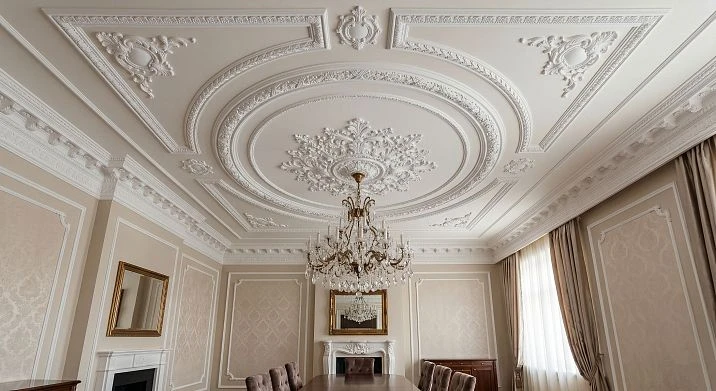
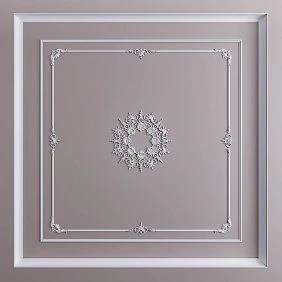
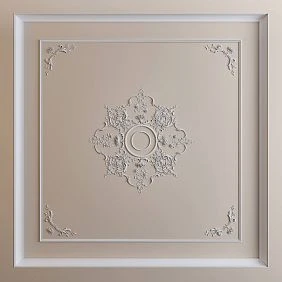
Ceiling decor around the chandelier — not an additional step after renovation, but part of the design logic.ceiling rose under the chandelier, a molding frame around the light center, a cornice along the perimeter — these three elements turn the chandelier from a technical object into an architectural accent. Stucco around the chandelier is not decoration for decoration's sake. It is a tool that makes the ceiling complete.
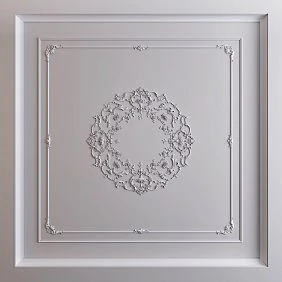
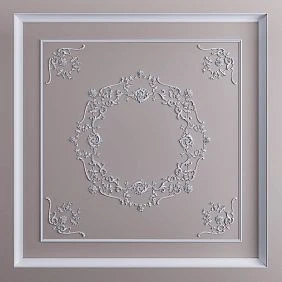
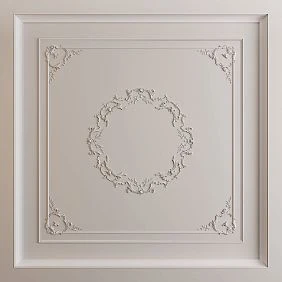
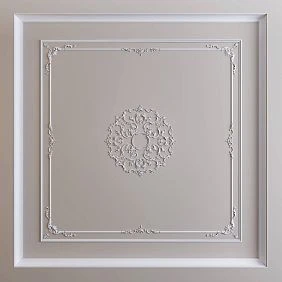
Why decor around a chandelier is needed
Ask yourself a simple question: why in classic interiors — French, Italian, English — are chandeliers always surrounded by a ceiling rosette, moldings, cornices? The answer is simple: because a light fixture without architectural context is just a lamp. But with context, it becomes the center of the space.
Decor around a chandelier on the ceiling performs several specific functions:
-
Hides the mounting point. The hook, mounting cup, wire — technical details that should not be visible. The ceiling rosette neatly covers this area, turning it into an ornamental center.
-
Creates visual weight. A chandelier without a rosette "hangs" in space. With a rosette, it "holds" onto the ceiling, giving it architectural support.
-
Forms the room's axis. A chandelier is the vertical axis of the room. Ceiling decor around the light fixture geometrically fixes this axis, making it readable.
-
Connects the center of the ceiling with the perimeter. If there is a rosette and a molding frame but no cornice, the ceiling composition looks isolated.a polyurethane corniceconnects the center with the perimeter — and then the entire ceiling becomes a unified whole.
-
Makes the light fixture part of the style. A classic crystal chandelier with a proper rosette and molding frame is architecture. The same chandelier on an empty ceiling is just an expensive light fixture without context.
How to make a chandelier part of a ceiling composition — that's what the entire article is about. The tools here are well-known and proven: rosette, moldings, cornice, ready-made kit. All that remains is to figure out how to choose them correctly.




Ceiling rosette: the main element around a chandelier
If you had to choose just one element to decorate the space under a chandelier, it would be the rosette. A ceiling rosette for a chandelier is the most direct and precise answer to the task: creating an architectural center on the ceiling without complex work or a large number of elements.
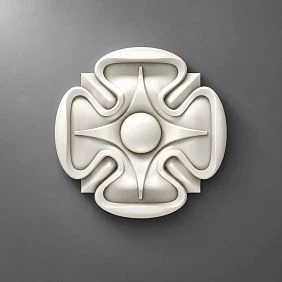
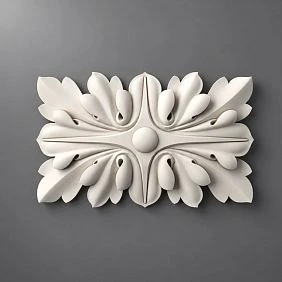
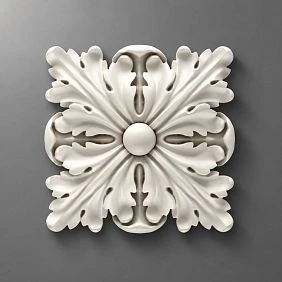
Polyurethane ceiling rosettesSTAVROS are cast products made of high-density foamed polyurethane. The material is lightweight, durable, does not deform with temperature and humidity changes, and can be painted with acrylic paints in any color. Installation is done with acrylic glue, without dowels or drilling. The result is clean, neat, with clear relief edges.
A polyurethane rosette for a chandelier comes in several types:
-
Round symmetrical — a classic option for a central chandelier. Ornament of petals, meander, acanthus frieze, or a laconic relief contour. Diameter from 200 to 600 mm.
-
Oval — for a non-standard room or a chandelier elongated along an axis.
-
Composite — when the rosette is assembled from several parts: a central disc and overlay petals. Allows creating more complex and large compositions.
-
Laconic — almost without relief, only a contour. For modern classic, quiet classic, minimal decor without ornamental overload.
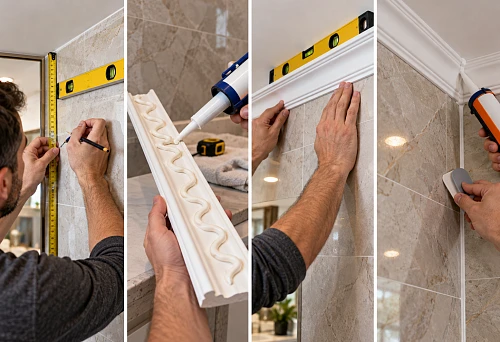
A polyurethane rosette for a chandelier is installed in 20–30 minutes. Glue is applied along the perimeter of the product, the rosette is pressed against the ceiling, aligned along the chandelier axis, and fixed without additional fasteners.
Our factory also produces:

How to choose the size of a rosette for a chandelier
This is the most practical question that is asked most often. And the most common source of errors: they buy either a too small socket that gets lost next to a large chandelier, or a too large one that visually overwhelms the space.
The rule of proportion: the diameter of the socket should be from 1/2 to 2/3 of the diameter of the diffuser (outer size) of the chandelier. This is a working proportion that provides visual balance.
Orientation table:
| Chandelier diameter | Recommended rosette diameter | Room Type |
|---|---|---|
| up to 400 mm | 180–250 mm | Bedroom, study, children's room |
| 400–600 mm | 250–350 mm | Living room, kitchen-living room, hallway |
| 600–800 mm | 300–450 mm | Living room, dining room, hall |
| 800–1000 mm | 400–550 mm | Large living room, grand hall |
| from 1000 mm | 500–650 mm | Hall, country house, high ceiling |
In addition to the chandelier diameter, consider:
Ceiling height. With a ceiling height of 2.6–2.7 m, even a 300 mm rosette can be slightly too large if the relief profile is high and heavy. For low ceilings, it is better to choose a thin, laconic relief and paint the rosette the color of the ceiling — this way it will not visually lower the height. For ceilings of 3 m and higher, you can use a more voluminous relief and a larger diameter.
Room area. In a room of 12–15 m², a 250–300 mm rosette is already an expressive accent. In a room of 40 m², the same rosette will be almost invisible: you need at least 400–500 mm or an additional molding frame.
Lamp style. A classic multi-tiered crystal chandelier requires an ornamental rosette with acanthus leaves, meander, or lush petal relief. A modern minimalist chandelier in the "quiet classic" style requires a laconic contour disc without overload. A mismatch of styles creates disharmony even with the correct sizes.
Presence of a molding frame. If the rosette will be used in combination with apolyurethane moldings, the size of the rosette can be reduced — the frame will take on part of the visual weight. If the rosette is the only element, it should be chosen slightly larger.
Distance from the chandelier to the walls. If the room is small and the chandelier is close to the walls, a large rosette can visually block the space. In this case, a small neat rosette plus a cornice around the perimeter is preferable.
Is a ceiling rosette under a chandelier necessary in principle — this is also a question worth clarifying. In a classic and neoclassical interior, a rosette is almost mandatory: it completes the architectural concept. In modern minimalism, it is sometimes replaced with a light molding frame or done without central decor at all. But if you are reading this article, you probably already know that you want a beautiful ceiling around the chandelier — and a rosette is the right answer here.
Get Consultation
Moldings around the chandelier: when one rosette is not enough
A ceiling rosette is a point. A molding frame is a field. This is a fundamental difference. The rosette emphasizes the lamp;moldings around the chandeliercreate a ceiling zone — a rectangular, square, or shaped outline that turns the chandelier and the space around it into the architectural center of the ceiling.
When one rosette is not enough:
-
The room is large — from 25–30 m². A 400 mm rosette in such a space looks like a lonely dot. A molding frame of 2000 × 2000 mm around it becomes a ceiling scene.
-
The ceiling is high — from 3 m. At that height, relief loses its scale. A frame of moldings adds a horizontal accent that is readable from a distance.
-
The interior is classic or neoclassical with pronounced symmetry. Here, a ceiling frame is a mandatory element of architectural logic.
-
Above the sofa area or dining table. A frame of moldings highlights a specific zone and geometrically connects the chandelier with the furniture beneath it.
Ceiling frame around a chandelier — how to build it correctly:
-
Determine the center of the ceiling — this is the chandelier mounting point.
-
Draw a frame symmetrical relative to the chandelier. The offset from the rosette to the molding is usually 300–600 mm.
-
Moldings are laid out in a rectangle or square. Corners are finished with corner pieces from the same series.
-
Inside the frame is a rosette or central stucco accent.
-
A cornice runs along the perimeter of the room. This way the frame doesn't look like it's 'floating' in the space.
Moldings combined with a rosette create a hierarchy of decor: cornice — outer frame — rosette. Three levels, three horizontal contours — and the ceiling ceases to be just a plane, becoming an architectural field.
Cornice and perimeter: how to connect the chandelier with the entire room
Imagine: a beautiful rosette, an expressive molding frame — and absolutely bare walls without a cornice. The visual effect will be like a painting without a frame on a peeling wall. There is a center, but no context.
This is where thea polyurethane cornice. Its task is to create a horizontal line along the perimeter of the ceiling that connects the ceiling center (chandelier + rosette + moldings) with the walls. Without a cornice, the ceiling composition around the chandelier remains isolated — beautiful, but architecturally unfinished.
Ceiling cornice and chandelier: how to combine:
-
In a classic interior, a cornice is a mandatory element. It works as the lower boundary of the ceiling plane, without which the entire architectural logic collapses.
-
The scale of the cornice should match the scale of the rosette and moldings. If the rosette is ornamental, 450 mm with a lush relief — a 60 mm cornice will look out of place. A profile of 100–130 mm is needed.
-
In a small room (up to 20 m²), a cornice of 70–90 mm. In a medium living room of 25–40 m² — 100–130 mm. In a large hall from 40 m² — 130–180 mm.
-
The cornice can be used with contour LED lighting. This creates a soft light transition between the wall and ceiling — especially effective in combination with a classic chandelier.
How to combine a cornice and a ceiling rosette: the main rule is a single series. If the cornice is from the "Classic" series by STAVROS, then the rosette and moldings should be from the same line. Then the scale of the profiles will be proportional, the reliefs will be coordinated, and the entire ceiling will look like a designed system, not a set of randomly purchased elements.
Decor around the chandelier in the living room
The living room is a space where the ceiling decor around the chandelier should work to its fullest. Here is the largest chandelier, the largest area, the highest expectations from the interior. Ceiling decor around the chandelier in the living room is not a modest accent, but an architectural statement.
A ceiling with a chandelier and stucco in the living room is built on a clear hierarchy: a cornice along the perimeter → a molding frame in the central zone → a rosette at the chandelier attachment point. Each level enhances the next.
What to consider when choosing decor for a living room with a chandelier:
The axis of the chandelier and the sofa group. In a classic living room layout, the sofa is perpendicular to the fireplace or main wall, the chandelier is in the geometric center of the room. The molding frame should be symmetrical to this axis. If the chandelier is offset, the frame shifts with it.
Scale. A living room of 25–40 m² with a ceiling of 2.9–3 m and a chandelier with a diameter of 600–800 mm — here it works correctlyMolding decor set CPU-P3. The system 3200 × 3200 × 83 mm with corner accents and a central element creates exactly the ceiling scene needed for a full-fledged living room.
Formal living room. If the living room is 35–50 m², ceiling height 3–3.5 m, chandelier multi-tiered with a diameter of 900–1100 mm — you needMolding decor set CPU-P4. A multi-level system of 21 product types, four levels of corner accents — this is a ceiling that creates an architectural scene around a large chandelier.
Large living room. Hall from 50 m², ceiling height from 3.5 m, chandelier diameter from 1000 mm —Molding decor set CPU-P6 with large ornamental dominants NPU-464 and NPU-475. Only with this scale of the system will the central accent be proportionate to the large chandelier and readable from a distance of 10–12 meters.
Ceiling rosette for a chandelier in the living room: in CPU kits, the rosette or central element is an organic part of the system. If you want only the rosette without the full kit, choose a diameter from 400 mm for a medium living room and from 500 mm for a large one.
Decor around the chandelier in the bedroom
In the bedroom, it's a different story. There is no formality, no large hall spaces, no multi-tiered crystal chandeliers. Here — silence, soft light, a sense of peace. The ceiling decor around the chandelier in the bedroom should be proportionate to this atmosphere.
Calm ceiling decor around the chandelier in the bedroom — a few principles:
-
The rosette should not be too heavy. For a bedroom, a diameter of 200–300 mm is optimal; the ornament is laconic, without lush acanthus leaves and multi-tiered friezes.
-
The color of the decor matches the ceiling color. If you paint the rosette and moldings in the same shade as the ceiling, the decor will create a relief effect without weighing down the space.
-
A molding frame in the bedroom is a good solution, but with a neat profile of 30–45 mm. The frame above the bed area creates an "architectural canopy" — soft, without physical structures.
A ceiling rosette for a chandelier in the bedroom: if the ceiling is 2.7–2.8 m and the chandelier diameter is 400–500 mm — a rosette of 220–280 mm will be the right choice. No pomp, no large relief.
For decorating the ceiling in the bedroom with a chandelier: -
Molding decor set CPU-P5 — a calm chamber system with a soft relief. Ideal for a bedroom where completeness is needed without pomposity.
-
Stucco decor set CPU-P1 — a stricter, geometrically concise system. For a bedroom in the style of modern classic or neoclassical, where ornamental relief is not needed, but a clear architectural organization of the ceiling is required.
Ceiling decor above the bed and chandelier: if the chandelier is in the center of the bedroom and the bed is under it (standard master bedroom layout), the molding frame should be oriented along the headboard axis. Then the bed, chandelier, and ceiling frame will all be on the same architectural axis — what designers call a "strong axis."
More details on how to properly buildceiling decor for the bedroom, — in a separate cluster article.
Decor around the chandelier above the dining table
A chandelier above the dining table is one of the most architecturally precise scenarios in an interior. Everything is already set: there is the table axis, the chandelier axis, and a specific zone to be decorated. The ceiling rosette above the dining table is the final touch that turns the dining area into a complete space.
Ceiling decor around the chandelier above the table: layout principles:
Rectangular frame along the table axis. A molding rectangle matching the proportions of the tabletop is the ideal scheme. Table 200 × 100 cm → frame 220–240 × 120–140 cm. Distance from the tabletop edge to the molding is 10–20 cm.
Rosette in the center of the frame — under the chandelier. Rosette diameter — according to the size of the light fixture's diffuser. For a pendant light 300–400 mm — rosette 180–250 mm. For a classic chandelier with a diameter of 600–700 mm — rosette 300–400 mm.
Cornice around the perimeter of the room. Without it, the frame above the table looks like a decorative "island" on an empty ceiling. With a cornice, it looks like part of a unified ceiling architecture.
Stucco molding around the chandelier above the table — zoning through the ceiling:
In a kitchen-living room, this composition solves two tasks at once: it decorates the dining area and separates it from the sofa area. A molding frame above the table + a rosette under the chandelier is an architectural boundary that works better than any partition.
Ceiling decor above the dining area:
-
Dining room and kitchen-living room 20–30 m² — Molding decor set CPU-P3. A zone size of 3200 × 3200 mm aligns well with a standard dining table for 6–8 people.
-
Formal dining room 30–40 m² with a ceiling height of 3 m or more — Molding decor set CPU-P4A richer ceiling system for the dining room, commonly referred to as the formal dining room.
Ceiling decor for the kitchen-living room: read the article for more detailed scenarios of zoning with ceiling decor in open spaces.ceiling decor for a kitchen-living room.
Decor around the chandelier in the hall and country house.
In the hall, everything is different than in the living room or bedroom. There is no sofa, no bed, no dining table. There is an entrance, a staircase, a door — and a gaze that immediately goes upward. The ceiling in the hall is the first thing people notice when they enter the house. And if there is a large chandelier with a beautiful ceiling rosette, the first impression is already formed.
Ceiling decor around the chandelier in the hall:
-
The ceiling rosette in the hall should be slightly more expressive than in a living room of the same area. The hall is a "statement," and it should be heard at first glance.
-
If the hall is small, up to 15–18 m², but with a ceiling of 3–3.5 m, this is not a reason for modest decor. The ceiling height allows for a larger and more embossed element.
-
If there is a staircase in the hall, the axis of the chandelier should coincide with the axis of the staircase. The ceiling rosette and molding frame should be along this axis.
Ceiling decor in the formal hall: for a formal entrance hall of 20–35 m², the best choice isMolding decor set CPU-P4. A multi-level system with four levels of corner accents creates a ceiling proportionate to the formal entrance space.
Ceiling rosette for a chandelier in the hall of a country house: here a special factor comes into play — a double-height space. If there is a double-height zone above the hall with a height of 4–5 m, a small 300 mm rosette simply won't be readable. A large element or a full CPU-P6 kit is needed — with large dominant NPU-464 (300 × 420 mm) and a central accent proportionate to the large pendant light.
About a comprehensive solution for ceiling decor in a country house — in the articleceiling decor in a country house.
Decor around the chandelier in the study
A study is a different kind of space. It doesn't need the formality of a living room or the softness of a bedroom. It needs strictness, composure, architectural clarity. The ceiling decor around the chandelier in the study should match this character.
Strict ceiling decor with a chandelier in the study:
-
A rosette without ornamental excess. A laconic circular frieze or geometric outline.
-
A molding frame — a strict rectangle along the axis of the desk. Without rounding or complex curves.
-
A calm cornice — 80–100 mm, without a lavish profile.
Ceiling rosette for a chandelier in the study: -
Study 16–20 m², ceiling 2.8–3 m —CPU-P1 kitA laconic system for those who value architectural order without decorative extremes.
-
A status office of 20–30 m², ceiling 3 m and higher, classic furniture, bookcases —CPU-P3 kitA richer system that gives the office the necessary status without the pomp of a living room.
About the nuances of ceiling decor for workspaces — in the articlestucco decor for the ceiling in the office.
Which kit to choose for a ceiling with a chandelier
Ready-made CPU STAVROS kits are the best solution for those who want not just a socket for a chandelier, but a finished ceiling. Each kit contains all the necessary elements: corner accents, field overlays, a central element, coordinated with each other in scale and proportions. No random selection — only a designed system.
CPU-P5 — for bedroom and quiet room
Molding decor set CPU-P5 — an intimate, delicate system for spaces where architectural completeness is needed without the slightest formality. Bedroom, children's room, guest room, small study — that's the right audience for CPU-P5.
The system includes a soft corner relief, moderate field overlays, and a calm central element. For a ceiling of 2.6–2.8 m — ideal; at a height of 3 m it also works if the room area does not exceed 20–25 m².
CPU-P1 — for calm classics
Stucco decor set CPU-P1 — a strict, geometrically precise system for those who value architectural order. Study, hallway, small living room, classic interior without pomp — here CPU-P1 works perfectly.
Laconic profile of corner accents, restrained overlays, clear central point for the chandelier. Classics without a palace effect — that's the CPU-P1 formula.
CPU-P3 — a universal option for living room and dining room
Molding decor set CPU-P3 — a working tool for most living spaces. Living room 25–40 m², dining room, kitchen-living room, open space — everywhere CPU-P3 creates an expressive ceiling center around the chandelier. Zone 3200 × 3200 × 83 mm with corner accents and a central element — a ready-made ceiling scene that doesn't need to be designed from scratch.
CPU-P4 — for formal living room and hall
Molding decor set CPU-P4 — the next level. Multi-level classic system of 21 product types, four levels of corner accents. Ceiling with CPU-P4 around a large classic chandelier — this is an architectural image, not just a renovated ceiling with decor.
Application: large formal living room, hall, representative dining room, country house hall.
CPU-P6 — for high ceiling and luxurious chandelier
Molding decor set CPU-P6 — the most ornamentally rich and large-scale system in the line. Large dominants NPU-464 (300 × 420 mm) and NPU-475 (350 × 180 mm), powerful central complex, maximally detailed corner accents. CPU-P6 creates a ceiling for a large multi-tier chandelier with a diameter of 1000–1500 mm in a hall, formal hall, or living room of a country house.
Application rule: CPU-P6 requires sufficient spatial scale. Ceiling height from 3.2–3.5 m, area from 40–50 m², chandelier diameter from 900–1000 mm. Only in such a context do ornamental dominants fully unfold.
On selecting a set for a specific space — detailed material in the articlewhich CPU ceiling decor set to choose.
Mistakes when decorating the ceiling around a chandelier
Mistake 1. Choosing a too small ceiling rose
A small ceiling rose next to a large chandelier is like a pencil signature under an oil painting. It exists, but it's barely visible. An important visual principle: the ceiling rose should be proportionate to the light fixture, not smaller than it.
Mistake 2. Choosing too large decor for a low ceiling
On a ceiling of 2.6–2.7 m, a heavy ceiling rose with a diameter of 500 mm and a high relief of 60 mm will literally hang over your head. Especially if the walls are also active. For a low ceiling — a thin profile, a laconic ornament, color matching the ceiling.ceiling molding for 2.6–2.8 m ceilings — about correct proportions in small spaces.
Mistake 3. Not considering the room's axis
The chandelier does not always hang in the geometric center of the room — its position is often determined by the furniture layout. The ceiling rose and molding frame should be coaxial with the chandelier — otherwise the decor will look misaligned. Before installation, always check the axis: chandelier — ceiling rose — frame center.
Error 4. Making only a rosette without a cornice and moldings
In a large room, one central element on an empty ceiling is a decorative "island" surrounded by nothing. A rosette without a cornice and moldings in a living room of 30 m² almost always looks unfinished. A system is needed.
Error 5. Mixing styles
A classic ornamental rosette with lush acanthus leaves — and a Scandinavian light chandelier with a concrete shade. This is incompatible. The decor around the chandelier should match the style of the light fixture. If the chandelier is classic — the rosette is classic; if the chandelier is in the spirit of "quiet luxury" — the rosette is laconic, with minimal relief. A unified style: frommoldings from polyurethaneon the ceiling towall decorand the floor molding.
Light and stucco: how ceiling relief works under different light sources
A separate topic worth addressing is the interaction of ceiling stucco decor and light. Not everyone knows, but the relief of a ceiling rosette and moldings works differently depending on the source and direction of lighting.
Classic chandelier in the center. Light is scattered evenly, shadows on the relief are soft. The ornament of the rosette reads gently, without harsh contrasts. This is the most "friendly" type of lighting for stucco decor.
Contour LED backlighting in the cornice. Light is directed at the ceiling or along the wall. The relief of the cornice receives side lighting — shadows become sharper, the ornament reads more voluminously. This is an effective solution that literally "turns on" the cornice decor.
Spotlights. Directional light creates pronounced shadows on the relief — especially if the spots are located not in the center, but along the perimeter. Moldings and rosettes may appear more voluminous than under diffused light.
Recommendation: if you plan contour lighting in the cornice — choose a cornice with sufficient shelf depth to hide the LED strip. If spots are along the perimeter — check how they will illuminate the central rosette: sometimes side lighting creates a beautiful play of shadows, sometimes — ugly sharp penumbras.
installation of polyurethane molding — there is a detailed description of the installation technology taking into account subsequent painting and integration with lighting.installing polyurethane molding — about clean corners, hidden joints, and proper painting of molding frames.
Ceiling decor around the chandelier: a complete system from perimeter to center
To draw a practical conclusion, let's formulate a complete system of ceiling decor around the chandelier — from walls to center:
Step 1. Cornice along the perimeter. It is selected based on the ceiling height and room area. From the catalog cornices made of polyurethane STAVROS — in the same series as the other elements.
Step 2. Molding frame around the central zone. It is built symmetrically relative to the chandelier attachment point. Frame size — from 1500 × 1500 mm for a small room to 3000 × 3000 mm for a large living room.
Step 3. Ceiling rosette or central element. At the chandelier attachment point. Diameter — according to the proportionality table with the chandelier.
Step 4. Corner accents at molding intersections. Overlay elements in the corners of the frame complete the geometry and add an ornamental accent at the molding "joints."
This is exactly how ready-made CPU STAVROS kits are designed — as complete systems where every step is already accounted for. No need to search for compatible elements in different catalogs and guess whether they will look good together. The CPU system is a ready-made solution.
Allpolyurethane interior itemsSTAVROS: cornices, moldings, rosettes, overlays, wall decor — are produced in a single series with coordinated proportions. This means that the "Classic" cornice will be proportionate to the "Classic" molding, and the "Classic" rosette will fit organically into the molding frame of the same series.
For those who want to see the full range of ceiling decor:polyurethane ceiling decor— an overview article describing the entire assortment. Comparison of CPU kits from P1 to P6:a set of stucco decor for the ceiling.
Where to buy STAVROS ceiling decor around the chandelier
The STAVROS catalog presents a full range for decorating the ceiling around the chandelier:Polyurethane ceiling rosettes, Moldings made of polyurethane, Polyurethane Crown Moldingandready-made ceiling decor kits.
Guide by tasks:
-
Only the rosette under the chandelier — sectionceiling rose
-
Socket + molding frame + cornice — manually select from catalog or choose a ready-made set
-
Finished ceiling with chandelier in a bedroom or small room —CPU-P5orCPU-P1
-
Ceiling in a living room, dining room, or kitchen-living room —CPU-P3
-
Formal living room, hall, representative dining room —CPU-P4
-
High ceiling, large chandelier, country house, hall —CPU-P6
STAVROS — Russian manufacturer of architectural decor from polyurethane. The CPU P1–P6 ceiling system line, cornices, moldings andceiling rosettes — everything is designed as a unified architectural system for classic and neoclassical residential interiors. STAVROS produces high-density polyurethane products: lightweight, durable, moisture-resistant, paintable in any color. Installation without construction work, results — for decades.
FAQ: answers to popular questions about ceiling decor around a chandelier
How to choose a ceiling socket for a chandelier?
The socket diameter should be 1/2–2/3 of the chandelier diameter. Also consider the ceiling height: for 2.6–2.8 m — a thin, laconic profile; for 3 m and above — you can choose a more voluminous relief. The socket style should match the style of the light fixture.
Can stucco molding be used around a chandelier on a low ceiling?
Yes. Choose a ceiling medallion with a thin relief profile, paint it the same color as the ceiling — and the molding will create a decorative effect without reducing the visual height of the room.
What is better: a ceiling medallion or moldings around a chandelier?
A medallion accents the light fixture itself, while moldings form the ceiling zone around it. In a classic interior, both elements are used together — a medallion in the center and a molding frame around it. In a small room, only a medallion is sufficient.
How to design a chandelier above a dining table?
A molding frame aligned with the table axis + a medallion in the center under the light fixture. The frame should be proportional to the tabletop with a 10–20 cm offset. A cornice around the perimeter of the kitchen-dining room completes the composition.
Which STAVROS set to choose for a ceiling with a chandelier?
CPU-P5 or CPU-P1 — for the bedroom and quiet rooms. CPU-P3 — for the living room and dining room. CPU-P4 — for a formal living room and hall. CPU-P6 — for a large hall, high ceiling, and a large luxurious chandelier.
Is a cornice necessary if there is a medallion and moldings?
In a large room — definitely. The cornice connects the central ceiling composition with the walls. Without it, the decor around the chandelier looks like an 'island' on an empty ceiling.
Can I install a ceiling rosette myself?
Yes. A polyurethane rosette is mounted with acrylic glue without dowels or drilling. Installation time is 20–30 minutes. After the glue dries, fill the joints and paint.