








































Article Contents:
- Why the ceiling works as a zoning tool in a kitchen-living room
- Which zones can be highlighted with ceiling stucco
- Dining area
- Kitchen island
- Sofa area
- Central zone of open space
- How to choose decor for the dining area
- How to choose decor for the kitchen island area
- CPU-P3 or CPU-P4: which set to choose for a kitchen-living room
- CPU-P3 — for dining area, island, and calm open space
- CPU-P4 — for a large kitchen-living room and formal dining area
- How to combine ceiling decor and cornices
- How to combine ceiling decor with walls in a kitchen-living room
- How to choose a set according to the size and height of the ceiling
- Mistakes when choosing ceiling decor for a kitchen-living room
- Mistake 1. Making one decor for the entire ceiling without zones
- Mistake 2. Not considering light fixtures
- Mistake 3. Placing too rich decor next to an active kitchen area
- Mistake 4. Not considering the hood and ventilation
- Mistake 5. Not connecting the ceiling with the cornice and walls
- Where to buy ceiling decor for the STAVROS kitchen-living room
- FAQ: Answers to Popular Questions
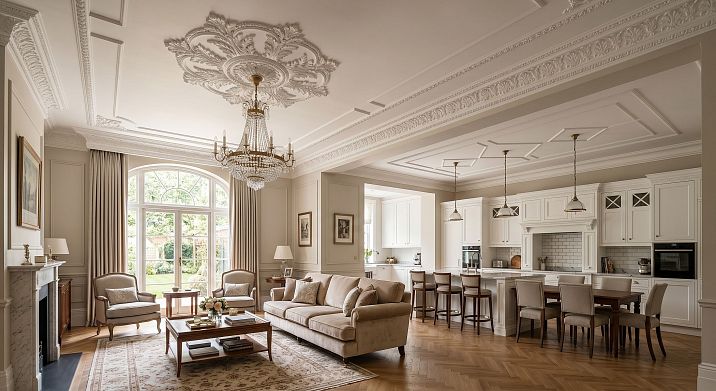
Open plan is an architectural argument for freedom. Partitions are removed, the kitchen, dining room, and living room are combined, the space breathes, light passes from the window to the far wall. All this is wonderful — until the realization comes: a large open space without internal structure looks like one huge non-functional rectangle. The dining table here, the sofa there, the kitchen facade on the third side. Everything in one room, and yet each element exists on its own.
It is hereceiling decor for a kitchen-living roomceases to be a decorative gesture and turns into an architectural tool. Stucco molding on the ceiling in a kitchen-living room is not just decoration. It is a line that, without a single wall, says: here is the dining area, there is the living room, between them is the kitchen island. Zoning the ceiling with stucco works where partitions are not needed or impossible — and it works elegantly, without reducing the space by a single square centimeter.



Why the ceiling works as a zoning tool in a kitchen-living room
In a traditional apartment, zoning happens on its own: walls separate functions, doors mark transitions, each room is a separate architectural world. In an open plan, this mechanism is absent. The entire space floats in one horizon — and that is why other planes take on the role of structuring elements.
The ceiling in a kitchen-living room is visible from all points simultaneously — from the armchair by the sofa, from behind the dining table, from the kitchen island side, from the entrance door. It is the only element that physically covers the entire space from above. And this is precisely what makes it an ideal tool for zoning without partitions.
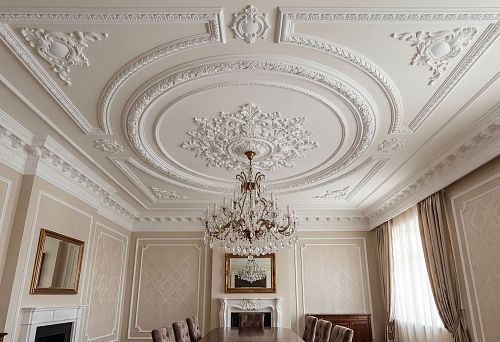
How does this work in practice? Moldings on the ceiling of a kitchen-living room create a ceiling frame that visually 'covers' a specific zone: the table with a chandelier, the island with pendant lights, the sofa group with central lighting. The zone under the frame reads as a highlighted, designed, completed space. The zone beyond the frame reads as a different architectural context. At the same time, there is no physical boundary: air, light, and gaze pass freely.
Zoning a kitchen-living room with stucco works on several levels of perception:
-
visual — a frame of moldings on the ceiling above the table is instantly read as a 'dining area' even without furniture below;
-
lighting — a chandelier or pendants inside the stucco ceiling frame become an architectural accent, not a random lighting point;
-
tactile — the soft relief of stucco molding in oblique light creates shadow graphics that structure the ceiling field;
-
spatial — zone boundaries are set from above, and lower levels (furniture, carpet, lighting) automatically align relative to this system.
Zoning an open space with ceiling decor is an elegant architectural technique used in the best European open space projects since the 1970s. In Russian residential interiors, it is not yet the norm, but that is precisely why, where it is applied, the result creates the effect of "as if an architect worked here." How to separate the kitchen and living room without a partition? Exactly like this — through a ceiling frame and stucco molding above functional zones.




Which zones can be highlighted with ceiling stucco molding
Before choosing a set and counting elements, it is important to make one fundamental decision: what exactly needs to be highlighted. In a kitchen-living room, as a rule, there are three to four functional zones — and the decision about which one to accentuate with ceiling decor determines the entire subsequent project.
Our factory also produces:


Dining area
The dining table is the most logical and strongest scenario for ceiling decor in a kitchen-living room. Why the table? Because it is the only zone where everyone sits facing the center. At the dining table, the gaze naturally rises upward — people look at each other, look at the chandelier, feel the space above them. Ceiling stucco molding above the dining area works most vividly here.
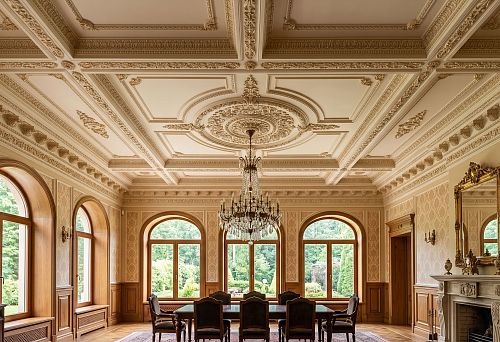
Ceiling decor above the dining table with a molding frame turns the table into an architecturally designed object. It is not just furniture placed under a chandelier. It is a dining area with a ceiling "sky" — highlighted, framed, complete. Stucco molding above the dining table creates that ceremonial dining context that in private homes was previously created by a separate dining room. Now this is done through ceiling decor — without allocating a separate room.
How to correctly highlight the dining area on the ceiling: the center of the ceiling frame must exactly coincide with the center of the table. This means the project should start from the furniture layout, not from the room's construction geometry. If the chandelier is offset relative to the table, it should be moved or the connection point adjusted during renovation. A ceiling frame without a chandelier in the center looks unfinished.
Ceiling decor above a round table — a more centered stucco composition with a pronounced central element and radial symmetry that repeats the table's geometry. Ceiling decor above a rectangular table — a square or elongated molding frame, proportionate to the table's perimeter with side chairs. In both cases, a ceiling rosette above the dining table is a mandatory element: a chandelier above the table with a ceiling rosette transforms from a light fixture into the architectural center of the zone.
Get Consultation
Kitchen island
The kitchen island is the second strong scenario for ceiling decor. If the dining table serves the function of formal dining, the island is a workspace, bar counter, and breakfast spot all at once. Stucco molding on the ceiling above the kitchen island works as a decorative "cover" for this hybrid object.
The specificity of the island as a base for a ceiling system: above it, as a rule, several pendant lights hang in a row — not a single central chandelier. This means that the molding frame should be oriented along the long axis of the island and encompass the entire group of pendants. Ceiling decor with pendants above the island: a frame of moldings defines the contour, and inside it, the lights form a linear lighting system that simultaneously serves as a decorative solution.
Ceiling decor above a kitchen island is slightly more complex to design than above a dining table — precisely because of the group of pendants. Moldings around the lights above the island should be placed considering the distances between connection points. This is resolved at the design stage before installation: the arrangement of pendants must be predetermined, and only then is the ceiling frame designed around it. How to zone a kitchen island with the ceiling: this sequence — first light, then decor — is the correct one.
Stucco for a kitchen-living room with an island is also a matter of scale: the island typically occupies a central position in the kitchen area and has an elongated or rectangular shape. A ceiling frame around its perimeter using a molding system provides a clear architectural definition of the kitchen area and separates it from the dining and living parts of the open space.
Sofa zone
A sofa in a kitchen-living room is a relaxation zone that often ends up being architecturally the least defined: a large sofa stands against a wall or in the center, a coffee table in front of it, a TV opposite. Ceiling decor above the sofa area in a kitchen-living room helps gather this furniture group from above — just as a molding frame above a table gathers the dining area.
A ceiling frame above the sofa in a kitchen-living room is a particularly valuable technique when the sofa area occupies the far part of the space from the kitchen: it enhances the feeling of a "living room corner" and visually separates the relaxation zone from the active culinary space. Zoning a living room with ceiling stucco works exactly like this: through the ceiling, a soft architectural boundary is created that helps the space breathe with structure.
Central zone of open space
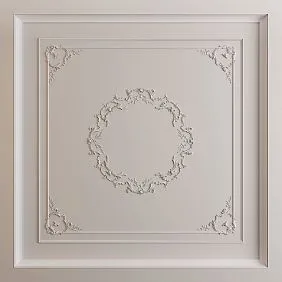
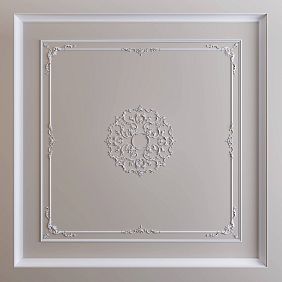
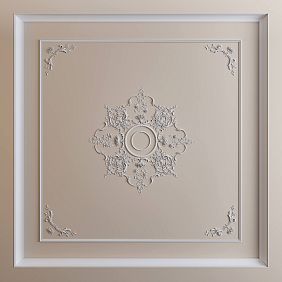
If the kitchen-living room is large — 35 m² or more — it is sometimes wiser not to fragment the ceiling into several separate zonal frames, but to highlight one central square 3200 × 3200 mm, which will become the architectural center of attraction for the entire open space. A decor set for a kitchen-living room 3200 × 3200 mm is exactly for this scenario.
Ceiling decor 3200 × 3200 mm for a kitchen-living room is placed where zones converge: above the junction of the dining group and sofa area, or above the central passage, or exactly at the center of the room's geometry. In this case, the ceiling system becomes not a marker of a separate function, but an architectural "cherry on top" of the entire space — a point around which everything else is organized. Ceiling decor in an open space interior of this scale is the pinnacle of spatial design.
How to choose decor for the dining area
This is a practical question with several important aspects, each of which affects the result.
The axis of the table and the axis of the chandelier. It has already been said — they must coincide. But it is important to add: the axis of the table in an open space is often offset from the building axis of the room. Therefore, the ceiling frame and socket for the chandelier are placed according to the furniture, not according to the building markings.Polyurethane ceiling rosettesfrom the STAVROS catalog are mounted with glue, which allows them to be placed exactly where needed — without drilling and without being tied to the reinforcement.
The shape of the table and the shape of the frame. For a rectangular table, a rectangular or square molding frame is optimal; a square frame is preferable because the 3200 × 3200 mm zone is already set by the CPU-P3 system. For a round table, the CPU-P3 system is also suitable — the central element of the kit enhances the perception of centricity, compensating for the rectangularity of the frame.
The luminaire and its compatibility with the decor. How to design the ceiling above the dining area considering the luminaire: the chandelier must be selected before the final installation of the ceiling system, and its diameter must be smaller than the diameter of the central rosette element. A chandelier above the dining table with a ceiling rosette is about proportionality: if the rosette has a diameter of 250 mm, a chandelier with a diameter of 500 mm will visually "eat up" the accent.
Proximity to appliances. In a kitchen-living room, the ceiling decor above the dining area often coexists with ventilation grilles, recessed lights in the kitchen area, and track systems. It is important:Polyurethane moldingsmust be placed so that the molding contours do not intersect with the functional elements of the ceiling. A layout diagram of all technical points is made before the decor is installed.
How to design the ceiling above the dining table in a kitchen-living room, summary: the axis of the table = the axis of the chandelier = the center of the frame. The frame shape corresponds to the spatial geometry of the zone. The luminaire is selected before the system is installed. Technical elements are placed outside the decorative zone.
How to choose decor for the kitchen island zone
The kitchen island is an active work zone. And here, a practical question is added to the architectural ones: is polyurethane stucco compatible with the conditions of an active kitchen?
The answer is yes, provided there is normal exhaust ventilation. Polyurethane as a material is resistant to moderate humidity and temperature fluctuations within the normal residential range. An important nuance: the material is not intended for conditions of constant condensation, overheating, or a sauna — but in a modern equipped kitchen-living room with a high-quality hood above the stove, these conditions do not occur. Ceiling decor above the kitchen island with normal ventilation works reliably and for a long time.
Moldings on the ceiling above the island: the geometry of the frame is built from the orientation of the island. If the island is located along the long axis of the room, the frame is elongated. If perpendicular, the frame is more square. In any case, all pendant lights above the island must be inside the decorative frame — this is fundamental for creating a unified lighting and decorative zone.
Ceiling decor with pendants above the island is a scenario where lights and moldings work in pairs. Three pendants in a row above a long island inside a molding frame is already a full-fledged ceiling lighting installation with architectural framing. This is exactly how the best kitchen-living room interiors in classic and neoclassical style look.
How to highlight a kitchen island on the ceiling using decor: step one — determine the location of all pendant lights above the island and fix the connection points. Step two — build a molding frame around the perimeter of this group with an indent of 15–20 cm on each side. Step three — add corner accents and, if necessary, a central element along the main axis. Stucco for a kitchen-living room with an island is a system that is designed from lighting.
CPU-P3 or CPU-P4: which kit to choose for a kitchen-living room
This is the central practical question of the entire article — and the answer depends on the scale of the room, ceiling height, and decorative scenario.
CPU-P3 — for the dining area, island, and calm open space
Molding decor set CPU-P3 — the main product hero of this article, and the reason is simple: the CPU-P3 card directly describes the kitchen-living room scenario. The ceiling zone above the dining table or island, highlighted through the CPU-P3 system, works as a visual separation of the kitchen and living room without a physical partition. This is precisely the main intent of this article, and this kit is the exact answer to it.
What the CPU-P3 system represents: in-depth ornamental detailing of the ceiling field, a transitional level between intimate and formal decor, a balanced saturation that is expressive enough for a kitchen-living room but does not create excessive grandeur. The coverage area of 3200 × 3200 × 83 mm covers the central zone of the room, leaving the perimeter open or decorated with a separate cornice.
CPU-P3 for a kitchen-living room with an area of 25–40 m² and ceilings from 2.7 m is the optimal choice. A ceiling decor kit for a kitchen-living room of this scale through the CPU-P3 system creates exactly the degree of architectural structuring needed for an open space: expressive enough to separate zones, restrained enough not to turn the kitchen space into a formal hall.
The dining table scenario through CPU-P3: the molding contours of the system set a rectangular frame above the zone, corner accents fix its geometry, field overlays create visual saturation inside the frame, and the central rosette element receives the chandelier. The result is a ceiling zone above the table that a person sees and immediately understands: this is a place for dining.
CPU-P4 — for a large kitchen-living room and a formal dining area
Molding decor set CPU-P4— another level of architectural statement. 21 product types, four levels of corner accents, a rich multi-level classical system — CPU-P4 is designed for spaces where the ceiling should become a decorative dominant.
CPU-P4 for a kitchen-living room is the choice for large spaces from 35 m² with ceilings from 2.8 m, private houses with a spacious kitchen-living room, interiors with a formal dining area where the table is designed for 8–12 people and the chandelier is the main decorative light fixture of the room. Ceiling decor for a large kitchen-living room through CPU-P4 creates that scale of decorative saturation at which a large ceiling rectangle ceases to be a "large white plane" and becomes an architectural stage.
Ceiling decor for a kitchen-living room in a private house — a special scenario for CPU-P4. In a house, the kitchen, dining area, and living room are often combined into a single formal space of 45–60 m². At this scale, CPU-P4 unfolds in full force: a rich corner system, deep field overlays, an expressive central accent. Ceiling decor in a combined kitchen-living room of a country house through CPU-P4 is an interior solution that immediately sets the level.
| Parameter | CPU-P3 | CPU-P4 |
|---|---|---|
| Room area | 25–40 m² | 28–45 m² and more |
| Ceiling height | from 2.7 m | from 2.8 m |
| Levels in the corner system | 2–3 | 4 |
| Number of product types | Moderate | 21 types |
| Decorative richness | transitional level | Saturated |
| Main Scenario | dining area, island | formal living-dining room, house |
How to combine ceiling decor and cornices
In a kitchen-living room, the cornice is a separate, independent and very important element. If the ready-made CPU-P3 or CPU-P4 set is a zonal decor (it works over a specific zone), then the cornice is a perimeter decor that covers the entire room along the perimeter.
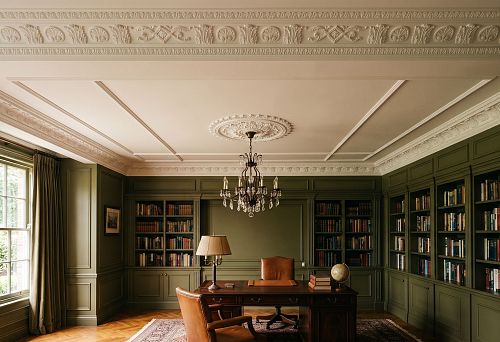
Polyurethane Crown Moldingin a kitchen-living room solve several tasks. First, they complete the transition of walls to the ceiling along the entire perimeter — in a combined space this transition is especially noticeable because there are many walls and they are long. Without a cornice, the ceiling in an open space "hangs" over the walls as an unconnected plane. Secondly, the cornice along the perimeter creates a single decorative contour that connects the zonal accent (the CPU-P3 set over the table) with the overall architecture of the room.
How to combine ceiling decor and cornices in a kitchen-living room: a cornice along the entire perimeter + a zonal CPU-P3 or CPU-P4 set over the dining area or the center of the open space — this is a full-fledged ceiling system for a kitchen-living room. The cornice is calmer in profile: in a combined space with a high ceiling, it can be moderate and laconic, because the main decorative load is carried by the zonal set.
A ceiling with cornices in a kitchen-living room with contour lighting through the LED groove of the cornice turns into a three-dimensional lighting system: warm soft light along the perimeter + main lighting inside the stucco zonal frame + accent pendants over the island. This is no longer just a ceiling — it is a lighting design that creates an atmosphere.
Moldings on the ceiling of a kitchen-living room outside the CPU-P zonal system: if the room has a complex configuration or is very long, individualMoldings made of polyurethanecan complement the perimeter cornice, creating intermediate decorative belts or a more complex cornice profile. In a long kitchen-living room, horizontal moldings help visually "shorten" the space.
How to combine moldings and cornices on the ceiling of a kitchen-living room: the cornice is the basic horizontal contour around the entire perimeter. Moldings are additional lines within the ceiling field or as part of a zonal set. They never compete with each other if they are maintained in the same ornamental style.
How to combine ceiling decor with walls in a kitchen-living room
A ceiling frame above the dining area works most effectively when it is supported by the walls. In a kitchen-living room, this is especially important because in an open space, a ceiling frame without wall context can look like a separate decorative "rug" on the ceiling — without connection to the overall architecture.
Moldings on the walls of a kitchen-living room support the ceiling geometry. If a frame of moldings is placed above the dining table, then on the wall next to the zone — at least one molding belt or frames create a visual connection between the ceiling and walls. A kitchen-living room with moldings on the walls and ceiling is an interior where the architectural decorative language is consistent and systematic.
Polyurethane wall decorfrom the STAVROS catalog allows you to create a coordinated system of wall and ceiling decor in a single classical style. Molding frames on the wall behind the dining table or above the sofa are wall decor that rhymes with the ceiling systems of the CPU-P series.
Stucco on the ceiling and moldings on the walls: the principle of coordination — the ornamental language and scale of the profiles must be unified. A mix of profiles and styles "breaks" the system. STAVROS offers all elements in a single "Classic" collection — this guarantees consistency without additional effort on the part of the buyer.
An important nuance for a kitchen-living room: the wall with facades and appliances is not a place for wall decor. Molding frames and overlays are appropriate on the walls of the dining area, the living room part, and the accent wall behind the sofa. The kitchen facade in a classic interior itself is an architectural element — through the facade profiles, the cornice above the upper cabinets, and decorative inserts. There is no need to mix wall decor with the kitchen facade.
Polyurethane moldingsin the form of ornamental overlays for the walls of a kitchen-living room creates decorative accents on the external "points" of the zonal space: the corner between the living room and dining room walls, the wall between the window and facades, the accent wall behind the sofa. These elements are the final touch that turns scattered decorative gestures into a single architectural project.
How to choose a set by size and ceiling height
Practical table for quick decision-making:
| Kitchen-living room area | Ceiling Height | Recommended solution |
|---|---|---|
| 20–25 m² | 2.6–2.7 m | CPU-P3 + cornice around the perimeter |
| 25–35 m² | 2.7–2.9 m | CPU-P3 or CPU-P4 |
| 30–45 m² | 2.8–3.0 m | CPU-P4 |
| from 40 m² (house) | from 3.0 m | CPU-P4 |
Ceiling decor for a kitchen-living room with a 2.7 m ceiling: CPU-P3 is optimal. The system is expressive enough to highlight the area without creating a feeling of overhang at standard urban height.
Ceiling decor for a kitchen-living room with a ceiling of 2.8 m and higher: the full range opens up — CPU-P3 for medium rooms, CPU-P4 for spacious ones.
Ceiling decor for a kitchen-living room with a high ceiling from 3 m: CPU-P4 truly shines here. A grand multi-level system in a large space with a high ceiling is an architectural statement that makes the kitchen-living room the main room of the house.
Ceiling decor for a kitchen-living room of 20 m²: a small space requires restraint. CPU-P3, a calm cornice, without additional molding belts — one zonal frame above the table is enough. There is no need to make the ceiling of a small room speak at full volume.
Ceiling decor for a kitchen-living room of 40 m² and above: here you can consider several zonal accents simultaneously — CPU-P4 above the dining area and a separate molding frame above the sofa group, connected by a single perimeter cornice.
Mistakes when choosing ceiling decor for a kitchen-living room
Mistake 1. Making one decor for the entire ceiling without zones
In an open space, ceiling decor works through contrast: a decorative zone vs. open space. If stucco evenly covers the entire ceiling without highlighting specific zones, it loses its main function — architectural zoning. How to choose ceiling decor for a kitchen-living room correctly: first, determine the zone — table, island, or center. Then, the set.
Mistake 2. Not considering light fixtures
A stucco frame above the dining area without a chandelier inside looks empty. A stucco frame above the island without pendants looks pointless. How to avoid overloading the kitchen-living room with stucco while achieving results: always design decor together with the lighting scheme, not after it. The lighting scheme is the first step, ceiling decor is the second.
Mistake 3. Placing too rich decor next to an active kitchen zone
If the kitchen facade is complex, rich, with profiles, milling, an upper tier cornice, and decorative inserts — the ceiling decor above it should be calmer. Mistakes in ceiling zoning in a kitchen-living room very often occur here: the kitchen facade is already a formal element, and rich ceiling decor above it creates overload. CPU-P3 is the maximum for such a situation. CPU-P4 — only if the facade is deliberately restrained.
Mistake 4. Not considering the hood and ventilation
The hood, ventilation grilles, and the route above the kitchen backsplash — all of this must be marked on the plan before installing the stucco decor. A ceiling frame passing through a ventilation grille is an installation error.installation of polyurethane moldingrequires preliminary marking of all technical points on the ceiling — and only then marking the decorative system.
Mistake 5. Not connecting the ceiling with the cornice and walls
A zonal stucco frame without a perimeter cornice looks like a "ceiling painting" — a decorative object without architectural context. A perimeter cornice creates the context without which the zonal set does not fully unfold. Always planinstalling polyurethane moldingas a whole: first the cornice, then the zonal system.
Where to buy ceiling decor for a kitchen-living room STAVROS
In the STAVROS catalog, the sectionfor polyurethane ceiling decorcontains a full line of ready-made sets CPU-P1–CPU-P6 for any spatial scenario. For zoning a dining table or kitchen island in a kitchen-living room of 25–40 m² —CPU-P3the most versatile and functional choice for open space tasks. For a large kitchen-living room, private house, and formal dining area —CPU-P4a rich multi-level system of 21 product types.
STAVROS offers a full range of additional solutions for zonal sets:Polyurethane Crown Moldingfor perimeter design of the kitchen-living room,Polyurethane ceiling rosettesunder the chandelier above the dining table,Moldings made of polyurethanefor additional contours and wall frames,Polyurethane wall decorfor coordinated wall design. The entire range is in the unified "Classics" collection, coordinated in ornamental language and scale.
STAVROS is a Russian manufacturer of architectural decor made from polyurethane and dense HIWOOD polystyrene. In-house production, full quality control, a line of ready-made CPU-P ceiling systems for all living scenarios: living room, bedroom, kitchen-living room, children's room, hall in a country house. Stucco molding on the ceiling in the kitchen-living room from STAVROS is a ready-made architectural zoning that is installed in one day and lasts for years.
Full rangepolyurethane products for interior— in the STAVROS catalog. Choose a set — and the kitchen-living room will get the structure that turns an open space into an architecturally cohesive interior.
FAQ: Answers to popular questions
How to zone a kitchen-living room with ceiling decor?
Choose the area you want to highlight — the dining table, kitchen island, or sofa group. Place the zonal set CPU-P3 or CPU-P4 above this area: the molding frame will create a visual boundary without physical partitions. Add a perimeter cornice — and the entire system will gain architectural completeness.
Which set to choose for a kitchen-living room?
For most kitchen-living rooms with an area of 25–40 m² and ceilings from 2.7 m —CPU-P3For a spacious kitchen-living room from 35–40 m² with ceilings from 2.8 m, a private house, or a formal dining area —CPU-P4.
Can stucco molding be used on the ceiling near the kitchen?
Yes, with proper exhaust ventilation above the stove. Polyurethane is resistant to moderate humidity in the residential range. Not recommended for conditions of constant condensation or overheating without ventilation.
What is better to highlight with stucco molding: the table or the island?
If the dining table is the main functional and decorative center of the kitchen-living room — the table. If the kitchen is built around an island with a bar counter and pendant lights — the island. In a large kitchen-living room, both scenarios can be designed: a zonal set above the table and a separate molding frame above the island.
How to combine ceiling decor with cornices?
The cornice is a perimeter element along all walls, laconic and calm. The zonal set is an accent element above a specific functional area. The cornice creates context, the set creates an accent. They do not compete but complement each other.
What size of set is suitable for a kitchen-living room?
All sets of the CPU-P series are designed for a zone of 3200 × 3200 × 83 mm. In a 25 m² kitchen-living room, this zone occupies the central third of the ceiling field, leaving a proper perimeter offset. This is the correct scale for most scenarios.
Is a cornice needed in a kitchen-living room if a set has already been purchased?
Yes. The zonal kit highlights a specific functional area. The perimeter cornice connects all walls to the ceiling and creates an architectural context for the kit. Without the cornice, the system looks incomplete.
How to choose ceiling decor for a kitchen-living room of 30 m²?
For an area of 30 m² and ceiling heights from 2.7 m — CPU-P3. The 3200 × 3200 mm zone will occupy the central part of the room, leaving a sufficient setback around the perimeter. It works well above the dining table or in the center of an open space combined with a perimeter cornice.