












































































Article Contents:
- Functions of the Rosette: From Camouflage to Dominance
- Masking Technical Elements
- Visual Enlargement of the Chandelier
- Creating a Ceiling Focal Point
- Stylistic Identification of the Interior
- Dimensional Mathematics: Ratio of Chandelier, Rosette, and Room
- Basic Rule: Rosette Diameter to Chandelier Diameter
- Correction by room area
- Ceiling Height as a Selection Factor
- Size Selection Table
- Geometry of Shapes: Circle, Oval, Square, Polygon
- Round Rosettes: Classic Versatility
- Oval Rosettes: Elegant Dynamics
- Square and Rectangular Rosettes: Architectural Geometry
- Polygonal Rosettes: Complex Symmetry
- Stylistic Ornaments: From Antiquity to Modern
- Classicism: Symmetry and Plant Stylization
- Baroque: Opulence and Dynamism
- Rococo: Elegance and Asymmetry
- Empire Style: Monumentality and Military Symbolism
- Art Nouveau: Plant Organics
- Art Deco: Geometry and Luxury
- Neoclassic: Reserved Elegance
- Installation on a Stretch Ceiling: Technical Nuances
- Preparing the Mounting Platform
- Stretching the Canvas with an Opening
- Installing the Rosette
- Installing the Chandelier
- Wiring and Electrical Installation: Safety and Aesthetics
- Hiding Wires
- Mounting the Bracket
- Centering the Chandelier
- Painting and Decorating: From Monochrome to Gold
- Monochrome Painting to Match the Ceiling Color
- Contrast painting
- Gilding and Patination
- Multicolor Decorating
- Frequently Asked Questions
- Conclusion: The Ceiling as a Canvas

The ceiling is the fifth wall of a room, often forgotten, underappreciated, left white and empty. The gaze slides over the walls, stops at furniture, paintings, textiles. The ceiling remains the background. But as soon as a chandelier is installed—a source of light, a compositional center—the ceiling demands attention. The light fixture hangs from a hook, wires emerge from a hole, a plastic cup hides the technical part. Functionally sufficient, aesthetically poor.polyurethane rosettestransform the technical mounting point into a decorative accent, frame the light fixture, create a visual focal point that draws the eye upward, organizing the perception of space through the ceiling plane.
Historically, a ceiling rosette (medallion) is an element of classical architecture that adorned the center of ceilings in state halls of palaces, mansions, and public buildings. Rosettes were made of plaster, wood, papier-mâché, covered with painting, gilding, and stucco ornamentation. Sizes reached up to three meters in diameter, with relief up to fifteen centimeters deep. The monumentality matched the scale of the spaces—ceilings five to eight meters high, halls one to two hundred square meters.ceiling rosettes under chandeliersof modern production inherit the forms but adapt the sizes, simplify installation, reduce weight, making classical decor accessible for standard apartments and houses.


Functions of a Rosette: From Camouflage to Dominance
WhyPolyurethane rosette for chandeliersis not just a decorative whim, but a functional element of design?




Camouflaging technical elements
A chandelier is attached to the ceiling via a hook, mounting plate, or cross-shaped base. Wires emerge from a hole in the ceiling, often uneven, with chipped plaster, traces of previous installations. The decorative bowl of the chandelier (the cap covering the mount) has a diameter of five to twelve centimeters—it only covers the immediate mounting point. If the hole is larger, the edges protrude. A rosette completely masks the technical zone—a diameter from twenty to one hundred fifty centimeters covers any traces of installation, old holes, unevenness, stains on the ceiling around the chandelier.
Our factory also produces:


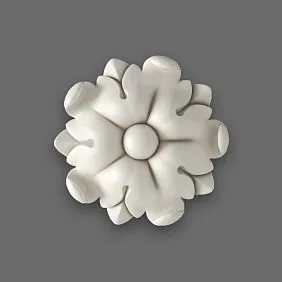

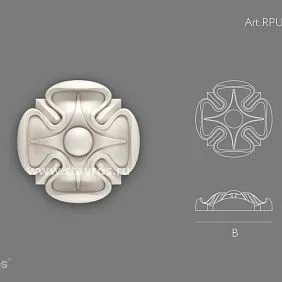


Visually enlarging the chandelier
A light fixture hanging on a bare ceiling is perceived as an isolated object, disconnected from the room's architecture. A rosette creates a visual base from which the chandelier 'grows.' Even a compact light fixture with a diameter of forty centimeters, framed by a rosette seventy centimeters in diameter, appears as a composition seventy centimeters in diameter—the visual mass increases, the fixture seems more significant. For small chandeliers (budget-friendly, simple designs), a rosette is a way to add status without changing the fixture itself.
Get Consultation
Creating a ceiling focal point
In most interiors, compositional centers are located at eye level—sofas, tables, paintings. The ceiling remains on the periphery of perception. A rosette with a chandelier creates a vertical axis that draws the eye upward. A large, ornamented rosette is an independent piece of decorative art, examined in detail. A lit chandelier illuminates the rosette's relief from below—creating a dramatic play of light and shadow, the ornament comes alive, and the three-dimensionality is enhanced.
Stylistic identification of the interior
An empty white ceiling is stylistically neutral—it communicates nothing about the room's style. A rosette instantly declares stylistic affiliation. A Baroque rosette with acanthus leaves and putti signifies a classic, luxurious, historical interior. An Art Deco rosette with geometric rays signifies the style of the twenties, elegance, modernity. A simple concentric rosette signifies neoclassicism, restraint, modern classicism.Polyurethane medallionsfunction as stylistic markers, instantly recognizable.
Dimensional Mathematics: The Ratio of Chandelier, Rosette, and Room
Choosing the rosette diameter is not an arbitrary decision. There are proportional rules linking the size of the light fixture, the rosette, the room's area, and the ceiling height.
Basic rule: rosette diameter to chandelier diameter
The classic ratio is a rosette diameter one and a half to two times larger than the chandelier diameter. A chandelier forty centimeters in diameter—a rosette sixty to eighty centimeters. A chandelier sixty centimeters—a rosette ninety to one hundred twenty. A chandelier eighty—a rosette one hundred twenty to one hundred sixty.
A smaller ratio (rosette only slightly larger than the chandelier) creates a cramped effect—the rosette seems like a backing, barely visible behind the fixture. A larger ratio (rosette three times larger than the chandelier) visually dominates—the chandelier gets lost against the massive rosette. Balance is achieved in the range of one and a half to two.
Adjustment by room area
The room's area affects the perception of the rosette size. In a small room (twelve to fifteen square meters), a large rosette (eighty to one hundred centimeters) visually weighs down, consumes space, creates a feeling of an overloaded ceiling. Compact rosettes forty to sixty centimeters are optimal—they create an accent without dominating.
In spacious rooms (thirty to fifty square meters), a small rosette (thirty to forty centimeters) gets lost—too small relative to the scale of the space. Large rosettes seventy to one hundred twenty centimeters are suitable—proportional to the volume, creating a significant accent.
In very large halls (sixty to one hundred square meters and more), monumental rosettes one hundred thirty to one hundred eighty centimeters are possible—or compositions of several rosettes (a large central one under the main chandelier, four smaller ones in the corners under spotlights).
Ceiling height as a selection factor
Standard ceilings (two meters forty to two meters seventy) require moderate rosettes—an excessively large rosette visually lowers the ceiling, creates heaviness. A range of forty to seventy centimeters is optimal.
High ceilings (three meters to three meters fifty) allow for large rosettes eighty to one hundred twenty centimeters—the scale corresponds to the height, the rosette is clearly readable from floor level.
Very high ceilings (four meters and above—historical buildings, mansions) require monumental rosettes one hundred thirty and larger—otherwise, the rosette looks like a tiny dot on a distant ceiling.
Size selection table
| Chandelier diameter | Socket diameter | Room area | Ceiling Height |
|---|---|---|---|
| 30-40 cm | 50-70 cm | 12-20 m² | 2.4–2.7 m |
| 40-50 cm | 60-80 cm | 18-25 m² | 2.5-2.8 m |
| 50-60 cm | 80-100 cm | 25-35 m² | 2.7-3.0 m |
| 60-80 cm | 100-130 cm | 35-50 m² | 3.0-3.5 m |
| 80-100 cm | 130-160 cm | 50-80 m² | 3.5-4.5 m |
Geometry of shapes: circle, oval, square, polygon
The socket is not necessarily round. The shape is determined by the interior style, room shape, and lighting fixture design.
Round sockets: classic versatility
The circle is the basic, most common socket shape. Radial symmetry suits most chandeliers (round, spherical, cascading with circular horn arrangement). Round sockets are universal — suitable for square, rectangular, and any rooms.
Ornaments of round sockets are organized concentrically — from the center to the edges. The center often contains a rosette (stylized flower), sun, or star. This is followed by circular bands of ornament — acanthus leaves, garlands, meanders, beads, pearl borders. The outer edge is framed by a molding, wreath, or rim.
Relief depth varies from three millimeters (neoclassical simple sockets) to five centimeters (baroque lavish). The deeper the relief, the more dramatic the play of light when the chandelier is on.
Oval sockets: elegant dynamics
The oval is an elongated shape that creates directionality. Oval sockets suit rectangular rooms — the long axis of the oval is oriented along the room's long axis, visually emphasizing the elongation.
Ornaments of oval sockets are also oriented — main elements (stylized leaves, garlands, ribbons) run along the long axis, while the short axis is decorated with compact motifs (rosettes, scrolls).
Oval sockets are common in Baroque, Rococo, and Empire styles — styles that favor dynamic forms. Dimensions: long axis fifty to one hundred eighty centimeters, short axis thirty to one hundred twenty.
Square and rectangular sockets: architectural geometry
Square rosettes are rare but a strong stylistic solution. Suitable for modern, Art Deco, and neoclassical interiors with a geometric inclination. The ornament is organized along the diagonals and sides of the square — corners are decorated with corner elements (palmette, scrolls, rosettes), sides — with linear motifs (meander, dentils, beads).
Square rosettes pair well with square or geometric chandeliers (lanterns, cubic lampshades, Art Deco light fixtures). Sizes range from forty to one hundred twenty centimeters per side.
Rectangular rosettes are used for elongated light fixtures — linear chandeliers, compositions of several pendants arranged in a row over a dining table.
Polygonal rosettes: complex symmetry
Hexagonal, octagonal rosettes — specific solutions for interiors with a pronounced geometric theme. The octagon — a classic shape in Moorish, Islamic decor, as well as in neoclassicism (octagonal ceiling coffers).
Ornaments of polygonal rosettes follow the symmetry of the shape — each sector repeats the ornament, creating a rhythmic structure. Such rosettes require an appropriate context — geometrically organized ceiling decor (coffers, molding panels, symmetrical compositions).
Stylistic ornaments: from antiquity to Art Nouveau
The rosette ornament — the key to stylistic identification. What does the relief convey?
Classicism: symmetry and stylized vegetation
Classicist rosettes are inspired by ancient models — Greek and Roman ceiling coffers. Ornaments: acanthus (stylized acanthus leaves), palmettes (fan-shaped leaves), meander (geometric broken pattern), egg-and-dart elements (ionics), pearl beading (a row of beads).
The composition is radially symmetrical — rays, wreaths, garlands radiate from the central rosette. Relief is moderate — five to fifteen millimeters. Diameters forty to eighty centimeters. Color is white, with possible light gilding of accents.
Baroque: opulence and dynamism
Baroque rosettes are maximally ornamented. Acanthus leaves are large, deeply carved, dynamically curved. Added are putti (winged infants), masks, garlands of flowers and fruits, scrolls (volutes), cartouches (decorative shields). Relief is deep — two to five centimeters. Diameters seventy to one hundred fifty centimeters.
The composition is dense — no empty areas, every centimeter is filled with ornament. Color is white with abundant gilding or entirely gold. Baroque rosettes require high ceilings (from three meters) and a corresponding interior — without Baroque furniture, fabrics, and overall luxury, the rosette looks alien.
Rococo: Elegance and Asymmetry
Rococo softens Baroque opulence, adding playfulness. Ornaments are lighter, finer — delicate plant tendrils, small flowers, shells (rocaille — stylized seashells that gave the style its name), ribbons, bows. Asymmetry is fundamental — left and right parts of the ornament differ, creating liveliness.
Relief is shallow — three to eight millimeters, creating a lace-like effect. Diameters fifty to ninety centimeters. Color is delicate — white, cream, with muted gilding or patination.
Empire: monumentality and military symbolism
Empire rosettes are strict, symmetrical, monumental. Ornaments: laurel wreaths, oak leaves, swords, shields, eagles, bees (Napoleon's symbol), stars, rays. Composition is radially symmetrical, geometrically precise. Relief is pronounced but not opulent — one to two centimeters, forms are rigid, clear.
Diameters sixty to one hundred twenty centimeters. Color is solemn — white with gold, or in rich colors (green, blue, burgundy) with gilding.
Art Nouveau (Art Nouveau): plant-based organic forms
Art Nouveau of the late nineteenth — early twentieth century created its own ornamental language. Smooth flowing lines, stylized plants (irises, lilies, poppies), asymmetry, rejection of geometric strictness. Art Nouveau rosettes have a complex contour — not a circle, but an organic shape resembling a flower, whirlpool, cloud.
Ornament — intertwining stems, petals, female profiles with flowing hair (a characteristic Art Nouveau motif). Relief is medium — one to two centimeters. Diameters fifty to ninety centimeters. Color can be polychrome — green leaves, beige petals, golden accents.
Art Deco: geometry and luxury
Art Deco of the 1920s-1930s combined geometry with luxury. Art Deco rosettes are geometric — concentric circles, radial rays, zigzags, stepped forms, stylized sun disks. Ornament is clear, graphic, symmetrical.
Relief is medium — five to fifteen millimeters, forms are rigid, angles sharp. Diameters sixty to one hundred centimeters. Color is contrasting — black with gold, white with silver, metallic paints possible (bronze, copper).
Neoclassicism: Reserved Elegance
Modern neoclassicism simplifies classical forms. Neoclassical rosettes have simple concentric bands — circles, ridges, simple leaves without detailed elaboration. Relief is minimal — three to seven millimeters. Diameters forty to seventy centimeters.
Color is monochrome — white on a white ceiling, gray on gray, only highlighted by the light shadow of the relief. Neoclassical rosettes suit modern apartments with moderate ceiling heights — creating a classical reference without historical heaviness.
Installation on a stretch ceiling: technical nuances
Stretch ceilings — a popular solution (quick installation, perfectly smooth surface, variety of colors and textures). But installingdecorative rosettes on a ceilingwith a stretch fabric requires special technology.
Preparing the mounting platform
A ceiling medallion cannot be attached directly to the stretch fabric — the fabric or PVC film cannot support the weight, will sag, and deform. A rigid base is required — a mounting platform installed on the base ceiling before stretching the fabric.
The mounting platform is a plywood or plastic disc with a diameter equal to or slightly smaller than the diameter of the medallion. The platform's thickness is selected so that after stretching the fabric, the platform is flush with the plane of the stretch ceiling (usually five to ten millimeters thick with a standard gap between the stretch ceiling and the base ceiling).
The platform is attached to the base ceiling at the location of the chandelier (where the wiring is routed). Fastening is done with dowels or adjustable-height hangers for precise leveling. A hole is made in the center of the platform for routing wires and attaching the chandelier.
Stretching the fabric with a hole
After installing the mounting platform, the fabric is stretched. A hole is made in the fabric at the location of the platform — carefully, using a thermal ring (a plastic ring glued to the fabric before cutting, preventing the material from fraying). The hole diameter is five to ten centimeters — sufficient for routing wires and mounting the chandelier, but smaller than the diameter of the medallion (the medallion will cover the hole).
Mounting the medallion
The medallion is glued to the stretch fabric using a special adhesive for stretch ceilings (non-aggressive to PVC or fabric). The adhesive is applied along the perimeter of the back side of the medallion with a thin roller (not as a continuous layer — excess adhesive will squeeze out and stain the fabric). The medallion is placed against the ceiling, centered relative to the hole, and pressed for a minute.
Important: the medallion is glued to the stretch fabric, not to the mounting platform (the platform is inside the hole, the medallion is outside, on the fabric around the hole). The weight of the medallion is low (from one hundred grams to one and a half kilograms depending on size), the stretch fabric holds it without sagging.
Mounting the chandelier
After gluing the medallion and allowing the adhesive to set (twelve to twenty-four hours), the chandelier is mounted. Wires are routed through the hole, and the chandelier is attached to the mounting platform (a hook, mounting plate, or crossbar is screwed into the plywood platform through the fabric). The decorative bowl of the chandelier covers the hole and the edge of the medallion in the center.
Wiring and electrical installation: safety and aesthetics
The medallion affects the method of mounting the chandelier, wiring, and ensuring electrical safety.
Concealing wires
A large-diameter medallion covers a significant area of the ceiling — allowing wires to be routed not strictly to the center but with a slight offset, which is convenient for non-standard chandelier placement or relocating a light fixture without chasing the ceiling. Wires are laid in a corrugated conduit on the surface of the base ceiling and routed out in the area of the medallion — the medallion conceals the conduit.
Mounting the fixture
For heavy chandeliers (wrought iron, crystal, multi-arm chandeliers weighing from ten to thirty kilograms), reinforced mounting is required — an anchor hook embedded in the ceiling slab. The medallion covers the area around the hook, masking installation marks (concrete chips, holes, unevenness).
Centering the chandelier
A large medallion establishes a visual center for the ceiling. Even if the chandelier is offset relative to the geometric center of the room (due to beam placement, wiring specifics, or other reasons), the medallion creates a sense of intentional composition — the eye perceives the center of the medallion as the correct place for the light fixture.
Painting and decorating: from monochrome to gold
polyurethane rosettesare supplied primed white — ready for painting. The choice of color and decorating technique determines the final effect.
Monochrome painting to match the ceiling color
A classic approach — the medallion is painted the same color as the ceiling. A white medallion on a white ceiling stands out only by its relief — under natural and artificial lighting, the relief casts shadows, and the pattern is read by volume, not color. The effect is restrained, elegant, not flashy.
Technique: the ceiling and medallion are painted with the same paint — matte or satin acrylic. Two to three thin coats with intermediate drying of four to six hours ensure even coverage. Use a roller for smooth areas and a brush for the relief.
Contrast painting
A modern designer technique — the medallion is painted in contrast to the ceiling. A white medallion on a dark ceiling (graphite, black, dark blue) stands out brightly, attracting maximum attention. A dark medallion on a light ceiling creates a graphic accent.
Colored options are possible: a golden medallion on a white ceiling (hinting at classic gilding without literal gold), a silver one on gray, a pastel one (blue, pink, mint) on white in Provence or shabby chic interiors.
Technique: first, paint the ceiling, protect the medallion with painter's tape (if already installed) or paint it separately before installation. Then paint the medallion in the chosen color — two to three coats with a brush and roller.
Gilding and patination
For historical stylizations, luxurious interiors, gilding is used — coating the raised elements of the relief with gold paint, imitation gold leaf (imitation of gold leaf), or gold wax.
Technique: the medallion is painted with a base color (white, cream, gray). After drying, gold paint is applied with a fine brush to the raised parts of the pattern (edges of leaves, tops of curls, beads) — creating a partial gilding effect, like on antique plasterwork. The gold can be yellow (warm, classic), greenish (antique), or reddish (red gold).
Patination — artificial aging. The base layer is light (white, cream), and a dark patina (brown, gray, greenish) is applied over it — not as a solid layer, but by rubbing into the recesses of the relief with a damp sponge. The recesses darken (imitating centuries of dirt, soot), while the raised areas remain light — creating the effect of antique plasterwork that has endured centuries.
Multicolor decorating
A rare but impressive technique is painting a rosette in multiple colors. Suitable for Modern, Art Nouveau, and eclectic styles. Leaves are painted green, flowers in natural colors (pink, yellow), and the background in cream or gold. Requires artistic skill or hiring a decorator.
Frequently asked questions
Is a rosette required for every chandelier?
No, a rosette is a decorative element, not functionally mandatory. In minimalist, modern, and loft interiors, chandeliers are often mounted without rosettes—bare ceiling, a pendant light on a cord or rod. A rosette is necessary for classical, neoclassical, and historical styles, where it is part of the decorative system. A rosette is also useful for masking ceiling defects around the chandelier mounting point.
Can a rosette be installed off-center on the ceiling?
Yes, the rosette is installed where the chandelier hangs. If the chandelier is offset from the center (over a dining table against a wall, over a lounge area in a studio, over a bed in a bedroom), the rosette is mounted in the same location. Asymmetrical placement of the rosette is a deliberate design decision that creates dynamism and zoning.
How much does a polyurethane ceiling medallion cost?
Prices depend on diameter and ornament complexity. Simple rosettes thirty to forty centimeters in diameter with minimal relief—from five hundred to one thousand rubles. Medium rosettes fifty to seventy centimeters with classical ornamentation—one thousand two hundred to two thousand five hundred. Large rosettes eighty to one hundred twenty centimeters with rich relief—three to six thousand. Monumental rosettes one hundred thirty to one hundred eighty centimeters with complex Baroque decor—seven to fifteen thousand.
How to care for a rosette?
A painted rosette does not require special care. Dust is removed with a dry soft brush or a vacuum cleaner with a soft brush attachment every three to six months. Deep relief is cleaned with a brush that reaches into the recesses of the ornament. Cobwebs (common in the recesses of rosettes on high ceilings) are removed with a damp cloth on a mop. The painted surface can withstand wet cleaning (after the paint has completely dried—one week after painting).
Can a rosette be used without a chandelier, as standalone decor?
Yes, a rosette can be a purely decorative element. Installed on the ceiling without a light fixture—it creates a compositional center, adorns an empty ceiling. Relevant for interiors with cornice lighting (no central chandelier, perimeter lighting behind cornices)—a rosette in the center compensates for the absence of a light fixture, fills the void. Also, several rosettes can form a composition—four rosettes in the corners of the ceiling, one in the center, creating rhythm and symmetry.
What glue should be used for installing an outlet?
On a standard ceiling (concrete, plaster, drywall, painted surface)—polyurethane glue for molding or liquid nails for plastics and polyurethane. On a stretch ceiling—special glue for stretch ceilings (non-aggressive to PVC or fabric), e.g., Cosmofen glue, Moment for stretch ceilings. Consumption: a 300 ml tube for one to two rosettes fifty to eighty centimeters in diameter.
Is additional fastening with screws necessary for the rosette?
For rosettes up to eighty centimeters in diameter, glue is sufficient—weight is small (three hundred to eight hundred grams), glue holds reliably. For large rosettes (one hundred to one hundred eighty centimeters, weight one to two and a half kilograms), additional fixation with screws through the rosette into the ceiling is recommended (four to eight screws around the perimeter). Screws are countersunk, heads are filled with putty, invisible after painting.
Conclusion: Ceiling as a Canvas
ceiling rosettes under chandelierstransform the technical zone of light fixture mounting into a decorative dominant, organizing the perception of the entire space through the ceiling plane. From compact neoclassical medallions creating a restrained accent in modern apartments to monumental Baroque compositions dominating formal halls—the range of solutions corresponds to any stylistic tasks, room scales, budgets.Polyurethane medallionsrevive the forgotten tradition of ceiling decor, when the fifth wall of a room was no less important than the four vertical ones.
Dimensional selection, based on the proportions of the chandelier, room area, ceiling height, ensures harmony—the rosette does not get lost or overwhelm, but creates visual balance. Variety of shapes—round, oval, square, polygonal—allows coordinating the rosette with the room's geometry and the light fixture's design. Stylistic classification of ornaments provides the ability to precisely express the stylistic identity of the interior—from strict Classicism to playful Rococo, from monumental Empire to geometric Art Deco.
Mounting technology for stretch ceilings expands applicability—rosettes are compatible with the most popular type of ceiling coverings when following the rules for installing mounting platforms and using suitable adhesives. Decoration options—from monochrome painting to gilding and patination—adapt rosettes to specific tasks: restrained elegance or historical luxury, modern graphics or antique stylization.
Company STAVROS produces a full range of ceiling rosettes made of high-density polyurethane (180-240 kg/m³). The catalog includes over two hundred fifty models—from minimalist twenty centimeters in diameter to monumental one hundred eighty. Shapes: round (one hundred eighty models), oval (forty models), square (fifteen models), polygonal (ten models). Stylistic coverage from antiquity to modernism—each historical era is represented by authentic ornaments recreated from archival samples of museum collections.
STAVROS production technology—free pouring of polyurethane into silicone molds made from handcrafted master models. Each acanthus leaf petal, each fluting groove, each volute curl is reproduced with precision to fractions of a millimeter. Relief depth from three millimeters (neoclassical rosettes) to five centimeters (Baroque) ensures expressive play of light and shadow when the chandelier is on—the ornament comes alive, creating a dynamic composition on the static ceiling surface.
The surface of rosettes is primed with white acrylic primer—ready for final painting with any interior paints without additional preparation. The primer ensures excellent paint adhesion, uniform absorption, and absence of stains. The whiteness of the primer allows leaving the rosette unpainted (if the ceiling is white), saving on materials and labor.
Special series of rosettes for stretch ceilings—lightweight models weighing twenty to thirty percent less than standard while maintaining size and ornament detail. Achieved by optimizing wall thickness, using lower-density polyurethane (160-180 kg/m³). Lightweight rosettes reliably adhere to the stretch fabric with glue without additional fasteners.
STAVROS rosette collections are organized by style. "Classic" collection—eighty models of Classicism, Neoclassicism, and antique motifs. "Baroque" collection—fifty models of lavish seventeenth-eighteenth century rosettes. "Empire" collection—thirty models of monumental Napoleonic era rosettes. "Modern" collection—twenty-five models with organic forms from the turn of the nineteenth-twentieth centuries. "Art Deco" collection—twenty models of geometric rosettes from the 1920s-1930s. "Contemporary" collection—thirty models of simplified modern rosettes.
Custom design—a service of the STAVROS design studio for unique interiors. A rosette is created based on the client's sketch, photograph of a historical sample, or description of the desired ornament. A 3D model is developed, a master model is made, a silicone mold is cast, and a production run is made (from one piece). Timeline—four to eight weeks from sketch approval to receiving the finished rosette.
Professional rosette installation services are available in Moscow, St. Petersburg, and major cities. STAVROS crews specialize in installing ceiling decor—master techniques for mounting on various ceiling types (concrete, drywall, stretch), ensuring perfect centering, high-quality joint sealing, and professional painting. Two-year warranty on installation.
Educational materials for self-installation are published on the STAVROS website and YouTube channel. Video instructions show all stages—ceiling preparation, center marking, glue application, rosette installation, gap sealing, painting and decoration techniques. Text guides detail nuances of working with stretch ceilings, mounting heavy rosettes, gilding and patination.
Choosing STAVROS, you get museum-quality rosettes at affordable prices, professional expertise in selecting sizes and styles, support at all stages from model selection to final painting. The ceiling ceases to be a forgotten plane, becoming a canvas for decorative art, where each rosette is not just a chandelier surround, but an architectural work transforming the space into a place where beauty is present on all levels—from floor to ceiling. From minimalist accents to Baroque masterpieces—STAVROS gives ceilings a voice that resonates in harmony with the rest of the interior.


