








































Article Contents:
- Why a Wood Slat Ceiling Works Differently Than a Wall
- Structural Systems of Ceiling Slat Panels
- Open Slat System with Gaps
- Closed Slat System on Underlayment
- Partial Slat Ceiling (Island)
- Slat Ceiling with Diagonal Pattern
- Materials for Ceiling Slat Panels
- Oak for Ceiling Slat Panels
- Ash: light ceiling option
- Pine: natural scent overhead
- Thermowood for wet ceilings
- Ceiling slat panels in different rooms: specific design scenarios
- Living room: slat ceiling above the sofa
- Bedroom: full oak slat ceiling
- Kitchen-dining room: slat ceiling above the dining table
- Bathroom: thermowood and gray stone
- Restaurant: open slat system with black space
- Home theater: acoustics and atmosphere
- Ceiling Panel Lighting: Integration, Not Compromise
- Recessed Lights in Gaps
- LED Strip in Horizontal Channels of the Substrate
- Spotlights in Technical Space
- Pendant Lights Through the Panel Ceiling
- Ceiling Panel Parameters: How to Choose Correctly
- Panel Orientation Relative to Room Length
- Panel Width for Ceiling
- Panel Thickness for Ceiling Mounting
- Ceiling Panel Installation: Professional-Level Technology
- Stage 1: Design and Layout
- Stage 2: Frame Installation
- Stage 3: Slat Acclimatization
- Stage 4: Mounting Slats on Frame
- Stage 5: Lighting Element Installation
- Stage 6: Perimeter Completion
- Ceiling Slat Panels and Natural Interior System
- Ceiling Slat Panel Care: Practical Tips
- Frequently Asked Questions
- Can a Slat Ceiling Be Installed in an Apartment with a 2.5 m Ceiling?
- What Is the Spacing for Attaching Slats to the Ceiling Frame?
- Is it possible to replace individual slats on the ceiling after installation?
- How to join a slatted ceiling and a slatted wall in a corner?
- Can a slatted ceiling be installed in a bathroom?
- How to calculate the order volume for a slatted ceiling?
- Slatted ceiling in the living room: full or island?
- Conclusion
The ceiling is the only surface in a room that a person sees every day but almost never notices. White, smooth, neutral — this is the standard scenario for most Russian apartments and offices. The ceiling is perceived as a technical plane, not as a design opportunity.
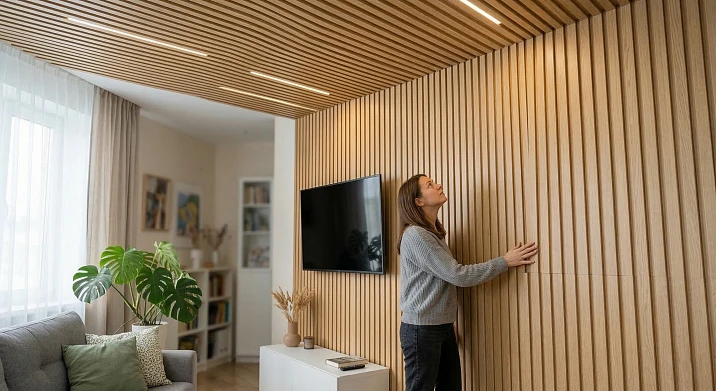
Wooden slatted ceiling panels radically change this scenario. They transform the ceiling into an architectural element — living, warm, acoustically active, visually rich. Enter a room with a wooden slatted ceiling — and the first thing you'll feel: the space 'covers' you with natural material. It's a completely different sensation of being inside.
Slatted ceiling panels are one of the most technically complex, yet most impressive tools in modern interior design. This article is a complete, detailed, professional guide on the topic: from physics to aesthetics, from installation nuances to specific design scenarios.





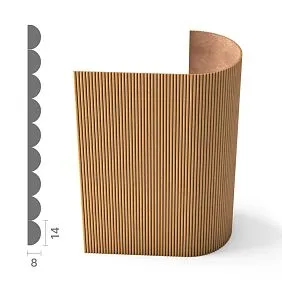
Why a ceiling with wooden slats works differently than a wall
The difference between a slatted wall and a slatted ceiling is fundamental. Not only structurally, but also psychologically, visually, acoustically.
A wall is a vertical surface. A person looks at it directly. It is perceived as a boundary of space, its frame. A ceiling is a horizontal surface overhead. It is perceived as the 'sky' inside a room. Psychologically, the ceiling is 'shelter,' 'roof' in the most literal sense. That which covers from above creates a feeling of security or, conversely, pressure—depending on the material and height.
A plain white ceiling is neutral. It does not press down, but it does not 'shelter' either—it simply disappears from perception. A wooden slatted ceiling is active. It 'shelters' with natural material, warm tone, and the living pattern of the grain. Being under a wooden ceiling is physiologically closer to being under tree canopies—and this is an evolutionarily 'correct' image of security and tranquility.
Acoustically: the horizontal surface overhead is the main source of sound reflection in a room. A flat white ceiling reflects sound vertically downward—creating boominess, increasing reverberation.Ceiling batten panelsscatter sound in different directions through the relief of the slats and gaps—reverberation decreases, the space sounds softer. In restaurants, meeting rooms, home theaters—this is a practically tangible result.
Lighting effect: slats on the ceiling interact with overhead lighting fundamentally differently than a white surface. Instead of uniform reflection—a relief pattern of shadows that changes depending on the light source's position.


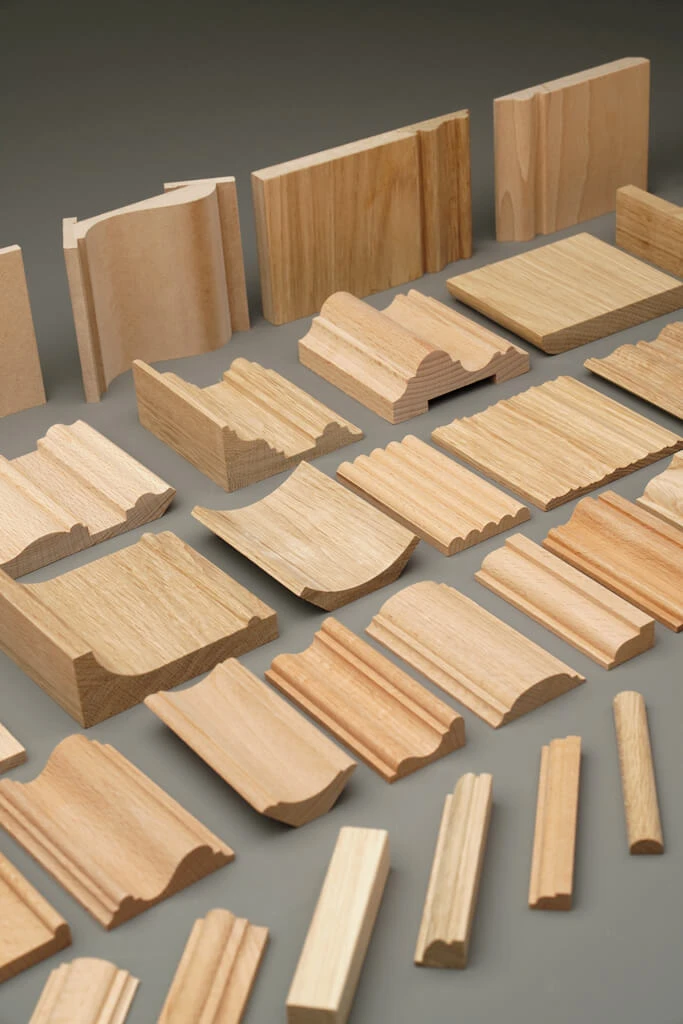
Structural systems for ceiling slatted panels
Before choosing the material and finish—you need to understand the structural logic of a ceiling slatted system. This is not the same as mounting slats on a wall.
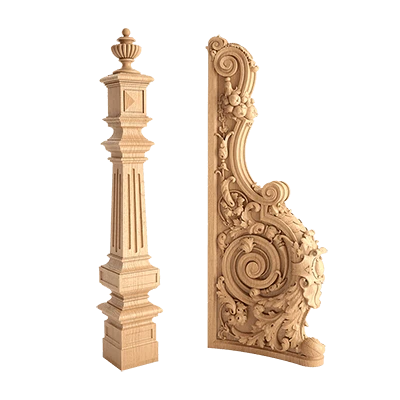
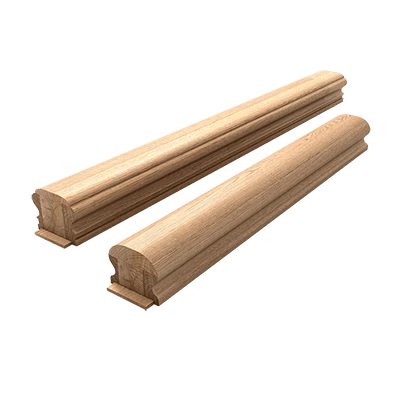
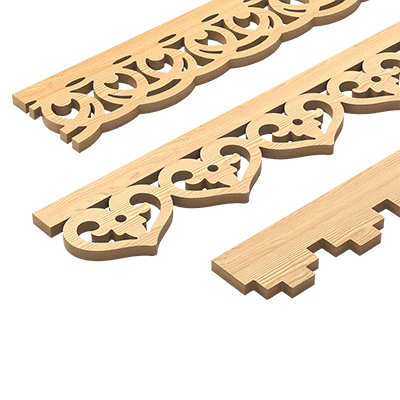
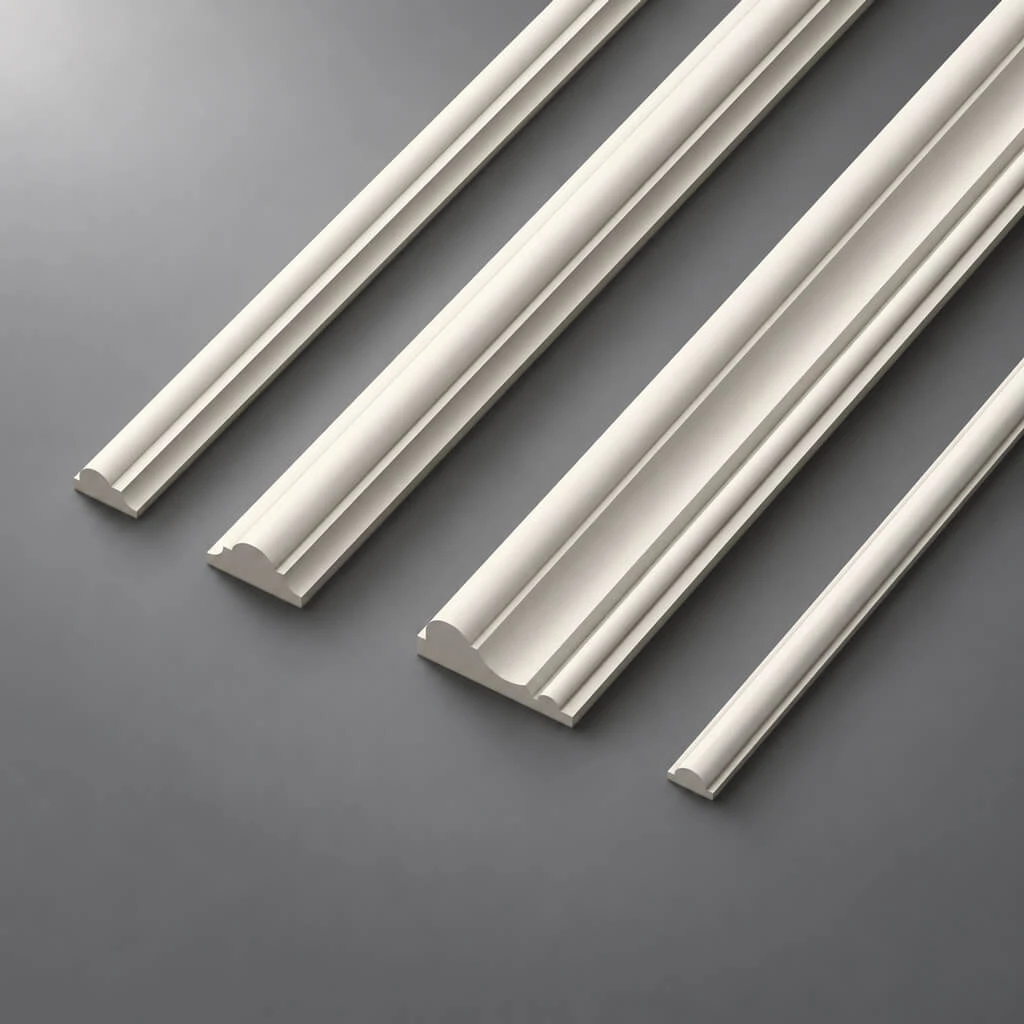
Our factory also produces:


Open slatted system with gaps
Slats are mounted crosswise or lengthwise on a metal or wooden frame (suspended structure), lowering the ceiling by 100–200 mm from the slab. Between the slats—open gaps through which the space above is visible (the slab or technical gap). In the technical gap—utilities, wiring, ventilation ducts. The gaps conceal the technical 'innards' behind the slatted plane.
This is the most common system for ceiling slatted panels. It allows:
-
Hide all utilities in the technical space behind battens
-
Integrate spot or track lighting
-
Place acoustic mineral wool in the technical space for sound insulation
-
Create a ventilation channel between battens and ceiling slab
Space behind battens in an open system is black (painted matte black). Against the dark background of the dark technical space, wooden battens 'float' in the air, creating the image of a three-dimensional wooden lattice, behind which lies infinite dark depth.
Get Consultation
Closed batten system on a substrate
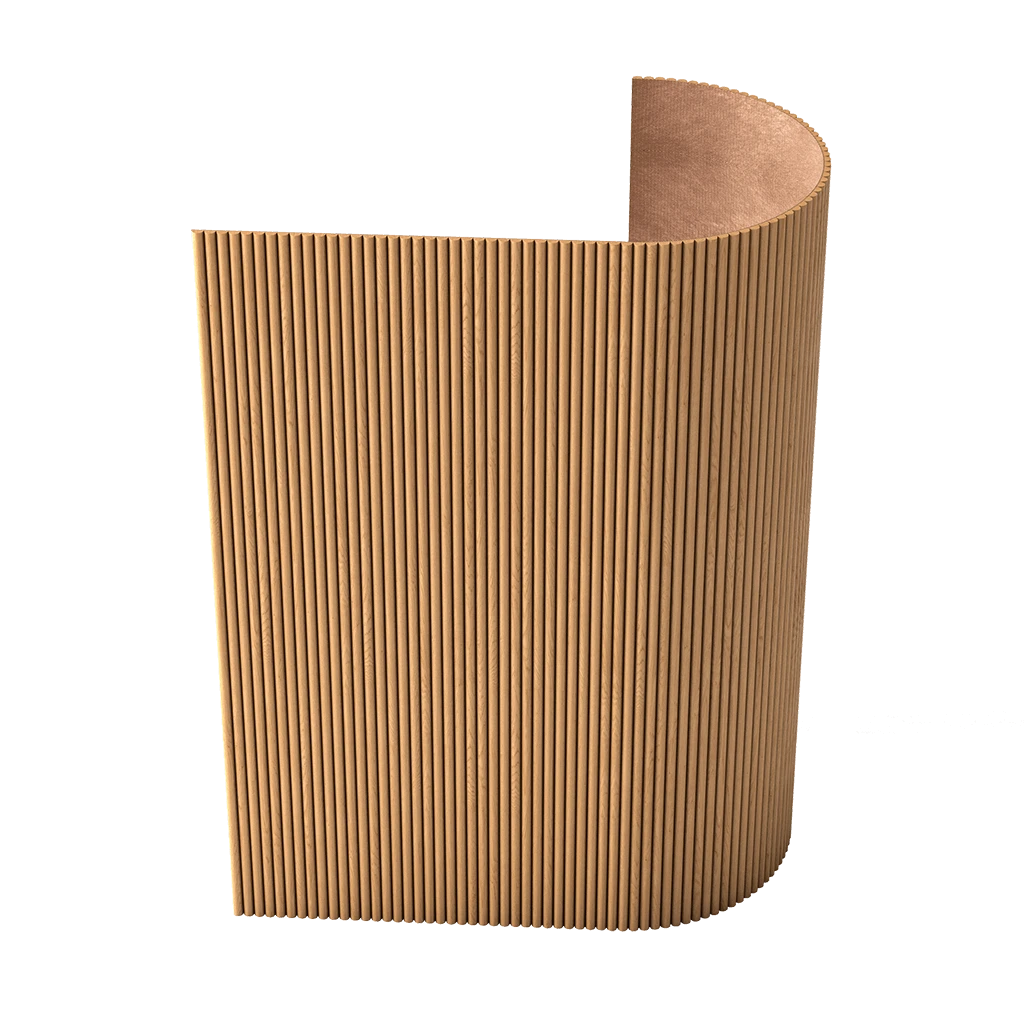
Battens are mounted on a rigid substrate of MDF or plywood, which is attached directly to the ceiling or to a lightweight frame. Gaps between battens are covered by the substrate, its surface is visible (dark felt, painted MDF).
This system is easier to install, does not require significant ceiling lowering (10–15 mm for substrate and batten thickness). Ideal for living spaces with limited height where lowering the ceiling by 150–200 mm is unacceptable. Utilities in this case are in the walls or in a minimal technical gap.
Ceiling batten panelson a substrate with built-in LED lighting between battens creates the same 'night' lighting effect as batten walls: warm glowing strips on a wooden ceiling. This is one of the most atmospheric ceiling solutions for bedrooms and living rooms.
Partial batten ceiling (island)
Slatted panels are not installed across the entire ceiling area, but on a separate 'island' — a section of the ceiling above a functional zone. Above the dining area, above the sofa, above the bed, above the bar counter. The rest of the ceiling is standard white or painted.
This is the most accessible form of ceiling slatted panels in terms of volume and cost — and yet one of the most impressive. A wooden 'island' above a specific zone is an architectural 'covering' that creates intimacy and coziness precisely where they are needed. A dining island with a wooden slatted ceiling and pendant lights is an image found in the best restaurants and replicated in home interiors.
Slatted ceiling with a diagonal pattern
Non-standard solution: slats are mounted not parallel to the walls, but at a 30–45° angle. A diagonal slatted pattern on the ceiling is a dynamic, non-standard look. It is especially expressive in square rooms, where parallel slats do not provide a direction for the gaze, while the diagonal creates movement.
Technically: diagonal slats require more careful marking and a greater number of perimeter cuts — accordingly, more waste (20–25% reserve instead of the standard 12–15%).
Materials for ceiling slatted panels
The choice of material for ceiling slatted panels has a specific logic — unlike wall panels, ceiling slats must meet requirements for weight and strength during horizontal installation.
Oak for ceiling slatted panels
Oak is the optimal material for ceiling slatted panels in residential and commercial spaces. A density of 700–750 kg/m³ ensures the rigidity of the slat during horizontal installation: a 3 m long oak slat does not sag with the correct fastening pitch.
The natural grain of oak on the ceiling is a special look. The slats are positioned horizontally overhead, and the medullary rays in a radial cut create a shimmering pattern that is visible precisely when looking from below upwards. The warm tone of oak 'warms up' the ceiling — the space beneath it feels warmer and cozier.
Toning for ceiling oak in residential interiors: natural (clear oil), cognac, tobacco. For commercial spaces — walnut, anthracite. Dark toning on the ceiling requires sufficient lighting: a dark ceiling without good light feels 'oppressive'.
Ash: a light ceiling option
Ash is lighter than oak. For rooms with low ceiling height (2.5–2.7 m), light ash with whitewashed oil is the optimal choice: whitewashed slats do not visually 'lower' the ceiling, and the natural grain of ash, when viewed from below, appears delicate and soft.
For Scandinavian and Nordic interiors — whitewashed ash on the ceiling + white walls + light floor = a maximally 'airy' Nordic look.
Pine: natural aroma overhead
Pine slats on the ceiling are aromatherapy in the literal sense. Pine contains natural phytoncides, and when the air heats up (which rises to the ceiling) — the phytoncides evaporate more actively. A pine ceiling 'forest' creates a delicate coniferous scent in the space.
For saunas, spas, relaxation rooms, eco-bedrooms — pine on the ceiling is a choice that cannot be replicated by any air freshener. The natural scent of pine from above is one of the most powerful natural calming agents.
Technically: pine is softer than oak (density 500–550 kg/m³), so the fastening spacing on the ceiling should be smaller — 400–500 mm instead of 600 mm for oak.
Thermowood for humid ceilings
In rooms with high humidity (bathrooms, spas, swimming pools) — thermowood: wood that has undergone thermal treatment at high temperature. Thermal treatment removes sugars from the wood, which are a breeding ground for fungi and mold. Thermowood practically does not absorb moisture — an ideal material for humid ceiling spaces.
Visually: Thermowood has a characteristic dark brown, chocolate tone without tinting — this is the result of the thermal treatment itself, not a dye. The natural grain is preserved, but the color is richly dark. For spa spaces — it creates an image of luxury and naturalness simultaneously.
Ceiling slat panels in different rooms: specific design scenarios
Theory without practice is a waste of time. Let's move on to specific scenarios, described with visual precision.
Living room: slatted ceiling above the sofa
Open-plan kitchen-living room, 35 sq. m. Ceiling 2.85 m — sufficient for an 'island' solution. Above the sofa — an 'island' of horizontal oak slat panels (tint 'anthracite'), 3.0 × 1.8 m, lowered 150 mm from the main ceiling on a metal frame. Slat spacing — 40 mm slat / 20 mm gap.
In the technical space behind the slats — LED strip 2700 K directed downward through the gaps. Three pendant lights on a long cable pass through the gaps of the slatted island — their wires are hidden in the technical space.
What does the eye see from the sofa? A dark wooden 'canopy' overhead with three lights on long cables. The slats, viewed from below at an angle — recede in perspective, creating depth. Warm light from below through the gaps — a soft glow above the sofa area.
This is one of the most expressive images for an open living room: a wooden 'island' above the sofa creates a 'room within a room' — a psychologically separate, intimate, protected space for relaxation.
Bedroom: full slatted oak ceiling
Bedroom 18 sq. m, ceiling 2.7 m. Closed slat system: oak slats in 'natural' tint, width 35 mm, gap 18 mm, backing — black felt. Mounted on a lightweight frame — ceiling lowered 20 mm.
Built-in 2700K LED strip in horizontal substrate channels — light from bottom to top (through the slat gaps creates a reverse effect: light 'emerges' from the gaps downward into the room). Dimmer for full blackout.
What does a lying person see? The entire ceiling — warm wooden slats with the lively natural grain of oak. The natural grain, when looking directly upward — is maximally 'readable' and perceived as a natural surface — sky through trees. In the evening with the built-in lighting on — warm glowing stripes on the ceiling. This is the last thing a falling-asleep person sees. And it is — natural, warm, calming.
Ceiling slatted panels made of oakIn the bedroom with built-in lighting — this is an investment in sleep quality, expressed in a specific architectural solution.
Kitchen-dining room: slatted ceiling above the dining table
Dining area in an open kitchen-living room. Above the dining table — an 'island' of oak slatted panels in 'cognac' tint, 2.4 × 1.2 m. Through the gaps between the slats — three pendant lampshades above the table. The slats in this system create a horizontal 'frame' for the pendant lights, uniting them into a single ceiling structure.
What does a person sitting at the table see? An amber wooden 'canopy' above the dining table. The warm light from the lampshades below 'heats up' the wooden slats to a golden glow. The image — 'a table set under a tree'. This is an archetypally cozy dining image — precisely the mood needed for a pleasant dinner.
Bathroom: thermowood and gray stone
SPA bathroom 12 sq. m with a ceiling height of 2.6 m. Full slatted ceiling made of thermowood — horizontal slats 40 mm wide, 20 mm gap. Thermowood tone — chocolate-dark. Walls — large gray travertine. Floor — dark slate.
Built-in spotlights in the technical space behind the slats — light passes through the gaps downward in soft stripes.
What does the view from the bathtub see? A dark natural wooden 'forest' overhead. Soft, warm stripes of light through the gaps. Steam mist from the hot bath rises to the dark wooden slats — an image of a sauna, spa, natural shelter. This is a space where you want to stay for hours.
Restaurant: open slat system with black space
Restaurant with 80 seats, ceiling height 3.5 m. Open slat system: oak slats 50 mm wide, 30 mm gap, mounted on a metal frame with a 200 mm drop. Behind the slats — all space up to the slab is painted matte black. Track spotlights in the technical space are directed downward through the gaps.
What does a restaurant visitor see? Warm oak slats suspended above the hall — a feeling that a wooden 'forest' is looming over the space. Stripes of directional light from behind the slats fall on the tables — dramatic, theatrical lighting. Brick walls + wooden slatted ceiling + black metal = the St. Petersburg restaurant image in its highest expression.
Home theater: acoustics and atmosphere
Home theater 22 sq. m. Full slatted ceiling made of oak (anthracite), width 45 mm, gap 25 mm. In the technical space behind the slats — acoustic mineral wool 50 mm thick. Built-in LED strip with RGB control.
Functionally: wooden slats diffuse sound, mineral wool absorbs — in combination this reduces reverberation to a minimum. The space sounds like a professional recording studio.
Atmospherically: RGB backlighting behind the slats changes color depending on the scene on the screen. Dark oak ceiling with blue lighting — space. With red — tension. With green — nature. The ceiling becomes part of the cinematic experience.
Lighting for ceiling slat panels: integration, not compromise
Lighting is the most technically complex aspect of ceiling slat panels. Unlike wall panels, where light comes from outside and 'washes' the surface, ceiling slats integrate lighting inside the structure.
Spotlights in gaps
Recessed spotlights (7–10 W, narrow beam angle 24–36°) are mounted directly into the gaps between the slats. They look like glowing strips or individual 'stars' in the wooden ceiling.
Technically: the decorative frame of the fixture must have a width less than or equal to the gap width (usually 15–20 mm). Power supply is through the technical space behind the slats. The spacing of the fixtures is determined by lighting calculation.
LED strip in horizontal channels of the substrate
In a closed system (slats on a substrate) — the LED strip is mounted in the grooves of the substrate between the slats. Light passes through the gaps down into the room — uniform glowing strips across the entire ceiling.
Color temperature: 2700 K for living spaces, 3000–3500 K for kitchens and work areas. A dimmer is mandatory.
Spotlights in the technical space
In an open system (slats on a suspended frame) — spotlights in the technical space behind the slats are directed downward through the gaps. This allows the spotlight itself to be completely hidden — only light passes through the gap into the room, not the fixture itself.
This creates a 'source-less light' effect — strips of light that appear to have no source. One of the most impressive lighting solutions for restaurants and lobbies.
Pendant lights through a slatted ceiling
With an open slat system, pendant lights are mounted in the technical space, and their rods/cables pass through the gaps between the slats. The decorative part of the light fixture is below the slatted ceiling. Wires and fasteners are concealed.
This is the most 'honest' architectural approach: the light fixture is visible below the slatted ceiling, its wire disappears upward into the gap. A wooden slatted ceiling + pendant lights 'through' it is one of the most memorable ceiling images.
Parameters of ceiling slat panels: how to choose correctly
Orientation of slats relative to the length of the room
This is a fundamental question that is rarely discussed — but greatly affects the visual result.
Slats along the long wall of the room: create a sense of 'endless' movement. The gaze follows along the slats and 'goes' to the far wall. The room appears longer.
Slats across the short side of the room (perpendicular to movement through the room): the gaze 'crosses' the slats when moving. The room appears wider.
For long corridors: slats across — visually 'widen' the corridor. Slats along the corridor — enhance the tunnel effect.
For square rooms: the choice of slat orientation creates direction — in a neutral square space, this is a way to set the 'main axis'.
Slat width for the ceiling
| Ceiling Height | Recommended slat width | Visual effect |
|---|---|---|
| 2.4–2.5 m | 20–30 mm | Delicate, does not 'press down' |
| 2.6–2.8 m | 30–45 mm | Balanced |
| 2.9–3.2 m | 45–60 mm | Expressive |
| 3.3 m and above | 60–80 mm | Monumental |
Rule: the lower the ceiling, the narrower the slats should be. Wide slats on a low ceiling visually 'lower' it even further.
Slat thickness for ceiling mounting
For ceiling mounting, the slat must be stiffer than for wall mounting—it bears the load of its own weight in a horizontal position. Minimum thickness:
-
Oak, ash, birch: 15 mm with a fastening pitch of 500 mm, 18–20 mm with a pitch of 600 mm
-
Pine: 18 mm with a fastening pitch of 400–450 mm
-
MDF: 18–22 mm (a more flexible material, requires greater thickness)
Installation of ceiling slat panels: professional-level technology
Installation of ceiling slat panels is significantly more difficult than wall installation. This is work in an uncomfortable position (overhead), with increased requirements for horizontal accuracy and pitch.
Stage 1: Design and Layout
Before installation — a project on paper or in software. Determine:
-
System type (open/closed/island)
-
Batten orientation
-
Fastening pitch to frame
-
Lighting element placement
-
Vent grille placement (if present)
-
Smoke detector placement (fire safety requirements)
Ceiling marking: frame lines and suspension points — strictly level. Horizontal deviation on a 15 sq m batten ceiling — no more than 2 mm.
Stage 2: Frame Installation
For an open system: a metal frame made of CD60 profile on adjustable hangers - allows setting the horizontal level with an accuracy of 1-2 mm. Spacing of the frame's load-bearing profiles: 500-600 mm (perpendicular to the slats). Frame profiles are leveled with a level to achieve perfect horizontality.
For a closed system on a substrate: a 9-12 mm plywood substrate is attached to the ceiling with mushroom dowels after preliminary marking and leveling.
Stage 3: Acclimatization of slats
Wooden slats are kept in the room for 72-96 hours. For the ceiling - especially important: slats that deform during acclimatization after installation will sag or 'bend'. Acclimatization on the floor in a horizontal position - as close as possible to installation conditions.
Stage 4: Mounting slats on the frame
Slats are attached to the frame profiles through the back side - with finishing nails or special clips. Clip mounting is preferable: slats can be removed without damage for access to utilities.
The first slat - strictly according to the markings, with control of parallelism to the wall. A gap template is mandatory: a metal spacer of the required thickness is inserted between the slats during each installation. Horizontal control - every three to four slats with a laser level.
Stage 5: Installation of lighting elements
After installing all slats (or in parallel - with pre-laid wiring) - installation of lighting elements: spotlights in the gaps, LED strips in the grooves, pendant lights through the gaps.
Connection to power supplies and dimmers - in the electrical panel or junction boxes in the technical space.
Stage 6: Perimeter Completion
Transition from slatted ceiling to wall — a critical detail. Options:
-
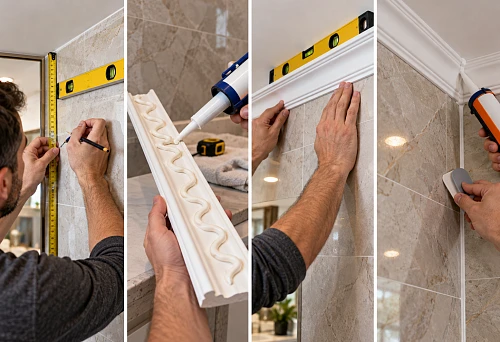
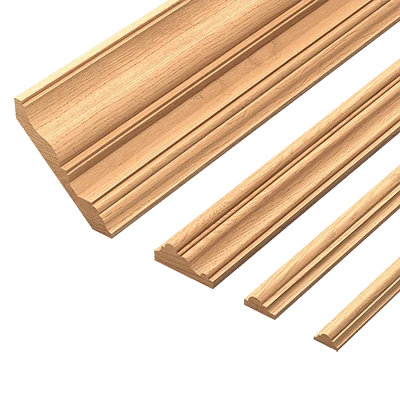
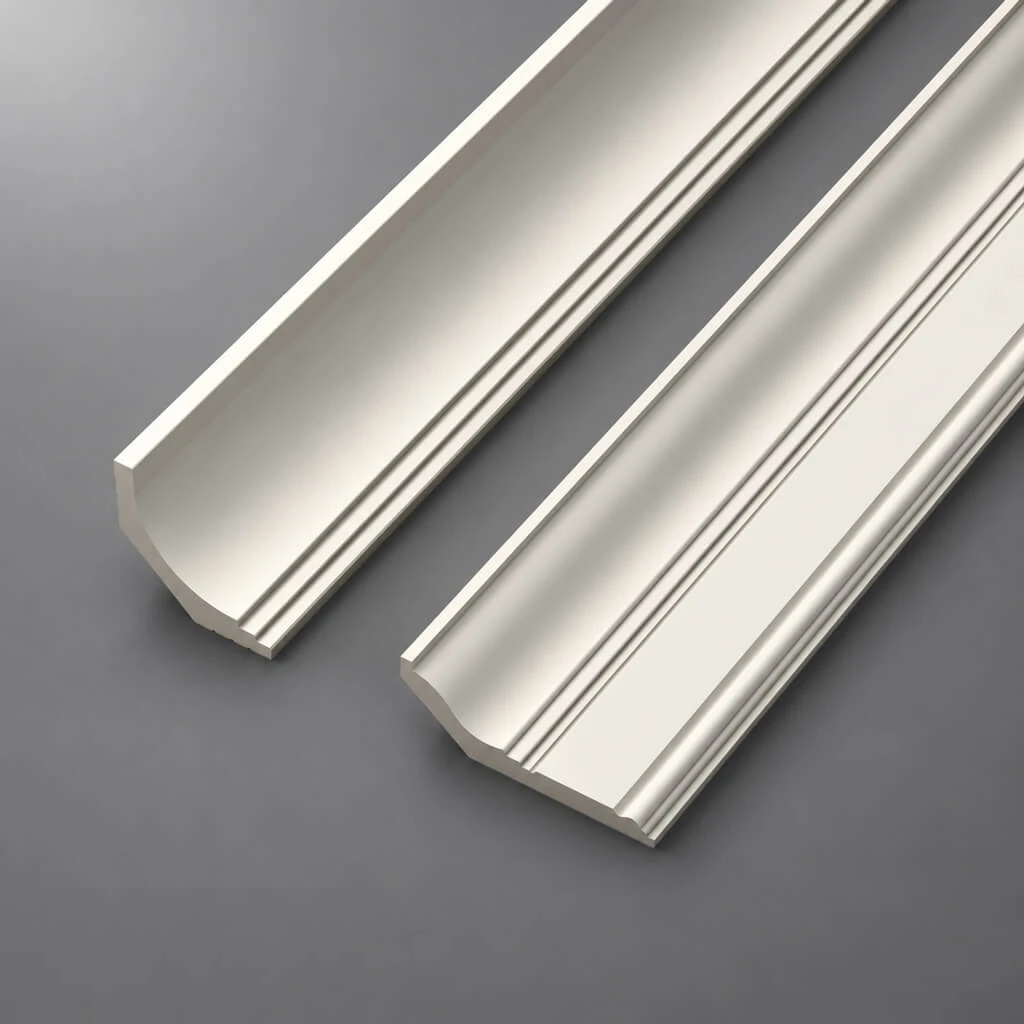
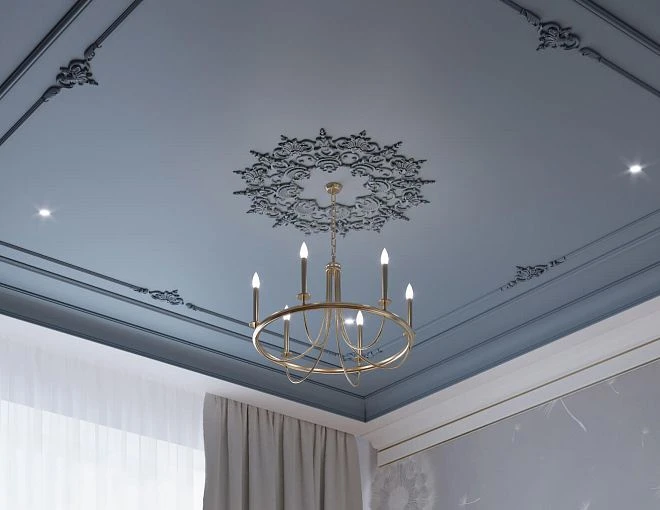
a polyurethane cornicePerimeter molding for slatted ceiling — conceals slat ends, creates a clean frame
-
Wooden frame strip made of the same material — around the perimeter
-
Light cornice with LED strip around the perimeter — conceals ends and adds contour lighting
Without perimeter completion — the slatted ceiling looks unfinished. This rule has no exceptions.
Ceiling slatted panels and natural interior system
Slatted ceiling — part of a larger natural interior system. It works most expressively when surrounded by other natural elements forming a unified whole.
Wooden slatted wall panelsin combination with slatted ceiling made of the same oak and tinting — this is a natural 'cocoon' enveloping the space from all sides. This is not overkill — it's a biophilic principle: the more natural materials in a space, the deeper the sense of calm and restoration.
solid wood floor skirting boardIn the same tone as the slatted ceiling — a natural 'frame' from below. Oak parquet in the same tonal range — wooden floor + wooden slats on walls + wooden slatted ceiling = complete natural immersion.
a polyurethane corniceAround the perimeter of the slatted ceiling in a classic profile — for interiors with historical context, where the transition from wooden slats to the wall must be architecturally justified.
Wooden furniture handlesOn built-in furniture matching the slatted ceiling — a detail that, upon closer inspection, reads as part of a unified natural system 'from top to bottom'.
Ceiling Panel Care: Practical Tips
The ceiling is the surface cleaned least often. That makes the correct initial choice of finish even more important.
Oil for ceiling slats. An oil finish for the ceiling is a viable option. Re-oil every 3–5 years. However, cleaning an oiled ceiling is more difficult than a lacquered one. For kitchens with slatted ceilings — lacquer only.
Hard matte lacquer. Optimal for ceilings in areas with grease vapors (kitchens, restaurant kitchens) and high humidity. Hard lacquer creates a closed film — easy to wipe clean. Every few years — sanding and re-coating if necessary.
Cleaning. Dry soft brush in the gaps — remove dust every 3–4 months. Damp wipe with a soft cloth — when stains appear. Aggressive cleaning agents — not allowed.
Frequently asked questions
Can a slatted ceiling be installed in an apartment with a 2.5 m ceiling?
Yes, with a closed system on an underlay — ceiling drop is only 20–25 mm. With an open system on a frame — drop is 120–150 mm. For a 2.5 m ceiling — only a closed system. Narrow slats (20–30 mm) + light tinting = minimal loss of visual height.
What is the spacing for attaching slats to the ceiling frame?
For oak and ash with a thickness of 15 mm — 500 mm. For a thickness of 18–20 mm — 600 mm. For pine with a thickness of 18 mm — 400 mm. Violating the spacing leads to sagging of the slats under their own weight.
Is it possible to replace individual slats on the ceiling after installation?
With clip mounting — yes, relatively easily. With adhesive and nail mounting — more difficult: the slat must be carefully removed without damaging adjacent ones. Therefore, clip mounting is preferable for ceiling systems — it provides access to utilities.
How to connect a slatted ceiling and a slatted wall in a corner?
Wooden corner profile — internal corner. The profile is installed in the corner and 'receives' the ends of the ceiling and wall slats. With a proper angle — the transition looks clean and architectural.
Can a slatted ceiling be installed in a bathroom?
Yes, when using thermally modified wood or larch with a water-resistant varnish coating. Standard oak with an oil coating in a humid bathroom — risk of deformation. Correct wood species + correct coating + correct ventilation = a durable wooden ceiling solution for the bathroom.
How to calculate the order volume for a slatted ceiling?
Ceiling area + 15–20% allowance for trimming. For a diagonal pattern — 25% allowance. Number of linear meters of slats: ceiling area (sq. m) ÷ (slat width + gap) × 1000 × room length (m).
Slatted ceiling in the living room: full or island?
Depends on the room height and budget. With a height of 2.8 m and above + budget allows — a full slatted ceiling creates the maximum effect. With a height of 2.6 m or a limited budget — an "island" over the key area (sofa, dining table) gives 80% of the effect at 40% of the cost.
Conclusion
The ceiling is the surface thought of last. And that's precisely why wooden slatted panels on the ceiling make such a strong impression: where a white emptiness is expected — natural wood, a warm pattern, a textured shadow. It's an unexpected element that changes the entire feel of the space.
Ceiling slatted panels made of solid oakwith professional tinting and coating,Polyurethane Crown Moldingto complete the perimeter,wooden floor baseboardandMoldingswithin a unified natural system — this is not a set of separate materials, but a holistic interior concept from floor to ceiling, where wood serves as the unifying language.
The full range of slatted panels, finishing systems, and decorative elements made of solid wood — in the STAVROS company catalog.
STAVROS — production of decorative interior solutions of European-level quality. Slatted panels for walls and ceilings, cornices, moldings, baseboards, stair elements, and furniture parts made of solid oak, ash, birch, and pine. For those who understand: the ceiling is not "just white" overhead, but a full-fledged architectural surface worthy of the best material.