Article Contents:
- Polystyrene: foamy lightness
- Polyurethane: elastic strength
- Polyurethane: elastic strength
- Density: key difference
- Flexibility: possibilities of shaping
- Water resistance and moisture absorption
- Where is lightweight polystyrene appropriate, and where is polyurethane preferable
- Ceiling cornices: the kingdom of polystyrene
- Floor skirting boards: polyurethane is unmatched
- Wall moldings: selection by height
- Curved surfaces: only polyurethane
- Wet areas: both materials are suitable
- Painting, maintenance, durability: practical aspects of operation
- Painting: subtleties and nuances
- Maintenance and cleaning: practical recommendations
- Resistance to impacts and damage
- Thermal resistance and fire safety
- Durability and Service Life
- Combining materials in interior design
- Standard scheme: polystyrene on ceiling, polyurethane on floor
- Zoning by height on walls
- Accent zones: polyurethane for highlighting
- Restoration: combination of old and new
- Frequently Asked Questions
- Can polystyrene and polyurethane be visually distinguished?
- Which material is better for beginners?
- Why is polyurethane so expensive?
- Can polystyrene be used on the floor in a bedroom?
- How to combine polystyrene and polyurethane in one interior?
- Which is more eco-friendly — polystyrene or polyurethane?
- Can polystyrene be bent after heating?
- Which material to choose for a commercial space?
- Is it necessary to prime before painting?
- Where to buy quality profiles?
- Conclusion: conscious choice for the perfect interior
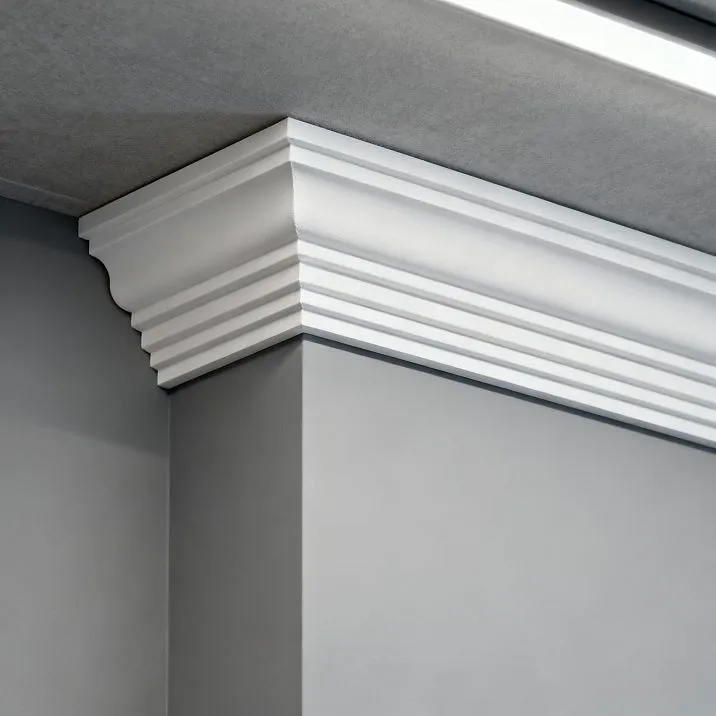
The white profile in hand looks flawless. Smooth, even, with clear relief. The seller claims it's the best choice for your interior. Next to it lies another profile — visually almost identical, but three times more expensive. "This is polyurethane," explains the consultant, "completely different quality." Visually indistinguishable, yet the price differs radically. What is the difference?
Polystyrene and polyurethane — two materials dominating the market of decorative molding. Both are white, both can be molded into any profile, both can be painted. But their physical properties, service life, and application areas differ radically. Buy the wrong one — and you'll face problems in a couple of years. Cracks, deformations, loss of appearance. Or, conversely — overpay for characteristics that are excessive for your case.
Let's examine in detail what each material represents, where it works ideally, and where it becomes inappropriate. Understanding the differences will allow for a conscious choice, optimizing costs without compromising quality, and obtaining a result that will delight for decades.
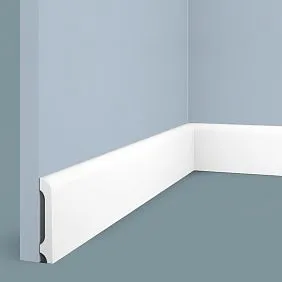
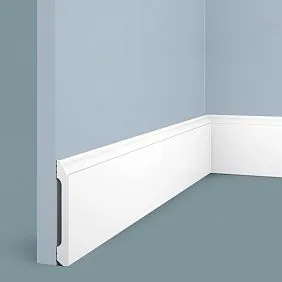
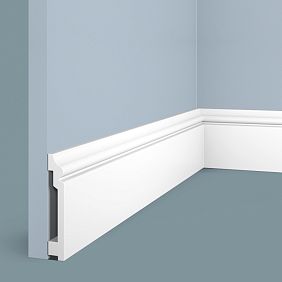
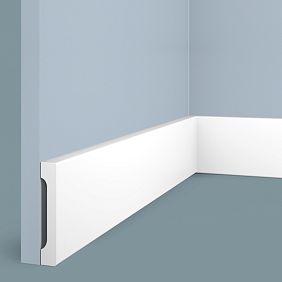
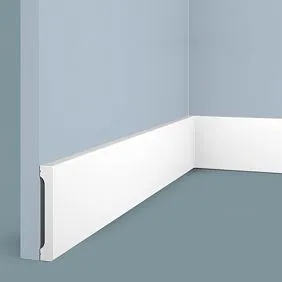
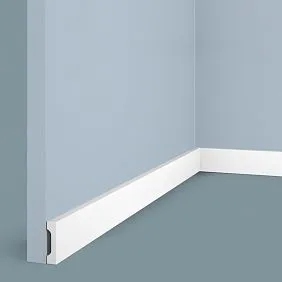
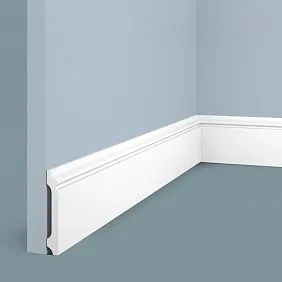

Comparison of polystyrene and polyurethane: physics and chemistry
Let's start with the basics — chemical composition and production technology. It is here that all differences are laid down, which later manifest in operation.




Polystyrene: foamy lightness
polystyrene baseboard Produced from expanded polystyrene by extrusion. Polymer granules are heated to a plastic state, a gas-forming agent — usually pentane or butane — is introduced. Under pressure, the mass is extruded through a die, the gas foams the material, forming millions of microscopic bubbles.
The resulting structure consists of 95-98% air. The walls between bubbles are thin and brittle, but collectively they form a rigid frame. The density of the finished product — 25-45 kg/m³. For comparison: the density of water is 1000 kg/m³, wood is 400-800 kg/m³. Polystyrene is 20-40 times lighter than water.
The ceiling molding creates a frame around the perimeter. Between them is a smooth ceiling surface. This scheme suits rooms of any size and is universally stylish. It is important to correctly choose the proportions — the rosette should not be too large relative to the room's perimeter. a 10 cm wide profile weighs 150-250 grams. Less than a glass of milk. This is an advantage during installation — no strong fasteners are needed, just glue. But the same lightness means low mechanical strength. The material crumbles under impact, compresses under pressure, breaks under bending.
The chemical nature of polystyrene — chains of styrene molecules connected into long polymers. The material is inert to water, acids, alkalis, and alcohols. But organic solvents — acetone, gasoline, white spirit — dissolve it instantly. This is critical when choosing adhesives and paints.
Low thermal conductivity due to air bubbles. Polystyrene is used as insulation — it retains heat 20 times better than brick. But this property also makes it vulnerable to heating. Above 80°C, the material begins to soften, and at 100°C, it melts.
Our factory also produces:


Polyurethane: elastic strength
Polyurethane baseboard for sale — means obtaining a material of a fundamentally different class. Polyurethane is synthesized by the reaction of polyol and isocyanate in the presence of a catalyst. The process is more complex than polystyrene production, which explains the higher price.
The mixture of components is poured into a mold, where a chemical reaction occurs with gas release. The material foams, filling the mold, then hardens. The resulting structure has closed cells, but the walls between them are thicker and stronger than in polystyrene. The density of the finished product — 200-350 kg/m³, 5-10 times higher than polystyrene.
A two-meter profile of the same width weighs 600-900 grams. Three to four times heavier than polystyrene. The weight creates difficulties during installation, but ensures stability. The material does not deform under its own weight even on long sections, maintaining ideal geometry.
Polyurethane has elasticity. It does not break when bent, but flexes and returns to its original shape after the load is removed. This allows installing profiles on curved surfaces — bay windows, columns, arches. Polystyrene cannot do this — it simply breaks.
Polyurethane has higher chemical resistance. It is inert not only to water and household substances, but also to most solvents. Any paints, adhesives, and cleaning agents can be used without risk of damaging the material.
Thermal resistance is also better. Polyurethane retains its properties up to 110-130°C. It can be installed near heat sources, used in humid rooms with hot steam, applied in climate systems.
Get Consultation
Density: key difference
Density determines most operational properties. Polystyrene with density 30-45 kg/m³ is lighter than water, floats, almost weightless. Polyurethane with density 200-350 kg/m³ is heavier, sinks, has noticeable weight. Difference of 7-10 times.
In practice, this means different mechanical strength. Polystyrene is soft, easily scratched by a fingernail, compressed by a finger.
Polyurethane baseboard ceiling Hard, difficult to scratch, does not compress even under strong pressure.
Density affects sound insulation. Light polystyrene almost does not dampen sound — it is too porous. Dense polyurethane has good sound absorption. In rooms with acoustic requirements, this may be critical.
Thermal conductivity is inversely related to density. The lower the density, the better the insulation. Polystyrene insulates heat better than polyurethane. But for decorative baseboards, this property is not critical — their task is not insulation, but aesthetics.
Flexibility: molding possibilities
Polystyrene is absolutely rigid. Attempting to bend the profile will result in breakage. This limits its use to straight sections and standard 90-degree angles. Polystyrene is unsuitable for non-standard geometries.
Polyurethane is flexible. The degree of flexibility depends on density — the lower the density, the more elastic the material. Special flexible polyurethane profiles can be bent into arcs with a radius of at least 50 cm without damage. This opens up possibilities for creating curved forms.
The flexibility of polyurethane allows profiles to be mounted on uneven surfaces. If the wall has slight waviness, the polyurethane profile adheres tightly, following the curve. Polystyrene forms gaps requiring sealant filling.
Shape memory is another property of polyurethane. After brief deformation, the material returns to its original geometry. A random impact may permanently dent polystyrene, but polyurethane will recover. This is especially important during transport — polyurethane profiles arrive intact even with careless packaging.
Water resistance and moisture absorption
Both materials have a closed-cell structure, ensuring low water absorption. Polystyrene absorbs less than 2% moisture by volume after prolonged immersion. Polyurethane absorbs less than 1%. Both are suitable for humid environments.
But there is a nuance. Polystyrene may delaminate along granule boundaries during freeze-thaw cycles. Water penetrates microgaps, freezes, expands, and breaks bonds. This is not a problem in heated rooms, but it is critical in unheated country houses.
Polyurethane is monolithic. It lacks a granular structure — the entire mass is uniform. It withstands freeze-thaw cycles without issues. For outdoor use — although rare for decorative skirting boards — polyurethane is preferable.
Both materials withstand direct contact with water. They can be washed or wiped with a damp cloth without fear of swelling or deformation.
Floor polyurethane skirting board Will last decades in bathrooms or kitchens without losing properties.
Where lightweight polystyrene is appropriate, and where polyurethane is preferable
Theoretical differences are clear. But how to apply this practically? Where each material reveals its advantages, and where its shortcomings become apparent?
Ceiling cornices: the kingdom of polystyrene
The ceiling molding creates a frame around the perimeter. Between them is a smooth ceiling surface. This scheme suits rooms of any size and is universally stylish. It is important to correctly choose the proportions — the rosette should not be too large relative to the room's perimeter. — optimal solution for finishing the junction between wall and ceiling. Here, mechanical strength is not required — the cornice is not subjected to impacts, friction, or pressure. The key is lightness and decorative appeal. Polystyrene is ideal for both parameters.
Lightness simplifies installation. The profile adheres to adhesive without additional fasteners. No need to drill into the ceiling, screw in self-tapping screws, or damage finishes. Apply adhesive, press, hold for 30 seconds — done. Even a beginner can complete an entire room in a couple of hours.
Wide cornices with deep relief are technically easier to produce from polystyrene. Extrusion allows forming complex profiles with fine details, small ornaments, multi-level relief. Polyurethane profiles are limited by molding technology, which does not allow such detail.
Price is a decisive factor for many. Polystyrene cornices are 3–5 times cheaper than polyurethane equivalents. Savings per room amount to several thousand rubles. With a limited budget, the choice is obvious.
For concealed lighting, polystyrene is also preferable. Special profiles with a ledge for LED strips are lightweight, do not exert load on fasteners, and are easy to install. Polyurethane equivalents are heavier and more expensive without visible advantages.
Floor skirting boards: polyurethane is unbeatable
On the floor, the situation is reversed. Here, the skirting board is constantly subjected to mechanical impacts. The vacuum cleaner hits during cleaning, feet brush against it while walking, furniture pushes it during rearrangement. Polystyrene quickly develops dents and chips.
Floor polyurethane skirting board Will withstand all this without consequences.
Polyurethane's strength guarantees longevity. After five years of use, it looks as new. Polystyrene, by contrast, loses its appearance within the same time and requires replacement. The extra cost of polyurethane is justified by the absence of the need to redo the work.
High floor skirting boards — a trend of recent years. Profiles 100–150 mm high create a European interior effect, visually elongating the space. Such heights are physically impossible with polystyrene — it will sag under its own weight. Polyurethane maintains perfect shape at any length.
Polyurethane's flexibility is useful when installing on uneven walls. Old buildings, houses with settling, walls after plastering — polyurethane profiles adhere tightly without gaps. Polystyrene would require extensive sealant filling, which is labor-intensive and unattractive.
Wall moldings: Selection by height
Wall decorative moldings are used for zoning space, creating panels, framing wallpaper. Material choice depends on installation height. The lower third of the wall — up to 60–80 cm from the floor — is a risk zone. Here, people touch moldings with hands, bags, children’s toys. Polyurethane is preferable.
The upper part of the wall is protected from contact. Moldings installed above 150 cm are practically invulnerable. Here, polystyrene is sufficient. Paying extra for polyurethane is unnecessary — its strength is not required.
A combined solution is optimal. Lower moldings from polyurethane, upper ones from polystyrene. Economical in cost, functional by characteristics, visually uniform when painted the same color.
In public spaces — offices, hotels, restaurants — polyurethane is recommended throughout the height. Foot traffic is high, risk of damage is maximal. Polystyrene cannot withstand intensive use and will require frequent replacement.
Curved surfaces: only polyurethane
Bays, columns, arched openings, curved walls — everywhere where the surface is not flat, polystyrene is powerless. It does not bend; attempting to bend it causes breakage. Special flexible polyurethane profiles solve this problem.
The bending radius depends on the profile size. Narrow profiles 30-50 mm bend to a radius of 30-50 cm. Medium 70-90 mm — up to 80-100 cm. Wide profiles require larger radii or special thermo-treatment to enhance flexibility.
Installing flexible profiles requires care. The profile is gradually bent, fixed with adhesive and temporary fasteners. After the adhesive has set, temporary fasteners are removed. The result — a smooth curve without joints or transitions.
The price of flexible polyurethane profiles is 30-50% higher than standard ones. But there are no alternatives — polystyrene cannot be installed on curved surfaces physically. You must either use polyurethane or forego decoration on curved sections.
Wet areas: both materials are suitable
Bathrooms, toilets, kitchens, laundry rooms — spaces with high humidity. Both materials are not afraid of water, do not swell, do not lose strength. You can use polystyrene or polyurethane without restrictions.
But there are nuances. For ceiling cornices in bathrooms, polystyrene is sufficient — there is no direct contact with water, and humidity is not critical.
Ceiling PPU skirting boards will be more expensive without visible advantages.
For floor skirting boards, polyurethane is preferable. It withstands direct water splashes, impacts from heavy objects, and friction from mops during cleaning. Its smooth, dense surface does not retain dirt and is easily cleaned with any cleaning agents.
In rooms with hot steam — saunas, hammams — polyurethane is mandatory. Temperature may reach 80-100°C, and polystyrene will soften and deform. Polyurethane withstands such conditions without problems.
Painting, maintenance, durability: practical aspects of operation
Buy and install — half the job. How does the material behave during operation? Is it easy to maintain? Can it be painted? How does it react to damage?
Painting: nuances and details
Both materials are excellently painted with water-dispersible paints. Acrylic, latex, and water-emulsion compositions lay evenly, create matte or semi-matte finishes, and last years without peeling.
For polystyrene, water-based paints are the only option. Organic solvents in alkyd enamels, nitro paints, and oil paints will damage the material. Apply with a brush — and the profile melts, runs, loses its shape. Only water, no organics.
Polyurethane is less demanding regarding paint chemistry. You can use alkyd enamels, oil paints, even automotive nitro enamels. But in practice, water-based paints are more convenient — odorless, dry quickly, and easily wash off from tools.
Priming before painting is desirable for both materials. It seals pores, ensures even paint absorption, and improves adhesion. Use water-based acrylic primer — it is safe for polystyrene and effective for polyurethane.
The number of coats depends on the desired color saturation. For white, one or two coats are usually sufficient. For dark and bright colors, three to four coats may be required. Allow drying time between coats as per the paint manufacturer’s instructions.
Decorative effects — patina, metalization, pearl — are easily achieved on both materials. Special paints and varnishes transform a white profile into an imitation of gold, silver, bronze, or malachite. The application technique is identical for polystyrene and polyurethane.
Maintenance and cleaning: practical recommendations
Polystyrene profiles require gentle handling. Dust can be removed with a soft dry cloth or a brush with natural bristles. Wet cleaning is permissible, but without excessive effort — too vigorous rubbing may damage the surface.
Choose cleaning agents carefully. Neutral water-based cleaning solutions are safe. Aggressive chemicals with solvents, abrasives, and stiff brushes are contraindicated. You can scratch, wipe away the relief, or fade the paint.
Polyurethane baseboard ceiling Requires little maintenance. Clean with any household cleaners without restrictions. Chlorine-based bleach, acidic cleaners, alkaline solutions — all are tolerated without damage. Stiff sponges and brushes are also acceptable — scratching a dense surface is difficult.
Disinfection is important in public spaces. Polyurethane withstands treatment with any disinfectants, including alcohol solutions and chlorine bleach. Polystyrene is afraid of alcohol and chlorine — they may fade or damage the surface.
Cleaning frequency affects the preservation of appearance. Dust accumulating in the recesses of the relief over time becomes embedded, darkens, and spoils the look. Wipe decorative elements at least once a month — and they will look new for years.
Resistance to impacts and damage
Polystyrene is brittle. A random impact leaves a dent, a strong impact — a chip. Sharp objects easily scratch the surface. Children, pets, and careless adults — all are potential threats to the integrity of polystyrene profiles.
Minor damage is repaired with putty. Dents are filled with acrylic putty, sanded, and painted. When done carefully, the repair is not noticeable. But deep chips, especially on relief sections, are difficult to restore — better to replace the damaged section.
Polyurethane is impact-resistant. Random impacts leave no marks; the material springs back to its original shape. Scratching is possible, but requires effort. Chipping is practically impossible — the material is not brittle and does not crumble.
If damage occurs, repair is simpler. Scratches are filled with putty and painted without trace. Dents often self-repair due to the material’s memory. Serious damage to polyurethane profiles is rare — it can only occur through intentional destruction.
Heat resistance and fire safety
Polystyrene softens at temperatures above 80°C and melts at 100°C. It is not recommended to install near heat sources — radiators, fireplaces, or heat guns. Maintain a distance of at least 30-50 cm from hot surfaces.
When burning, polystyrene melts, drips, and emits toxic black smoke. Modern grades contain flame retardants that slow combustion, but they do not make the material completely non-combustible. Fire hazard class G3-G4 — moderately to highly flammable.
When burning, polyurethane emits less smoke than polystyrene. Fire hazard class is usually G2-G3 — moderately flammable. Self-extinguishing after removing the heat source occurs more quickly. However, both materials are flammable, and complete fire safety is impossible.
Polyurethane emits less smoke than polystyrene when burning. The flammability class is usually G2-G3 — moderately flammable. Self-extinguishing after removal of the fire source occurs more quickly. However, both materials are flammable, and complete fire safety is impossible.
In real interiors, the flammability of baseboards is not critical. They constitute a minimal share of the total mass of materials in the room. Furniture, textiles, flooring, and doors — all these burn more actively. Panic over the flammability of decorative elements is unwarranted.
Durability and service life
Polystyrene ceiling cornices last 15-20 years under normal conditions. The material does not chemically age and does not lose strength over time. However, it may yellow under ultraviolet light, develop microcracks, and lose relief definition.
On the floor, polystyrene lasts a maximum of 5-7 years. Mechanical impacts gradually damage the surface, accumulating dents and chips. After 5 years, the baseboard looks worn and requires replacement.
Polyurethane profiles last 25-30 years or more on any surface. The material does not yellow, crack, or lose strength. After twenty years, it looks like new with minimal maintenance.
Economic calculation is simple. Polystyrene is cheaper to purchase, but requires replacement every 5-7 years on the floor. Over 25 years — three to four replacements with labor costs for disassembly and installation. Polyurethane is more expensive, but installed once and for all. In the long term, polyurethane is more cost-effective.
Combining materials in the interior
Why choose one thing? Professional designers have long understood: a thoughtful combination of different materials yields the best result. Each material has its place, where it reveals its strengths.
Standard scheme: polystyrene for the ceiling, polyurethane for the floor
Classic solution, proven by thousands of renovations.
The ceiling molding creates a frame around the perimeter. Between them is a smooth ceiling surface. This scheme suits rooms of any size and is universally stylish. It is important to correctly choose the proportions — the rosette should not be too large relative to the room's perimeter. decorates the upper part of the room,
Polyurethane baseboard for sale is suitable for the floor. Optimal balance of price, quality, and practicality.
Polystyrene works perfectly on the ceiling. Mechanical loads are absent, lightness simplifies installation, and low cost saves budget. After 15-20 years, the cornice looks new and performs its function flawlessly.
Polyurethane is indispensable on the floor. It withstands all impacts, retains its appearance for decades, and does not require replacement. The extra cost is offset by longevity and the absence of repair hassles.
Visually, the interior appears unified. With identical coloring, ceiling and floor profiles are indistinguishable by material. Guests won’t notice the difference, but you will know that each element is in its proper place.
Zoning by height on walls
Wall moldings are used to create decorative panels and space zoning. A rational solution — lower moldings made of polyurethane, upper ones made of polystyrene. The lower third of the wall is protected by a durable material, while the upper part is decorated economically.
The boundary is at a height of 60-80 cm — a conditional line, below which there is a high risk of contact. A molding at this height can be horizontal, separating the lower panel, or vertical, creating a frame.
Significant savings. Polyurethane is 3-5 times more expensive than polystyrene. Using it only in the lower zone saves 50-70% of the budget on wall decoration without compromising practicality.
Installation is done in two stages. First, install the lower polyurethane moldings, then the upper polystyrene ones. Alignment at the same height requires precision — even the slightest mismatch will be noticeable. Use a laser level for marking.
Accent zones: polyurethane for highlighting
In large rooms, it is sometimes necessary to highlight a specific zone — a fireplace arch, niche, or archway. Here, polyurethane profiles are appropriate, even if the main decoration is polystyrene. The difference in texture and relief depth will create an accent.
Polyurethane allows for deeper and more detailed relief. Profiles with large elements, expressive plastic, and complex ornaments appear richer than polystyrene ones. Use this to create visual focal points in the interior.
Flexible polyurethane profiles are indispensable for non-standard shapes. If the room has an oriel, column, or arch — decorate them with polyurethane. The rest of the space can be decorated with polystyrene, saving budget.
Color zoning enhances the effect. Main decoration is painted in neutral white or beige. Accent polyurethane elements — in contrasting colors or with decorative patina or metallic effects. The interior gains depth and expressiveness.
Restoration: combination of old and new
When restoring interiors, a common question arises: what to do with damaged decorative sections? Replace the entire profile or only the damaged part? Combining materials offers flexibility.
If the old plaster or wooden decor is partially damaged, restoration with similar materials is expensive. You can replace the lost sections with polyurethane copies. After painting, you won’t notice the difference, and the cost is much lower.
Polystyrene profiles damaged at the bottom can be replaced with polyurethane profiles of the same shape. The top remains polystyrene, while the bottom becomes stronger. The interior retains unity but gains protection in the vulnerable zone.
Modernizing an old interior often requires adding new elements. If the original decor is polystyrene, but you need to add baseboards, choose polyurethane. Polystyrene ceiling moldings remain, while the floor receives a durable material.
Frequently asked questions
Can polystyrene be visually distinguished from polyurethane?
It’s hard to distinguish visually — both are white, smooth, and paint well. But the weight difference is obvious. Pick up the profile — if it’s almost weightless, it’s polystyrene. If it feels noticeably heavy, it’s polyurethane. Density can also be checked by pressing with a fingernail — polystyrene will dent, while polyurethane won’t.
Which material is better for beginners?
Polystyrene is easier to install due to its light weight. It can be cut with a stationery knife, glued without additional fasteners, and requires no special tools. Polyurethane is heavier, requires self-tapping screws for fixation, and cutting requires a circular saw or metal hacksaw. For your first experience, choose polystyrene.
Why is polyurethane so expensive?
The production technology is more complex. Two-component raw materials, precise dosing, reaction control, and long curing times in molds. Equipment is more expensive, energy consumption is higher, and the defect rate is greater. All this is reflected in the price. But the quality matches the cost — durability and strength justify the extra expense.
Can polystyrene be used on the floor in a bedroom?
In a bedroom, loads are minimal — no intensive movement, furniture is stationary. Polystyrene will last longer than in a hallway or living room. But polyurethane is still preferable — it will definitely not require replacement after 5–7 years.
How to connect polystyrene and polyurethane in one interior?
With the same profile and paint color, the difference is not noticeable. Choose profiles from the same series or select the most similar ones. After installation and painting, it’s impossible to visually distinguish the material. The interior looks unified, even though different technologies were used.
Which is more eco-friendly — polystyrene or polyurethane?
Both materials are inert in their finished form and do not emit harmful substances under normal conditions. Certificates of compliance confirm their safety for residential spaces. When burning, both release toxic products, but this is not a reason to avoid them — all polymers burn with smoke emission.
Can polystyrene be bent after heating?
Theoretically yes — polystyrene softens when heated to 80–90°C. But in practice, controlling the process is difficult — it’s easy to overheat and melt it. Only special flexible polyurethane profiles can be bent; polystyrene does not work this way.
Which material to choose for a commercial space?
For offices, stores, hotels, and restaurants, polyurethane is definitely the best choice. Foot traffic is high, wear is intense, and durability requirements are maximum. Polystyrene will quickly lose its appearance and require replacement. Polyurethane will withstand years of use without repair.
Is priming needed before painting?
Polyurethane does not require primer, but it is recommended — it improves paint adhesion. For polystyrene, it is recommended — it seals pores and ensures even color. Use water-based acrylic primers for both materials.
Where to buy quality profiles?
In specialized stores of finishing materials and decor. Pay attention to the manufacturer — well-known brands guarantee stable quality. Check profiles for defects, warping, or surface irregularities before purchasing.
Conclusion: thoughtful choice for the perfect interior
Polystyrene and polyurethane are two materials with fundamentally different properties.
polystyrene baseboard Lightweight, affordable, easy to install, ideal for ceiling decor.
Polyurethane baseboard for sale Cost-effective for floors and high-load areas — it is strong, durable, and withstands decades of use.
There is no single best material. There is a material optimal for a specific task. Polystyrene on ceilings saves budget without compromising quality. Polyurethane on floors invests in longevity, eliminating the need for repeated repairs.
Combining materials — a professional approach. Use polyurethane where strength is critical — on floors, lower wall sections, curved surfaces. Use polystyrene where decorative function is sufficient — on ceilings, upper wall sections, protected zones.
The right choice during renovation determines comfort for years to come. Don’t cut corners on critical areas, but also don’t overpay for unnecessary features. Each material has its place, and each task has its optimal solution.
STAVROS offers a full range of polystyrene and polyurethane profiles.
Ceiling PPU skirting boards and polystyrene cornices from leading manufacturers, wide selection of profiles, professional consultations.
Experienced specialists will help you choose the optimal solution for your project. Calculation of required material, installation recommendations, adhesive and accessory selection — receive full support at every stage.
Quality guarantee, competitive prices, delivery across Russia — STAVROS makes professional decor accessible. Certified products, compliance with standards, technical support after purchase.
Create an interior that will delight for decades. Choose materials thoughtfully, use them rationally, and achieve results exceeding expectations.
Polyurethane baseboard ceiling or polystyrene cornice — in any case, quality and durability are guaranteed with STAVROS.