Article Contents:
- Why Wall Preparation is Critically Important for Stucco Decoration
- Physics of Adhesion: Adhesion and Its Enemies
- Aesthetics of Perfect Lines
- Economic feasibility
- Wall Diagnosis: Where to Start
- Checking Geometry and Flatness
- Assessing the Strength of the Base
- Determining the Type of Existing Finish
- Measuring Humidity
- Tools and Materials for Preparation
- Tools for Diagnosis and Marking
- Tools for Cleaning and Leveling
- Materials for Leveling
- Materials for Final Finish
- Step-by-Step Wall Preparation Technology
- Stage One: Surface Preparation
- Stage Two: Repairing Serious Defects
- Stage Three: Priming the Base
- Stage Four: Final Leveling
- Stage Five: Sanding
- Stage Six: Final Priming
- Features of Preparing Different Types of Bases
- Concrete Walls
- Plastered Walls
- Gypsum Board Structures
- Painted walls
- Wooden Surfaces
- Marking Before Installation: Precision is the Key to Beauty
- Determining Horizontal and Vertical Lines
- Planning Element Placement
- Checking Symmetry
- Common Mistakes During Preparation and How to Avoid Them
- Insufficient Cleaning from Dust
- Skipping primer or single-layer priming
- Installation on un-dried materials
- Ignoring humidity
- Incorrect Material Selection
- Saving on layer thickness
- Preparation for different types of molded decoration
- Wide moldings and cornices
- Rosettes and panels
- Carved Inlays
- Corner Elements
- Adhesion chemistry: choosing primers and their features
- Deep-penetration primers
- Adhesion primers (concrete-contact)
- Universal primers
- Antiseptic primers
- Timeframe: how long does preparation take?
- Working conditions: temperature, humidity, ventilation
- Temperature regime
- Air humidity
- Ventilation
- Checking wall readiness for installing moldings
- Visual Inspection
- Checking with a rule
- Adhesion test
- Checking dryness
- Special cases: non-standard situations
- Installing moldings in new construction
- Working with old buildings
- Wet Areas
- Unheated rooms
- Questions and answers: addressing common doubts
- Economics of preparation: what quality costs
- Estimated cost for 20 m² of wall
- Conclusion: the foundation of beauty
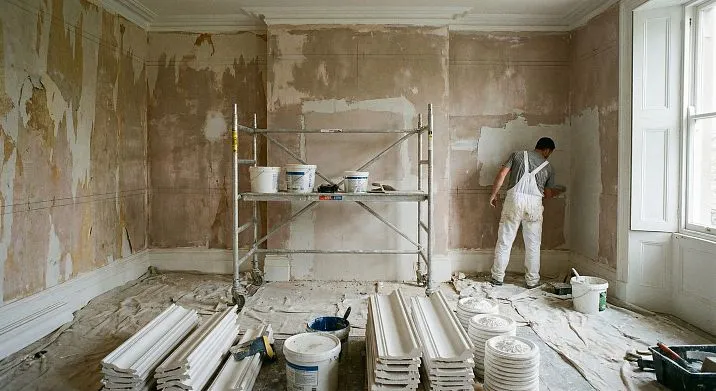
Have you ever noticed that in some interiors, moldings look like part of the architecture, as if they’ve always been there, while in others they appear hastily glued on, with visible gaps and unevenness? The secret to a flawless result lies not in the molding itself or even in the installer’s skill — it all depends on preparation. A wall that seems flat at first glance may reveal dozens of flaws during decoration installation, turning an elegant concept into a mediocre execution.
Preparing walls for molded decoration is the foundation upon which all future beauty is built. It’s invisible work whose results don’t show immediately but determine longevity, aesthetics, and overall interior impression. We’ll examine all stages in detail — from surface diagnostics to final priming, from material selection to technical tricks that distinguish professional work from amateur efforts.


Why wall preparation is critically important for molded decoration
Many underestimate this stage, considering it mere formality. After all, molding will cover unevenness, right? In reality, it’s the opposite. Molded decoration — whether moldings, cornices, rosettes, or appliqués — has rigid geometry. It cannot replicate the curves of an uneven wall, cannot compensate for bumps or depressions. The result of poor preparation — gaps between decoration and wall, element delamination, deformation of flexible parts, visible seams.




Adhesion Physics: Adhesion and Its Enemies
Adhesive works only with tight contact between surfaces. If there is an air gap of at least one millimeter between the molding and the wall, the bonding area decreases, the load is distributed unevenly, and over time the element will detach. Dust, grease, and residues of old coatings create a barrier that hinders adhesion. Moisture in the substrate disrupts the adhesive polymerization process. All of this is eliminated by proper preparation.
Our factory also produces:


Aesthetics of Perfect Lines
Molding works on contrast: its sharp lines, symmetrical forms, and precise geometry contrast against the wall's plane. But if the wall itself is uneven, if the molding either fits tightly or gaps several millimeters, this contrast is destroyed. The eye lingers on the irregularities, and instead of admiration for the decoration, irritation from carelessness arises.
Get Consultation
Economic feasibility
QualityPolyurethane moldingsIt costs money, the master's work too. Saving on preparation means risking all investments. Renovation costs more than proper initial execution. Removing already glued molding damages both the decoration and the wall, requiring complete replacement of elements and new foundation repair.
Wall Diagnosis: Where to Start
Before any work, it is necessary to assess the surface condition. This is not a quick inspection, but a systematic check by several parameters.
Checking Geometry and Flatness
Take a long straightedge or construction level — at least 2 meters. Place it against the wall in different locations: horizontally, vertically, diagonally. Gaps between the straightedge and the wall indicate unevenness. For molding installation, deviations of no more than 2–3 mm per linear meter are acceptable. Anything more requires leveling.
Room angles are checked separately — they must be strictly vertical and, ideally, right angles (90 degrees). Angular deviations create problems when joining moldings — elements cut at standard 45 degrees will not fit together nicely if the angles themselves are far from straight.
Assessing the Strength of the Substrate
Tapping the wall reveals plaster delamination. A dull sound is normal; a ringing sound indicates voids. Run a trowel lightly over the wall: if the coating flakes, crumbles, or peels off, it must be removed. Check corners and areas around door and window openings — these are often problem zones.
Absorption Test: Wet a small area of the wall with water. If it absorbs immediately, the substrate is porous and requires thorough priming. If water beads and does not absorb, the surface is glossy or coated with a substance reducing adhesion — it needs to be matte.
Determining the Type of Existing Coating
It is important to understand what you are working with. Concrete, plaster, drywall, old paint, wallpaper — each substrate requires its own approach. Wallpaper under molding is unacceptable — it must be completely removed. Paint is tested for strength: stick a piece of painter’s tape and quickly pull it off. If the paint peels off with the tape, it must be scraped off. If it holds, sufficient matting and priming are enough.
Measuring humidity
Wall moisture should not exceed 4–5%. It can be measured with a moisture meter or indirectly — attach a piece of dense plastic film to the wall with tape around the perimeter. After 24 hours, check: if condensation forms under the film, the wall is damp. Installing molding on a damp substrate is strongly discouraged — the adhesive will not bond properly, and mold may develop.
Tools and Materials for Preparation
Quality preparation requires the right set of tools and materials. Saving here is inappropriate — cheap materials will not deliver the desired result.
Tools for Diagnosis and Marking
-
Laser Level or Long Straightedge (at least 2 meters)
-
Plumb Bob for Checking Verticality
-
Tape Measure and Metal Ruler
-
Pencil, Chalk, or Marker for Marking
-
Moisture Meter (if planning a serious project)
Tools for Cleaning and Leveling
-
Trowels of Various Widths (from 10 to 60 cm)
-
Metal Brush for Removing Loose Layers
-
Scraping Tool or Shovel for Removing Old Coatings
-
Sanding Machine with Abrasive Set (Grain Size from 40 to 120)
-
Construction Vacuum Cleaner — Essential for Removing Dust
Materials for leveling
-
Deep-penetration primer — strengthens the base and reduces absorbency
-
Start spackling compound — for filling significant unevenness (up to 5-10 mm)
-
Finish spackling compound — for creating a perfectly smooth surface (layer up to 2 mm)
-
Reinforcing mesh — for working with cracks or gypsum board joints
-
Abrasive mesh or sandpaper — for sanding spackling compound
Materials for final finishing
-
Adhesion primer — creates a rough surface for better adhesive bonding
-
Acrylic sealant — for sealing small cracks
-
Antiseptic impregnation — if the wall is exposed to moisture or there is a risk of mold
Step-by-step wall preparation technology
Now let's move to practice. Each stage is important; skipping or carelessly performing any of them reduces overall quality.
Stage one: surface preparation
Remove everything that obstructs access to the wall: furniture, pictures, shelves, outlets (unplug first), and light fixtures. Protect the floor with plastic sheeting or cardboard — the work will be dusty. If molding is installed only on one wall, adjacent walls can be protected with painter’s plastic.
Remove old finishes: wallpaper is soaked with water and detergent, then scraped off with a putty knife. Paint is scraped off with a putty knife (if peeling) or sanded with a sander. Plaster is wiped off with a sponge and multiple water changes. Old plaster that sounds hollow is removed down to a solid base.
Stage two: repairing serious defects
Cracks are widened and deepened to allow spackling compound to penetrate. Narrow cracks (up to 2 mm) can be filled with acrylic sealant; wider cracks are spackled using reinforcing tape. Large dents are filled with start spackling compound in multiple applications, each layer drying completely.
If the wall is severely warped (deviation exceeding 5 mm per meter), leveling with plaster on guides is required. This is labor-intensive but necessary for quality results. Alternatively, install gypsum board, which provides an ideally flat surface but reduces room area.
Stage three: priming the base
After repair compounds dry, the wall is thoroughly cleaned of dust — with a vacuum cleaner, then with a damp cloth. The dry surface is primed with deep-penetration primer. Primer is applied with a roller or wide brush, generously and without gaps. Pay special attention to corners, areas near ceiling and floor.
Primer dries in 4-6 hours (exact time specified on packaging), after which a second coat is applied — this ensures uniform absorbency and base strength. On porous surfaces (gas concrete, old plaster), a third coat may be required.
Stage four: final leveling
After the primer dries, finish spackling compound is applied. Goal — achieve a perfectly smooth surface without bumps, scratches, or unevenness. Spackling compound is mixed according to instructions (ready mixes are more convenient but more expensive), applied with a wide putty knife in a thin layer.
Application technique: hold the putty knife at a 20-30 degree angle to the wall, apply with even pressure, overlapping the previous stroke by 2-3 cm. Do not attempt to apply a thick layer in one go — better to apply two thin layers than one thick layer, which will shrink and crack.
The first layer of finish spackling compound dries in 12-24 hours. After drying, inspect the surface with a straightedge and by looking through (shine a bright light along the wall — unevenness will cast shadows). Any defects found are corrected with a second spackling layer.
Stage five: sanding
Dried spackling compound is sanded to perfection. Use abrasive mesh with grit 120-150 on a sanding block or machine. Use circular motions without heavy pressure. Goal — remove putty knife marks, small bumps, and achieve a surface smooth to the touch.
Sanding is a dusty job — always use a respirator and safety goggles. After sanding, the wall is cleaned again of dust — first with a vacuum cleaner, then with a slightly damp cloth (not wet, to avoid softening the spackling compound).
Stage six: final priming
Final stage before installing molding — applying adhesion primer. It creates a slightly rough surface that improves adhesive bonding. Primer is applied with a roller in one coat and dries in 2-4 hours. After drying, the wall is ready for installation.Wall molding decoration.
Features of preparing different types of bases
There are no universal recipes — each type of wall requires a specific approach.
Concrete walls
Concrete is strong but often uneven. Panels have joints that must be carefully spackled. The concrete surface is smooth with low adhesion — a "concrete contact" primer is required, creating a rough layer. Old concrete may be dusty — it must be thoroughly primed with a strengthening compound.
Plastered walls
Plaster quality varies. Fresh, well-applied plaster is an excellent base and requires only priming. Old plaster may flake, crumble, or have voids — such areas are removed and replastered. Lime plaster is soft and poorly holds fasteners — it’s better to cover it with a layer of gypsum putty.
Gypsum board structures
Gypsum board provides a smooth surface, but joints between sheets and screw locations require treatment. Joints are taped with reinforcing tape and spackled in multiple layers. Screws should be countersunk 0.5–1 mm, and screw heads spackled. The entire gypsum board surface is covered with a thin layer of finishing putty — this equalizes absorption and hides joints.
Painted walls
Walls painted with oil or alkyd paint have a glossy surface with low adhesion. The paint must either be completely removed (labor-intensive) or sanded matte — using coarse sandpaper (grit 40–60) to create texture. After sanding — use a primer for smooth surfaces.
Water-emulsion paint is tested for adhesion: if it holds — a primer is sufficient; if it flakes — it is removed with a damp sponge or putty knife.
Wooden surfaces
Wood is a living material that changes dimensions with humidity fluctuations. Installing rigid molding on a wooden base is risky — cracks and delamination may occur. If no alternative exists, wood must be completely dry (humidity up to 12%), treated with a preservative, and primed with a wood-specific primer. Fastening is combined — adhesive plus mechanical fasteners (screws, nails).
Marking before installation: precision is the guarantee of beauty
Even a perfectly prepared wall does not guarantee a good result if the molding is installed crooked. Marking is the bridge between preparation and installation.
Determining horizontals and verticals
Use a laser level to mark reference lines. Horizontal lines are marked at the height where cornices, panel moldings, and other elements will be installed. Vertical lines are marked at corners, along door and window openings.
Do not rely on ceiling or floor lines — they are often not perfectly horizontal. Use a level. If the ceiling is noticeably sloped, you must choose: install molding strictly horizontally (visually correct, but the ceiling slope will be visible) or with a slight incline matching the ceiling (less noticeable, but technically incorrect).
Planning element placement
Draw a detailed layout of the molding with exact dimensions. Consider element lengths, joint placement (they should be symmetrical or hidden in less noticeable areas), and cutting requirements. Calculate material quantity with a 10–15% reserve for trimming and potential defects.
For complex compositions — panels, frames, or combinations of elements — make a full-scale pencil sketch on the wall. This will allow you to assess proportions and make adjustments before starting installation.
Checking symmetry
If the composition is symmetrical (most classical solutions are symmetrical), find and mark the central axis. Measure dimensions left and right from it. Asymmetry of 1–2 cm may be unnoticed in a sketch but will be obvious on the finished wall.
Common Mistakes in Preparation and How to Avoid Them
Even knowing the theory, it’s easy to make mistakes in practice. Let’s review common errors.
Insufficient dust cleaning
Dust is an invisible enemy of adhesion. After sanding, a thin layer of gypsum dust remains on the wall, reducing adhesive bond. Vacuum the wall thoroughly before priming and before installation. Wet cleaning is more effective, but requires the surface to be completely dry before the next step.
Skipping primer or applying only one layer
Primer is not a formality — it’s essential. It strengthens the base, equalizes absorption, and improves adhesion. One layer is often insufficient, especially on porous surfaces. Saving on primer results in poor molding adhesion.
Installing on un-dried materials
Each compound requires drying time. Putty applied in thick layers may appear dry on the surface but remain wet inside. Installing molding on an un-dried base will result in delamination. Do not rush — follow the drying time intervals specified by material manufacturers.
Ignoring humidity
Wet walls are a strict contraindication for installation. Water-based adhesive will not dry properly, polyurethane adhesive will not polymerize. Mold may form under the molding. If the wall is wet, eliminate the moisture source, dry the substrate, treat with antiseptic, and only then install the decoration.
Incorrect material choice
Using incorrect compositions reduces results. Primer is too coarse for the final layer, and the final layer is not strong enough to fill deep defects. Primer for absorbent substrates does not work on smooth surfaces, and vice versa. Read manufacturer recommendations, choose compositions according to their purpose.
Saving on layer thickness
Attempting to level significant unevenness with one thick layer of putty results in cracks and delamination. Correctly — several thin layers with intermediate drying. Yes, it takes longer, but the result is incomparably better.
Preparation for different types of decorative molding
Not all molding is the same; different elements require different requirements for the substrate.
Wide moldings and cornices
Large elements require an especially smooth surface — any wall unevenness will be reflected as a gap along the entire length of the molding. If the wall has minor waviness, it is permissible to use an elastic adhesive-sealant, which will fill the gaps. But this is a palliative measure; it is better to level the wall.
Rosettes and panels
These elements are mounted over the entire surface and require an ideally flat substrate. Even the slightest convexity of the wall under the center of the rosette will cause the edges to detach. Check the installation location especially carefully, and if necessary, make local leveling.
Carved Appliqués
Thin carved elements are fragile and difficult to press firmly against the wall during installation. The substrate must be as flat and clean as possible. Use special adhesives for delicate elements — they set quickly and do not require prolonged pressing.
Corner elements
Room corners are rarely perfectly straight. Before installing corner elements, measure the actual angle and, if necessary, adjust the molding cuts. Poor fit of a corner element is especially noticeable, as it is located at the intersection of two planes.
Chemistry of adhesion: selection of primers and their characteristics
Primer is not just a liquid that is brushed onto walls. It is a complex composition solving specific tasks.
Deep-penetration primers
Penetrate into the pores of the substrate to a depth of 5–10 mm, bind loose particles, strengthen the surface. Reduce and equalize absorbency, which is important for even drying of the adhesive. Suitable for all mineral substrates: concrete, plaster, putty, gypsum board. Applied in 1–2 layers, drying time 2–6 hours.
Adhesion primers (concrete contact)
Contain quartz sand or other fillers creating a rough surface. Used on smooth, low-absorbent substrates: concrete, old paint, tiles. Improve adhesion of subsequent layers. Applied in one layer, dry in 3–4 hours. After drying, the surface resembles sandpaper.
Universal primers
Combine properties of strengthening and improving adhesion. Suitable for most substrates of medium density. Convenient when it is not possible to select a specialized composition. Less effective on problematic surfaces than specialized primers.
Antiseptic primers
Contain fungicides preventing mold and fungus growth. Essential in humid rooms, on walls with a history of biological damage, in poorly ventilated homes. Applied before the main primer, sometimes instead of it (if the composition is universal).
Time schedule: how long does preparation take?
Quality does not tolerate haste. Actual preparation times for walls under molding depend on the initial condition, but on average:
-
Diagnosis and cleaning — 1 day
-
Repairing defects and initial leveling — 2–3 days (including drying time)
-
Priming the substrate — 1 day
-
Final plastering — 2–3 days (two layers with intermediate drying)
-
Sanding and cleaning — 1 day
-
Final primer — 1 day
Total: 8–10 days for quality wall preparation of 20–30 m². Can be faster if using fast-drying compounds and working under optimal conditions (temperature 20–22°C, humidity 50–60%, good ventilation). Cannot be slower — extending the timeline without reason reduces motivation and increases the risk of contaminating prepared surfaces.
Materials work correctly only under certain conditions.
Materials work correctly only under certain conditions.
Temperature regime
Optimum: 18–22°C. Below 15°C, most compounds dry poorly, and adhesive polymerizes slowly. Above 25°C — rapid moisture evaporation leads to spackling cracking and uneven primer drying. Work in heated (in winter) or ventilated (in summer) rooms.
Air humidity
Norm: 40–60%. High humidity (over 70%) slows drying and promotes mold growth. Low humidity (under 30%) causes excessive moisture evaporation from compounds, worsening their properties. Use a hygrometer for monitoring; adjust humidity as needed with humidifiers or dehumidifiers.
Ventilation
Required to remove vapors, accelerate drying, and ensure comfortable working conditions. Avoid drafts — they cause uneven drying and lead to cracks. Optimal: natural ventilation through slightly open windows or mechanical ventilation via exhaust fans.
Checking wall readiness for installing moldings
Conduct a final inspection before starting installation.
Visual Inspection
Inspect the wall from various angles under side lighting. There should be no visible unevenness, stains, cracks, or unprimed areas. Run your hand over the surface — it should feel smooth, without roughness (except when using an adhesive primer, which is intentionally rough).
Check with a straightedge
Place a long straightedge again — gaps should be minimal, no more than 2 mm. Especially carefully check areas where long moldings will be installed — any unevenness will be noticeable there.
Adhesion test
Stick a piece of painter’s tape to the wall and quickly peel it off. There should be no wall particles left on the tape — this confirms the surface is strong. If the primer peels off, an additional layer must be applied.
Checking dryness
Ensure the wall is completely dry. Touch it — the surface should feel cool, not cold, and not damp to the touch. If in doubt, use a moisture meter or allow an additional day for drying.
Special cases: non-standard situations
Conditions are not always ideal. Let’s discuss how to act in complex situations.
Installing moldings in new construction
New homes undergo shrinkage for the first 1–2 years. Walls may crack, and gaps may appear at structural joints. Installing moldings immediately after handover is risky — cracks may appear through the decoration within a year. If possible, wait until active shrinkage ends. If waiting is not possible, use elastic adhesives and sealants, and provide compensatory gaps at element joints.
Working with old buildings
Old homes have many nuances: crooked walls, peeling plaster, moisture, mold. Often, it’s simpler to cover walls with gypsum board, creating a flat and stable base, than to fight defects of historical structures. If preserving old plaster, thoroughly reinforce it with deep-penetration primers, remove all flaking, and treat with antiseptics.
Wet rooms
Bathrooms, toilets, kitchens (splash zone) — areas of high humidity. Polyurethane molding is moisture-resistant but requires special base preparation: waterproofing, antiseptic treatment, use of moisture-resistant primers and adhesives. Note that molding is not recommended in areas of direct water contact — ceramic is required there.
Unheated rooms
Vacation homes and suburban houses with seasonal occupancy are subject to temperature fluctuations and humidity changes. Use materials with enhanced elasticity and adhesion. Polyurethane molding is better suited than gypsum. Ensure room ventilation even when unoccupied — this prevents moisture accumulation and mold growth.
Questions and answers: addressing popular doubts
Can molding be installed on wallpaper?
Categorically not recommended. Wallpaper is a weak base — the adhesive holds the molding to the wallpaper, and the wallpaper holds to the wall. Over time, the wallpaper will peel off, and the molding will fall. Wallpaper must be completely removed, the wall must be prepared according to the technology, and only then can the decoration be installed.
How many primer coats are needed?
Depends on the base. Dense, low-absorbent surfaces — 1 layer. Porous, loose — 2-3 layers. Guideline: after the primer dries, run your hand over it — if your hand remains clean and dust-free, it’s sufficient. If dust remains on your hand, apply another layer.
What to do if the wall is uneven but you don’t have time to level it?
Use flexible polyurethane moldings — they partially follow the wall’s curves. Apply elastic adhesive sealants to fill gaps. But this is a compromise that reduces quality. It’s better to allocate time for proper preparation than to accept mediocre results.
Is sanding the final putty necessary if it will be under molding?
Yes, sanding is mandatory. First, spatula marks create unevenness that prevents molding from adhering properly. Second, visible areas of the wall will remain between molding elements, and if they have defects, it will spoil the overall impression.
Can drying materials be accelerated with heaters?
Forced drying with a heat gun or heater is permissible, but cautiously. Rapid drying causes cracks. Optimal: natural drying in a warm room. If using heaters, do not direct hot air directly at the wall, and maintain temperature no higher than 25°C.
Which is better: ready-mixed or dry putty?
Ready-mixed is more convenient, requires no mixing, and has a more uniform consistency. Dry putty is cheaper, lasts longer, and allows control over viscosity. For finishing layers, ready-mixed is better — it’s more pliable and gives a smoother surface. For starting layers, dry putty can be used.
How to prepare a wall painted with water-emulsion paint?
Test paint strength with tape. If the paint holds — light sanding (matting) and application of an adhesive primer are sufficient. If it peels — wipe with a damp sponge, let dry, apply putty if needed, then prime.
A wall is plastered but uneven. Which is faster: plastering or covering with drywall?
If unevenness is significant (over 10 mm), drywall is faster and guarantees a perfectly flat surface. Plastering such unevenness requires multiple thick layers with intermediate drying — time-consuming and material-intensive. Drywall’s downside: reduces room area by 3-5 cm on each side.
Is it necessary to use reinforcing mesh at drywall joints?
Yes, it prevents cracking. Drywall sheets slightly deform with humidity and temperature fluctuations, and joints are the weakest point. Reinforcing tape (metallic or paper) distributes stress, preventing cracking of the putty.
Can polyurethane molding be installed in winter in an unheated room?
No. Most adhesives work only at temperatures no lower than +5-10°C. At sub-zero temperatures, the adhesive doesn’t polymerize, and the molding won’t stick. If no heating is available, use heat guns to warm the room to at least +15°C and maintain this temperature until the adhesive fully dries (24-48 hours).
Economics of preparation: cost of quality
Preparation costs constitute a significant portion of the project budget. But cutting corners here is inappropriate — poor preparation ruins the entire result.
Estimated cost for 20 m² of wall
-
Deep-penetration primer (2 layers): 500-800 rubles
-
Starting putty (if required): 1000-1500 rubles
-
Finishing putty: 800-1200 rubles
-
Adhesive primer: 400-600 rubles
-
Sanding abrasives: 300-500 rubles
-
Consumables (tape, film, auxiliary compounds): 500 rubles
Total materials: 3500-5100 rubles
Labor cost (if you don’t do it yourself): 10000-20000 rubles, depending on region and complexity
Total preparation budget: 13500-25000 rubles. This is comparable to the cost of molding itself, but without this stage, decoration won’t reach its full potential.
Conclusion: the foundation of beauty
Preparing walls for stucco decoration — a job no one will see. But it is precisely this work that determines whether the interior will be flawless or merely a collection of beautiful elements poorly attached to uneven walls. This is labor requiring patience, precision, and understanding of materials. It is an investment of time and money, which pays off through the longevity and aesthetic perfection of the result.
Professionals know: quality begins with the foundation. Any error during the preparation stage will become apparent later, when correcting it will be difficult and expensive. Therefore, do not rush, follow the technology, use the right materials, and do not cut corners on critical operations.
If you plan toinstall stucco decorationStart with an honest assessment of the wall condition. You may need help from a specialist — a master who has seen hundreds of projects, knows typical problems, and can choose the optimal strategy for a specific situation. Investing in professional preparation pays off with peace of mind and confidence in the result.
Remember:wall-mounted decor for wallsOnly reveals its beauty on a perfectly prepared foundation. Do not吝惜 time on this stage — you are creating not a temporary ornament, but a part of the interior that will delight you for decades.
STAVROS offers not only the widest range of stucco decoration in polyurethane, wood, and plaster, but also a full suite of services: consultations on selecting elements, calculation of required quantities, recommendations for surface preparation, and professional installation. Our craftsmen have been working with stucco for over twenty years, know all the subtleties of preparing different types of bases, and use proven technologies and materials.
By contacting STAVROS, you receive a guarantee of quality at every stage — from consultation to final finishing. We work with private clients and designers, implementing projects of any complexity — from installing a single cornice to full classical stucco decoration of a mansion. Our approach — honesty, professionalism, attention to detail.
Your ideal interior begins with proper preparation. Entrust this work to STAVROS professionals — and enjoy a flawless result that will delight you for many years. Quality is seen in details, and details — our specialty.