












































































Article Contents:
- Types of baseboards: functional classification
- Wood: the strength of nature and the subtleties of selection
- Solid wood vs veneer: materials science
- Oak and maple: technical comparison of species
- Cable channels: functionality in detail
- Impact resistance: physics of protection
- Polyurethane: when technology surpasses nature
- Absolute stability: independence from conditions
- Complex profiles: freedom of form
- Large format: integrity and speed
- Flexibility: solution for complex geometries
- Height and proportions: mathematics of visual perception
- Baseboards 60-80 mm: universal standard
- Baseboards 100-120 mm: accent and scale
- Baseboards 150-200 mm: palace luxury
- Proportions and harmony
- Joints: technology of flawless details
- Joints to doors: aesthetics and geometry
- Joints to wall panels
- Curved walls: challenge of geometry
- Moisture resistance and cleaning: operational scenarios
- Kitchens: grease, moisture, temperature fluctuations
- Bathrooms: extreme humidity
- Hallways and entryways: mechanical load
- Cleaning: practicality in detail
- Cost evaluation: full economic model
- Price per meter: initial investments
- Additional work: installation and finishing
- Consumables
- Long-term perspective: cost of ownership
- Selection checklist: decision-making algorithm
- FAQ: answers to common questions
- Conclusion: conscious choice for perfect result

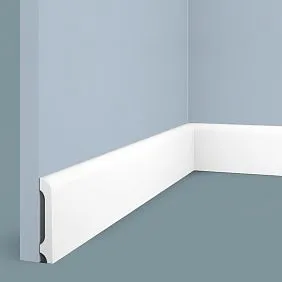
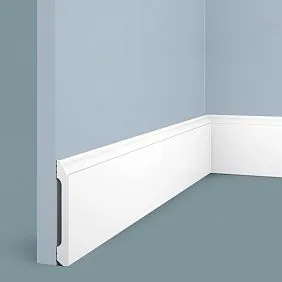
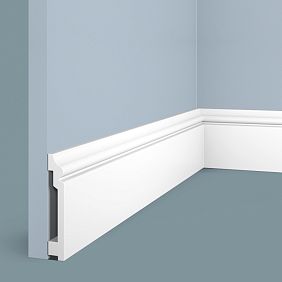
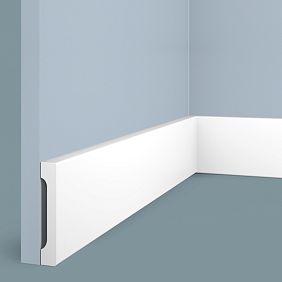
A baseboard is not just a strip between the floor and the wall. It is the finishing touch of interior design, its frame, its protection, and its character. The choice of baseboard material determines not only the aesthetics of the space, but also its functionality, durability, and cost of operation for decades to come.Wooden skirting boardsAnd polyurethane profiles solve the same tasks, but in different ways. In this article, we will create a technical decision map — a clear system of criteria by which you can make a balanced, reasoned decision about the choice of baseboard material for a specific project.

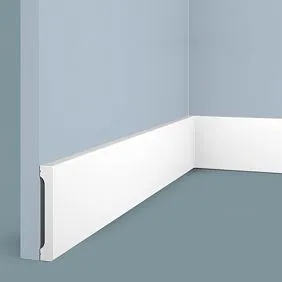
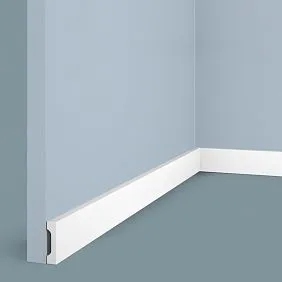
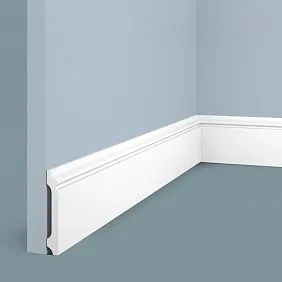
Types of baseboards: functional classification
Before discussing materials, it is necessary to understand what functional types of baseboards exist, what tasks they solve. The type determines the choice of material.
Floor baseboards — the most common category. Their main function is to cover the technological gap between the floor covering and the wall, protect the lower part of the wall from damage during cleaning, impacts from furniture, and dirt.Wooden baseboardFloor baseboards must be strong, wear-resistant, and easy to maintain.
The height of floor baseboards varies from modest 40-60 mm (minimalism, compact spaces) to impressive 120-200 mm (classic interiors, spacious rooms).Wide Wooden Skirting BoardVisually raises ceilings, creates a sense of solidity, can serve as a decorative accent.
Ceiling baseboards (cornices, moldings) decorate the transition between the wall and the ceiling.Ceiling baseboard woodenPrimarily serves a decorative function, but also hides cracks in corners, uneven joints, and can serve as a base for decorative lighting.
Ceiling baseboards are usually lighter than floor baseboards, as they are not subjected to mechanical loads. Profile width ranges from 30 mm (discreet accent) to 150 mm (architectural dominance). The shape can be simple (quarter-round, rectangular) or complex (multi-step relief, carved).
Furniture joints — a specific category of baseboards and profiles used in furniture manufacturing. These include baseboards for kitchens (cover the space between lower cabinets and the floor), cabinet moldings (top the upper part of furniture), edge profiles for countertops and facades.
Furniture baseboards must ideally match the material and finish of the furniture. For solid wood furniture, it is logical to use wooden profiles of the same species. For MDF furniture intended for painting, both wooden and polyurethane elements are suitable, which can be painted to match the facade color.




Wood: the strength of nature and the subtleties of selection
When discussing wooden baseboards, the first question is: solid wood or veneer? Both options have their place, but serve different purposes.
Our factory also produces:


Solid wood vs veneer: materials science
Solid wood baseboard — a solid profile, milled and routed from a single piece of wood. The main advantage is complete repairability. A solid wood baseboard can be sanded multiple times, removing scratches and dents. The depth of the wood allows routing complex profiles with clear relief.
The disadvantage of solid wood is sensitivity to humidity fluctuations. Wood 'breathes', slightly expanding when humidity increases and contracting when it decreases. High-quality solid wood, properly dried (humidity 8-10%), minimizes these changes, but does not eliminate them completely.
Veneered baseboard — a base of MDF or inexpensive wood (usually pine), covered with a thin layer (0.5-3 mm) of valuable species — oak, maple, walnut. Advantages: greater geometric stability (MDF base does not 'move' with humidity), possibility to use expensive species at affordable prices, smooth surface without knots and defects.
Disadvantage: limited repairability. Veneer can be easily damaged by deep scratches, penetrating to the base. Restoration is more complex than with solid wood. Nevertheless, for most residential spaces, veneered baseboards serve for decades without problems.
Get Consultation
Oak and maple: technical comparison of species
Oak — species #1 for baseboards in the premium segment. Density 650-750 kg/m³, hardness 3.7-4.0 Brinell units. This means high resistance to dents, scratches, and abrasion. An oak baseboard in the hallway, where shoes, bags, and strollers are constantly moving, serves for decades, retaining its original appearance.
Oak texture is coarse and expressive. Characteristic medullary rays create a 'mirror' effect on radial cuts — light streaks that play with changing viewing angles. Color ranges from light straw (young oak) to dark brown (worn oak). Over time, oak darkens, acquiring a noble patina.
Oak stains well, especially effectively — with brushing (artificial aging, where soft fibers are removed by brush, while hard fibers remain, creating a relief texture).
Maple — a species that does not fall short of oak on many parameters, but costs less. Density 650-700 kg/m³, hardness 3.5-3.8 units. The difference from oak is minimal and insignificant for most applications.
The main difference with maple is texture. It is fine, uniform, practically without distinct pattern. This is both an advantage and a limitation. Advantage — maple baseboard accepts any stains beautifully, can be painted to match walnut, redwood, or wenge, and the texture will not 'conflict' with the color. Limitation — there is no distinctive natural beauty that oak possesses.
Maple is slightly more hygroscopic (more reactive to humidity), so for humid rooms oak is preferable. But for ordinary living rooms, maple is an excellent choice, especially if cost savings without sacrificing quality are important.
Cable channels: functionality in detail
Modern homes are filled with electronics. Internet, television, security systems, lighting control — all this requires wires to be hidden somewhere. A wooden baseboard with a cable channel elegantly solves this problem.
A cable channel is a cavity in the back of the baseboard (facing the wall), covered by a removable lid. The channel size depends on the baseboard model: narrow baseboards (60-80 mm) have a 10×15 mm channel (sufficient for 2-3 thin wires), wide ones (100-120 mm) — up to 20×30 mm (can accommodate 5-7 cables or thicker wires).
Important nuances of cable channels: the cover must be easily removable for access to wires, but at the same time securely fixed and not fall out. The best designs use snap-fit or tongue-and-groove connections. The inner walls of the channel must be smooth, without burrs, to avoid damaging wire insulation.
Alternative to cable channels - thickened baseboard (25-30 mm instead of standard 15-18 mm), mounted at a small distance from the wall, with wires laid behind it. This method is simpler to manufacture but less convenient - to access the wires, the entire baseboard must be removed.
Impact resistance: physics of protection
Baseboard - the first line of defense for walls against mechanical damage. It absorbs impacts from vacuum cleaners, furniture legs during rearrangement, children's toys, and shoes - all of this is taken on by the baseboard.
Wood's impact resistance depends on its hardness and toughness. Hardwoods (oak, beech, ash) better resist dents, but under very strong impact may split. Softwoods (pine, linden) easily get dents, but do not crack.
For baseboards, optimal hardwoods with medium toughness - oak and beech. They withstand household impacts without visible damage. If damage occurs, a solid wooden baseboard can be locally restored - spackled, sanded, and repainted.
Polyurethane baseboard behaves differently. It is elastic, absorbs energy without deforming under minor impacts. However, a strong point impact may leave a dent or even a chip. Repairing such damage is more difficult - spackling on polyurethane is more noticeable.
Polyurethane: when technology surpasses nature
Ceiling molding made of polyurethaneand baseboards made of this material have conquered the market due to a unique combination of properties unattainable with natural materials.
Absolute stability: independence from conditions
The main 'Achilles heel' of wood - dependence on humidity and temperature. Polyurethane is absolutely inert. It doesn't care whether the room humidity is 30% or 90%. It is indifferent to temperatures from -20 to +60 degrees. It doesn't dry out, swell, warp, or crack.
This stability is critical for certain scenarios. Bathroom - humidity regularly fluctuates from 50% to 90% and higher. A wooden baseboard here requires special treatment with moisture-resistant compounds and remains vulnerable. Polyurethane baseboard - absolutely calm.
Unheated veranda, balcony - temperature in winter may drop below zero, in summer rise above 40 degrees. Wood under such conditions experiences stress and may warp. Polyurethane preserves its geometry.
Kitchen near stove and sink - zone with frequent humidity and temperature fluctuations. Polyurethane baseboard is more reliable here than wooden one.
Complex profiles: freedom of form
Injection molding technology allows creating polyurethane baseboards with incredibly complex profiles. Multi-level cornices, deep ornaments, fine carving - all this is reproduced with perfect accuracy.
Wooden baseboards are milled from solid stock. The more complex the profile, the more processing stages, the higher the risk of chips and defects. Very thin elements (carved leaves, scrolls) in wood are fragile. In polyurethane, they are strong due to monolithic structure.
For classic interiors, where rich ornamentation is important, polyurethane allows achieving palace-like luxury at an affordable price. A similar carved wooden baseboard would cost 5-10 times more.
Large format: integrity and speed
Polyurethane baseboards are supplied in bundles of 2-2.4 meters (some models up to 3 meters). Wooden baseboards are usually 1.8-2.2 meters long (limited by raw material length and drying technology).
Greater length means fewer joints. In a 4x5 meter room (perimeter 18 meters), 9 joints are needed for 2-meter baseboards and 6 for 3-meter ones. Each joint is a potential point of misalignment during drying and a focal point for assessing installation quality.
Polyurethane's lightness (5-7 times lighter than wood) radically simplifies and speeds up installation. One person can easily handle a 3-meter polyurethane baseboard. A 3-meter wooden baseboard weighing 5-7 kg requires an assistant.
Flexibility: solution for complex geometries
Many polyurethane baseboards are produced in two versions: rigid (for straight sections) and flexible - flex (for radii). A flexible baseboard can be bent to a radius of 50 cm (depending on profile width) and fixed to curved walls, columns, or bay windows.
With wood, such tasks are more complex. Steam-bending wood - a technically complex process requiring equipment and skills. Assembling radius from short segments - labor-intensive, many joints. Milling radius from solid stock - high material waste, high cost.
For projects with complex room geometries, polyurethane is often the only rational solution.
Height and proportions: mathematics of visual perception
Baseboard height is not arbitrary. It is an exact calculation, taking into account ceiling height, room area, interior style, and proportions of other elements.
Baseboards 60-80 mm: universal standard
Baseboards 60-80 mm are the most common category. They suit most standard apartments with ceiling heights of 2.5-2.7 m. Such a baseboard is sufficiently noticeable to serve a decorative function, but does not dominate the interior.
The profile can be simple (rectangular, quarter-round) for modern styles or ornate (with curves, moldings) for classic styles. Thickness is usually 15-18 mm, weight per meter of oak baseboard - 600-900 grams.
Baseboards in this category are suitable for bedrooms, living rooms, offices, children's rooms - spaces with moderate mechanical load. For hallways and corridors, where load is higher, height of 80-100 mm is recommended for better wall protection.
Baseboards 100-120 mm: accent and scale
Baseboards 100-120 mm are already architectural elements that attract attention. They visually raise ceilings (especially if painted in wall color), create a sense of solidity, and emphasize classic or neoclassical styles.
Such baseboards are suitable for rooms with ceilings from 2.8 meters. In rooms with low ceilings (2.4-2.5 m), a high baseboard may 'consume' space, making it visually even lower.
Profiles of high baseboards are often complex, multi-level, with decorative elements. Thickness may reach 20-25 mm (for stability and proportionality). Weight per meter of oak baseboard 120 mm - 1.2-1.8 kg, requiring secure mounting.
High baseboards combine beautifully with high door casings and ceiling cornices, creating a unified architectural composition.
Baseboards 150-200 mm: palace luxury
Baseboards 150-200 mm are a privilege of large spaces with high ceilings (from 3.2-3.5 m). Halls, living rooms in country houses, grand rooms - this is their territory.
Such baseboards often have complex configurations with multiple profile levels, carved or molded elements. They can be combined with wall panels at the lower part of the wall, creating classic boiserie.
Wooden baseboard pricewhich is high due to size and profile complexity, justified in luxury interiors where cost-saving is not important, but maximum expressiveness is.
Installing such massive baseboards requires professionalism. Weight per meter may reach 3-4 kg, gluing alone is insufficient; self-tapping screws or special strips are required.
Proportions and harmony
Architectural proportion rule: baseboard height should be 1/20 - 1/15 of wall height for balanced perception. At ceiling height 2.7 m, optimal baseboard height is 130-180 mm. At ceiling height 3.5 m - 175-230 mm.
However, interior style may adjust these proportions. Minimalism tends toward thin baseboards (40-60 mm regardless of ceiling height). Classic style - toward tall (100-150 mm even at 2.7 m ceilings).
Harmony with other elements is important. If door casings are narrow (60-70 mm), a wide baseboard (150 mm) will be disharmonious. If ceiling cornice is massive (120 mm), a thin baseboard (50 mm) will be lost.
Joints: technology of flawless details
Interior quality is determined not so much by material choice as by quality of their joints. Joints are critical points where installers' skill is tested for strength.
Joining to doors: aesthetics and geometry
Baseboard meets door casing - what to do? Three main solutions.
90-degree cut - baseboard is milled strictly perpendicular and rests against door casing. This is a simple, fast solution, but aesthetically not always successful - the baseboard end is visible.
Beveled cut (45 degrees) - baseboard is milled at 45 degrees, forming a bevel that visually smooths the transition to the casing. Looks professional, but requires precise trimming.
Use of special end caps - for some baseboard models, end caps are produced that are slipped onto the end, creating a neat finish. Suitable for baseboards with cable channels.
Important nuance: baseboard height and casing width must correspond. If baseboard is 100 mm and casing is 70 mm, baseboard will protrude beyond casing, which is unattractive. Optimal when baseboard equals or slightly narrower than casing.
Joining to wall panels
If lower wall section is finished with wooden panels or molding frames, baseboard must harmoniously integrate into this system.
Classic approach - baseboard is part of panel system. Baseboard height corresponds to lower panel height (usually 80-120 mm). Material and finish of baseboard match panels.
Modern approach - baseboard contrasts with panels. For example, dark panels + white baseboard or vice versa. This creates additional rhythm, emphasizes geometry.
During installation, ensure alignment - top edge of baseboard must be strictly at the same level as top edge of panel. Even the slightest misalignment (even 1-2 mm) will be noticeable.
Curved walls: geometry challenge
Bays, columns, semicircular niches - elements that create space beauty but complicate baseboard installation.
For polyurethane, the task is solved simply - use flexible baseboard, which follows any radius. For wood, there are three paths.
Steam bending - wood is steamed in a special chamber, then bent to shape and fixed until fully dried. Labor-intensive, requires equipment, but yields a seamless element without joints.
Segment assembly - radius is assembled from short straight segments. For large radius curves (from 1.5-2 meters) and short segments (15-20 cm), visually smooth curve is achieved. Many joints - downside, but achievable with standard crew.
Milling to radius - baseboard is cut from solid stock using CNC router to specified radius. Expensive, but result is ideal - seamless radius element without joints.
Choice of method depends on radius of curvature, budget, availability of technology. For radius less than 80 cm, bending is problematic, better to use segment assembly. For radius over 2 meters, segment assembly gives good result.
Moisture resistance and cleaning: operational scenarios
Baseboard is used under different conditions. Bedroom - one set of requirements, bathroom - completely different. Kitchen, hallway, children's room - each room has its own specifics.
Kitchens: grease, moisture, temperature fluctuations
Kitchen - an aggressive environment for any materials. Water splashes, grease, steam, temperature fluctuations near the stove and oven. What to choose?
Wooden skirting on the kitchen is possible, but requires proper finishing. The coating must be moisture-resistant (polyurethane varnish, moisture-resistant enamel) and easy to clean. Oil-based coating on the kitchen is not recommended - oil absorbs grease.
The species matters. Oak is preferable to beech due to lower hygroscopicity. Especially critical is the area near the sink - here there are constant splashes. It is possible to use a combination: wooden skirting around the kitchen perimeter, polyurethane in the sink area.
Polyurethane skirting on the kitchen - a universal solution. It does not absorb moisture, grease, is easily cleaned with any cleaning agents, and is not afraid of hot steam. After painting with moisture-resistant paint - practically an eternal material for kitchen conditions.
Bathrooms: extreme humidity
Bathroom and toilet - zones of maximum humidity. After a shower, humidity can reach 90-95%. Condensation settles on all surfaces, including skirting boards.
Wooden skirting in the bathroom - a risky solution. Even oak with quality lacquer coating may start to "play" over time due to constant humidity fluctuations. If you still choose wood, you need: species with low hygroscopicity (oak, larch), multi-layer (4-5 layers) lacquer coating, edge treatment with moisture-resistant compounds, quality ventilation.
Polyurethane skirting in the bathroom - optimal choice. Absolute moisture resistance, does not rot, does not mold, easy to clean. You can choose models with a profile imitating wood, and after painting, visually indistinguishable from wooden skirting.
Hallways and entryways: mechanical load
Entryway - zone of maximum mechanical load on floor skirting. Shoes, bags, umbrellas, strollers, bicycles - all this regularly contacts the skirting.
Wooden skirting from hardwoods (oak, ash, beech) is appropriate here. Its impact resistance, resistance to scratches, and ability to locally repair damage make it a rational choice. Height of 80-120 mm provides good wall protection.
The coating must be wear-resistant - polyurethane varnish (at least 3 layers) or durable enamel. Oil in the entryway is undesirable - it is less resistant to abrasion.
Polyurethane skirting in the entryway works well, but with a caveat. It is protected from minor scratches and scuffs by quality paint. However, a strong impact (falling bicycle, suitcase) may leave a dent that is difficult to repair inconspicuously.
A good compromise - combination: wooden skirting in zones of maximum load (near the entrance door, along the hallway), polyurethane in other areas of the apartment.
Cleaning: practicality in details
Skirting - zone of dust accumulation. It needs to be wiped regularly. How convenient is this?
Wooden skirting with smooth lacquered finish is easily wiped with a damp cloth. Dust and dirt do not penetrate the surface. Complex relief profiles (carvings, deep grooves) are harder to clean - dust gets trapped in recesses, requiring a brush or vacuum cleaner.
Polyurethane skirting with painted surface is also easy to clean. Modern paints create a smooth, dirt-repellent coating. Even complex ornamentation is easier to clean than on wood, as polyurethane has a monolithic structure without pores.
Important point - skirting with cable channel. The removable cover accumulates dust along the edges. It is advisable to periodically (every 2-3 months) remove the cover, wipe the inside and outside, and clean the channel itself.
Cost assessment: full economic model
Wooden baseboard pricewhich may seem high, requires a comprehensive assessment taking into account all associated costs.
Price per meter: initial investments
Price range for floor skirting (data valid for quality products):
Polyurethane:
-
Simple profiles 60-80 mm: 250-450 rub/m
-
Complex profiles 80-120 mm: 450-800 rub/m
-
Ornamented 100-150 mm: 800-1500 rub/m
Wood (solid pine/spruce):
-
Simple profiles 60-80 mm: 300-550 rub/m
-
Figured profiles 80-100 mm: 550-900 rub/m
Wood (solid beech):
-
Simple profiles 60-80 mm: 600-1000 rub/m
-
Figured profiles 80-120 mm: 1000-1800 rub/m
Wood (solid oak):
-
Simple profiles 60-80 mm: 900-1600 rub/m
-
Decorative profiles 80-120 mm: 1600-3000 rub/m
-
High profiles 150-200 mm: 3500-6000 rub/m
For an 80 sq.m apartment (baseboard perimeter approximately 60-70 m), the difference between polyurethane and oak may amount to 30-80 thousand rubles just on materials.
Additional work: installation and finishing
Installation cost:
-
Polyurethane baseboard: 200-350 rub/m (fast, simple, adhesive)
-
Wooden baseboard: 350-600 rub/m (more complex, requires fasteners, precise trimming)
Finishing:
-
Polyurethane: painting is mandatory, 150-300 rub/m (2-3 paint coats)
-
Wood: varnishing 150-250 rub/m, staining + varnishing 250-400 rub/m, painting with enamel 250-400 rub/m (requires more careful preparation)
For polyurethane, painting is always included in mandatory expenses. For wood, options exist — you can buy pre-varnished baseboard (30-50% more expensive), paint it yourself (saves on labor but risks imperfect result), or hire professionals for painting.
Consumables
For polyurethane:
-
Adhesive: 300-500 rub per 10 m of baseboard
-
Joint adhesive: 200-300 rub per project
-
Paint: 150-300 rub/m (depending on paint quality and number of coats)
For wood:
-
Self-tapping screws or nails: 200-400 rub per project
-
Wood putty: 150-250 rub per project
-
Varnish or paint: 150-350 rub/m
-
Adhesive (additional to fasteners): 300-500 rub per 10 m
Long-term perspective: ownership cost
Service life:
-
Polyurethane: 15-25 years (quality)
-
Wood (hardwood solid): 30-50+ years
Renewability:
-
Polyurethane: can be repainted 2-3 times, then usually requires replacement
-
Wood: can be sanded and repainted multiple times
Calculation for 30 years:
-
Polyurethane: initial installation + replacement after 20 years = double material and installation costs
-
Wood: initial installation + 2-3 renewals (sanding, painting) at 30-40% of initial cost
In the long-term perspective, a quality wooden baseboard may prove more economical, especially when considering its contribution to property value upon sale (oak baseboards increase the finish class).
Decision-making algorithm checklist
To systematize the choice, we propose a checklist — a sequence of questions whose answers definitively determine the optimal solution.
Step 1: Type of room
-
Bathroom/shower/Pool → Polyurethane (moisture resistance is critical)
-
Kitchen (sink/stove area) → Polyurethane (moisture + grease)
-
Kitchen (general area) → Wood or polyurethane (depending on budget and style)
-
Hallway/Corridor → Wood (impact resistance)
-
Bedroom/Living room/Office → Based on style and budget
Step 2: Room geometry
-
Straight walls, standard angles → Any material
-
Bays, columns, curved walls → Polyurethane (flexibility) or custom wood (expensive)
Step 3: Interior style
-
Classic, country, eco, Scandinavian → Wood (materiality is important)
-
Minimalism, high-tech, contemporary → Any (depending on budget)
-
Neoclassicism, art deco → Combination (wood on floor, polyurethane on ceiling)
Step 4: Budget
-
Limited → Polyurethane or wood of inexpensive species (pine, veneer)
-
Medium → Oak, ash (solid or veneer)
-
Premium → Oak (solid), complex profiles
Step 5: Ceiling height
-
Up to 2.6 m → Skirting board 60-80 mm
-
2.6-3.0 m → Skirting board 80-120 mm
-
More than 3.0 m → Skirting board 120-200 mm
Step 6: Operational requirements
-
High mechanical load → Wood of hard species (oak, ash)
-
High humidity → Polyurethane
-
Frequent cleaning, sanitary requirements → Polyurethane (easy to clean)
-
Restoration capability is important → Wood (solid)
Step 7: Additional features
-
Cable channel needed → Wood with cable channel or special polyurethane models
-
Need lighting → Special profiles with LED channel
-
Ecological importance is crucial → Wood (natural material)
FAQ: answers to frequently asked questions
Can wooden baseboard be used in a bathroom?
Possible, but with restrictions. Choose moisture-resistant species (oak, larch), mandatory multi-layer (4-5 layers) lacquer coating, treat ends with moisture-protective compounds. Ensure proper ventilation. Even with all conditions met, service life will be shorter than with polyurethane. Polyurethane is preferable for shower areas.
Which skirting board is better for underfloor heating?
Underfloor heating creates constant heating of the lower part of the wall. Polyurethane is absolutely inert to heating up to 50-60 degrees. Wood, under constant heating, may dry out and develop gaps. If choosing wood, use stable species (oak), skirting boards must be properly dried (humidity 8%), mount with consideration for thermal expansion.
Is it necessary to prime the wall before installing skirting boards?
Desirable. Primer strengthens the surface layer of the wall, improves adhesive bond of the glue, reduces absorbency (glue does not penetrate into the wall). For polyurethane skirting boards glued on, primer is critical. For wooden skirting boards screwed on, it is less important, but still recommended.
Can wooden skirting boards be painted after installation?
Yes, but more difficult than before installation. Need to protect walls and floor with painter’s tape, paint vertically (harder to achieve even layer). Professionals recommend painting before installation, then carefully mounting, touching up only joints and fasteners.
Which is cheaper in the end — wood or polyurethane?
Polyurethane is initially 30-60% cheaper. But after 20-30 years, considering the possibility of renewing wood and the need to replace polyurethane, ownership cost may equalize. For short-term perspective (5-10 years), polyurethane is more economical. For long-term (30+ years), high-quality wood may be more cost-effective.
How to determine the quality of wooden skirting boards when purchasing?
Check: wood moisture (8-10%, measured by moisture meter), geometry (fit two skirting boards together — they must match perfectly), absence of defects (knots, cracks, blue stain are unacceptable), quality of sanding (run hand over — must be perfectly smooth), profile uniformity along entire length.
Which glue to use for polyurethane skirting boards?
Special installation glues for polyurethane: Orac Decor FDP500, Decomaster, Quelyd. They provide quick fixation, elastic seam, white color (invisible at joints). Do not use "Moment" and similar — they may damage polyurethane. For end joints — special end joint glue that "welds" elements.
Can wooden and polyurethane skirting boards be combined in one apartment?
Yes, and even recommended. Typical scheme: wooden skirting boards in all rooms (except bathroom), polyurethane in bathroom and toilet. Or: wooden skirting boards in living rooms, polyurethane on kitchen. Ceiling moldings can be polyurethane throughout the apartment for cost savings. After painting in a unified color scheme, material differences are not noticeable.
Conclusion: thoughtful choice for perfect result
Choosing between wooden and polyurethane skirting boards is not about "which is better", but about "what is optimal for a specific situation". Wood — where tactile feel, ecological safety, longevity, and multiple renewals are important. Polyurethane — where moisture resistance, geometric stability, complex shapes, and budget savings are critical.
Professional approach — using each material according to its strengths.Wooden skirting Moscowandwooden skirting board St. PetersburgFrom reliable manufacturers, combined with high-quality polyurethane profiles for specific zones, create an optimal system where beauty, functionality, and economic rationality are balanced.
STAVROS has specialized in producing and supplying elitesolid oak and beech skirting boardsand also offers a wide range of polyurethane profiles for any task. The catalog features more than 80 models of wooden skirting boards of various heights (from 40 to 200 mm), profiles (from minimalist modern to ornate classic), with cable channel options, various finishing options.
STAVROS experts will help select the optimal solution for your project, considering interior style, usage conditions, budget. In-house production allows manufacturing skirting boards to individual sizes and profiles. Delivery throughout Russia, professional consultations, quality guarantee — STAVROS creates conditions for realizing the most demanding design concepts. Because the ideal interior is built from correctly chosen details, each of which is flawless in its execution.


