Article Contents:
- What is duroplastic and how it differs from polystyrene
- Polystyrene: affordable lightness
- Duroplastic: strength through pressure
- Key differences in numbers
- Strength, moisture resistance, and durability: practical tests
- Mechanical strength in everyday use
- Moisture resistance: myths and reality
- Durability: calculated for years
- Resistance to temperature fluctuations
- Where to apply each type: floor, ceiling, wet areas
- Floor baseboards: duroplastic's undisputed leadership
- Ceiling moldings: polystyrene unmatched
- Wall moldings: selection by height
- Wet areas: both materials are suitable
- Installation and painting features: from theory to practice
- Surface preparation: unified requirements
- Adhesive selection: critical detail
- Cutting and fitting: precision determines everything
- Installation of polystyrene profiles
- Installation of duroplastic profiles
- Painting: final touch
- Where to buy reliable baseboards from duroplastic and polystyrene
- Supplier selection criteria
- Company STAVROS: Quality and Reliability
- Frequently Asked Questions
- Can polystyrene be painted with regular paint?
- What adhesive to use for installation?
- How to cut duroplastic?
- How long do these materials last?
- Can polystyrene be installed on a heated floor?
- What is better for the bathroom?
- How to care for baseboards?
- Can it be mounted by yourself?
- What height should the skirting board be?
- Is it necessary to prime before painting?
- Conclusion: a conscious choice for a long-lasting interior
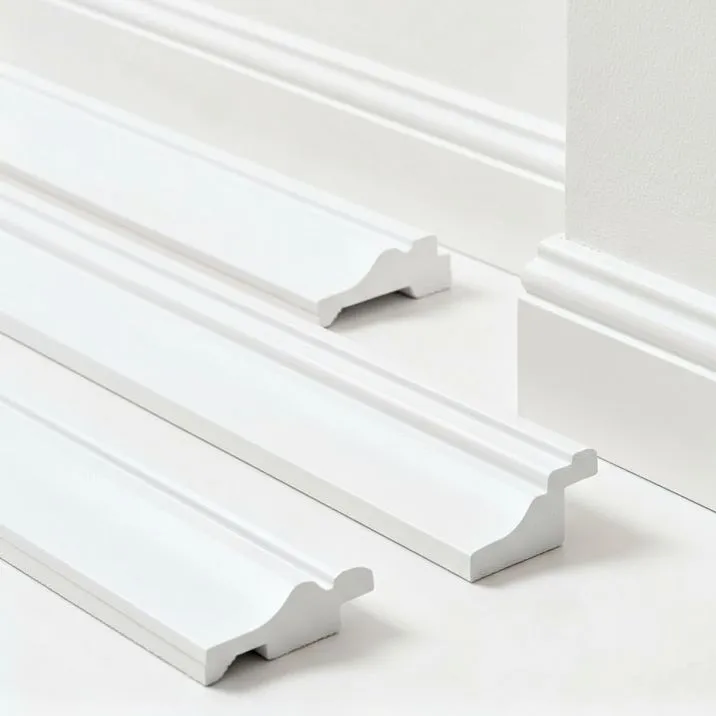
You stand before choosing a skirting board — and your eyes are overwhelmed. White profiles look identical, but prices differ three to four times. The seller confidently names materials: polystyrene, duro-polymer, extruded polystyrene. It sounds impressive, but what lies behind these terms? Why does one
skirting board duro-polymer cost as much as three polystyrene ones? And most importantly — which one will last longer, and which one will need replacement within a couple of years?
These questions are natural, since we’re talking about more than just minor details. Skirting boards encircle the entire perimeter of a room, form a finished interior look, and protect walls from damage. A wrong choice will result in disappointment — either wasted money if you overpaid for unnecessary features, or the need to redo the work if you saved money in the wrong places. Let’s examine both materials in detail so your choice is conscious and correct.
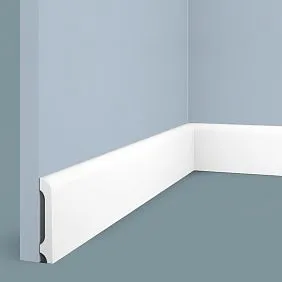
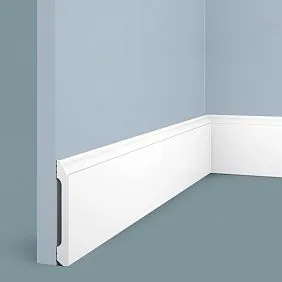
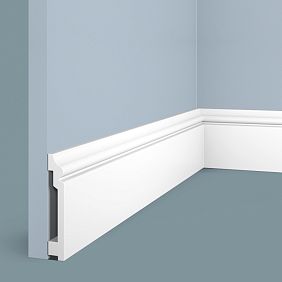
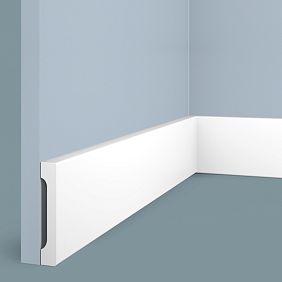
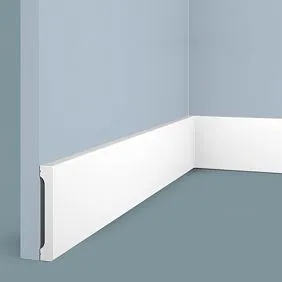
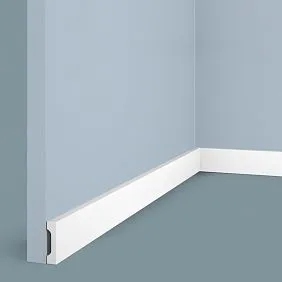
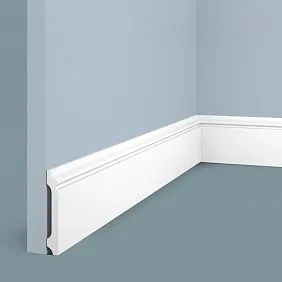

What is duro-polymer and how does it differ from polystyrene
Let’s start with the foundation — chemical composition and production technology. Both materials originate from the same substance — polystyrene, a synthetic polymer derived from petroleum products. But this similarity ends here, and fundamental differences begin.




Polystyrene: accessible lightness
polystyrene baseboard is produced by extruding expanded polystyrene. Raw granules are heated, a foaming agent is introduced, and the mass is forced through a die under pressure. The result is a profile with a porous structure filled with tiny air bubbles. It is precisely these bubbles that make the material lightweight — density is only 30-45 kg/m³.
Imagine: a two-meter plank weighs about 200-300 grams. This is less than a bottle of mineral water. Lightness simplifies transportation, makes installation accessible even for beginners, and does not require strong fasteners. But the same lightness translates into fragility — a random impact leaves a dent, a sharp edge scratches the surface.
The structure of polystyrene is cellular and porous. Under a microscope, closed cells of 0.3-0.8 mm in size, filled with air, are visible. This structure provides good thermal insulation properties, but reduces mechanical strength. The material does not bend — it breaks when the elastic limit is exceeded.
Polystyrene is chemically inert to water, acids, alkalis, and alcohols. However, organic solvents — acetone, toluene, benzene — destroy it instantly. This is important to consider when choosing adhesive compositions and paints. Water-emulsion paints are ideal, but nitro enamels will turn the skirting board into a shapeless mass.
Our factory also produces:


Duro-polymer: strength through pressure
Duro-polymer skirting board is the same polystyrene, but subjected to additional processing under high pressure and temperature. The technology allows obtaining a material with fundamentally different properties, although the chemical base remains the same.
The essence of the process is compacting the structure. Expanded polystyrene is subjected to pressure of several atmospheres at a temperature of about 150-180°C. Air bubbles collapse, cell walls fuse, and the material becomes monolithic. Density increases to 350-420 kg/m³ — this is ten times greater than that of ordinary polystyrene.
A two-meter duro-polymer skirting board 100 mm high weighs about one kilogram. This is a noticeable weight compared to polystyrene, but still lighter than a wooden analog by 1.5-2 times. The weight creates certain inconveniences during installation, but ensures shape stability and resistance to deformation.
The surface of duro-polymer is smooth, almost glossy, with no visible pores. The material resembles quality plastic — dense, hard, elastic. An impact that would leave a dent on polystyrene is absorbed by duro-polymer without consequences. Scratches also almost do not remain — the surface layer has high hardness.
The chemical resistance of duro-polymer is higher than that of polystyrene. It withstands contact with most household solvents, although prolonged exposure to aggressive chemicals should still be avoided. Any type of paint — from water-emulsion to alkyd and oil-based — can be used.
Get Consultation
Key differences in numbers
To make the picture clearer, let’s compare the main characteristics. The density of polystyrene is 30-45 kg/m³, and that of duro-polymer is 350-420 kg/m³. The difference is tenfold. Water absorption for both materials is minimal — less than 2%, making them suitable for humid rooms.
The softening temperature of polystyrene is 80-100°C, while duro-polymer withstands heating up to 90-110°C without deformation. It may seem like a small difference, but in practice, this means that duro-polymer can be installed closer to heat sources — radiators, underfloor heating.
Bending strength — a critical parameter for floor skirting boards. Polystyrene withstands a load of 5-10 kg per linear meter without residual deformation. Duro-polymer — up to 50 kg and more. This fivefold superiority explains why duro-polymer is chosen specifically for floors.
Strength, moisture resistance, and longevity: practical tests
Theory is good, but how do the materials behave under real conditions? What happens to the skirting board after one, three, or five years of use? Let’s consider key aspects of durability.
Mechanical strength in everyday life
Duro-polymer floor skirting board for sale is worth it at least because it withstands all those impacts, jolts, and scratches it experiences daily. The vacuum cleaner hits it during cleaning — no traces. The leg of the sofa hits the profile — the shape remains. A child accidentally hits it with a toy — no scratches.
PVC skirting board quickly develops dents under the same conditions. Corners suffer especially — protruding parts easily chip under careless handling. After one or two years of active use, the PVC on the floor looks worn, loses its appearance.
The situation on the ceiling is different. Here, the skirting board is not subjected to mechanical impacts, and PVC serves for decades without problems. Lightness becomes an advantage — the cornice does not exert load on fasteners, does not sag, retains its shape. Paying extra for duroplastic on the ceiling is pointless.
Moisture Resistance: Myths and Reality
Both materials do not absorb water — this is a fact. The closed cells of PVC do not allow moisture to penetrate into the structure. Duroplastic, with its monolithic density, is even more impermeable to water. You can confidently install either material in the bathroom, kitchen, or laundry room.
But there is a nuance. Although PVC is water-resistant, it may delaminate along the granule boundaries under prolonged exposure to moisture and temperature fluctuations. Freeze-thaw cycles, typical for unheated rooms, lead to gradual structural degradation. Duroplastic is absolutely stable — its monolithic structure does not change even under extreme conditions.
In humid areas, not only the material's moisture resistance but also the quality of joints matters. Gaps between boards — potential water accumulation zones. PVC is easy to cut, but joints are less tight due to the material's softness. Duroplastic maintains precise geometry, joints are tight, and sealant application is minimal.
Durability: Calculated in Years
The service life of PVC skirting board on the ceiling — 15-20 years. On walls — 10-15 years. On the floor — 5-7 years at best. After this, the material loses its appearance, develops chips, cracks, and deformations. Replacement is required.
Buy duroplastic skirting board — means investing in long-term prospects. Service life on any surface — 25-30 years and more. The material does not yellow, does not lose strength, does not develop microcracks. After twenty years, a duroplastic skirting board looks exactly as it did on the day of installation.
The economic calculation is simple. PVC on the floor costs 100-200 rubles per meter, but it will need to be replaced every 5-7 years. Over 25 years — three to four replacements, totaling 300-800 rubles per meter plus labor costs for dismantling and installation. Duroplastic costs 400-600 rubles per meter, but is installed once for the entire service life. The benefit is obvious.
Resistance to Temperature Fluctuations
Russia — a country of climatic contrasts. In unheated rooms, minus degrees in winter, plus forty degrees under the roof in summer. PVC under such fluctuations may deform — expand when heated, contract when cooled. The linear expansion coefficient is quite high.
In practice, this means that a two-meter board heated by 40°C will elongate almost 1.5 mm. If compensating gaps are not provided, joints will separate or, conversely, profiles will bow into arcs. Duroplastic is more stable — its expansion coefficient is 1.5 times lower.
In heated rooms, temperature fluctuations are moderate, and both materials work without problems. But in country houses, where heating may be turned off for several days in winter, duroplastic is more reliable.
Where to apply each type: floor, ceiling, humid areas
Choosing the right material for a specific location — half the success. Use each material where it best showcases its advantages and does not reveal its shortcomings.
Floor skirting boards: Duroplastic's undisputed leadership
The floor — an area of maximum loads. Here, the skirting board is constantly subjected to impacts, friction, and pressure. The vacuum cleaner hits during cleaning, furniture presses when arranged, and feet brush against it while walking.
Duro-polymer skirting board It is specifically designed for such conditions — its strength and impact resistance ensure longevity under the most demanding conditions.
High skirting boards — a trend in modern interiors. Profiles 100-150 mm high visually elongate the room, create a sense of elegance, and protect walls from dirt. Such heights are physically impossible to achieve with PVC — the material will sag under its own weight. Duroplastic holds its shape perfectly, allowing for striking vertical accents.
In transitional zones — hallways, entryways — duroplastic is indispensable. Here, the concentration of mechanical impacts is maximum. A PVC skirting board will be covered in dents and chips within half a year. A duroplastic one will retain its original appearance for years.
For children's rooms, where toddlers actively play and often brush against walls with toys, duroplastic is the optimal choice. It withstands all impacts, won't crack, and won't leave dangerous sharp fragments. Safety and durability in one material.
Ceiling cornices: PVC is unbeatable
On the ceiling, mechanical loads are absent. The cornice serves exclusively decorative purposes, concealing the junction between wall and ceiling. Here, PVC's lightness becomes a decisive advantage.
polystyrene baseboard It weighs orders of magnitude less than duroplastic, simplifying installation and reducing load on the base.
Gypsum board ceilings, especially suspended ones, have load restrictions. A heavy duroplastic cornice may require reinforcement of the frame and additional fasteners. PVC holds securely with adhesive, without creating stress in the structure.
Wide decorative cornices with deep relief — a classic element of historical interiors. PVC allows creating complex ornaments, which are impossible in duroplastic due to technological limitations of extrusion. Classicism, baroque, rococo — all these styles require rich decoration, and PVC handles the task perfectly.
For concealed lighting, PVC is also optimal. Special profiles with a ledge for LED strips weigh minimally, are easy to install, and create a floating ceiling effect. Duroplastic here is over-engineered for strength and unnecessarily expensive.
Wall moldings: Selection by height
Wall moldings are used for zoning space, creating decorative panels, and framing wallpaper. The installation height determines the material choice. The lower part of the wall — up to 60-80 cm from the floor — is subject to mechanical impacts. Here, duro-polymer is justified.
The upper part of the wall — above shoulder level — is protected from damage. Here, polystyrene is sufficient. By combining materials, you optimize costs without compromising durability. A lower protective panel made of duro-polymer, and upper decorative elements made of polystyrene — a rational solution.
In offices, hotels, restaurants — anywhere with high foot traffic — use duro-polymer along the entire wall height. The material withstands accidental impacts, won't scratch upon contact, and is easily cleaned with disinfectants.
Wet areas: both materials are suitable
Bathrooms, toilets, kitchens, laundries — rooms with high humidity. Both materials are not afraid of water, do not swell, and do not lose strength in a humid environment. However, duro-polymer is preferable for several reasons.
Firstly, absolute stability at any humidity level. Duro-polymer does not change dimensions, does not deform, and joints remain tight. Polystyrene may slightly change under prolonged moisture exposure — insignificantly, but enough to cause joints to delaminate.
Secondly, a smooth, non-porous surface. Dirt does not accumulate on duro-polymer, no deposits form, and soap foam easily washes off. Polystyrene, with its micro-relief, requires more thorough cleaning.
Thirdly, resistance to cleaning agents. Duro-polymer withstands contact with chlorine-containing bleach, acidic and alkaline cleaners. Polystyrene may fade or yellow under aggressive chemicals.
For ceiling moldings in bathrooms, polystyrene is quite suitable — there is no direct contact with water, and humidity does not bother it. For baseboards, it is better to use duro-polymer — they will withstand water splashes, impacts from heavy bottles, and friction from mops during cleaning.
Installation and painting features: from theory to practice
Correct installation — guarantee of longevity and aesthetics. Let’s consider the nuances of working with each material to ensure the result delights you for years.
Surface preparation: unified requirements
Regardless of the material, the base must be flat, clean, dry, and strong. Peeling paint, leftover wallpaper, dust — all of this reduces adhesive bond and may lead to profile delamination. It is advisable to prime concrete and plastered surfaces.
Check wall flatness. Place a long straightedge or construction level — gaps exceeding 3-5 mm will cause problems during installation. Baseboards will replicate wall irregularities, forming gaps. It is better to level the surface with putty in advance rather than struggle later with filling gaps with sealant.
The moisture content of the base should not exceed 10%. Fresh plaster, freshly painted walls require drying. Installing on a wet surface will lead to delamination — the adhesive will not set properly.
Adhesive selection: critical detail
Only water-based adhesives are suitable for polystyrene — polymer adhesives, acrylic sealants, special mounting compounds for expanded polystyrene. Organic solvents will destroy the material instantly. Check the adhesive composition — if it contains acetone, toluene, xylene, do not use it.
Duro-polymer is less sensitive to adhesive chemistry. Liquid nails, polyurethane adhesives, epoxy compounds can be used. However, in practice, water-based adhesives are more convenient — they have no strong odor, are easy to apply, and excess can be washed off with water.
For heavy duro-polymer profiles, adhesive may be insufficient. Additional mechanical fastening with self-tapping screws or anchors is mandatory. Fastening spacing — 40-50 cm. Fastener heads are embedded into the material, holes are filled with putty, and after painting, fastener locations become invisible.
Cutting and fitting: precision determines everything
Polystyrene is easily cut with a stationery knife or a fine-toothed hacksaw. For corner joints, use a miter box — a device allowing precise 45 and 90-degree cuts. A sharp tool gives a clean cut without dents or chips.
Duro-polymer requires more serious tools. An optimal choice is a circular saw with a fine-toothed disc for aluminum or laminate. It provides an ideally flat cut at a precise angle. A metal hacksaw also works, but requires more effort and care.
Jointing elements — the most critical moment. Gaps in corners and on straight sections ruin the entire appearance. Professionals fit profiles with minimal gaps — no more than 0.5 mm. Micro-gaps are filled with acrylic sealant before painting, and after painting, joints become invisible.
Internal corners are cut at 45 degrees, joining two strips. External corners are treated similarly or use ready-made corner elements if the manufacturer offers them. For non-standard angles — not 90 degrees — calculate the exact cut angle using the formula: cut angle = room angle / 2.
Installing polystyrene profiles
Start with the longest wall, from the internal corner. Cut the first profile according to the angle, apply adhesive to the back side using a zigzag or dots spaced 10-15 cm apart. Do not be stingy with adhesive, but also do not overdo it — excess will squeeze out upon pressing.
Attach the profile to the wall, align it with the bottom edge (for baseboards) or the ceiling (for ceiling moldings), press along the entire length. Hold for 20-30 seconds until the adhesive sets. The lightness of polystyrene allows you to do without additional fasteners — adhesive is sufficient.
Join the next strip tightly to the previous one. Check horizontal alignment with a level — deviations accumulate and may become noticeable by the end of the wall. Adjust the position while the adhesive is still wet.
Immediately wipe away excess adhesive squeezed out from joints with a damp cloth. Dried acrylic adhesive is difficult to remove without damaging the surface.
Installation of duroplastic profiles
The technology is similar, but the weight of the profiles requires additional measures. Apply adhesive generously — duro-polymer is heavy and must hold securely. After gluing, additionally fix with screws or finishing nails spaced 40-50 cm apart.
Pre-drill holes in the profile slightly smaller than the screw diameter. This prevents material cracking. Drill holes in the wall for anchors of the corresponding size.
Drive screw heads 2-3 mm below the profile surface. Fill recesses with acrylic putty, sand smooth with fine-grit sandpaper after drying. After painting, mounting points will be invisible.
Heavy profiles are installed by two people — one holds, the other fastens. This is especially important for duro-polymer ceiling moldings, where weight creates inconvenience when working at height.
Painting: the finishing touch
Both materials paint well with water-dispersive paints. For polystyrene, this is the only acceptable option. For duro-polymer, you can also use alkyd and oil-based paints, but water-based paints are preferable — odorless, dry quickly, and easy to apply.
Check all joints before painting. Fill gaps with acrylic sealant, smooth with a wet finger, let dry. Sand mounting areas until smooth. Remove dust with a dry cloth or vacuum cleaner.
Duro-polymer does not require priming — its dense, smooth surface ensures good paint adhesion. Polystyrene is best primed with acrylic primer — this seals pores, ensures even paint absorption, and improves the final finish.
Paint smooth profiles with a roller, textured ones with a brush. Apply paint in thin layers — three thin layers are better than one thick layer. Allow drying time between layers as per paint manufacturer’s instructions — usually 2-4 hours.
To achieve patina, metallic, or pearlescent effects, use special decorative paints. Duro-polymer accepts such finishes beautifully, transforming into gold, silver, or bronze imitation. Polystyrene also accepts decoration, but requires prior priming.
Where to buy reliable duro-polymer and polystyrene skirting boards
Material quality determines the result. Chinese counterfeits, handmade production, and substandard items will lead to disappointment. Where to find truly reliable skirting boards?
Supplier selection criteria
First — reputation. The company has been on the market for more than a year, has positive reviews, and works with well-known manufacturers. One-day shops selling unclear products disappear after the first customer complaints.
Second — assortment. A serious supplier offers products from different brands and price categories. This allows selection, comparison, and choosing the optimal option for a specific project.
Third — consultative support. Professional consultants will help calculate the required material amount, select profiles for your interior, recommend adhesive and fittings. This is especially important for beginners doing renovation for the first time.
Fourth — warranties. A reliable supplier guarantees product quality, accepts defective items back, and compensates for damage upon defect discovery. This is a safeguard in case something goes wrong.
Company STAVROS: Quality and Reliability
STAVROS specializes in supplying high-quality skirting boards made of polystyrene and duro-polymer. The assortment includes products from leading manufacturers — a wide range of profiles for any task, from budget renovations to premium interiors.
Professional consultants will help you choose the optimal solution for your project. Material quantity calculation, installation recommendations, and fitting selection — all this is available upon contacting STAVROS.
Buy duroplastic skirting board Choosing STAVROS means getting quality assurance. All products are certified and meet Russian and European safety standards. Product warranty, return in case of defects, and technical support after purchase.
Convenience of purchase is another plus. Online catalog with detailed descriptions and photos, option to order with delivery across Russia, various payment methods. You can visit the showroom in person, see samples, touch materials, and evaluate quality with your own eyes.
duropolymer skirting board price No extra charges. STAVROS works directly with manufacturers, allowing us to offer optimal prices with high-quality service. Regular promotions, discounts for loyal customers, special offers for bulk orders.
Delivery to Moscow and throughout Russia. Our own logistics ensures cargo safety during transport. Skirting boards are fragile items requiring careful handling. STAVROS guarantees that profiles arrive intact, without chips or deformations.
Frequently asked questions
Can polystyrene be painted with regular paint?
Polystyrene can only be painted with water-dispersive paints without solvents. Alkyd enamels, nitro paints, and solvent-based compositions will damage the material. Duro-polymer has fewer restrictions, but water-based paints are still preferable.
Which adhesive to use for installation?
Water-based polymer adhesives, acrylic sealants, and special mounting adhesives for polystyrene foam are suitable for polystyrene. For duro-polymer, you can use liquid nails, polyurethane adhesives, or epoxy compositions. Heavy profiles are additionally secured with screws or anchors.
How to cut duro-polymer?
Duro-polymer skirting boards are best cut with a circular saw using a fine-toothed blade. This gives a clean cut at a precise angle. You can also use a metal hacksaw with a fine tooth, but it will require more effort. Polystyrene can be cut with an office knife or a fine-toothed hacksaw.
How long do these materials last?
When properly installed, polystyrene on ceilings lasts 15-20 years, on floors — 5-7 years. Duro-polymer lasts 25-30 years or more on any surface. Service life depends on installation quality, operating conditions, and mechanical loads.
Can polystyrene be installed on a heated floor?
Not recommended. When heated above 50-60°C, polystyrene begins to soften and deform. Duro-polymer is more heat-resistant, but it is also better to install it at a distance from heating elements. Use thermostats limiting floor surface temperature.
What is better for the bathroom?
skirting board duro-polymer Its absolute moisture resistance guarantees longevity in humid environments. Polystyrene is also applicable, especially for ceiling moldings, but requires quality silicone sealant at joints.
How to care for baseboards?
Polystyrene is wiped with a soft damp cloth without abrasive agents. Duro-polymer can be washed using regular cleaning agents without fear of damage. Regular dry dusting extends service life and preserves appearance.
Can it be installed by oneself?
Yes, installation is accessible for self-execution. Polystyrene is especially easy to install due to its low weight. The key is precise cutting of corners and quality adhesion. For duro-polymer, a helper may be needed due to the weight of profiles.
What height should the skirting board be?
Height depends on ceiling height and interior style. For standard rooms 2.5-2.7 m, baseboards 70-100 mm are suitable. For high ceilings 3 m and above — 100-150 mm. A universal solution for most interiors — profiles 80-90 mm high.
Is priming needed before painting?
Duro-polymer can be painted without primer — its dense smooth surface ensures good paint adhesion. Polystyrene is preferable to prime to seal pores and achieve uniform color. Use water-based primers.
Conclusion: thoughtful choice for a long-lasting interior
Choosing between polystyrene and duro-polymer — it's choosing between affordability and longevity, between saving today and investing in the future. There is no single best material — there is a material optimal for a specific task.
polystyrene baseboard Ideal for ceiling decoration. Lightweight, inexpensive, easy to install, creates a beautiful finished look of the room. For the overwhelming majority of residential interiors, this is the optimal solution in terms of price-to-quality ratio.
Duro-polymer skirting board Essential for floor applications. Strong, impact-resistant, long-lasting — it withstands all loads and retains its original appearance for decades. An investment in quality pays off through the absence of replacement needs.
Combine materials wisely. Duro-polymer on the floor, polystyrene on the ceiling — a rational approach optimizing costs without compromising quality. Each material has its place where it fully reveals its advantages and does not expose its shortcomings.
Do not economize on quality where it is critical.
Duro-polymer floor skirting board for sale Suitable for floors and lower wall sections in passageways, rooms with high humidity — here duro-polymer justifies every dollar invested. But do not overpay for excessive features — on ceilings, expensive duro-polymer does not provide advantages over budget polystyrene.
Correct installation is half the success. Proper foundation preparation, correct adhesive selection, precise joint fitting, careful painting — all this determines the final result. Follow the technology, do not rush, and the profiles will serve the stated period.
Company STAVROS — your reliable partner in creating quality interiors. Wide assortment, professional consultations, quality guarantee, convenient purchasing — everything to ensure your renovation is successful.
Buy duroplastic skirting board or choose polystyrene moldings — in either case, you will receive quality products and qualified support.
Make a thoughtful choice based on understanding material properties and their application specifics. Then the renovation result will delight you for many years, and baseboards will become not just functional elements, but important details of a harmonious interior.