Article Contents:
- Accent Wall in the Living Room: Why Highlight One Surface
- Mirror as the Best Tool for an Accent Wall
- Optical Space Expansion
- Light Multiplication
- Visual lightness
- Decorative Value
- Functionality
- Baseboard as the Baseline of the Composition
- Baseboard Height and Visual Weight
- Baseboard Profile and Composition Style
- Baseboard Color in the Accent Wall System
- Baseboard Material: Solid Wood or MDF
- Architectural Approach: Vertical Panels Plus a Central Mirror
- Vertical Panels as the Rhythmic Foundation
- Symmetry or Asymmetry
- Panel Height: Floor-to-Ceiling or Wainscoting
- Panel Material: Wood, MDF, Mouldings
- Combining Baseboard, Wall, and Mirror Frame Colors
- Monochromatic Scheme: Everything in One Color
- Contrast Scheme: Two Colors
- Three-Color Scheme: Base, Accent, Neutral
- Gradient Scheme: Transition from Dark to Light
- Color Temperature: Warm or Cool
- One Large Mirror or a Composition of Several
- One Large Mirror: Focus and Monumentality
- Composition of Two to Three Mirrors: Rhythm and Dynamics
- Mirror Frames in the Composition: Identical or Different
- Practical Checklist: Sizing for the Perfect Composition
- Step 1: Measure the Wall
- Step 2: Determine the Baseboard Height
- Step 3: Calculate the Mirror Height
- Step 4: calculate the mirror width
- Step 5: determine the mirror shape
- Step 6: choose the mirror frame
- Step 7: calculate the mirror placement on the wall
- Step 8: determine additional elements
- Step 9: create a visualization
- Typical mistakes when creating an accent wall with a mirror
- Mistake 1: mirror too small
- Mistake 2: low, unexpressive baseboard
- Mistake 3: color conflict
- Mistake 4: incorrect mirror mounting height
- Mistake 5: decor overload
- Frequently Asked Questions
- Conclusion: accent wall as an investment in the home atmosphere

A living room without a focal point is just a room with furniture. A living room with a well-thought-out accent wall is a space with character, drama, architectural depth. And if that wall combineswooden baseboardan expressive profile andLarge framed mirrornatural wood — the result exceeds expectations. The mirror works as an optical amplifier of space, the baseboard sets the scale and visual support for the composition, and together they transform an ordinary wall into an architectural dominant that changes the perception of the entire room.


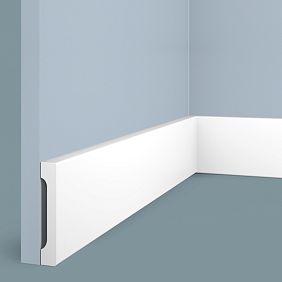
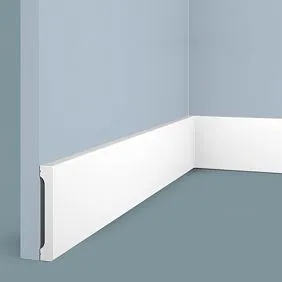
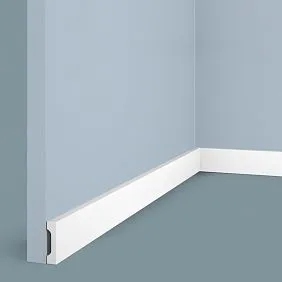
Accent wall in the living room: why highlight one surface
The four walls of a living room are rarely equal. One contains a window with a view, another has a doorway, a third borders other rooms, and the fourth remains free. It is this free wall that logically becomes the accent wall — the one that receives maximum attention, decor, and architectural treatment. Usually, it's the wall behind the sofa or opposite the entrance — the one that catches the eye upon entering the room.
Why is an accent wall needed at all? Three reasons.
First — compositional center. The human eye seeks a focal point, a point around which space is organized. If all walls are the same, the gaze wanders, finding no support. An accent wall provides that support, becomes a compositional anchor from which all other furnishings are arranged. The sofa is oriented towards the accent wall. Armchairs face it. The coffee table is positioned so that the accent wall is in the field of view of those seated. The composition gains meaning.
Second — visual interest. Three neutral walls (painted one color, without decor) and one accent wall (with wooden panels, moldings, a large mirror) create a balance between calm and interest. The eye has somewhere to go, but there is no overload — the decor is localized, controlled, not spread throughout the entire room. This is especially important in small living rooms (fifteen to twenty square meters), where excess decor on all walls creates a feeling of crampedness.
Third — cost-effectiveness. Treating one wall with expensive materials (solid wood, carved elements, a large mirror in a custom frame) costs many times less than treating all four. You get maximum visual impact for reasonable costs. One luxurious wall makes a stronger impression than four mediocre ones.




Mirror as the best tool for an accent wall
Of all possible techniques for creating an accent wall, a mirror is one of the most effective and functional. Why?
Our factory also produces:


Optical expansion of space
A mirror doubles the visible volume of a room. A living room of twenty square meters with a large mirror on the accent wall appears a third larger. The reflection of the opposite wall, window, furniture creates an illusion of depth, as if another room exists behind the mirror. This is especially valuable for narrow living rooms (three meters wide, six meters long), where a mirror on the long wall visually expands the space.
Get Consultation
Light multiplication
A mirror reflects natural light from the window and artificial light from the chandelier, sconces, floor lamps. One light beam becomes two, the brightness of the room increases. A living room with north-facing windows, where light is always insufficient, becomes noticeably brighter with a large mirror.Mirror with frameIt's not just decor — it's a functional element that works for comfort daily.
Visual lightness
A solid wooden panel, brickwork, dark wallpaper — all this creates visual mass, heaviness. A mirror, on the contrary, creates lightness, transparency, air. A wall with a mirror does not press, does not consume space, but rather — opens it up, makes it more free. This is important in low-ceilinged rooms (ceiling two meters fifty — two meters sixty centimeters), where heavy finishes can create a feeling of a box.
Decorative value
Mirror in a solid wood frameWith carving, patination, gilding — it is an independent art object that becomes the visual center of the wall. The frame sets the style (classical, baroque, neoclassical, modern), color (natural wood, white enamel, gold, silver), and scale. A large mirror in a striking frame does not need additional decoration — it is sufficient on its own.
Functionality
Unlike a painting or panel, a mirror is functional. Before leaving the house, you can stop in front of it, check your appearance, adjust your clothing. This is convenient if the living room adjoins the hallway or serves as a transit zone.
Baseboard as the baseline of the composition
The mirror is the accent, the star of the composition. But a star needs a stage. The wall plays the role of the stage, and the role of the stage's foundation is the baseboard. The baseboard sets the lower boundary of the composition, creates visual support, and determines the scale of all elements.
Baseboard height and visual weight
A standard baseboard five to seven centimeters high in the context of an accent wall with a large mirror gets lost, becomes invisible. It does not create sufficient visual weight to hold the composition. The mirror seems to float above the floor without support. This creates imbalance, a sense of incompleteness.
A high baseboard — eighty, one hundred, one hundred twenty millimeters — is a completely different matter. It forms a powerful horizontal line that visually anchors everything above it. The mirror no longer floats — it stands on a solid foundation. The composition gains stability, monumentality, architectural quality.
The height of the baseboard depends on the ceiling height and the size of the mirror. For a living room with ceilings two meters seventy to two meters ninety centimeters and a mirror height of one hundred fifty to one hundred eighty centimeters, a baseboard height of one hundred to one hundred twenty millimeters is optimal. For lower ceilings (two meters fifty to two meters seventy), eighty to one hundred millimeters is sufficient. For high ceilings (three meters and above), a baseboard of one hundred twenty to one hundred fifty millimeters can be used.
Baseboard profile and composition style
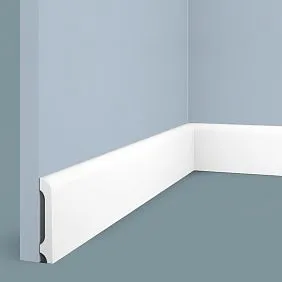
The baseboard profile sets the style of the entire accent wall. A simple rectangular baseboard with a bevel — modern, minimalist, laconic. It suits modern living rooms where the mirror has a simple geometric frame, and the wall is painted in a neutral color without decoration.
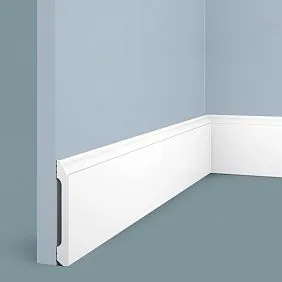
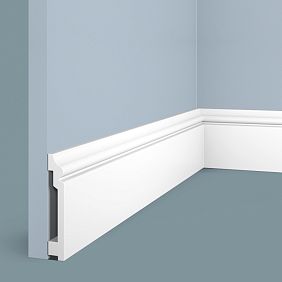
A shaped baseboard with coves, beads, fillets — classical, traditional, decorative. It suits classical living rooms where the mirror is in a carved frame, and the wall is treated with moldings or boiserie panels. The baseboard profile should echo the profile of the mirror frame and moldings — creating a unified language of forms.
A carved baseboard with ornamentation — luxurious, formal, for status interiors. Floral motifs, geometric patterns, classical designs. Such a baseboard itself becomes a decorative element and requires a corresponding mirror frame (also carved, with ornamentation).
Baseboard color in the accent wall system
The color of the baseboard is critically important for the harmony of the composition. Three main approaches.
Baseboard in the color of the wall. White wall — white baseboard. Gray wall — gray baseboard. This creates solidity, a sense that the wall and baseboard are a single structure. This technique visually elongates the height of the wall, making the room appear taller. Suitable for living rooms with low ceilings.
Baseboard in the color of the mirror frame. If the mirror frame is walnut-toned, the baseboard is also walnut. If the frame is white, the baseboard is white. This creates a visual connection between the bottom of the wall (baseboard) and the center of the wall (mirror), unifying the composition. Suitable for classical and neoclassical interiors.
Contrasting baseboard. Light wall — dark baseboard (graphite, wenge, black). Or vice versa: dark wall — light baseboard. Contrast creates graphic quality, a clear boundary, modern aesthetics. Suitable for modern living rooms where visual clarity and structure are valued.
Baseboard material: solid wood or MDF
For an accent wall in the living room, the best choice isa baseboard made of solid oak or beech. Solid wood is noble, durable, and creates a sense of quality. The wood grain (especially if the baseboard is varnished or oiled) adds tactility, naturalness, warmth. If the mirror frame is also solid wood — they will be perfectly coordinated in texture, color, and spirit.
MDF baseboard under enamel — a more budget-friendly alternative, suitable for modern interiors where everything is painted matte white, gray, black. MDF provides a perfectly smooth surface, which is valued in minimalism. But if the mirror is in a wooden frame, the combination of a wooden frame and an MDF baseboard can create visual dissonance (wood and non-wood). It's better to have either all wood or all painted.
Architectural approach: vertical panels plus a central mirror
The most expressive way to create an accent wall is to use an architectural approach where the mirror is integrated into a system of vertical panels or moldings. This is not just a mirror hung on a wall — it is an integrated composition where all elements work together.
Vertical panels as the rhythmic foundation
The wall is divided by vertical moldings or battens into several sections of equal or different widths. The central section (usually the widest) is intended for the mirror. The side sections can be filled with painted surface, wallpaper, wooden panels, fabric.
For example, a wall four meters wide is divided into five vertical sections: two narrow ones at the edges (sixty centimeters each), two medium ones (eighty centimeters each), one central wide one (one hundred forty centimeters). A mirror one hundred eighty centimeters high, one hundred twenty centimeters wide is integrated into the central section. The side sections are painted or wallpapered. The vertical moldings between sections are made of oak, painted to match the baseboard. The result is a structured, architectural composition where the mirror is the center, and the panels are the framing.
Symmetry or asymmetry
Symmetrical composition — when the side sections mirror each other relative to the center. Two panels on the left, a mirror in the center, two panels on the right (identical to the left ones). Such a composition creates a classical, balanced, solemn atmosphere. Suitable for traditional classical living rooms where order, proportions, and respectability are valued.
Asymmetric composition is when the left and right parts differ. For example, a wide panel on the left, a mirror in the center, and two narrow panels on the right. Or a mirror shifted from the center to the left, with more space on the right. Asymmetry creates dynamism, modernity, and unexpectedness. Suitable for modern living rooms, eclectic interiors where creativity is welcome.
Panel height: up to the ceiling or waist-high
Vertical panels can run from the baseboard to the ceiling cornice (full wall height) or only up to a certain height (one and a half to two meters). Full height creates monumentality, architectural quality, turning the wall into a colonnade. A mirror in such a system is perceived as part of the architecture, built into the structure.
Waist-high panels (one hundred twenty to one hundred fifty centimeters) create a more intimate, less formal atmosphere. The upper part of the wall remains free—painted or wallpapered. The mirror can be placed within the panel area or higher, partially extending beyond their boundaries. Such a composition is lighter, more airy, suitable for low-ceilinged rooms.
Panel material: wood, MDF, moldings
Vertical panels can be made from different materials.
Wooden slats (width five to ten centimeters, thickness two to four centimeters) create a pronounced relief, tactility, and naturalness. The slats are attached to the wall vertically, with a certain spacing or tightly next to each other.Wooden slats on the walladd volume, texture, and a modern character. Suitable for eco-interiors, Scandinavian style, and modern classic.
Moldings (narrow decorative strips three to eight centimeters wide) create frames, outlines of sections. Moldings are attached to the wall vertically, forming the boundaries of the panels. Inside the frames, the wall remains smooth or receives additional decoration.Wall finishing with moldings— a classic technique that works in any style from strict classic to neoclassical.
MDF or plywood panels — solid vertical strips covering the wall. A more large-scale, holistic solution that creates a sense of cladding and solidity. Panels can be painted, laminated to resemble wood, or covered with veneer.
Combination of baseboard, wall, and mirror frame colors
Color harmony is the foundation of a successful accent wall. The three main elements (baseboard, wall, mirror frame) must be coordinated. Let's consider proven schemes.
Monochromatic scheme: everything in one color
White baseboard, white wall, white mirror frame. Or gray baseboard, gray wall, gray frame. Monochrome creates maximum integrity, minimalism, and purity. The emphasis is not on color, but on form, relief, and the play of light and shadow. A mirror pane in a white frame on a white wall with a white baseboard — this is a classic of neoclassicism, elegant, restrained, timeless.
Monochromatic is suitable for small living rooms where an excess of colors can create visual noise. One color expands the space, making it lighter and more airy.
Contrast scheme: two colors
Wall light (white, light gray, beige), baseboard and frame dark (walnut, wenge, graphite). Or vice versa: wall dark (dark gray, blue, emerald), baseboard and frame light (white, cream, light wood). Contrast creates graphic quality, clarity, and structure. A mirror in a dark frame on a light wall stands out, attracts the eye, and becomes a focal point.
Contrast scheme is suitable for spacious living rooms where visual drama can be afforded. In small rooms, dark elements on a light background can visually fragment the space.
Three-color scheme: base, accent, neutral
Wall neutral (light gray), baseboard matching the wall (gray), mirror frame accent (gold, bronze, dark walnut). Three shades, but with a clear hierarchy: base (wall and baseboard unified), accent (frame stands out). Such a scheme creates a balance between calmness and interest. The eye focuses on the frame, but the background does not conflict; it supports.
Three-color scheme is suitable for eclectic, modern living rooms where visual complexity is valued, but not chaos.
Gradient scheme: transition from dark to light
Baseboard dark (dark oak, graphite), wall medium (gray, beige), mirror frame light (white, light wood, silver). Or vice versa: from bottom to top, from light to dark. Gradient creates a smooth transition, visual softness, and an absence of sharp boundaries. This is suitable for living rooms where one wants to avoid graphic rigidity and create a more relaxed atmosphere.
Color temperature: warm or cool
It is important to maintain a unified color temperature. If the baseboard is made of warm golden oak, the mirror frame should also be warm (natural wood, gold, bronze). If the baseboard is cool (gray, whitewashed oak, white enamel), the frame should also be cool (white, gray, silver). Mixing warm and cool (for example, a warm walnut baseboard and a cool silver frame) is a mistake that creates visual dissonance.
One large mirror or a composition of several
A mirror on an accent wall can be a single large one or a composition of several mirrors. Both approaches work but solve different tasks.
One large mirror: focus and monumentality
OneLarge framed mirrorMeasuring one hundred twenty by one hundred eighty centimeters or larger — this is a powerful focal point that dominates the wall, draws all attention, and creates a sense of monumentality. Such a mirror works like a portal, a window into another space. The reflection in it is large-scale, full, and captivating.
One large mirror is suitable for:
-
Spacious living rooms (twenty-five to thirty-five square meters and larger), where the scale of the mirror is proportionate to the scale of the room.
-
Classic interiors, where monumentality, solemnity, and formality are valued.
-
Symmetrical compositions, where the mirror is placed strictly in the center of the wall.
-
Situations where the mirror is the only large decorative element on the wall (without additional paintings, sconces, shelves).
Size of one large mirror:
-
Minimum one hundred by one hundred fifty centimeters for a living room of twenty to twenty-five square meters.
-
Optimum one hundred twenty to one hundred forty centimeters width, one hundred eighty to two hundred centimeters height for a living room of twenty-five to thirty-five square meters.
-
Maximum one hundred fifty to one hundred eighty centimeters width, two hundred twenty to two hundred fifty centimeters height for living rooms larger than thirty-five square meters with high ceilings.
Composition of two to three mirrors: rhythm and dynamics
Instead of one large mirror, you can use two to three smaller mirrors, placed side by side or in a specific geometry. For example, three vertical mirrors measuring sixty by one hundred twenty centimeters each, placed in a row with an interval of ten to fifteen centimeters. Or two square mirrors eighty by eighty, placed symmetrically relative to the center of the wall.
A composition of several mirrors is suitable for:
-
Modern living rooms, where dynamics, visual complexity, and non-obviousness are valued.
-
Wide, low walls (width four to five meters, height two meters fifty to two meters seventy), where a single mirror does not fill the space proportionally.
-
Asymmetrical compositions, where mirrors are of different sizes, shapes, and placed irregularly.
-
Situations where mirrors need to be combined with other elements (paintings, sconces, shelves) in a single composition.
Composition options:
Horizontal row: three to five mirrors of the same size, placed in a horizontal line. Creates rhythm, visually expands the wall horizontally.
Vertical row: two to three mirrors one above the other. Stretches the space upward, suitable for narrow, high walls.
Symmetrical pair: two mirrors of the same size and shape, placed symmetrically relative to the center. A classic, balanced scheme.
Asymmetrical group: mirrors of different sizes and shapes, placed according to the principle of visual balance (not symmetry, but equilibrium of masses). A modern, creative scheme.
Grid: four, six, or nine mirrors, placed in a geometric grid (two by two, two by three, three by three). A graphic, structural scheme.
Mirror frames in a composition: identical or different
If a composition of several mirrors is used, the frames should be coordinated. The ideal option is absolutely identical frames (same size, same shape, same color, same profile). This creates maximum integrity, a sense of seriality, and order.
An acceptable option is frames of different sizes but of the same style, color, and material. For example, one frame is eighty by one hundred twenty, another is sixty by one hundred, but both are made of oak, both are walnut-stained, and both have the same profile. The sizes are different, but the kinship is obvious.
An unacceptable option is completely different frames: one is a carved gold Baroque frame, another is a simple black modern frame, and a third is a white Provence frame. This is chaos, a lack of system, and a visual conflict.
Practical checklist: selecting sizes for the perfect composition
Creating an accent wall with a baseboard and mirror requires precise calculation of dimensions. Here is a step-by-step checklist.
Step 1: measure the wall
Measure the width and height of the wall that will become the accent wall. Record the dimensions in centimeters. Consider the location of outlets, switches, and openings—they may limit the placement of elements.
Step 2: Determine the height of the baseboard
For ceilings up to two meters seventy centimeters—baseboard eighty to one hundred millimeters. For ceilings two meters seventy to three meters—baseboard one hundred to one hundred twenty millimeters. For ceilings above three meters—baseboard one hundred twenty to one hundred fifty millimeters.
Step 3: Calculate the height of the mirror
The height of the mirror depends on the height of the wall (from the top edge of the baseboard to the ceiling cornice or ceiling). Optimal: the mirror occupies from fifty to seventy percent of the wall height.
For example, wall height from baseboard to ceiling is two meters fifty centimeters (ceiling two meters seventy minus baseboard twenty centimeters). Mirror height one hundred fifty to one hundred seventy-five centimeters—that's sixty to seventy percent, perfect.
Step 4: Calculate the width of the mirror
The width of the mirror depends on the width of the wall and the chosen composition (one mirror or several).
For a single mirror: optimally from thirty to fifty percent of the wall width. For example, a wall four meters (four hundred centimeters). Mirror width one hundred twenty to two hundred centimeters—that's thirty to fifty percent.
For a composition of several mirrors: the total width of all mirrors plus intervals between them—from fifty to seventy percent of the wall width.
Step 5: Determine the shape of the mirror
Vertical rectangular—a universal choice for most living rooms. Square—for modern interiors with square proportions. Arched—for classic interiors with high ceilings. Round—for accents, but rarely as the only element on a large wall (a circle requires a square or rectangular frame).
Step 6: Choose the mirror frame
The frame should match the interior style, baseboard color, and molding profile (if any). Frame molding width: for mirrors up to one hundred centimeters—molding six to ten centimeters. For mirrors one hundred to one hundred fifty centimeters—molding ten to fifteen centimeters. For mirrors larger than one hundred fifty centimeters—molding fifteen to twenty-five centimeters.
Step 7: Calculate the placement of the mirror on the wall
The mirror should be placed at a comfortable viewing height. The center of the mirror (midpoint of its height) should be at eye level of a standing person—approximately one hundred fifty to one hundred seventy centimeters from the floor. This means the lower edge of the mirror will be at a height of seventy-five to ninety centimeters from the floor (if the mirror is one hundred fifty centimeters tall).
Distance from the top edge of the baseboard to the lower edge of the mirror frame—minimum thirty to fifty centimeters. This creates a visual pause, breathing space.
Step 8: Determine additional elements
If a composition with vertical panels or moldings is planned, calculate their width, quantity, and intervals. If side elements (sconces, shelves, paintings) are planned, determine their sizes and placement relative to the mirror.
Step 9: Create a visualization
Before purchase and installation, create a sketch or computer visualization. Draw the wall to scale, indicate the baseboard, mirror, and additional elements. Assess proportions, balance, and visual weight. If something is off—adjust the dimensions at the project stage, not after installation.
Typical mistakes when creating an accent wall with a mirror
Even with a checklist, mistakes can be made. Here are the top five blunders to avoid.
Mistake 1: Mirror too small
A mirror sixty by eighty centimeters on a wall four meters wide and two meters seventy high—this is not an accent wall, it's a mirror lost on the wall. The mirror must have sufficient visual weight to dominate. Better one large mirror than several small, unremarkable ones.
Mistake 2: Low, unremarkable baseboard
A baseboard five to seven centimeters under a large mirror—it's like a cardboard foundation under a marble column. The scales don't match. For an accent wall with a large mirror, a baseboard of at least eighty millimeters is needed, better one hundred to one hundred twenty.
Mistake 3: Color conflict
Warm walnut baseboard, cold gray wall, warm gold mirror frame. Three different temperatures, two warm elements and one cold one between them. Visual conflict. Either all warm or all cold.
Mistake 4: Incorrect mirror placement height
The mirror is hung too high (the bottom edge at a height of one hundred twenty centimeters) or too low (the bottom edge at a height of fifty centimeters). In the first case, it's impossible to see yourself fully; in the second, the mirror seems to be sliding toward the floor. The center of the mirror should be at eye level—one hundred fifty to one hundred seventy centimeters.
Mistake 5: decor overload
A large mirror plus four paintings plus two sconces plus a shelf plus a clock on one wall—this is not an accent wall, it's a decor warehouse. An accent works when it's singular (or a maximum of two to three elements). The mirror should be the main feature; the rest is a delicate addition or absent altogether.
Frequently asked questions
Can you hang a mirror on an accent wall with wallpaper?
Yes, but the wallpaper should not be too bold. A large, contrasting pattern will compete with the mirror for attention. Solid-colored wallpaper, a small delicate pattern, or textured paintable wallpaper is better. Alternatively, wallpaper only in the side sections (if the wall is divided by moldings), with a smooth painted surface behind the mirror.
What distance should be between the bottom edge of the mirror and the top edge of the console (if present)?
If there is a console under the mirror, the distance from the console tabletop to the bottom edge of the mirror frame is ten to twenty centimeters. This creates a visual connection without merging. The mirror and console are perceived as an ensemble.
Is a ceiling cornice needed for an accent wall with a mirror?
Not mandatory, but desirable for a finished composition. The cornice completes the wall from the top, just as the baseboard completes it from the bottom. If there is a baseboard with a height of one hundred millimeters, it's logical to have a cornice with a height of eighty to one hundred twenty millimeters. This creates a frame in which the mirror exists.
How to illuminate an accent wall with a mirror?
Ideally—directed spotlights on the ceiling, positioned so that light falls on the wall and mirror at an angle of forty-five to sixty degrees (not straight down, but slightly from the side). This creates even lighting without glare. Additionally—sconces on the sides of the mirror (at a distance of fifty to seventy centimeters from the edges of the frame), providing soft side lighting.
Can you create an accent wall with a mirror in a small living room?
Yes, but the dimensions must be proportionate. A living room of fifteen square meters—a mirror one hundred by one hundred fifty centimeters (no larger), an eighty-millimeter baseboard, minimal additional decor. The mirror will visually expand the small living room, but if it's too large or there's too much decor, the effect will be the opposite—overload.
Which wood species is best for a mirror frame and baseboard?
Oak—a universal classic, durable, expressive texture, takes stain well. Beech—more delicate, ideal for enamel painting. If you want natural wood under varnish—oak. If painted white/gray—beech. Important: the frame and baseboard should be from the same species, otherwise the textures will conflict.
How much does it cost to create an accent wall with a mirror and baseboard?
Depends on dimensions, materials, complexity. Approximately: baseboard for a four-meter wall (height one hundred millimeters, solid oak)—fifteen to twenty-five thousand rubles. Mirror one hundred twenty by one hundred eighty in a wooden frame—forty to eighty thousand (simple frame) up to one hundred fifty to three hundred thousand (carved frame with gilding). Moldings/panels (if present)—thirty to eighty thousand. Installation—twenty to fifty thousand. Total from one hundred to five hundred thousand rubles depending on the level.
Conclusion: an accent wall as an investment in the home's atmosphere
An accent wall in the living room, combining an expressivewooden baseboardandLarge framed mirrormade of natural wood—is not just decor. It's an architectural solution that changes the perception of the entire room. The mirror doubles the space, multiplies light, creates visual depth. The baseboard sets the scale, forms the baseline on which the entire composition rests. Together, they transform an ordinary living room into a space with character, drama, and professional execution.
Creating an accent wall requires attention to detail, understanding of proportions, a sense of color and material. The baseboard height should correspond to the ceiling height and mirror size. The colors of the baseboard, wall, and frame should be coordinated—monochrome, contrast, or a three-color scheme, but not chaos. The mirror size should be sufficient to dominate but not overwhelm. The mirror placement should be at the correct height—center at eye level.
When all elements are aligned correctly, the accent wall becomes not just a beautiful background, but a functional center of the living room. Here, gazes gather, attention focuses, and the perception of the interior begins. It's an investment in the home's atmosphere, in daily comfort, in the pleasure of the space.
The company STAVROS has been creating elements for such interiors for over twenty years.Baseboards made of solid oak and beechwith heights from sixty to one hundred fifty millimeters, with dozens of profiles from simple to carved.Mirrors in wooden framesof any sizes and styles—from minimalist to baroque, from natural wood to gilding.Moldings and cornicesfor creating vertical panels and architectural compositions.
STAVROS offers not just a catalog of elements, but a systematic approach. STAVROS designers help plan an accent wall considering the proportions of your space, interior style, and budget. Production is carried out at their own facility with quality control at all stages. Factory finishing (staining, painting, patination) guarantees color unity across all elements. Delivery throughout Russia with professional packaging.
Choosing STAVROS means choosing quality that lasts for decades. Wood never goes out of style, doesn't lose value, and doesn't require frequent replacement.Mirror with frameSolid oak with hand carving will look just as noble twenty years from now as it did on the day of installation. Solid wood skirting will outlast several generations of flooring. This is an investment not for a year, not for five — but for the entire lifetime of the home.
Create interiors that inspire. Invest in elements that contribute to the atmosphere every day. Choose materials that are honest, reliable, and beautiful. Choose STAVROS — choose craftsmanship, tradition, quality.