Article Contents:
- MDF Solutions: Painter-Ready Skirting Boards and Architraves as a Budget Alternative to Solid Wood
- Why Choose MDF for Skirting Boards and Architraves
- MDF Skirting Board and Architrave Profiles
- Doorways: Framing with Polyurethane Molding for a Classic Look
- Why Choose Polyurethane for Door Portals
- Polyurethane Door Portal Elements
- Style Unity: How to Paint MDF and Polyurethane the Same Color
- Preparing MDF Surface for Painting
- Preparing Polyurethane for Painting
- Painting MDF and Polyurethane: Unified Technology
- Installation: DIY Mounting of MDF Architraves and Skirting Boards
- Tools and Materials
- MDF Skirting Board Installation: Step-by-Step Guide
- MDF Architrave Installation: Step-by-Step Guide
- Wall Molding: Creating Frames Around Doors with Polyurethane Profiles
- Why Use Molding Around Doors
- Molding Placement Options
- Installing Molding Around Doors
- Complete Kit: MDF Skirting Board Plus Architraves Plus Molding
- Kit Planning
- Kit Installation Sequence
- Color Solutions: Classic and Modern Options
- White — Universal Classic
- Gray — Modern Alternative
- Wall Color — Visual Expansion
- Door Color — Portal Unity
- Contrast — Black on White or Vice Versa
- Frequently Asked Questions: Answers to Popular Queries
- Conclusion: Create a Complete Interior with a Comprehensive Solution from STAVROS

What transforms an ordinary interior door into an architectural accent? What makes the eye linger on the opening, appreciate the proportions, and feel the completeness of the composition? The answer is simple — proper framing.MDF Skirting Board and Architrave at the bottom of the wall creates a transition from the floor to the vertical plane, while the Polyurethane moldings for doorways forms a portal that turns a utilitarian passage into an aesthetic element. When these details work in unison — painted in a single color, coordinated in profile, installed flawlessly — the interior gains an integrity that cannot be faked.
Today, we will break down a comprehensive approach to finishing doorways and walls: how to choose MDF skirting boards and architraves, why polyurethane is ideal for door decoration, how to achieve stylistic unity through painting, and how to install everything yourself without hiring crews. This is not just theory — it's a step-by-step guide with specific recommendations, techniques, and solutions to common problems.



MDF Solutions: Skirting Boards and Architraves for Painting as a Budget Alternative to Solid Wood
MDF is not a compromise. It is a rational choice that, with the right approach, does not fall short of solid wood in visual aesthetics, while surpassing it in geometric stability, moisture resistance, and paintability. What is MDF? Medium Density Fiberboard — a material created by pressing wood fibers with synthetic binders under high temperature and pressure. The density of quality MDF for moldings is 760-850 kg/m³, with a formaldehyde emission class of E1 (safe for residential spaces, including children's rooms).




Why Choose MDF for Skirting Boards and Architraves
Geometric stability is the main advantage. Solid wood is a living material that reacts to changes in air humidity. In winter, when heating is on, humidity drops to 20-30%, wood dries out, skirting boards and architraves can pull away from the wall, and gaps can appear between planks. In summer, when humidity rises to 60-70%, wood swells, and planks can bow into an arc. MDF is stable — it does not shrink or swell with humidity fluctuations in the 30-70% range. A plank installed in winter will not deform in summer.— is a horizontal element that frames the room at the bottom of the walls where the wall meets the floor. Skirting boards perform several functions: they hide the technological gap between the wall and floor covering (necessary for thermal expansion), protect the lower part of the wall from mechanical damage, create visual completion, and may conceal wiring. maintains its geometry for decades.
Paintability is the second key virtue. The MDF surface is smooth, dense, and lacks the open pores of wood. Primer absorbs evenly, creating a perfect base for paint. One coat of primer plus two coats of paint — and you get a flawless finish without color variation, base show-through, or roughness. Solid oak or ash requires multiple coats of primer, pore filling, and lengthy preparation — MDF is significantly simpler.MDF door and window casings for painting after quality painting, are indistinguishable from solid wood.
Price is the third factor.buy MDF skirting board can be 2-3 times cheaper than a similar one made of solid oak. MDF architraves cost 150-400 rubles per linear meter (depending on the profile), while oak architraves cost 800-1500 rubles. When finishing an apartment of 60-80 m², the savings amount to 30-50 thousand rubles — a substantial sum that can be directed towards quality paint, mounting adhesive, and tools.
Moisture resistance is the fourth advantage. Moisture-resistant MDF (with paraffin impregnation) withstands humidity up to 80-90% without deformation. It can be installed in kitchens, bathrooms, hallways — places where solid wood risks swelling or cracking.MDF trim in damp rooms — practicality without aesthetic loss.
Our factory also produces:


MDF Skirting Board and Architrave Profiles
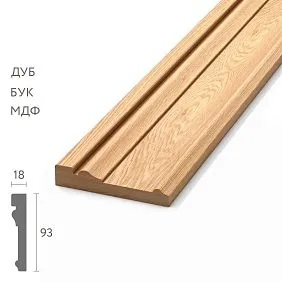
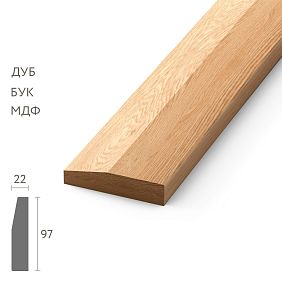
Manufacturers offer dozens of profiles — from the simplest rectangular ones to complex classical ones with curves, grooves, and protrusions.
Straight profile — a minimalist option. The cross-section is rectangular (skirting board 80×16 mm, architrave 70×12 mm) or slightly beveled. Suitable for modern interiors — Scandinavian style, minimalism, loft. The straight profile is easier to install (joins without meticulous fitting) and easier to paint (no recesses where paint can pool).
Classical profiled profile — a traditional option with curves, grooves, and steps. Skirting board 100-120 mm high with soft curves, architrave 80-90 mm wide with two or three grooves. Suitable for classical, neoclassical, traditional interiors. The profiled profile creates a play of light and shadow, visual volume, and a sense of nobility.
Wide European profile — skirting board 120-150 mm high, architrave 100-120 mm wide. Rectangular or slightly profiled cross-section. Characteristic of English and American interiors, it creates monumentality and visually expands the walls. Suitable for spacious rooms with high ceilings (from 3 m).
Get Consultation
Doorways: Framing with Polyurethane Molding for a Classical Look
If MDF architraves are a budget-friendly door framing, then polyurethane molding is a decoration that turns an opening into an architectural portal. What does polyurethane offer? The ability to create volumetric relief, ornamentation, and a classical order system without the cost of plaster, stone, or carved wood.
Why Polyurethane for Door Portals
Detail is the main advantage. Polyurethane is cast in silicone molds taken from original carved master models. Every detail of the ornament — an acanthus leaf petal, a volute curl, an oak leaf — is reproduced with precision down to fractions of a millimeter.Polyurethane door decoration allows for recreating classical portals from the Renaissance, Baroque, and Empire eras without engaging wood carvers.
Lightweight is the second virtue. The density of polyurethane is 250-350 kg/m³ — 3-4 times lighter than plaster, 7-8 times lighter than stone. A large architrave 150 mm wide and 2.5 m long weighs 2-3 kg, not 8-10 kg (like plaster) or 20-25 kg (like stone). Installation is simplified, no reinforced fasteners are needed, and the risk of collapse is minimal.
Moisture resistance is the third advantage. Polyurethane is not afraid of moisture — water absorption is less than 1-2%. It can be installed in bathrooms, kitchens, hallways without the risk of swelling, delamination, or mold. Plaster molding in damp rooms deteriorates in 3-5 years; polyurethane molding lasts 30-50 years.
Paintability is the fourth virtue. Polyurethane comes with a white primer coating, ready to be painted with any water-based, acrylic, or latex paints. Any color, patina effect, gilding, or silvering can be achieved.Framing a Doorway with Decorative Moldingafter painting, polyurethane is indistinguishable from plaster or stone — only by weight.
Door portal elements made of polyurethane
A classic door portal includes several elements:
Vertical trims (pilasters) — side frames to the right and left of the door. Width 80-200 mm, height corresponds to the opening height (usually 210-220 cm). The profile can be flat (simple molding), profiled (with grooves, protrusions), or three-dimensional (pilaster with base, shaft, capital).polyurethane create a classic frame between the wall and ceiling. The profile height varies from minimalist 50 mm to ceremonial 200 mm — the choice depends on the room's height and style. In a room with 2.7 m ceilings, a 150 mm cornice will look excessive, 'pressing' from above. And in a hall with 3.5 m ceilings, a narrow 60 mm cornice will get lost, failing to visually mark the boundary.create vertical rhythm, visually elongate the opening.
Horizontal trim (frieze) — the top framing above the door. Width matches the width of the vertical trims, length — the width of the opening plus the overhangs of the side trims (usually 100-120 cm). The frieze can be smooth or with a relief ornament (floral motifs, geometric patterns, stucco panels).
Capitals — decorative elements crowning the vertical pilasters. The shape of the capital determines the order: Doric (simple, without scrolls), Ionic (with volutes-scrolls), Corinthian (with acanthus leaves). Capitals give the portal classical solemnity.
Pediment — a triangular or semicircular element above the horizontal trim. The pediment is the highest degree of portal decorativeness, characteristic of main entrances, living rooms, dining rooms. In the center of the pediment, a cartouche (decorative shield), rosette (circular ornament), or garland can be placed.
Bases — the lower elements of pilasters, creating a transition from the floor to the pilaster shaft. Bases visually stabilize the portal, giving it massiveness and solidity.
Style unity: how to paint MDF and polyurethane the same color
The main secret of a harmonious interior is the unity of color of all decorative elements. When the baseboard at the bottom of the wall, the door trim, the moldings around the opening, and the ceiling cornice are painted the same color (white, gray, beige, any other), a wholeness arises that cannot be faked. How to achieve this?
Preparing MDF surface for painting
MDF is supplied either with factory primer (white or gray) or without coating (raw MDF). If there is no primer, it must be applied independently.
Sanding — the first stage. Even if MDF is supplied smooth, light sanding with 180-220 grit sandpaper improves primer adhesion. Sand along the length of the plank, without strong pressure. The goal is to slightly roughen the surface, create micro-roughness. After sanding, remove dust with a dry cloth or vacuum.
Priming — the second stage. Use acrylic primer for MDF (there are special compounds that fill pores). Apply primer with a brush or roller in a thin, even layer. Don't aim to cover the MDF in one go — two thin coats are better than one thick one. The first coat dries in 4-6 hours, after which the second is applied. After the second coat dries (another 4-6 hours), the surface is ready for painting.
Sanding the primer — the third stage (optional, for perfect results). After the primer dries, the surface may have slight roughness (raised fibers). Light sanding with 240-320 grit sandpaper removes roughness, making the surface perfectly smooth. After sanding, remove dust.
Preparing polyurethane for painting
Polyurethane is supplied with factory white primer, ready for painting without additional preparation. But there are nuances.
Cleaning — the first step. Wipe the surface with a damp cloth, remove dust, grease (fingerprints), and dirt. Let dry for 10-15 minutes.
Sealing joints — the second step. If the molding is installed, the joints between elements must be filled with acrylic putty. Apply putty in a thin layer, smoothing with a spatula. After drying (2-3 hours), sand the joints with 180-220 grit sandpaper to make them invisible.
Additional priming — the third step (optional). If you plan to paint in a dark or bright color, an additional coat of primer (tinted to the future paint color) will improve coverage and reduce paint consumption. Apply primer with a brush, dries in 2-4 hours.
Painting MDF and polyurethane: unified technology
The painting technology for MDF and polyurethane is identical — both materials are painted with water-based or acrylic paints.
Paint selection — is critically important. Use interior acrylic paints (matte, semi-matte, or satin). Glossy paints highlight the slightest irregularities, matte paints hide them.Painting polyurethaneand MDF is best done with premium segment paints (Tikkurila, Dulux, Caparol, Benjamin Moore) — they have high coverage, do not leave streaks, and are easy to apply.
Tinting — if a color other than white is needed. Have the paint tinted in-store using a computer tinting machine — this guarantees color accuracy and repeatability (if you need to buy more paint later). Ask to tint the entire volume at once — paints from different batches may slightly differ in shade.
Applying the first coat — use a brush (for moldings with relief) or a roller (for flat baseboards and trims). Move the brush along the length of the plank, without jerks. Don't try to cover the base in one coat — the paint should be applied thinly and evenly. Thoroughly paint relief indentations, ensuring paint gets into all grooves. The first coat dries in 2-4 hours.
Sanding between coats — an optional but recommended step. After the first coat dries, slight roughness may appear. Sand the surface with fine 320-400 grit sandpaper, remove dust. The surface will become perfectly smooth.
Applying the second coat — the final stage. The second coat is applied similarly to the first, but the paint goes onto a prepared base, coverage is higher. After the second coat dries (another 2-4 hours), the coating is ready. If maximum durability is needed (for baseboards that will be washed), a third coat can be applied or a matte varnish can be used.
Installation: DIY installation of MDF architraves and skirting boards
Installing MDF moldings is a moderately complex task, accessible to a home craftsman with a minimal set of tools. The main things are marking accuracy, careful joining, and choosing the right fasteners.
Tools and materials
Tools:
-
Miter saw (or a fine-toothed handsaw plus a miter box)
-
Tape measure, pencil, square
-
Adhesive mounting gun
-
Nail set (for countersinking nails)
-
Hammer or pneumatic nail gun
-
Sandpaper grit 180-220
-
Narrow spatula (for filling holes)
Materials:
-
MDF skirting boards and architraves (calculate the linear footage with a 10% surplus for offcuts)
-
Mounting adhesive (liquid nails, polyurethane adhesive)
-
Finish nails 30-40 mm long (if using combined installation)
-
Acrylic filler (for filling holes)
-
Corner elements (internal and external corners) or material for joining at 45 degrees
Installing MDF skirting boards: step-by-step instructions
Step 1: Marking. Start with the longest wall. Place the skirting board against the wall, check how tightly it fits. If the wall is uneven (protrusions, depressions more than 3-5 mm), the skirting board won't adhere tightly — wall leveling or using screws will be required.
Step 2: Cutting corners. Corners are joined in two ways: at 45 degrees (classic method) or using corner elements (simplified). Joining at 45 degrees requires precision — cut with a miter saw or in a miter box. Internal corner: two strips are cut at 45 degrees facing each other, joined with the angle inward. External corner: two strips are cut at 45 degrees facing each other, joined with the angle outward.
Step 3: Installation with adhesive. Apply adhesive to the back of the skirting board in a zigzag pattern with a 5-7 cm spacing. Place the skirting board against the wall, press, align along the bottom edge (the skirting board should fit tightly to the floor). Hold for 30-60 seconds for initial setting. If the wall is even, adhesive is sufficient.
Step 4: Combined installation (adhesive + nails). If the wall is uneven or maximum reliability is required, use combined installation. Apply adhesive, place the skirting board, secure with finish nails spaced 40-50 cm apart. Drive nails at a 45-degree angle to the wall, sink the heads 1-2 mm below the surface with a nail set.Installing MDF skirting boards for paintingwith nails is more reliable but requires filling the holes.
Step 5: Filling joints and holes. After installing all skirting boards, inspect the joints. If there are gaps (imperfect corner fitting), fill them with acrylic filler. Also fill nail holes. After the filler dries (2-3 hours), sand with 180-220 grit sandpaper. The skirting board is ready for painting.
Installing MDF architraves: step-by-step instructions
Step 1: Marking. Measure the height of the door opening from the floor to the top edge.MDF baseboardsare usually installed with a 5-10 mm offset from the edge of the opening to avoid covering hinges and locks.
Step 2: Cutting vertical architraves. Vertical architraves are cut to the height of the opening. The top end is cut at 45 degrees (for joining with the horizontal architrave). The bottom end is cut at 90 degrees (placed on the floor or on the skirting board).
Step 3: Cutting the horizontal architrave. The horizontal architrave (top strip) is cut to the width of the opening plus overhangs. Both ends are cut at 45 degrees (for joining with vertical architraves).
Step 4: Installation with finish nails.MDF door casingis installed with 30-40 mm long finish nails spaced 40-50 cm apart. Nails are driven into the end of the door frame (if it's wooden) or into the wall near the opening (if the frame is metal). Heads are sunk with a nail set, holes are filled.
Step 5: Combined installation (adhesive + nails). For maximum reliability, apply adhesive to the back of the architrave, press, secure with nails. The adhesive sets in 12-24 hours, after which the main load is on the adhesive bond.
Step 6: Filling joints. The joints of architraves in corners (where vertical and horizontal meet) should be tight, without gaps. If there are gaps (imperfect fitting), fill with acrylic filler, sand. The architraves are ready for painting.
Wall moldings: creating frames around doors with polyurethane profiles
A simple casing frames the door.Moldings made of polyurethanecreate a frame composition that transforms the opening into an architectural portal. How does it work?
Why are moldings needed around a door
Emphasizing the opening is the first function. Moldings highlight the door on the wall plane, making it a focal point. This is especially important in large rooms (living rooms, halls), where the door can 'get lost' against the wall.
Creating a portal is the second function. Moldings placed 10-20 cm from the casings form a double frame - an inner one (casings) and an outer one (moldings). Between them, there can be a different wall color, patterned wallpaper, or decorative plaster. This creates a portal effect, depth, and volume.
Connection with other elements is the third function. If the room has wall panels (molding frames on the lower part of the walls) or ceiling cornices, then moldings around the door tie everything into a unified decorative system.DIY door decoration with moldingsallows for the creation of a cohesive architectural ensemble.
Molding placement options
Rectangular frame - the simplest option. Moldings are placed parallel to the casings at a distance of 10-15 cm, forming a rectangle. Molding width is 50-80 mm (slightly narrower than the casings). The profile can be simple (flat or with one groove) or classic (profiled with roundings).
Arched frame - for classic interiors. Vertical moldings are straight, the horizontal molding above the door is arched (semi-circular). This creates solemnity, characteristic of classicism, baroque, and empire style.
Broken frame - a modern technique. Moldings are not placed around the entire door perimeter, but only on the sides (vertical) or only on top (horizontal). This creates conciseness, suitable for minimalist interiors.
Moldings with capitals - maximum decorativeness. Corner elements - rosettes, capitals, cartouches - are installed in the upper corners of the frame (at the junctions of vertical and horizontal moldings). This is characteristic of neoclassicism, English style, and American classic.
Installing moldings around a door
Step 1: Marking. Determine the distance from the casings to the moldings (usually 10-15 cm). Draw lines on the wall with a pencil, using a level (the lines must be strictly vertical and horizontal).
Step 2: Cutting the moldings. Cut the vertical moldings to height (from the floor or baseboard to the door height plus the height of the horizontal molding). Cut the top ends at a 45-degree angle for joining with the horizontal molding. Cut the horizontal molding to width, both ends at a 45-degree angle.
Step 3: Mounting with adhesive. Apply polyurethane adhesive (or liquid nails) to the back of the molding in a zigzag pattern. Place the molding against the wall according to the markings, press, and hold for 30-60 seconds. For wide moldings (over 80 mm), additionally secure with dowels (2-3 pieces per vertical molding 2-2.2 m high).
Step 4: Sealing joints. Fill the joints at the corners with acrylic putty, sand. The moldings are ready for painting.
Step 5: Painting. Paint the moldings the same color as the casings, baseboards, and ceiling cornices. The painting technique is the same as for casings (primer, two coats of paint).
Ready-made set: MDF baseboard plus casings plus molding
The most harmonious result is achieved when all finishing elements - baseboards at the bottom of the walls, casings around doors, moldings on walls, ceiling cornices - are selected and installed as a single set. How to organize such a set?
Planning the set
Step 1: Determine the style. Modern minimalism - straight profiles, white color, minimal decor. Classic - profiled profiles, possible patina, gilding, wider moldings. Neoclassical - a balance between simplicity and decorativeness, medium-width profiled profiles, white or light gray color.
Step 2: Choose profiles. Baseboard, casings, and moldings should have related profiles. If the baseboard is profiled (with roundings), the casings and moldings should also be profiled. If the baseboard is straight, the other elements should be straight. Width: the baseboard is usually wider than the casings (baseboard 100 mm, casings 80 mm, moldings 60 mm). This creates proportionality - from a wide base at the bottom to narrower elements at the top.
Step 3: Calculate the quantity. Baseboard - room perimeter minus door opening widths plus 10% for cuts. Casings - opening height multiplied by 2.5 (two vertical plus one horizontal) multiplied by the number of doors plus 10% for cuts. Moldings - if planning frames around doors, calculate similarly to casings, but considering the larger perimeter.
Step 4: Order everything from one manufacturer. This guarantees profile compatibility, a uniform white primer shade (important for subsequent painting), and uniform material density.Wooden and MDF casingfrom the same production batch will perfectly match.
Set installation sequence
Stage 1: Wall preparation. Walls must be leveled, painted, or wallpapered. Baseboards and casings are installed on the finished wall finish.
Stage 2: Installing baseboards. Start with baseboards — they set the lower level from which all other elements are positioned.
Stage 3: Installing door casings. After baseboards, install the casings. Vertical casings are placed on the floor (or on the baseboard if it is already installed).
Stage 4: Installing moldings around doors (if planned). After casings, install the external moldings, creating framed compositions.
Stage 5: Installing ceiling cornices (if planned). Cornices are installed last, completing the decor of the upper part of the walls.
Stage 6: Sealing all joints. Inspect all joints (baseboard corners, casing corners, molding joints), fill gaps with putty, sand.
Stage 7: Painting all elements. Paint baseboards, casings, moldings, and cornices in a uniform color. If elements were pre-painted before installation, touch up the puttied areas. A uniform color creates integrity, tying all elements into a unified system.
Color solutions: classic and modern options
What color to choose for baseboards, casings, moldings? There are several proven strategies.
White — the universal classic
White is the most common solution. It visually expands space, creates cleanliness, freshness, and pairs with any wall, floor, or door colors. White baseboards extend the whiteness of walls, making the transition from floor to wall delicate. White casings highlight doors without dominating.A white MDF baseboard creates visual continuity with white door casings, white ceiling cornices, and white window frames. When all architectural details are executed in the same color, they form a unified system, a spatial framework that connects disparate elements — floor, walls, ceiling, furniture — into an integral composition. This technique is fundamental to Scandinavian design, where white architectural decor creates a light shell within which the most diverse colors and textures can coexist.— a fail-safe option for any interior.
Gray — a modern alternative
Gray (light gray, medium gray, graphite) — a trend in recent years. It is softer than white, creates calmness, elegance, and suits modern minimalist interiors. Gray baseboards and casings against light gray walls create tonal contrast — elements are visible but not loud.
Matching wall color — visual expansion
Baseboards and casings painted the same color as the walls visually 'dissolve,' making walls appear taller and space wider. This is a technique for small rooms with low ceilings (2.5 m and below). If walls are beige, baseboards are beige. If walls are blue, baseboards are blue. The effect — airiness, lightness.
Matching door color — unity of the opening
Casings painted the same color as the door leaf create unity of the opening. If doors are dark (wenge, black, dark brown), casings are dark. The door with casings is perceived as a single object, clearly highlighted against a light wall. This suits contrast interiors.
Contrast — black on white or vice versa
Contrast solution (white baseboards and casings on dark walls or dark on white) creates graphic quality, modernity, drama. This is a bold solution requiring precise calculation. Contrast suits spacious rooms with good lighting, for modern and industrial styles.
Frequently asked questions: answers to popular queries
Can you paint an MDF baseboard after installation?
Yes, you can. Moreover, many craftsmen prefer to paint baseboards and casings after installation — it's easier to paint over putty on joints and holes. Protect the floor and walls with painter's tape, paint the baseboard with two coats of paint. The main thing — prime the MDF well before installation.
What glue is best for installing polyurethane moldings?
Special polyurethane glue (e.g., Quelyd Decor or Orac Decofix) or liquid nails (Moment Montage, Tytan). Polyurethane glue sets faster (30-60 seconds), liquid nails are more reliable for heavy elements.
Do moldings need additional fastening with dowels?
For narrow moldings (up to 80 mm) and lightweight elements, glue is sufficient. For wide moldings (over 100 mm), capitals, pediments, additional fastening with dowels is advisable (2-3 per element). Dowels are drilled through the molding into the wall, heads are countersunk, puttied, and invisible after painting.
How to join MDF baseboard in internal corners?
Two methods: at a 45-degree angle (classic, requires precise cutting) or using internal corner elements (simplified, elements purchased separately). Corner elements are easier — insert into the corner, insert baseboard ends into them, no complex fitting.
Can MDF baseboards be used in damp areas?
Yes, if it is moisture-resistant MDF (green or labeled HDF, moisture-resistant). Regular MDF in damp areas (bathrooms, kitchens) may swell. After installing moisture-resistant MDF, be sure to paint it — this provides additional moisture protection.
How much does a set of MDF skirting boards and architraves for a 60 m² apartment cost?
Approximately: MDF skirting boards 80-100 mm — 25-30 linear meters at 200-300 rubles per meter = 5000-9000 rubles. MDF architraves for 5 doors — 35-40 linear meters at 200-300 rubles = 7000-12000 rubles. Total 12000-21000 rubles. Polyurethane moldings (if planned) — another 5000-10000 rubles. Fasteners, glue, putty, paint — another 3000-5000 rubles. Total budget 20000-36000 rubles.
How long does paint take to dry on MDF and polyurethane?
Acrylic paint dries to the touch in 2-4 hours, full drying — 12-24 hours. Wait 3-4 hours between coats. Do not touch the surface for a day after the final coat. Full paint polymerization (maximum durability) — 5-7 days.
Can wooden skirting boards be combined with MDF architraves?
Yes, if both are painted in a unified color with opaque paint. The material difference is not visible under paint. If a natural finish is planned (oil, varnish, stain), it's better to choose a single material — either all wood or all MDF. The texture difference will be noticeable.
How to care for painted skirting boards and architraves?
Wipe with a damp cloth once a week. Do not use abrasives or aggressive cleaning agents. For mechanical damage (scratches, chips), touch up locally with a brush. Every 5-7 years, you can repaint completely (first sand lightly with fine sandpaper for adhesion of the new coat).
Is it mandatory to use moldings around doors?
No, it's optional decor. If the interior is minimalist, architraves are sufficient. Moldings around doors are appropriate in classical, neoclassical, traditional interiors where decorativeness, framed compositions, and portal effects are valued.
Conclusion: create a finished interior with a comprehensive solution from STAVROS
Skirting board, architrave, molding — these are not just trim pieces covering joints and hiding imperfections. They are architectural elements that shape the character of an interior, set the rhythm, create proportions, and bind disparate planes into a unified composition. When these elements are selected skillfully — coordinated in profile, painted in a unified color, installed flawlessly — a sense of integrity arises that cannot be faked. The interior gains completeness, nobility, and professional execution.
STAVROS is a leading Russian manufacturer of trim products from MDF and solid wood, as well as decorative polyurethane moldings. For over two decades, STAVROS has been creating finishing elements used by private clients, interior designers, and construction companies across Russia. In-house full-cycle production guarantees quality control at all stages — from raw material selection to packaging of finished products.
MDF skirting boards and architraves for painting from STAVROS are made of MDF with a density of 760-850 kg/m³, emission class E1, milled on high-precision equipment, sanded, ready for priming and painting. The catalog features dozens of profiles: from simple rectangular to complex classical ones, with heights from 60 to 160 mm. Each plank has perfect geometry (deviation no more than 0.5 mm over 2 meters length), a smooth surface (180-grit sanding), and even ends (cut on miter saws).
Polyurethane moldings for doorways from STAVROS are made of two-component polyurethane with a density of 250-350 kg/m³, cast in high-detail silicone molds. Each element has clear relief (99% reproduction of original details), white primer (ready for painting without additional preparation), and stable geometry (deviation no more than 1 mm). The catalog includes hundreds of items: moldings, pilasters, capitals, friezes, pediments, rosettes, cartouches. Any architectural style — from antiquity to modern — finds embodiment in STAVROS products.
Moldings made of polyurethane for walls and ceilings — over 150 profiles with widths from 30 to 200 mm. Smooth and textured, straight and flexible (for curved surfaces), simple and ornamented. STAVROS moldings do not crack, do not deform, are easily installed with adhesive, and can be painted any color.
STAVROS professional consultants will help you select a set of elements for your project: calculate the required quantity of skirting boards, architraves, moldings, recommend optimal profiles for your interior style, and advise on installation and painting technology. The company's website features detailed catalogs with photos, dimensions, and prices. Delivery across Russia is available, as well as pickup from warehouses in Moscow and St. Petersburg.
By choosing STAVROS, you choose quality tested by time. You choose trim that does not deform, does not crack, and maintains its geometry for decades. You choose moldings that look like plaster or stone but weigh much less, install much easier, and last much longer. You choose a partner who understands your tasks and offers comprehensive solutions — from skirting board to ceiling cornice, from simple architrave to complex door portal.
Create interiors where every detail works for the overall idea. Where the skirting board at the base of the wall, the architrave around the door, the molding on the wall are elements of a unified decorative system, linked by profile, color, and proportions. Where a doorway is not just a utilitarian passage but an architectural portal that sets the tone for the entire space. Trust the masters at STAVROS — and your home will gain that very finished, professional, impeccable appearance you were striving for.