












































































Article Contents:
- What is MDF and Why It Became the Standard in Skirting Board Production
- MDF Skirting Board vs. Wooden and Plastic: An Honest Comparison
- MDF vs. Wood
- MDF vs. Plastic
- Dimensions, Profiles, and Colors: How to Choose a Skirting Board for a Specific Interior
- Skirting Board Height and Ceiling Height
- Profile: Simple or Complex
- Color and Finish
- Standard MDF Skirting Board Dimensions: Table
- DIY MDF Skirting Board Installation: Complete Step-by-Step Guide
- Tools and Materials
- Step One: Preparing the Room and Surfaces
- Step Two: Marking
- Step Three: Cutting and Fitting Corners
- Step Four: Applying Adhesive and Fixing
- Step Five: Sealing Joints and Finishing Work
- Features of installation in difficult conditions
- Uneven Walls
- Curved walls
- Joints with Door Frames
- MDF Skirting Board Care: How to Maintain Appearance for Years
- Daily Maintenance
- Protection from Mechanical Damage
- What to Do If the Skirting Board Gets Wet
- Recoating
- MDF Skirting Board in Different Interior Styles
- Classic
- Scandinavian style and minimalism
- Provence and Country Style
- Loft and Industrial Style
- Modern classic and neoclassic
- Durability and Economics: How Long Will an MDF Skirting Board Last
- The Environmental Aspect: MDF and Safety
- Common Mistakes When Choosing and Installing Skirting Boards
- FAQ: Answers to Popular Questions About MDF Skirting Boards
- STAVROS: A Reliable Partner in the World of Wood and MDF Products

Repair ends where attention to detail ends. Beautiful laminate is laid, walls are painted, furniture is arranged — and here is the final touch:MDF Skirting BoardIt might seem like an insignificant detail. But it is here, in this narrow strip along the wall, that the final question is decided: will the interior look complete or unfinished. A skirting board is not a decorative trifle. It is the period placed at the end of a sentence. And if this period is correct, the text reads smoothly. If not — it ruins the entire impression.
Over the past ten years, the skirting board market has changed radically. Plastic has lost ground. Wood remains, but its price category and demanding care cut off a significant portion of buyers. MDF has firmly taken the middle ground — and, to the surprise of many, this middle ground has proven to be a very worthy place. Today, we will examine what an MDF skirting board is, how it is better and worse than its competitors, and how to properly choose, install, and preserve it for years.


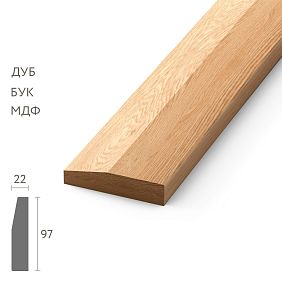


What is MDF and Why It Became the Standard in Skirting Board Production
MDF is an abbreviation for Medium Density Fiberboard, which translates to 'medium density fiberboard'. This material is produced by pressing finely ground wood fibers under high pressure at a temperature of 160–200°C with the addition of urea-based binding resins. The result is a monolithic, homogeneous material without voids, knots, and random defects that are inevitable in natural wood.
The density of MDF, depending on the grade, is 700–850 kg/m³. For comparison: pine is about 520–540 kg/m³, oak is 750–800 kg/m³. That is, in terms of density, MDF is comparable to oak, while being absolutely homogeneous. This is a key property for producing skirting boards: every linear meter behaves the same during milling, painting, and installation.
The structure of an MDF skirting board is as follows: the base is a pressed MDF board of the required profile (milled or extruded), the finish layer is a PVC laminate film, natural wood veneer, melamine coating, or paint. Depending on the finish layer, the skirting board acquires an appearance completely identical to natural wood or, conversely, a purely modern one — glossy, matte, painted.
Formolding products made of wood and MDFmaterial homogeneity is critically important: it ensures profile accuracy along the entire length, stability of behavior during temperature and humidity changes, and predictable results during installation.




MDF Skirting Board vs. Wooden and Plastic: An Honest Comparison
Before spending money on any of the three options, it's worth understanding their real advantages and disadvantages — not those written in advertising brochures, but those that manifest in real life.
Our factory also produces:


MDF vs. Wood
Wooden skirting board is undoubtedly a beautiful product. Solid pine, oak, or beech with a natural wood grain pattern — it's warmth, naturalness, and a sense of quality. But it has three fundamental weaknesses. The first is instability. Wood reacts to changes in humidity and temperature: it expands in summer, contracts in winter. A long solid wood skirting board, firmly glued to the wall, may warp or crack at the joint after six months. MDF is significantly more stable — its linear expansion is 2–3 times less than that of natural wood.
The second weakness of wood is inhomogeneity. Even from the same batch, skirting boards may differ in shade and grain pattern: this is normal for a natural material, but creates problems during joining. MDF with a laminate coating is completely identical from meter to meter.
The third is price. A high-quality solid oak skirting board costs 3–5 times more than an MDF counterpart with a veneer coating. At the same time, the visual result is practically indistinguishable. Paying for the difference in material with the same appearance is a matter of principles, not practicality.
MDF wins in stability, price, and homogeneity. Wood wins in material authenticity and the possibility of re-sanding and repainting 'to zero'.
Get Consultation
MDF vs. Plastic
Plastic (PVC) skirting board is the cheapest option on the market. At the same time, it is waterproof, does not rot, and is easy to clean. But it has two insurmountable drawbacks. The first is appearance. Despite all the efforts of manufacturers, a PVC skirting board with an imitation 'wood look' looks exactly like an imitation. The polymer surface reflects light differently than wood or MDF with a film — and this is immediately noticeable. The second drawback is rigidity when heated. In summer, in a room with direct sunlight, the plastic skirting board heats up and deforms — a corner that neatly fit against the wall in winter starts to 'pop off' in summer.
MDF is superior to plastic in all aspects: it looks better, behaves more stably during temperature fluctuations, and does not deform from heating. The only area where PVC unconditionally leads is bathrooms with constant high humidity and direct contact with water.
The conclusion is simple:MDF Skirting Board— is the optimal choice for residential premises of any type: living room, bedroom, study, children's room, hallway. For bathrooms with regular puddles on the floor — plastic or MDF skirting board with enhanced moisture-resistant coating.
Sizes, Profiles, and Colors: How to Choose a Skirting Board for a Specific Interior
It would seem that a skirting board is just a skirting board. But no: choosing the size and profile is a full-fledged design task that requires an understanding of spatial proportions.
Skirting Board Height and Ceiling Height
The main rule: the height of the skirting board should be proportional to the ceiling height. With a ceiling of 2.5 m, a 50–60 mm skirting board is appropriate. With a height of 2.7–2.8 m — 70–80 mm. With ceilings of 3 m and above — 90–120 mm. A high skirting board in a low room visually 'eats up' the height, creating a oppressive effect. A low skirting board in a spacious hall gets lost and does not set the desired scale.
Profile: Simple or Complex
The profile of a skirting board is its cross-section, the shape of the front surface. There are several basic types:
-
Straight (rectangular) — strict, modern, without decoration. Ideal for minimalism, high-tech, Scandinavian style.
-
Beveled — with a diagonal front plane, creates lightness and visually 'separates' the wall from the floor.
-
Convex (classical) — with a smooth rounded relief, expressive and traditional.
-
Figured (with milling) — a complex profile with several steps and coves. Appropriate in a classical interior.
Tip: the richer the milling of the skirting board, the more classical and 'expensive' the interior looks. But the same skirting board in a modern apartment will look like an anachronism.
Color and Coating
The color solution for the skirting board is a strategic issue. There are three approaches.
Skirting board matching the floor color. The most common and safe option. The skirting board 'continues' the floor upward, visually expanding the horizontal. The room is perceived as more spacious. Especially effective with dark floors and a dark skirting board — the room becomes 'grounded', stable.
Baseboard matching the wall color. Creates a 'floating floor' effect — the flooring appears to detach from the wall. A modern technique actively used in minimalist and Scandinavian interiors. White walls + white baseboard = maximally clean space.
Contrasting baseboard. Dark baseboard on a light floor or light on dark. This is a graphic technique that clearly 'draws' the room's outline, making the space's architecture legible. Suitable for designer interiors with a well-thought-out concept.
MDF baseboard finishing comes in several types: PVC laminate film with wood texture (most common), melamine coating ready for painting (white primer, ready for any color), natural veneer (premium segment), acrylic enamel (bright colors, matte or glossy finish).
Standard MDF baseboard dimensions: table
MDF baseboard manufacturers adhere to several standard formats. Use the following parameters as a guide when selecting:
-
Height: 40, 50, 60, 70, 80, 100, 120 mm — the main selection parameter
-
Thickness: 12–16 mm — standard for most models
-
Strip length: 2.2 m or 2.5 m — standard lengths
-
Rounding radius (for flexible models): from 30 cm
When calculating the amount of baseboard needed, measure the perimeter of all rooms, subtract the width of doorways, and add 10–15% for cuts and joints. A small reserve protects against the 'one strip short' situation when a new batch can no longer be matched to the exact shade.
Installing MDF baseboard yourself: complete step-by-step guide
Installation is where theory turns into practice. And where most mistakes are made not from ignorance, but from haste. Let's break down the process in detail.
Tools and materials
For installing MDF baseboard you will need:
-
Tape measure, pencil, painter's tape — for marking
-
Laser or bubble level — for checking horizontality
-
Miter saw or fine-toothed wood saw — for cutting
-
Miter box — for precise angled cuts
-
Mounting adhesive (acrylic or liquid nails) — primary fastening
-
Finish nails and nail set — for additional fixation in critical areas
-
Acrylic sealant matching the baseboard color — for sealing joints
-
Putty knife or caulking gun
Step one: preparing the room and surfaces
Before starting work, ensure the flooring is laid and acclimatized (especially important for laminate — it must 'settle' before baseboard installation). Walls are cleaned of dust and construction debris. Wall finishing is complete: wallpaper is hung, plaster is dry, paint is applied.
Check wall evenness in the baseboard area: use a long straightedge. If gaps exceed 5–7 mm — the wall requires preparation, otherwise the baseboard will fit unevenly and pull away from the wall in 'humped' spots.
If the baseboard was stored in an unheated room, bring it into the room 24 hours before installation. MDF acclimatizes just like laminate: it absorbs the room's moisture and stabilizes. Installation without acclimatization risks the baseboard 'warping' after absorbing moisture and pulling away from the wall.
Step two: marking
Mark the installation line on the walls. The standard installation height for baseboard is flush with the floor, without a gap. If the floor is uneven (which is common), the baseboard is installed level with the floor at its lowest point: a small gap between baseboard and floor is acceptable, between baseboard and wall — not.
Step three: cutting and fitting corners
This is the most critical stage. An error in an angled cut is the most common problem during baseboard installation.
Internal corner (when walls meet at a 90° angle inward): the baseboard is cut at 45° so that the ends of two strips meet in the corner. In a miter box, the corresponding workpiece position is used.
External corner (protruding wall corner): cut at 45° in the opposite direction.
Real corners in apartments are rarely exactly 90°. Usually they are 88°, 91°, 93°. This means a standard 45° cut will leave a gap. Solution: use a protractor to measure the actual angle, divide the result by two — this is the cutting angle for each of the two planks. A small trick that gives a perfect joint.
Important: dry-fit each plank before applying glue. Adjust the joint until you make the right decision. Then — apply the glue.
Step four: applying glue and fixing
Mounting adhesive is applied to the back of the skirting board in two places: on the vertical (adjacent to the wall) and horizontal (adjacent to the floor) planes. Not as a continuous layer — in a zigzag pattern or dots spaced 15–20 cm apart.
Press the skirting board against the wall, gently 'rock' it — this ensures even distribution of the adhesive. Secure with painter's tape while it sets. In high-stress areas (corners, long straight sections) additionally drive finishing nails through the body of the skirting board into the wall. The nail is countersunk with a nail set, and the hole is filled with acrylic putty to match.
Step five: sealing joints and finishing work
Joints between planks and between the skirting board and the wall are potential gap locations. Fill them with acrylic sealant: it remains elastic after drying and compensates for seasonal material movement. Apply the sealant with a gun, smooth it with a finger or a spatula dipped in water. Remove excess immediately, before it dries.
After the adhesive has completely dried (usually 24 hours), remove the painter's tape and inspect the result. If there are minor irregularities in the joints — apply putty, sand with P220 sandpaper, and paint with a brush to match the skirting board.
Features of installation in difficult conditions
Uneven walls
If the wall 'waves' more than 5 mm, standard adhesive won't help — the skirting board will pull away at the 'convex' points. Solution: use mounting foam instead of adhesive on difficult sections. The foam expands and fills voids. But work with it carefully: excess is difficult to remove from the skirting board surface without leaving marks.
Alternative — mechanical fastening: dowels spaced 40–50 cm apart. The hole in the skirting board is countersunk, the dowel is driven into the wall, the head of a finishing nail or screw is countersunk with a nail set, and the hole is puttied. Labor-intensive, but gives a guaranteed result even on 'difficult' walls.
Curved walls
In houses with rounded walls or niches, a straight skirting board won't fit. Use special flexible MDF skirting board with milled cuts on the back side — they allow bending the plank along a radius. During installation, such skirting board is fixed with adhesive and additionally pressed along the entire length of the curve with painter's tape until completely set.
Joints with door frames
Where the skirting board meets a door frame or casing, two techniques are used. First — 'under the casing': the skirting board is inserted under the casing, which covers the end. This is the neatest solution. Second — end cut: the skirting board is cut at a right angle flush with the casing, the end is puttied and painted. Looks less neat, but sometimes there is no other option.
MDF skirting board care: how to maintain its appearance for years
MDF skirting board does not require complex care, but a few simple rules will extend its life and preserve its original appearance.
Daily maintenance
Dust collects quickly on skirting boards — especially in corners. It's enough to go over it once a week with a soft dry brush or vacuum with a soft attachment. Wet cleaning — with a slightly damp, well-wrung cloth. No abrasive sponges, no acetone or alcohol-containing products: they damage the laminate film.
Protection from mechanical damage
The lower part of the skirting board is a risk zone: chair legs, vacuum cleaners, shoes hit here. Soft plastic corner protectors on skirting board corners solve this problem. In high-traffic areas (hallway, kitchen) choose skirting boards with a harder and thicker laminate coating.
What to do if the skirting board gets wet
If slightly wet — wipe dry immediately, ventilate the room. If the skirting board gets seriously wet (leak, flooding by neighbors) and has had time to swell — most likely, it will need to be replaced. Swollen MDF does not return to its original dimensions when dried, but deforms.
Recoating
If a painted skirting board loses its appearance — it can be repainted. Sand the surface with fine P180 sandpaper, apply MDF primer, then 2 coats of acrylic paint in the desired color. Repainting skirting boards with laminate film is more difficult: the film needs to be either sanded to a matte state for good adhesion, or a special primer for PVC surfaces must be used.
MDF skirting board in different interior styles
Classic
In a classic interior, the skirting board is part of the architectural system. Height 100–120 mm, complex shaped profile with several steps and a bead, oak or walnut finish — or white enamel with gilded molding. In such a room, the skirting board 'echoes' the cornice andmoldings, creating a unified decorative language from floor to ceiling.
Scandinavian style and minimalism
Here the principle is the opposite: the skirting board should be almost invisible. Height 50–60 mm, straight profile without milling, white matte paint. Or — a concealed skirting board: a special profile recessed flush into the wall, with a minimal protrusion of 10–15 mm. This is expensive installation, but the result is absolute spatial purity.
Provence and country
Light wood, rounded profile, 'aged' effect on the finish. Skirting board 70–80 mm with soft milling in milk or cream color. Perfectly combines with woodenitems from the solid wood in the same style — furniture legs, wooden handles, overlays.
Loft and industrial style
Skirting board in a loft — intentional contrast. Dark anthracite skirting board with a straight profile on a light concrete floor — a graphic, urban accent. Or — no traditional skirting board at all, replaced by a metal corner profile.
Modern Classicism and Neoclassicism
An intermediate style requires an intermediate solution: a convex profile of medium complexity, height 80–100 mm, finish in light oak or white enamel. Such a baseboard works as a neutral yet expressive element that does not overload the space.
Durability and Economics: How Long Does an MDF Baseboard Last?
Under normal operating conditions (dry living space, regular cleaning, no extreme loads), an MDF baseboard with a laminated finish lasts 15–25 years without needing replacement. This is comparable to the lifespan of the flooring itself.
Economic argument: An MDF baseboard costs 2–4 times less than a wooden counterpart with an identical visual result. DIY installation saves on labor costs. The final cost of the entire 'baseboard project' for a 70 m² apartment, with a competent approach, fits into an amount that the interior economy justifies many times over.
The environmental aspect: MDF and safety
This is a topic that is usually approached cautiously. Formaldehyde in MDF is a real fact. Old production technologies used urea-formaldehyde resins with high emission levels. The modern E1 standard (formaldehyde content less than 8 mg/100 g of material) makes MDF safe for use in living spaces—its emission does not exceed that of natural wood. Products of class E0 and 'super E0' (used in children's furniture) have emissions practically equal to zero.
Conclusion for the consumer: when purchasing, check the certificate of conformity for the emission class. An MDF baseboard of class E1 is a safe material for adults and children. A baseboard without a certificate is a risk.
An additional environmental plus of MDF: it is produced from woodworking waste (sawdust, shavings), i.e., from raw materials that would otherwise go to waste. This makes MDF a significantly more 'sustainable' material than solid boards from felled trees.
Common mistakes when choosing and installing baseboards
Over years of practice, the same mistakes are repeated again and again. Here is a list of 'anti-patterns' to avoid:
Buying baseboards before finishing the floor installation. The flooring may slightly change the floor height, and therefore the required baseboard height. Buy after.
Not making a surplus. 10% 'for joints' is the minimum. 15% is better. The extra cost for spare strips is incomparably less than the cost of the problem 'one meter from the wrong batch'.
Installing without acclimatization. A baseboard brought in from the cold and immediately glued may develop gaps within a day. Let it 'breathe' in the room for a day.
Using mounting foam without protecting the front surface. The foam expands, squeezes out from under the baseboard, and stains the wall and front surface. Tape the top edge of the baseboard with painter's tape before installation.
Not checking the angle before cutting. 'Approximately 45° by eye' always results in a gap at the joint. Always measure with an angle finder.
Skipping joint sealing. Unsealed joints mean dust, moisture, and over time—dark stripes at the connection points.
FAQ: Answers to popular questions about MDF baseboards
Can MDF baseboards be installed in the kitchen?
Yes. The kitchen is a normal living space with normal humidity. An MDF baseboard with a laminated film or varnish finish works perfectly in the kitchen. Avoid the area directly by the sink where the floor regularly gets wet.
Can MDF baseboards be glued with liquid nails?
Yes. 'Liquid nails' (polyurethane mounting adhesive) is one of the best options. Provides a strong bond and does not require additional fasteners on flat walls.
How to join baseboards on a long wall without a visible joint?
The joint of two planks is made at a 45° angle, not a right angle. This allows the joint to 'hide' in the shadow of the bevel. Place the joint behind furniture or in the least noticeable area of the wall.
Are special corner caps needed for MDF baseboards?
Not mandatory. With a neat 45° cut, the joints in corners come out clean without caps. But factory-made caps are good insurance for those unsure about cutting accuracy.
Can MDF baseboards be installed without glue, using only screws?
Theoretically—yes. Practically—on walls made of aerated concrete and other porous materials, screws hold well; on drywall—only with anchors. A combination of glue + 2–3 screws per plank is the optimal solution for any conditions.
How much does an MDF baseboard cost?
The range is wide: from 80–100 rubles per linear meter in the economy segment to 400–600 rubles per meter in the premium segment (veneer, complex profile). A standard laminated baseboard 70 mm of good quality is 150–250 rubles per meter. For a 70 m² apartment with a perimeter of about 100 m (accounting for doorways), approximately 90–100 linear meters will be needed.
How to match a baseboard to laminate flooring?
The easiest way is to take a laminate sample to the baseboard seller and match the color on the spot. Most MDF baseboard manufacturers offer collections 'to match' popular laminate brands. Keep in mind that laminate looks different under bright store lighting and at home — double-check the match in natural daylight.
What is the difference between an MDF baseboard 'for painting' and a regular one?
A baseboard 'for painting' has a finish of white melamine primer and is intended for applying any color of paint at the installation site. This allows for an exact match to the wall shade or creating a unique color according to the design concept. A standard baseboard with a laminate film is a finished product that cannot be repainted without prior surface preparation.
STAVROS: a reliable partner in the world of wood and MDF products
To conclude this conversation about MDF baseboards, it is impossible not to mention the manufacturer whose range is centered around wood and MDF products.
STAVROS is a Russian manufacturer of decorative products made from solid wood, MDF, and polyurethane. The company's catalog features over 4,000 models and 20,000 modifications across 39 product groups:Trimming Items, furniture legs and supports, decorative overlays, furniture handles, rosettes, cornices, moldings, carved architraves, capitals, pilasters, and much more. All products are made from properly dried wood under strictly controlled conditions (temperature 20–24°C, humidity at least 40%), which guarantees stability of geometry and finish during use.
STAVROS works with both private customers and professionals: designers, furniture manufacturers, construction companies, and developers. Shipping from a single item, extensive stock program, delivery across Russia. Each product undergoes quality control at the factory.
When it comes to interior details — baseboards, handles, moldings, decorative elements — it is important to have a reliable partner whose products are consistent from batch to batch and meet the stated parameters. STAVROS is exactly such a partner. Because a good interior starts with the right details, and the right details start with the right manufacturer.


