












































































Article Contents:
- Proportion rule: sofa leg height and wooden baseboard height
- Where this rule comes from and why it works
- Why breaking this rule is so noticeable
- Additional parameter: color and wood species
- Low baseboard 40–50 mm and low legs — modern minimalism
- Minimalist aesthetics: less doesn't mean more modest
- Furniture legs in minimalist style
- Numerical ratio: minimalist system
- Color in minimalist system
- Wide high baseboard 80–120 mm and high turned furniture legs — classic and baroque
- Turned leg: what it is and why it's 'classical'
- High wooden baseboard in classic interior
- Connection: turned leg + high baseboard
- Baroque style: complete lower zone system
- Wood species: how to match leg and baseboard from same material
- Oak: character and constancy
- Beech: for painting and tinting
- Larch: for kitchens and hallways
- Uniform batch rule
- Replacing sofa legs — step by step, and simultaneous baseboard replacement
- Leg replacement: why it's done and when it's needed
- Step-by-step furniture leg replacement guide
- Simultaneous baseboard replacement: logic of comprehensive update
- How much it costs: price for lower zone update
- Where to buy legs and baseboard as a set
- Single source principle
- What STAVROS offers for set orders
- How to place a set order
- FAQ: Answers to Popular Questions
- About the Company STAVROS

There is a rule that is not framed on the wall or taught first in design schools—yet it is precisely what distinguishes a professional interior from an amateur one. It is simply formulated: the height of furniture legs and the height of the baseboard must be in proportional alignment. Not identical. Precisely—proportional.
When this rule is broken, a feeling arises that is hard to put into words but easy to sense: the sofa seems to 'sink' into the floor, or conversely, 'float' above it. The dresser looks heavy and weighed down. The armchair—random. AndWooden baseboard it just stands there by the wall, disconnected from everything, like a signature under someone else's letter.
When the rule is followed—the interior 'settles' into place. Furniture connects with the floor. The space gains architectural logic. And all this—without costly changes: just the right choice of legs paired with the right choice of baseboard.
This is exactly what this article is about. Lively, specific, with numbers and examples. Without vague talk about 'harmony' and 'balance'—only practical advice you can take and apply today.


The rule of proportions: sofa leg height and wooden baseboard height




Where this rule comes from and why it works
Classical architecture was built on order systems—strict proportional relationships between the base of a column, the shaft, and the capital. The column base is its 'leg,' the lower part that transitions from the horizontal plane of the floor to the vertical plane of the shaft. The baseboard in an interior serves the same function: it frames the transition from floor to wall, establishing the lower 'weight' of the space.
A furniture leg does the same thing—only for an individual piece: it transitions the horizontality of the floor into the verticality of the facade. And when the 'base' of the wall (baseboard) and the 'base' of the furniture (leg) are proportionally aligned—architectural unity emerges. The furniture and the wall 'speak' the same language.
An empirical rule, derived from the practice of the best classical interiors:
The height of the baseboard should be from 1/2 to 2/3 of the height of the legs of the main furniture in the room.
This is not a rigid standard, but a practical guideline. With sofa legs of 80 mm—baseboard 40–55 mm. With legs of 150 mm—baseboard 75–100 mm. With legs of 200 mm and above—baseboard 100–130 mm.
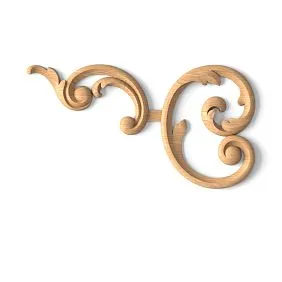
Our factory also produces:




Why breaking this rule is so noticeable
The eye reads the lower zone of the room as a single horizontal band: floor → baseboard → legs → furniture body. This is the 'lower row' of the interior. If the elements of this row are not aligned—the brain registers a 'rhythm disruption.'
Specific examples of violations:
High baseboard + low legs. Wide wooden baseboard 120 mm + sofa on 40 mm legs. The baseboard 'swallows' the legs: visually the sofa appears to be standing directly on the floor, and the baseboard seems too dominant. The lower zone of the room is overloaded with one element.
Low baseboard + high legs. Baseboard 40 mm + table on 200 mm legs. The table legs protrude above the baseboard, like columns above the zero mark. The transition from floor to furniture is abrupt, unmotivated. A feeling of furniture 'weightlessness'—not in a good way.
Correct proportion.Wooden baseboard 80 mm + sofa on 120–150 mm legs. The baseboard 'picks up' the legs from below, creating a visual rhythm: floor — thin strip of baseboard — legs — body. The lower zone is read as a unified system.
Get Consultation
Additional parameter: color and wood species
Proportion is a necessary, but not the only, condition for unity. The color and material of the legs and baseboard either enhance or undermine it.
Option for maximum unity:furniture legs oak with 'natural' oil finish + wooden baseboard made of oak with the same oil finish. Same wood species, same finish—absolute visual unity of the lower zone.
Acceptable contrast: white legs + white baseboard. Wood species is unimportant—unity is achieved through color.
Conflict: dark walnut legs + white baseboard without a specific designer intent. The legs and baseboard 'live in different worlds.' If this is a deliberate contrast—it needs to be supported by other pairs of contrasts in the room. If it's accidental—redo it.
Low baseboard 40–50 mm and low legs—contemporary minimalism
The aesthetics of minimalism: less does not mean more modest
Contemporary minimalism and its derivatives—Scandinavian style, Japanese minimalism, mid-century modern—are built on the principle of a 'clean horizontal.' Space is perceived as a single horizontal plane without heavy vertical accents. The baseboard in such an interior is delicate, almost unnoticeable. Its task is to cover the technical joint without drawing attention.
A low baseboard of 40–50 mm is the perfect solution for such spaces. A laconic profile: rectangular or slightly beveled cross-section without ornament. From the STAVROS catalog: molding K-034 (from 230 rub./lm) with a minimal straight profile, K-125 (from 270 rub./lm), K-105 (from 300 rub./lm)—these are classics of minimalist baseboard.
Furniture legs for minimalist style
For a modern minimalist interior, legs from the STAVROS catalog with the following characteristics are optimal:
-
Tapered straight legs with a slight narrowing towards the bottom are a characteristic shape of mid-century and Scandinavian style. Height: 80–120 mm.
-
Straight cylindrical legs — strict geometry, no decor. Height: 60–100 mm.
-
Square straight legs — for sofas in the spirit of Japanese minimalism. Height: 40–80 mm.
The STAVROS catalog features over 130 modelsfurniture supports, and the 'modern/minimalist' group includes both low supports 50–80 mm high for sofas and taller ones — 120–150 mm for armchairs and tables.
Ratio in numbers: the minimalist system
| Sofa leg | Recommended skirting board | STAVROS profile |
|---|---|---|
| 40–60 mm | 25–40 mm | K-034, K-125 |
| 60–90 mm | 40–55 mm | K-105, K-006 |
| 90–120 mm | 55–75 mm | K-006, K-016, K-071 |
| 120–150 mm | 75–95 mm | K-070, K-043, K-001 |
Color in the minimalist system
For minimalist interiors, three color solutions for baseboard + leg are optimal:
-
White + white — a universal technique. Legs are white (painted or birch/beech with white oil), baseboard K-034 or K-125 with white matte enamel. The lower zone completely 'dissolves' into the interior.
-
Natural light beech — beech legs + baseboard K-034 or K-125 made of beech with clear oil. A uniform light wood tone. Scandinavian purity.
-
Dark oak + dark oak — legs with dark oil, oak baseboard with the same oil. A graphic, expressive lower row against light walls. The principle of a 'dark base' — gives the interior a sense of being 'grounded'.
Wide high baseboard 80–120 mm and tall turned legs for furniture — classic and baroque
Turned leg: what it is and why it's 'classic'
A turned leg is a leg crafted on a lathe: with characteristic rounded elements — ball, vase, barrel, cone — alternating along the axis. This is the oldest type of furniture leg, known since Antiquity. Medieval, Renaissance, Baroque, and Neoclassical furniture — all stand on turned legs in one form or another.
A turned leg declares 'handcraftedness' and 'materiality'. It says: 'I am made of wood, and this wood is hand-finished.' In contrast to the modern square tapered leg, which showcases precision and industrial geometry, the turned leg showcases the organic nature of wood processed by a master.
The STAVROS catalog offers the widest selection of turned legs: from simple ones with one or two decorative elements (ball at the bottom + straight shaft) to complex multi-level ones with a full set of turned forms (vase, cylinder, cone, ball, foot). Height: from 80 to 250 mm and more. Wood species: beech, oak, larch on request.
High wooden baseboard in a classic interior
A wide wooden baseboard 80–120 mm is a 'statement'. It doesn't 'hide' near the floor: it dominates the lower wall zone, creating a visual 'plinth' for the entire room.
This technique — a high baseboard as a 'plinth' — has been known since the Renaissance, when walls in classic interiors were divided into three horizontal zones: plinth (lower third), wall field, and cornice. A high baseboard is the modern version of the 'plinth': it sets the scale for the lower zone and requires furniture of corresponding scale.
From the STAVROS catalog for this range: K-070 (from 950 rub./lm) — a moderately rich profile 80+ mm, K-009 (from 1,420 rub./lm) — a rich classic profile, K-018 (from 1,630 rub./lm) — monumental, K-066 (from 2,580 rub./lm) and K-104 (from 6,060 rub./lm) — flagship models of the collection for spaces with ceilings 3.0 m and higher.
The combination: turned leg + high baseboard
A turned leg 150–200 mm high + baseboard 80–120 mm — this is the perfect classic pair. Specific examples:
A Baroque-style sofa on 180 mm legs + baseboard K-066 (80 mm) — ratio 180/80 = 2.25. The baseboard makes up 44% of the leg height. This is within the classic proportion of 1/2–2/3. The lower zone looks 'substantial' and solid.
A Neoclassical-style armchair on 120 mm legs + baseboard K-070 (75 mm) — ratio 120/75 = 1.6. The baseboard makes up 63% of the leg height — at the upper limit of the range. The armchair legs 'barely protrude' above the baseboard. A very cohesive, 'dense' lower row.
A console table on 250 mm legs + baseboard K-018 (110 mm) — ratio 250/110 = 2.27. The ratio is ideal. The console legs are clearly visible above the baseboard — and at the same time, the baseboard 'supports' them visually from below.
Baroque style: complete lower zone system
In Baroque interiors, the lower zone is the most decoratively saturated. A high skirting board K-104 or K-066 with a rich ornament. Turned legs with several decorative elements: ball, vase, cone, foot. Dark wood or patina in 'old gold'. Herringbone parquet or solid oak parquet. All elements are maximally detailed — this is not 'overload', but an architectural program.
With such a system, a unified wood species is important. Oak legs + oak skirting board K-066 or K-104 made of oak — with unified treatment ('dark walnut' oil or patina varnish) — create a monolithic lower zone that takes your breath away.
Wood species: how to match legs and skirting from the same material
Oak: character and constancy
Oak is the most 'furniture-like' species among those used in decorative skirting. Its characteristics:
-
Brinell hardness 3.7–4.0 kN/mm² — high resistance to dents
-
Density 700–750 kg/m³ — 'heavy' wood, creating a sense of monumentality
-
Pronounced grain with medullary rays — a unique texture not found in any other species
-
Good stability after kiln drying to 8–10%
For turned legs, oak is the ideal species: hardness allows for turning fine details without chipping, the grain when polished gives a 'living' natural effect.
For skirting, oak is also optimal with a transparent finish: natural oak skirting under 'natural' or 'whitewashed oak' oil next to legs from the same oak — this is the perfect material unity.
Wooden oak skirting in the STAVROS catalog: the entire K-series is made from beech and oak. The species is specified when ordering. Oak options are for transparent finishes and demanding customers who value 'living' texture.
Beech: for painting and tinting
Beech is a fine-grained, uniform species. Under white or colored enamel, it gives a perfectly smooth surface without a visible grain pattern. This is precisely why most turned legs in the STAVROS catalog are made of beech: turning work on beech is cleaner, complex profiles are read more clearly, the surface for painting — without additional preparation.
Wooden beech skirting + beech legs under a unified white matte enamel — this is 'white classic'. A white living room with a high skirting board K-009 or K-070, a sofa on turned beech legs in white, white wall moldings — a neoclassical interior without a single dark detail. An absolutely organic solution.
Larch: for kitchens and hallways
Larch is rarely mentioned in the context of decorative skirting and furniture legs — but completely in vain. It is a resinous coniferous species with natural moisture resistance — the best choice for rooms with high humidity and active traffic.
For a kitchen or hallway: larch skirting K-034 or K-006 under 'whitewashed larch' oil + bar stool or kitchen island legs made of larch — this is an organic 'kitchen' combination. A light, slightly grayish tone, expressive growth rings, Scandinavian character.
Rule of a single batch
When buying skirting and legs from the same wood species — not only the type of wood is important, but also the delivery batch. Natural wood has color variation even within the same species: different trees, different harvest years, different parts of the trunk. With a transparent finish, this can lead to 'one oak' being light yellow, and 'another oak' — dark brown.
Solution: order skirting and legs from one manufacturer, from the same batch. STAVROS produces moldings and legs in a unified production system — this guarantees species uniformity and closeness of natural tone. Applying oil or varnish from the same bottle completes the unity.
Replacing sofa legs — step by step, and simultaneous skirting change
Leg replacement: why it's done and when it's needed
The fastest and cheapest way to update an interior is to change the legs on a sofa or armchair. It takes 20–30 minutes, costs from 1,000 to 5,000 rubles per set (4–8 pieces), and visually transforms the entire lower zone of the room.
When leg replacement is justified:
-
Changing style without replacing the sofa. Straight square legs → turned with ornament: a modern sofa acquires a classic character.
-
Changing color. All sofa legs in a dark tone → white: the sofa 'lightens' visually, becomes more airy.
-
Adjusting height. Sofa too low → taller legs: both the seating height increases, and the proportional relationship with the skirting improves.
-
Replacing broken legs. An obvious necessity, but often serves as a reason for a systematic update.
Step-by-step guide to replacing furniture legs
Step 1. Determine the type of attachment of the old legs.
There are two main types of furniture leg attachments:
-
Bolt connection: the leg screws into a threaded insert (M8 or M10 euro screw) pressed into the bottom of the sofa
-
Plate with bolts: the leg is attached via a metal plate with 4 bolts
Most often, upholstered furniture has an M8 threaded insert. Easy to identify: unscrew the old leg, turn counterclockwise. If it unscrews — it's a bolt connection.
Step 2. Measure the thread of the old leg.
Standards: M8 (8 mm diameter) — the most common for upholstered furniture. M10 — for heavy cabinet furniture. Before ordering new legs from STAVROS — clarify the thread standard with the manager, specifying the furniture type.
Step 3. Choose new legs.
From the catalog ofSTAVROS furniture supports— over 130 models. For replacing sofa legs: height 80–180 mm, M8 or M10 bolt attachment, beech or oak wood.
A crucial point when choosing: determine the desired final seating height of the sofa. Standard sofa seating height: 40–45 cm from the floor. If the current sofa with legs removed has a frame at a height of 30 cm from the floor — you need legs 100–120 mm to achieve a seating height of 40–42 cm.
Step 4. Open the sofa and unscrew the old legs.
Turn the sofa over onto a soft surface (blanket, carpet). Unscrew all legs counterclockwise. If the legs are on plates — unscrew the plate mounting bolts.
Step 5. Install the new legs.
Screw the new legs into the same threaded inserts clockwise. Tighten firmly, but without over-tightening (wood may crack). If the legs are on plates — place the plate of the new set, mark the holes, drill (3 mm drill bit), screw in the bolts.
Step 6. Set up the sofa and check stability.
Place the sofa on its legs. Check if it wobbles: if one leg is shorter — place a felt pad or use adjustable glides (included with some STAVROS legs).
Simultaneous baseboard replacement: the logic of comprehensive updating
If you are changing the legs on a sofa — this is the perfect moment to simultaneously replace the baseboard. The reason is simple: new legs will change the proportion of the lower zone. The old baseboard with new legs may look disproportionate — even if it looked fine before the leg change.
Algorithm:
-
Choose new legs → determine their height
-
Using the rule of proportions, calculate the required baseboard height (1/2–2/3 of the leg height)
-
Choose a baseboard from the STAVROS K-series catalog of the required height and ornamental level
-
Ensure the wood species/color of the baseboard matches the legs
-
Order legs and baseboard simultaneously — single delivery
Practical calculation: new legs 130 mm, turned, beech, for white enamel → baseboard 65–85 mm → K-070 (from 950 rub./lm, height ~80 mm) made of beech → unified white painting. Done: system created.
How much does it cost: price for updating the lower zone
Consider a specific scenario: living room 20 m², perimeter ~18 lm, sofa + two armchairs (4+2+2 = 8 legs).
| Element | Selection | Price |
|---|---|---|
| Baseboard K-070, 18 lm | 950 RUB/linear meter × 18 | ~17,100 RUB |
| Turned legs, 8 pcs, beech, h=130 mm | depends on the model | ~3,000–8,000 RUB |
| Painting (paint + labor) | acrylic matte enamel | ~3,000–5,000 RUB |
| TOTAL | ~23,000–30,000 RUB |
For 23–30 thousand rubles — a completely updated lower zone of the living room with professional proportions, unified material and color. This is the price of one mass-market sofa. But the result is like that of a designer project.
Where to buy legs and skirting boards as a set
Single source principle
The question 'where to buy' has one correct answer for those who understand the principle of unified decor: from one manufacturer. Only then will the wood species, processing technology, drying quality, and ornamental level be guaranteed to match.
WhenWooden baseboardandFurniture legspurchased from different places — there is no guarantee of compatibility. A construction store supplies skirting boards from one factory, a marketplace — legs from China made of 'something resembling beech'. Painting with the same paint saves the situation with a solid color — but not with a transparent finish.
What STAVROS offers for a set order
The STAVROS catalog contains all elements of the interior's lower zone from a unified production program:
-
wooden K-series millwork— over 30 profiles, from 230 to 6,060 RUB/linear meter, beech and oak, all supplied unfinished
-
Furniture Legs and Supports— over 130 models: straight, tapered, turned, carved, bar, tall, short, beech, oak
-
decorative inlays for furniture— for coordinating furniture front decor with skirting boards
-
Mirror and picture frames RM-series— for completing the ensemble at wall level
All wooden products — kiln-dried, 3D milling, hand sanding. Supplied unfinished: paint from one can — and unity is guaranteed.
How to place a set order
-
Determine the style and dimensional system: interior style → leg height → required skirting board height based on proportion
-
Choose a skirting board from the K-series of the required height and ornamental level
-
Choose legs of the required height, shape, and species (beech or oak)
-
Ensure unity: one species, one ornamental level
-
Place your order on stavros.ru or by phone at 8 (800) 555-46-75
-
Warehouse stock — shipment on the day of order. Delivery across Russia and CIS.
FAQ: Answers to popular questions
Do skirting boards and legs have to be made from the same wood species?
With a transparent finish — yes, absolutely. With solid single-color painting — no: the wood grain is hidden, and unity is achieved through color. The only important thing is that the wood density allows it to accept paint equally well — beech is optimal for this.
What leg height should I choose for a standard sofa?
The optimal sofa seat height is 40–45 cm from the floor. If the sofa frame without legs is at a height of 28–32 cm — legs of 80–130 mm are needed. If you want to 'raise' the sofa — 130–170 mm.
Wide 120 mm wooden skirting board — for which ceilings?
For ceilings from 2.8 m. With a ceiling height of 2.5 m, a tall 120 mm skirting board will create a 'squashed' effect. Rule: the height of the skirting board should not exceed 5–6% of the ceiling height. With a 3.0 m ceiling → skirting board up to 150–180 mm — within the norm.
Can STAVROS furniture legs be installed on a Soviet-era sofa?
Depends on the sofa's construction. If there are M8 or M10 threaded inserts in the base — yes. If the legs are on plates — you need to drill holes in the base for the new plate. In old Soviet sofas, legs are often simply screwed into the wooden frame — in this case, replacement with threaded inserts is needed (a simple operation, performed without removing the upholstery).
Wooden skirting board price — why such a wide range from 230 to 6,060 rubles per linear meter?
The range is determined by the complexity of the profile, the height of the skirting board, and the depth of the ornament. K-034 at 230 rubles per linear meter is a concise 40×20 mm strip. K-104 at 6,060 rubles per linear meter is a monumental 120+ mm profile with multi-level floral carving across the entire front. Different products for different tasks.
Should legs and skirting boards be painted before or after installation?
Optimally: paint the legs before installing them on the sofa (the entire surface is accessible), the skirting board — after mounting it on the wall, carefully painting the joints. A final thin coat of paint 'to match' on the installed skirting board is the last step.
How can I tell if the skirting board tone and leg tone will match when buying online?
Order samples. STAVROS offers samples of wooden millwork for 180 rubles — this allows you to assess the actual tone, texture, and surface quality before the main order. When ordering skirting board and legs simultaneously — request a guarantee of wood species matching from the manager.
About the company STAVROS
A space where the skirting board 'converses' with the furniture legs, and the furniture legs 'respond' to the ornament of a mirror frame — this is not an accident. It is a system. And it can only be created when all elements come from a single source.
STAVROS produces a complete program of wooden decorative products for professional interiors:
-
wooden K-series millwork— over 30 profiles from 230 to 6,060 rubles per linear meter, from the concise K-034 to the monumental K-104
-
Furniture Legs and Supports— over 130 models: turned, straight, tapered, carved, for upholstered and case furniture, beech and oak
-
Decorative Inserts— for furniture fronts in a unified ornamental system
-
RM-series frames— over 30 models for paintings and mirrors
-
MLD elements— decor for molding systems on walls and furniture
All wooden products are made from solid beech and oak, kiln-dried to 8–10%, 3D-milled and hand-sanded. Supplied unfinished for unified final finishing of the entire set.
Showrooms in Moscow and St. Petersburg. Delivery throughout Russia and CIS. Shipment from 1 piece on the day of order.
STAVROS is when proportion is not guessed, but calculated. And when details are not matched by eye, but created as a system.


