

































Article Contents:
- Why slopes are the most underrated place in the interior
- Types of slopes for slatted panels: window, door, arched
- Window slopes: three surfaces and light load
- Door slopes: clean geometry without thermal problems
- Arched openings: flexible slats and radius solutions
- Materials for slopes from slatted panels: what to choose and why
- Natural oak: for door slopes and insulated window openings
- MDF: optimum in terms of practicality/aesthetics ratio
- Veneered MDF: Naturalness Without Risk
- What Is Not Suitable for Window Reveals
- Design of Reveals from Slat Panels: Concepts and Parameters
- Slat Parameters for Reveals: The Logic of Narrow Space
- Unified System Concept: Reveals + Wall + Ceiling
- Contrast Concept: Reveals as an Accent on a Neutral Wall
- Reveals with Lighting: A Natural Light Portal
- Joining Slat Reveals with Wall and Windowsill: The Details That Decide Everything
- Detail 'Reveal — Window Frame'
- Detail 'Reveal — Wall'
- Sill-to-slope joint
- Top slope-to-wall joint
- Step-by-step DIY installation of sloped surfaces using strip panels
- Step 1: Preparing the slope surface
- Step 2: Acclimatizing the strips
- Step 3: Marking and preparing the lathing (if needed)
- Step 4: Installing the Slats
- Step 5: LED lighting (if needed)
- Step 6: Trims and finishing
- Sloped surfaces with strip panels in different interior styles
- Scandinavian style: white ash and neutral background
- Japandi: Dark Ash and Meditative Emptiness
- Modern Classic: 'Nut' Oak and Molding Framing
- Monochromatic Minimalism: MDF in Wall Color
- Door Jambs from Slatted Panels: Features and Techniques
- Interior Door Jambs: Casing or Slatted Jamb?
- 'Portal' Concept: Slatted Jamb + Slatted Arch
- Entrance Door Jambs: Lacquered MDF for the Hallway
- Material Calculation for Slatted Panel Jambs
- Care for Slatted Panel Jambs: Simple Rules
- Slatted Panel Jambs and Wall Finishing with Slatted Panels: Unified System vs Separate Element
- Frequently Asked Questions About Slat Panel Slopes
- Can wooden slat slopes be installed over existing PVC slopes?
- Which slat slope material to choose with regular condensation formation on slopes?
- How to attach slat panels on slopes — adhesive or battens?
- Is casing needed when installing slat slopes?
- MDF slat panels or natural oak for slopes in a bedroom?
- Is a slat panel needed on the ceiling when slat slopes are present?
- Conclusion
There are details in an apartment that everyone sees but no one notices — until they are done right. Window and door slopes are among them. White plaster, plastic overlays, peeling paint on the edges of the window opening — all this is such a familiar 'background' that most people have simply stopped perceiving it. And in vain.
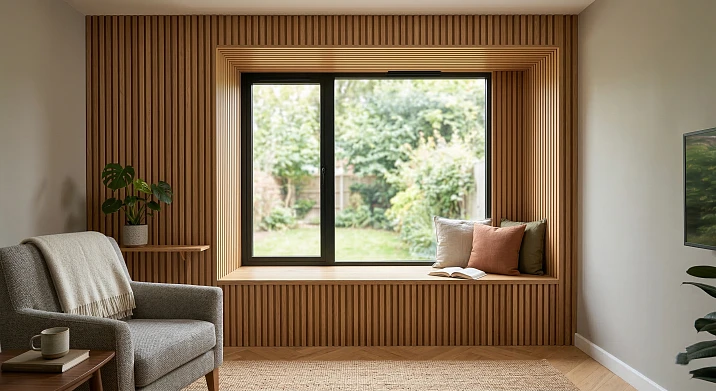
Slat panel slopes change this background radically. They transform a window or door opening from a 'technical zone' into an architectural element — expressive, natural, organically integrated into the interior. Wooden vertical slats on the slope, the warm amber tone of oak, a subtle play of light and shadow in the gaps — and the window ceases to be just a hole in the wall. It becomes a frame for the view, a natural portal between the interior and the outside world.
But before getting down to business — you need to understand the specifics. Slopes are a zone with special conditions: temperature fluctuations, condensation, direct sunlight on one of the surfaces. Here you cannot simply 'transfer' experience from a regular wall slat panel — a different material logic, a different installation approach, a different finish coating is needed.
This is exactly the logic we will analyze—in detail, without generalities, with specific parameters and solutions.
Why Window Reveals Are the Most Underrated Spot in Interior Design
Ask yourself: when was the last time you purposefully looked at the window reveals in your apartment? Most likely, never—or only when something went wrong: the paint cracked, the plastic yellowed, the plaster corner came loose. Reveals are perceived as something taken for granted—a neutral white edge of the window opening that should 'not get in the way'.
But think differently. The window is the main source of natural light in a room. The human gaze reflexively gravitates towards light. This means that the window reveals are in the constant field of vision—exactly where the gaze transitions from the dark interior to the bright outdoor space. This is the zone of maximum visual activity.
And it is in this zone that plain white surfaces stand.
Reveals made from slatted panels are about a conscious choice to make this zone beautiful. The warm wooden material on the reveal works as a 'natural frame' for the light flow from the window: light passing by the wooden reveals acquires an amber sheen, a warm hue. Psychologically—this is one of the most powerful techniques for creating coziness in a room.
Wooden slat panelsSlatted panels as reveals—a technique long used by professional interior designers, but rarely seen in standard apartments. Because it requires an understanding of the specifics.

Types of reveals for slatted panels: window, door, arched
Reveals come in different types, and each type has its own geometry, its own conditions, its own solutions for slatted panels.
Our factory also produces:



Window reveals: three surfaces and light load
A window reveal consists of three planes: the top (above the window), the bottom (below the window, usually covered by the windowsill), and two side planes. In practice, the top and two side planes of the reveal are available for finishing with slatted panels.
The width of the reveal depends on the wall thickness: in panel buildings — 150–200 mm, in old brick buildings — 400–600 mm and more. It is in buildings with wide reveals that slatted panels work most impressively: a wide reveal made of natural oak is no longer a 'strip of material', but a full-fledged wooden niche, reminiscent of a traditional bay window.
The main specific feature of a window reveal: the temperature gradient. The inner surface of the reveal is warm (+20°C in winter), the outer surface is cold. In houses with insufficient insulation, condensation forms on the reveals in winter — the dew point shifts inward. This is critical for material selection.
Get Consultation
Door reveals: pure geometry without thermal problems
Door reveals are technically simpler in terms of material operating conditions: there is no temperature gradient, no risk of condensation. Here, slatted panels work under standard room conditions, as on a regular wall. The complexity lies in the geometry: reveals of interior doors often have a small width (80–120 mm with standard door blocks) and require precise trimming of the slats.
Wall finishing with slatted panelswith door reveals — a natural junction point: the slatted wall 'extends' into the doorway, reveals made of the same slats — a unified wooden system.
Arched openings: flexible slats and radius solutions
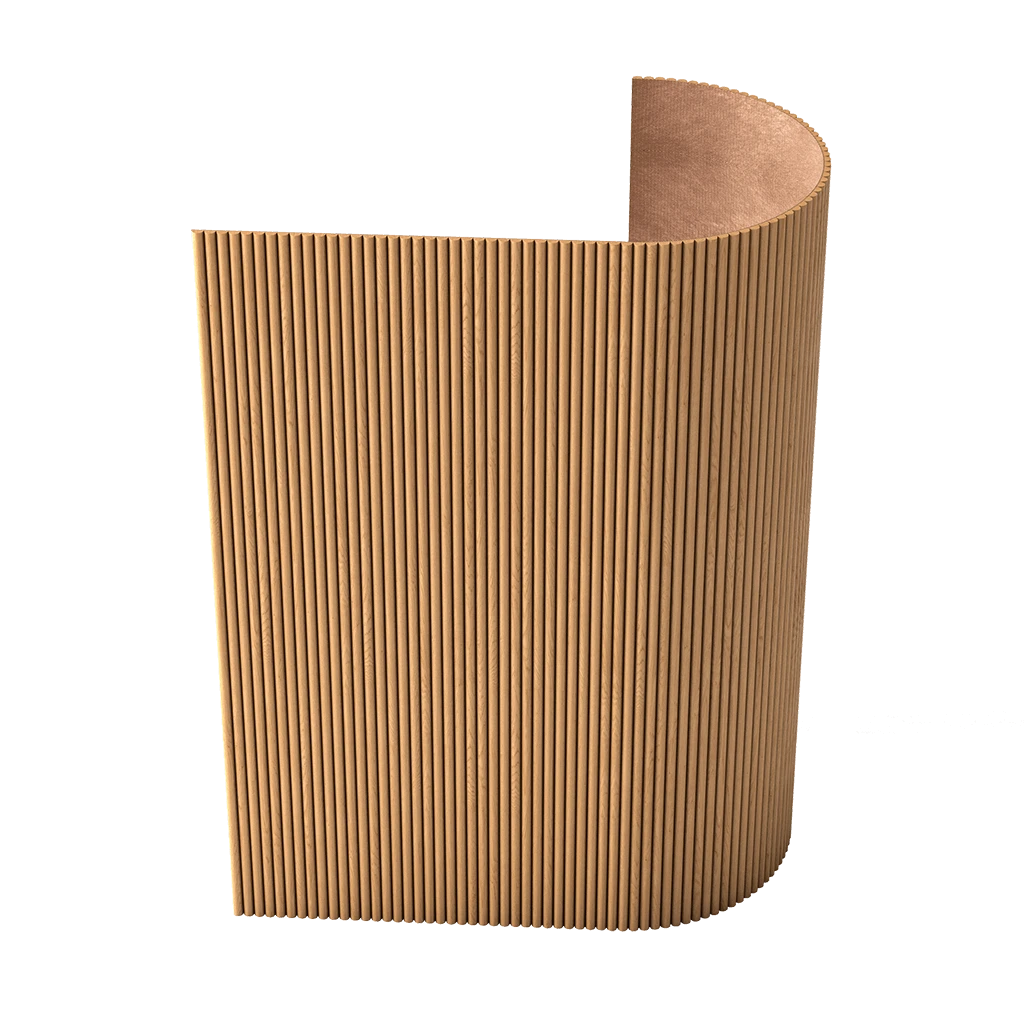
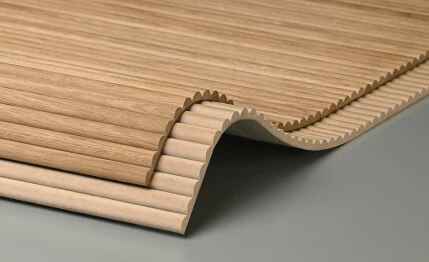
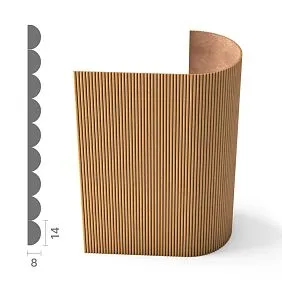
Arched openings are a challenge for slatted reveals due to the curved upper part. A standard rigid solid oak slat is not suitable for a radius reveal — it requires either sawing the slat into segments with trimming at an angle (for large radii), or the use offlexible slatted panelswith a flexible backing.
The side planes of arched openings are standard rectangular reveals, mounted in the usual way.
Materials for slopes from slatted panels: what to choose and why
For a regular wall, the choice of slatted panel material is determined primarily by aesthetics. For a slope, the conditions dictate strict technical requirements that narrow the choice down to specific options.
Natural oak: for door slopes and insulated window openings
Wooden slat panelsNatural oak is the best aesthetic choice. Natural pattern, warm amber tone, tactile surface. For slopes, only under the condition of good insulation of the window opening (no condensation) and a varnish finish.
Oak on a slope with a varnish coating (polyurethane water-based varnish in 3–4 layers) is resistant to wet cleaning, to rare drops of condensation, and to intense light exposure. Without a varnish coating (with oil) on window slopes is not recommended: oil does not provide sufficient protection from moisture.
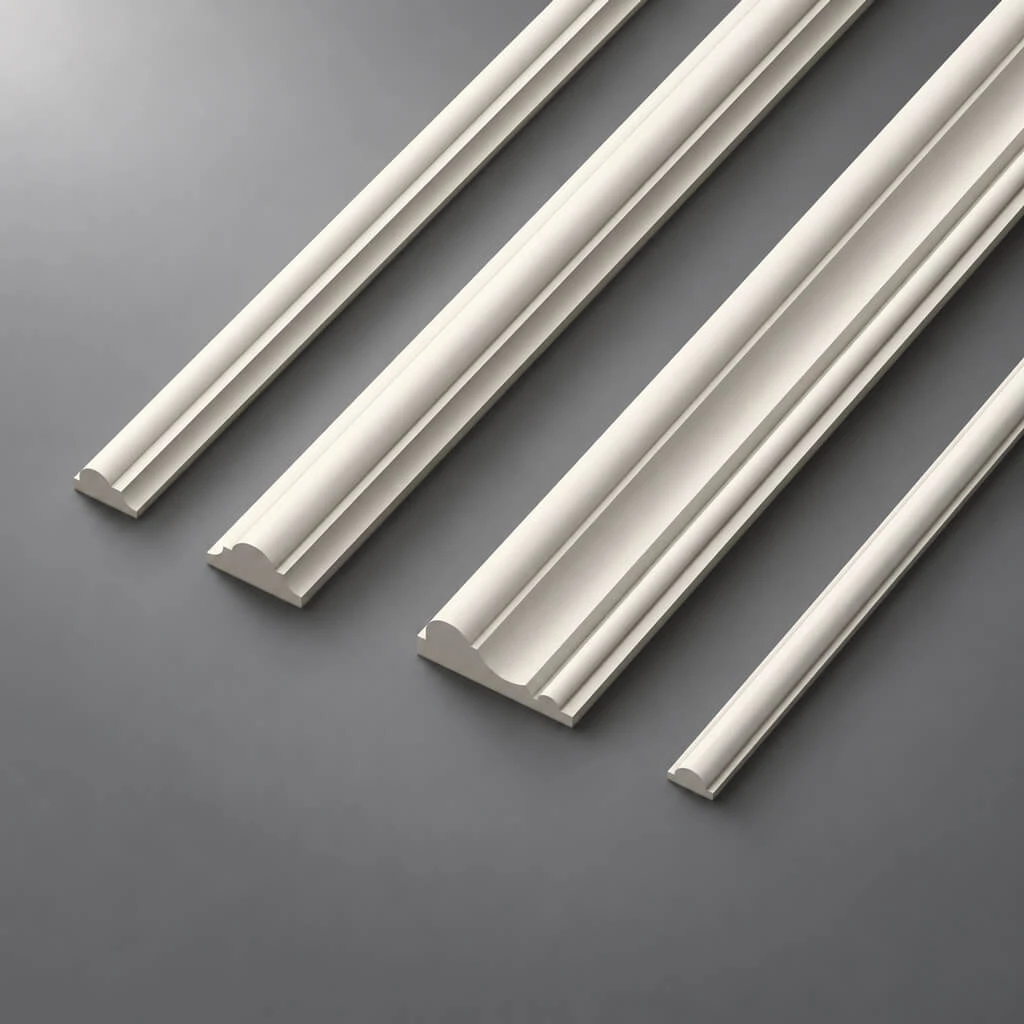
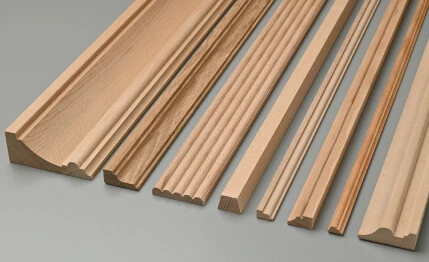
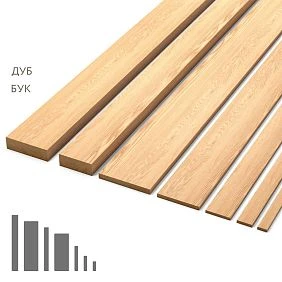
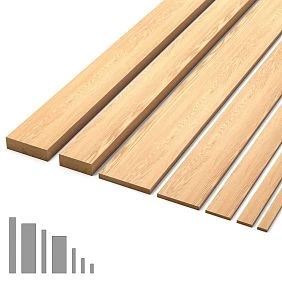
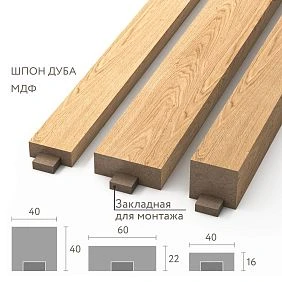
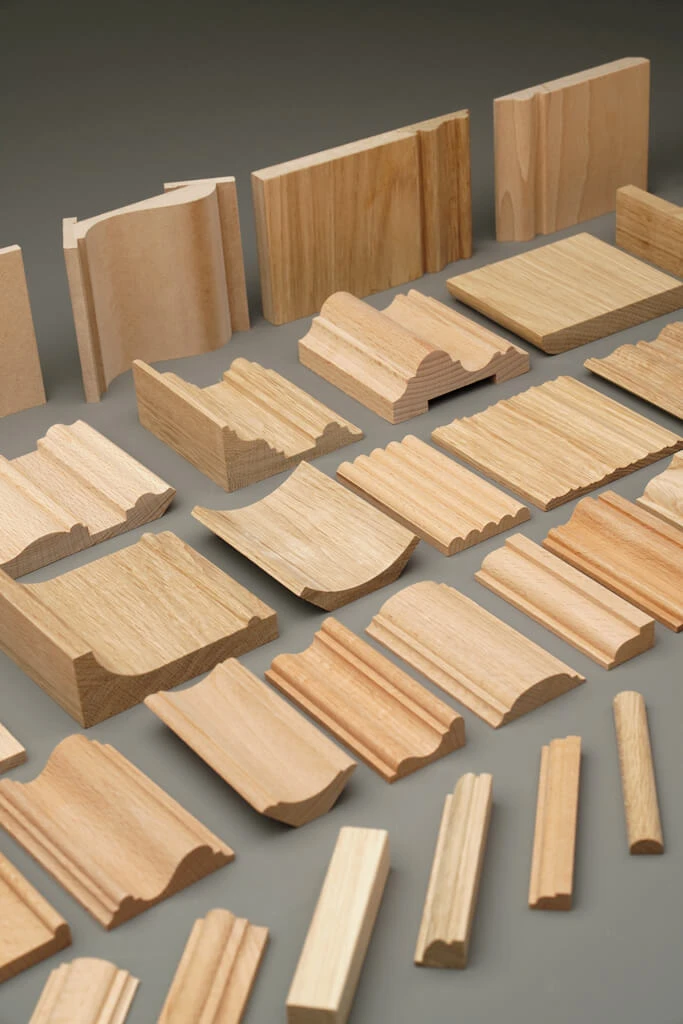
Solid oak moldingNon-standard section slats suitable for slopes: width 40–80 mm (to match the slope width or to create a slatted rhythm on wide slopes), thickness 18–22 mm.
MDF: optimum in terms of practicality/aesthetics ratio
MDF slatted panelFor slopes, it is the technically preferred option under any operating conditions. MDF with polyurethane varnish:
-
does not react to humidity fluctuations (no seasonal movements)
-
resistant to rare condensation formation
-
allows precise trimming at any angle without fiber chipping
-
accepts any color of matte RAL enamel — for monochrome concepts
For window reveals in apartments with unstable microclimate or in houses with possible condensation — lacquered MDF is the only reasonable choice among wood-containing materials.
Requirement: MDF class E0/E1. For reveals — especially important, as the surface in the light flow area could theoretically release volatile substances from low-grade MDF when heated by the sun.
paintable slatted wall panelsMDF — for reveals painted to match the main slatted wall. A unified color for reveals and accent wall is a strong architectural technique.
Veneered MDF: naturalness without risk
MDF slats with natural oak veneer 0.6–1.2 mm — the golden mean. Natural wood grain on the front surface + technical stability of the MDF base. For reveals — the optimal choice if you want the aesthetics of natural oak without the risk of deformation from moisture.
What is not suitable for reveals
-
Solid pine without lacquer coating — resin exudation when heated by the sun.
-
MDF class E2 — undesirable in the area of direct solar heating.
-
PVC panels are categorically not recommended for slopes with direct sunlight exposure: they yellow and deform when heated. Despite the prevalence of plastic slopes, this material is not suitable for a natural interior.
-
WPC (Wood-Plastic Composite) is suitable for exterior slopes, but for interior slopes it is excessive and does not create a natural aesthetic.
Design of slopes using slat panels: concepts and parameters
A technically correct material choice is half the success. The other half is design: slat parameters, orientation, and integration with the wall.
Slat parameters for slopes: the logic of narrow spaces
A slope is a narrow surface by definition. The logic of its parameters fundamentally differs from that of a wide wall panel.
Orientation of slats on window slopes:
Horizontal orientation of slats on the side planes of a slope is the standard and most logical choice. Horizontal slats 'move' in the direction of the slope's depth (from the room toward the window), visually 'guiding' the eye toward the light source. This aligns with the psychology of perceiving light perspective.
Vertical slats on slopes are an alternative for cases where the wall slats are also vertical and a unified system is needed. Requires careful integration with the vertical slats of the wall.
Slat width for slopes:
Slope width 150–250 mm: battens 20–30 mm wide with 8–12 mm gap. 3–6 horizontal battens across the slope width.
Slope width 300–500 mm: battens 30–40 mm wide with 12–16 mm gap. 5–10 battens across the slope width.
Slope width 500+ mm (wide slopes of historical houses): battens 35–50 mm wide with 15–20 mm gap. A wide slope is a full-fledged wooden niche, allowing for a more expressive rhythm here.
Bat thickness for slopes: 15–20 mm. A thicker bat 'eats up' the already small slope width. 18 mm is the optimum: sufficient volume for shadow in the gaps, minimal 'heaviness' of the slope.
Concept of a unified system: slopes + wall + ceiling
The strongest design solution is slopes made of batten panels as part of a unified system with a batten accent wall.
Scheme: vertical battens on the accent wall in the living room → the same battens 'transition' to the slopes of the nearest window → horizontal battens on the slopes are joined to the vertical wall battens with a solid wood corner profile.
Identical material and tinting of the battens on the wall and slopes create a unified natural system in which the window 'dissolves' into the wooden interior. This technique is especially effective with wide slopes: the wooden niche frames the window like a natural frame, and the light flow from the window 'backlights' the wooden battens from the end.
Slatted panels in interior designas an architectural element — precisely this principle of a unified wooden system, in which slopes are not a 'separate detail' but a continuation of the overall concept.
Concept of contrast: slopes as an accent on a neutral wall
Another concept is sloped walls made of slatted panels on walls without slatted finishing. Neutral white or painted walls, and wooden slatted slopes as an independent accent.
This approach works with sufficient slope width (from 250 mm): narrow white slopes with two or three horizontal slats are too 'modest' an element that gets lost. Wide slopes with a full slatted rhythm are a self-sufficient natural accent.
For this concept: slats made of natural amber oak or dark ash on white walls create a strong contrast that works precisely due to the natural warmth of wood against a neutral background.
Slopes with lighting: a natural light portal
Slatted panels with lightingon slopes is one of the most technically sophisticated and visually powerful techniques. An LED strip on the back plane of the slope (behind the slats) creates the effect of a 'glowing niche': warm light from the gaps between the slats envelops the window opening.
In the evening, when it's dark outside: LEDs behind the slope slats create a warm glow around the perimeter of the window—a natural light portal. The window transforms from a 'black rectangle' of night glass into an architectural element with its own atmospheric lighting.
Technical requirements for LEDs on slopes: 2700K strip, IP54 (splash protection in case of rare condensation on the window opening), dimmer. The strip is attached to the back plane of the slope behind the slats—the light source is hidden, only the result is visible.
Joining slatted slopes with the wall and windowsill: details that make all the difference
The devil is in the details. It is precisely at the points where slopes meet the window frame, wall, and windowsill that most DIY installations 'fail': visible gaps, crooked joints, 'protruding' edges of slats. Let's examine each detail.
Detail 'slope—window frame'
The junction between the slatted slope and a plastic or wooden window frame is the most critical detail. This is where the transition occurs between different materials with different coefficients of thermal expansion.
Solution for plastic windows: a starter profile with an F-shaped or J-shaped cross-section made of white PVC or aluminum. The profile is fixed to the window frame, and the end of the slatted field is inserted into its groove. A 2–3 mm expansion gap between the end of the slats and the window frame is concealed behind the profile. During seasonal wood movement, the profile holds the slats in place, preventing the formation of a visible gap.
Solution for wooden windows (wooden window frame): a corner wooden molding made from solid wood of the same species as the slats. The molding is attached to the window frame, and the ends of the slats are inserted behind the molding with a 2 mm gap. A single natural material creates a monolithic wooden transition from the slope to the frame.
Solution for aluminum windows: a corner aluminum profile. A metallic accent at the transition point serves as an architectural element for modern minimalist concepts.
Detail: 'Slope — Wall'
The transition between the slatted slope and the main wall plane is an area that requires a neat solution.
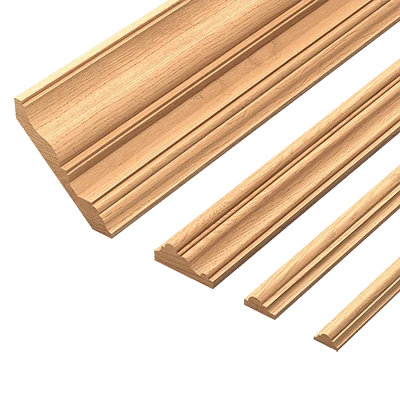
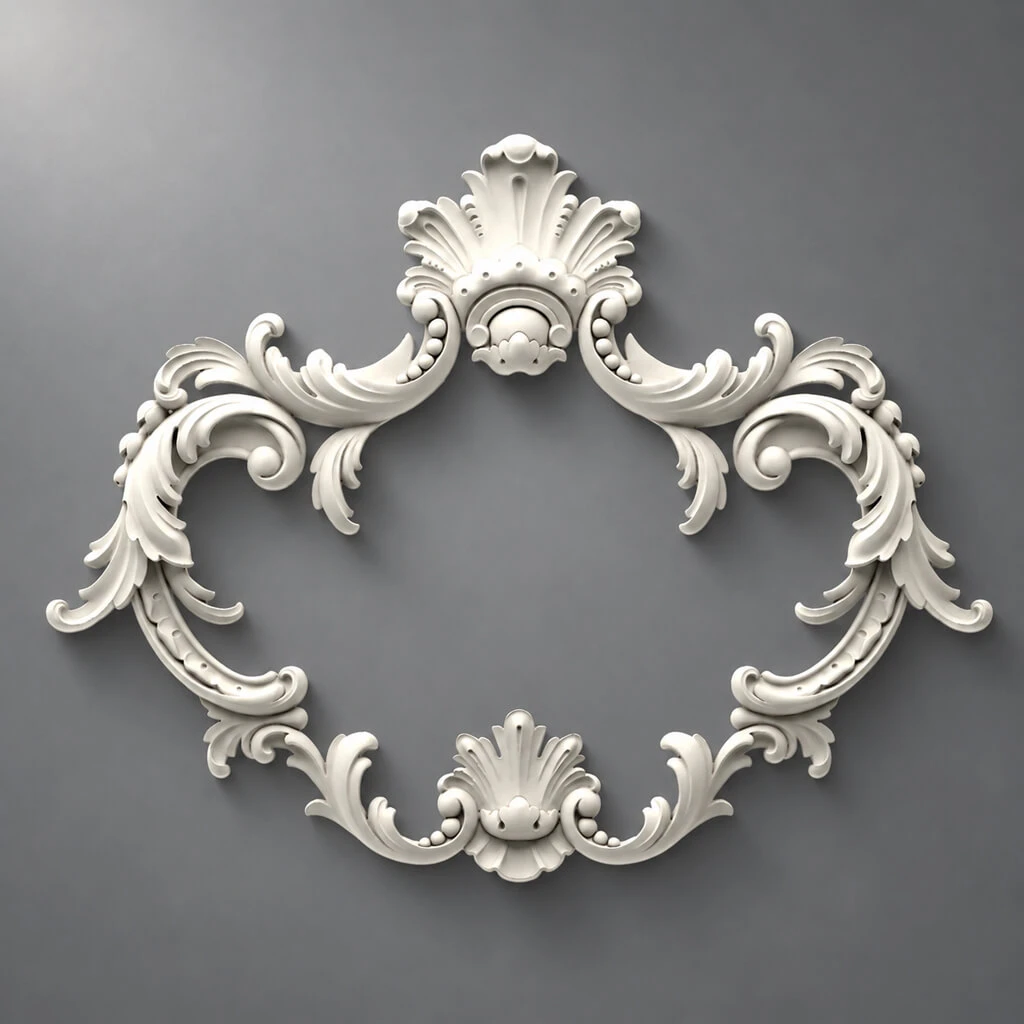
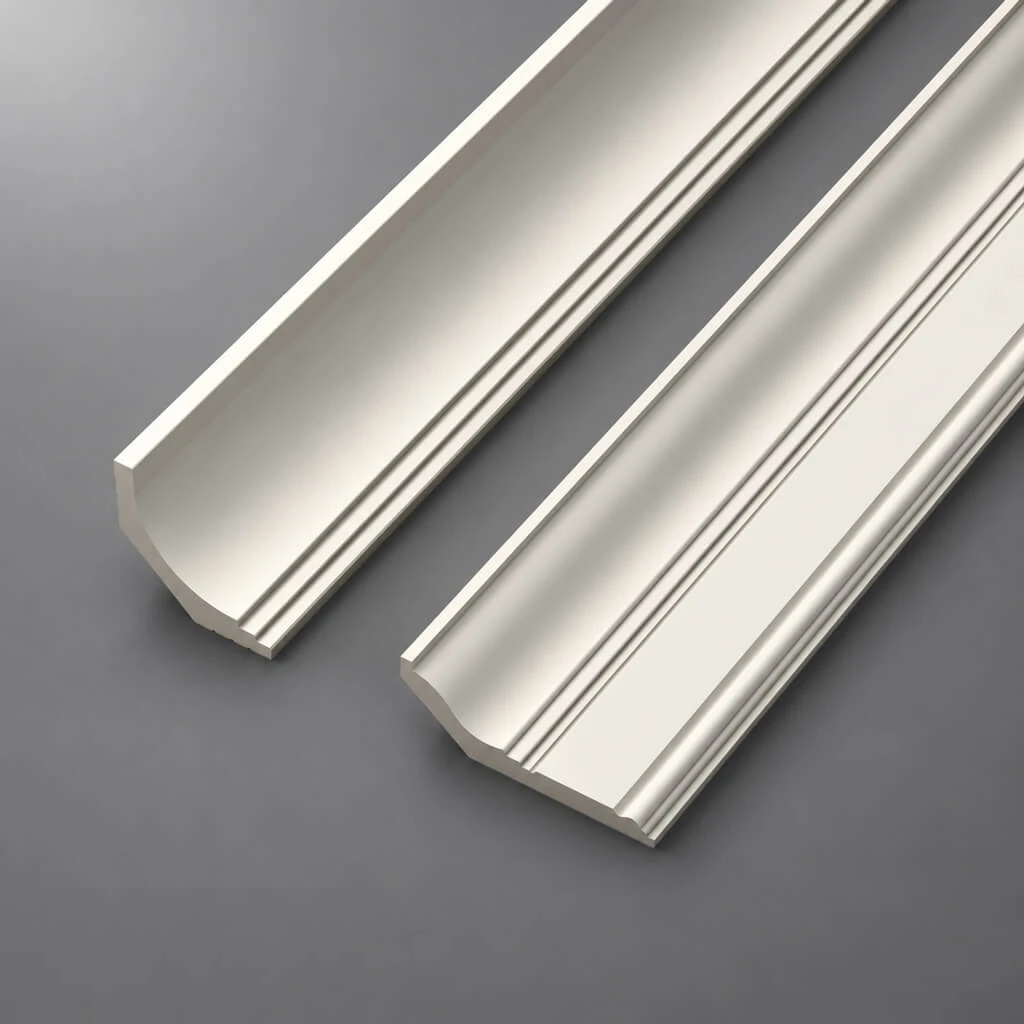
Option 1: Wall without slatted cladding. A corner wooden molding (casing) made from solid wood frames the slatted slope around the perimeter, covering the joint between the slope and the wall.Solid wood moldings— Casing 40–60 mm wide with a profiled cross-section for classic concepts or a straight cross-section for contemporary ones.
Option 2: Wall with slatted cladding. The vertical wall slats and the horizontal slope slats meet at the corner point. A straight corner transition is achieved using a 20×20 mm wooden corner profile, which covers the ends of both slatted fields. With precisely calculated dimensions, the transition is practically invisible.
Option 3: 'Overlap'. The wall slats are brought to the edge of the slope, and the slope slats start from the end of the wall. A corner profile is placed between the fields. This creates a sense of a 'unified' wooden space without visible joints.
Node "slope — windowsill"
The lower edge of the side slope rests against the windowsill. Important: the windowsill and slatted slope made of different materials should not compete.
Optimal solution: a solid wood windowsill made of the same wood as the slats of the slope. Wooden windowsill + wooden slatted slopes — a unified natural system.
With an existing plastic windowsill: the end of the slatted slope is cut strictly along the surface of the windowsill with a 2 mm gap, the joint is covered with white silicone or a wooden skirting board. Not ideal, but acceptable.
When designing new finishing from scratch: first, the wooden windowsill is installed, then — the slatted slopes. The order is important: the slopes "rest" on the windowsill.
Node "top slope — wall"
The top slope (horizontal surface above the window) — often the narrowest: 150–250 mm. The slats here are oriented the same as on the side slopes (horizontally relative to the room, i.e., perpendicular to the plane of the window). The joint of the top slope with the side ones — a 15×15 mm corner wooden profile.
Top slope with LED behind the slats — the most effective point for a "dripping" lighting effect: warm light from the gaps of the top slope flows down the side slopes, creating a natural "halo" effect around the window.
Step-by-step installation of slopes from slatted panels with your own hands
installation of slatted panelsInstallation on slopes is fundamentally no more difficult than on a wall, but requires precision and the correct sequence.
Stage 1: Slope surface preparation
Before installing the slatted slope, the surface must be: level (tolerance 3 mm/2 m), dry (base moisture not exceeding 12%), dust-free, and primed.
If the slope has an old coating (paint, plaster, PVC cladding): remove it completely. It is especially critical to remove old PVC slopes along with the adhesive. Installing wooden slats over a PVC base is not recommended: different expansion coefficients will lead to deformation of the slatted field.
Condensation check: before installing a wooden slope, ensure the slope surface is not a dew point. Simple test: attach a 30×30 cm piece of polyethylene to the slope for 24 hours with heating on in freezing weather. If condensation appears under the film, additional slope insulation is required before installing the slats.
Stage 2: Slat acclimatization
Unpack the slats in the room 72–96 hours before installation. Lay them horizontally without crossing, with spacers between rows for free air circulation. Room temperature during acclimatization: the same as during operation (+18–22°C). Humidity: the room's operating humidity.
This is especially important for natural oak: a slat 'unaccustomed' to the room's microclimate may change geometry after installation and deform the adhesive or nail fastening.
Stage 3: Marking and preparation of battens (if necessary)
For level concrete slopes in new buildings: adhesive installation without battens is permissible if the surface tolerance is no more than 3 mm/2 m.
For slopes with irregularities exceeding 3 mm or for slopes requiring additional insulation: wooden battens 25×20 mm (thin, to not 'eat up' the slope width). Battens are leveled with a laser level. Fasteners: 6×40 mm concrete nails.
When adding thermal insulation (polystyrene foam or EPS 10–20 mm on the back plane of the slope before installing the battens) — the condensation problem is solved, the dew point shifts outward. Recommended for slopes of external walls in climatic zones with severe winters.
Step 4: Installing the Slats
Battens are mounted from the windowsill upward on the side slopes. The first batten — level, strictly horizontal. Adhesive: solvent-free mounting adhesive (for concrete and wood). When installing battens additionally — finishing nails 1.6×40 mm.
The gap between battens is set using spacer shims of equal thickness. One shim — one gap, consistent spacing along the entire height of the slope.
Trimming battens to the width of the slope: miter saw or hand saw with fine teeth. Perpendicular cut for straight slopes. For sloped slopes (slopes with a bevel from the frame to the wall) — cut at an angle matching the surface slope. Angle measured with a bevel gauge or protractor.
Trimmed batten ends by width — when installed with the end facing the window frame outward, coat the end with end-grain sealant or varnish to prevent moisture absorption into the end grain.
Step 5: LED lighting (if required)
If lighting behind the battens is planned — the LED strip is installed before mounting the battens. The strip is attached to the back surface of the slope (behind the future battens). The wire is routed through a technical channel in the batten structure or through a hole in the lower part of the slope under the windowsill. Connection to the dimmer and power supply — concealed behind the windowsill or in a decorative housing.
Step 6: Casing and finishing
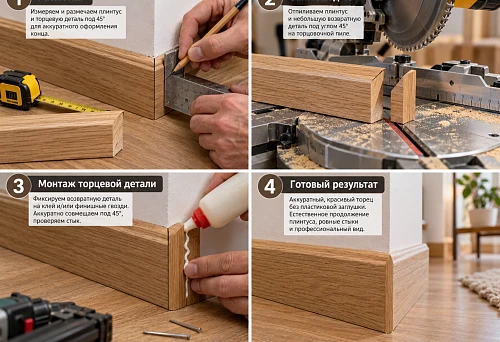
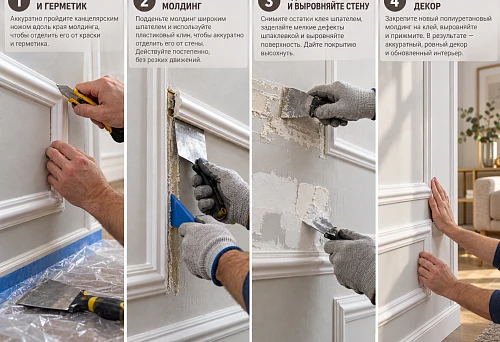
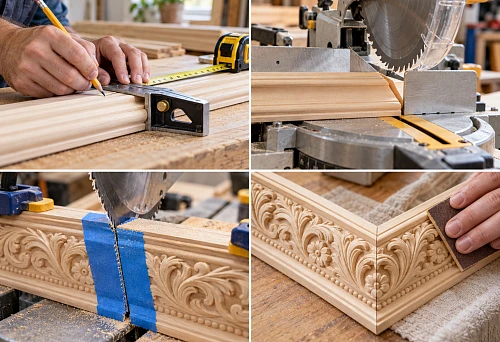
Solid wood casing is mounted around the perimeter of the slope (transition from slope to wall). Fastening: finishing nails 1.6×40 mm + mounting adhesive. Casing is joined at corners at 45° — miter saw with a 45° stop.
Slope to window frame joint: profile or molding with a 2 mm expansion gap. The gap is filled with flexible neutral-color silicone sealant — not acrylic (acrylic cracks with wood movement).
FullStep-by-step installation guide for slatted panels— with detailed schematics for walls and ceilings, also applicable in adapted form for reveals.
Reveals made from slatted panels in various interior styles
Reveals are a detail that 'works' in any style, provided the material and parameters are chosen wisely.
Scandinavian style: white ash and neutral background
Whitewashed ash or 'milk' oak on reveals — a delicate natural texture without dark accents. Against white walls — an almost monochrome play of textures: a white wall, a slightly warmer white of the wood on the reveal. Natural in the details, neutral overall.
Slatted panels in the living room interiorin Scandinavian style with whitewashed oak on an accent wall — reveals made from the same slats logically complete the natural system.
Japandi: dark ash and meditative emptiness
Dark 'smoky' ash on reveals + a dark slatted accent wall + neutral light surfaces on the floor and ceiling. Dark reveals visually 'deepen' the window opening, creating the effect of a 'window niche' from a traditional Japanese house — a dark frame around a bright outdoor view.
Wooden slat panelsmade from ash with a 'smoky' tint in a Japandi concept — one of the most precise material solutions.
Modern classic: oak 'walnut' and molding frame
Natural oak with 'dark walnut' tint on slopes + profiledsolid wood architravearound the perimeter of the slope. Slopes with molding frame matching oak parquet and wooden doors — an architectural detail respecting classical context.
Monochromatic minimalism: MDF in wall color
MDF slats on slopes in accent wall color (RAL 7016 anthracite, RAL 6005 dark green) — slopes as an 'extension' of the accent wall into the window opening. Dark framed slope makes the window visually 'deeper', giving the space architectural expressiveness.
paintable slatted wall panelsmade of MDF — for slopes painted the same color as the wall.
Door slopes from slat panels: features and techniques
Door slopes in interior — often an overlooked detail that, when properly designed, dramatically changes the perception of the doorway.
Interior door slopes: architrave or slat slope?
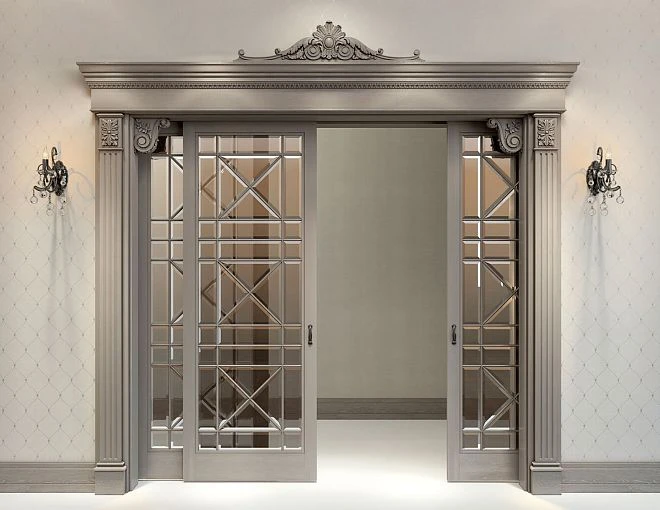
In standard apartments, door reveals are covered with architraves—straight or profiled trims that conceal the joint between the door frame and the wall. A slatted reveal is an alternative to architraves, suitable for reveal widths from 80 mm.
For reveal widths of 80–120 mm (standard interior door in a panel building): 2–3 horizontal slats 25–30 mm with a 10 mm gap. A narrow slatted reveal is a delicate natural accent that pairs well with a slatted accent wall in the adjacent room.
For reveal widths of 150–250 mm (brick buildings, renovations): a full slatted field with 4–6 slats. Sufficient to create a distinctive 'wooden portal'.
How to install slatted panelsOn door reveals—adhesive method for even surfaces or installation on a thin 20×20 mm batten for uneven surfaces.
'Portal' concept: slatted reveal + slatted arch
In doorless openings (arches, passages between open-plan zones), a slatted reveal can 'flow' over the top horizontal surface of the arch—creating a wooden 'portal'. A unified slatted rhythm on the side reveals and the arch of the opening—an architectural framing of the transition between zones.
For such a concept: slats are oriented horizontally on the side reveals and transversely on the arch—or in a single direction with corner transitions, if geometry allows. Corner transitions are solved with wooden corner profiles 15×15 mm or 20×20 mm.
Entrance door reveals: MDF with varnish for the hallway
Entrance door reveals are a high-traffic area with an unstable microclimate (door opens to the outside, moisture is brought in). Exclusively MDF with polyurethane varnish or natural oak with 4–5 layers of varnish. No oil finish—it will not withstand the mechanical impacts of the hallway.
Material calculation for reveals made of slatted panels
Practical calculation for typical window reveals.
Example 1: Standard window 1400×1400 mm in a panel house, reveal 180 mm
Side reveals (2 pcs): height 1400 mm, width 180 mm.
Top reveal (1 pc): width 1400 mm + 2×180 mm = 1760 mm, depth 180 mm.
Battens 25 mm / gap 10 mm: pitch = 35 mm. Number of battens per reveal width: 180 / 35 = ~5 battens.
Linear meters of battens:
-
Side reveals: 2 × 5 battens × 1.4 m = 14 lin. m
-
Top reveal: 5 battens × 1.76 m = 8.8 lin. m
-
Total: 22.8 lin. m. With 15% margin: ~26 lin. m.
Example 2: Wide reveal of a historical house, window 1600×1800 mm, reveal 450 mm
Step 40 mm / gap 18 mm = 58 mm. Slats per slope width: 450 / 58 = ~8 slats.
Linear meters:
-
Side slopes: 2 × 8 × 1.8 = 28.8 lin. m
-
Top slope: 8 × (1.6 + 0.9) = 20 lin. m
-
Total: 48.8 lin. m. With 15% reserve: ~56 lin. m.
For multiple identical windows — multiply by the quantity and add a general reserve of 10–15%.
Care for slat panel slopes: simple rules
Slopes are a zone with special conditions. Care rules here are stricter than for ordinary wall slat panels.
For slats with lacquer coating (oak-lacquer or MDF-lacquer):
-
Wet wiping with microfiber as needed (window slopes accumulate dust faster than walls)
-
Neutral cleaning agent without abrasives and without chlorine
-
No steam cleaner: high-temperature steam damages the lacquer
-
Every 2–3 years: light polishing with soft wax polish (only on lacquer) — restores shine with matte lacquer
If condensation forms (rare cases):
-
Immediately remove moisture with a soft cloth
-
If condensation forms regularly — the problem is in the insulation of the reveal, not in the care of the battens. An additional thermal insulation layer is required
Annual joint inspection:
-
Visual inspection of the batten — window frame joint. If a gap forms — fill with transparent silicone sealant. Not acrylic.
-
Check the skirting board and architrave: whether they have come away from the wall
Reveals made of batten panels andWall finishing with slatted panelsUnified system vs separate element
The most common question: should slatted window reveals be done separately or only paired with a slatted accent wall?
Answer: both options work — with the right approach.
Slatted reveals as part of a unified wall system — the strongest solution. The reveals 'dissolve' into the slatted wall, creating a unified natural space. The window opening becomes part of the room's wooden architecture, not a 'cutout' in it. Maximum architectural effect.
Slatted reveals as a standalone element on neutral walls — a delicate natural accent. Wooden reveals on a white wall — this is 'less wood, more accent'. This option is suitable for small spaces where a full slatted wall might be excessive.
In both cases — one principle: reveals made from slatted panels work when they are done with attention to detail. Quality material, correct slat parameters, neat joints, and finishing with casings. Then the window opening ceases to be a technical 'hole' in the wall and becomes a natural architectural element.
decorative slatted wall panels— stylistic and functional solutions that organically combine with slatted reveals.
Frequently asked questions about reveals made from slatted panels
Can wooden slatted reveals be installed over existing PVC reveals?
Not recommended. PVC has a high coefficient of thermal expansion and an unstable surface for adhesive. Wooden slats on a PVC base will eventually come loose or deform. Correctly: completely remove the PVC reveals, clean the surface of adhesive, level it, and install the slatted reveal on the prepared base.
What material should be chosen for sloped reveals when condensation regularly forms on the reveals?
With regular condensation — first eliminate the cause (additional insulation of the reveal with 20 mm XPS + vapor barrier), then install the slats. Without eliminating the cause — no material will withstand constant exposure to moisture. After eliminating condensation — MDF with polyurethane varnish as the material for the slats.
How to install slatted panelson reveals — adhesive or battens?
For even reveals in new builds (concrete, tolerance 3 mm/2 m): adhesive method. For reveals with unevenness, for reveals with added thermal insulation, for brick walls of old housing stock: battens. Combined option — battens + adhesive for slats to battens — maximum reliability.
Is a casing needed when installing slatted reveals?
A casing (framing molding) around the perimeter of a slatted reveal is always needed — except for cases where the slatted reveal is part of a unified slatted wall (then the ends of the reveal 'dissolve' into the wall's slatted field without additional framing).
MDF Plank Panelsor natural oak for reveals in a bedroom?
In a bedroom without condensation problems and with a normal microclimate — natural oak with varnish. The natural warmth of oak at a bedroom window — a natural 'ritual' of morning awakening: the first thing a person sees, opening their eyes to the daylight — a warm amber wooden reveal. This is not sentimentality, it is a reasoned argument in favor of natural material.
Is it necessary to slatted panel on the ceiling needed?with slatted reveals?
Not mandatory, but with slatted reveals and a slatted accent wall, ceiling slats complete the 'natural grotto': wooden wall, wooden reveals, wooden ceiling over the area. An architecturally rich solution for living rooms with high ceilings.
Conclusion
Reveals made from slatted panels are a conscious choice to properly address a place most people are accustomed to overlooking. A window opening with wooden slatted reveals ceases to be a neutral 'frame' for the glazing unit and becomes a natural architectural element: a wooden niche, warm amber light, the living pattern of the grain. Such an interior works not only visually but also psychologically — creating a sense of shelter, coziness, and closeness to natural material.
The correct choice of material considering operating conditions, proper slat parameters for the specific reveal format, neat joint details, and wooden architraves — from these elements, a result is formed that serves for decades and becomes more valuable with each year.
Solid oak and ash millworkfor reveals,slatted MDF panelswith lacquer coating,wooden architraves and solid wood moldingsfor finishing reveals — the full range of materials for slatted reveals of any format is presented in the STAVROS company catalog.
STAVROS is a Russian manufacturer of slat systems, millwork, and moldings made from solid natural wood. Full-cycle production: from wood selection and drying to applying finishing coatings. Professional consultation on material selection, parameters, and solutions for window reveals, taking into account the specific conditions of your room. Because every window opening in your home deserves natural wood—not white plastic that yellows after three years.