








































Article Contents:
- Slatted Finishing: Not Texture, but Architecture
- What Happens to Space When Slats Are on the Wall
- Rhythm as the Main Tool of a Slatted Wall
- Wall Molding: Not Decoration, but Architectural Plasticity
- Decorative Molding: What the Concept Includes
- Why Polyurethane Molding Decor Changed the Game
- When Slatted Finishing and Molding Work Together
- First Condition: Different Wall Zones
- Second condition: coordinated scale
- Third condition: unified tonal key
- Fourth condition: stylistic unity
- How to distribute accents in a room: architectural logic
- Main accent: one strong wall
- Secondary accents: molding on transitions
- Neutral surfaces: where there is nothing — also a solution
- Errors of overload and fragmentation: honest analysis
- First error: slatted panels on all four walls plus molding
- Second error: molding frames on a slatted surface
- Mistake three: small-scale molding next to large slats
- Mistake four: mixing styles without authorial logic
- Mistake five: ignoring the ceiling as part of the system
- Practical scenarios for different rooms
- Living room: TV wall with slats and perimeter molding
- Bedroom: accent behind the headboard and molding as a frame
- Entrance hall and foyer: architectural statement from the first step
- Study: interior as an argument
- Children's room: lightness, rhythm, without historical pomp
- Materials and parameters: compatibility table
- Assembly logic: in what sequence this is assembled
- Color: three working strategies
- First strategy: contrast
- Second strategy: monochrome
- Third strategy: tonal gradation
- Special techniques: niches, portals, TV zones
- Niche with slatted backing and stucco framing
- TV zone with slatted background and stucco accents
- Door portal with slatted framing
- Types of slatted panels: selection for a specific task
- STAVROS: two systems under one roof
- FAQ

An interior with depth is not one with many things. It's one where every element is in its place and speaks the same language as its neighbor. But when two elements speak different languages—one modern, the other historical—a question arises: conflict or dialogue?Wall finishing with slatted panelsandWall moldings—this is precisely such a pair. Two different architectural statements, two different material worlds. And it is here that one of the most interesting interior potentials lies hidden, which most designers either don't use at all or apply incorrectly.
Let's talk about how it works—when it works. And why it doesn't work—when the rules are broken.


Slatted wall finish: not texture, but architecture
Before discussing combined application, one must precisely understand what a slatted wall is in a space. Not as a material—as an architectural phenomenon.
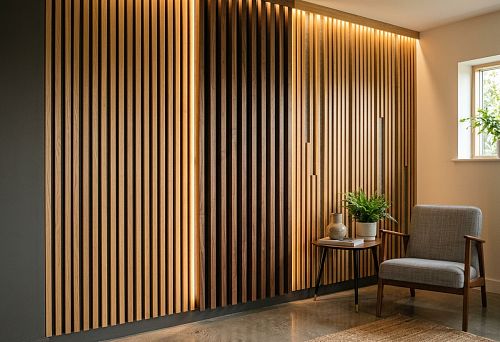
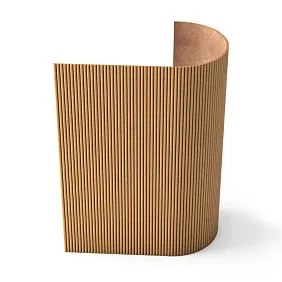
slatted wall panels for interior finishingcreate a vertical (or horizontal, but more often vertical) rhythm on the wall plane. Rhythm is repetition. Repetition is a pattern. And a pattern in spatial perception is order. The wall ceases to be just a 'background'—it becomes an ordered surface with internal logic.
Exactly thereforeWooden slat panelsproduce such an effect of 'gathered' space. Not richness, not luxury—precisely organization. A room with a slatted wall seems thought-out, even if the rest of the furniture is simple. The rhythm of the slats structures perception.




What happens to the space when there are slats on the wall
Verticalslatted panels for wallsdo three things simultaneously.
First: they stretch the space upward. A vertical line is a natural cue for the eye to 'look up.' This is especially valuable in rooms with ceilings of 2.7–2.8 m, where the standard height 'eats away' the feeling of spaciousness.
Second: they create material warmth. Wood is the only finishing material that humans perceive as biologically close. Not as 'beautiful,' but as 'one's own.'Solid oak slat panelsprovide this warmth in maximum concentration.
Third: they form shadow. The gap between the slats is not just emptiness. It is shadow. And shadow is volume. The wall gains a three-dimensionality that a painted plane lacks. Light glides over the slats differently at various times of day—the surface lives.
Our factory also produces:



Rhythm as the main tool of a slatted wall
Slatted panels in interior designwork through rhythm. The width of the slat and the width of the gap are rhythm parameters. A dense rhythm (narrow slat, small gap)—a saturated, enclosed surface. An open rhythm (wide slat, large gap)—a light, 'breathing' surface. Between them—an infinite range.
The rhythm of a slatted wall should echo other rhythms in the space: the pitch of furniture fronts, the arrangement of windows, the proportions of architectural decor. When all rhythms are coordinated—the space resonates. When rhythms conflict—what designers call 'noise' appears.
Get Consultation
Wall molding: not decoration, but architectural plasticity
Wall moldingsis perceived by many as 'old-fashioned decor for classic interiors.' This is an oversimplification that deprives the designer of a powerful tool.
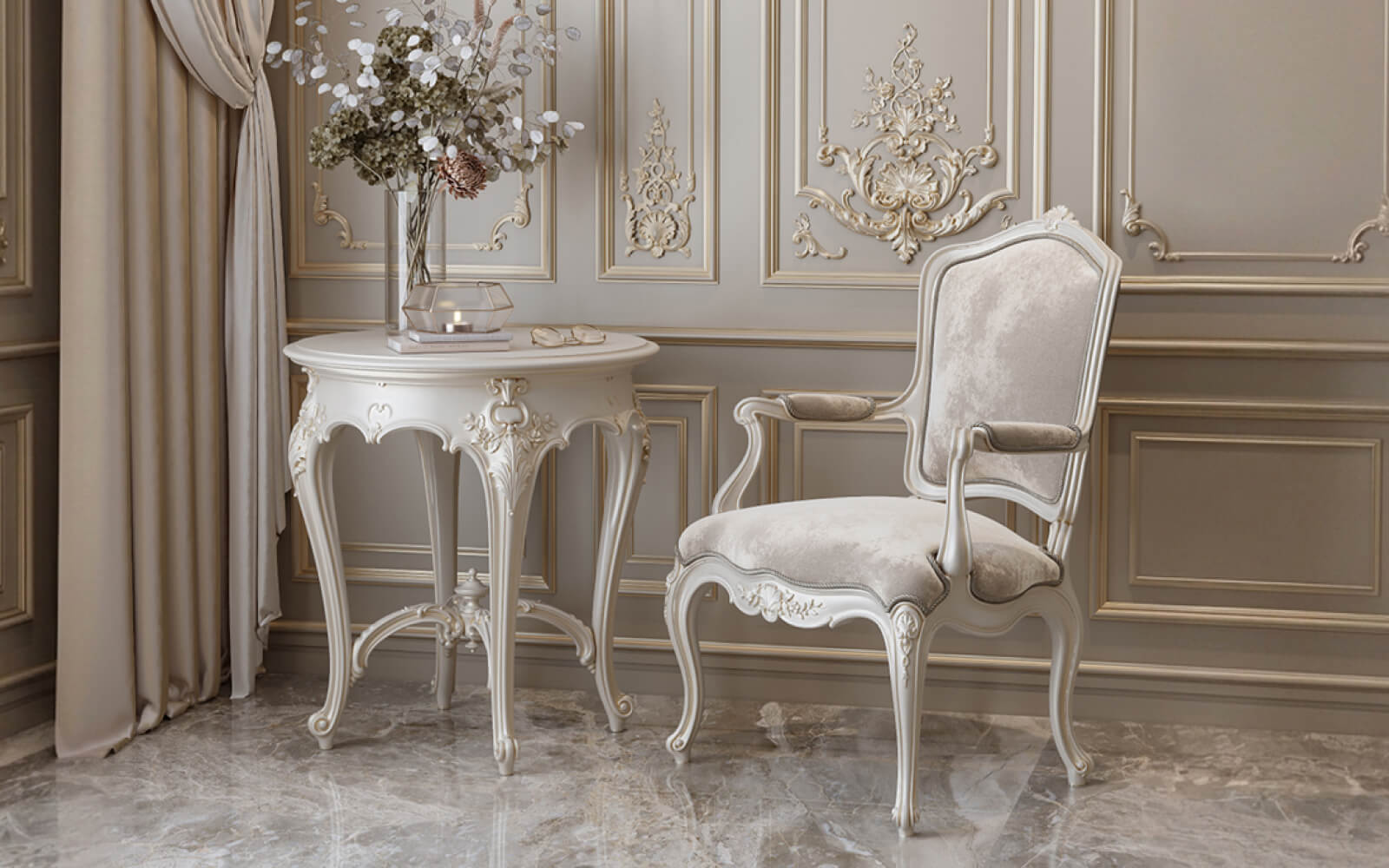
What is molding architecturally? It is the three-dimensional plasticity of a surface—profiles, reliefs, moldings, frames, cornices. It performs tasks that a flat surface cannot: it divides the wall into fields, marks transitions between planes, creates horizontal and vertical accents.
Decorative Molding: What the Concept Encompasses
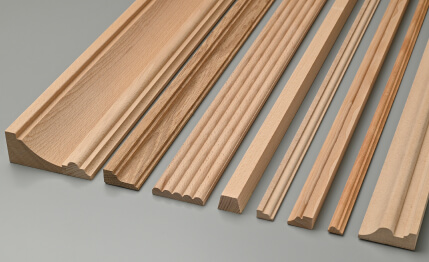
Decorative wall molding— a broad concept. It includes:
-
Cornices — horizontal profiles at the junction of the wall and ceiling
-
Moldings — profile frames that divide the wall into fields
-
Pilasters — vertical protruding elements that imitate columns
-
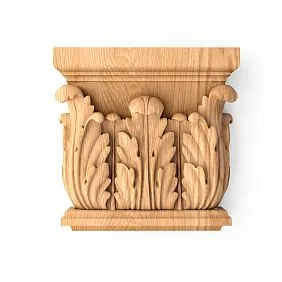
Capitals — crowning parts of pilasters
-
Rosettes — ceiling medallions
-
Corbels — consoles under cornices
-
Architraves — door or window surrounds
Each of these elements is not just 'decoration'. Each solves a specific architectural task. A cornice separates the wall and ceiling — it is not decor, it is an architectural boundary. A molding frame creates a wall field — it is not an ornament, it is structure.
Why polyurethane molding decor changed the game
Historicallywall moldingwas made from plaster. A heavy, fragile, expensive material requiring specialists for installation and constant condition monitoring. Cracks from building settlement, chips from mechanical contact, lack of waterproofing — significant limitations.
polyurethaneRelief Decorationworks differently. The weight of an element is 5–10 times less than its plaster counterpart. Installation — adhesive plus mechanical fastening. The flexibility of polyurethane provides resistance to micro-vibrations and building settlement. Painting — any shade with acrylic paint. A wide range of profiles — from strict geometry to lush Baroque.
It is this accessibility that madedecorative moldinga real tool for a wide range of interiors — not only for elite construction but also for an ordinary apartment with sufficient ceiling height.
When slat wall cladding and molding work together
The question 'can they be combined?' should be posed differently: 'under what conditions does the combination work?'. Conditions exist, and they are precise.
First condition: different wall zones
The most common mistake is trying to place a slat panel and molding on the same plane of the wall. A relief slat plus relief molding on one surface — that's doubling the signal. Two rhythms in one field mutually suppress each other.
The ironclad rule:Wall finishing with slatted panelsand molding occupy different surfaces or different zones of the same surface.
Practical implementation:
-
Slatted panels — the lower register of the wall (up to 100–130 cm). Molding — the upper register and the ceiling border.
-
Slatted panels — an accent wall (one). Molding — neutral walls and all horizontal transitions.
-
Slatted panels — inside a molding frame as field infill. The frame is made of molding, the slats are inside the frame.
Second condition: coordinated scale
Scale is the main variable when combining two systems. A narrow 35 mm slat and a massive 130 mm cornice — a scale conflict. A wide 90 mm slat and a delicate 24 mm molding — the same, only mirrored.
General principle: the scale of the molding is coordinated with the scale of the slat through the proportion of the room. In a high room (from 3 m) — both wide slats and developed molding profiles. In a 2.7 m room — moderate elements on both sides.
Third condition: a unified tonal key
Stylistic tension between slats and molding is acceptable and even desirable. Tonal conflict — no. White molding on a dark gray wall with dark slats — this is tension that works as intended contrast. Random beige molding on a wall with warm oak slats — this is not contrast, it's chaos.
The tonal key must be consciously chosen and maintained in all elements of the system.
Condition four: stylistic unity
Slatted walls are an element of contemporary language in interiors. A Corinthian capital with lush acanthus leaves is an element of historical Baroque. These two will not agree. For joint application, either a common stylistic denominator (neoclassical, soft classic, modern classic) or intentional eclecticism with clear authorial logic is needed.
How to distribute accents around the room: architectural logic
An interior is a system of accents. Main accent, secondary accents, neutral surfaces. Without this hierarchy, the space falls apart—there is no focal point for the gaze, no route for perception.
Main accent: one strong wall
Most living spaces have one 'main' wall—the one that catches the eye upon entering. This is the fireplace wall, the wall behind the sofa, the wall with the TV area, the wall behind the headboard.
This wall is the right place for slatted panels for walls as a dominant accent. Full height, dark wood or pronounced texture, lighting in the gaps—this is a statement that defines the character of the entire space.
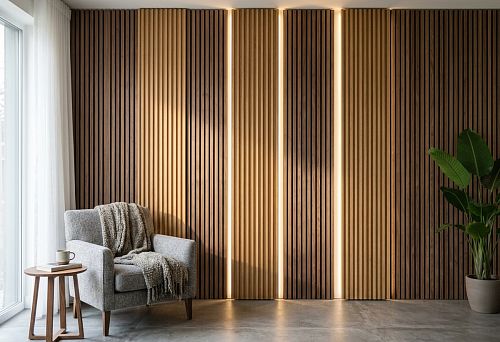
Slatted panels with lighting on the main accent wall is a separate level: warm light in the gaps between the slats turns a static surface into an atmospheric object that lives differently during the day and evening.
Secondary accents: molding on transitions
When the main accent is defined — the slatted wall — the other surfaces take on a secondary role. And here space emerges formolding on walls.
A ceiling cornice around the perimeter of the room. Molding frames on neutral walls. Pilasters framing doorways. This is the second layer of architectural decor — not competing with the slatted wall, but organizing the remaining space.
In such a system, the molding does not compete with the slats — it structures everything that lies beyond the accent wall. The room gains architectural unity: both the modern slatted surface and the classic decorative framework exist in a single space with clear roles.
Neutral surfaces: where there is nothing — is also a solution
Neutral walls without slats and without molding — are not 'unfilled space'. It is a pause. A musical pause is also part of the composition. In a space where all surfaces are occupied by something, a neutral wall creates a rhythmic rest.
The correct distribution in a room: one accent slatted wall, horizontal transitions with molding, one or two neutral walls with minimal decor. This is one third — one third — one third in a simplified formula.
Errors of overload and fragmentation: an honest breakdown
An overloaded interior is not one with many elements. It is one where elements compete for attention without hierarchy. Let's analyze the most common mistakes.
First mistake: slatted panels on all four walls plus molding
Wall slat panels in interioron all four walls — a solution that requires a large space and high ceilings. In a standard residential room, four slatted walls create a 'cage' — a closed, oppressive space. Add molding to that — and the space collapses as an architectural statement.
360-degree slat panels are suitable in halls with an area of 25 sq. m or more and ceilings from 3.2 m. In standard spaces, a maximum of two walls, and even then with different treatments: one accent wall, the other light.
Second mistake: molding frames on a slatted surface
This is literally 'ornament on ornament.' A molding frame glued onto a slat panel is not doubling the decor; it destroys it. The slats disappear under the frame as an independent system, and the frame loses its clear background. Both elements cease to function.
Molding frames only on smooth painted surfaces. Never on slatted textures.
Third mistake: small-scale molding next to large slats
decorative slatted wall panelswith a wide 85 mm slat is a large, structural surface. Next to it, an 18 mm molding is invisible, 'unreadable.' Fine molding gets lost next to a powerful slat system.
The scale of the molding must be sufficient to be 'audible' in the context of adjacent elements.
Fourth mistake: mixing styles without authorial logic
MDF slat panels for paintingin a modern minimal style—and Corinthian capitals on pilasters nearby. This is not eclecticism. This is stylistic confusion. Eclecticism implies intention: the designer knows why they take a historical element into a modern context and can explain it through the space. Random mixing is different.
Mistake five: ignoring the ceiling as part of the system
Slatted wall + wall molding are two elements. But there is a third: the ceiling. If the ceiling "falls out" of the system — simply painted without a transition cornice — the space loses its completeness. A ceiling cornice fromstucco decorationis a mandatory element of the system that connects the slatted wall and the ceiling into a single architectural volume.
Practical scenarios for different rooms
Living room: TV wall with slats and perimeter molding
This is the most common scenario, and when implemented correctly — one of the most expressive.
Slatted panels in the living room interioron the TV wall — full height from floor to ceiling. Oak or thermally modified wood slat, width 62–85 mm, open spacing. TV niche — either integrated into the slatted system or highlighted with a separate horizontal element.
on the other three walls: ceiling cornice frommoldings for wallsaround the entire perimeter, including the slatted wall. On the side walls — molding frames in the lower and upper fields. On the wall behind the sofa — neutral, only cornice.
Tone: dark slats + white molding + neutral walls in a soft tone. Or a unified tone of molding and walls with a dark slatted accent wall.
Ceiling height for this scenario: from 2.75 m. At 2.6 m — only a narrow cornice, without developed molding frames.
Bedroom: accent behind the headboard and molding as a framework
In the bedroomRafter panelsBehind the headboard — a delicate scenario. The slat is narrow, 38–52 mm. The spacing — equal to or slightly greater than the width of the slat. The tone — soft natural, without dark tints.
Molding in the bedroom — first and foremost, the ceiling cornice. It creates a horizontal boundary and 'fits' the slatted accent wall into the architecture of the space. Molding frames on the side walls — if desired, delicate, with a flat profile.
Not acceptable: massive Corinthian molding in a bedroom with delicate slats. The sleeping space should create tranquility, not tension from a clash of scales.
Slatted panels in the bedroom interiorWith warm LED lighting in the gaps — and a delicate MDF or polyurethane cornice — create an atmosphere that cannot be achieved by any other combination of materials.
Entryway and hall: an architectural statement from the first step
The entryway — a space where the first impression of the house is formed in 3–4 seconds. It is here that the combination ofwall finishing with slatted panelsand molding works with maximum strength.
Slatted panels in the hallway interior— the lower register up to a height of 110–130 cm. Above — a neutral surface, well-receiving horizontal molding as a transitional element. Ceiling cornice — mandatory. With a ceiling height from 2.8 m — pilasters with capitals at the entrance door or on the sides of the passage to the next room.
Pilasters in the hall with capitals and a horizontal architrave above the doorway—this is a classic portal technique that elevates the transition from the hall to the living space into an 'event,' not just a passage.
Study: Interior as an Argument
A home study is a space where architectural weight carries direct psychological meaning.Wooden slat panelsOn the work wall (behind the monitor or workspace)—dark oak or walnut. Pilasters with Doric capitals on the sides create an architectural 'frame' for the work zone. Polyurethane cornice along the perimeter.
On walls with bookshelves—no battens needed: the shelves themselves create rhythm. Molding frames on free wall fragments fill the space without competing with the shelves.
Study color scheme: dark wood battens + white or taupe moldings + neutral walls in a cool or warm neutral tone.
Children's Room: Lightness, Rhythm, Without Historical Pomp
In a children's room, moldings in a historical style are inappropriate. But geometric polyurethane decor is quite suitable. Simple rectangular molding frames on the walls. Light geometric cornice. Batten panels—light,Painted MDF plank panelsin a bright or neutral tone—on one accent wall.
This system is practical: when the child's age changes, repaint the panels and moldings in a different tone. The material remains the same, only the color changes.
Materials and parameters: compatibility table
| Room Type | Slatted panel | Molding | Crown Molding | Combination |
|---|---|---|---|---|
| Living room, 3.0 m | Oak 65–85 mm, dark | Moldings + capitals | 108–130 mm | Dark battens + white molding |
| Bedroom, 2.75 m | MDF 42–58 mm, light | Cornice only | 75–95 mm | Monochromatic warm |
| Hall, 2.80 m | Oak 52–72 mm, lower case | Pilasters + cornice | 95–115 mm | White molding + dark wood |
| Study, 2.90 m | Walnut/oak 68–88 mm | Doric capital + cornice | 100–120 mm | Dark wood + white/taup |
| Children's, 2.65 m | MDF for painting 38–52 mm | Geometric frames | 65–80 mm | Unified tone |
| Kitchen, 2.70 m | Moisture-resistant MDF 48–62 mm | Geometric cornice | 75–90 mm | Neutral monochrome |
Installation logic: the sequence of assembly
installation of slatted panels on the walland installation of moldings are two different technological processes. Their correct sequence determines the quality of the final result.
Stage 1 — marking and design. Before any work begins, the following are recorded on paper: the layout of the slatted field, placement of pilasters and cornices, and areas of molding frames. Everything is coordinated with the room height, location of sockets and switches, door and window openings.
Stage 2 — surface preparation. Leveling with plaster to permissible deviation (no more than 3 mm/m for adhesive installation). Priming. Marking installation lines on walls.
Stage 3 — battens or substrate. For adhesive-mounted slatted panels — a prepared flat plane. For installation on battens — a wooden or metal frame with a ventilation gap.
Stage 4 — installation of slatted panels.Installation of batten panelsBottom to top. Finishing profiles on the ends.
Stage 5 — installation of pilaster bases and shafts. Polyurethane pilasters are mounted with adhesive plus mechanical fastening. Strictly level.
Stage 6 — installation of capitals and architraves. Capital — on adhesive and fastening from below.
Stage 7 — installation of ceiling cornice. Cornice — the last horizontal element, closing the system from above.
Stage 8 — sealing. All joints of polyurethane elements are sealed with acrylic sealant. Joint of slatted panel with pilaster — similarly. Filling of fastener holes.
Stage 9 — painting of molding. Acrylic primer + two coats of finishing acrylic paint.
Stage 10 — finishing treatment of slatted panels. Oil, varnish or wax — depending on material and desired effect.
This sequence is not a recommendation, but a technological necessity. Violation of the order creates problems at the joints, which cannot be solved without partial dismantling.
Color: three working strategies
When two strong elements are present in the space — slatted surface and molding — the color solution must be made consciously.
Strategy one: contrast
Dark battens (mocha oak, walnut, thermowood) — white or off-white molding. A classic bipolar contrast that reads as quality. This is the most stable solution: it works in any stylistic context, from strict classic to modern eclectic interiors.
Reverse option: light battens (natural ash, white MDF) — taupe or gray tinted molding. A more complex solution requiring precise tone selection.
Strategy two: monochrome
Everything in one tone. Battens for painting in the same tone as the molding and walls. The relief works through shadows, not color. This is a maximally modern, minimalist solution. The space unifies into a single monochrome volume, where the decor reads as architectural plasticity, not as a color accent.
This technique requiresMDF battens for painting— natural solid wood in a monochrome system looks like something foreign (the wood texture is visible, which disrupts the unified tone).
Strategy three: tonal gradation
Floor — the darkest. Walls — medium tone. Molding — one or two tones lighter than the walls. Ceiling — the lightest. Battens — in the tone of the walls or slightly darker.
This is a classic 'weight' system that gives the space stability: dark elements 'ground' it, light ones 'lift' it. Molding in this system plays the role of a light accent at the transitions between planes.
Special techniques: niches, portals, TV zones
Niche with a slatted backing and molded framing
A wall niche is a natural architectural frame. The back wall of the niche is the perfect place forslatted panels for walls: a closed field, a clear boundary, internal lighting. The external framing of the niche—pilasters with capitals and a horizontal cornice—turns the niche into a true architectural portal.
This is one of the most expressive and precise techniques for the combined use of slats and molding: each element occupies its own physical place without competing with the other.
TV zone with a slatted background and molded accents
TV area with slatted panels—an accent wall. The slats run behind the TV and on the sides, creating an architectural frame for the media zone. Molding is on the horizontal transitions: a cornice above the slatted wall (transition to the ceiling), a horizontal molding under the TV (if the TV is mounted at a height from the floor). This is not overload—it's the architectural logic of zoning.
Door portal with slatted framing
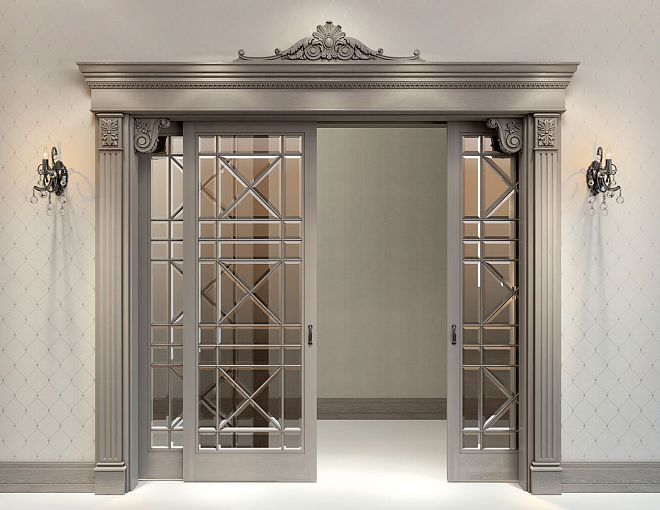
A standard door casing is a functional element. A portal is an architectural statement. Pilasters on the sides of the doorway, capitals, a horizontal architrave. Next to the portal—slatted panels on the wall of the corridor or hallway. The portal reads as an architectural accent, the slats—as the background on which the portal lives.
Slat rhythm in corridors and hallswith molded door portals — one of the most convincing scenarios for classic and neoclassical interiors in urban apartments with standard or improved layouts.
Types of slat panels: choosing for a specific task
When discussing the combined use of slatted walls and moldings, it is important to understand thatTypes of slat panelsdiffer significantly — and this affects stylistic compatibility with moldings.
Solid oak.Solid oak slat panels— maximum natural texture, lively surface character. Combines with moldings in styles such as modern classic, soft neoclassicism, eclecticism. Requires coordinated scale of moldings.
MDF for painting. Neutral surface that can take any tone. Maximum compatibility with any style of molding — from geometric to Corinthian.MDF slat panels for walls— the ideal choice for monochrome systems.
Thermowood. Dark, moisture-resistant material. Pairs well with white moldings — the contrast of dark wood and light decor works in any room.
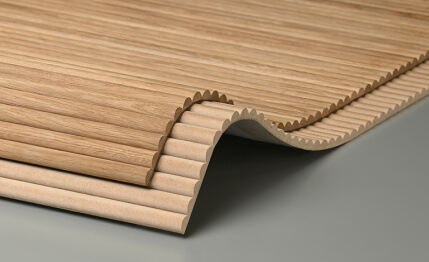
soft slat panels— flexible structures for curved surfaces and arches. They don't always pair with classical-type moldings, but with geometric profiles — quite well.
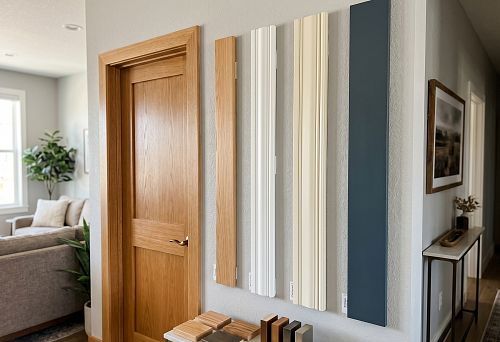
slatted modular wall panel— factory system with a set pitch and standard sizes. Provides uniform rhythm across the entire surface. Pairs well with molding frames as a border for a modular field.
STAVROS: manufacturing two systems under one roof
When the task is to create an interior withwall finishing with slatted panelsanddecorative moldings on wallsas a single system, it is critically important that both components originate from the same production logic. Otherwise, scale and stylistic coordination will have to be solved independently — and this takes significantly more time and resources than it seems.
STAVROS producesSlatted wall panelsmade from natural solid oak, ash, thermowood, and MDF — in a full range of widths, profiles, and finishes. And simultaneously — a fullAssortment of polyurethane decor: cornices, moldings, pilasters, capitals, architraves, rosettes — coordinated systems for any stylistic context.
This means: one supplier — two system components. One scale logic, one production precision, one opportunity to achieve a coordinated result without the need to 'fit' elements from different manufacturers.
Calculation, consultation, samples, delivery across Russia. A professional approach to every project.
FAQ
How to understand if molding is needed when slatted panels are already planned?
Ask yourself: are there horizontal transitions in the room (wall-ceiling, areas between slatted and non-slatted fields) that visually appear 'unfinished'? If yes — a cornice or transition molding made of stucco is needed. If the slatted wall is the only accent in a neat, minimal space — molding may be excessive.
Can molding and slatted panels be used in an apartment with a 2.55 m ceiling?
Yes, but with limitations. Only a narrow cornice (55–72 mm) without an elaborate profile. Slatted panels — without pilasters with capitals (they will 'weigh down' the ceiling). Molding frames — only flat, with a minimal profile. The main rule for a low ceiling: decor works subtly, not emphasizing the height.
Is it necessary to plan electrical wiring in advance for slatted panels with lighting?
Yes,Slatted panels with lightingThey require running the cable to the desired point on the wall before starting panel installation. After installation — it is impossible to run electrical wiring concealed without damaging the structure.
What adhesive to use for installing polyurethane decor?
Specialized mounting adhesive for polyurethane or liquid nails compatible with polyurethane. Acrylic compounds like 'Moment Montazh' or equivalents. Silicone — only transparent or color-matched, for final sealing of joints, not for primary fastening.
What to do if the joints between the slats and stucco decor leave gaps?
Joints are sealed with acrylic sealant of the same tone as the finish paint. Acrylic sealant is elastic and can be painted after drying. White or transparent silicone cannot. Properly selected sealant makes joints invisible.
Is it possible to make slatted panels and molding yourself?
DIY Batten Panels— a quite realistic DIY task with basic tools. Installing polyurethane molding is even easier: adhesive, level, sealant. The difficulty lies in marking and precisely aligning the joints between the two systems. This stage requires thorough preparation and accurate measurements.