








































































Article Contents:
- What is decorative slat finishing?
- Where are decorative slats used in interior design?
- Living room wall finishing
- TV zone design
- Accent wall in the bedroom
- Hallway and corridor decor
- Kitchen-living room zoning
- Partitions and visual space division
- What types of decorative slats are there for finishing?
- Solid wood slats
- MDF slats
- Ready-Made Plank Panels
- Veneered Solutions
- Painted and Primed Options
- Why Decorative Slats Are Convenient for Finishing
- How to Choose Slats for Wall Finishing
- By material
- By Size and Thickness
- By Color and Texture
- By interior style
- By installation method
- By surface type
- What to Choose — Individual Slats or Ready-Made Panels
- Finishing Different Zones with Decorative Slats
- Behind the Sofa
- At the Head of the Bed
- In the dining area
- On columns and wall sections
- Near the staircase
- In the office, study, showroom
- How to choose the color of slats
- Installation of decorative slats: from preparation to lighting
- Foundation Preparation
- Marking
- Choosing the spacing between slats
- Fastening
- Medium-thickness pieces are attached using a combined method - with adhesive and additional mechanical fixation.
- Lighting and decorative inserts
- Common mistakes when finishing with decorative slats
- When decorative slats are especially appropriate
- How to order decorative slats for finishing
- Conclusion: Who is decorative slat cladding suitable for?
- FAQ: Answers to common questions about decorative slat cladding
- Conclusion
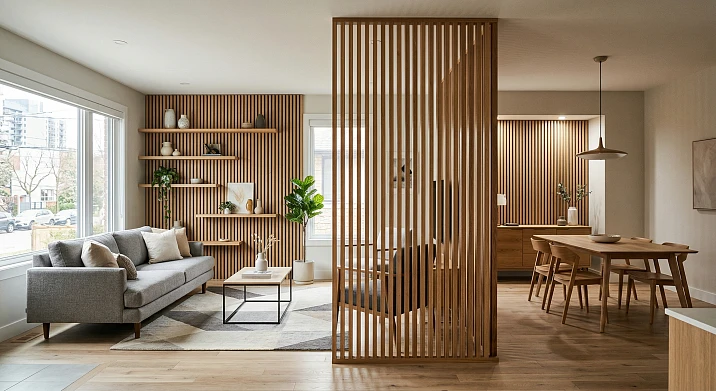
Imagine: an ordinary white wall. Unremarkable, standard, the kind your gaze slides past without stopping. Now — the same wall, but with vertical slats of natural oak: a steady rhythm, living texture, a soft play of shadow in the grooves. The space hasn't changed — the perception of the space has. That's how decorative slat cladding works: not makeup, not camouflage — an architectural statement.
This material is a practical guide for those seeking not just a pretty picture online, but understanding: what, where, how, and why. We'll break down application scenarios, material types, selection mistakes, installation nuances, and answer the questions that most often go unanswered.
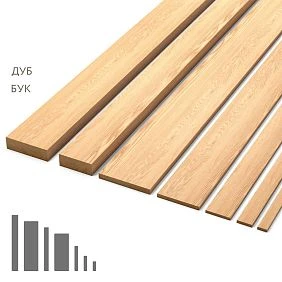
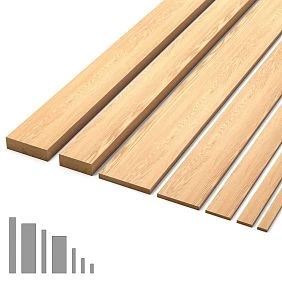
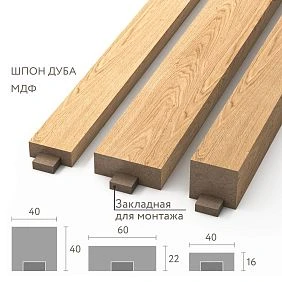
What is decorative slat cladding?
Let's start with precision, not vague formulations. Decorative slat cladding is a method of finishing walls, ceilings, niches, partitions, and architectural surfaces using linear wooden or MDF profiles, fastened parallel to each other with a specified spacing.
These are not panels in the traditional sense (though slatted panels are one format), not clapboard, and not blockhouse. Decorative slats work differently: they don't cover the wall completely, but create a rhythmic structure on its surface — with gaps, interplay of light and shadow, and a tactile depth you want to touch.
Why has this technique become so in demand? There are several reasons, and each is significant.
First, slats solve the eternal problem of an empty wall: a long, flat surface without details looks unfinished, and filling it with paintings or patterned wallpaper isn't always appropriate. Second, the vertical lines of the slats visually elongate the height of a room — a technique designers have been using consciously for decades. Third, natural wood in an interior provides what no artificial material can: warmth, organic feel, a sense of living nature nearby.
—Decorative wall panelingHow does it differ from classic wooden cladding? Fundamentally — in the openness of the structure. Classic cladding covers the wall completely. Slats — leave gaps, create transparency and lightness. This is their main visual asset.




Where are decorative battens used in interior design?
Perhaps there is no other finishing solution that is applied in such a variety of scenarios. Battens are versatile—and that is their strength. But versatility does not mean 'suitable everywhere and always.' Let's examine specific zones.
Our factory also produces:
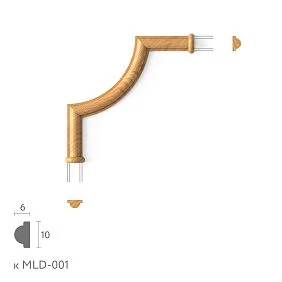
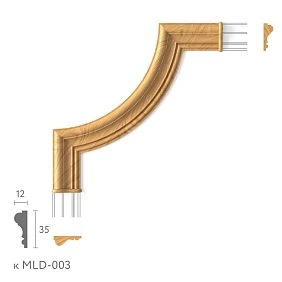
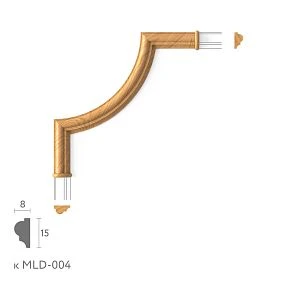



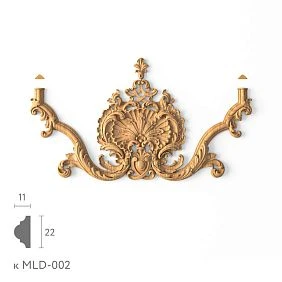

Wall finishing in the living room
The living room is a space with the highest concentration of attention. Everything matters here: proportions, light, accents. Decorative finishing with battens in the living room is most often implemented in two scenarios.
Full accent wall—from floor to ceiling, across the entire width. Creates a powerful architectural backdrop, makes the room feel deeper. This technique requires good natural or artificial lighting—a dark room with dark battens risks becoming a dark room with dark battens.
Local accent—a fragment of the wall behind the sofa, an insert in a niche, decorative framing. Works subtly, doesn't overload, creates a sense of thoughtfulness—when it seems that the design was planned, not accidentally assembled.
Get Consultation
TV zone design
The wall behind the TV is a special story. A dark rectangle of the screen on a light wall looks like a hole. Battens solve this problem architecturally: they integrate the TV into the context, making the zone cohesive and complete. Dark battens next to a dark screen merge into a single volume. Light ones create contrast, which emphasizes the TV itself as the center of the zone.
Accent wall in the bedroom
Behind the headboard of the bed—one of the most advantageous positions for batten decor. Here, battens work on several tasks at once: create a focal point, form a sense of intimacy and protection, 'frame' the bed as the main object in the room.
The combination of slats with warm bottom lighting is especially effective. The light rises between the slats, creating a delicate light curtain. This effect cannot be replicated by any other finishing method.
Hallway and corridor decor
The hallway sets the first impression.decorative wall battensIn this area, they work not only aesthetically—oak and dense wood species are resistant to mechanical impacts, which are abundant in the hallway: keys, bags, umbrellas, children's toys.
In narrow corridors, horizontal slat layout is a classic technique for visual expansion. In hallways with low ceilings, vertical slats stretch the space upward.
Zoning a kitchen-living room
Open floor plans are the norm for modern apartments. A slatted partition or decorative 'screen' made of slats between the kitchen and living areas solves the zoning problem without a solid wall. The space is visually divided but remains unified, airy, and transparent.
Partitions and visual space division
A separate and increasingly in-demand category is slatted partitions. This is not a wall, not a screen, not a curtain—it is a structure that simultaneously divides and connects. The slats allow light, air, and sight to pass through, marking a boundary without rigidly closing it off.
Slatted partitions are used:
-
between the living room and the study;
-
between the bedroom and the dressing room;
-
in studios and apartments;
-
in commercial spaces — restaurants, coworking spaces, showrooms.
What types of decorative slats are there for finishing
Material selection is not a secondary issue after appearance. It is a primary issue because the material determines everything else: durability, repairability, performance in use, and the final cost per square meter of finishing.
Solid wood slats
Oak, beech, ash, walnut — the top tier of interior slats. Each solid wood product carries a unique grain pattern, annual rings, and natural shade uniqueness. This cannot be replicated by any film or paint.
Oak — the favorite among species fordecorative finishing with slats. Density 650–750 kg/m³, high tannin content (a natural antiseptic), bending strength limit about 105 MPa. An oak slat is a material that lasts 30–50 years, allows for multiple surface restorations, and acquires a noble depth of tone over time.
Beech — density 620–680 kg/m³, more uniform structure without pronounced grain. Ideal for painting to the desired color: a uniform surface gives a perfect result under enamel. Beech is also used for complex bent profiles — steaming allows creating curved shapes.
MDF battens
High-density MDF (750–850 kg/m³) — an affordable and technologically advanced material. Its main advantages: absolute geometric stability, structural uniformity, perfect adhesion of any coatings, possibility of milling complex profiles.
MDF battens are chosen when:
-
a specific color from the RAL palette is needed;
-
precise geometry without natural variations is important;
-
the budget is limited, but surface quality is not.
Main limitation: MDF cannot be re-sanded like solid wood. Restoration after mechanical damage is more difficult. In high-load areas, solid wood is preferable.
Ready-made lath panels
Slatted panels made of solid oak and MDF— a separate and very convenient category. Several battens are already fixed on a backing with a precise spacing. This is a ready-made modular block that is mounted on the wall as a whole.
The main advantage of panels is precision and speed. The spacing is fixed structurally: no need for meticulous manual marking of each batten. On large areas, this saves hours of work and eliminates accumulating errors.
Flexible fabric-based panels are a separate category. They are mounted on curved surfaces: columns, arches, rounded niches. Achieving such a result with rigid individual slats is practically impossible without special equipment.
Veneered solutions
MDF slats with a thin layer of natural veneer on the face. Visually — almost like solid wood: living texture, natural pattern. Price-wise — lower than solid wood. It's important to understand the limitation: veneer with a thickness of 0.5–1.5 mm cannot be sanded and refinished like solid wood. If damaged, restoration requires replacing the part.
Painted and primed options
Slats 'for painting' or 'for enamel' are blanks that have undergone preliminary priming. An ideal base for applying the final color. Such slats are often made from beech — for its uniform, non-porous structure, which gives a flawless painted surface.
Why decorative slats are convenient for finishing
The list of advantages of slat finishing is not a marketing template, but a set of quite specific functional properties.
Visual correction of space. Vertical slats increase the perceived height of a room. Horizontal ones — widen it. Diagonal ones — add dynamism. This is a tool of architectural illusion that always works.
Adding texture. Flat painted surfaces are laconic but lifeless. Slats provide tactile depth that is perceptible from any distance. The space begins to 'breathe'.
Masking imperfections. An uneven wall behind slats is not a problem. Wooden profiles conceal minor base defects without requiring perfect leveling.
Versatility of style. Slatted wall paneling fits well in minimalism, Scandinavian style, Japandi, neoclassicism, loft, and contemporary interiors. Only the choice of material, shade, and spacing changes—the concept remains effective in any style.
Zoning without partitions. Visual separation of space without losing airiness and light—this is what slats can do like no other finishing tool.
How to choose slats for wall paneling
This is where the most important part begins. There are many beautiful pictures online. But a systematic approach to selection is rare. Let's break down each parameter.
By material
Answer three questions:
-
Do you need a natural wood texture, or will a high-quality painted surface suffice?
-
How intense is the load on the area (entryway—high, bedroom—low)?
-
What is the budget?
Solid wood—for those doing a renovation once and for the long term. MDF—for those who prioritize color and flexibility. Veneer—a compromise with a limited budget while maintaining a natural appearance.
By size and thickness
The thickness of the slats affects the visual weight of the surface. Thin slats (10×20 mm) create light graphics. Massive ones (30×50 mm) create architectural strength. The width should be proportional to the wall area and room height: in a small room, wide slats will create a feeling of a cage.
Practical table:
| Slat cross-section | Recommended spacing | Visual effect | Style |
|---|---|---|---|
| 10×20 mm | 60–100 mm | Light, thin graphics | Minimalism, Japandi |
| 15×30 mm | 80–120 mm | Soft rhythm | Scandinavian |
| 20×40 mm | 100–160 mm | Expressive texture | Modern |
| 25×50 mm | 150–200 mm | Rich texture | Neoclassical |
| 30×50 mm | 200–300 mm | Strong verticals | Loft, brutalist style |
By color and texture
Light shades are for small rooms, Scandinavian and Japanese styles. Medium shades (natural oak, honey) are universal. Dark shades (wenge, tobacco, graphite) are for large spaces with good lighting.
Texture is important separately: an expressive wood grain pattern works only when the rest of the interior is calm enough. If the room already has an active pattern on the floor, fabric, or wallpaper, a rich texture of slats will create information overload.
By interior style
Style determines not only the shade but also the profile, spacing, and direction of the slats:
-
Minimalism and Japandi: thin vertical slats, light wood, wide spacing;
-
Scandinavian style: white or pale slats on a light background, lightness and airiness;
-
Modern interior: medium slats with pronounced texture, neutral or warm tones;
-
Neoclassical: wider profiles, warm shades, combination withmoldings and solid wood cornices;
-
Loft: dark, textured, powerful slats; rough treatment as an artistic technique.
By installation method
Glue, clips, finishing nails — three main methods. The choice depends on the product format and installation conditions. Ready-made panels with glue are the fastest option. Hidden clips are for expensive products when the surface must be perfectly clean from fasteners.
By surface type
A flat wall is the standard case. For columns, arches, rounded corners — flexible slatted panels are needed. For niches — individual slats cut to fit on-site. Each case has its own technology.
What is better to choose — individual slats or ready-made panels
A question that arises for most buyers. And it deserves an honest and specific answer.
Choose individual slats when:
-
the wall has a non-standard shape or size;
-
a non-standard layout with different spacing or direction is needed;
-
working with columns, niches, slopes;
-
precise matching of shade and texture is important;
-
you want full control over the result.
Choose ready-made slatted panels when:
-
The wall is even and of standard proportions;
-
Installation speed is important;
-
You are working with a large area (from 10 m²);
-
Guaranteed even step geometry is needed;
-
Installation is done independently.
From the perspective of the external result with professional installation, there is no difference. From a practicality standpoint on large areas — panels are significantly more convenient and faster.
Finishing different zones with decorative slats
Let's go through specific scenarios — not in general terms, but with practical details.
Behind the sofa
The area behind the sofa is the main 'back wall' of the living room. Full slat finishing here creates a sense of architectural depth. An important nuance: the slats should start and end symmetrically relative to the sofa's axis. Asymmetry here looks like a mistake, not a design technique.
At the head of the bed
Here, it's enough to allocate about 120–140 cm in width behind the bed and raise the slats to a height from the pillow to the ceiling. Alternatively, you can create a local 'headboard' zone 80–100 cm high as a standalone element that doesn't touch the ceiling.
In the dining area
Slats behind the dining table work as a frame for the area, giving it autonomy and a special character. In open-plan layouts, this helps visually 'highlight' the dining spot from the unified space.
On columns and wall sections
Columns with slatted finishing are one of the elegant techniques. Flexible panels are especially good: they precisely follow the column's radius, without gaps or cuts.
Near the staircase
The wall along the staircase flight is non-standard in shape but a very visually active surface. Vertical slats along the staircase emphasize its dynamics. It's important to plan the start and end of the layout relative to the steps and landings.
In the office, study, showroom
Commercial spaces are a special topic. A slatted wall in a meeting room creates a sense of status and concentration. In a showroom or store, it adds warmth and organic feel that encourages purchases. In an open office, it provides functional zoning without solid partitions.
How to choose the color of battens
Color is not about 'like/dislike'. It's logic. And here are its basic rules.
Reference to the floor. Battens and floor made of the same wood (or matching wood) — unity that always works. Battens and floor made of different wood — contrast that requires conscious logic.
Reference to the doors. If the doors in the room are made of dark oak, battens made of light ash will create a sense of inconsistency. Unity or conscious contrast — there is no third option.
Light battens on a dark wall — a classic technique for creating relief. Dark battens on a light wall — modern minimalism.
Tonal combination chart:
| Batton shade | Wall background | Floor | Effect |
|---|---|---|---|
| Light oak/honey | White | Light ash | Lightness, Scandinavian coziness |
| Medium oak | Beige | Medium oak | Warmth, naturalness |
| Dark oak/tobacco | Light gray | Dark floor | Contrast, strength |
| Gray slats | White/gray | Concrete, ceramics | Modern |
| White slats | Any | Any | Neutral, freedom |
Installation of decorative slats: from preparation to lighting
Installation is where theory meets reality. Here, not only the beauty of the layout matters, but also the technical proficiency of execution.
Foundation Preparation
The wall must be dry, even (tolerance ±3 mm per 2 meters), degreased, and primed. Damp substrates cause adhesive peeling and slat deformation. Check wall moisture with a moisture meter: the permissible limit for installation is no more than 4%.
Marking
Start from the center of the wall or from a clear axis (window, fireplace, niche shelf). Mark with a pencil using a level. For vertical slats—check with a plumb line every 3–5 slats. Accumulated deviation on a long wall will create a noticeable 'slant' by the end.
Choosing the spacing between slats
Spacing is the distance between the inner edges of adjacent slats (gap). Do not confuse with axial spacing (from axis to axis). With a slat width of 20 mm and a gap of 40 mm, the axial spacing will be 60 mm. It is the gap that determines the visual density of the surface.
Practical rule: a gap equal to or less than the slat width—dense texture. A gap 1.5–2 times larger than the slat width—airy, light layout.
Fastening
Three working methods:
-
Mounting adhesive + finish nails without heads. Universal, fast, reliable. Nails are countersunk, holes are filled with wood putty to match the color.
-
Hidden clips. Metal brackets are attached to the panel backing and snap into the base grooves. Surface—no visible fasteners. Preferred for expensive solid wood products.
-
Adhesive without additional fasteners. Acceptable for lightweight MDF slats and ready-made panels. Essential—apply pressure during adhesive polymerization time (20–40 minutes).
Trimming and jointing
Miter saw or hand saw with a thin blade. 90° angle for straight joints. 45° angle for external and internal corners. Gaps between adjacent panels should not exceed 0.5 mm for a monolithic surface appearance.
For complex angles, use a decorative corner profile made of the same material: it will hide the inevitable cutting inaccuracies.
Lighting and decorative inserts
LED strip in the grooves between the slats is one of the most effective lighting techniques. Installed before mounting the slats: a groove or channel in the substrate. Warm light (2700–3000 K) brings out the warm tones of wood. Neutral (4000 K) is for gray and cool-toned slats.
Decorative inserts between slats are also popular: mirror strips, metal inserts, glass tiles. They add an interesting rhythmic accent and enhance the surface's light play.
Common mistakes when finishing with decorative slats
Let's look at the most common miscalculations—and what to do about them.
Too narrow spacing—'fence' effect. Dense layout of wide slats without sufficient gaps creates a feeling of a grid or fence. Solution: increase the gap or reduce the width of the slat.
Random color selection. Slats are chosen because they 'look nice,' without coordinating with the floor, doors, or furniture. The result is a mismatched interior. Solution: order a sample and compare it in the actual space.
Incorrect proportion of height and width in the layout. Slats on a wall 3 m wide start and end on a non-multiple step. This results in cut, non-whole slats at the edges. Solution: calculate the layout in advance on paper or in a program.
Poor base preparation. Installation on a damp or dusty wall → peeling → rework. Saving on preparation always costs more.
Overloading with battens. Four walls + ceiling + furniture — this isn't Scandinavian interior, it's a wooden box. One accent — one surface.
Unsuitable material for wet areas. MDF without moisture-resistant coating in an entryway or kitchen swells and warps. For high-humidity zones — only solid wood with moisture-resistant varnish.
Ignoring lighting. Battens without directional or built-in lighting lose half their effect. Shadows in the grooves are the main beauty. Without light, it's not there.
When decorative battens are especially appropriate
There are situations where battens are not just beautiful, but precise and functional:
-
You need an accent wall without an active wallpaper pattern, without complex painting — just texture and rhythm.
-
You need zoning without major construction: studio, open floor plan, large hall.
-
You want to visually elevate the interior class without a full renovation — battens do this faster than any other method.
-
A long empty wall in a corridor, lobby, office hallway — a monotonous surface needs to be 'broken up' with a detail.
-
Acoustics. Batten panels with felt backing reduce reverberation — relevant for home theaters, studies, meeting rooms.
How to order decorative slats for finishing
Before proceeding with the purchase, it's worth clarifying several key parameters. This will save time and prevent mistakes.
Dimensions. Measure the wall (or area), add 10–15% extra for trimming. Check the standard product length with the manufacturer.
Material. Solid oak or beech — for durability and natural texture. MDF — for painting in a specific color.
Finish. Unfinished (for self-treatment), primed (for painting), oiled or varnished (ready for installation).
Color. Always request a sample. The color on a monitor screen and the color in the actual lighting of your room are different things.
Installation type. Rigid panel, individual slats, flexible panel — the choice depends on the surface shape.
Readiness for painting or enamel. If you plan to paint yourself — choose 'for painting' with a primed surface. This will save preparation work.
Conclusion: who is decorative slat finishing suitable for
Honest answer: practically anyone who thinks about interior design consciously. Slats are not a seasonal fashion, not a trend that will fade in a year. It's an architectural language that has been used for several decades — and it doesn't age, because it's based on natural materials and pure geometry.
Slat finishing is suitable for:
-
private clients who do a renovation once and for the long term;
-
designers who need a tool with predictable and expressive results;
-
owners of commercial spaces where atmosphere is part of the product;
-
those who value natural materials and want the tactile presence of wood in everyday life.
The main condition for a successful result is a systematic approach to selection. Not by photo, not by first impression, but by logic: material → size → shade → spacing → installation → light. When all six elements are coordinated, the result will inevitably be good.
FAQ: answers to popular questions about decorative slat finishing
What is decorative slat finishing?
It is a method of decorating walls and interior areas using parallel wooden or MDF profiles, creating a rhythmic textured surface with gaps between the elements.
Where is it best to use decorative slats?
Most popular areas: accent wall in the living room, TV zone, headboard in the bedroom, hallway and corridor, slatted partitions in open layouts, commercial interiors.
What's better — individual slats or ready-made panels?
Ready-made panels are more convenient for installation on large, flat surfaces: precise spacing, fast work. Individual slats — for non-standard shapes, complex areas, custom layouts.
Which material is the strongest for slat finishing?
Solid oak — maximum strength (bending strength limit ~105 MPa, Janka hardness ~5.5 kN), natural protection against biological effects, service life 30–50 years.
Are decorative slats suitable for a small room?
Yes. Choose narrow slats (up to 20 mm), vertical layout, light shades, and wide spacing between slats. This visually enlarges the space.
Can slats be used for zoning?
Yes, slatted partitions are one of the most popular scenarios. They delineate zones while allowing light and air to pass through, without the feeling of a solid wall.
How to choose the spacing between slats?
Spacing equal to the width of the slat or slightly larger — dense texture. Spacing 1.5–2 times larger than the slat width — airy, light layout. For small rooms — wide spacing.
Can planks be installed by oneself?
Yes, on a level and prepared base. Ready-made panels are especially convenient for DIY installation. For complex projects (corners, lighting, curved surfaces), it's better to involve a professional.
How to care for wooden panels?
Dry or slightly damp wiping with a soft cloth. Neutral detergents. Avoid abrasives and excess water. Oil coating should be renewed every 1–3 years.
The main mistake when choosing slats?
Buying from a photo without considering the actual wall dimensions, ceiling height, wood shade in specific lighting, and compatibility with the rest of the interior.
Conclusion
Finishing with decorative slats is both simple and complex. Simple — because the result is always predictably beautiful when the choice is made wisely. Complex — because a wise choice requires understanding the material, proportions, light, and style.
If you are looking for a manufacturer where you can find both Decorative solid oak battens, andready-made slatted panels, andmoldings with cornices for a unified finishing system, and the entire range of solid wood interior products— pay attention to STAVROS company.
Over 20 years of manufacturing wooden interior decor. Own equipment, controlled wood drying to 8–12% moisture content, geometric tolerance ±0.1 mm. Two quality levels — Standard and Prestige. Shipment from one piece, delivery across all of Russia. The range includes over 4,000 models and 20,000 modifications across 39 product groups.
STAVROS is when behind a beautiful appearance lies real production, real technology, and real quality control at every stage. This is what makes an interior not just beautiful in a photograph, but beautiful in life—after a year, after ten, after twenty.